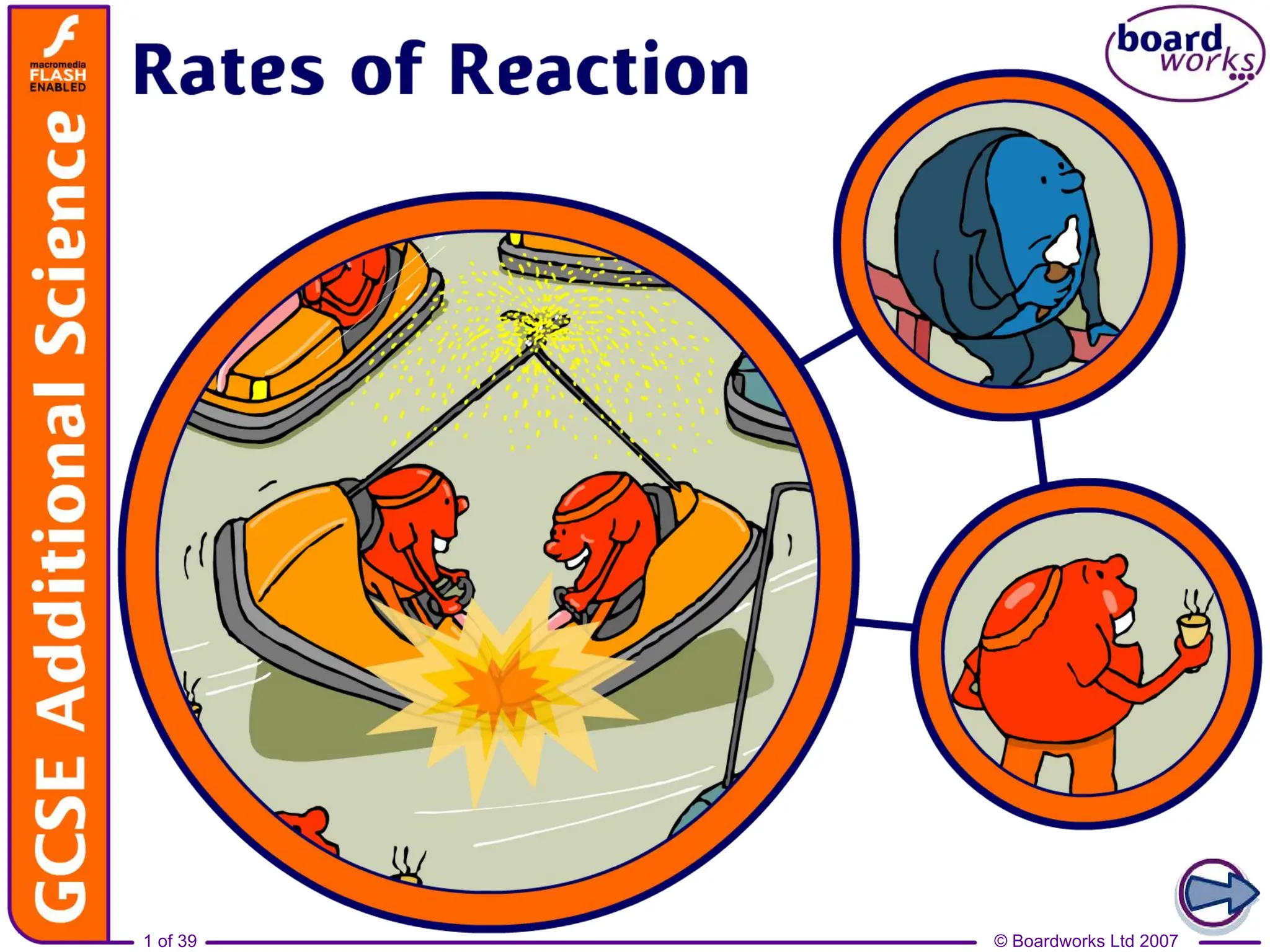
1 of 39 © Boardworks Ltd 2007
© Boardworks Ltd 2007
2 of 39
Content
1. Meaning and Measurement of Rate of
Reactions
2. Rate Expression and Rate Constant
3. Factors Affecting Rate
4. Collision Theory
© Boardworks Ltd 2007
3 of 39
●
© Boardworks Ltd 2007
4 of 39
●
© Boardworks Ltd 2007
5 of 39
Exercise 1
1. Assume that we have a solution of H2SO4 0.5 M in the laboratory. What
volume of H2SO4 0.5 M solution is required to obtain 0.005 mol of H2SO4?
2. Find out the molarity of the following solutions:
a) 7.1 g of sodium sulfate (Na2SO4) in 250 mL solution. (Ar Na=23, S=32,
O=16)
b) 0.002 mol of Fe(NO3)2 in 15 mL solution.
3. A student plans to make a 250 mL solution of 0.1 M K2SO4. How many
grams of K2SO4 must be used? (Ar K=39, S=32, O=16)
4. What is the volume of a 0.5 M H2SO4 solution needed to prepare a solution
of 0.2 M H2SO4 using a 250 mL volumetric flask?
5. Hydrochloric acid (HCl) contain 37% of HCl mass and density of 1.19 kg/L
a) Determine the molarity of the solution! (Ar H=1, Cl=35.5)
b) What is the volume of solution needed to prepare about 500 mL of HCl
4M?
© Boardworks Ltd 2007
6 of 39
MEANING AND
MEASUREMENT OF RATE OF
REACTIONS
© Boardworks Ltd 2007
7 of 39
Meaning & Measurement of Rate of Reactions
The rate of the reaction is the change of concentration
a substance divided by the time interval.
for example :
A + B → C + D
time
ion
concentrat
)
(
reaction
of
Rate




© Boardworks Ltd 2007
8 of 39
• When the reaction takes places, the amount of reactant
A & B decreases and the amount of product C & D
increases.
Meaning & Measurement of Rate of Reactions
t
[D]
D
D
of
reaction
of
Rate
t
[C]
C
C
of
reaction
of
Rate
t
[B]
-
B
B
of
reaction
of
Rate
t
[A]
-
A
A
of
reaction
of
Rate






















© Boardworks Ltd 2007
9 of 39
Meaning & Measurement of Rate of Reactions
• For reaction with different coefficient.
mA + nB → oC + pD
The relation
D
p
C
o
B
n
A
m




1
1
1
1







© Boardworks Ltd 2007
10 of 39
Example
The formation of ammonia is given by the following reaction
N2(g) + 3H2(g) → 2NH3(g)
If in certain time t, the rate of formation of NH3 is 0,5 M/s, determine
a) the rate of reaction for N2
b) the rate of reaction for H2
Answer
N2(g) + 3H2(g) → 2NH3(g)
0,5 M/s
a) the rate of reaction for N2 b) the rate of reaction for H2
25
,
0
5
,
0
2
1
2
1
3
2




 NH
N 

0,75
5
,
0
2
3
2
3
3
2




 NH
H 

© Boardworks Ltd 2007
11 of 39
Example
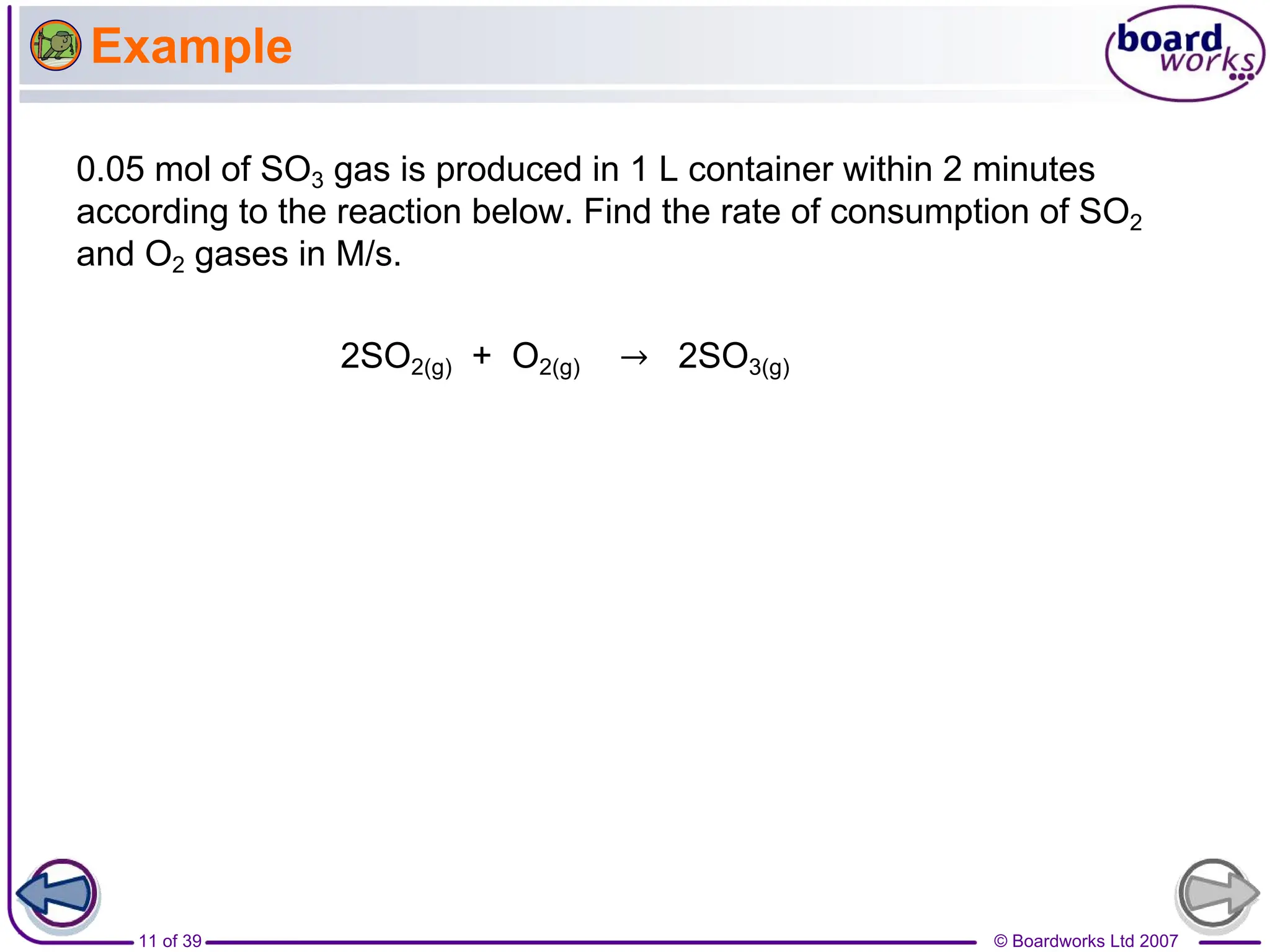
0.05 mol of SO3 gas is produced in 1 L container within 2 minutes
according to the reaction below. Find the rate of consumption of SO2
and O2 gases in M/s.
2SO2(g) + O2(g) → 2SO3(g)
© Boardworks Ltd 2007
12 of 39
Example
• Find the rate relationship of reactants and products for the given
reaction.
N2(g) + 3H2(g) → 2NH3(g)
© Boardworks Ltd 2007
13 of 39
RATE EXPRESSION AND
RATE CONSTANT
© Boardworks Ltd 2007
14 of 39
Rate Expression and Rate Constant
• For reaction
A + B → product
The rate law is stated in the form of the rate equation as
follows :
V = k [A]x [B]y
Where,
V = rate of reaction (M/s)
k = rate of reaction constant
[A] = concentration of A
[B] = concentration of B
x = order of reaction in A
y = order of reaction in B
x + y = total order
© Boardworks Ltd 2007
15 of 39
Example
• Write the possible rate expression of the following reactions.
a.Cl2(g) + H2(g) → 2HCl(g)
b.Fe(s) + Cl2(g) → FeCl3(g)
c.Fe2O3(s) + 3H2SO4(aq) → Fe2(SO4)3(s) + 3H2O(l)
d.Ca(s) + 2Ag+
(aq) → 2Ca+2
(aq) + Ag(s)
© Boardworks Ltd 2007
16 of 39
Order of Reaction
© Boardworks Ltd 2007
17 of 39
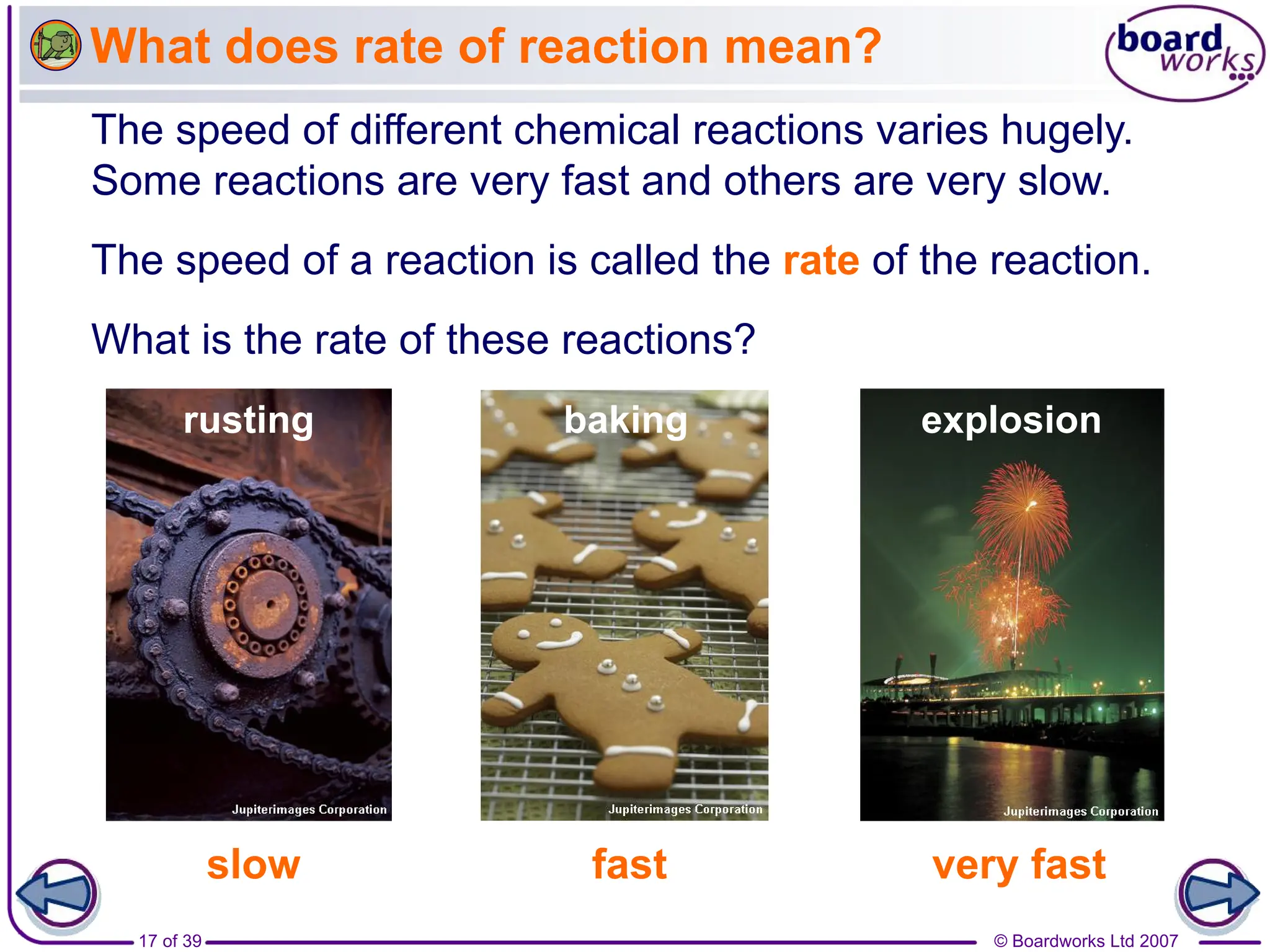
What does rate of reaction mean?
The speed of different chemical reactions varies hugely.
Some reactions are very fast and others are very slow.
What is the rate of these reactions?
The speed of a reaction is called the rate of the reaction.
rusting baking explosion
slow fast very fast
© Boardworks Ltd 2007
18 of 39
Rates of reaction
Why are some reactions faster than others?
© Boardworks Ltd 2007
19 of 39
Reactions, particles and collisions
Reactions take place when particles collide with a
certain amount of energy.
The minimum amount of energy needed for the particles
to react is called the activation energy, and is different
for each reaction.
The rate of a reaction depends on two things:
l the frequency of collisions between particles
l the energy with which particles collide.
If particles collide with less energy than the activation
energy, they will not react. The particles will just bounce
off each other.
© Boardworks Ltd 2007
20 of 39
Changing the rate of reactions
l increased temperature
l increased concentration of
dissolved reactants, and increased
pressure of gaseous reactants
l increased surface area of solid
reactants
l use of a catalyst.
Anything that increases the number of successful collisions
between reactant particles will speed up a reaction.
What factors affect the rate of reactions?
© Boardworks Ltd 2007
21 of 39
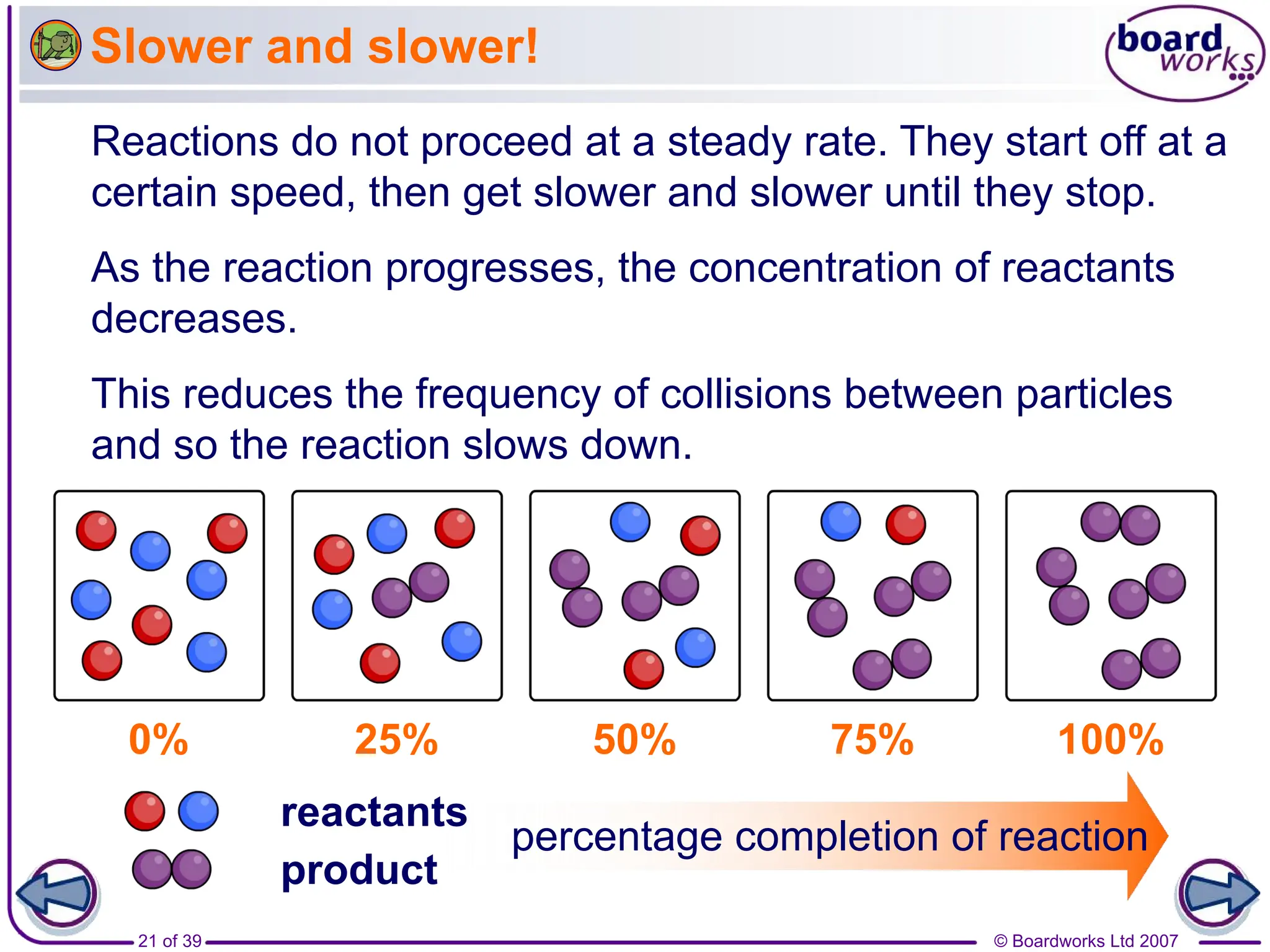
Slower and slower!
Reactions do not proceed at a steady rate. They start off at a
certain speed, then get slower and slower until they stop.
As the reaction progresses, the concentration of reactants
decreases.
This reduces the frequency of collisions between particles
and so the reaction slows down.
percentage completion of reaction
100%
0% 25% 50% 75%
reactants
product
© Boardworks Ltd 2007
22 of 39
© Boardworks Ltd 2007
23 of 39
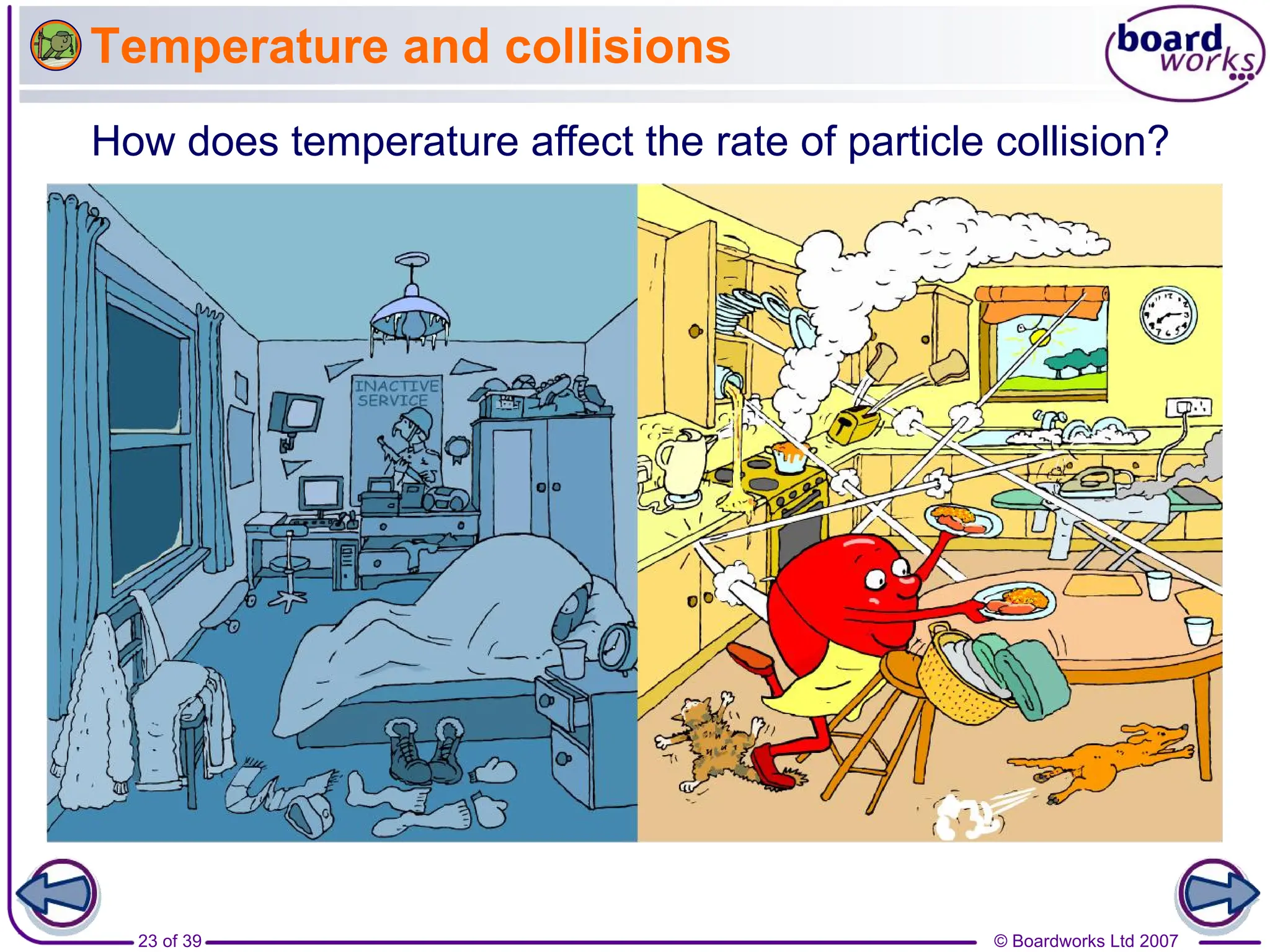
Temperature and collisions
How does temperature affect the rate of particle collision?
© Boardworks Ltd 2007
24 of 39
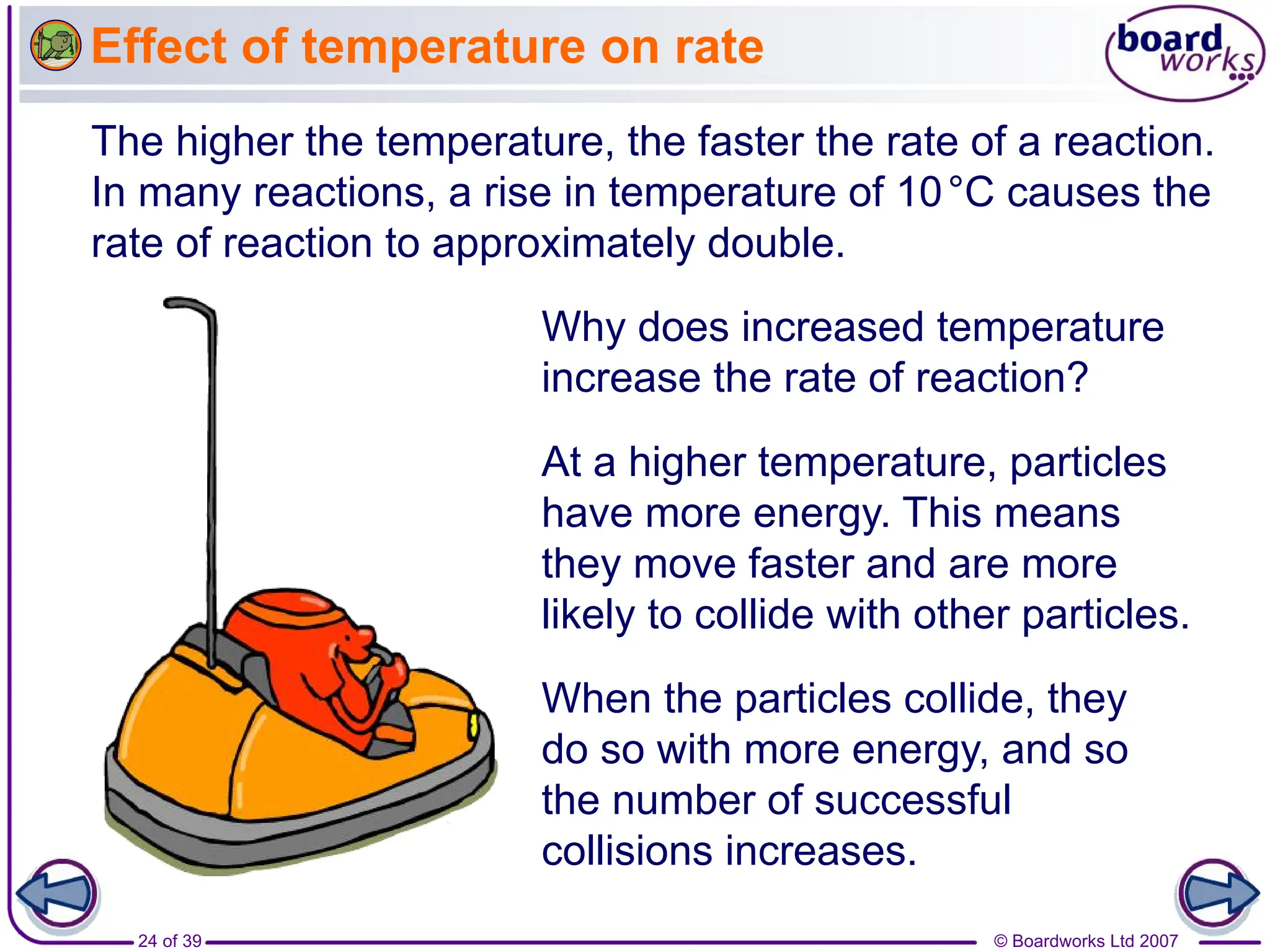
Effect of temperature on rate
The higher the temperature, the faster the rate of a reaction.
In many reactions, a rise in temperature of 10°C causes the
rate of reaction to approximately double.
Why does increased temperature
increase the rate of reaction?
At a higher temperature, particles
have more energy. This means
they move faster and are more
likely to collide with other particles.
When the particles collide, they
do so with more energy, and so
the number of successful
collisions increases.
© Boardworks Ltd 2007
25 of 39
Temperature and particle collisions
© Boardworks Ltd 2007
26 of 39
© Boardworks Ltd 2007
27 of 39
Effect of concentration on rate of reaction
The higher the concentration of a dissolved reactant, the
faster the rate of a reaction.
Why does increased concentration increase the rate of
reaction?
At a higher concentration, there are more particles in the
same amount of space. This means that the particles are
more likely to collide and therefore more likely to react.
higher concentration
lower concentration
© Boardworks Ltd 2007
28 of 39
Concentration and particle collisions
© Boardworks Ltd 2007
29 of 39
Effect of pressure on rate of reaction
The gas particles become closer together, increasing the
frequency of collisions. This means that the particles are more
likely to react.
Why does increasing the pressure of gaseous reactants
increase the rate of reaction?
As the pressure increases, the space in which the gas
particles are moving becomes smaller.
lower pressure higher pressure
© Boardworks Ltd 2007
30 of 39
© Boardworks Ltd 2007
31 of 39
Effect of surface area on rate of reaction
Any reaction involving a solid can only take place at the
surface of the solid.
If the solid is split into several pieces, the surface area
increases. What effect will this have on rate of reaction?
The smaller the pieces, the larger the surface area. This
means more collisions and a greater chance of reaction.
This means that there is an increased area for the reactant
particles to collide with.
low surface area high surface area
© Boardworks Ltd 2007
32 of 39
Surface area and particle collisions
© Boardworks Ltd 2007
33 of 39
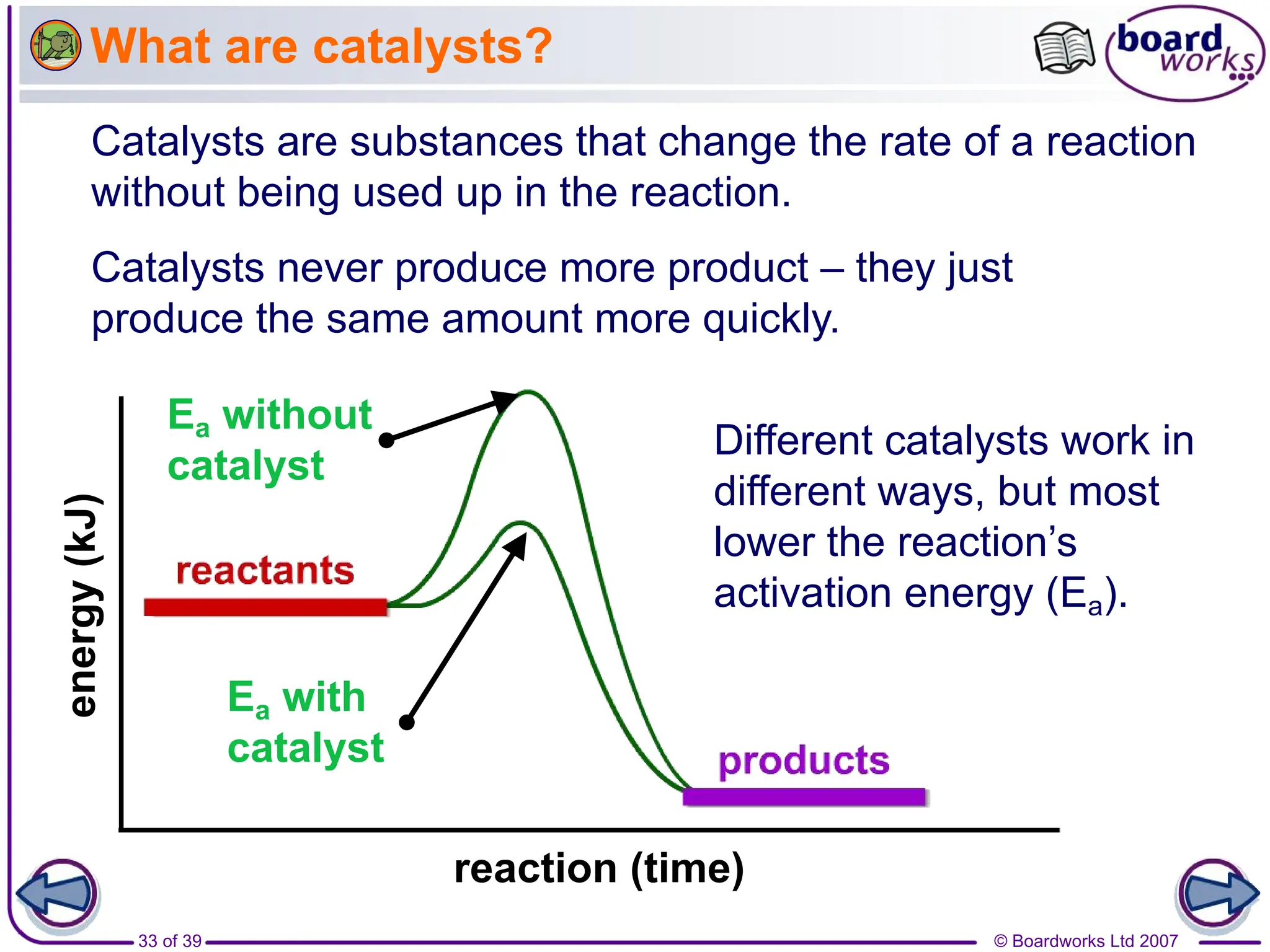
reaction (time)
energy
(kJ)
What are catalysts?
Catalysts are substances that change the rate of a reaction
without being used up in the reaction.
Catalysts never produce more product – they just
produce the same amount more quickly.
Different catalysts work in
different ways, but most
lower the reaction’s
activation energy (Ea).
Ea with
catalyst
Ea without
catalyst
© Boardworks Ltd 2007
34 of 39
Everyday catalysts
l Nickel is a catalyst in the production of margarine
(hydrogenation of vegetable oils).
Many catalysts are transition metals or their compounds.
For example:
l Platinum is a catalyst in the
catalytic converters of car
exhausts. It catalyzes the
conversion of carbon
monoxide and nitrogen
oxide into the less polluting
carbon dioxide and nitrogen.
l Iron is a catalyst in the production of ammonia
from nitrogen and hydrogen (the Haber process).
© Boardworks Ltd 2007
35 of 39
Catalysts in industry
Catalysts are also essential for living cells. Biological
catalysts are special types of protein called enzymes.
Why are catalysts so important for industry?
l Products can be made more
quickly, saving time and money.
l Catalysts reduce the need for
high temperatures, saving fuel
and reducing pollution.

Rate of Reaction.pdf

  • 1.
    1 of 39© Boardworks Ltd 2007
  • 2.
    © Boardworks Ltd2007 2 of 39 Content 1. Meaning and Measurement of Rate of Reactions 2. Rate Expression and Rate Constant 3. Factors Affecting Rate 4. Collision Theory
  • 3.
    © Boardworks Ltd2007 3 of 39 ●
  • 4.
    © Boardworks Ltd2007 4 of 39 ●
  • 5.
    © Boardworks Ltd2007 5 of 39 Exercise 1 1. Assume that we have a solution of H2SO4 0.5 M in the laboratory. What volume of H2SO4 0.5 M solution is required to obtain 0.005 mol of H2SO4? 2. Find out the molarity of the following solutions: a) 7.1 g of sodium sulfate (Na2SO4) in 250 mL solution. (Ar Na=23, S=32, O=16) b) 0.002 mol of Fe(NO3)2 in 15 mL solution. 3. A student plans to make a 250 mL solution of 0.1 M K2SO4. How many grams of K2SO4 must be used? (Ar K=39, S=32, O=16) 4. What is the volume of a 0.5 M H2SO4 solution needed to prepare a solution of 0.2 M H2SO4 using a 250 mL volumetric flask? 5. Hydrochloric acid (HCl) contain 37% of HCl mass and density of 1.19 kg/L a) Determine the molarity of the solution! (Ar H=1, Cl=35.5) b) What is the volume of solution needed to prepare about 500 mL of HCl 4M?
  • 6.
    © Boardworks Ltd2007 6 of 39 MEANING AND MEASUREMENT OF RATE OF REACTIONS
  • 7.
    © Boardworks Ltd2007 7 of 39 Meaning & Measurement of Rate of Reactions The rate of the reaction is the change of concentration a substance divided by the time interval. for example : A + B → C + D time ion concentrat ) ( reaction of Rate    
  • 8.
    © Boardworks Ltd2007 8 of 39 • When the reaction takes places, the amount of reactant A & B decreases and the amount of product C & D increases. Meaning & Measurement of Rate of Reactions t [D] D D of reaction of Rate t [C] C C of reaction of Rate t [B] - B B of reaction of Rate t [A] - A A of reaction of Rate                      
  • 9.
    © Boardworks Ltd2007 9 of 39 Meaning & Measurement of Rate of Reactions • For reaction with different coefficient. mA + nB → oC + pD The relation D p C o B n A m     1 1 1 1       
  • 10.
    © Boardworks Ltd2007 10 of 39 Example The formation of ammonia is given by the following reaction N2(g) + 3H2(g) → 2NH3(g) If in certain time t, the rate of formation of NH3 is 0,5 M/s, determine a) the rate of reaction for N2 b) the rate of reaction for H2 Answer N2(g) + 3H2(g) → 2NH3(g) 0,5 M/s a) the rate of reaction for N2 b) the rate of reaction for H2 25 , 0 5 , 0 2 1 2 1 3 2      NH N   0,75 5 , 0 2 3 2 3 3 2      NH H  
  • 11.
    © Boardworks Ltd2007 11 of 39 Example 0.05 mol of SO3 gas is produced in 1 L container within 2 minutes according to the reaction below. Find the rate of consumption of SO2 and O2 gases in M/s. 2SO2(g) + O2(g) → 2SO3(g)
  • 12.
    © Boardworks Ltd2007 12 of 39 Example • Find the rate relationship of reactants and products for the given reaction. N2(g) + 3H2(g) → 2NH3(g)
  • 13.
    © Boardworks Ltd2007 13 of 39 RATE EXPRESSION AND RATE CONSTANT
  • 14.
    © Boardworks Ltd2007 14 of 39 Rate Expression and Rate Constant • For reaction A + B → product The rate law is stated in the form of the rate equation as follows : V = k [A]x [B]y Where, V = rate of reaction (M/s) k = rate of reaction constant [A] = concentration of A [B] = concentration of B x = order of reaction in A y = order of reaction in B x + y = total order
  • 15.
    © Boardworks Ltd2007 15 of 39 Example • Write the possible rate expression of the following reactions. a.Cl2(g) + H2(g) → 2HCl(g) b.Fe(s) + Cl2(g) → FeCl3(g) c.Fe2O3(s) + 3H2SO4(aq) → Fe2(SO4)3(s) + 3H2O(l) d.Ca(s) + 2Ag+ (aq) → 2Ca+2 (aq) + Ag(s)
  • 16.
    © Boardworks Ltd2007 16 of 39 Order of Reaction
  • 17.
    © Boardworks Ltd2007 17 of 39 What does rate of reaction mean? The speed of different chemical reactions varies hugely. Some reactions are very fast and others are very slow. What is the rate of these reactions? The speed of a reaction is called the rate of the reaction. rusting baking explosion slow fast very fast
  • 18.
    © Boardworks Ltd2007 18 of 39 Rates of reaction Why are some reactions faster than others?
  • 19.
    © Boardworks Ltd2007 19 of 39 Reactions, particles and collisions Reactions take place when particles collide with a certain amount of energy. The minimum amount of energy needed for the particles to react is called the activation energy, and is different for each reaction. The rate of a reaction depends on two things: l the frequency of collisions between particles l the energy with which particles collide. If particles collide with less energy than the activation energy, they will not react. The particles will just bounce off each other.
  • 20.
    © Boardworks Ltd2007 20 of 39 Changing the rate of reactions l increased temperature l increased concentration of dissolved reactants, and increased pressure of gaseous reactants l increased surface area of solid reactants l use of a catalyst. Anything that increases the number of successful collisions between reactant particles will speed up a reaction. What factors affect the rate of reactions?
  • 21.
    © Boardworks Ltd2007 21 of 39 Slower and slower! Reactions do not proceed at a steady rate. They start off at a certain speed, then get slower and slower until they stop. As the reaction progresses, the concentration of reactants decreases. This reduces the frequency of collisions between particles and so the reaction slows down. percentage completion of reaction 100% 0% 25% 50% 75% reactants product
  • 22.
    © Boardworks Ltd2007 22 of 39
  • 23.
    © Boardworks Ltd2007 23 of 39 Temperature and collisions How does temperature affect the rate of particle collision?
  • 24.
    © Boardworks Ltd2007 24 of 39 Effect of temperature on rate The higher the temperature, the faster the rate of a reaction. In many reactions, a rise in temperature of 10°C causes the rate of reaction to approximately double. Why does increased temperature increase the rate of reaction? At a higher temperature, particles have more energy. This means they move faster and are more likely to collide with other particles. When the particles collide, they do so with more energy, and so the number of successful collisions increases.
  • 25.
    © Boardworks Ltd2007 25 of 39 Temperature and particle collisions
  • 26.
    © Boardworks Ltd2007 26 of 39
  • 27.
    © Boardworks Ltd2007 27 of 39 Effect of concentration on rate of reaction The higher the concentration of a dissolved reactant, the faster the rate of a reaction. Why does increased concentration increase the rate of reaction? At a higher concentration, there are more particles in the same amount of space. This means that the particles are more likely to collide and therefore more likely to react. higher concentration lower concentration
  • 28.
    © Boardworks Ltd2007 28 of 39 Concentration and particle collisions
  • 29.
    © Boardworks Ltd2007 29 of 39 Effect of pressure on rate of reaction The gas particles become closer together, increasing the frequency of collisions. This means that the particles are more likely to react. Why does increasing the pressure of gaseous reactants increase the rate of reaction? As the pressure increases, the space in which the gas particles are moving becomes smaller. lower pressure higher pressure
  • 30.
    © Boardworks Ltd2007 30 of 39
  • 31.
    © Boardworks Ltd2007 31 of 39 Effect of surface area on rate of reaction Any reaction involving a solid can only take place at the surface of the solid. If the solid is split into several pieces, the surface area increases. What effect will this have on rate of reaction? The smaller the pieces, the larger the surface area. This means more collisions and a greater chance of reaction. This means that there is an increased area for the reactant particles to collide with. low surface area high surface area
  • 32.
    © Boardworks Ltd2007 32 of 39 Surface area and particle collisions
  • 33.
    © Boardworks Ltd2007 33 of 39 reaction (time) energy (kJ) What are catalysts? Catalysts are substances that change the rate of a reaction without being used up in the reaction. Catalysts never produce more product – they just produce the same amount more quickly. Different catalysts work in different ways, but most lower the reaction’s activation energy (Ea). Ea with catalyst Ea without catalyst
  • 34.
    © Boardworks Ltd2007 34 of 39 Everyday catalysts l Nickel is a catalyst in the production of margarine (hydrogenation of vegetable oils). Many catalysts are transition metals or their compounds. For example: l Platinum is a catalyst in the catalytic converters of car exhausts. It catalyzes the conversion of carbon monoxide and nitrogen oxide into the less polluting carbon dioxide and nitrogen. l Iron is a catalyst in the production of ammonia from nitrogen and hydrogen (the Haber process).
  • 35.
    © Boardworks Ltd2007 35 of 39 Catalysts in industry Catalysts are also essential for living cells. Biological catalysts are special types of protein called enzymes. Why are catalysts so important for industry? l Products can be made more quickly, saving time and money. l Catalysts reduce the need for high temperatures, saving fuel and reducing pollution.