Rate of Reactions
Fast or Slow Reactions
• Extremely slow reactions
– Iron rusting
– Limestone weathering
• Extremely fast reactions
– Explosion
Measuring
Rate of Reactions
• Some rate of reactions have detectable
change with respect to time
• Changes that are observable like
– When a volume of gas is given off
– When there is a change in mass during the
reaction
– When there are temperature changes
– When there are colour changes
– When a precipitate forms
– When there are pH changes
Collision Theory
• For a reaction to occur
– The reacting particles must collide into
each other
– The reacting particles must possess
enough activation energy
• Once products are formed, effective
collisions have occurred
Factors affecting
Rate of Reactions
• Temperature of the substances used
(reactants)
• Concentration of the substances
used (reactants)
• Pressure on the reaction
• Particle size (surface area) of the
substances used (reactants)
• Presence of catalyst
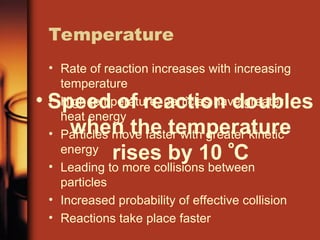
Temperature
• Rate of reaction increases with increasing
temperature
• High temperature, particles have greater
heat energy
• Particles move faster with greater kinetic
energy
• Leading to more collisions between
particles
• Increased probability of effective collision
• Reactions take place faster
• Speed of reaction doubles
when the temperature
rises by 10 C
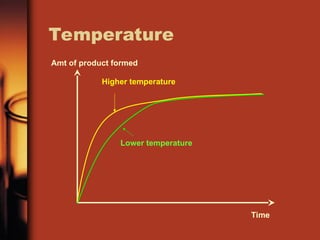
Temperature
Amt of product formed
Time
Higher temperature
Lower temperature
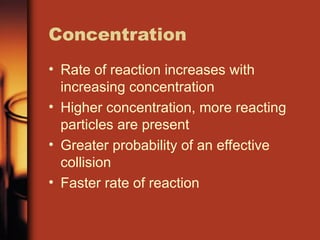
Concentration
• Rate of reaction increases with
increasing concentration
• Higher concentration, more reacting
particles are present
• Greater probability of an effective
collision
• Faster rate of reaction
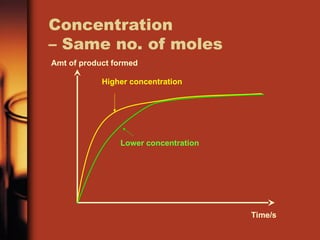
Concentration
– Same no. of moles
Amt of product formed
Time/s
Higher concentration
Lower concentration
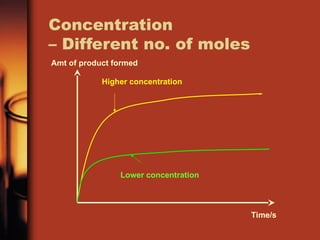
Concentration
– Different no. of moles
Amt of product formed
Time/s
Higher concentration
Lower concentration
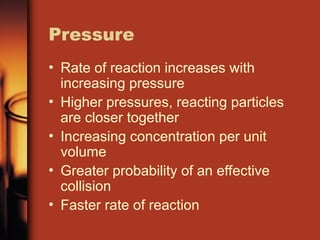
Pressure
• Rate of reaction increases with
increasing pressure
• Higher pressures, reacting particles
are closer together
• Increasing concentration per unit
volume
• Greater probability of an effective
collision
• Faster rate of reaction
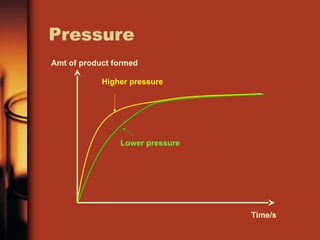
Pressure
Amt of product formed
Time/s
Higher pressure
Lower pressure
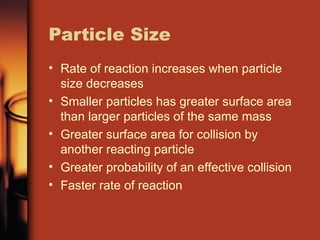
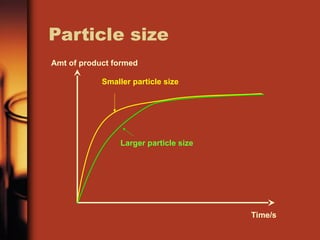
Particle Size
• Rate of reaction increases when particle
size decreases
• Smaller particles has greater surface area
than larger particles of the same mass
• Greater surface area for collision by
another reacting particle
• Greater probability of an effective collision
• Faster rate of reaction
Particle size
Amt of product formed
Time/s
Smaller particle size
Larger particle size
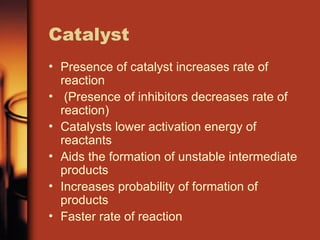
Catalyst
• Presence of catalyst increases rate of
reaction
• (Presence of inhibitors decreases rate of
reaction)
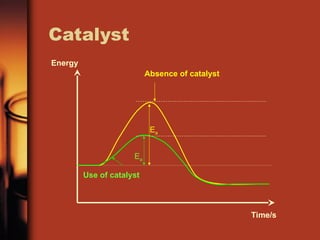
• Catalysts lower activation energy of
reactants
• Aids the formation of unstable intermediate
products
• Increases probability of formation of
products
• Faster rate of reaction
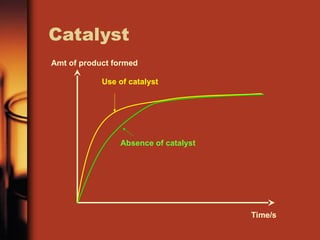
Catalyst
Amt of product formed
Time/s
Use of catalyst
Absence of catalyst
Catalyst
Energy
Time/s
Use of catalyst
Absence of catalyst
Ea
Ea
Catalyst
Definition: A substance which
increases the rate of a chemical
reaction by providing an alternative
pathway with a lower activation
energy but remains unchanged at
the end of the reaction

rateofreactionsdjdjdkdmdmmrsjsks ppt.ppt

  • 1.
  • 2.
    Fast or SlowReactions • Extremely slow reactions – Iron rusting – Limestone weathering • Extremely fast reactions – Explosion
  • 3.
    Measuring Rate of Reactions •Some rate of reactions have detectable change with respect to time • Changes that are observable like – When a volume of gas is given off – When there is a change in mass during the reaction – When there are temperature changes – When there are colour changes – When a precipitate forms – When there are pH changes
  • 4.
    Collision Theory • Fora reaction to occur – The reacting particles must collide into each other – The reacting particles must possess enough activation energy • Once products are formed, effective collisions have occurred
  • 5.
    Factors affecting Rate ofReactions • Temperature of the substances used (reactants) • Concentration of the substances used (reactants) • Pressure on the reaction • Particle size (surface area) of the substances used (reactants) • Presence of catalyst
  • 6.
    Temperature • Rate ofreaction increases with increasing temperature • High temperature, particles have greater heat energy • Particles move faster with greater kinetic energy • Leading to more collisions between particles • Increased probability of effective collision • Reactions take place faster • Speed of reaction doubles when the temperature rises by 10 C
  • 7.
    Temperature Amt of productformed Time Higher temperature Lower temperature
  • 8.
    Concentration • Rate ofreaction increases with increasing concentration • Higher concentration, more reacting particles are present • Greater probability of an effective collision • Faster rate of reaction
  • 9.
    Concentration – Same no.of moles Amt of product formed Time/s Higher concentration Lower concentration
  • 10.
    Concentration – Different no.of moles Amt of product formed Time/s Higher concentration Lower concentration
  • 11.
    Pressure • Rate ofreaction increases with increasing pressure • Higher pressures, reacting particles are closer together • Increasing concentration per unit volume • Greater probability of an effective collision • Faster rate of reaction
  • 12.
    Pressure Amt of productformed Time/s Higher pressure Lower pressure
  • 13.
    Particle Size • Rateof reaction increases when particle size decreases • Smaller particles has greater surface area than larger particles of the same mass • Greater surface area for collision by another reacting particle • Greater probability of an effective collision • Faster rate of reaction
  • 14.
    Particle size Amt ofproduct formed Time/s Smaller particle size Larger particle size
  • 15.
    Catalyst • Presence ofcatalyst increases rate of reaction • (Presence of inhibitors decreases rate of reaction) • Catalysts lower activation energy of reactants • Aids the formation of unstable intermediate products • Increases probability of formation of products • Faster rate of reaction
  • 16.
    Catalyst Amt of productformed Time/s Use of catalyst Absence of catalyst
  • 17.
  • 18.
    Catalyst Definition: A substancewhich increases the rate of a chemical reaction by providing an alternative pathway with a lower activation energy but remains unchanged at the end of the reaction