Discover the
possibilities of
paper packaging
solutions.
Latest update: 11 March 2019
© Copyright Ranpak
The Paper Packaging Experts™
2
How to
pack with ...
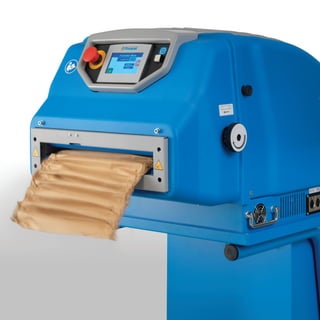
Waved paper pads
This brochure shows you how to pack with
our waved paper pads for various situations,
applications and products.
3
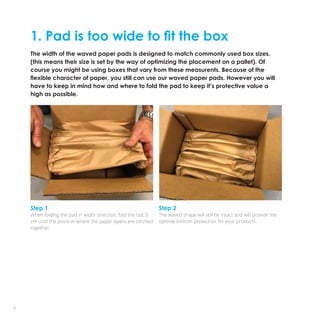
1. Pad is too wide to fit the box
The width of the waved paper pads is designed to match commonly used box sizes.
(this means their size is set by the way of optimizing the placement on a pallet). Of
course you might be using boxes that vary from these measurents. Because of the
flexible character of paper, you still can use our waved paper pads. However you will
have to keep in mind how and where to fold the pad to keep it’s protective value a
high as possible.
Step 1
When folding the pad in width direction, fold the last 3
cm until the position where the paper layers are stitched
together.
Step 2
The waved shape will still be intact and will provide the
optimal bottom protection for your products.
4
2. Additional bottom protection
Our Kraft paper has a natural stiffness that can give extra protection to your
product by using smart solutions and folding it into simple structures. Below a simple
example of an A-shape that can be used on the bottom of the box.
5
Step 1
Take a pad that fits the length of the
box.
Step 4
Push on the A shape until you feel
the natural resistance of the paper
structure.
Step 5
The squeezed paper shape offers
extra bottom protection for heavier
or more fragile products.
Step 2
Fold the pad in the middle into
an A-shape.
Step 3
Place the pad at the bottom
of the box.
Step 6
This is a smart solution that will
prevent your product from breaking
even after several drops on the
bottom.
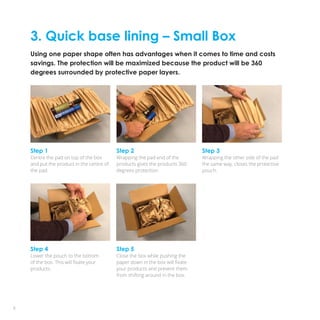
Step 1
Centre the pad on top of the box
and put the product in the centre of
the pad.
Step 4
Lower the pouch to the bottom
of the box. This will fixate your
products.
Step 5
Close the box while pushing the
paper down in the box will fixate
your products and prevent them
from shifting around in the box.
Step 2
Wrapping the pad end of the
products gives the products 360
degrees protection.
Step 3
Wrapping the other side of the pad
the same way, closes the protective
pouch.
3. Quick base lining – Small Box
Using one paper shape often has advantages when it comes to time and costs
savings. The protection will be maximized because the product will be 360
degrees surrounded by protective paper layers.
6
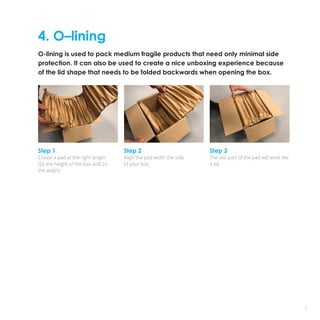
4. O–lining
O-lining is used to pack medium fragile products that need only minimal side
protection. It can also be used to create a nice unboxing experience because
of the lid shape that needs to be folded backwards when opening the box.
Step 1
Create a pad at the right length
(2x the height of the box and 2x
the width).
Step 2
Align the pad width the side
of your box.
Step 3
The last part of the pad will work like
a lid.
7
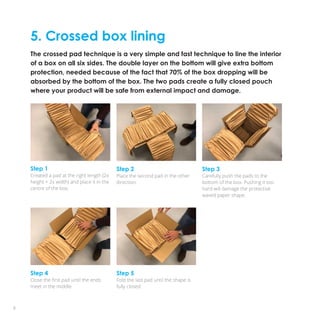
5. Crossed box lining
The crossed pad technique is a very simple and fast technique to line the interior
of a box on all six sides. The double layer on the bottom will give extra bottom
protection, needed because of the fact that 70% of the box dropping will be
absorbed by the bottom of the box. The two pads create a fully closed pouch
where your product will be safe from external impact and damage.
8
Step 1
Created a pad at the right length (2x
height + 2x width) and place it in the
centre of the box.
Step 2
Place the second pad in the other
direction.
Step 3
Carefully push the pads to the
bottom of the box. Pushing it too
hard will damage the protective
waved paper shape.
Step 4
Close the first pad until the ends
meet in the middle.
Step 5
Fold the last pad until the shape is
fully closed.
6. Bottom & side lining big box
This application can be used to offer side and bottom protection. The creation of
the protective paper pouch is not only protection from outside shocks but also
has an insulating effect to keep products cool.
9
Step 1
Place a single or double pad on the bottom of the box.
It is allowed to have some open space on the bottom.
Step 2
By placing the layer of paper upright in the box, it will
close the gaps at the bottom and offer protection to the
sidewalls of the box.
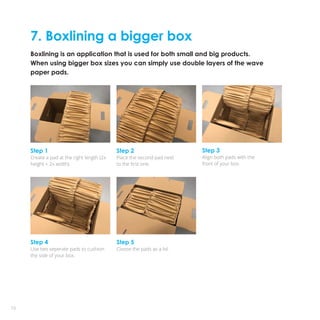
7. Boxlining a bigger box
Boxlining is an application that is used for both small and big products.
When using bigger box sizes you can simply use double layers of the wave
paper pads.
Step 4
Use two seperate pads to cushion
the side of your box.
Step 5
Cloose the pads as a lid.
10
Step 1
Create a pad at the right length (2x
height + 2x width).
Step 2
Place the second pad next
to the first one.
Step 3
Align both pads with the
front of your box.
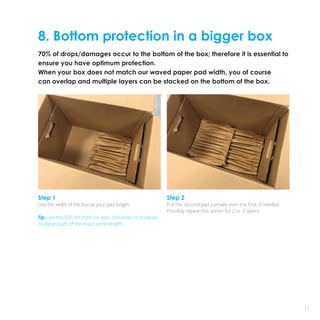
8. Bottom protection in a bigger box
70% of drops/damages occur to the bottom of the box; therefore it is essential to
ensure you have optimum protection.
When your box does not match our waved paper pad width, you of course
can overlap and multiple layers can be stacked on the bottom of the box.
11
Step 1
Use the width of the box as your pad length.
Tip: use the EDS function on your converter to produce
multiple pads of the exact same length.
Step 2
Put the second pad partially over the first, if needed.
Possibly repeat this action for 2 or 3 layers.
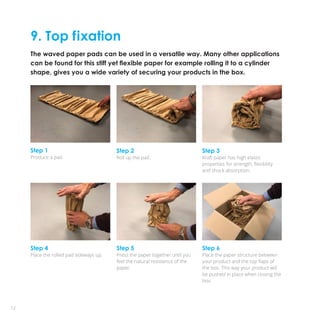
9. Top fixation
The waved paper pads can be used in a versatile way. Many other applications
can be found for this stiff yet flexible paper for example rolling it to a cylinder
shape, gives you a wide variety of securing your products in the box.
12
Step 4
Place the rolled pad sideways up.
Step 5
Press the paper together until you
feel the natural resistence of the
paper.
Step 1
Produce a pad.
Step 2
Roll up the pad.
Step 3
Kraft paper has high elastic
properties for strength, flexibility
and shock absorption.
Step 6
Place the paper structure between
your product and the top flaps of
the box. This way your product will
be pushed in place when closing the
box.
Ranpak Europe
Sourethweg 4-6
6422 PC Heerlen / The Netherlands
T +31 88 2551111
E eu.info@ranpak.com
250005_EN

Ranpak how to pack with WrapPak booklet

  • 1.
    Discover the possibilities of paperpackaging solutions. Latest update: 11 March 2019 © Copyright Ranpak The Paper Packaging Experts™
  • 2.
  • 3.
    How to pack with... Waved paper pads This brochure shows you how to pack with our waved paper pads for various situations, applications and products. 3
  • 4.
    1. Pad istoo wide to fit the box The width of the waved paper pads is designed to match commonly used box sizes. (this means their size is set by the way of optimizing the placement on a pallet). Of course you might be using boxes that vary from these measurents. Because of the flexible character of paper, you still can use our waved paper pads. However you will have to keep in mind how and where to fold the pad to keep it’s protective value a high as possible. Step 1 When folding the pad in width direction, fold the last 3 cm until the position where the paper layers are stitched together. Step 2 The waved shape will still be intact and will provide the optimal bottom protection for your products. 4
  • 5.
    2. Additional bottomprotection Our Kraft paper has a natural stiffness that can give extra protection to your product by using smart solutions and folding it into simple structures. Below a simple example of an A-shape that can be used on the bottom of the box. 5 Step 1 Take a pad that fits the length of the box. Step 4 Push on the A shape until you feel the natural resistance of the paper structure. Step 5 The squeezed paper shape offers extra bottom protection for heavier or more fragile products. Step 2 Fold the pad in the middle into an A-shape. Step 3 Place the pad at the bottom of the box. Step 6 This is a smart solution that will prevent your product from breaking even after several drops on the bottom.
  • 6.
    Step 1 Centre thepad on top of the box and put the product in the centre of the pad. Step 4 Lower the pouch to the bottom of the box. This will fixate your products. Step 5 Close the box while pushing the paper down in the box will fixate your products and prevent them from shifting around in the box. Step 2 Wrapping the pad end of the products gives the products 360 degrees protection. Step 3 Wrapping the other side of the pad the same way, closes the protective pouch. 3. Quick base lining – Small Box Using one paper shape often has advantages when it comes to time and costs savings. The protection will be maximized because the product will be 360 degrees surrounded by protective paper layers. 6
  • 7.
    4. O–lining O-lining isused to pack medium fragile products that need only minimal side protection. It can also be used to create a nice unboxing experience because of the lid shape that needs to be folded backwards when opening the box. Step 1 Create a pad at the right length (2x the height of the box and 2x the width). Step 2 Align the pad width the side of your box. Step 3 The last part of the pad will work like a lid. 7
  • 8.
    5. Crossed boxlining The crossed pad technique is a very simple and fast technique to line the interior of a box on all six sides. The double layer on the bottom will give extra bottom protection, needed because of the fact that 70% of the box dropping will be absorbed by the bottom of the box. The two pads create a fully closed pouch where your product will be safe from external impact and damage. 8 Step 1 Created a pad at the right length (2x height + 2x width) and place it in the centre of the box. Step 2 Place the second pad in the other direction. Step 3 Carefully push the pads to the bottom of the box. Pushing it too hard will damage the protective waved paper shape. Step 4 Close the first pad until the ends meet in the middle. Step 5 Fold the last pad until the shape is fully closed.
  • 9.
    6. Bottom &side lining big box This application can be used to offer side and bottom protection. The creation of the protective paper pouch is not only protection from outside shocks but also has an insulating effect to keep products cool. 9 Step 1 Place a single or double pad on the bottom of the box. It is allowed to have some open space on the bottom. Step 2 By placing the layer of paper upright in the box, it will close the gaps at the bottom and offer protection to the sidewalls of the box.
  • 10.
    7. Boxlining abigger box Boxlining is an application that is used for both small and big products. When using bigger box sizes you can simply use double layers of the wave paper pads. Step 4 Use two seperate pads to cushion the side of your box. Step 5 Cloose the pads as a lid. 10 Step 1 Create a pad at the right length (2x height + 2x width). Step 2 Place the second pad next to the first one. Step 3 Align both pads with the front of your box.
  • 11.
    8. Bottom protectionin a bigger box 70% of drops/damages occur to the bottom of the box; therefore it is essential to ensure you have optimum protection. When your box does not match our waved paper pad width, you of course can overlap and multiple layers can be stacked on the bottom of the box. 11 Step 1 Use the width of the box as your pad length. Tip: use the EDS function on your converter to produce multiple pads of the exact same length. Step 2 Put the second pad partially over the first, if needed. Possibly repeat this action for 2 or 3 layers.
  • 12.
    9. Top fixation Thewaved paper pads can be used in a versatile way. Many other applications can be found for this stiff yet flexible paper for example rolling it to a cylinder shape, gives you a wide variety of securing your products in the box. 12 Step 4 Place the rolled pad sideways up. Step 5 Press the paper together until you feel the natural resistence of the paper. Step 1 Produce a pad. Step 2 Roll up the pad. Step 3 Kraft paper has high elastic properties for strength, flexibility and shock absorption. Step 6 Place the paper structure between your product and the top flaps of the box. This way your product will be pushed in place when closing the box.
  • 14.
    Ranpak Europe Sourethweg 4-6 6422PC Heerlen / The Netherlands T +31 88 2551111 E eu.info@ranpak.com 250005_EN