2
T H IR D Q U A R T E R
Chapter 1: Random variables and
probability distribution
Lesson 2: Random Variables and
Probability Distribution
At the end of this lesson, students should be
able to:
1. find the values of a random variable and
2. Illustrate a probability distribution for a
discrete random variable and its properties.
3.
3
R E CA L L ( R E V I E W )
Recall of random variables.
• In conducting an experiment, each
possible result is called an outcome and
listing all of the possible results make up
the sample space.
• There are two types of random
variables, discrete and continuous.
Discrete random variables assume a
countable number (integer) of values
while continuous random variables
assume an uncountable one (arises from
4.
4
Examples:
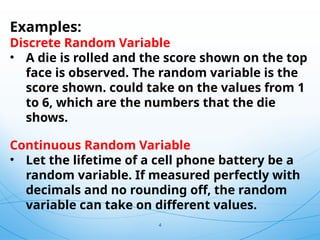
Discrete Random Variable
•A die is rolled and the score shown on the top
face is observed. The random variable is the
score shown. could take on the values from 1
to 6, which are the numbers that the die
shows.
Continuous Random Variable
• Let the lifetime of a cell phone battery be a
random variable. If measured perfectly with
decimals and no rounding off, the random
variable can take on different values.
5.
5
Learn about it!
ProbabilityDistribution of a Discrete Random Variable
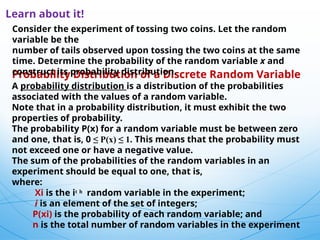
A probability distribution is a distribution of the probabilities
associated with the values of a random variable.
Note that in a probability distribution, it must exhibit the two
properties of probability.
The probability P(x) for a random variable must be between zero
and one, that is, 0 ≤ P(x) ≤ 1. This means that the probability must
not exceed one or have a negative value.
The sum of the probabilities of the random variables in an
experiment should be equal to one, that is,
where:
Xi is the iͭ ʰ random variable in the experiment;
i is an element of the set of integers;
P(xi) is the probability of each random variable; and
n is the total number of random variables in the experiment
Consider the experiment of tossing two coins. Let the random
variable be the
number of tails observed upon tossing the two coins at the same
time. Determine the probability of the random variable x and
construct its probability distribution.
6.
6
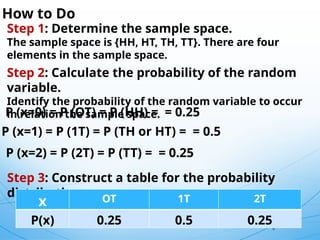
How to Do
Step1: Determine the sample space.
The sample space is {HH, HT, TH, TT}. There are four
elements in the sample space.
Step 2: Calculate the probability of the random
variable.
Identify the probability of the random variable to occur
in relation the sample space.
P (x=0) = P (OT) = P (HH) = = 0.25
P (x=1) = P (1T) = P (TH or HT) = = 0.5
P (x=2) = P (2T) = P (TT) = = 0.25
Step 3: Construct a table for the probability
distribution.
x OT 1T 2T
P(x) 0.25 0.5 0.25
7.
7
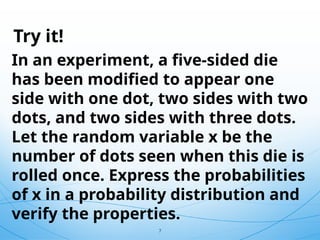
In an experiment,a five-sided die
has been modified to appear one
side with one dot, two sides with two
dots, and two sides with three dots.
Let the random variable x be the
number of dots seen when this die is
rolled once. Express the probabilities
of x in a probability distribution and
verify the properties.
Try it!
8.
8
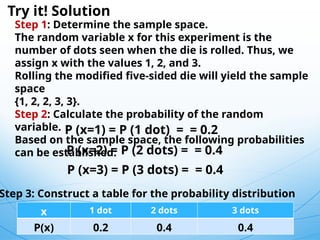
Step 1: Determinethe sample space.
The random variable x for this experiment is the
number of dots seen when the die is rolled. Thus, we
assign x with the values 1, 2, and 3.
Rolling the modified five-sided die will yield the sample
space
{1, 2, 2, 3, 3}.
Step 2: Calculate the probability of the random
variable.
Based on the sample space, the following probabilities
can be established:
Try it! Solution
P (x=1) = P (1 dot) = = 0.2
P (x=2) = P (2 dots) = = 0.4
P (x=3) = P (3 dots) = = 0.4
Step 3: Construct a table for the probability distribution
x 1 dot 2 dots 3 dots
P(x) 0.2 0.4 0.4
9.
9
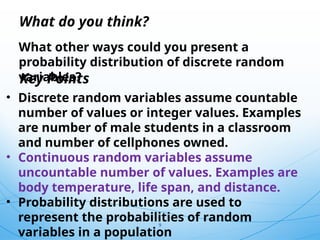
What other wayscould you present a
probability distribution of discrete random
variables?
What do you think?
• Discrete random variables assume countable
number of values or integer values. Examples
are number of male students in a classroom
and number of cellphones owned.
• Continuous random variables assume
uncountable number of values. Examples are
body temperature, life span, and distance.
• Probability distributions are used to
represent the probabilities of random
variables in a population
Key Points
10.
End of Lesson2
THANK YOU
for 60
minutes
Dear
10
If you don’t fight for what
you want, don’t cry for
what you lost…