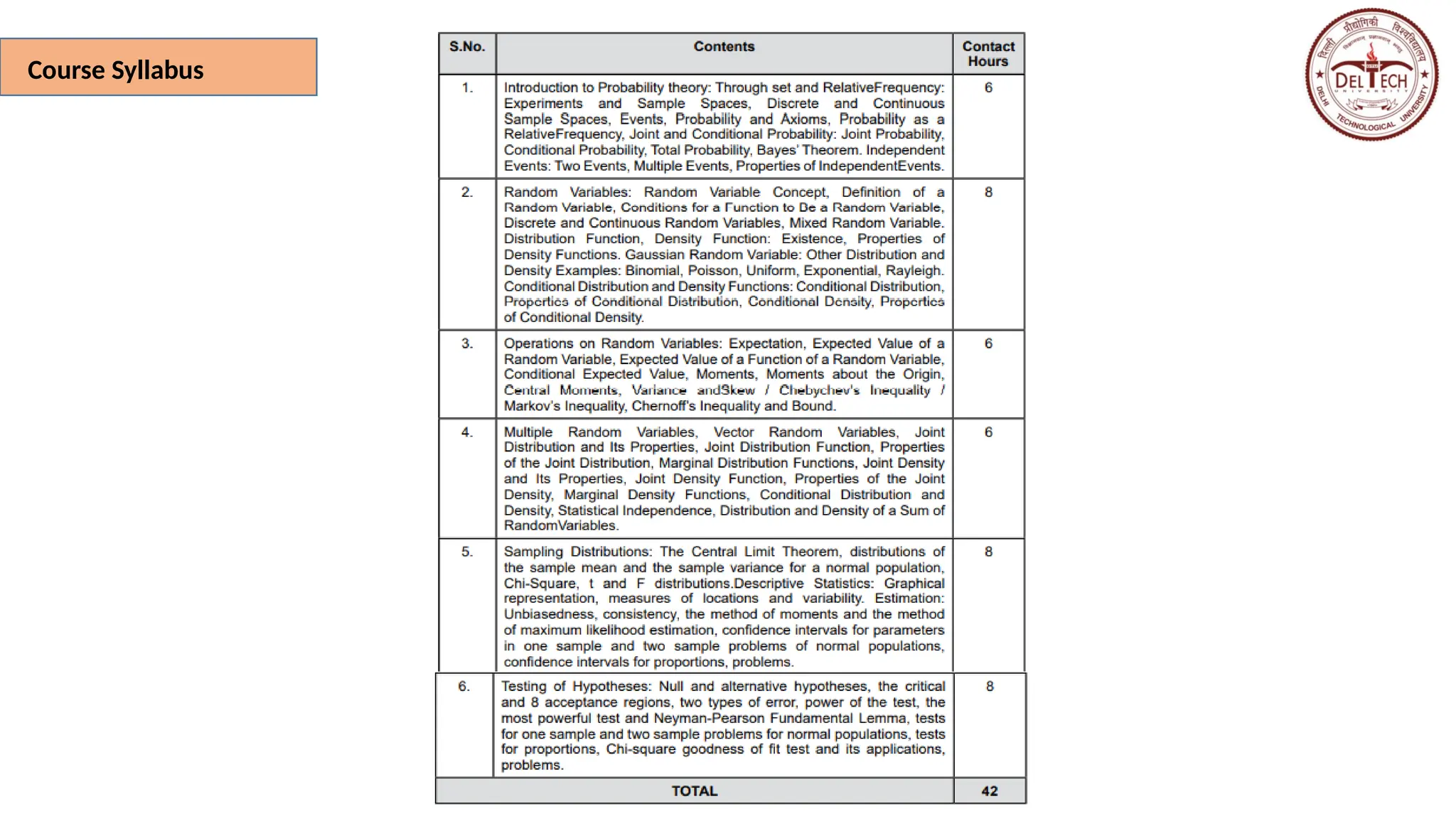
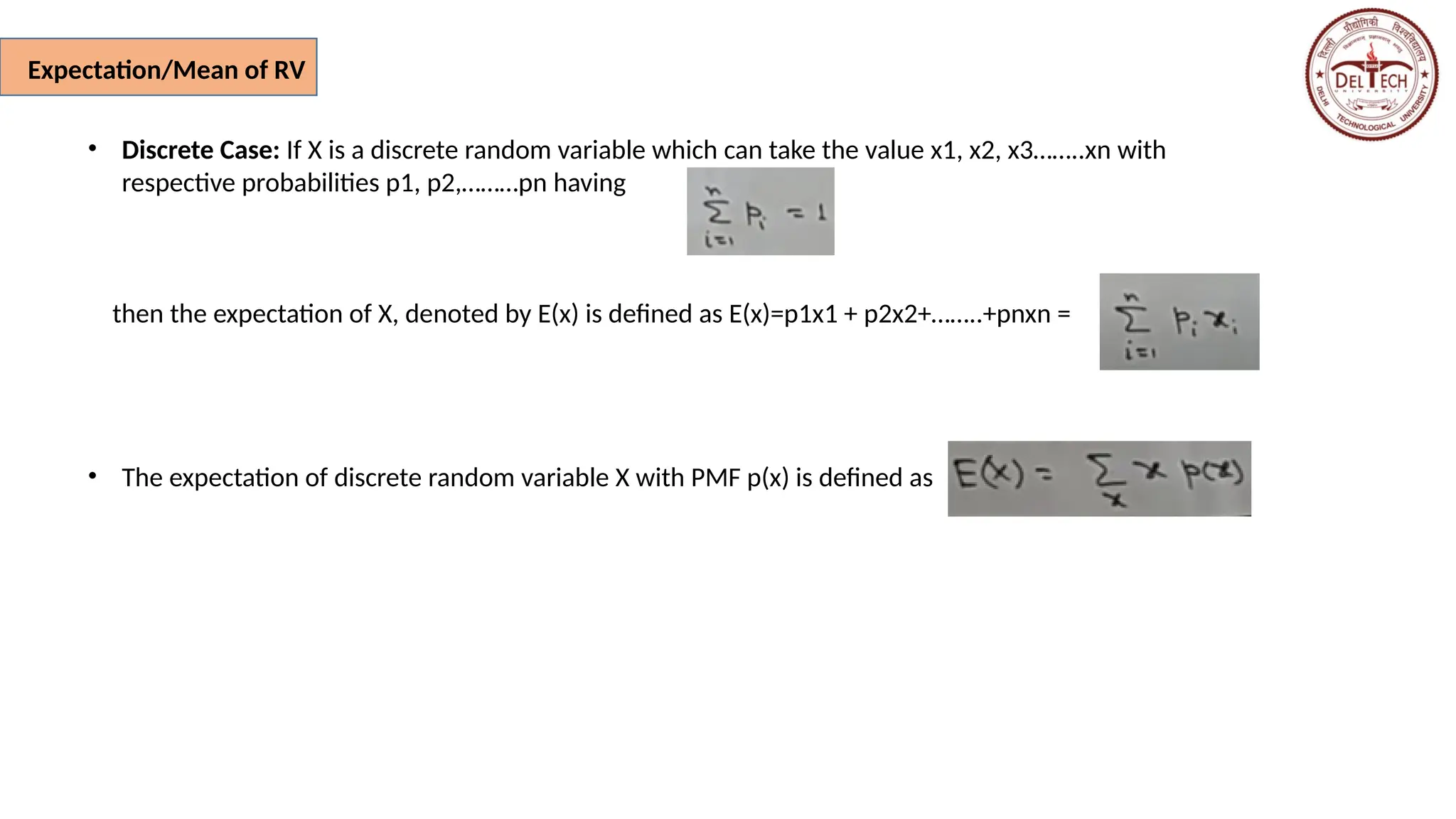
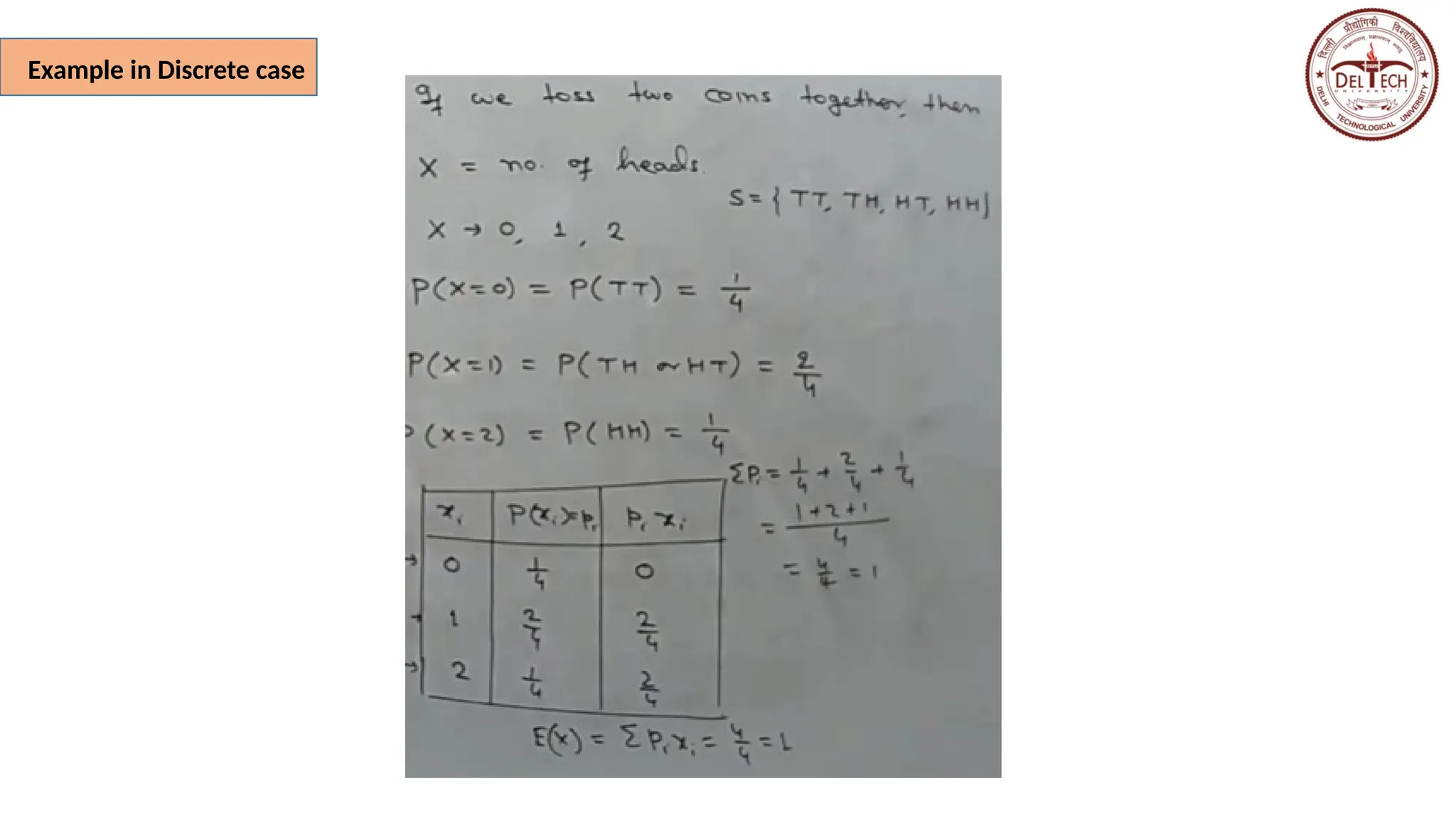
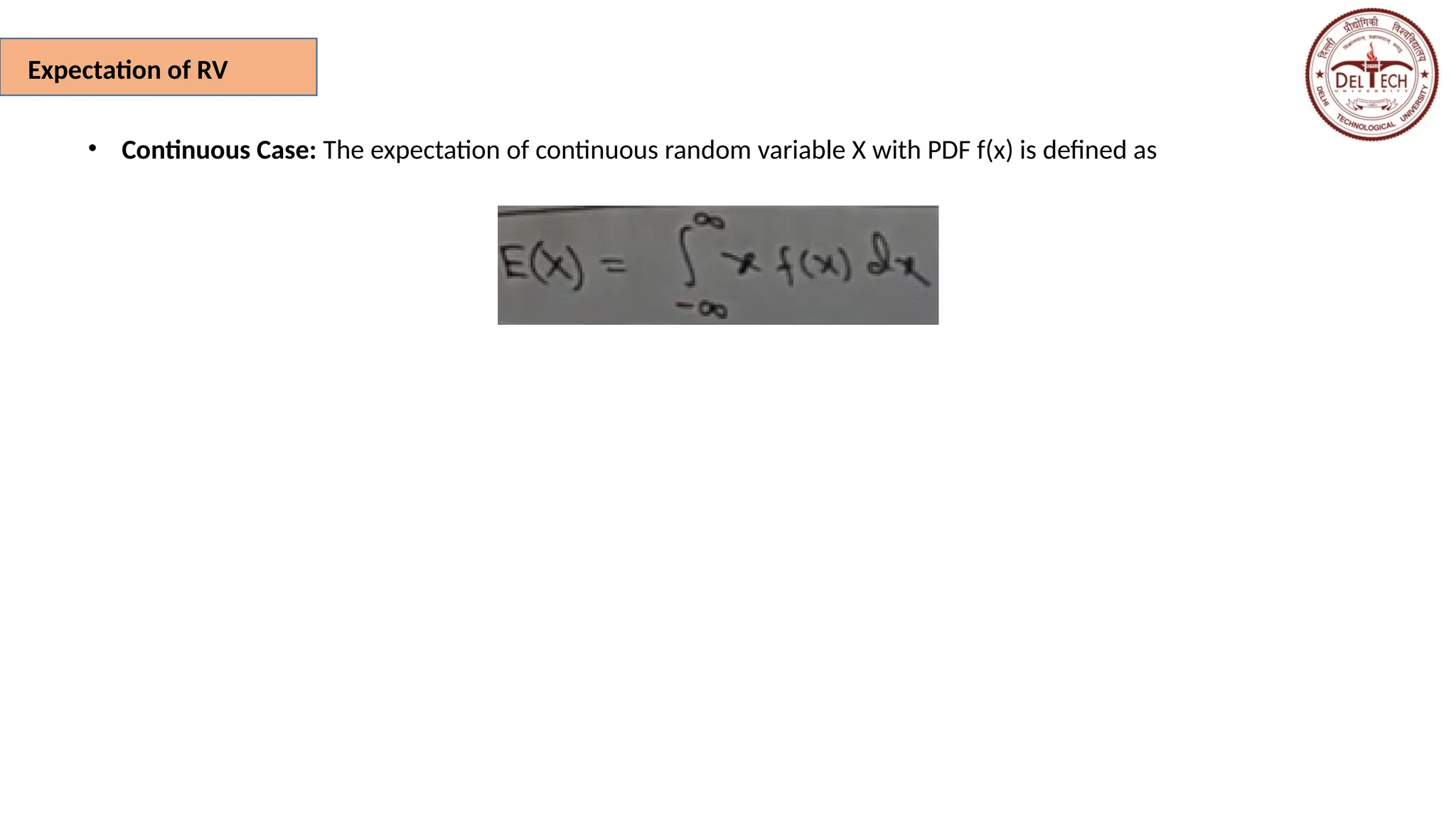
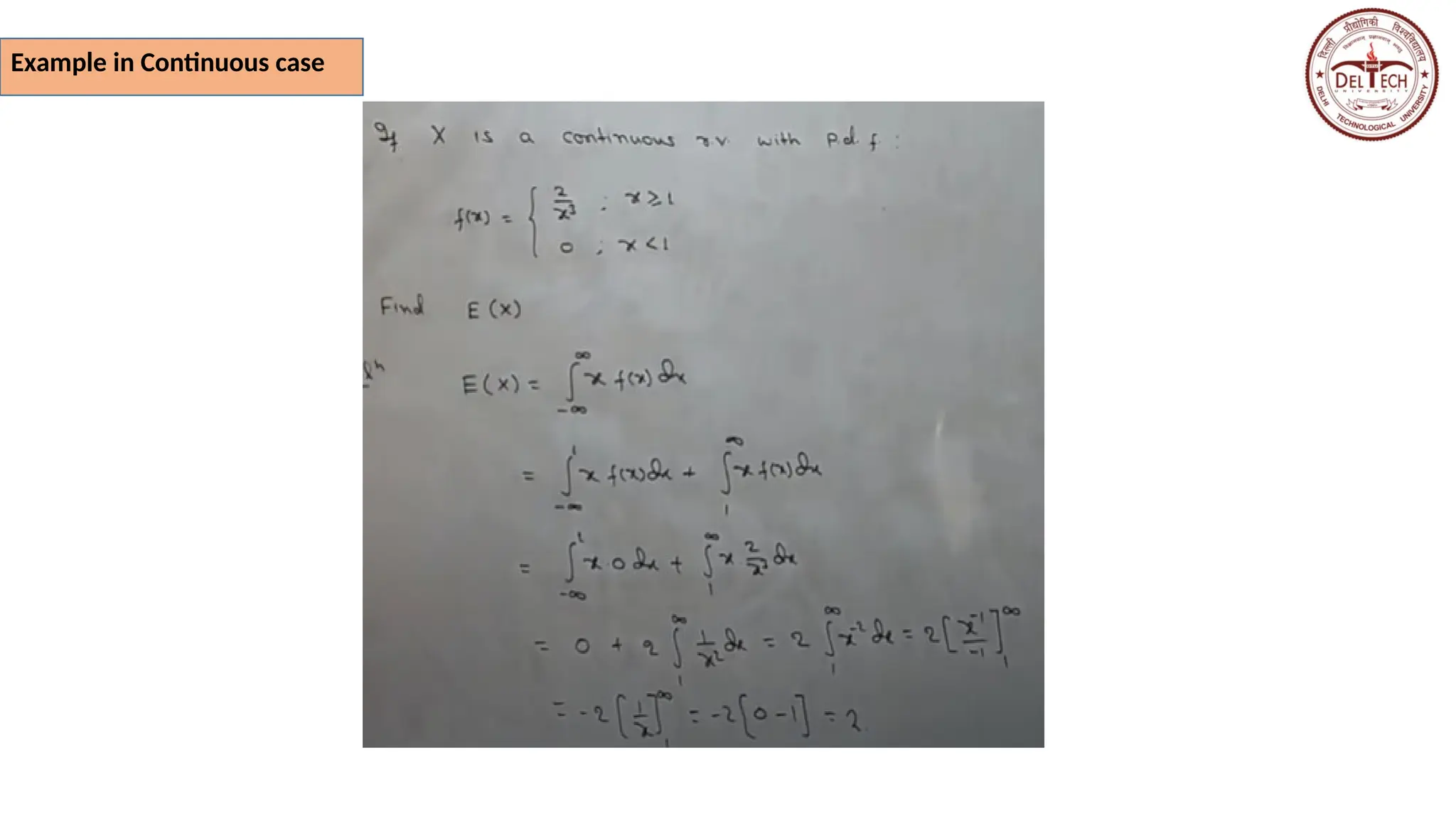
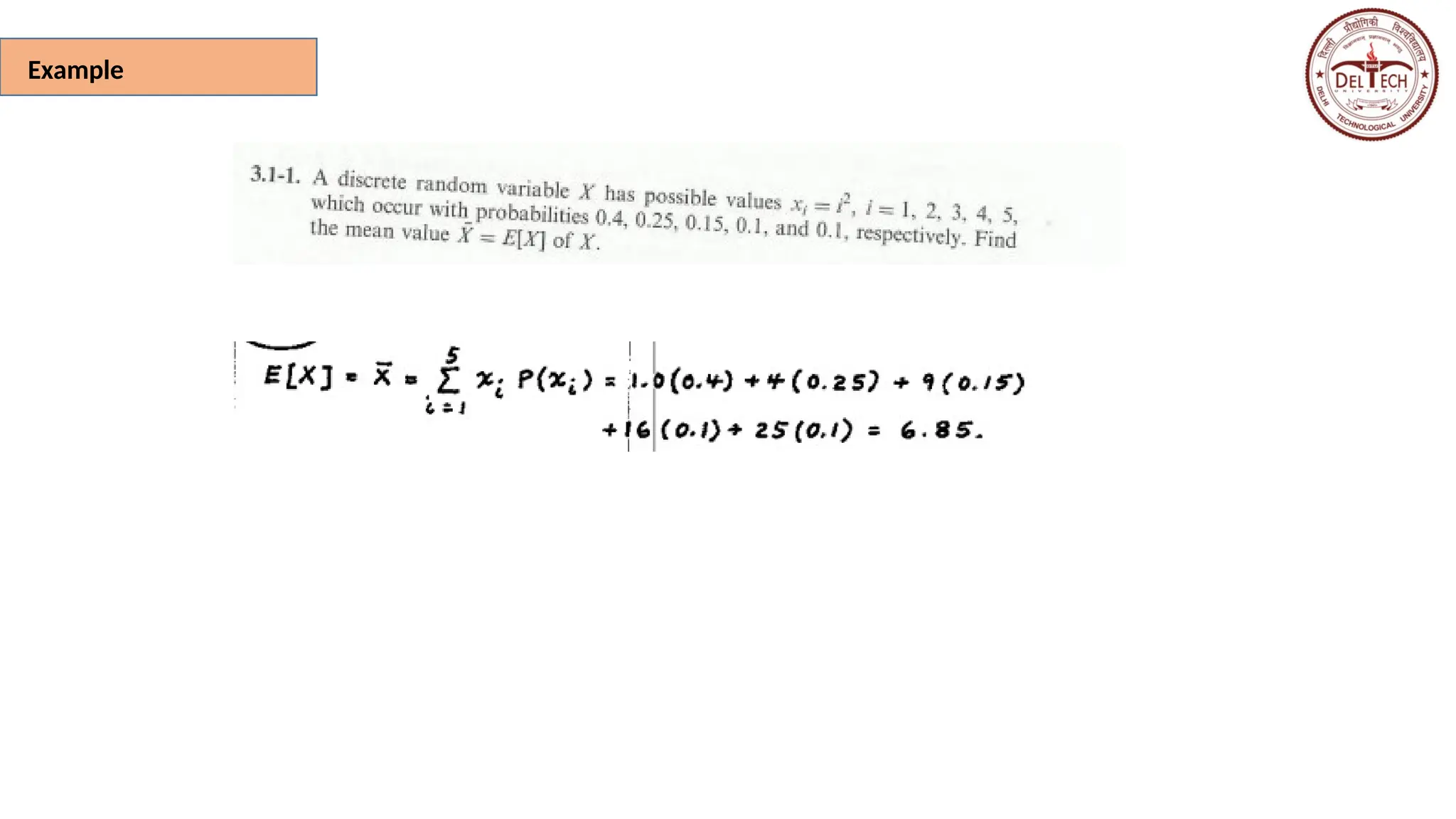
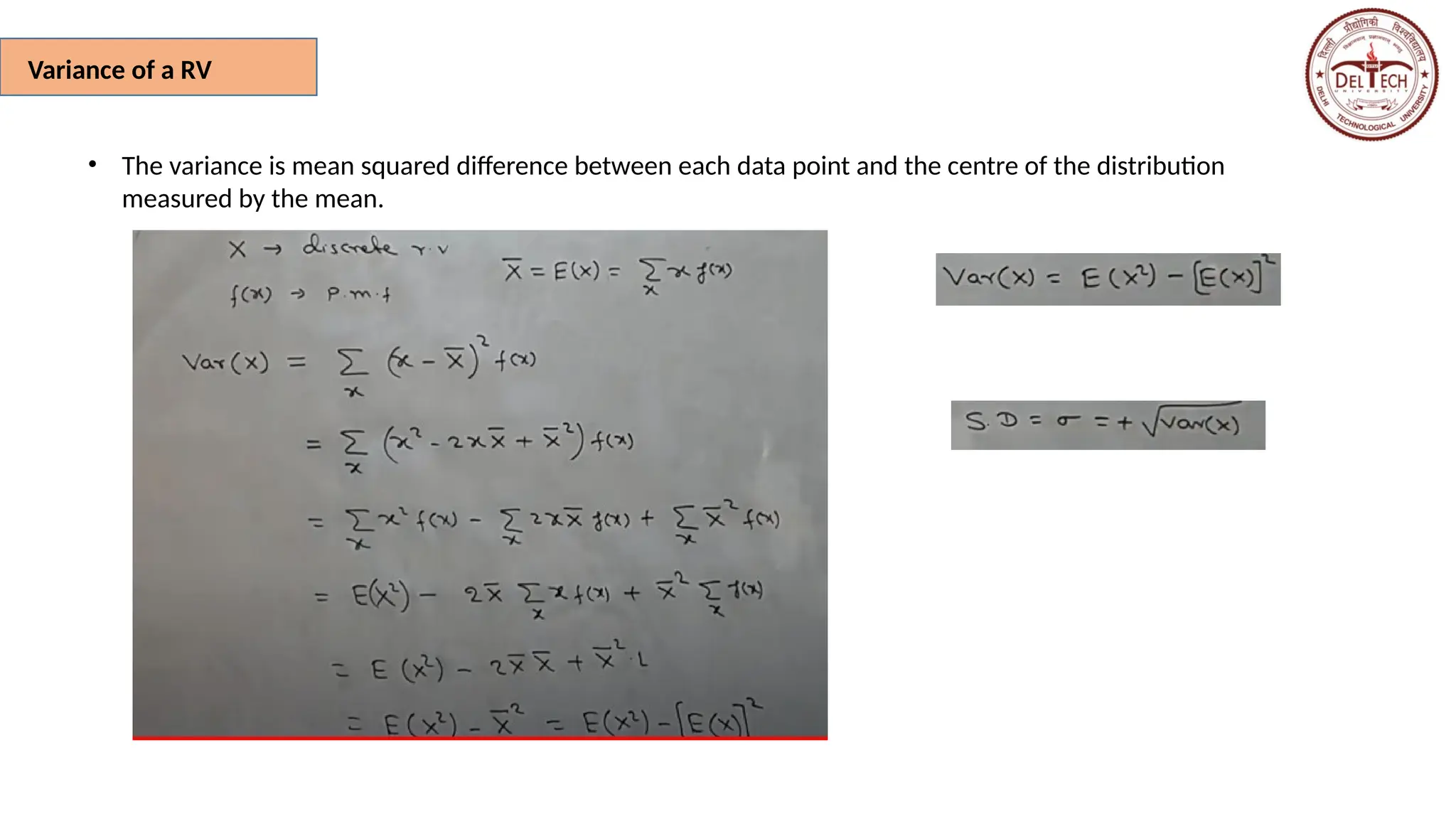
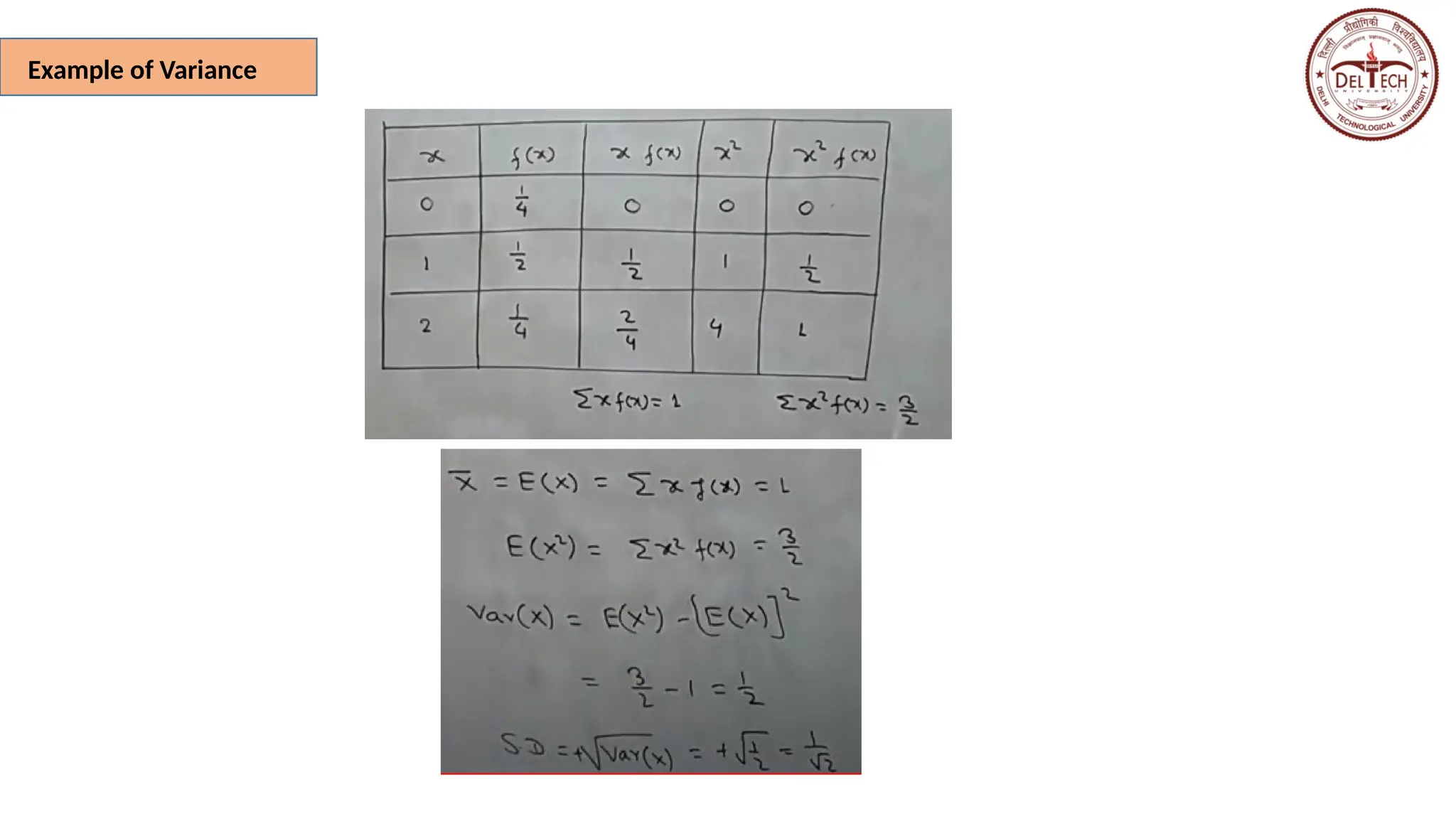
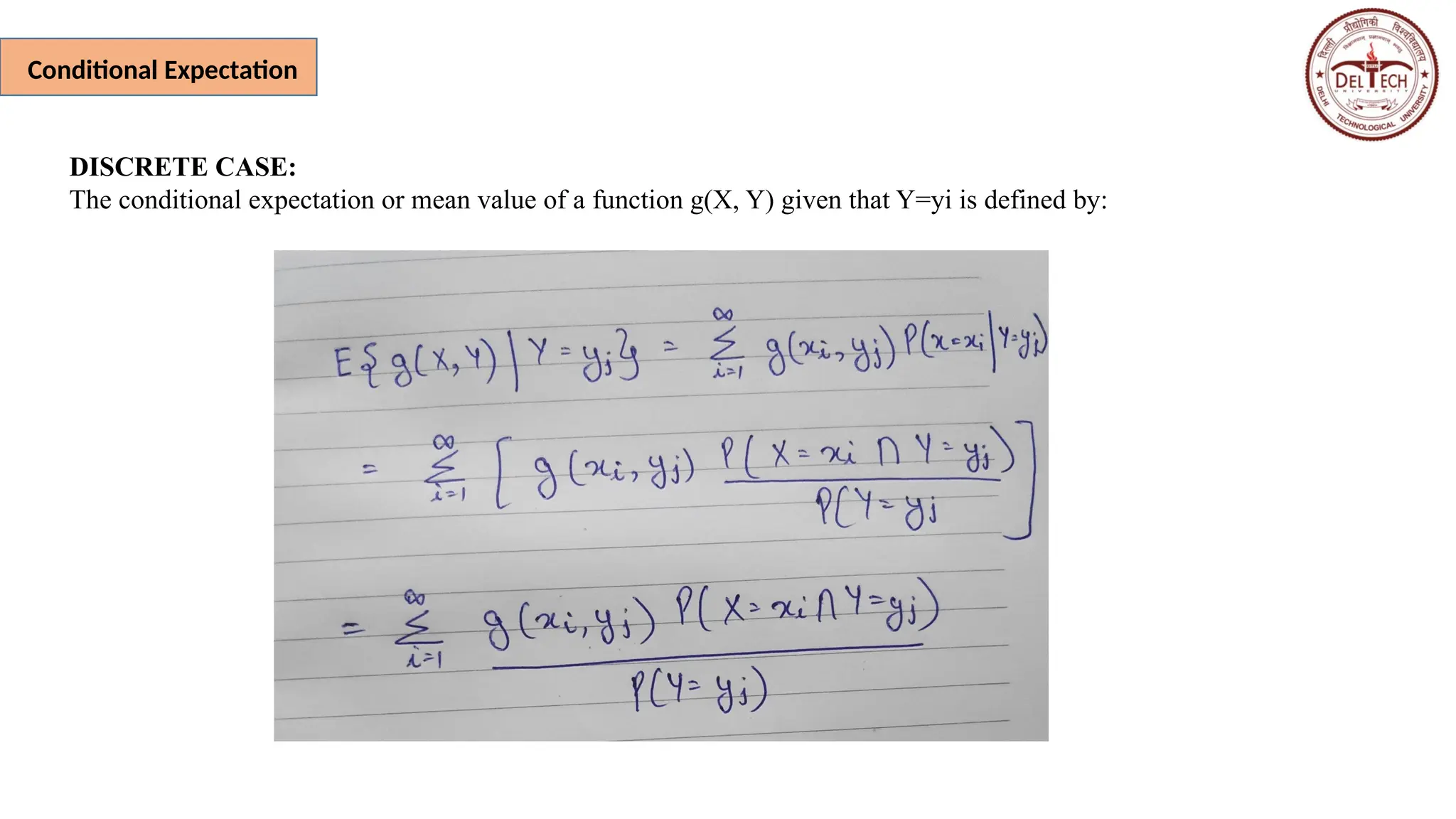
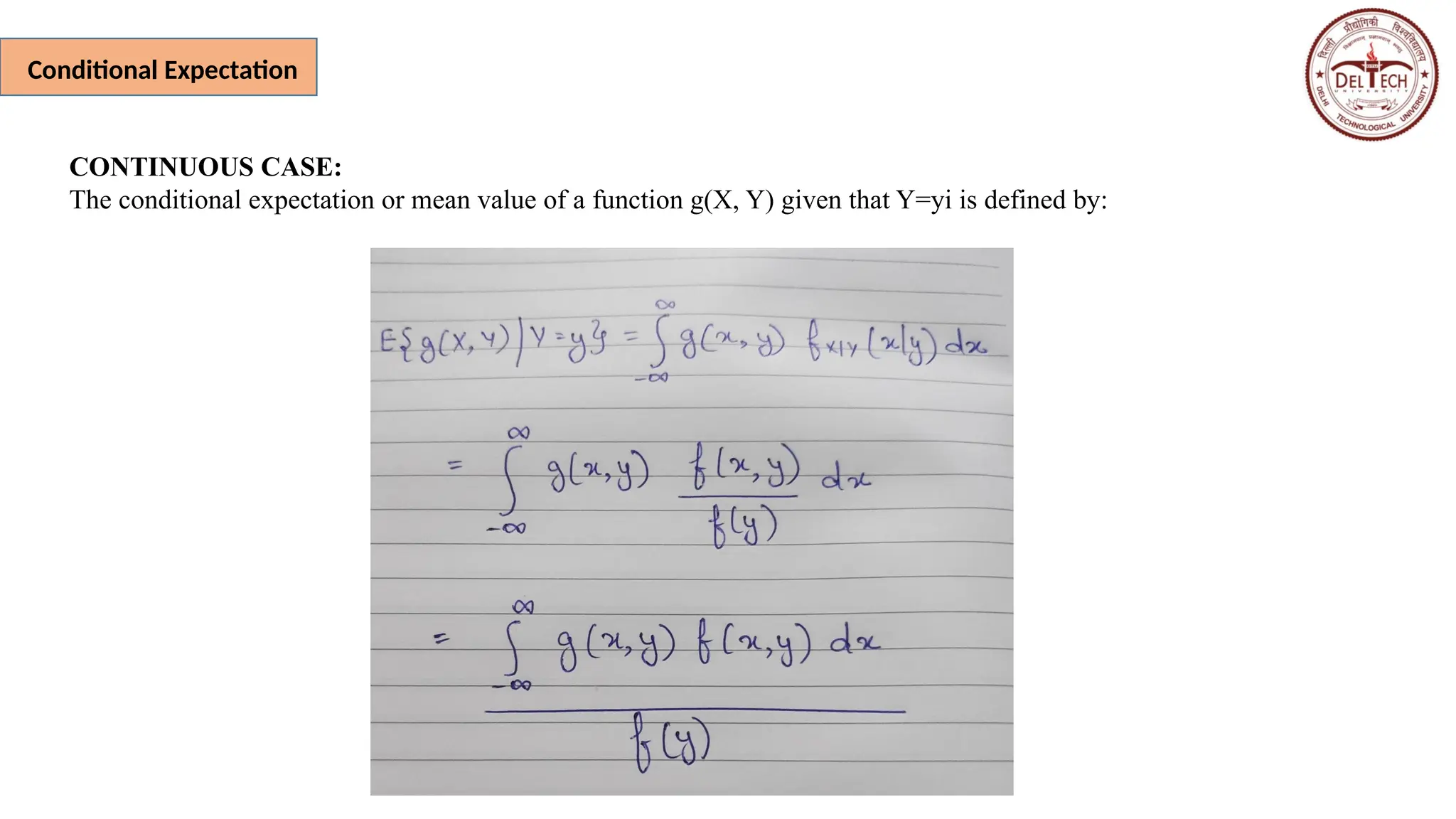
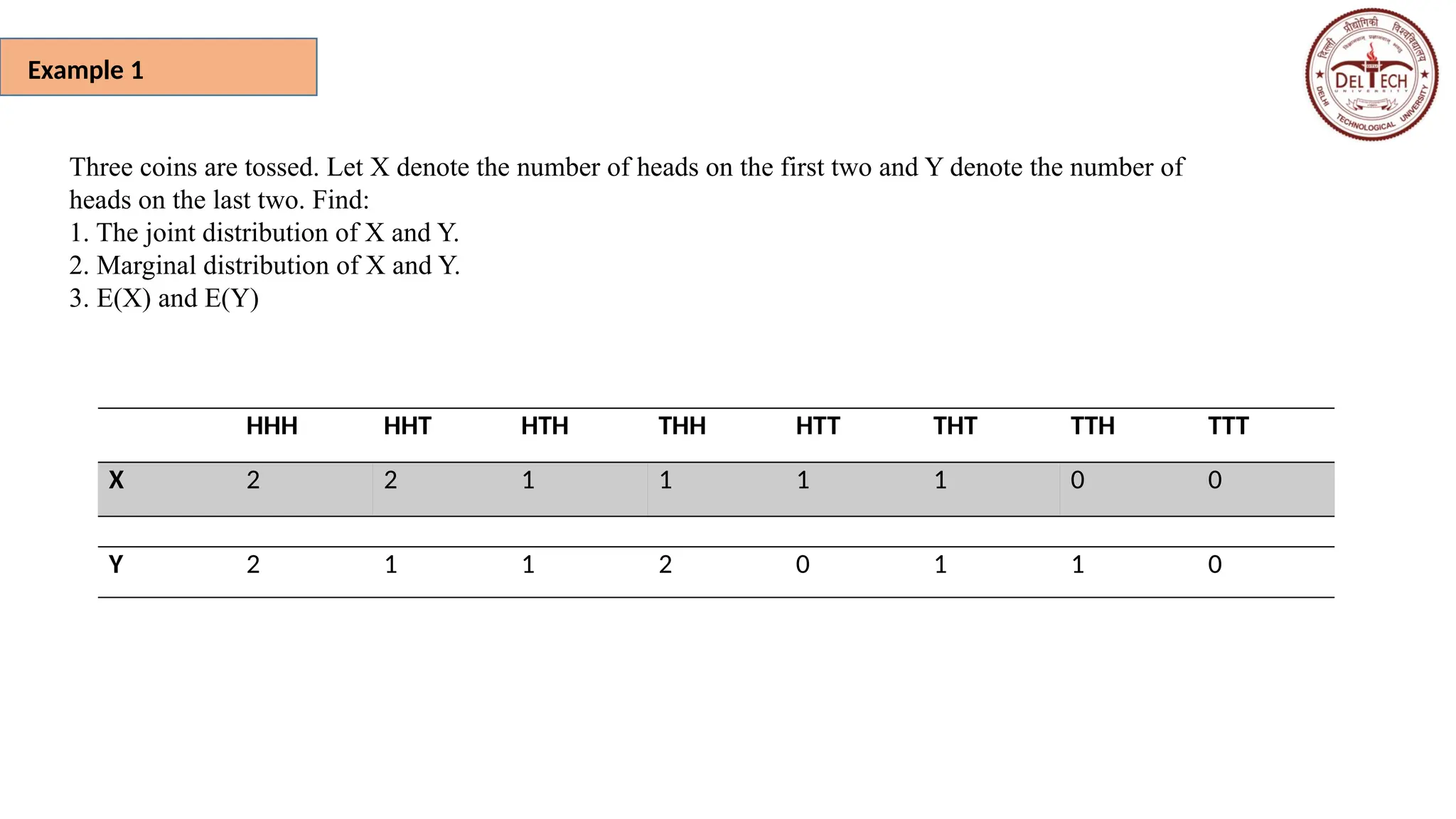
The document covers the expectation and variance of random variables (RVs), detailing both discrete and continuous cases, as well as conditional expectations and covariance. It includes examples of calculating joint and marginal distributions and applying Chebyshev's inequality to assess probabilities related to RVs. Various calculations involving expectations and distributions from coin toss outcomes are also illustrated.
![Expected value of function of RV
• Consider a random variable X with PDF or PMF f(x), If g(x) is a function of random variable X, then
E[g(x)] is defined as](https://image.slidesharecdn.com/chapter3randomvariable-240912120743-a874af67/75/Random-Variable-Probability-and-Statistics-pptx-7-2048.jpg)
![Example 2
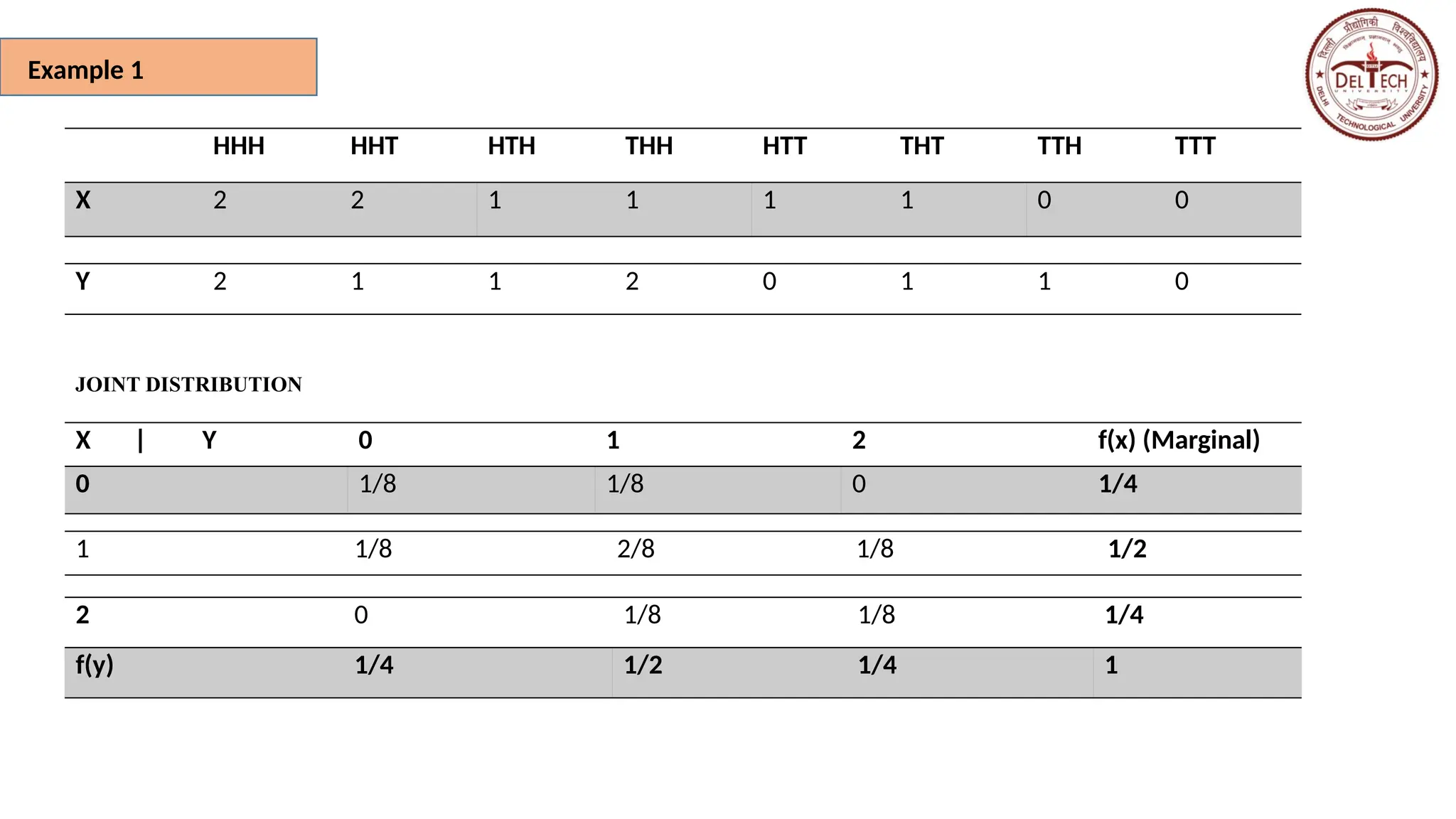
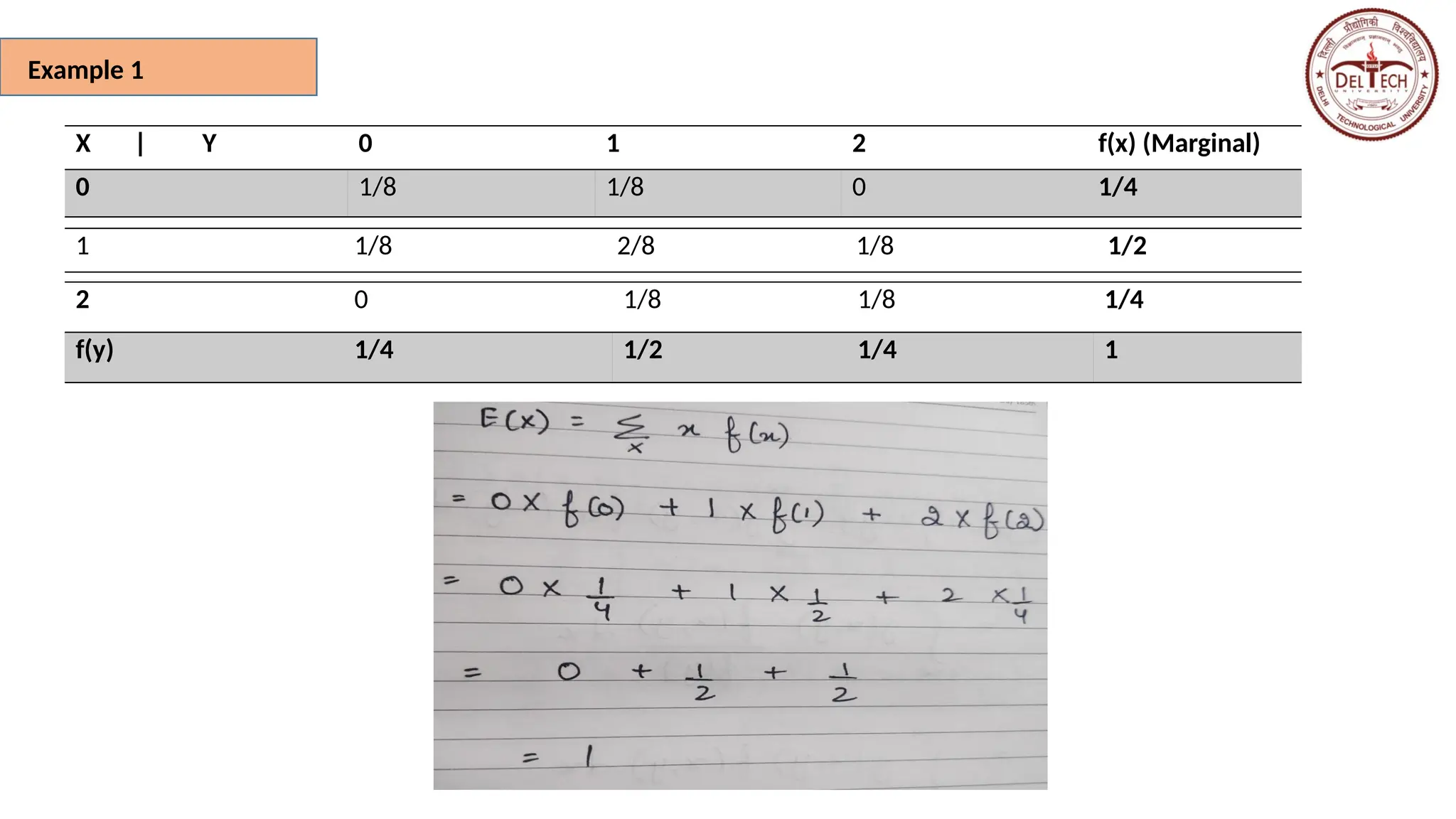
X | Y 0 1 2 f(x) (Marginal)
0 1/8 1/8 0 1/4
1 1/8 2/8 1/8 1/2
2 0 1/8 1/8 1/4
f(y) 1/4 1/2 1/4 1
Find E[ Y | X=1]](https://image.slidesharecdn.com/chapter3randomvariable-240912120743-a874af67/75/Random-Variable-Probability-and-Statistics-pptx-16-2048.jpg)
![Example 2
Find E[ Y | X=1]](https://image.slidesharecdn.com/chapter3randomvariable-240912120743-a874af67/75/Random-Variable-Probability-and-Statistics-pptx-17-2048.jpg)


![[DSC Europe 25] Katherine Forrest - AI NOW: Understanding the Velocity of Cha...](https://cdn.slidesharecdn.com/ss_thumbnails/wvvbruqfrci0sfq9xwgb-4-251212104007-e5ad1987-thumbnail.jpg?width=640&height=640&fit=bounds)

![[DSC Europe 25] Ivan Peric - Intelligence Swarm Logic and Techno-Functional M...](https://cdn.slidesharecdn.com/ss_thumbnails/7my7c97fsduiccadgavw-2-251212103249-5a03f7c6-thumbnail.jpg?width=640&height=640&fit=bounds)
![[DSC Europe 25] Behzad Hosseini - AI Agents in the Wild: Deploying Models tha...](https://cdn.slidesharecdn.com/ss_thumbnails/3qtejajvsjqrzwfept2c-10-251212103250-7f2b1068-thumbnail.jpg?width=640&height=640&fit=bounds)

![[DSC Europe 25] Milan Sekuloski - Data, Defence, and Development: Cybersecuri...](https://cdn.slidesharecdn.com/ss_thumbnails/dfrkwwx4qly6atqpbl4z-4-251209104645-c3d4b0ca-thumbnail.jpg?width=640&height=640&fit=bounds)
![[DSC Europe 25] Jon Dajci - Bridging TradFi and DeFi: Building the Future of ...](https://cdn.slidesharecdn.com/ss_thumbnails/fqmhfvlbqhkihjvqvhmu-7-251211083849-6af7e325-thumbnail.jpg?width=640&height=640&fit=bounds)


![[DSC Europe 25] Branko Urosevic -Rethinking Financial Talent: Integrating Cod...](https://cdn.slidesharecdn.com/ss_thumbnails/8jjrus8ttko6qj64f58f-3-251212103250-642c6374-thumbnail.jpg?width=640&height=640&fit=bounds)


![[DSC Europe 25] Dusan Nesic - Securing Tomorrow’s Infrastructure: Why Cyber-P...](https://cdn.slidesharecdn.com/ss_thumbnails/qikbszfftyowjm2q6duw-1-251211083848-8f2ead6b-thumbnail.jpg?width=640&height=640&fit=bounds)