

















Historical View
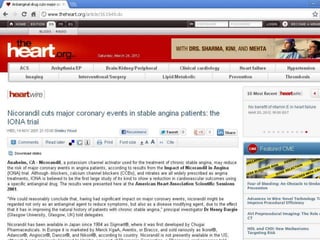
• Nicorandil has been available in Japan since 1984 as
                      Sigmart®,
         • where it was first developed by :
             Chugai Pharmaceuticals.
HYPOTHESIS


EVIDENCE BASED MEDCINE


   RECOMMENDATIONS


      CONCLUSION
HYPOTHESIS
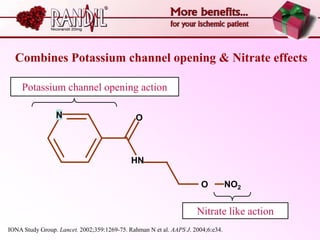
Combines Potassium channel opening & Nitrate effects

     Potassium channel opening action

                 N                             O


                                             HN

                                                                       O          NO2


                                                                     Nitrate like action
IONA Study Group. Lancet. 2002;359:1269-75. Rahman N et al. AAPS J. 2004;6:e34.
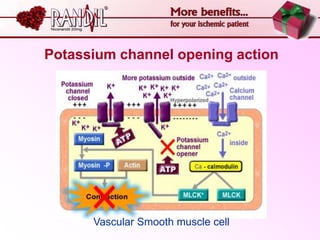
Potassium channel opening action


      Vascular Smooth muscle cell
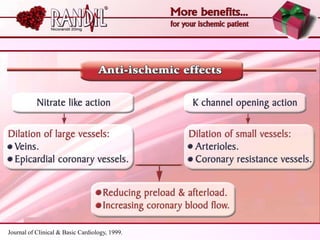
Journal of Clinical & Basic Cardiology, 1999.
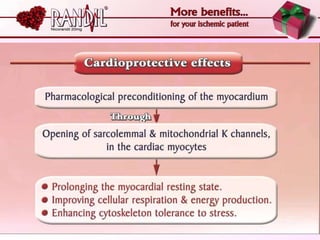
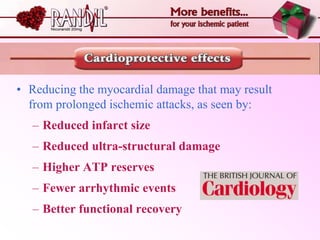
• Reducing the myocardial damage that may result
  from prolonged ischemic attacks, as seen by:
   – Reduced infarct size
   – Reduced ultra-structural damage
   – Higher ATP reserves
   – Fewer arrhythmic events
   – Better functional recovery
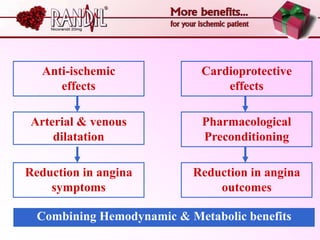
Anti-ischemic             Cardioprotective
      effects                    effects

Arterial & venous            Pharmacological
    dilatation               Preconditioning

Reduction in angina        Reduction in angina
    symptoms                   outcomes

  Combining Hemodynamic & Metabolic benefits
EVIDENCE BASED MEDCINE
Impact Of Nicorandil in Angina
IONA Study Group. Lancet. 2002;359:1269-75
- Double blind, randomized, controlled trial, on 5126
   patients with chronic stable angina.
- Comparing Nicorandil versus placebo (when added
   to existing anti-anginal treatment).
- With a follow up period of up to 3 years.
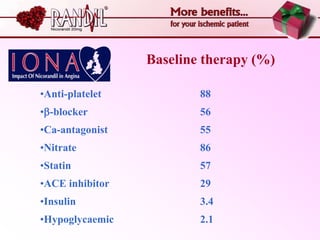
Baseline therapy (%)

•Anti-platelet           88
•-blocker               56
•Ca-antagonist           55
•Nitrate                 86
•Statin                  57
•ACE inhibitor           29
•Insulin                 3.4
•Hypoglycaemic           2.1
• Primary End Point:
  – Coronary Heart Disease Death.
  – Non fatal Myocardial Infarction.
  – Unplanned Hospitalization for Cardiac Chest Pain.
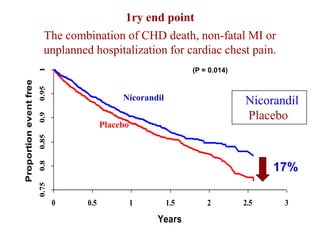
1ry end point
                          The combination of CHD death, non-fatal MI or
                          unplanned hospitalization for cardiac chest pain.
                                                                 (P = 0.014)
                        1
Proportion event free
                        0.95


                                              Nicorandil                       Nicorandil
                                                                               Placebo
                        0.9


                                         Placebo
                        0.85
                        0.8


                                                                                     17%
                        0.75


                               0   0.5             1       1.5       2         2.5    3
                                                       Years
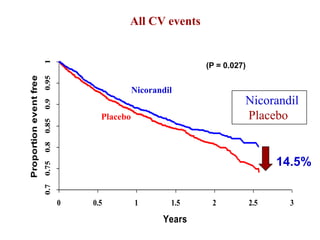
All CV events

                        1

                                                              (P = 0.027)
Proportion event free
                        0.95


                                               Nicorandil
                                                                        Nicorandil
                        0.9


                                     Placebo                            Placebo
                        0.85
                        0.8


                                                                                  14.5%
                        0.75
                        0.7


                               0   0.5         1        1.5    2            2.5    3
                                                      Years
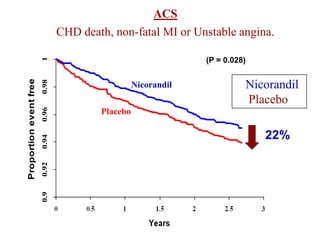
ACS
                               CHD death, non-fatal MI or Unstable angina.
                        1

                                                              (P = 0.028)
Proportion event free
                        0.98


                                                 Nicorandil             Nicorandil
                                                                        Placebo
                        0.96


                                       Placebo

                                                                            22%
                        0.94
                        0.92
                        0.9
The Japanese Coronary Artery
      Disease (JCAD) study


HORINAKA S et al. Circulation Journal Vol.74,
March 2010.
JCAD study
• A multicenter collaborative prospective observational
  study of a large cohort of coronary artery disease
  patients (13,812).
  Who underwent coronary angiography and were
  diagnosed as having significant stenosis in at least 1
  coronary artery, with:
• Stable angina in 8,808 patients (64%).
• Acute MI in 2,955 patients (21%).
• Unstable angina in 2,049 patients (15%).
JCAD study
Patients were followed up for an average of 2.7 years, on medical treatments •
of:
Beta blockers, Nitrates, CCB, Statins, ACEI, ARB and Nicorandil.


As part of the JCAD Study, the effect of Nicorandil on outcome was •
examined (2,558 on Nicorandil Vs 2,558 control).
JCAD study
Nicorandil group risk factors:
Hypertension                     (55%).
Hyperlipidemia                   (53%)
Impaired glucose tolerance       (42%)
Smoker                           (38%)
Family history                   (16%)
Heart failure                    (11%)
75% males and 25% females.
JCAD study
Nicorandil group background medications:
Beta blockers         (22%).
Statins               (36%)
Diuretics             (18%)
ACEI                  (29%)
ARB                   (15%)
Sulfonylureas         (10%)
JCAD study

1ry endpoint:
- Death from all causes.
2ry endpoints:
- Cardiac death.                - Fatal MI.
- Cerebral or vascular death.   - Congestive heart failure.
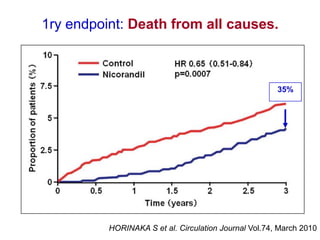
1ry endpoint: Death from all causes.


                                                       35%


          HORINAKA S et al. Circulation Journal Vol.74, March 2010
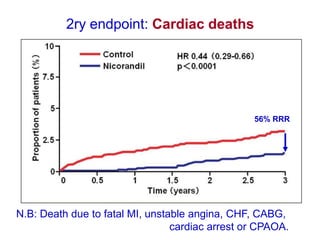
2ry endpoint: Cardiac deaths


                                                 56% RRR


N.B: Death due to fatal MI, unstable angina, CHF, CABG,
                                 cardiac arrest or CPAOA.
JCAD study
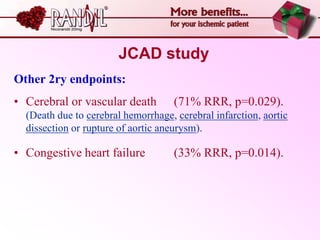
Other 2ry endpoints:
• Cerebral or vascular death         (71% RRR, p=0.029).
  (Death due to cerebral hemorrhage, cerebral infarction, aortic
  dissection or rupture of aortic aneurysm).

• Congestive heart failure           (33% RRR, p=0.014).
RECOMMENDATIONS
CONCLUSION
Dosage and Administration

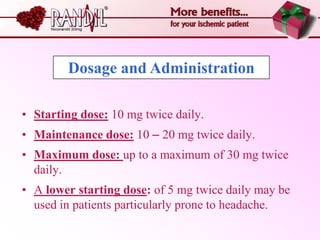
• Starting dose: 10 mg twice daily.
• Maintenance dose: 10 – 20 mg twice daily.
• Maximum dose: up to a maximum of 30 mg twice
  daily.
• A lower starting dose: of 5 mg twice daily may be
  used in patients particularly prone to headache.
Packing Quality

• High quality packing:
     - Double Al strip, sealed in Al bag, with
     moisture absorbent.
     - 3 strips, each of 10 double scored tablets.
• Price: 36 L.E.
CAD patient
            refractory to current
            anti-anginal therapy


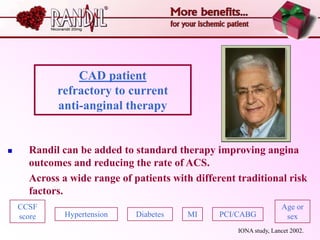
     Randil can be added to standard therapy improving angina
      outcomes and reducing the rate of ACS.
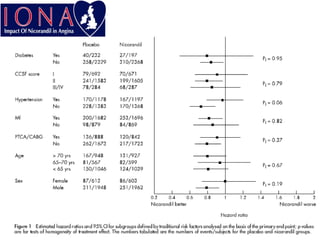
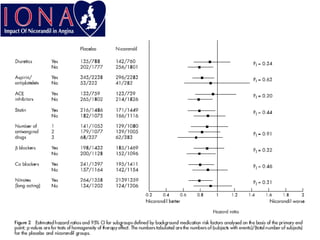
      Across a wide range of patients with different traditional risk
      factors.
    CCSF                                                            Age or
    score     Hypertension    Diabetes   MI      PCI/CABG            sex
                                                     IONA study, Lancet 2002.
Newly diagnosed
      CAD patient


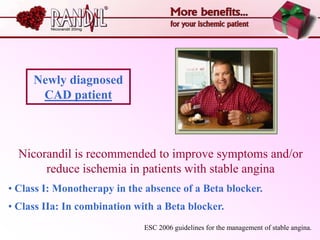
  Nicorandil is recommended to improve symptoms and/or
       reduce ischemia in patients with stable angina
• Class I: Monotherapy in the absence of a Beta blocker.
• Class IIa: In combination with a Beta blocker.
                              ESC 2006 guidelines for the management of stable angina.
Communicate With Us
• Adwia.com
• http://randilbrand.blogspot.com/
• http://www.facebook.com/Randil.Adwia
THANK YOU
Myocardial protection from either ischaemic preconditioning or
               nicorandil is not blocked by gliclazide

• Both IPC and nicorandil- induced protection
  are abolished by glibenclamide but not
  gliclazide in-vivo.
• These results may have important clinical
  implications in type II diabetic patients at risk
  of acute coronary syndromes.
• http://discovery.ucl.ac.uk/75012/
Myocardial protection from either ischaemic preconditioning or
                    nicorandil is not blocked by gliclazide
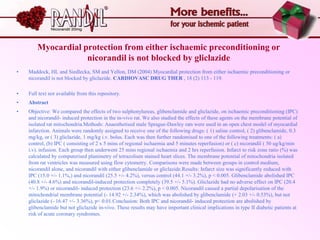
•   Maddock, HL and Siedlecka, SM and Yellon, DM (2004) Myocardial protection from either ischaemic preconditioning or
    nicorandil is not blocked by gliclazide. CARDIOVASC DRUG THER , 18 (2) 113 - 119.

•   Full text not available from this repository.
•   Abstract
•   Objective: We compared the effects of two sulphonylureas, glibenclamide and gliclazide, on ischaemic preconditioning (IPC)
    and nicorandil- induced protection in the in-vivo rat. We also studied the effects of these agents on the membrane potential of
    isolated rat mitochondria.Methods: Anaesthetised male Sprague-Dawley rats were used in an open chest model of myocardial
    infarction. Animals were randomly assigned to receive one of the following drugs: ( 1) saline control, ( 2) glibenclamide, 0.3
    mg/kg, or ( 3) gliclazide, 1 mg/kg i.v. bolus. Each was then further randomised to one of the following treatments: ( a)
    control, (b) IPC ( consisting of 2 x 5 mins of regional ischaemia and 5 minutes reperfusion) or ( c) nicorandil ( 50 ug/kg/min
    i.v). infusion. Each group then underwent 25 mins regional ischaemia and 2 hrs reperfusion. Infarct to risk zone ratio (%) was
    calculated by computerised planimetry of tetrazolium stained heart slices. The membrane potential of mitochondria isolated
    from rat ventricles was measured using flow cytometry. Comparisons were made between groups in control medium,
    nicorandil alone, and nicorandil with either glibenclamide or gliclazide.Results: Infarct size was significantly reduced with
    IPC (15.0 +/- 1.1%,) and nicorandil (25.5 +/- 4.2%), versus control (44.1 +/- 3.2%), p < 0.005. Glibenclamide abolished IPC
    (40.8 +/- 4.6%) and nicorandil-induced protection completely (39.5 +/- 5.1%). Gliclazide had no adverse effect on IPC (20.4
    +/- 1.9%) or nicorandil- induced protection (23.6 +/- 2.2%), p < 0.005. Nicorandil caused a partial depolarisation of the
    mitochondrial membrane potential (- 14.92 +/- 2.34%), which was abolished by glibenclamide (+ 2.03 +/- 0.53%), but not
    gliclazide (- 16.47 +/- 3.36%), p< 0.01.Conclusion: Both IPC and nicorandil- induced protection are abolished by
    glibenclamide but not gliclazide in-vivo. These results may have important clinical implications in type II diabetic patients at
    risk of acute coronary syndromes.

Randil

  • 3.
    Historical View • Nicorandilhas been available in Japan since 1984 as Sigmart®, • where it was first developed by : Chugai Pharmaceuticals.
  • 4.
    HYPOTHESIS EVIDENCE BASED MEDCINE RECOMMENDATIONS CONCLUSION
  • 5.
  • 6.
    Combines Potassium channelopening & Nitrate effects Potassium channel opening action N O HN O NO2 Nitrate like action IONA Study Group. Lancet. 2002;359:1269-75. Rahman N et al. AAPS J. 2004;6:e34.
  • 7.
    Potassium channel openingaction Vascular Smooth muscle cell
  • 8.
    Journal of Clinical& Basic Cardiology, 1999.
  • 10.
    • Reducing themyocardial damage that may result from prolonged ischemic attacks, as seen by: – Reduced infarct size – Reduced ultra-structural damage – Higher ATP reserves – Fewer arrhythmic events – Better functional recovery
  • 11.
    Anti-ischemic Cardioprotective effects effects Arterial & venous Pharmacological dilatation Preconditioning Reduction in angina Reduction in angina symptoms outcomes Combining Hemodynamic & Metabolic benefits
  • 12.
  • 14.
    Impact Of Nicorandilin Angina IONA Study Group. Lancet. 2002;359:1269-75
  • 15.
    - Double blind,randomized, controlled trial, on 5126 patients with chronic stable angina. - Comparing Nicorandil versus placebo (when added to existing anti-anginal treatment). - With a follow up period of up to 3 years.
  • 16.
    Baseline therapy (%) •Anti-platelet 88 •-blocker 56 •Ca-antagonist 55 •Nitrate 86 •Statin 57 •ACE inhibitor 29 •Insulin 3.4 •Hypoglycaemic 2.1
  • 17.
    • Primary EndPoint: – Coronary Heart Disease Death. – Non fatal Myocardial Infarction. – Unplanned Hospitalization for Cardiac Chest Pain.
  • 18.
    1ry end point The combination of CHD death, non-fatal MI or unplanned hospitalization for cardiac chest pain. (P = 0.014) 1 Proportion event free 0.95 Nicorandil Nicorandil Placebo 0.9 Placebo 0.85 0.8 17% 0.75 0 0.5 1 1.5 2 2.5 3 Years
  • 19.
    All CV events 1 (P = 0.027) Proportion event free 0.95 Nicorandil Nicorandil 0.9 Placebo Placebo 0.85 0.8 14.5% 0.75 0.7 0 0.5 1 1.5 2 2.5 3 Years
  • 20.
    ACS CHD death, non-fatal MI or Unstable angina. 1 (P = 0.028) Proportion event free 0.98 Nicorandil Nicorandil Placebo 0.96 Placebo 22% 0.94 0.92 0.9
  • 24.
    The Japanese CoronaryArtery Disease (JCAD) study HORINAKA S et al. Circulation Journal Vol.74, March 2010.
  • 25.
    JCAD study • Amulticenter collaborative prospective observational study of a large cohort of coronary artery disease patients (13,812). Who underwent coronary angiography and were diagnosed as having significant stenosis in at least 1 coronary artery, with: • Stable angina in 8,808 patients (64%). • Acute MI in 2,955 patients (21%). • Unstable angina in 2,049 patients (15%).
  • 26.
    JCAD study Patients werefollowed up for an average of 2.7 years, on medical treatments • of: Beta blockers, Nitrates, CCB, Statins, ACEI, ARB and Nicorandil. As part of the JCAD Study, the effect of Nicorandil on outcome was • examined (2,558 on Nicorandil Vs 2,558 control).
  • 27.
    JCAD study Nicorandil grouprisk factors: Hypertension (55%). Hyperlipidemia (53%) Impaired glucose tolerance (42%) Smoker (38%) Family history (16%) Heart failure (11%) 75% males and 25% females.
  • 28.
    JCAD study Nicorandil groupbackground medications: Beta blockers (22%). Statins (36%) Diuretics (18%) ACEI (29%) ARB (15%) Sulfonylureas (10%)
  • 29.
    JCAD study 1ry endpoint: -Death from all causes. 2ry endpoints: - Cardiac death. - Fatal MI. - Cerebral or vascular death. - Congestive heart failure.
  • 30.
    1ry endpoint: Deathfrom all causes. 35% HORINAKA S et al. Circulation Journal Vol.74, March 2010
  • 31.
    2ry endpoint: Cardiacdeaths 56% RRR N.B: Death due to fatal MI, unstable angina, CHF, CABG, cardiac arrest or CPAOA.
  • 32.
    JCAD study Other 2ryendpoints: • Cerebral or vascular death (71% RRR, p=0.029). (Death due to cerebral hemorrhage, cerebral infarction, aortic dissection or rupture of aortic aneurysm). • Congestive heart failure (33% RRR, p=0.014).
  • 33.
  • 36.
  • 37.
    Dosage and Administration •Starting dose: 10 mg twice daily. • Maintenance dose: 10 – 20 mg twice daily. • Maximum dose: up to a maximum of 30 mg twice daily. • A lower starting dose: of 5 mg twice daily may be used in patients particularly prone to headache.
  • 38.
    Packing Quality • Highquality packing: - Double Al strip, sealed in Al bag, with moisture absorbent. - 3 strips, each of 10 double scored tablets. • Price: 36 L.E.
  • 39.
    CAD patient refractory to current anti-anginal therapy  Randil can be added to standard therapy improving angina outcomes and reducing the rate of ACS. Across a wide range of patients with different traditional risk factors. CCSF Age or score Hypertension Diabetes MI PCI/CABG sex IONA study, Lancet 2002.
  • 40.
    Newly diagnosed CAD patient Nicorandil is recommended to improve symptoms and/or reduce ischemia in patients with stable angina • Class I: Monotherapy in the absence of a Beta blocker. • Class IIa: In combination with a Beta blocker. ESC 2006 guidelines for the management of stable angina.
  • 41.
    Communicate With Us •Adwia.com • http://randilbrand.blogspot.com/ • http://www.facebook.com/Randil.Adwia
  • 45.
  • 46.
    Myocardial protection fromeither ischaemic preconditioning or nicorandil is not blocked by gliclazide • Both IPC and nicorandil- induced protection are abolished by glibenclamide but not gliclazide in-vivo. • These results may have important clinical implications in type II diabetic patients at risk of acute coronary syndromes. • http://discovery.ucl.ac.uk/75012/
  • 47.
    Myocardial protection fromeither ischaemic preconditioning or nicorandil is not blocked by gliclazide • Maddock, HL and Siedlecka, SM and Yellon, DM (2004) Myocardial protection from either ischaemic preconditioning or nicorandil is not blocked by gliclazide. CARDIOVASC DRUG THER , 18 (2) 113 - 119. • Full text not available from this repository. • Abstract • Objective: We compared the effects of two sulphonylureas, glibenclamide and gliclazide, on ischaemic preconditioning (IPC) and nicorandil- induced protection in the in-vivo rat. We also studied the effects of these agents on the membrane potential of isolated rat mitochondria.Methods: Anaesthetised male Sprague-Dawley rats were used in an open chest model of myocardial infarction. Animals were randomly assigned to receive one of the following drugs: ( 1) saline control, ( 2) glibenclamide, 0.3 mg/kg, or ( 3) gliclazide, 1 mg/kg i.v. bolus. Each was then further randomised to one of the following treatments: ( a) control, (b) IPC ( consisting of 2 x 5 mins of regional ischaemia and 5 minutes reperfusion) or ( c) nicorandil ( 50 ug/kg/min i.v). infusion. Each group then underwent 25 mins regional ischaemia and 2 hrs reperfusion. Infarct to risk zone ratio (%) was calculated by computerised planimetry of tetrazolium stained heart slices. The membrane potential of mitochondria isolated from rat ventricles was measured using flow cytometry. Comparisons were made between groups in control medium, nicorandil alone, and nicorandil with either glibenclamide or gliclazide.Results: Infarct size was significantly reduced with IPC (15.0 +/- 1.1%,) and nicorandil (25.5 +/- 4.2%), versus control (44.1 +/- 3.2%), p < 0.005. Glibenclamide abolished IPC (40.8 +/- 4.6%) and nicorandil-induced protection completely (39.5 +/- 5.1%). Gliclazide had no adverse effect on IPC (20.4 +/- 1.9%) or nicorandil- induced protection (23.6 +/- 2.2%), p < 0.005. Nicorandil caused a partial depolarisation of the mitochondrial membrane potential (- 14.92 +/- 2.34%), which was abolished by glibenclamide (+ 2.03 +/- 0.53%), but not gliclazide (- 16.47 +/- 3.36%), p< 0.01.Conclusion: Both IPC and nicorandil- induced protection are abolished by glibenclamide but not gliclazide in-vivo. These results may have important clinical implications in type II diabetic patients at risk of acute coronary syndromes.