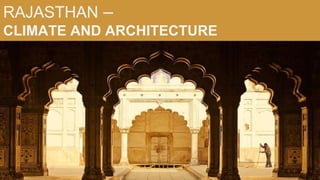
RAJASTHAN –
CLIMATE AND ARCHITECTURE
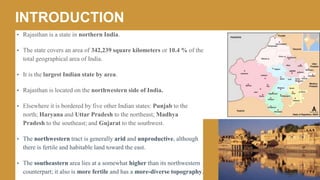
• Rajasthan is a state in northern India.
• The state covers an area of 342,239 square kilometers or 10.4 % of the
total geographical area of India.
• It is the largest Indian state by area.
• Rajasthan is located on the northwestern side of India.
• Elsewhere it is bordered by five other Indian states: Punjab to the
north; Haryana and Uttar Pradesh to the northeast; Madhya
Pradesh to the southeast; and Gujarat to the southwest.
• The northwestern tract is generally arid and unproductive, although
there is fertile and habitable land toward the east.
• The southeastern area lies at a somewhat higher than its northwestern
counterpart; it also is more fertile and has a more-diverse topography.
INTRODUCTION
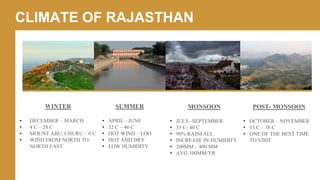
CLIMATE OF RAJASTHAN
WINTER
• DECEMBER – MARCH
• 4 C – 28 C
• MOUNT ABU, CHURU – 0 C
• WIND FROM NORTH TO
NORTH EAST
SUMMER
• APRIL - JUNE
• 32 C – 46 C
• HOT WIND – LOO
• HOT AND DRY
• LOW HUMIDITY
MONSOON
• JULY- SEPTEMBER
• 35 C- 40 C
• 90% RAINFALL
• INCREASE IN HUMIDITY
• 200MM – 400 MM
• AVG 100MM/YR
POST- MONSOON
• OCTOBER – NOVEMBER
• 33 C – 38 C
• ONE OF THE BEST TIME
TO VISIT
VERNACULAR ARCHITECTURE
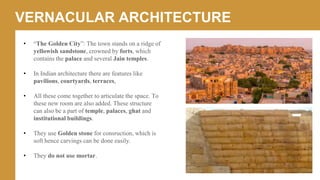
• “The Golden City”: The town stands on a ridge of
yellowish sandstone, crowned by forts, which
contains the palace and several Jain temples.
• In Indian architecture there are features like
pavilions, courtyards, terraces,
• All these come together to articulate the space. To
these new room are also added. These structure
can also be a part of temple, palaces, ghat and
institutional buildings.
• They use Golden stone for consruction, which is
soft hence carvings can be done easily.
• They do not use mortar.
VERNACULAR ARCHITECTURE
PAVILLION
BARADARI BARADARI
CHATRI CHATRI
ENTRANCEJAROKHA
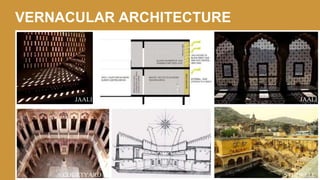
VERNACULAR ARCHITECTURE
JAALIJAALI
COURTYARD STEPWELL
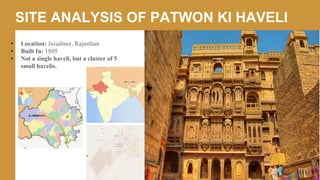
SITE ANALYSIS OF PATWON KI HAVELI
• Location: Jaisalmer, Rajasthan
• Built In: 1805
• Not a single haveli, but a cluster of 5
small havelis.
SITE ANALYSIS OF PATWON KI HAVELI
• The heat inside of the building is controlled by
the use of textures in Jaisalmer.
• The building facades have large number
of projections like jharokhas and chajjas which
provide shade to the facades.
• Traditional layouts essentially promoted airflow
within and around buildings.

Rajasthan

  • 1.
  • 2.
    • Rajasthan isa state in northern India. • The state covers an area of 342,239 square kilometers or 10.4 % of the total geographical area of India. • It is the largest Indian state by area. • Rajasthan is located on the northwestern side of India. • Elsewhere it is bordered by five other Indian states: Punjab to the north; Haryana and Uttar Pradesh to the northeast; Madhya Pradesh to the southeast; and Gujarat to the southwest. • The northwestern tract is generally arid and unproductive, although there is fertile and habitable land toward the east. • The southeastern area lies at a somewhat higher than its northwestern counterpart; it also is more fertile and has a more-diverse topography. INTRODUCTION
  • 3.
    CLIMATE OF RAJASTHAN WINTER •DECEMBER – MARCH • 4 C – 28 C • MOUNT ABU, CHURU – 0 C • WIND FROM NORTH TO NORTH EAST SUMMER • APRIL - JUNE • 32 C – 46 C • HOT WIND – LOO • HOT AND DRY • LOW HUMIDITY MONSOON • JULY- SEPTEMBER • 35 C- 40 C • 90% RAINFALL • INCREASE IN HUMIDITY • 200MM – 400 MM • AVG 100MM/YR POST- MONSOON • OCTOBER – NOVEMBER • 33 C – 38 C • ONE OF THE BEST TIME TO VISIT
  • 4.
    VERNACULAR ARCHITECTURE • “TheGolden City”: The town stands on a ridge of yellowish sandstone, crowned by forts, which contains the palace and several Jain temples. • In Indian architecture there are features like pavilions, courtyards, terraces, • All these come together to articulate the space. To these new room are also added. These structure can also be a part of temple, palaces, ghat and institutional buildings. • They use Golden stone for consruction, which is soft hence carvings can be done easily. • They do not use mortar.
  • 5.
  • 6.
  • 7.
    SITE ANALYSIS OFPATWON KI HAVELI • Location: Jaisalmer, Rajasthan • Built In: 1805 • Not a single haveli, but a cluster of 5 small havelis.
  • 8.
    SITE ANALYSIS OFPATWON KI HAVELI • The heat inside of the building is controlled by the use of textures in Jaisalmer. • The building facades have large number of projections like jharokhas and chajjas which provide shade to the facades. • Traditional layouts essentially promoted airflow within and around buildings.