PRESENTATION
        ON
RAIN WATER HARVESTING


                   PREPARED BY

               prashanth Halemane.
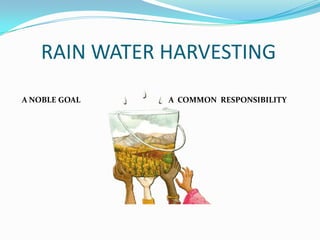
RAIN WATER HARVESTING
A NOBLE GOAL   A COMMON RESPONSIBILITY
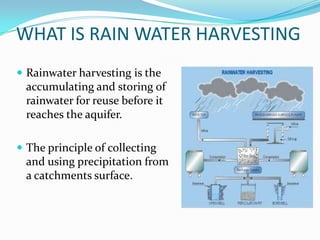
WHAT IS RAIN WATER HARVESTING
 Rainwater harvesting is the
 accumulating and storing of
 rainwater for reuse before it
 reaches the aquifer.

 The principle of collecting
 and using precipitation from
 a catchments surface.
WHY RAIN WATER HARVESTING :
 Surface water is inadequate to meet our demand and
    we have to depend on ground water.
   To arrest ground water decline and augment ground
    water table
   To beneficiate water quality in aquifers
   To conserve surface water runoff during monsoon
   To reduce soil erosion
   Due to rapid urbanization, infiltration of rain water
    into the sub-soil has decreased drastically and
    recharging of ground water has diminished.
RAIN WATER PATTERN IN INDIA
 Total annual rainfall in India: 400 million hectare-
  meters (area x height)
 India’s area: 329 million hectares
 If evenly spread, average height: 1.28m
 Actual distribution:
   Highly skewed area-wise
   Thar desert receives less than 200mm annually, while
    Cherrapunji receives 11,400mm
   But almost every part of India receives at least 100mm
    annually
 Key: even 100mm annual rainfall sufficient if
  harvested properly and where it falls
RAIN WATER HARVESTING
TECHNIQUES :
 Roof top rainwater harvesting.


 Surface runoff harvesting .
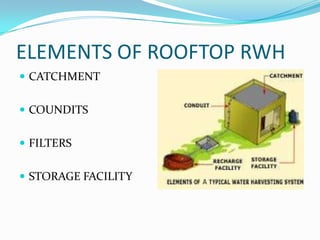
ELEMENTS OF ROOFTOP RWH
 CATCHMENT


 COUNDITS


 FILTERS


 STORAGE FACILITY
METHODS OF ROOFTOP RWH

 Storage of direct use


 Recharging ground water aquifer
        - Recharging dug wells
        - Recharging pits
        - Recharging tube well
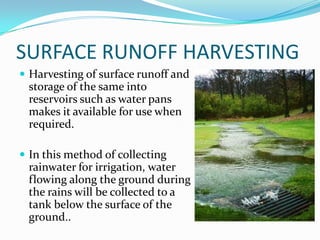
SURFACE RUNOFF HARVESTING
 Harvesting of surface runoff and
 storage of the same into
 reservoirs such as water pans
 makes it available for use when
 required.

 In this method of collecting
 rainwater for irrigation, water
 flowing along the ground during
 the rains will be collected to a
 tank below the surface of the
 ground..
TRADITIONAL RWH STRUCTURE
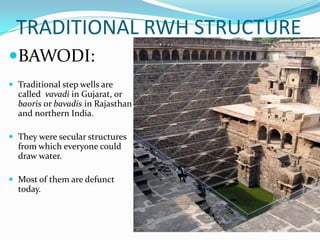
BAWODI:
 Traditional step wells are
  called vavadi in Gujarat, or
  baoris or bavadis in Rajasthan
  and northern India.

 They were secular structures
  from which everyone could
  draw water.

 Most of them are defunct
  today.
JOHADS
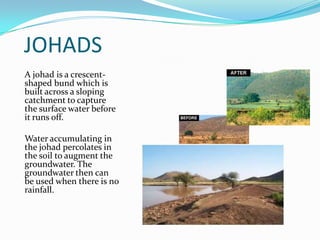
A johad is a crescent-
shaped bund which is
built across a sloping
catchment to capture
the surface water before
it runs off.

Water accumulating in
the johad percolates in
the soil to augment the
groundwater. The
groundwater then can
be used when there is no
rainfall.
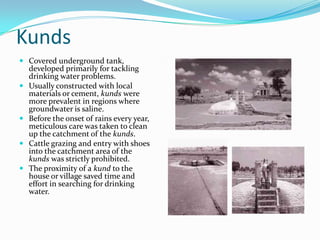
Kunds
 Covered underground tank,
  developed primarily for tackling
    drinking water problems.
   Usually constructed with local
    materials or cement, kunds were
    more prevalent in regions where
    groundwater is saline.
   Before the onset of rains every year,
    meticulous care was taken to clean
    up the catchment of the kunds.
   Cattle grazing and entry with shoes
    into the catchment area of the
    kunds was strictly prohibited.
   The proximity of a kund to the
    house or village saved time and
    effort in searching for drinking
    water.
USES OF RAINWATER HARVESTING
 Domestic Use


 Agricultural Use


 Increase groundwater supplies
POTENTIAL OF RWH

 Impacts on downstream flows.
 Reduce soil erosion.
 Increase the crop production.
 Increase infiltration and groundwater recharge.
 Improve food & economic security.
ADVANTAGE
 It uses local construction materials and labor.
 Sources of energy are not needed to operate the
  systems.
 The owner/user can easily maintain the systems.
 The water is convenient and accessible; valuable time
  and effort are saved in collecting and/or hauling water.
 It provides a supply of water to meet future
  agricultural needs.
RWH: A NOBLE GOAL


 A COMMON RESPONSIBILITY
THANK YOU
    FOR

 ATTENTION
1.Prashanth Halemane
2.Vinay Vihari…………...

Rainwater hervesting

  • 1.
    PRESENTATION ON RAIN WATER HARVESTING PREPARED BY prashanth Halemane.
  • 2.
    RAIN WATER HARVESTING ANOBLE GOAL A COMMON RESPONSIBILITY
  • 3.
    WHAT IS RAINWATER HARVESTING  Rainwater harvesting is the accumulating and storing of rainwater for reuse before it reaches the aquifer.  The principle of collecting and using precipitation from a catchments surface.
  • 4.
    WHY RAIN WATERHARVESTING :  Surface water is inadequate to meet our demand and we have to depend on ground water.  To arrest ground water decline and augment ground water table  To beneficiate water quality in aquifers  To conserve surface water runoff during monsoon  To reduce soil erosion  Due to rapid urbanization, infiltration of rain water into the sub-soil has decreased drastically and recharging of ground water has diminished.
  • 5.
    RAIN WATER PATTERNIN INDIA  Total annual rainfall in India: 400 million hectare- meters (area x height)  India’s area: 329 million hectares  If evenly spread, average height: 1.28m  Actual distribution:  Highly skewed area-wise  Thar desert receives less than 200mm annually, while Cherrapunji receives 11,400mm  But almost every part of India receives at least 100mm annually  Key: even 100mm annual rainfall sufficient if harvested properly and where it falls
  • 6.
    RAIN WATER HARVESTING TECHNIQUES:  Roof top rainwater harvesting.  Surface runoff harvesting .
  • 7.
    ELEMENTS OF ROOFTOPRWH  CATCHMENT  COUNDITS  FILTERS  STORAGE FACILITY
  • 8.
    METHODS OF ROOFTOPRWH  Storage of direct use  Recharging ground water aquifer - Recharging dug wells - Recharging pits - Recharging tube well
  • 9.
    SURFACE RUNOFF HARVESTING Harvesting of surface runoff and storage of the same into reservoirs such as water pans makes it available for use when required.  In this method of collecting rainwater for irrigation, water flowing along the ground during the rains will be collected to a tank below the surface of the ground..
  • 10.
    TRADITIONAL RWH STRUCTURE BAWODI: Traditional step wells are called vavadi in Gujarat, or baoris or bavadis in Rajasthan and northern India.  They were secular structures from which everyone could draw water.  Most of them are defunct today.
  • 11.
    JOHADS A johad isa crescent- shaped bund which is built across a sloping catchment to capture the surface water before it runs off. Water accumulating in the johad percolates in the soil to augment the groundwater. The groundwater then can be used when there is no rainfall.
  • 12.
    Kunds  Covered undergroundtank, developed primarily for tackling drinking water problems.  Usually constructed with local materials or cement, kunds were more prevalent in regions where groundwater is saline.  Before the onset of rains every year, meticulous care was taken to clean up the catchment of the kunds.  Cattle grazing and entry with shoes into the catchment area of the kunds was strictly prohibited.  The proximity of a kund to the house or village saved time and effort in searching for drinking water.
  • 13.
    USES OF RAINWATERHARVESTING  Domestic Use  Agricultural Use  Increase groundwater supplies
  • 14.
    POTENTIAL OF RWH Impacts on downstream flows.  Reduce soil erosion.  Increase the crop production.  Increase infiltration and groundwater recharge.  Improve food & economic security.
  • 15.
    ADVANTAGE  It useslocal construction materials and labor.  Sources of energy are not needed to operate the systems.  The owner/user can easily maintain the systems.  The water is convenient and accessible; valuable time and effort are saved in collecting and/or hauling water.  It provides a supply of water to meet future agricultural needs.
  • 16.
    RWH: A NOBLEGOAL A COMMON RESPONSIBILITY
  • 17.
    THANK YOU FOR ATTENTION
  • 18.