Partnerships to unlock
growth in smallholder finance
The MasterCard Foundation
Rural and Agricultural Finance Learning Lab
6 Mar 2017 Dakar, Senegal
Introduction to the Rural and Agricultural Finance
Learning Lab
• The MasterCard Foundation engaged GDI and Dalberg to design and manage the Rural and
Agricultural Finance Learning Lab from 2015 to 2021
• The Lab fosters knowledge creation and sharing that leads to better financial solutions
provided to more smallholder farmers
• We provide guidance, conduct research, share knowledge, and connect partners
• Key research themes include smallholder finance business models, ecosystems, and impact.
• Supports innovative ideas, organizations, and
initiatives that can create large-scale change
• Launched the Initiative for Smallholder
Finance
• A strategy advisory firm dedicated to global
development and innovation
• Expertise in access to finance and
agricultural development, and ICT4D
We want to talk about doubling growth in the
smallholder finance sector
• Inflection Point sizes the
smallholder finance market,
reframes the sector,
recommends a systems
approach, and issues a call
to action
• Better together explores “last
mile business partnerships”
as a potential key to
unlocking growth and
reaching new markets
But first…
Name: Organization:
Motivation
Motivation
Why is your organization
interested in serving
smallholders?
Pourquoi votre organisation
est interess de servir les
petits producteurs?
Secret weapon(s)
Armes Secretes
What strengths do you have in
serving smallholders that are
attractive to other
organizations?
Quelles forces avez-vous en
supportant les petits
producteurs qui sont attractifs
aux autres organisations?
Achilles heel(s)
Talon d’Achilles
What are your limitations –
where might you need a
partner in order to succeed?
Quelles sont vos limites - Ou
avez vous besoins de
partenaires pour avoir du
succes?
Exercise: Partnering to serve smallholders
Inflection Point: Unlocking
growth in the era of
smallholder finance
Financial needs and disbursements
(USD Bn)1
61%
0
16%
2% 12%
31%
23%
98%
57%
2%
ST agri
needs2
~3 ~4 ~1
Non-agri
needs
100%
LT agri
needs3
12%
5%
1%
8%
31%
83%
99%
61%
~8 ~3
Non-agri
needs
1%
ST agri
needs2
~8
LT agri
needs3
Financial needs and disbursements
(USD Bn)1
~2 million ~16 million ~30 million
Financial needs and disbursements
(USD Bn)1
Current financing for smallholders in Africa meets 20%
($7B) of the $33B need across 50M farms
Value
chain
actors
Non-agri
needs
~3
1%
~3
99%
ST agri
needs2
31%
69%
Commercial smallholder famers
in tight value chains
Commercial smallholder farmers
in loose value chains
#farmers
Formal
financial
institutions Informal /
community
-based
financial
institutions
Noncommercial smallholder
farmers
1. Excludes Middle East and North Africa. Includes financing to producer groups by state banks and
commercial banks; 2. ST agri needs refers to short term financing needs of less than a year (typically for inputs,
harvest and export); 3. LT agri needs refers to long term financing needs of more than one year (typically for
renovation or equipment). Notes: Commercial banks and social lenders disbursements counted toward
smallholders in tight value chains; state bank financing distribution in proportion to farmer segment needs; MFI
agri lending included in loose value chains; MFI non-agri lending distributed in proportion to farmer segment
need; High touch NGOs included under subsistence. Informal / community-based allocated in proportion to
non-agri needs.
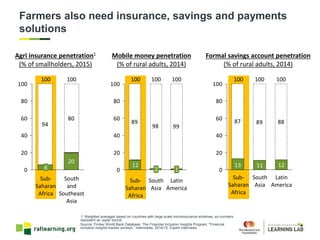
Farmers also need insurance, savings and payments
solutions
1. Weighted averages based on countries with large scale microinsurance schemes, so numbers
represent an upper bound.
Source: Findex World Bank Database; The Financial Inclusion Insights Program, “Financial
inclusion insights tracker surveys,” Intermedia, 2014/15; Expert interviews.
89
99
12
98
0
20
40
60
80
100
2
Sub-
Saharan
Africa
100
South
Asia
100
Latin
America
100
1
Mobile money penetration
(% of rural adults, 2014)
87 89 88
121113
0
20
40
60
80
100
100
Sub-
Saharan
Africa
Latin
America
100
South
Asia
100
Formal savings account penetration
(% of rural adults, 2014)
94
80
20
0
20
40
60
80
100
6
100
Sub-
Saharan
Africa
100
South
and
Southeast
Asia
Agri insurance penetration1
(% of smallholders, 2015)
In Africa $3B in lending comes from value chain actors
versus $2B from formal financial institutions
1. Excludes China, Central Asia, Middle East and North Africa, and Eastern Europe. Includes
financing to producer groups by state banks and commercial banks. Includes agri and non-agri
lending.
Source: ISF Briefing 1, “Local bank financing for smallholder farmers,” Oct. 2013; Rural and
Agricultural Finance Learning Lab Smallholder Financial Solutions Database; annual reports;
expert interviews; Dalberg analysis.
Smallholder lending in South and Southeast Asia, Sub-Saharan Africa and LATAM by source
(Annual disbursements $USD Bn)1
56
0
10
20
30
40
50
60
Total lendingLending by informal
/ community based
financial institutions
25
Lending by value
chain actors
17
Lending by formal
financial institutions
14
**See report for full breakdown of lending
Asia
SSA
LatAm
SSA
($bn)
~2 ~3 ~2 ~7
South and Southeast Asia
Sub-Saharan Africa
Latin America
Formal lending growth rate of 7%, while encouraging,
needs to double (14%) to meet half the need by 2025
1. Excludes China, Central Asia, Middle East and North Africa, and Eastern Europe. 2.CAGR assumptions: state bank market participant projections of ~8.5%,
value chain actors in line crop production projections: 3.1% export crops, 2.3% non-export crops; MFIs market participant projections of ~13.90%; commercial
banks in line with projected growth of retail banking: ~15% in Sub-Saharan Africa, ~14% in South and Southeast Asia, ~13% in Latin America; social lenders
market participant projections of ~15%; high touch NGOs in line with 2010-2015 growth of ~30-35%.
Sources: expert interviews; FAO crop production projections; World Bank, McKinsey and BMI retail banking projections, annual reports
Commercial
banks
~1
Social
lenders
~0.4
High
touch
NGOs
~0.1
Value
chain
actors
2.5
MFIs
~43
Total
smallholder
need for
finance
~210
Demand
not met by
FIs and
VCAs
~167
Lending by
formal FIs
and VCAs
2020E
~3
~5
Lending by
formal FIs
and VCAs
today
~31
State
banks
CAGR ~7%2
Estimated portfolio growth 2015-2020
Growth projections for smallholder lending by source 2015-2020
(Annual disbursements, USD billion)1
Demand partially served
through informal and
community-based
financial institutions
White spaces in agri-insurance, mobile payments, market access for loose value chains, non-commercial farmers
FINANCIAL SERVICE
PROVIDERS (Incl. VCAs)
SMALLHOLDER FARMERS
CAPITAL PROVIDERS /
FUNDERS
MARKET ACTORS
Three key groups of market
participants
STATUS QUO
Three key barriers currently
limit sector growth
ENVISIONED FUTURE STATE
Three key areas of activity
unlock progress
Limited and mismatched
capital availability
Low business model
sustainability
Shortfall of demand relative
to need
Market cannot clear
Market cannot clear
Smart subsidy unlocks new
and better-matched sources
of capital
Progressive partnerships
increase risk-adjusted
business model returns
Customer centric product
design drives demand and
usage
System effects: improvements at one level
of the industry have a positive effect on
other levels
Market clears
Market clears
To unlock this growth, we need concerted action that
addresses barriers across all levels of the industry
See report for full breakdown of current state of the industry and major
barriers
The three action areas are supported by key enablers
PROGRESSIVE
PARTNERSHIPSCUSTOMER CENTRICITY SMART SUBSIDY
TECHNOLOGY
TRANSPARENCY
Enablers
• Improved information gathering and sharing
• Continued digitization of data collection and service provision
• Reform of policies that affect smallholder finance provisionPOLICY
1 2 3
Sub-Saharan Africa is particularly well positioned to
unlock growth (1/2)
Hungry
financial
institutions
Extensive
penetration
and use of
mobile
phones &
money
• Strong interest from financial institutions to penetrate smallholder
finance market (Africa accounts for >50% of total bank lending
measured)
• Willingness to partner with value chain actors and informal
financial institutions (which currently provide 80% of finance)
• Use of digital technology is a game in changer in providing financial
services that are competitive in its cost, ease of access and
reliability
• Leading countries well positioned for all digital tools (mobile
deposit, disbursement & payment; credit profiling and mobile-
enabled agent banking)
• Less mature or nascent mobile ecosystems must overcome
challenges but indicate huge potential given high penetration of
SIM cards (e.g. +80% in Nigeria, ~90% in Ghana)
• Brokering of
relationships between
suitable partners
• High partnership set-
up costs
• Developing the right
systems and tools
• Increasing financial
and technological
literacy, particularly
to up/cross sell
higher value added
financial services
Key strengths Key challenges
Sub-Saharan Africa is particularly well positioned to
unlock growth (2/2)
Improving
ecosystem
• Renewed focus by government on agriculture and
commercialization of smallholder farmers increases availability of
externally-subsidized enablers (e.g. provision of high quality inputs
by governments, public extension services or farmer aggregation)
• Increased investment in regional trade corridors to foster markets
integration and increase demand for local produce/ financial
services, while decreasing farmer vulnerability and risk
• Alignment between
investment & greatest
need segment
• Subject to political
agendas
• Mid-long term time
span
Key strengths Key challenges
Increased
interest
from capital
providers in
blended
finance
• High concentration of actors experimenting with blended finance
approaches (e.g. AATIF impact investment, FRP matching grants,
guarantees from Rabobank Fdn, MCE Social Capital, or Root Capital
direct blended investments.)
• Potential to catalyze additional capital through demonstration
effects and opportunities to replicate success stories (including
public leveraging 1-5x private capital)
• Transparency on
subsidy effectiveness
• Design and structure
of blended
instruments suited to
smallholder finance
Progressive partnerships
for smallholder finance
Change in cost
bearing
responsibility
NGO / Public agency
Farmer aggregation
Technical assistance
Loan origination and
collection
R&D and other back
office
Market access
Cost of capital
Value chain actor Financial institution
FarmersupportFinancing
Financing moves off value chain
actor balance sheet
Leverages existing value chain
actor-farmer interactions
NGO/ public agency supports financial institutions and agri-
product development and system building
Guaranteed through buyer
participation
Buyer has incentive to train farmers to
increase production quality and volume
Close relationship
also lowers risk for
the fin. institution
ILLUSTRATIVE
NGO / public agency supports value chain
actor with farmer aggregation
In Inflection Point, we called for “progressive partnerships” that
share cost and risk to achieve financial sustainability
Now we are studying last mile partnerships forged by agribusiness (value chain actor) or ag-focused
technology players – 4 FRP winners – with financial institutions; initial insights on motivation and process
Motivation: why would last mile firms seek to partner
with FIs?
Top line (revenue) motivations
• Improved farmer productivity (especially for off-takers)
• Increased sales volumes over existing infrastructure (for input
providers/tech platforms)
• Opportunities for rollout of new financial products
• Increased farmer loyalty because of expanded offering
Reducing costs and risks
• Reduced balance sheet pressure (for VCAs already lending)
• Reduced administration costs (for lenders)
• Lower transaction costs
• Piggy-back on technology investment
What is the value proposition for financial institutions?
A framework for how last mile partners reduce cost/risk
Product development includes advising FIs on (i) how and when a product should be
delivered, (ii) what products are needed and (iii) developing products, including provision of
technical expertise
Source: Stakeholder interviews, Dalberg analysis
Last mile firms offer…
Customer
acquisition
Product
distribution /
collection
Product
development*
Credit risk
management
Farmer aggregation
Group farmers together to ease
promotion/delivery of services
Access to market/off-taking
Provide a guaranteed market, ensuring
farmers have income
Technical assistance
Provide training e.g. agronomic practices,
financial literacy etc.
Interface with farmers
Act as “feet on the ground” and handle
farmer interactions
Know-Your-Customer (Data)
Collect farmer data, e.g. income, farm size,
expenditure
Areas of FI cost reduction
Areas of FI risk
reduction
Key: Does not contribute Somewhat contributes Strongly contributes
Biopartenaire provides bundled productivity solution
motivated by cocoa supply; wants to outsource lending
Model and motivation:
• Provide extension and inputs
(facilitated by credit) cost-neutrally to
increase farmer productivity to secure
quality cocoa supply
• Move direct farmer lending (and
related risks) from balance sheet,
leverage Advans’ branchless banking
system to reach farmers
Potential success factors:
• Work with MFI given motivation and
reach, high-level strategic buy-in
• Flexible MOU for experimentation, start
w/savings product
• Support of IFC risk-sharing agreement
for current lending
Biopartenaire current partnership
model for saving product
Savings
Advans provides
farmers with a
savings product
and a mobile
channel for
deposits
Farmer groups - each
farmer group has a
village coordinator who
acts as a distribution
point for inputs
Biopartenaire
provides Advans
with a customer
base for their
savings product
Biopartenaire
sustainability
department
Biopartenaire
provides credit,
using the
savings
as collateral
Source: Biopartenaire documentation, field visit with Biopartenaire team, interviews with current and
potential Biopartenaire partners, Dalberg analysis
Kifiya has built an agent and payments infrastructure and
wants to increase transaction volumes and product sales
*As noted earlier, Kifiya is foremost a technology platform provider. They are currently developing agriculture
focused products and partnerships in order to increase the volume of transactions through their platform
Kifiya partnership model
Farmers
Kifiya
platform
Multi-purpose cooperatives
(contains Kifiya agent)
Provide extension
support, inputs,
finance products etc.
One-stop-shop for MPC to
facilitate transactions
Insurance Lending
(7 MFIs)
Transit
companies
Utility
companies
Model and motivation:
• Wants partners to deliver financial
services at scale by leveraging its DFS
infrastructure (fees and commissions)
• Looking for insurance companies to
underwrite risk and scale up the micro-
insurance product they developed for
farmers
Potential success factors:
• FI partners motivated by customer
acquisition and government incentives
• Best-in-class micro-insurance product
design (100x more precise satellite
data, 60% cost savings in delivery)
Prep-eez has found strong interest but its pioneering
model and data goals require FIs to think outside the box
Opportunity and motivation:
• Wealth of farmer data (KYC, etc.) offered to
multiple FIs for developing new products,
and platform for delivering them
• Position as input seller/off-taker aligns Prep-
eez with goal of increasing farmer
purchasing power and productivity
Challenges:
• FIs motivated by market share, but need
internal approvals across departments,
some more risk-averse than others
• FIs have never worked with this kind of
alternative data before so lack certainty on
product design and business model
• High interest rate environment dampens
farmer demand for credit
Envisioned partnership model
Other
Prepeez BUs
Prepeez
platform
Insurance
(under negotiation)
Credit and saving
(under negotiation)
Farmers
Farm and
farmer data
Extension
support
Purchase produce
Access farmer
profiles
Access farmer
profiles
Provide inputs
Source: Dalberg analysis and interviews
Examples of partnership and opportunities in Senegal
include private and public sector
Future potential
CNCAS extensive branch and agency
infrastructure a potential foundation for additional
financial services in cooperation with private sector
partners?
Manobi’s technology platform provides farmer data,
training and marketing, all of which are potentially
useful for financial institutions
Rice value chain partnership
Vital partnered with CNCAS to take on farmer input
loans and increase total lending (This contract farming
+ warehouse receiptingm model also enabled lending
from BNDE and PAMECAS)
Takeaways for more successful partnerships
• Find partners who are strongly motivated to serve smallholders
• Last mile partners need to learn ”bank speak” and make the business
case
• Transparency about interests and objectives – small zone of possible
agreement
• Structured communications, but flexible agreements – give room to
experiment
• Facilitators can help – short-term guarantees, technical assistance,
technology platforms
Preview of the afternoon
We believe action is needed in three core areas,
supported by key enablers
PROGRESSIVE
PARTNERSHIPSCUSTOMER CENTRICITY SMART SUBSIDY
TECHNOLOGY
TRANSPARENCY
Enablers
• Improved information gathering and sharing
• Continued digitization of data collection and service provision
• Reform of policies that affect smallholder finance provisionPOLICY
1 2 3
This afternoon we’ll look at the role of agribusiness
partners and digitalization as a potential game changer
PROGRESSIVE
PARTNERSHIPS
14:30 Agribusiness as
channel for markets and
finance, and partner to FIs
TECHNOLOGY
Enablers
16:15 How can digital tools enable smallholder finance?
Learning Lab, KCB, Mercy Corps, OI
AgDevCo, ECA,
GADC, Learning Lab
Q&A
Backup
Nine existing and emerging models meet different
farmer finance needs
1. Significant portion used for agriculture purposes even if not specifically targeted or
customized to meet agricultural needs; 2. Have more recently started offering some long-term
financing; 3. Not shown: national safety nets, e.g., food reserves, national health insurance,
etc. 4. Refers to bank and non-bank microfinance institutions; 5. Some buyers have more
recently started offering some long-term finance to increase farmer mechanization. 5.
Includes input suppliers, buyers and outgrower schemes, farmer orgs and warehouses.
4.
Trade finance loans for producer
groups by social lenders2
2b
Short-term loans, saving accounts
and microinsurance by MFIs
5.
Short-term loans and saving
accounts by informal nstitutions1
3.
Working capital loans directly by
state banks
1. (In-kind) inputs on credit
directly by value chain actors5
2a
Working capital loans directly by
MFIs4
6.
Working capital loans by comm.
banks via value chain actors5
8. Agri-insurance
9.
Mobile-based payments and
other financial solutions
7.
Input loans by high touch NGOs
(often bundled w/other services)
Purchasing
inputs,
labor
Purchasing
Assets,
upgrading
Infra-
structure,
crops
Accessing
markets
Mitigating
agri-
cultural
risk
Smooth-
ing
expend-
itures &
building
assets
Making
payments
Mitigating
general
“life”
risk3
Smallholder segments
1
2a
3
4
5
2b
Non-
commercial
smallholders
Commercial
smallholders
in tight value
chains
Commercial
smallholders
in loose value
chains
6
7
8
9
Smallholder finance models based on smallholder segments and needs
Established models Emerging models (Not comprehensive)
Model
ECA Mozambique faces an uphill climb thanks to social and
political unrest, and an underdeveloped mobile ecosystem
*CDM is a subsidiary of SABMiller
Source: ECA documentation, interviews with current ECA partners, Dalberg analysis
ECA
Initially envisioned partnership model
Loan facility Mobile payments
Farmers
ECA deducts input loan
payments after harvest, and
pays farmers (currently pay
cash but working towards
mobile payments)
Annual loan
to ECA
ECA
ECA buys and
distributes inputs
to farmers
Off-taker
purchases
(under negotiation)
Payments solution
for ECA farmers
Purchase maize
from ECA
Opportunity and motivation:
• Outgrower scheme with close relationships with
smallholders cultivated over time, and links to large
buyer demand
• Mobile payments can increase efficiency of
operations and reduce cash risks
Challenges:
• Underdeveloped mobile money ecosystem (liquidity
challenges for agents) and connectivity issues
• Banking sector generally not interested in
smallholder market
• Social and political unrest threatening off-taker
agreements and general operations

RAFLL WAPL session 3

  • 1.
    Partnerships to unlock growthin smallholder finance The MasterCard Foundation Rural and Agricultural Finance Learning Lab 6 Mar 2017 Dakar, Senegal
  • 2.
    Introduction to theRural and Agricultural Finance Learning Lab • The MasterCard Foundation engaged GDI and Dalberg to design and manage the Rural and Agricultural Finance Learning Lab from 2015 to 2021 • The Lab fosters knowledge creation and sharing that leads to better financial solutions provided to more smallholder farmers • We provide guidance, conduct research, share knowledge, and connect partners • Key research themes include smallholder finance business models, ecosystems, and impact. • Supports innovative ideas, organizations, and initiatives that can create large-scale change • Launched the Initiative for Smallholder Finance • A strategy advisory firm dedicated to global development and innovation • Expertise in access to finance and agricultural development, and ICT4D
  • 3.
    We want totalk about doubling growth in the smallholder finance sector • Inflection Point sizes the smallholder finance market, reframes the sector, recommends a systems approach, and issues a call to action • Better together explores “last mile business partnerships” as a potential key to unlocking growth and reaching new markets But first…
  • 4.
    Name: Organization: Motivation Motivation Why isyour organization interested in serving smallholders? Pourquoi votre organisation est interess de servir les petits producteurs? Secret weapon(s) Armes Secretes What strengths do you have in serving smallholders that are attractive to other organizations? Quelles forces avez-vous en supportant les petits producteurs qui sont attractifs aux autres organisations? Achilles heel(s) Talon d’Achilles What are your limitations – where might you need a partner in order to succeed? Quelles sont vos limites - Ou avez vous besoins de partenaires pour avoir du succes? Exercise: Partnering to serve smallholders
  • 5.
    Inflection Point: Unlocking growthin the era of smallholder finance
  • 6.
    Financial needs anddisbursements (USD Bn)1 61% 0 16% 2% 12% 31% 23% 98% 57% 2% ST agri needs2 ~3 ~4 ~1 Non-agri needs 100% LT agri needs3 12% 5% 1% 8% 31% 83% 99% 61% ~8 ~3 Non-agri needs 1% ST agri needs2 ~8 LT agri needs3 Financial needs and disbursements (USD Bn)1 ~2 million ~16 million ~30 million Financial needs and disbursements (USD Bn)1 Current financing for smallholders in Africa meets 20% ($7B) of the $33B need across 50M farms Value chain actors Non-agri needs ~3 1% ~3 99% ST agri needs2 31% 69% Commercial smallholder famers in tight value chains Commercial smallholder farmers in loose value chains #farmers Formal financial institutions Informal / community -based financial institutions Noncommercial smallholder farmers 1. Excludes Middle East and North Africa. Includes financing to producer groups by state banks and commercial banks; 2. ST agri needs refers to short term financing needs of less than a year (typically for inputs, harvest and export); 3. LT agri needs refers to long term financing needs of more than one year (typically for renovation or equipment). Notes: Commercial banks and social lenders disbursements counted toward smallholders in tight value chains; state bank financing distribution in proportion to farmer segment needs; MFI agri lending included in loose value chains; MFI non-agri lending distributed in proportion to farmer segment need; High touch NGOs included under subsistence. Informal / community-based allocated in proportion to non-agri needs.
  • 7.
    Farmers also needinsurance, savings and payments solutions 1. Weighted averages based on countries with large scale microinsurance schemes, so numbers represent an upper bound. Source: Findex World Bank Database; The Financial Inclusion Insights Program, “Financial inclusion insights tracker surveys,” Intermedia, 2014/15; Expert interviews. 89 99 12 98 0 20 40 60 80 100 2 Sub- Saharan Africa 100 South Asia 100 Latin America 100 1 Mobile money penetration (% of rural adults, 2014) 87 89 88 121113 0 20 40 60 80 100 100 Sub- Saharan Africa Latin America 100 South Asia 100 Formal savings account penetration (% of rural adults, 2014) 94 80 20 0 20 40 60 80 100 6 100 Sub- Saharan Africa 100 South and Southeast Asia Agri insurance penetration1 (% of smallholders, 2015)
  • 8.
    In Africa $3Bin lending comes from value chain actors versus $2B from formal financial institutions 1. Excludes China, Central Asia, Middle East and North Africa, and Eastern Europe. Includes financing to producer groups by state banks and commercial banks. Includes agri and non-agri lending. Source: ISF Briefing 1, “Local bank financing for smallholder farmers,” Oct. 2013; Rural and Agricultural Finance Learning Lab Smallholder Financial Solutions Database; annual reports; expert interviews; Dalberg analysis. Smallholder lending in South and Southeast Asia, Sub-Saharan Africa and LATAM by source (Annual disbursements $USD Bn)1 56 0 10 20 30 40 50 60 Total lendingLending by informal / community based financial institutions 25 Lending by value chain actors 17 Lending by formal financial institutions 14 **See report for full breakdown of lending Asia SSA LatAm SSA ($bn) ~2 ~3 ~2 ~7 South and Southeast Asia Sub-Saharan Africa Latin America
  • 9.
    Formal lending growthrate of 7%, while encouraging, needs to double (14%) to meet half the need by 2025 1. Excludes China, Central Asia, Middle East and North Africa, and Eastern Europe. 2.CAGR assumptions: state bank market participant projections of ~8.5%, value chain actors in line crop production projections: 3.1% export crops, 2.3% non-export crops; MFIs market participant projections of ~13.90%; commercial banks in line with projected growth of retail banking: ~15% in Sub-Saharan Africa, ~14% in South and Southeast Asia, ~13% in Latin America; social lenders market participant projections of ~15%; high touch NGOs in line with 2010-2015 growth of ~30-35%. Sources: expert interviews; FAO crop production projections; World Bank, McKinsey and BMI retail banking projections, annual reports Commercial banks ~1 Social lenders ~0.4 High touch NGOs ~0.1 Value chain actors 2.5 MFIs ~43 Total smallholder need for finance ~210 Demand not met by FIs and VCAs ~167 Lending by formal FIs and VCAs 2020E ~3 ~5 Lending by formal FIs and VCAs today ~31 State banks CAGR ~7%2 Estimated portfolio growth 2015-2020 Growth projections for smallholder lending by source 2015-2020 (Annual disbursements, USD billion)1 Demand partially served through informal and community-based financial institutions White spaces in agri-insurance, mobile payments, market access for loose value chains, non-commercial farmers
  • 10.
    FINANCIAL SERVICE PROVIDERS (Incl.VCAs) SMALLHOLDER FARMERS CAPITAL PROVIDERS / FUNDERS MARKET ACTORS Three key groups of market participants STATUS QUO Three key barriers currently limit sector growth ENVISIONED FUTURE STATE Three key areas of activity unlock progress Limited and mismatched capital availability Low business model sustainability Shortfall of demand relative to need Market cannot clear Market cannot clear Smart subsidy unlocks new and better-matched sources of capital Progressive partnerships increase risk-adjusted business model returns Customer centric product design drives demand and usage System effects: improvements at one level of the industry have a positive effect on other levels Market clears Market clears To unlock this growth, we need concerted action that addresses barriers across all levels of the industry See report for full breakdown of current state of the industry and major barriers
  • 11.
    The three actionareas are supported by key enablers PROGRESSIVE PARTNERSHIPSCUSTOMER CENTRICITY SMART SUBSIDY TECHNOLOGY TRANSPARENCY Enablers • Improved information gathering and sharing • Continued digitization of data collection and service provision • Reform of policies that affect smallholder finance provisionPOLICY 1 2 3
  • 12.
    Sub-Saharan Africa isparticularly well positioned to unlock growth (1/2) Hungry financial institutions Extensive penetration and use of mobile phones & money • Strong interest from financial institutions to penetrate smallholder finance market (Africa accounts for >50% of total bank lending measured) • Willingness to partner with value chain actors and informal financial institutions (which currently provide 80% of finance) • Use of digital technology is a game in changer in providing financial services that are competitive in its cost, ease of access and reliability • Leading countries well positioned for all digital tools (mobile deposit, disbursement & payment; credit profiling and mobile- enabled agent banking) • Less mature or nascent mobile ecosystems must overcome challenges but indicate huge potential given high penetration of SIM cards (e.g. +80% in Nigeria, ~90% in Ghana) • Brokering of relationships between suitable partners • High partnership set- up costs • Developing the right systems and tools • Increasing financial and technological literacy, particularly to up/cross sell higher value added financial services Key strengths Key challenges
  • 13.
    Sub-Saharan Africa isparticularly well positioned to unlock growth (2/2) Improving ecosystem • Renewed focus by government on agriculture and commercialization of smallholder farmers increases availability of externally-subsidized enablers (e.g. provision of high quality inputs by governments, public extension services or farmer aggregation) • Increased investment in regional trade corridors to foster markets integration and increase demand for local produce/ financial services, while decreasing farmer vulnerability and risk • Alignment between investment & greatest need segment • Subject to political agendas • Mid-long term time span Key strengths Key challenges Increased interest from capital providers in blended finance • High concentration of actors experimenting with blended finance approaches (e.g. AATIF impact investment, FRP matching grants, guarantees from Rabobank Fdn, MCE Social Capital, or Root Capital direct blended investments.) • Potential to catalyze additional capital through demonstration effects and opportunities to replicate success stories (including public leveraging 1-5x private capital) • Transparency on subsidy effectiveness • Design and structure of blended instruments suited to smallholder finance
  • 14.
  • 15.
    Change in cost bearing responsibility NGO/ Public agency Farmer aggregation Technical assistance Loan origination and collection R&D and other back office Market access Cost of capital Value chain actor Financial institution FarmersupportFinancing Financing moves off value chain actor balance sheet Leverages existing value chain actor-farmer interactions NGO/ public agency supports financial institutions and agri- product development and system building Guaranteed through buyer participation Buyer has incentive to train farmers to increase production quality and volume Close relationship also lowers risk for the fin. institution ILLUSTRATIVE NGO / public agency supports value chain actor with farmer aggregation In Inflection Point, we called for “progressive partnerships” that share cost and risk to achieve financial sustainability Now we are studying last mile partnerships forged by agribusiness (value chain actor) or ag-focused technology players – 4 FRP winners – with financial institutions; initial insights on motivation and process
  • 16.
    Motivation: why wouldlast mile firms seek to partner with FIs? Top line (revenue) motivations • Improved farmer productivity (especially for off-takers) • Increased sales volumes over existing infrastructure (for input providers/tech platforms) • Opportunities for rollout of new financial products • Increased farmer loyalty because of expanded offering Reducing costs and risks • Reduced balance sheet pressure (for VCAs already lending) • Reduced administration costs (for lenders) • Lower transaction costs • Piggy-back on technology investment
  • 17.
    What is thevalue proposition for financial institutions? A framework for how last mile partners reduce cost/risk Product development includes advising FIs on (i) how and when a product should be delivered, (ii) what products are needed and (iii) developing products, including provision of technical expertise Source: Stakeholder interviews, Dalberg analysis Last mile firms offer… Customer acquisition Product distribution / collection Product development* Credit risk management Farmer aggregation Group farmers together to ease promotion/delivery of services Access to market/off-taking Provide a guaranteed market, ensuring farmers have income Technical assistance Provide training e.g. agronomic practices, financial literacy etc. Interface with farmers Act as “feet on the ground” and handle farmer interactions Know-Your-Customer (Data) Collect farmer data, e.g. income, farm size, expenditure Areas of FI cost reduction Areas of FI risk reduction Key: Does not contribute Somewhat contributes Strongly contributes
  • 18.
    Biopartenaire provides bundledproductivity solution motivated by cocoa supply; wants to outsource lending Model and motivation: • Provide extension and inputs (facilitated by credit) cost-neutrally to increase farmer productivity to secure quality cocoa supply • Move direct farmer lending (and related risks) from balance sheet, leverage Advans’ branchless banking system to reach farmers Potential success factors: • Work with MFI given motivation and reach, high-level strategic buy-in • Flexible MOU for experimentation, start w/savings product • Support of IFC risk-sharing agreement for current lending Biopartenaire current partnership model for saving product Savings Advans provides farmers with a savings product and a mobile channel for deposits Farmer groups - each farmer group has a village coordinator who acts as a distribution point for inputs Biopartenaire provides Advans with a customer base for their savings product Biopartenaire sustainability department Biopartenaire provides credit, using the savings as collateral Source: Biopartenaire documentation, field visit with Biopartenaire team, interviews with current and potential Biopartenaire partners, Dalberg analysis
  • 19.
    Kifiya has builtan agent and payments infrastructure and wants to increase transaction volumes and product sales *As noted earlier, Kifiya is foremost a technology platform provider. They are currently developing agriculture focused products and partnerships in order to increase the volume of transactions through their platform Kifiya partnership model Farmers Kifiya platform Multi-purpose cooperatives (contains Kifiya agent) Provide extension support, inputs, finance products etc. One-stop-shop for MPC to facilitate transactions Insurance Lending (7 MFIs) Transit companies Utility companies Model and motivation: • Wants partners to deliver financial services at scale by leveraging its DFS infrastructure (fees and commissions) • Looking for insurance companies to underwrite risk and scale up the micro- insurance product they developed for farmers Potential success factors: • FI partners motivated by customer acquisition and government incentives • Best-in-class micro-insurance product design (100x more precise satellite data, 60% cost savings in delivery)
  • 20.
    Prep-eez has foundstrong interest but its pioneering model and data goals require FIs to think outside the box Opportunity and motivation: • Wealth of farmer data (KYC, etc.) offered to multiple FIs for developing new products, and platform for delivering them • Position as input seller/off-taker aligns Prep- eez with goal of increasing farmer purchasing power and productivity Challenges: • FIs motivated by market share, but need internal approvals across departments, some more risk-averse than others • FIs have never worked with this kind of alternative data before so lack certainty on product design and business model • High interest rate environment dampens farmer demand for credit Envisioned partnership model Other Prepeez BUs Prepeez platform Insurance (under negotiation) Credit and saving (under negotiation) Farmers Farm and farmer data Extension support Purchase produce Access farmer profiles Access farmer profiles Provide inputs Source: Dalberg analysis and interviews
  • 21.
    Examples of partnershipand opportunities in Senegal include private and public sector Future potential CNCAS extensive branch and agency infrastructure a potential foundation for additional financial services in cooperation with private sector partners? Manobi’s technology platform provides farmer data, training and marketing, all of which are potentially useful for financial institutions Rice value chain partnership Vital partnered with CNCAS to take on farmer input loans and increase total lending (This contract farming + warehouse receiptingm model also enabled lending from BNDE and PAMECAS)
  • 22.
    Takeaways for moresuccessful partnerships • Find partners who are strongly motivated to serve smallholders • Last mile partners need to learn ”bank speak” and make the business case • Transparency about interests and objectives – small zone of possible agreement • Structured communications, but flexible agreements – give room to experiment • Facilitators can help – short-term guarantees, technical assistance, technology platforms
  • 23.
    Preview of theafternoon
  • 24.
    We believe actionis needed in three core areas, supported by key enablers PROGRESSIVE PARTNERSHIPSCUSTOMER CENTRICITY SMART SUBSIDY TECHNOLOGY TRANSPARENCY Enablers • Improved information gathering and sharing • Continued digitization of data collection and service provision • Reform of policies that affect smallholder finance provisionPOLICY 1 2 3
  • 25.
    This afternoon we’lllook at the role of agribusiness partners and digitalization as a potential game changer PROGRESSIVE PARTNERSHIPS 14:30 Agribusiness as channel for markets and finance, and partner to FIs TECHNOLOGY Enablers 16:15 How can digital tools enable smallholder finance? Learning Lab, KCB, Mercy Corps, OI AgDevCo, ECA, GADC, Learning Lab
  • 26.
  • 27.
  • 28.
    Nine existing andemerging models meet different farmer finance needs 1. Significant portion used for agriculture purposes even if not specifically targeted or customized to meet agricultural needs; 2. Have more recently started offering some long-term financing; 3. Not shown: national safety nets, e.g., food reserves, national health insurance, etc. 4. Refers to bank and non-bank microfinance institutions; 5. Some buyers have more recently started offering some long-term finance to increase farmer mechanization. 5. Includes input suppliers, buyers and outgrower schemes, farmer orgs and warehouses. 4. Trade finance loans for producer groups by social lenders2 2b Short-term loans, saving accounts and microinsurance by MFIs 5. Short-term loans and saving accounts by informal nstitutions1 3. Working capital loans directly by state banks 1. (In-kind) inputs on credit directly by value chain actors5 2a Working capital loans directly by MFIs4 6. Working capital loans by comm. banks via value chain actors5 8. Agri-insurance 9. Mobile-based payments and other financial solutions 7. Input loans by high touch NGOs (often bundled w/other services) Purchasing inputs, labor Purchasing Assets, upgrading Infra- structure, crops Accessing markets Mitigating agri- cultural risk Smooth- ing expend- itures & building assets Making payments Mitigating general “life” risk3 Smallholder segments 1 2a 3 4 5 2b Non- commercial smallholders Commercial smallholders in tight value chains Commercial smallholders in loose value chains 6 7 8 9 Smallholder finance models based on smallholder segments and needs Established models Emerging models (Not comprehensive) Model
  • 29.
    ECA Mozambique facesan uphill climb thanks to social and political unrest, and an underdeveloped mobile ecosystem *CDM is a subsidiary of SABMiller Source: ECA documentation, interviews with current ECA partners, Dalberg analysis ECA Initially envisioned partnership model Loan facility Mobile payments Farmers ECA deducts input loan payments after harvest, and pays farmers (currently pay cash but working towards mobile payments) Annual loan to ECA ECA ECA buys and distributes inputs to farmers Off-taker purchases (under negotiation) Payments solution for ECA farmers Purchase maize from ECA Opportunity and motivation: • Outgrower scheme with close relationships with smallholders cultivated over time, and links to large buyer demand • Mobile payments can increase efficiency of operations and reduce cash risks Challenges: • Underdeveloped mobile money ecosystem (liquidity challenges for agents) and connectivity issues • Banking sector generally not interested in smallholder market • Social and political unrest threatening off-taker agreements and general operations

Editor's Notes

  • #3 We are an initiative of the MasterCard Foundation jointly implemented by the Global Development Incubator (GDI) and Dalberg, out of Nairobi and the US We do research and share lessons with the goal increasing the quantity and quality of smallholder finance
  • #4 I want to share today from 2 recent pieces of research the Lab has worked on that can help frame what we are discussing today and especially this afternoon They are Inflection Point, where we sized and characterized the global market for smallholder finance and issued a call to action And a recent study on what we call “last mile business partnerships” with financial institutions
  • #5 If you are sitting next to people in your same organization, try to find someone nearby who is not from your organization (across the row). Who learned something new and interesting about the person sitting next to them? Some very powerful secret weapons perhaps? Surprising Achilles heel? Ok would someone like to share?
  • #7 The untapped market is a big one (and many are starting to recognize) The farmers themselves are varied, as are the needs. There is need for every segment and type (and availability of finance doesn’t necessarily mean quality) but I might particularly point out long term finance in tight value chains, short term finance for loose value chains, and non-agri needs for noncommercial smallholders (e.g. school fee loans) -Zooming in into SSA, we can see the financing gap is relatively smaller for ST agri needs of commercial smallholders in tight value chains but larger for all other segments and need types -This difference is explained by the relatively less number of farmers in tight value chains and the relatively more sources of finance focused on commercial smallholder farmers in tight value chains
  • #8 Going beyond credit, the penetration of other financial services is also very low, and it’s important to note that farmers needs are not just for borrowing – indeed, with high interest rates, agricultural production loans only make sense if the farmer is able to significantly increase yields on the basis of this working capital (think 50% and higher) Here you can see the penetration of insurance, mobile money and formal savings for SSA, South and South East Asia and Latin America. Similary to the previous slides the blank spaces indicate the gap while the shading indicates the extent to which the need for each of these services is being met. Across all farmer segments, there are few options for effective agricultural risk mitigation particularly for SSA where agri insurance has seen more challenges to scale given the relatively less support from govt promgras, Mobile money penetration among rural adults continues to be low on average, although relatively more prevelante in SSA. Note that within SSA there are large differences between countries: penetration is around 60% in countries such as Kenya but less than 1% in countries such as Nigeria Savings low across all regions
  • #9 So, what does supply of financial services look like? Well this slide looks at the total $56B in lending across the 3 key regions of Africa, Latin America and Asia. But I’ve called out the part of Africa here below. What is most interesting is that the single biggest supplier of finance are “value chain actors”, that is agribusinesses, such as offtakers and input providers Formal financial institutions, value chain actors and informal or community based financial institutions channel ~$55 billion of credit to smallholder farmers each year, $7Bn of which are disbursed in Sub-Saharan Africa Formal financial institutions currently supply ~$14 billion (~11 billion in agricultural financing and ~$3 billion in non-agricultural financing) State banks, which are active predominantly in Asia, supply more than ~$9B MFIs, which are more prevalent in Asia and Latin America, provide more than $3B Commercial banks ~$1B, primarily in Sub-Saharan Africa Social lenders ~$0.35B, excluding financing to agri-businesses, with the bulk of their lending disbursed in Latin America Social ventures ~$0.025, primarily in Sub-Sharan Africa Value chain actors supply an estimated ~$17Bn primarily in input loans. They include a wide range of actors and formality levels (from informal, no-contract arrangements with local traders to carefully designed purchasing agreements with multinational buyers) As much as ~25billion more in non-agricultural financing may be available from informal and community-based FSPs. The fragmentation and poor documentation of informal providers only permit an indicative sizing of this segment based on survey data measuring total population access to informal sources of finance. Informal finance, while in some ways more flexible than formal products, can often expose customers to extremely high interest rates or be unreliable.
  • #10 Now this is an exciting space, with a projected 7% compound annual growth rate going forward. However, given the opportunities, we think the sector can do better. We are calling for a concerted effort to double growth to 14% - this would halve the need by 2020. I want to also call attention to the diversity of models addressing the need: State banks, MFIs, commercial banks (increasingly), social lenders, high-touch NGOs and value chain actors. -Looking ahead, and assuming a constant smallholder need for finance, expected growth in the supply of finance will not signficaintly close the gap -Overall stakeholders project existing formal financial instutions and value chain actors financing to growh by 7% annually on average. -High touch NGOs, social lenders and commercial banks are expected to grow the fasters but even then formal fin institutions and value chain actors would meet less than 20% of the financing needs in 5 years, highlighting the need for a fundamental shift in the growth trajectory of the smallholder finance industry
  • #11 To unlock this kind of growth, we look at the market as a system of actors who are interdependent. Here, simplistically, you can see three major levels of funders, financial service providers (including VCAs) and smallholder farmers. At each level there are barriers the prevent the market from clearing. Limited and mismatched capital for providers, low business model sustainability, and a shortfall of demand relative to need – meaning farmers do not want or are not equipped to use the current products available. We need coordination activity at each level to unlock growth. Smart subsidy to unlock capital in a way that leverages the private sector, progressive partnerships that make the business case work, and customer-centric product design to drive demand. -Unlocking growth to achieve our vision will require concerted efforts across the smallholder financing ecosystem. That is,, given the high degree of interdependence among the different levels of the industy model, progress will have to made against multiple barriers simulataneously in order to move the needle. -Explain framework and give examples of interdependencies E.g. even if capital is available from funders the market will not clear unless FSPs can absorb it and SHF demand product. Similarly, even if an FSP designs the perfect product the market will, again, not clear if it does not have the capital to deploy it. -Shfiting the growth trajectory requires moving towards a future in which FSPs engagle closely with customers to design and offer appropiate and desirable products that are demanded by SHFs, delivered through innovative partnerships that increase business model sustainability and supported by more and smarter subsidy
  • #12 You can see these three actions areas across the top here, but they are also supported by some key enablers…
  • #13 One thing that is exciting about working in Africa is that we think the continent is especially well positioned to unlock this kind of growth. And here are a few reasons why…
  • #15 I want to focus for now on one key action area, that of progressive partnerships – “the need for the smallholder finance sector to create and scale more and deeper partnerships designed to strengthen business model sustainability and increase reach
  • #16 We believe these types of partnerships can help share cost and risk in order to achieve financial sustainability. There are many ways this can happen, and sometimes muliple FIs can do this… But right now we are studying (and sharing last mile partnerships forged by agribusiness (value chain actor) or ag-focused technology players with financial institutions. We’re especially looking at 4 winners from the MasterCard Foundation’s Fund for Rural Prosperity Innovation Competition. We have some initial insights I’ll share today on motivation and a little bit on process
  • #17 From the point of view of value chain actors, a financial institution can help increase farmer productivity, spending power, and loyalty Many are already providing finance and would like to take this off balance sheet
  • #18 Looking at it from the other side of the coin, let’s look at the business model of Fis, which includes customer acquisition, product distribution, product development and and credit risk management. On this left side you can see how last mile firms can reduce the costs or the risks of these activities through… Customer acquisition Biopartenaire reduces customer acquisition costs for Advans by allowing them to access a large number of farmers at once. Advans would otherwise have to invest in marketing costs and work to build trust with these farmers In Ghana, Prepeez intend to allow multiple FSPs to view the records of farmers they work with; this reduces FSPs’ costs of seeking out farmers whom they can offer financial services Product distribution / collection Kifiya’s platform serves as a central channel that insurance companies can use to sell their products, reducing the costs of establishing distribution channels to reach farmers. Vodacom has leveraged ECA’s on-ground presence and connection with growers to try and develop a distribution channel for mobile money and to grow the mobile money ecosystem Biopartenaire serves as a distribution channel for Advans’ savings product Product development Kifiya has designed an agri-insurance product for farmers, which has reduced the cost for insurance companies to conduct their own research and development for farmer-tailored insurance products. Biopartenaire uses its’ knowledge of cocoa agronomic cycles and farmer incomes to design financial packages and advise Advans on how products should be rolled out Prepeez is educating farmers on WRS Credit risk management Biopartenaire provides farmers with technical assistance (agronomic, agribusiness and financial literacy training), which increases productivity and finance management, thereby reducing credit risk Prepeez is providing easy-to-access farmer and agriculture data ECA provides on-lending services to farmers. As the lender and collector of credit, ECA conducts due diligence on farmers and absorbs a portion of the loss should a farmer default
  • #19 To make some of these concepts more concrete, I will share briefly about a few of the partnership approaches we are studying, and talk about how they are motivated, potential success factors emerging, and a few challenges Biopartenaire motivation as offtaker Advans motivation Current model Experimentation
  • #20 Kifiya is a tech platform, but they illustrate an interesting way in which last mile partners can enable FIs to outsource innovation to a degree
  • #21 In Ghana, we see an innovative approach that is stretching traditional FIs. Types of data Agribusinesses can provide an array of data that can be used to better assess farmers for credit and insurance products, such as data on farm size, crops grown, market prices etc. FSPs are interested in agriculture specific data because they often know little about these areas and have few other data sources by which to adequately assess of smallholder farmers Use of data Financial institutions express interest in utilizing alternate data in order to better manage risk in lending to farmers and expand customer base Financial institutions also demonstrate interest in using alternate data for product development: “The data collected shapes your thinking” – GAIP, Ghana Preconditions FSPs have a lack of trust in alternate data provided by agribusinesses. Before buying in, FSPs require better understanding of how to best use alternate data and verification on the data's quality and accuracy Examples Prepeez is collecting significant amounts farmer data, including plot size and growing activities. FSPs in Ghana have expressed significant interest in utilizing this data for farmer assessment “We don’t know much about farmers and have little data about them - any data that can be provided by a partner is useful” Outside of this deep dive, projects are being led by Mercy Corps’ Agrifin Accelerate and AGRA on the use of alternative data from agribusinesses for credit scoring. Multiple financial institutions have expressed strong interest in utilizing alternative data for improving their ability to lend to smallholder farmers Financial service providers believe that the data agribusinesses’ provide can improve the viability of assessing smallholders for financial products. Most FSPs are currently unsure of how to best use alternative data and whether it can be trusted
  • #22 We can already see some progressive partnerships here in Senegal, and here I am speaking from only a quick review – there is a lot of potential here, and in Senegal the public sector/state banks may also be a key partner for these models Experience Vital, a large rice processor which converted from own-production to contract farming, partnered with CNCAS to increase lending - Vital purchases rice and pays CNCAS back for farmers’ loans. This model of contract farming + warehouse receipting also helped increase lending from BNDE and PAMECAS Future potential CNCAS extensive branch and agency infrastructure provides potential foundation for layering on additional financial services with private sector partners Manobi’s technology platform provides farmer data (including georeferencing), and farmer training and market platform, all of which can make them an attractive partner for Financial Institutions
  • #23 In our learning brief, which you can find at raflearning.org we have identified a number of insights on the challenges to partnerships formation, and key supporting factors to their success, and a guide for last mile firms looking to partner with FIs. In the interest of time, I’ll just cite a few takeaways from this ongoing research…
  • #25 I showed you this slide earlier, it’s our call to action…
  • #26 This afternoon we’ll zoom in on some key parts of this…
  • #29 Caveat: these are indicative and don’t fully cover all the new models that partners are experimenting with