The case for greater
development investment
in financial inclusion &
microfinance
Building the bridge from informal to formal economies
with access to finance for micro, small and mid-size
enterprises (MSMEs) in Nicaragua and beyond
The need to increase domestic access to finance
and resource mobilization is greater than ever
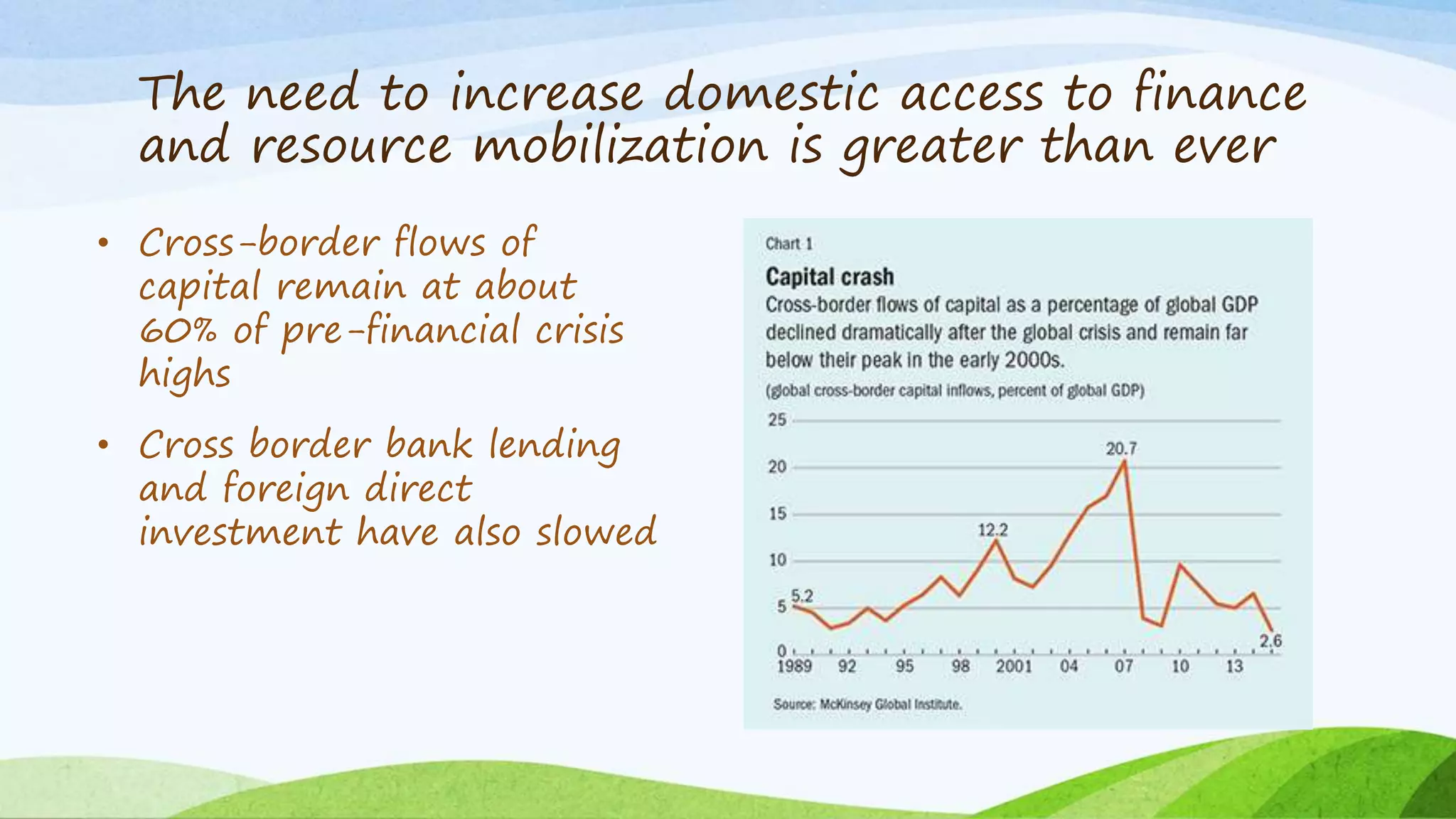
• Cross-border flows of
capital remain at about
60% of pre-financial crisis
highs
• Cross border bank lending
and foreign direct
investment have also slowed
The need to increase domestic access to finance
and resource mobilization is greater than ever
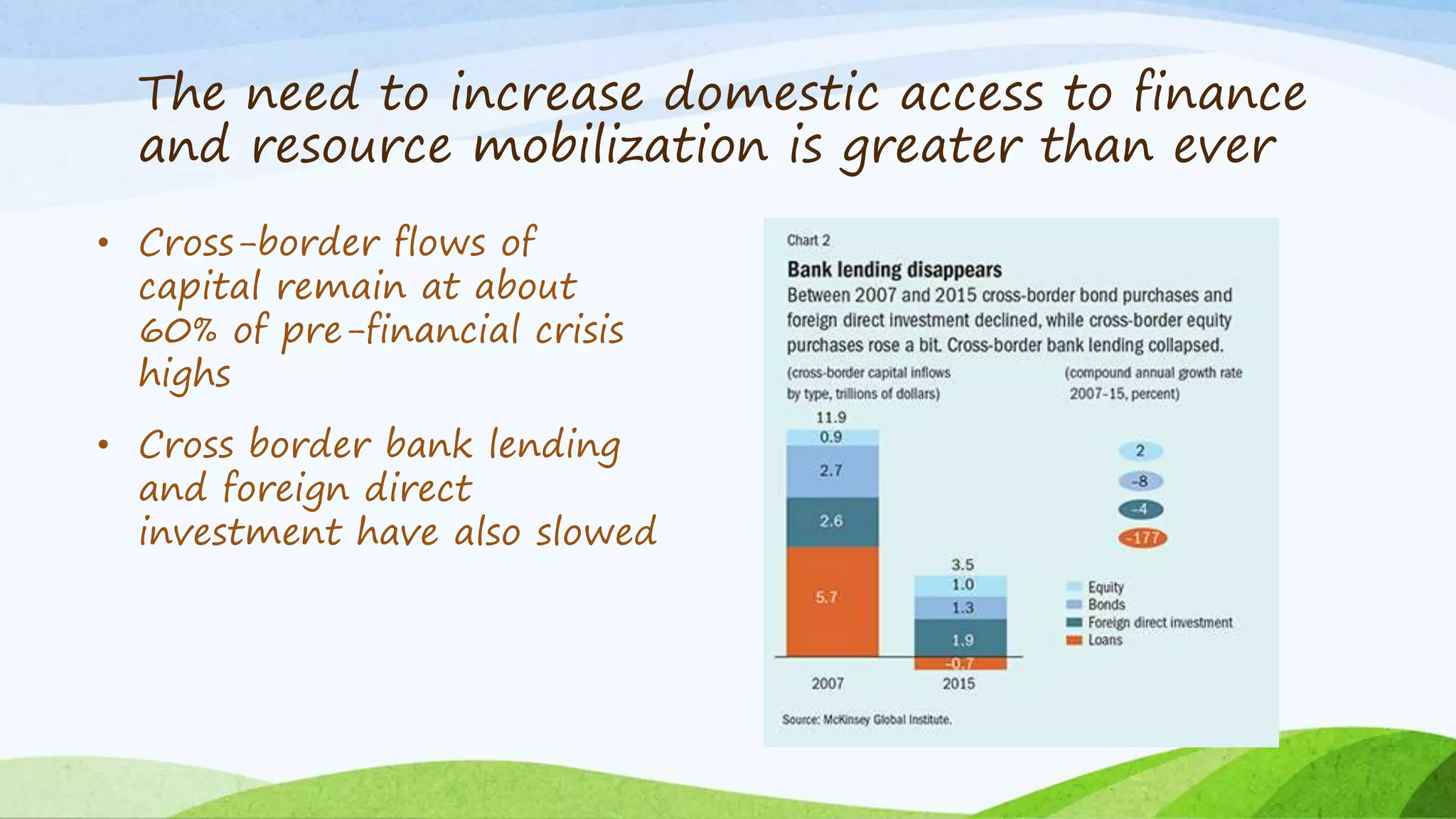
• Cross-border flows of
capital remain at about
60% of pre-financial crisis
highs
• Cross border bank lending
and foreign direct
investment have also slowed
Development of domestic small and mid-size
enterprises (SMEs) provides a significant lever to
reduce poverty and increase domestic cash flows
“Small- and medium-sized firms will create most of the jobs that
will be needed to help today’s poor escape poverty and for the 470
million who will enter the labour market by 2030.”
- The Report of the High-Level Panel of Eminent Persons on the
Post-2015 Development Agenda, UN 2013
5
…While broader access to financial services indirectly
supports several MDGs for poor families
Major challenges
• To escape poverty while
dedicating oneself to an activity
with little increase in
productivity
• Increase of
productivity
• Protect against
unexpected events
• Stabilize daily life
Source: Bill & Melinda Gates Foundation
• To face risks – such as loss of a
harvest, illnesses or death – that
can wipe out available resources in
an instant
• To maintain levels of education and
nutrition for a family without a
stable flow of income
Primary motive to save
• Large and medium-size investments
• Access to supplies and capital at wholesale prices
• To find more productive ways to use time and
resources
• To capture all of the earnings from investments
without the need for credit
• To prepare for serious illness, death, or loss of income
that cannot be anticipated, but can be planned for
• Lack of medical or life insurance for large sectors of the
population
• To avoid incurring significant debt when unexpected
events occur
• Smooth consumption to achieve stability for
spending on education and nutrition
• Higher levels of education and nutrition increase
productivity
• Leveraging loans to with fixed payments to
improve the capacity to save
Time
Income
Yet, access to credit and financial services
crucial to foster SME growth remains limited
• As of 2014, < 25% of
adults 25 yrs + in
Nicaragua had an
account at a financial
institution
• < 10% of Nicaraguans
25+ years old have
borrowed from a
private informal lender
Sources: Global Findex Database, 2012 (http://datatopics.worldbank.org/financialinclusion
Graphic and Analysis by Kerry Brennan, Financial Access Initiative (www.financialacess.org)
Development finance interventions, with technical
support and innovation, can bridge the gap
• No access to
financial services
• Poor-focused
social microfinance
institutions
• Formal financial
sector with a
wide suite of
financial services
Via concessional grants and
loans, product innovation,
technical support and facilitating
regulatory structures
Via blended finance,
innovative financing tools and
the right regulatory and
technology enablers
1 2
Microcredit to the poorest groups still
requires concessional financing
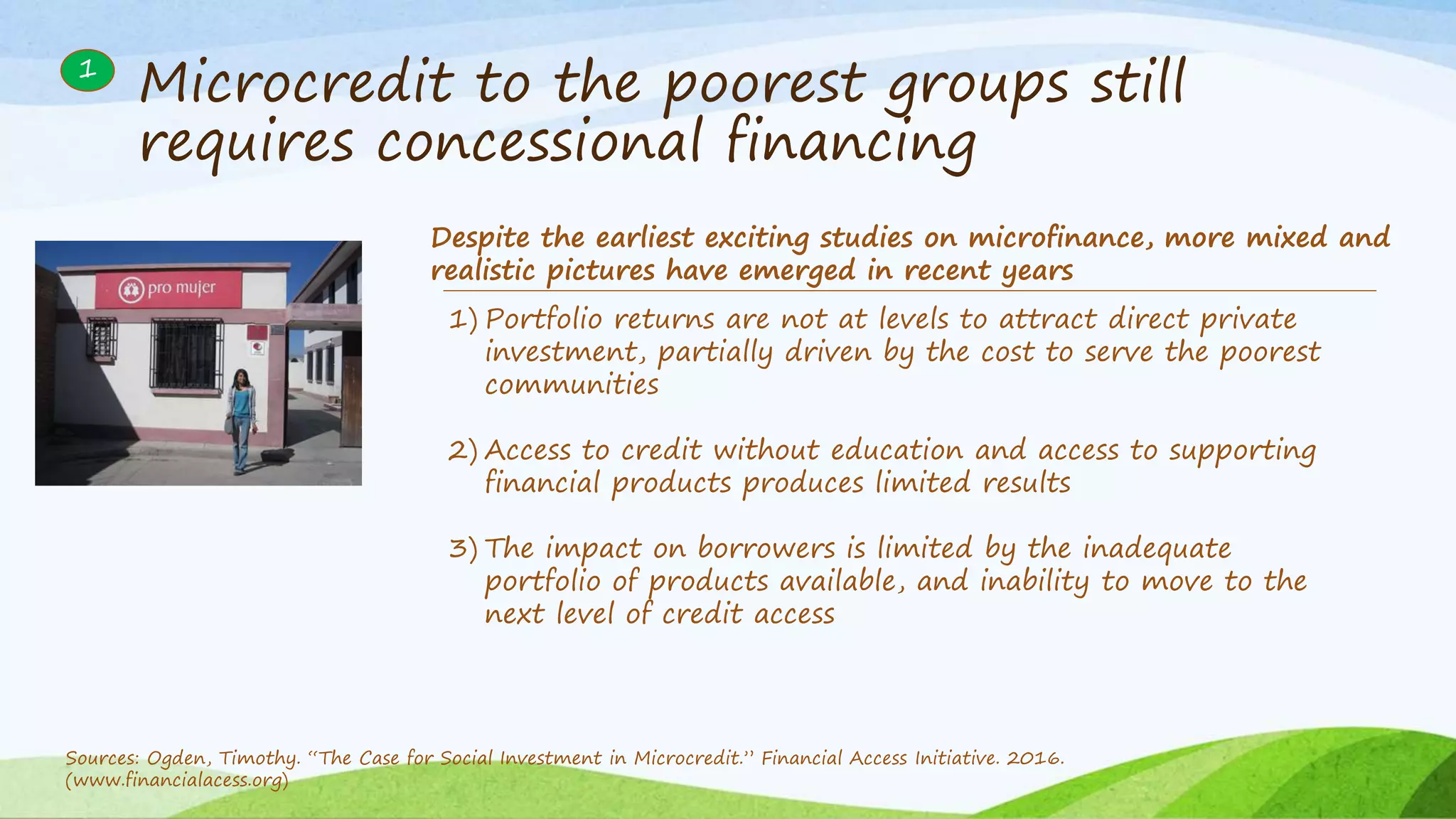
1) Portfolio returns are not at levels to attract direct private
investment, partially driven by the cost to serve the poorest
communities
2) Access to credit without education and access to supporting
financial products produces limited results
3) The impact on borrowers is limited by the inadequate
portfolio of products available, and inability to move to the
next level of credit access
Despite the earliest exciting studies on microfinance, more mixed and
realistic pictures have emerged in recent years
1
Sources: Ogden, Timothy. “The Case for Social Investment in Microcredit.” Financial Access Initiative. 2016.
(www.financialacess.org)
Microfinance is the only social
investment to have reached global
scale and built out infrastructure
in over 75 countries
One success case from
Nicaragua:
MicMARIA ALEJANDRA
RODRIGUEZ (click to view
external video)
Sources: Case study by Pro Mujer www.promujer.org
Ogden, Timothy. “The Case for Social Investment in Microcredit”. Financial Access Initiative. December 2016.
1
But traditional microfinance can produce results…
However, enablers are needed to improve
microfinance efficiency and outcomes
1
Financial
Product
Innovation
Technology
Policy/
Regulatory
However, investment is needed to improve
microfinance efficiency and outcomes
1
Financial
Product
Innovation
Technology
Policy/
Regulatory
Financial
Microfinance institutions that serve the
most poor and remote communities
require subsidies to grow to scale, as well
as to invest in innovations. This can be
provided via:
• Grants
• Below market-rate equity and debt
• Possible limited private involvement by
social investors via crowdfunding or
social investment funds
Beyond balance sheet support, this
development finance should be used to
fund the innovations to be discussed next
1
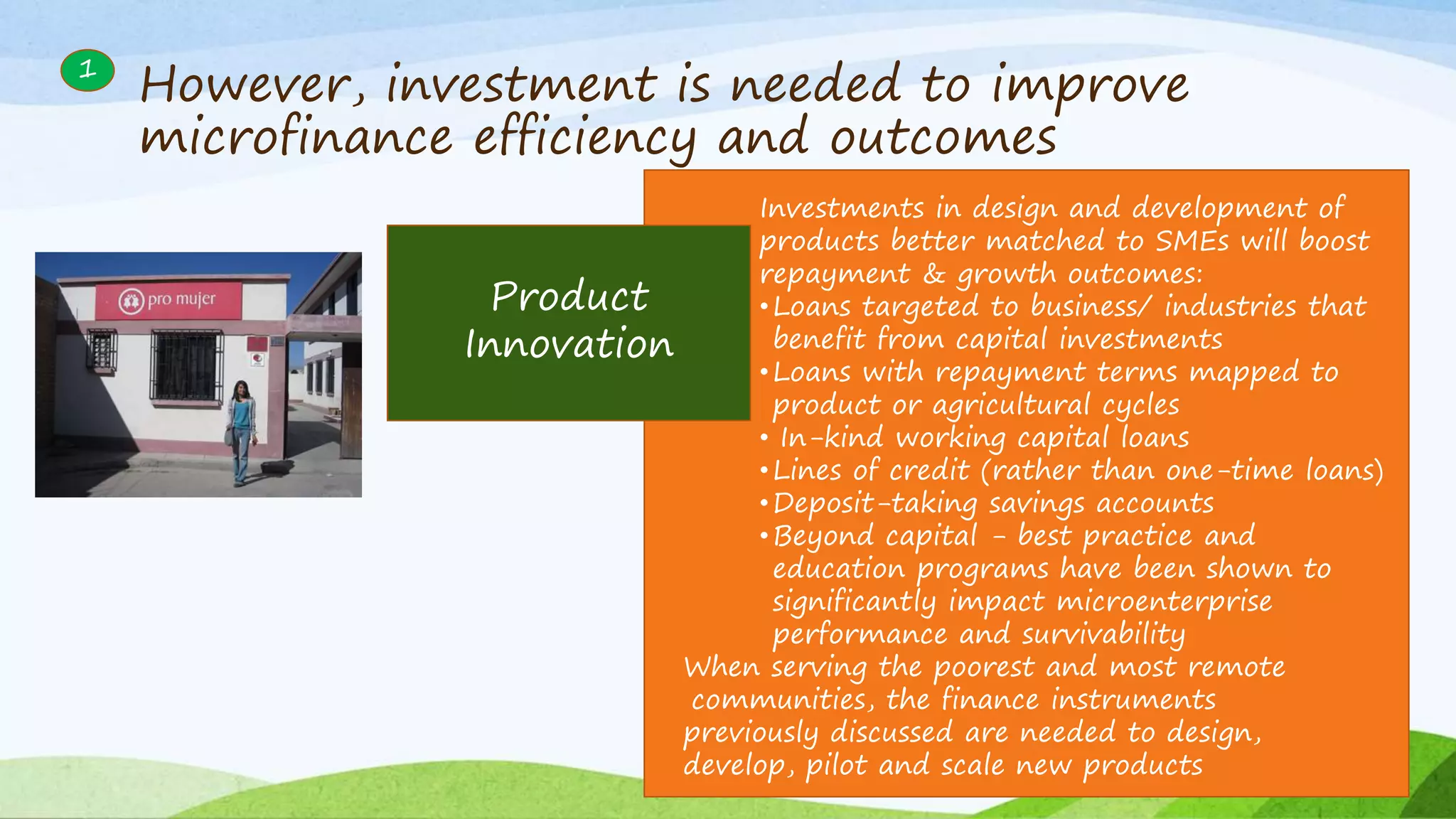
Product
Innovation
Investments in design and development of
products better matched to SMEs will boost
repayment & growth outcomes:
•Loans targeted to business/ industries that
benefit from capital investments
•Loans with repayment terms mapped to
product or agricultural cycles
• In-kind working capital loans
•Lines of credit (rather than one-time loans)
•Deposit-taking savings accounts
•Beyond capital - best practice and
education programs have been shown to
significantly impact microenterprise
performance and survivability
When serving the poorest and most remote
communities, the finance instruments
previously discussed are needed to design,
develop, pilot and scale new products
However, investment is needed to improve
microfinance efficiency and outcomes
1
Technology
Better use of technology can lower costs,
improve outcomes, and build a data set
that will help move people to a next level of
formal financial service access:
• Mobile phone loan repayments significantly
lower cost to serve and can provide a
consistent data set to begin to build credit
history information
• Phone-based reminders to save
• Business best practice reminders – e.g., in
one pilot, shopkeepers showed significant
gains from reminders to keep change on
hand
• (Responsible) Data sharing across
institutions can reduce over-indebtedness
and increase loan-repayment rating
abilities
However, investment is needed to improve
microfinance efficiency and outcomes
1
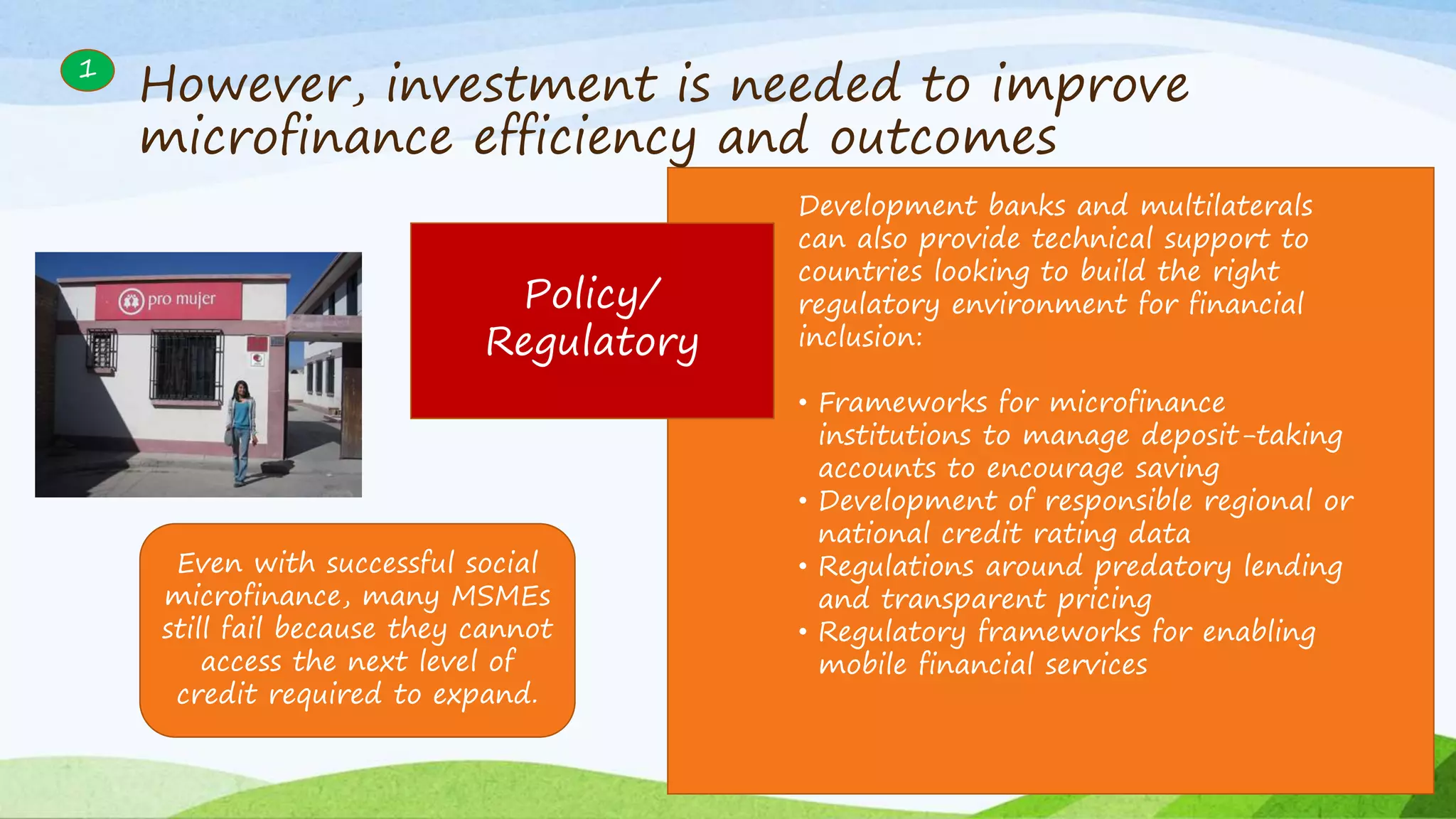
Policy/
Regulatory
Development banks and multilaterals
can also provide technical support to
countries looking to build the right
regulatory environment for financial
inclusion:
• Frameworks for microfinance
institutions to manage deposit-taking
accounts to encourage saving
• Development of responsible regional or
national credit rating data
• Regulations around predatory lending
and transparent pricing
• Regulatory frameworks for enabling
mobile financial services
However, investment is needed to improve
microfinance efficiency and outcomes
1
Policy/
Regulatory
Development banks and multilaterals
can also provide technical support to
countries looking to build the right
regulatory environment for financial
inclusion:
• Frameworks for microfinance
institutions to manage deposit-taking
accounts to encourage saving
• Development of responsible regional or
national credit rating data
• Regulations around predatory lending
and transparent pricing
• Regulatory frameworks for enabling
mobile financial services
Even with successful social
microfinance, many MSMEs
still fail because they cannot
access the next level of
credit required to expand.
However, investment is needed to improve
microfinance efficiency and outcomes
Improved social microfinance paves the way for
private sector investment in financial services
2
Financial
Product
Innovation
Technology
Policy/
Regulatory
Improved social microfinance paves the way for
private sector investment in financial services
2
Financial
Product
Innovation
Technology
Policy/
Regulatory
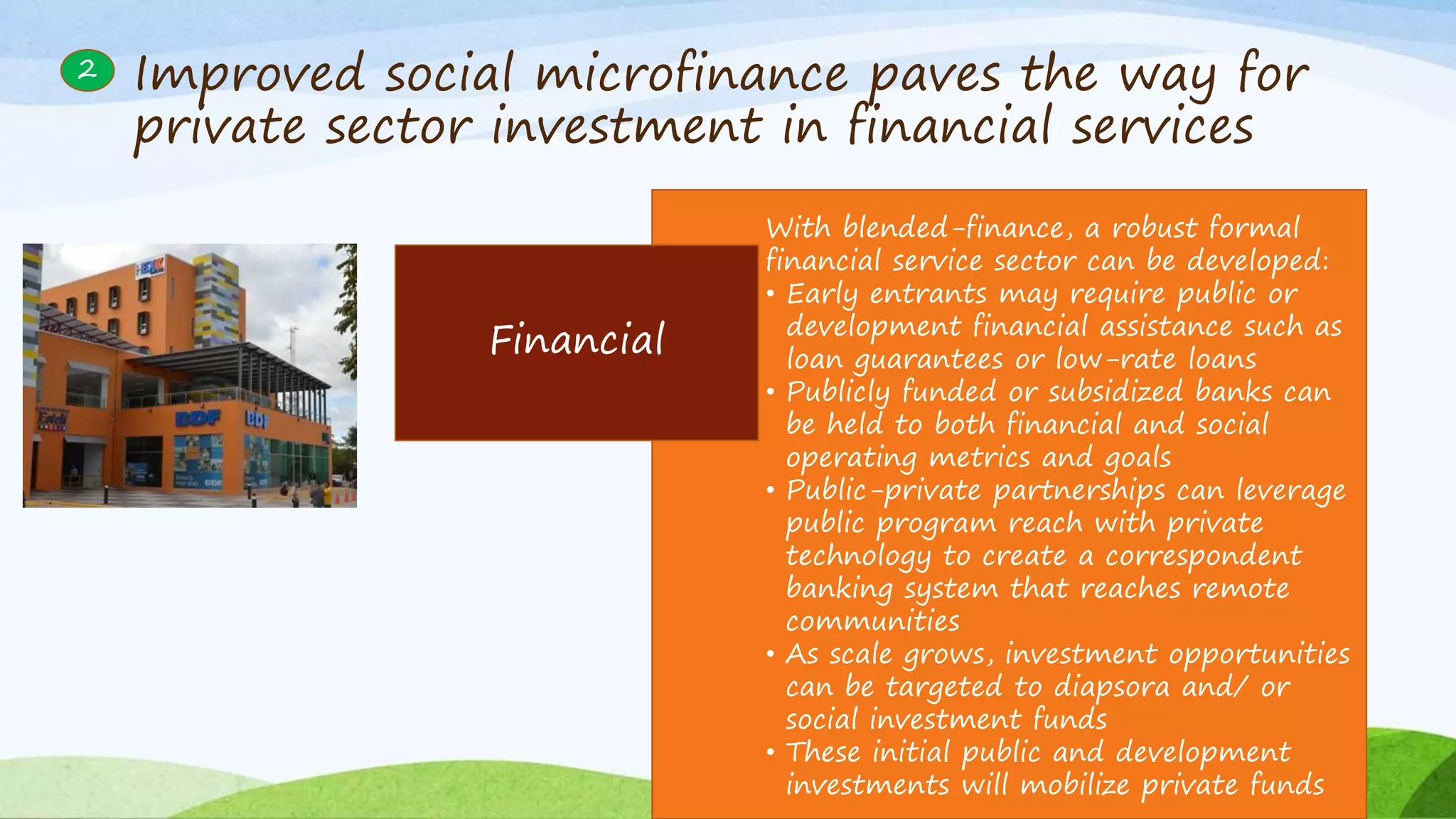
Financial
With blended-finance, a robust formal
financial service sector can be developed:
• Early entrants may require public or
development financial assistance such as
loan guarantees or low-rate loans
• Publicly funded or subsidized banks can
be held to both financial and social
operating metrics and goals
• Public-private partnerships can leverage
public program reach with private
technology to create a correspondent
banking system that reaches remote
communities
• As scale grows, investment opportunities
can be targeted to diapsora and/ or
social investment funds
• These initial public and development
investments will mobilize private funds
Improved social microfinance paves the way for
private sector investment in financial services
2
Product
Innovation
Larger-scale and for profit financial
institutions have the ability to design and
deploy additional financial products with
greater financial return potential:
SME Related
•Larger and longer-term credit facilities to
support expansion
•Larger capital investment loans
•Business insurance products
•Automated payment services
Individual Products
•Remittance tools
•Personal insurance
•Mortgages
•Automated payment services for household
utilities
Improved social microfinance paves the way for
private sector investment in financial services
2
Technology
With infrastructure and regulation in place,
financial technology is an area that will
attract private investment:
• Leveraging public or development funded
investments in early technologies to build
credit histories and registries allows for
lower cost customer evaluation and
reduced default rates
• Proprietary risk valuation algorithms that
leverage social loan repayment history as
well as utility, phone service payment, and
other data
• More robust and varied mobile financial
services – e.g., remittances, insurance
• Proprietary risk valuation algorithms that
• Point of Sale technology for correspondent
banking systems to reach more customers
Improved social microfinance paves the way for
private sector investment in financial services
2
Policy/
Regulatory
• Know Your Customer rules that
acknowledge local context and
limitations to identity documentation
• Creating national Id numbers that can
be used for tax as well as credit and
KNC rules
• Frameworks that enable mobile-
financial services
• Consumer protection principles defined
by World Bank and leading Fis
• Avoidance of Over-Indebtedness
• Transparent Pricing
• Appropriate Collections Practices
• Ethical Staff Behavior
• Mechanisms for Redress of
Grievances
• Privacy of Client Data
21
Example from Mexio – Partnership to deliver
electronic payments and expand services
Sources: BANSEFI, Diconsa, McKinsey Global Institute
Outcomes
▪ Leveraged the network of 23,000
Diconsa stores in order to reach
15-20m low-income, otherwise
unserved customers,
▪ Utilize POS technology to
electronically deliver government
payments
▪ Created a network of
correspondent banks within
Diconsa to provide access to
credit, insurance and remittances
▪ Significantly increased rates of
uptake by bundling financial
services with government transfer
payments
▪ Cost per transaction is ~25%
below normal branch transaction
+
+
+
...transforming into resultsThe sum of efforts..
The case is clear for concessional financing to
launch domestic financial service sectors
• In developing countries, formal MSMEs represent approximately 45% of employment and ~33%
of GDP
• The total unmet need for credit by all informal and formal MSMEs in emerging markets was
estimated at $2.1 trillion – $2.3 trillion in 2010
• There is existing infrastructure and institutions that can be enhanced, rather than starting from
scratch
• Microfinance has already demonstrated the ability to mobilize private funds across multiple
continents
• Growing domestic economies via SME investment and scale will expand domestic capital flows,
tax base and reduce poverty
Sources: IFC and WRI (2008). The Next 4 Billion. Market Size and Business Strategy at the Base of the Pyramid.
www.indexmundi.com/facts/indicators/NY.GDP.MKTP.PP.CD/ rankings
Goland, Tony. Schiff, Stein. Schiff, Robert. “Two Trillion and Counting”. IFC and McKinsey & Company. 2010.
While concessional financing is still required to reach the poorest and most remote
communities, these investments can be leveraged to attract private investment to
scale and broaden financial services which in turn facilitate growth of MSMEs and
domestic economies.

The Investment Case For Financial Inclusion

  • 1.
    The case forgreater development investment in financial inclusion & microfinance Building the bridge from informal to formal economies with access to finance for micro, small and mid-size enterprises (MSMEs) in Nicaragua and beyond
  • 2.
    The need toincrease domestic access to finance and resource mobilization is greater than ever • Cross-border flows of capital remain at about 60% of pre-financial crisis highs • Cross border bank lending and foreign direct investment have also slowed
  • 3.
    The need toincrease domestic access to finance and resource mobilization is greater than ever • Cross-border flows of capital remain at about 60% of pre-financial crisis highs • Cross border bank lending and foreign direct investment have also slowed
  • 4.
    Development of domesticsmall and mid-size enterprises (SMEs) provides a significant lever to reduce poverty and increase domestic cash flows “Small- and medium-sized firms will create most of the jobs that will be needed to help today’s poor escape poverty and for the 470 million who will enter the labour market by 2030.” - The Report of the High-Level Panel of Eminent Persons on the Post-2015 Development Agenda, UN 2013
  • 5.
    5 …While broader accessto financial services indirectly supports several MDGs for poor families Major challenges • To escape poverty while dedicating oneself to an activity with little increase in productivity • Increase of productivity • Protect against unexpected events • Stabilize daily life Source: Bill & Melinda Gates Foundation • To face risks – such as loss of a harvest, illnesses or death – that can wipe out available resources in an instant • To maintain levels of education and nutrition for a family without a stable flow of income Primary motive to save • Large and medium-size investments • Access to supplies and capital at wholesale prices • To find more productive ways to use time and resources • To capture all of the earnings from investments without the need for credit • To prepare for serious illness, death, or loss of income that cannot be anticipated, but can be planned for • Lack of medical or life insurance for large sectors of the population • To avoid incurring significant debt when unexpected events occur • Smooth consumption to achieve stability for spending on education and nutrition • Higher levels of education and nutrition increase productivity • Leveraging loans to with fixed payments to improve the capacity to save Time Income
  • 6.
    Yet, access tocredit and financial services crucial to foster SME growth remains limited • As of 2014, < 25% of adults 25 yrs + in Nicaragua had an account at a financial institution • < 10% of Nicaraguans 25+ years old have borrowed from a private informal lender Sources: Global Findex Database, 2012 (http://datatopics.worldbank.org/financialinclusion Graphic and Analysis by Kerry Brennan, Financial Access Initiative (www.financialacess.org)
  • 7.
    Development finance interventions,with technical support and innovation, can bridge the gap • No access to financial services • Poor-focused social microfinance institutions • Formal financial sector with a wide suite of financial services Via concessional grants and loans, product innovation, technical support and facilitating regulatory structures Via blended finance, innovative financing tools and the right regulatory and technology enablers 1 2
  • 8.
    Microcredit to thepoorest groups still requires concessional financing 1) Portfolio returns are not at levels to attract direct private investment, partially driven by the cost to serve the poorest communities 2) Access to credit without education and access to supporting financial products produces limited results 3) The impact on borrowers is limited by the inadequate portfolio of products available, and inability to move to the next level of credit access Despite the earliest exciting studies on microfinance, more mixed and realistic pictures have emerged in recent years 1 Sources: Ogden, Timothy. “The Case for Social Investment in Microcredit.” Financial Access Initiative. 2016. (www.financialacess.org)
  • 9.
    Microfinance is theonly social investment to have reached global scale and built out infrastructure in over 75 countries One success case from Nicaragua: MicMARIA ALEJANDRA RODRIGUEZ (click to view external video) Sources: Case study by Pro Mujer www.promujer.org Ogden, Timothy. “The Case for Social Investment in Microcredit”. Financial Access Initiative. December 2016. 1 But traditional microfinance can produce results…
  • 10.
    However, enablers areneeded to improve microfinance efficiency and outcomes 1 Financial Product Innovation Technology Policy/ Regulatory
  • 11.
    However, investment isneeded to improve microfinance efficiency and outcomes 1 Financial Product Innovation Technology Policy/ Regulatory Financial Microfinance institutions that serve the most poor and remote communities require subsidies to grow to scale, as well as to invest in innovations. This can be provided via: • Grants • Below market-rate equity and debt • Possible limited private involvement by social investors via crowdfunding or social investment funds Beyond balance sheet support, this development finance should be used to fund the innovations to be discussed next
  • 12.
    1 Product Innovation Investments in designand development of products better matched to SMEs will boost repayment & growth outcomes: •Loans targeted to business/ industries that benefit from capital investments •Loans with repayment terms mapped to product or agricultural cycles • In-kind working capital loans •Lines of credit (rather than one-time loans) •Deposit-taking savings accounts •Beyond capital - best practice and education programs have been shown to significantly impact microenterprise performance and survivability When serving the poorest and most remote communities, the finance instruments previously discussed are needed to design, develop, pilot and scale new products However, investment is needed to improve microfinance efficiency and outcomes
  • 13.
    1 Technology Better use oftechnology can lower costs, improve outcomes, and build a data set that will help move people to a next level of formal financial service access: • Mobile phone loan repayments significantly lower cost to serve and can provide a consistent data set to begin to build credit history information • Phone-based reminders to save • Business best practice reminders – e.g., in one pilot, shopkeepers showed significant gains from reminders to keep change on hand • (Responsible) Data sharing across institutions can reduce over-indebtedness and increase loan-repayment rating abilities However, investment is needed to improve microfinance efficiency and outcomes
  • 14.
    1 Policy/ Regulatory Development banks andmultilaterals can also provide technical support to countries looking to build the right regulatory environment for financial inclusion: • Frameworks for microfinance institutions to manage deposit-taking accounts to encourage saving • Development of responsible regional or national credit rating data • Regulations around predatory lending and transparent pricing • Regulatory frameworks for enabling mobile financial services However, investment is needed to improve microfinance efficiency and outcomes
  • 15.
    1 Policy/ Regulatory Development banks andmultilaterals can also provide technical support to countries looking to build the right regulatory environment for financial inclusion: • Frameworks for microfinance institutions to manage deposit-taking accounts to encourage saving • Development of responsible regional or national credit rating data • Regulations around predatory lending and transparent pricing • Regulatory frameworks for enabling mobile financial services Even with successful social microfinance, many MSMEs still fail because they cannot access the next level of credit required to expand. However, investment is needed to improve microfinance efficiency and outcomes
  • 16.
    Improved social microfinancepaves the way for private sector investment in financial services 2 Financial Product Innovation Technology Policy/ Regulatory
  • 17.
    Improved social microfinancepaves the way for private sector investment in financial services 2 Financial Product Innovation Technology Policy/ Regulatory Financial With blended-finance, a robust formal financial service sector can be developed: • Early entrants may require public or development financial assistance such as loan guarantees or low-rate loans • Publicly funded or subsidized banks can be held to both financial and social operating metrics and goals • Public-private partnerships can leverage public program reach with private technology to create a correspondent banking system that reaches remote communities • As scale grows, investment opportunities can be targeted to diapsora and/ or social investment funds • These initial public and development investments will mobilize private funds
  • 18.
    Improved social microfinancepaves the way for private sector investment in financial services 2 Product Innovation Larger-scale and for profit financial institutions have the ability to design and deploy additional financial products with greater financial return potential: SME Related •Larger and longer-term credit facilities to support expansion •Larger capital investment loans •Business insurance products •Automated payment services Individual Products •Remittance tools •Personal insurance •Mortgages •Automated payment services for household utilities
  • 19.
    Improved social microfinancepaves the way for private sector investment in financial services 2 Technology With infrastructure and regulation in place, financial technology is an area that will attract private investment: • Leveraging public or development funded investments in early technologies to build credit histories and registries allows for lower cost customer evaluation and reduced default rates • Proprietary risk valuation algorithms that leverage social loan repayment history as well as utility, phone service payment, and other data • More robust and varied mobile financial services – e.g., remittances, insurance • Proprietary risk valuation algorithms that • Point of Sale technology for correspondent banking systems to reach more customers
  • 20.
    Improved social microfinancepaves the way for private sector investment in financial services 2 Policy/ Regulatory • Know Your Customer rules that acknowledge local context and limitations to identity documentation • Creating national Id numbers that can be used for tax as well as credit and KNC rules • Frameworks that enable mobile- financial services • Consumer protection principles defined by World Bank and leading Fis • Avoidance of Over-Indebtedness • Transparent Pricing • Appropriate Collections Practices • Ethical Staff Behavior • Mechanisms for Redress of Grievances • Privacy of Client Data
  • 21.
    21 Example from Mexio– Partnership to deliver electronic payments and expand services Sources: BANSEFI, Diconsa, McKinsey Global Institute Outcomes ▪ Leveraged the network of 23,000 Diconsa stores in order to reach 15-20m low-income, otherwise unserved customers, ▪ Utilize POS technology to electronically deliver government payments ▪ Created a network of correspondent banks within Diconsa to provide access to credit, insurance and remittances ▪ Significantly increased rates of uptake by bundling financial services with government transfer payments ▪ Cost per transaction is ~25% below normal branch transaction + + + ...transforming into resultsThe sum of efforts..
  • 22.
    The case isclear for concessional financing to launch domestic financial service sectors • In developing countries, formal MSMEs represent approximately 45% of employment and ~33% of GDP • The total unmet need for credit by all informal and formal MSMEs in emerging markets was estimated at $2.1 trillion – $2.3 trillion in 2010 • There is existing infrastructure and institutions that can be enhanced, rather than starting from scratch • Microfinance has already demonstrated the ability to mobilize private funds across multiple continents • Growing domestic economies via SME investment and scale will expand domestic capital flows, tax base and reduce poverty Sources: IFC and WRI (2008). The Next 4 Billion. Market Size and Business Strategy at the Base of the Pyramid. www.indexmundi.com/facts/indicators/NY.GDP.MKTP.PP.CD/ rankings Goland, Tony. Schiff, Stein. Schiff, Robert. “Two Trillion and Counting”. IFC and McKinsey & Company. 2010. While concessional financing is still required to reach the poorest and most remote communities, these investments can be leveraged to attract private investment to scale and broaden financial services which in turn facilitate growth of MSMEs and domestic economies.

Editor's Notes

  • #6 MEX-AAA123-20110106-
  • #22 MEX-AAA123-20110106-