
Imaging Prostate Cancer
Qua Vadis
Hedvig Hricak, MD,PhD
Chairman,Radiology
MemorialSloanKettering CancerCenter
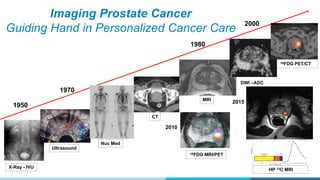
Imaging Prostate Cancer
Guiding Hand in Personalized Cancer Care
1950
1970
1980
2000
Ultrasound
X-Ray - IVU
CT
Nuc Med
MRI
18FDG MRI/PET
2015
2010
18FDG PET/CT
DWI –ADC
HP 13C MRI
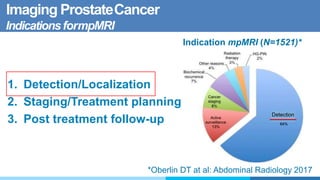
Imaging ProstateCancer
IndicationsformpMRI
1. Detection/Localization
2. Staging/Treatment planning
3. Post treatment follow-up
*Oberlin DT at al: Abdominal Radiology 2017
Indication mpMRI (N=1521)*
Detection
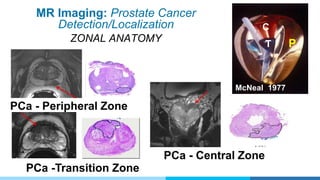
MR Imaging: Prostate Cancer
Detection/Localization
ZONAL ANATOMY
PCa - Peripheral Zone
PCa - Central Zone
PCa -Transition Zone
P
C
T
McNeal 1977
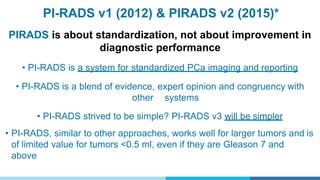
PI-RADS v1 (2012) & PIRADS v2 (2015)*
PI-RADS Description
score
1 Clinically significant cancer is highly unlikely to be present
2 Clinically significant cancer is unlikely to be present
3 Clinically significant cancer is equivocal
4 Clinically significant cancer is likely to be present
5 Clinically significant cancer is highly likely to be present
*ACR
PIRADS is about standardization, not about improvement in
diagnostic performance
• PI-RADS is a system for standardized PCa imaging and reporting
• PI-RADS is a blend of evidence, expert opinion and congruency with
other systems
• PI-RADS strived to be simple? PI-RADS v3 will be simpler
• PI-RADS, similar to other approaches, works well for larger tumors and is
of limited value for tumors <0.5 ml, even if they are Gleason 7 and
above
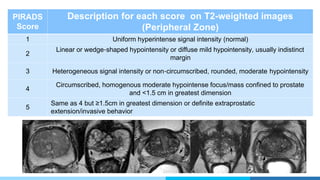
PIRADS
Score
Description for each score on T2-weighted images
(Peripheral Zone)
1 Uniform hyperintense signal intensity (normal)
2
Linear or wedge‐shaped hypointensity or diffuse mild hypointensity, usually indistinct
margin
3 Heterogeneous signal intensity or non‐circumscribed, rounded, moderate hypointensity
4
Circumscribed, homogenous moderate hypointense focus/mass confined to prostate
and <1.5 cm in greatest dimension
5
Same as 4 but ≥1.5cm in greatest dimension or definite extraprostatic
extension/invasive behavior
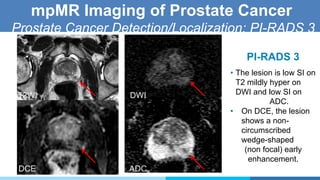
mpMR Imaging of Prostate Cancer
Prostate Cancer Detection/Localization: PI-RADS 3
PI-RADS 3
• The lesion is low SI on
T2 mildly hyper on
DWI and low SI on
ADC.
• On DCE, the lesion
shows a non-
circumscribed
wedge-shaped
(non focal) early
enhancement.
T2WI
DCE
DWI
ADC
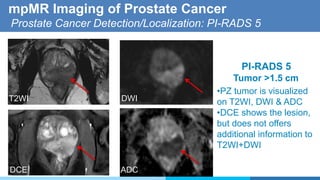
PI-RADS 5
Tumor >1.5 cm
•PZ tumor is visualized
on T2WI, DWI & ADC
•DCE shows the lesion,
but does not offers
additional information to
T2WI+DWI
T2WI
DCE
DWI
ADC
mpMR Imaging of Prostate Cancer
Prostate Cancer Detection/Localization: PI-RADS 5
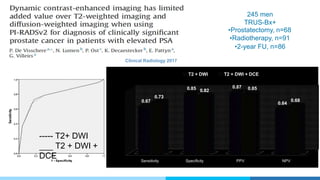
245 men
TRUS-Bx+
•Prostatectomy, n=68
•Radiotherapy, n=91
•2-year FU, n=86
----- T2+ DWI
T2 + DWI +
DCE
Clinical Radiology 2017
Sensitivity Specificity PPV NPV
0.67
0.85 0.87
0.64
0.73
0.82 0.85
0.68
T2 + DWI T2 + DWI + DCE
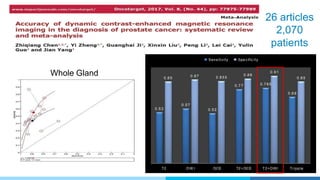
26 articles
2,070
patients
Whole Gland
0 .5 3
0 .5 7
0 .5 2
0 .7 7 0 .7 8 5
0 .6 9
0 .8 5
0 .8 7 0 .8 5 5
0 .8 8
0 .9 1
0 .8 5
T2 DW I DCE T2 +DCE T2+DWI Tripple
Sensitivity Spe cific ity
Imaging ProstateCancer
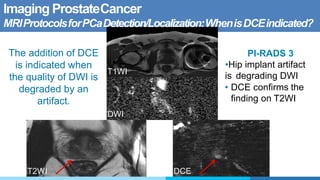
MRIProtocolsforPCaDetection/Localization:WhenisDCEindicated?
T2WI DCE
DWI
T1WI
PI-RADS 3
•Hip implant artifact
is degrading DWI
• DCE confirms the
finding on T2WI
The addition of DCE
is indicated when
the quality of DWI is
degraded by an
artifact.
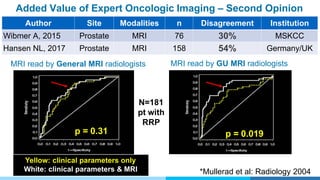
Author Site Modalities n Disagreement Institution
Wibmer A, 2015 Prostate MRI 76 30% MSKCC
Hansen NL, 2017 Prostate MRI 158 54% Germany/UK
Added Value of Expert Oncologic Imaging – Second Opinion
Yellow: clinical parameters only
White: clinical parameters & MRI *Mullerad et al: Radiology 2004
MRI read by GU MRI radiologistsMRI read by General MRI radiologists
p = 0.31 p = 0.019
N=181
pt with
RRP
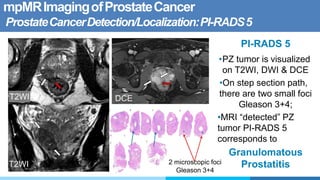
mpMRImagingofProstateCancer
ProstateCancerDetection/Localization:PI-RADS5
PI-RADS 5
•PZ tumor is visualized
on T2WI, DWI & DCE
•On step section path,
there are two small foci
Gleason 3+4;
•MRI “detected” PZ
tumor PI-RADS 5
corresponds to
Granulomatous
Prostatitis
DCE
T2WI
T2WI
2 microscopic foci
Gleason 3+4
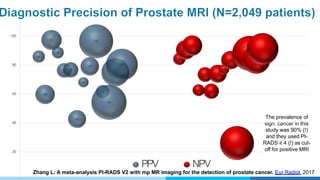
The prevalence of
sign. cancer in this
study was 90% (!)
and they used PI-
RADS ≥ 4 (!) as cut-
off for positive MRI
86
60
97
88
76 77
43
68
79
96
62
54
75
80
84
90
93
63
73
62
74
77
83
26
92
88
84
91
20
40
60
80
100
PPV NPV
Zhang L: A meta-analysis PI-RADS V2 with mp MR imaging for the detection of prostate cancer. Eur Radiol. 2017
86
60
97
88
76 77
43
68
79
96
62
54
75
80
84
90
93
63
73
62
74
77
83
26
92
88
84
91
89
20
40
60
80
100
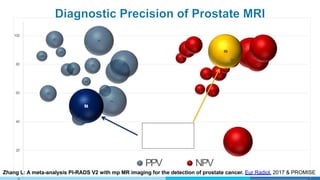
PPV NPV
Zhang L: A meta-analysis PI-RADS V2 with mp MR imaging for the detection of prostate cancer. Eur Radiol. 2017 & PROMISE
mpMRImagingofProstateCancer
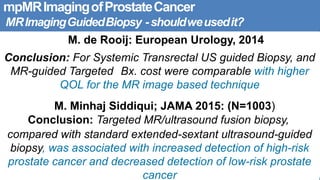
MRImagingGuidedBiopsy -shouldweusedit?
M. de Rooij: European Urology, 2014
Conclusion: For Systemic Transrectal US guided Biopsy, and
MR-guided Targeted Bx. cost were comparable with higher
QOL for the MR image based technique
M. Minhaj Siddiqui; JAMA 2015: (N=1003)
Conclusion: Targeted MR/ultrasound fusion biopsy,
compared with standard extended-sextant ultrasound-guided
biopsy, was associated with increased detection of high-risk
prostate cancer and decreased detection of low-risk prostate
cancer
mpMRImagingofProstateCancer
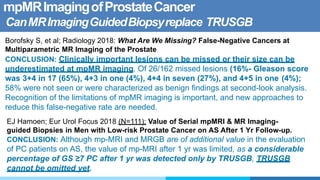
CanMRImagingGuidedBiopsyreplace TRUSGB
Borofsky S, et al; Radiology 2018: What Are We Missing? False-Negative Cancers at
Multiparametric MR Imaging of the Prostate
CONCLUSION: Clinically important lesions can be missed or their size can be
underestimated at mpMR imaging. Of 26/162 missed lesions (16%- Gleason score
was 3+4 in 17 (65%), 4+3 in one (4%), 4+4 in seven (27%), and 4+5 in one (4%);
58% were not seen or were characterized as benign findings at second-look analysis.
Recognition of the limitations of mpMR imaging is important, and new approaches to
reduce this false-negative rate are needed.
EJ Hamoen; Eur Urol Focus 2018 (N=111): Value of Serial mpMRI & MR Imaging-
guided Biopsies in Men with Low-risk Prostate Cancer on AS After 1 Yr Follow-up.
CONCLUSION: Although mp-MRI and MRGB are of additional value in the evaluation
of PC patients on AS, the value of mp-MRI after 1 yr was limited, as a considerable
percentage of GS ≥7 PC after 1 yr was detected only by TRUSGB, TRUSGB
cannot be omitted yet.
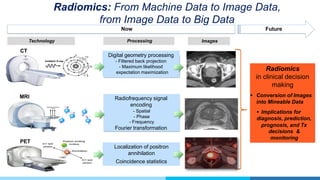
Radiomics: From Machine Data to Image Data,
from Image Data to Big Data
CT
MRI
PET
Digital geometry processing
- Filtered back projection
- Maximum likelihood
expectation maximization
Radiofrequency signal
encoding
- Spatial
- Phase
- Frequency
Fourier transformation
Localization of positron
annihilation
Coincidence statistics
Technology Processing Images
Now Future
Radiomics
in clinical decision
making
 Conversion of Images
into Mineable Data
 Implications for
diagnosis, prediction,
prognosis, and Tx
decisions &
monitoring
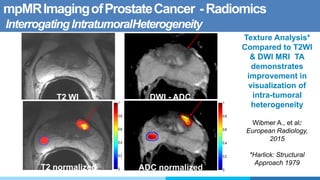
mpMRImagingofProstateCancer -Radiomics
InterrogatingIntratumoralHeterogeneity
Texture Analysis*
Compared to T2WI
& DWI MRI TA
demonstrates
improvement in
visualization of
intra-tumoral
heterogeneity
Wibmer A., et al:
European Radiology,
2015
*Harlick: Structural
Approach 1979
ADC normalizedT2 normalized
T2 WI DWI - ADC
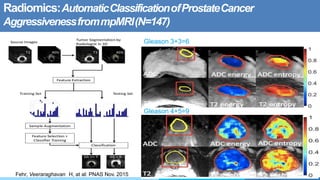
Radiomics:AutomaticClassificationofProstateCancer
AggressivenessfrommpMRI(N=147)
Gleason 3+3=6
Gleason 4+5=9
Fehr, Veeraraghavan H, at al: PNAS Nov. 2015
Anatomy Lecture 2018 – Molecular“The Anatomy Lecture of Dr. Nicolaes Tulp” – Rembrandt,1632
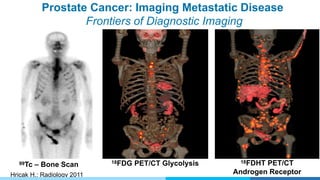
Prostate Cancer: Imaging Metastatic Disease
Frontiers of Diagnostic Imaging
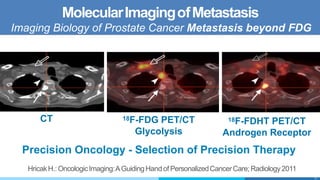
18FDHT PET/CT
Androgen Receptor
18FDG PET/CT Glycolysis99Tc – Bone Scan
Hricak H.: Radiology 2011
23
18F-FDG PET/CT
Glycolysis
18F-FDHT PET/CT
Androgen Receptor
MolecularImagingofMetastasis
Imaging Biology of Prostate Cancer Metastasis beyond FDG
CT
Precision Oncology - Selection of Precision Therapy
HricakH.:OncologicImaging:AGuidingHandof PersonalizedCancerCare;Radiology2011
24
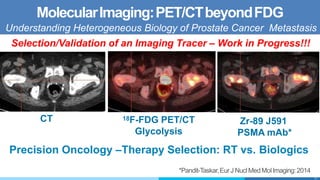
18F-FDG PET/CT
Glycolysis
CT
*Pandit-Taskar,EurJ NuclMedMolImaging:2014
Zr-89 J591
PSMA mAb*
Precision Oncology –Therapy Selection: RT vs. Biologics
MolecularImaging:PET/CTbeyondFDG
Understanding Heterogeneous Biology of Prostate Cancer Metastasis
Selection/Validation of an Imaging Tracer – Work in Progress!!!
Prostate Cancer: Radiopharmaceuticals produced (and in translation) by the MSK
RMIP Core over the last 5 years. First-in-Human IND’s are highlighted in italics.
Radiopharmaceutical Imaging Target Cancer Site Human studies
Small Molecules (Imaging)
[18
F]-FLT tumor cell proliferation Lymphoma, prostate, H&N, NSCLC MSKCC IND 104742
[18
F]-FDHT androgen receptor Prostate MSKCC IND 66115
[18
F]-FACBC amino acid metabolism Breast, Prostate, Brain RDRC/ MSKCC IND 113970
[18
F]-FIAU gene expression Prostate MSKCC IND BB-IND 14028
[18
F]-FEAU gene expression All tumors and T-cell therapies MSKCC IND
[18
F]-dasatinib tyrosine kinases Prostate, Breast MSKCC IND 118697
[18
F]-glutamine tumor metabolism All solid malignancies MSKCC IND 116187
[124
I]-FIAU gene expression Prostate MSKCC IND BB-IND 14028
[124
I]-PUH71 HSP-90 All solid malignancies and lymphoma MSKCC IND 110291
[18
F]-FCholine Tumor cell proliferation Brain MSKCC RDRC
[11
C]-Choline Tumor cell proliferation Prostate MSKCC IND 127257
Antibodies and Fragments (Imaging)
[89
Zr]-DFO-huJ591 PSMA Prostate MSKCC IND 114077
[89
Zr]-DFO-MSTP2109A PSMA Prostate MSKCC IND 116724
Small Molecules (Imaging)
[18
F]-FLT tumor cell proliferation Lymphoma, prostate, H&N, NSCLC MSKCC IND 104742
[18
F]-FDHT androgen receptor Prostate MSKCC IND 66115
[18
F]-FACBC amino acid metabolism Breast, Prostate, Brain RDRC/ MSKCC IND 113970
[18
F]-FIAU gene expression Prostate MSKCC IND BB-IND 14028
[18
F]-FEAU gene expression All tumors and T-cell therapies MSKCC IND
[18
F]-dasatinib tyrosine kinases Prostate, Breast MSKCC IND 118697
[18
F]-glutamine tumor metabolism All solid malignancies MSKCC IND 116187
[124
I]-FIAU gene expression Prostate MSKCC IND BB-IND 14028
[124
I]-PUH71 HSP-90 All solid malignancies and lymphoma MSKCC IND 110291
[18
F]-FCholine Tumor cell proliferation Brain MSKCC RDRC
[11
C]-Choline Tumor cell proliferation Prostate MSKCC IND 127257
Antibodies and Fragments (Imaging)
[89
Zr]-DFO-huJ591 PSMA Prostate MSKCC IND 114077
[89
Zr]-DFO-MSTP2109A PSMA Prostate MSKCC IND 116724
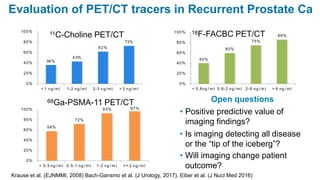
Evaluation of PET/CT tracers in Recurrent Prostate Ca
11C-Choline PET/CT 18F-FACBC PET/CT
68Ga-PSMA-11 PET/CT
Krause et al. (EJNMMI, 2008) Bach-Gansmo et al. (J Urology, 2017), Eiber et al. (J Nucl Med 2016)
36%
43%
62%
73%
0%
20%
40%
60%
80%
100%
< 1 ng/ml 1-2 ng/ml 2-3 ng/ml > 3 ng/ml
40%
60%
75%
86%
0%
20%
40%
60%
80%
100%
< 0.8ng / m l 0.8-2 ng / m l 2-6 ng / m l > 6 ng / m l
Open questions
• Positive predictive value of
imaging findings?
• Is imaging detecting all disease
or the “tip of the iceberg”?
• Will imaging change patient
outcome?
58%
72%
93% 97%
0%
20%
40%
60%
80%
100%
< 0.5 ng / m l 0.5-1 ng / m l 1-2 ng / m l >= 2 ng / m l
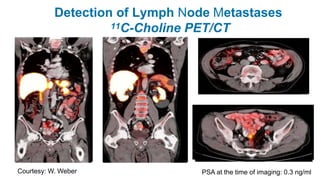
PSA at the time of imaging: 0.3 ng/ml
Detection of Lymph Node Metastases
11C-Choline PET/CT
Courtesy: W. Weber
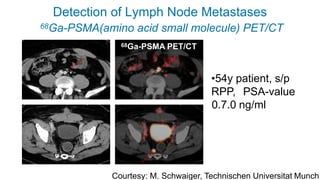
Detection of Lymph Node Metastases
Courtesy: M. Schwaiger, Technischen Universitat Munch
68Ga-PSMA(amino acid small molecule) PET/CT
68Ga-PSMA PET/CT
•54y patient, s/p
RPP, PSA-value
0.7.0 ng/ml
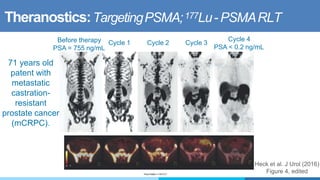
Theranostics:TargetingPSMA;177Lu- PSMARLT
68Ga-PSMA-11 PET/CT
Before therapy
PSA = 755 ng/mL
Cycle 1 Cycle 2 Cycle 3
Cycle 4
PSA < 0.2 ng/mL
Heck et al. J Urol (2016)
Figure 4, edited
71 years old
patent with
metastatic
castration-
resistant
prostate cancer
(mCRPC).
Oncologic Imaging
Precision Diagnostics and New Technology
“As much as new ideas are fundamental to the
advancement of science, technologic innovations
are the engine of scientific progress”
Shirley Tilghman
2001 – Inaugural Address - President, Princeton University
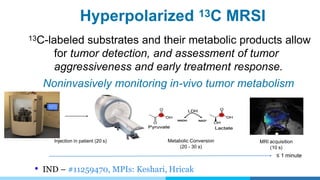
Metabolic Conversion
(20 - 30 s)
Injection in patient (20 s)
13C-labeled substrates and their metabolic products allow
for tumor detection, and assessment of tumor
aggressiveness and early treatment response.
Noninvasively monitoring in-vivo tumor metabolism
MRI acquisition
(10 s)
≤ 1 minute
Hyperpolarized 13C MRSI
• IND – #11259470, MPIs: Keshari, Hricak
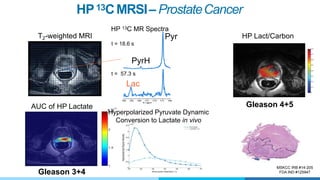
HP13CMRSI– ProstateCancer
MSKCC IRB #14-205
FDA IND #125947
Pyr
t = 18.6 s
PyrH
t = 57.3 s
Lac
T2-weighted MRI
HP 13C MR Spectra
AUC of HP Lactate
HP Lact/Carbon
Gleason 4+5
Gleason 3+4
Hyperpolarized Pyruvate Dynamic
Conversion to Lactate in vivo
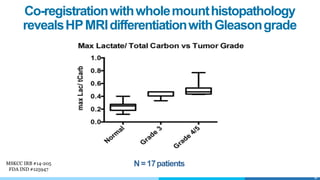
MSKCC IRB #14-205
FDA IND #125947
N=17patients
33
Co-registrationwithwholemounthistopathology
revealsHPMRIdifferentiationwithGleasongrade
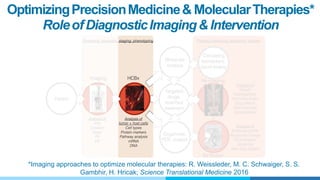
OptimizingPrecisionMedicine& MolecularTherapies*
RoleofDiagnosticImaging& Intervention
*Imaging approaches to optimize molecular therapies: R. Weissleder, M. C. Schwaiger, S. S.
Gambhir, H. Hricak; Science Translational Medicine 2016
Radiomics in Oncology

Radiomics in Oncology

  • 1.
    Imaging Prostate Cancer QuaVadis Hedvig Hricak, MD,PhD Chairman,Radiology MemorialSloanKettering CancerCenter
  • 2.
    Imaging Prostate Cancer GuidingHand in Personalized Cancer Care 1950 1970 1980 2000 Ultrasound X-Ray - IVU CT Nuc Med MRI 18FDG MRI/PET 2015 2010 18FDG PET/CT DWI –ADC HP 13C MRI
  • 3.
    Imaging ProstateCancer IndicationsformpMRI 1. Detection/Localization 2.Staging/Treatment planning 3. Post treatment follow-up *Oberlin DT at al: Abdominal Radiology 2017 Indication mpMRI (N=1521)* Detection
  • 4.
    MR Imaging: ProstateCancer Detection/Localization ZONAL ANATOMY PCa - Peripheral Zone PCa - Central Zone PCa -Transition Zone P C T McNeal 1977
  • 5.
    PI-RADS v1 (2012)& PIRADS v2 (2015)* PI-RADS Description score 1 Clinically significant cancer is highly unlikely to be present 2 Clinically significant cancer is unlikely to be present 3 Clinically significant cancer is equivocal 4 Clinically significant cancer is likely to be present 5 Clinically significant cancer is highly likely to be present *ACR PIRADS is about standardization, not about improvement in diagnostic performance • PI-RADS is a system for standardized PCa imaging and reporting • PI-RADS is a blend of evidence, expert opinion and congruency with other systems • PI-RADS strived to be simple? PI-RADS v3 will be simpler • PI-RADS, similar to other approaches, works well for larger tumors and is of limited value for tumors <0.5 ml, even if they are Gleason 7 and above
  • 6.
    PIRADS Score Description for eachscore on T2-weighted images (Peripheral Zone) 1 Uniform hyperintense signal intensity (normal) 2 Linear or wedge‐shaped hypointensity or diffuse mild hypointensity, usually indistinct margin 3 Heterogeneous signal intensity or non‐circumscribed, rounded, moderate hypointensity 4 Circumscribed, homogenous moderate hypointense focus/mass confined to prostate and <1.5 cm in greatest dimension 5 Same as 4 but ≥1.5cm in greatest dimension or definite extraprostatic extension/invasive behavior
  • 7.
    mpMR Imaging ofProstate Cancer Prostate Cancer Detection/Localization: PI-RADS 3 PI-RADS 3 • The lesion is low SI on T2 mildly hyper on DWI and low SI on ADC. • On DCE, the lesion shows a non- circumscribed wedge-shaped (non focal) early enhancement. T2WI DCE DWI ADC
  • 8.
    PI-RADS 5 Tumor >1.5cm •PZ tumor is visualized on T2WI, DWI & ADC •DCE shows the lesion, but does not offers additional information to T2WI+DWI T2WI DCE DWI ADC mpMR Imaging of Prostate Cancer Prostate Cancer Detection/Localization: PI-RADS 5
  • 9.
    245 men TRUS-Bx+ •Prostatectomy, n=68 •Radiotherapy,n=91 •2-year FU, n=86 ----- T2+ DWI T2 + DWI + DCE Clinical Radiology 2017 Sensitivity Specificity PPV NPV 0.67 0.85 0.87 0.64 0.73 0.82 0.85 0.68 T2 + DWI T2 + DWI + DCE
  • 10.
    26 articles 2,070 patients Whole Gland 0.5 3 0 .5 7 0 .5 2 0 .7 7 0 .7 8 5 0 .6 9 0 .8 5 0 .8 7 0 .8 5 5 0 .8 8 0 .9 1 0 .8 5 T2 DW I DCE T2 +DCE T2+DWI Tripple Sensitivity Spe cific ity
  • 11.
    Imaging ProstateCancer MRIProtocolsforPCaDetection/Localization:WhenisDCEindicated? T2WI DCE DWI T1WI PI-RADS3 •Hip implant artifact is degrading DWI • DCE confirms the finding on T2WI The addition of DCE is indicated when the quality of DWI is degraded by an artifact.
  • 12.
    Author Site Modalitiesn Disagreement Institution Wibmer A, 2015 Prostate MRI 76 30% MSKCC Hansen NL, 2017 Prostate MRI 158 54% Germany/UK Added Value of Expert Oncologic Imaging – Second Opinion Yellow: clinical parameters only White: clinical parameters & MRI *Mullerad et al: Radiology 2004 MRI read by GU MRI radiologistsMRI read by General MRI radiologists p = 0.31 p = 0.019 N=181 pt with RRP
  • 13.
    mpMRImagingofProstateCancer ProstateCancerDetection/Localization:PI-RADS5 PI-RADS 5 •PZ tumoris visualized on T2WI, DWI & DCE •On step section path, there are two small foci Gleason 3+4; •MRI “detected” PZ tumor PI-RADS 5 corresponds to Granulomatous Prostatitis DCE T2WI T2WI 2 microscopic foci Gleason 3+4
  • 14.
    The prevalence of sign.cancer in this study was 90% (!) and they used PI- RADS ≥ 4 (!) as cut- off for positive MRI 86 60 97 88 76 77 43 68 79 96 62 54 75 80 84 90 93 63 73 62 74 77 83 26 92 88 84 91 20 40 60 80 100 PPV NPV Zhang L: A meta-analysis PI-RADS V2 with mp MR imaging for the detection of prostate cancer. Eur Radiol. 2017
  • 15.
    86 60 97 88 76 77 43 68 79 96 62 54 75 80 84 90 93 63 73 62 74 77 83 26 92 88 84 91 89 20 40 60 80 100 PPV NPV ZhangL: A meta-analysis PI-RADS V2 with mp MR imaging for the detection of prostate cancer. Eur Radiol. 2017 & PROMISE
  • 16.
    mpMRImagingofProstateCancer MRImagingGuidedBiopsy -shouldweusedit? M. deRooij: European Urology, 2014 Conclusion: For Systemic Transrectal US guided Biopsy, and MR-guided Targeted Bx. cost were comparable with higher QOL for the MR image based technique M. Minhaj Siddiqui; JAMA 2015: (N=1003) Conclusion: Targeted MR/ultrasound fusion biopsy, compared with standard extended-sextant ultrasound-guided biopsy, was associated with increased detection of high-risk prostate cancer and decreased detection of low-risk prostate cancer
  • 17.
    mpMRImagingofProstateCancer CanMRImagingGuidedBiopsyreplace TRUSGB Borofsky S,et al; Radiology 2018: What Are We Missing? False-Negative Cancers at Multiparametric MR Imaging of the Prostate CONCLUSION: Clinically important lesions can be missed or their size can be underestimated at mpMR imaging. Of 26/162 missed lesions (16%- Gleason score was 3+4 in 17 (65%), 4+3 in one (4%), 4+4 in seven (27%), and 4+5 in one (4%); 58% were not seen or were characterized as benign findings at second-look analysis. Recognition of the limitations of mpMR imaging is important, and new approaches to reduce this false-negative rate are needed. EJ Hamoen; Eur Urol Focus 2018 (N=111): Value of Serial mpMRI & MR Imaging- guided Biopsies in Men with Low-risk Prostate Cancer on AS After 1 Yr Follow-up. CONCLUSION: Although mp-MRI and MRGB are of additional value in the evaluation of PC patients on AS, the value of mp-MRI after 1 yr was limited, as a considerable percentage of GS ≥7 PC after 1 yr was detected only by TRUSGB, TRUSGB cannot be omitted yet.
  • 18.
    Radiomics: From MachineData to Image Data, from Image Data to Big Data CT MRI PET Digital geometry processing - Filtered back projection - Maximum likelihood expectation maximization Radiofrequency signal encoding - Spatial - Phase - Frequency Fourier transformation Localization of positron annihilation Coincidence statistics Technology Processing Images Now Future Radiomics in clinical decision making  Conversion of Images into Mineable Data  Implications for diagnosis, prediction, prognosis, and Tx decisions & monitoring
  • 19.
    mpMRImagingofProstateCancer -Radiomics InterrogatingIntratumoralHeterogeneity Texture Analysis* Comparedto T2WI & DWI MRI TA demonstrates improvement in visualization of intra-tumoral heterogeneity Wibmer A., et al: European Radiology, 2015 *Harlick: Structural Approach 1979 ADC normalizedT2 normalized T2 WI DWI - ADC
  • 20.
  • 21.
    Anatomy Lecture 2018– Molecular“The Anatomy Lecture of Dr. Nicolaes Tulp” – Rembrandt,1632
  • 22.
    Prostate Cancer: ImagingMetastatic Disease Frontiers of Diagnostic Imaging 18FDHT PET/CT Androgen Receptor 18FDG PET/CT Glycolysis99Tc – Bone Scan Hricak H.: Radiology 2011
  • 23.
    23 18F-FDG PET/CT Glycolysis 18F-FDHT PET/CT AndrogenReceptor MolecularImagingofMetastasis Imaging Biology of Prostate Cancer Metastasis beyond FDG CT Precision Oncology - Selection of Precision Therapy HricakH.:OncologicImaging:AGuidingHandof PersonalizedCancerCare;Radiology2011
  • 24.
    24 18F-FDG PET/CT Glycolysis CT *Pandit-Taskar,EurJ NuclMedMolImaging:2014 Zr-89J591 PSMA mAb* Precision Oncology –Therapy Selection: RT vs. Biologics MolecularImaging:PET/CTbeyondFDG Understanding Heterogeneous Biology of Prostate Cancer Metastasis Selection/Validation of an Imaging Tracer – Work in Progress!!!
  • 25.
    Prostate Cancer: Radiopharmaceuticalsproduced (and in translation) by the MSK RMIP Core over the last 5 years. First-in-Human IND’s are highlighted in italics. Radiopharmaceutical Imaging Target Cancer Site Human studies Small Molecules (Imaging) [18 F]-FLT tumor cell proliferation Lymphoma, prostate, H&N, NSCLC MSKCC IND 104742 [18 F]-FDHT androgen receptor Prostate MSKCC IND 66115 [18 F]-FACBC amino acid metabolism Breast, Prostate, Brain RDRC/ MSKCC IND 113970 [18 F]-FIAU gene expression Prostate MSKCC IND BB-IND 14028 [18 F]-FEAU gene expression All tumors and T-cell therapies MSKCC IND [18 F]-dasatinib tyrosine kinases Prostate, Breast MSKCC IND 118697 [18 F]-glutamine tumor metabolism All solid malignancies MSKCC IND 116187 [124 I]-FIAU gene expression Prostate MSKCC IND BB-IND 14028 [124 I]-PUH71 HSP-90 All solid malignancies and lymphoma MSKCC IND 110291 [18 F]-FCholine Tumor cell proliferation Brain MSKCC RDRC [11 C]-Choline Tumor cell proliferation Prostate MSKCC IND 127257 Antibodies and Fragments (Imaging) [89 Zr]-DFO-huJ591 PSMA Prostate MSKCC IND 114077 [89 Zr]-DFO-MSTP2109A PSMA Prostate MSKCC IND 116724 Small Molecules (Imaging) [18 F]-FLT tumor cell proliferation Lymphoma, prostate, H&N, NSCLC MSKCC IND 104742 [18 F]-FDHT androgen receptor Prostate MSKCC IND 66115 [18 F]-FACBC amino acid metabolism Breast, Prostate, Brain RDRC/ MSKCC IND 113970 [18 F]-FIAU gene expression Prostate MSKCC IND BB-IND 14028 [18 F]-FEAU gene expression All tumors and T-cell therapies MSKCC IND [18 F]-dasatinib tyrosine kinases Prostate, Breast MSKCC IND 118697 [18 F]-glutamine tumor metabolism All solid malignancies MSKCC IND 116187 [124 I]-FIAU gene expression Prostate MSKCC IND BB-IND 14028 [124 I]-PUH71 HSP-90 All solid malignancies and lymphoma MSKCC IND 110291 [18 F]-FCholine Tumor cell proliferation Brain MSKCC RDRC [11 C]-Choline Tumor cell proliferation Prostate MSKCC IND 127257 Antibodies and Fragments (Imaging) [89 Zr]-DFO-huJ591 PSMA Prostate MSKCC IND 114077 [89 Zr]-DFO-MSTP2109A PSMA Prostate MSKCC IND 116724
  • 26.
    Evaluation of PET/CTtracers in Recurrent Prostate Ca 11C-Choline PET/CT 18F-FACBC PET/CT 68Ga-PSMA-11 PET/CT Krause et al. (EJNMMI, 2008) Bach-Gansmo et al. (J Urology, 2017), Eiber et al. (J Nucl Med 2016) 36% 43% 62% 73% 0% 20% 40% 60% 80% 100% < 1 ng/ml 1-2 ng/ml 2-3 ng/ml > 3 ng/ml 40% 60% 75% 86% 0% 20% 40% 60% 80% 100% < 0.8ng / m l 0.8-2 ng / m l 2-6 ng / m l > 6 ng / m l Open questions • Positive predictive value of imaging findings? • Is imaging detecting all disease or the “tip of the iceberg”? • Will imaging change patient outcome? 58% 72% 93% 97% 0% 20% 40% 60% 80% 100% < 0.5 ng / m l 0.5-1 ng / m l 1-2 ng / m l >= 2 ng / m l
  • 27.
    PSA at thetime of imaging: 0.3 ng/ml Detection of Lymph Node Metastases 11C-Choline PET/CT Courtesy: W. Weber
  • 28.
    Detection of LymphNode Metastases Courtesy: M. Schwaiger, Technischen Universitat Munch 68Ga-PSMA(amino acid small molecule) PET/CT 68Ga-PSMA PET/CT •54y patient, s/p RPP, PSA-value 0.7.0 ng/ml
  • 29.
    Theranostics:TargetingPSMA;177Lu- PSMARLT 68Ga-PSMA-11 PET/CT Beforetherapy PSA = 755 ng/mL Cycle 1 Cycle 2 Cycle 3 Cycle 4 PSA < 0.2 ng/mL Heck et al. J Urol (2016) Figure 4, edited 71 years old patent with metastatic castration- resistant prostate cancer (mCRPC).
  • 30.
    Oncologic Imaging Precision Diagnosticsand New Technology “As much as new ideas are fundamental to the advancement of science, technologic innovations are the engine of scientific progress” Shirley Tilghman 2001 – Inaugural Address - President, Princeton University
  • 31.
    Metabolic Conversion (20 -30 s) Injection in patient (20 s) 13C-labeled substrates and their metabolic products allow for tumor detection, and assessment of tumor aggressiveness and early treatment response. Noninvasively monitoring in-vivo tumor metabolism MRI acquisition (10 s) ≤ 1 minute Hyperpolarized 13C MRSI • IND – #11259470, MPIs: Keshari, Hricak
  • 32.
    HP13CMRSI– ProstateCancer MSKCC IRB#14-205 FDA IND #125947 Pyr t = 18.6 s PyrH t = 57.3 s Lac T2-weighted MRI HP 13C MR Spectra AUC of HP Lactate HP Lact/Carbon Gleason 4+5 Gleason 3+4 Hyperpolarized Pyruvate Dynamic Conversion to Lactate in vivo
  • 33.
    MSKCC IRB #14-205 FDAIND #125947 N=17patients 33 Co-registrationwithwholemounthistopathology revealsHPMRIdifferentiationwithGleasongrade
  • 34.
    OptimizingPrecisionMedicine& MolecularTherapies* RoleofDiagnosticImaging& Intervention *Imagingapproaches to optimize molecular therapies: R. Weissleder, M. C. Schwaiger, S. S. Gambhir, H. Hricak; Science Translational Medicine 2016