Radio Trailer: Survey Response
Noshin Jahan
• I carried out a survey on SurveyMonkey.com
about the Radio trailer for our horror film.
• Overall, we received 14 responses, 50% of the
audience are female, 42% are male and 7.14%
preferred not to reveal their gender. We did
receive a 50/50 response which gives us an
advantage of knowing our audience’s
preferences. And having an impartial view of
what all gender of our audience prefer.
Age Statistics
All responses from the audience, are aged between 15
30, majority of the responses are from 17 and 18 year
olds. This is great as horror films are typically targeted
at teenagers, young adults and middle aged people.
Therefore we got responses from the prime age group
that usually like to spend money on watching films.
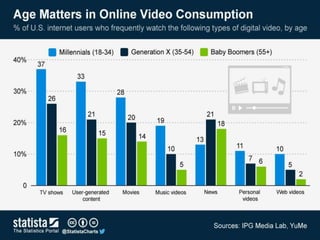
The ‘Age Matters in Online Video Consumption’ chart
from Statista shows that majority of people who watch
films on online platforms such as YouTube and Netflix
are Millennials (18-34). This means that our horror
film/trailer will most likely be viewed by Millennials
and young people.
Music & Sound effects
Music & Sound effects analysis
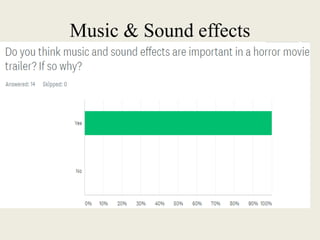
• 100% of our audience concluded that music and sound
effects in a trailer is important.
• Few of the many responses to the question:
• ‘following the conventions of a horror movie trailer, it makes
the audience afraid and on their toes to watch more.’
• ‘Interestingly, sometimes music can tell a story by itself.’
• ‘Helps us identify that it is horror’
• ‘It empathises moments, building them up then scaring me’
• ‘music creates tension and mystery and fear’
• Overall, some responses I’ve received include music
‘scaring’ them and it ‘builds tension’ and some mentioned
that it helps us identify with the genre.
Voices?
Voices?
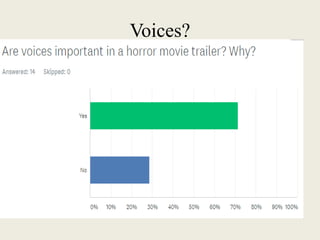
• 71% concluded that voice is important and 28% say that it isn’t.
• Responses:
• ‘It is important to provide some context and information, so voices can
convey that especially for a radio trailer’
• ‘It makes the film sound official because many other films use voices’
• ‘I think voices sound too cheesy as every trailer uses voices and it also
gives away the plot’
• ‘just needs screams, growls and heavy panting to get me scared’
• ‘Voices are important to HELP tell the story and stop confusion. Also,
quiet whispers can seem spooky.’
• Overall, there are mixed reviews, some say that voice helps the audience
understand the narrative whilst others say that voices are ‘cheesy’ and
too overused. Majority says that voices are essential in helping the
audience understand the story. Although it doesn’t need to give any plot
away but it is essential in establishing the genre, our group thinks voices
are important fort this reason.
What kind of sounds scares you? i.e.
screams, laughing
• We want an understanding of what scares the audience and what
young people find scary yet alluring.
• Responses:
• ‘ominous music, a cacophony of orchestral music or real life
sounds such as ambulance/police sirens’
• ‘growls, demonic screaming/laughing, dead silence’
• ‘Creepy laugh Screaming Crying Door creaking Sound of knife
against skin’
• ‘silence and then a sudden sound’
• ‘Whispers and creepy sinister laughter.’
• Overall, the audience prefers ‘silence’, ‘sudden sounds’ (sounds
found in codes and conventions of horror), one person suggested
‘orchestral music’, orchestral music is associated heavily with
the horror genre, it seems odd to pair orchestral music with
horror, however
Why do you think sounds is so effective in
building suspense in horror films?
• We want an understanding of how sound makes the audience feel.
• Responses:
• ‘Like piano it creates an big effect; I like in insidious for example used
high pitched piano sounds when something bad was going to happen’
• ‘Because the sounds used are unusual and not something we're used to
hearing’
• ‘It allows the audience to make sense of the text, for example, in horror the
audience must know the film belongs to the horror genre through sounds
associated with horror. It establishes the genre and narrative.’
• ‘even if its low sound it creates uneasiness’
• ‘ the volume increasing and the drowning sound makes it more intense for
me as a audience member, makes me pay more attention’
• Overall, the audience mentioned that sounds are effective because it
creates a mood and atmosphere, others mentioned that it allows the
audience to identify the film belonging to the horror genre. Horror films,
typically use bizarre sounds that makes people feel ‘uneasy’
What kind of sounds do horror films
typically use?
• We want an understanding of what the audience want the
audience usually hear in horror films so that we can similarly
fulfil what they want to hear.
• Responses:
• ‘Breathing, silence, lullabies, increasingly loud music’
• ‘Eerie music, silence, shouting, screaming’
• ‘Screams, dialogue, silence’
• ‘laughing, silence’
• ‘heavy breathing’
• Overall, majority of the audience mentioned that ‘silence’
scares them, silence is important in horror film, many horror
films use silence in ‘cat scare’ (scares that make audience
think something horrifying is about to happen when its all just
harmless). Some said they prefer screams, heavy breathing and
psychotic laughing, these are all part of the codes and
conventions found in horror films.
What do you think makes a successful
horror trailer?
• The audience’s input on what makes a horror trailer successful,
allows us to use their input and gives us an idea of what the people
what and what young people want to see/hear.
• Responses:
• ‘Suspense and not telling the story. Give a hint and make it
interesting’
• ‘It introduces the main plot but doesn't give away the whole movie.
Instead it hints to what may happen.’
• ‘Build up of tension through sound, unusual sounds. Something
doesn't give the whole plot away, but enough to anticipate the
audience’
• ‘Making the story clear but not giving everything away’
• Overall, majority of the audience stress that they don’t want the
whole plot of the film to be given away otherwise it doesn’t compel
them to watch it. Others, mentioned that they do want some
information of the plot to anticipate them.
What is your favourite horror movie
trailer?
• We want an understanding of what kind of trailers they have
watched and became successful. It is easier to understand what
the audience want when they recommend their favourite trailer.
• Responses:
• Majority of the audience mentioned that ‘Annabelle/Creation’ is
their best horror trailer, others said ‘It’ (2017), ‘Split’, ‘The
Exorcist (1973), ‘Paranormal Activity’ and ‘Lights out’. These
horror film trailers use the codes and conventions found in
horror films in the film. These films use dialogues to provide
context and various sound such as orchestral music, screaming,
demonic laughing, silence and sudden loud sounds (with the
intention to make the audience jump).
• Overall, the audience want a trailer that is typical and follows
conventions, but at the same time they want something enticing
(which is up to the plot of the film), they don’t want plot given
away (which many film trailers do)
Overall
• We now have an understanding of what the audience
wants. The survey has shaped our idea of what we
would like to put into the trailer for the audience.
• The audience want: Various uneasy music and sound
such as screaming and silence, they want
voices/dialogues but it mustn't give anything away so
that it compels them to watch it.
• It was important to conduct primary research, as I
gained quantitative data and it was very time-efficient
to make and to complete. It was important to us to
undertake primary research as we want to find out what
a young audience wants to see.

Radio trailer: Survey Response

  • 1.
    Radio Trailer: SurveyResponse Noshin Jahan
  • 2.
    • I carriedout a survey on SurveyMonkey.com about the Radio trailer for our horror film. • Overall, we received 14 responses, 50% of the audience are female, 42% are male and 7.14% preferred not to reveal their gender. We did receive a 50/50 response which gives us an advantage of knowing our audience’s preferences. And having an impartial view of what all gender of our audience prefer.
  • 4.
    Age Statistics All responsesfrom the audience, are aged between 15 30, majority of the responses are from 17 and 18 year olds. This is great as horror films are typically targeted at teenagers, young adults and middle aged people. Therefore we got responses from the prime age group that usually like to spend money on watching films. The ‘Age Matters in Online Video Consumption’ chart from Statista shows that majority of people who watch films on online platforms such as YouTube and Netflix are Millennials (18-34). This means that our horror film/trailer will most likely be viewed by Millennials and young people.
  • 5.
  • 6.
    Music & Soundeffects analysis • 100% of our audience concluded that music and sound effects in a trailer is important. • Few of the many responses to the question: • ‘following the conventions of a horror movie trailer, it makes the audience afraid and on their toes to watch more.’ • ‘Interestingly, sometimes music can tell a story by itself.’ • ‘Helps us identify that it is horror’ • ‘It empathises moments, building them up then scaring me’ • ‘music creates tension and mystery and fear’ • Overall, some responses I’ve received include music ‘scaring’ them and it ‘builds tension’ and some mentioned that it helps us identify with the genre.
  • 7.
  • 8.
    Voices? • 71% concludedthat voice is important and 28% say that it isn’t. • Responses: • ‘It is important to provide some context and information, so voices can convey that especially for a radio trailer’ • ‘It makes the film sound official because many other films use voices’ • ‘I think voices sound too cheesy as every trailer uses voices and it also gives away the plot’ • ‘just needs screams, growls and heavy panting to get me scared’ • ‘Voices are important to HELP tell the story and stop confusion. Also, quiet whispers can seem spooky.’ • Overall, there are mixed reviews, some say that voice helps the audience understand the narrative whilst others say that voices are ‘cheesy’ and too overused. Majority says that voices are essential in helping the audience understand the story. Although it doesn’t need to give any plot away but it is essential in establishing the genre, our group thinks voices are important fort this reason.
  • 9.
    What kind ofsounds scares you? i.e. screams, laughing • We want an understanding of what scares the audience and what young people find scary yet alluring. • Responses: • ‘ominous music, a cacophony of orchestral music or real life sounds such as ambulance/police sirens’ • ‘growls, demonic screaming/laughing, dead silence’ • ‘Creepy laugh Screaming Crying Door creaking Sound of knife against skin’ • ‘silence and then a sudden sound’ • ‘Whispers and creepy sinister laughter.’ • Overall, the audience prefers ‘silence’, ‘sudden sounds’ (sounds found in codes and conventions of horror), one person suggested ‘orchestral music’, orchestral music is associated heavily with the horror genre, it seems odd to pair orchestral music with horror, however
  • 10.
    Why do youthink sounds is so effective in building suspense in horror films? • We want an understanding of how sound makes the audience feel. • Responses: • ‘Like piano it creates an big effect; I like in insidious for example used high pitched piano sounds when something bad was going to happen’ • ‘Because the sounds used are unusual and not something we're used to hearing’ • ‘It allows the audience to make sense of the text, for example, in horror the audience must know the film belongs to the horror genre through sounds associated with horror. It establishes the genre and narrative.’ • ‘even if its low sound it creates uneasiness’ • ‘ the volume increasing and the drowning sound makes it more intense for me as a audience member, makes me pay more attention’ • Overall, the audience mentioned that sounds are effective because it creates a mood and atmosphere, others mentioned that it allows the audience to identify the film belonging to the horror genre. Horror films, typically use bizarre sounds that makes people feel ‘uneasy’
  • 11.
    What kind ofsounds do horror films typically use? • We want an understanding of what the audience want the audience usually hear in horror films so that we can similarly fulfil what they want to hear. • Responses: • ‘Breathing, silence, lullabies, increasingly loud music’ • ‘Eerie music, silence, shouting, screaming’ • ‘Screams, dialogue, silence’ • ‘laughing, silence’ • ‘heavy breathing’ • Overall, majority of the audience mentioned that ‘silence’ scares them, silence is important in horror film, many horror films use silence in ‘cat scare’ (scares that make audience think something horrifying is about to happen when its all just harmless). Some said they prefer screams, heavy breathing and psychotic laughing, these are all part of the codes and conventions found in horror films.
  • 12.
    What do youthink makes a successful horror trailer? • The audience’s input on what makes a horror trailer successful, allows us to use their input and gives us an idea of what the people what and what young people want to see/hear. • Responses: • ‘Suspense and not telling the story. Give a hint and make it interesting’ • ‘It introduces the main plot but doesn't give away the whole movie. Instead it hints to what may happen.’ • ‘Build up of tension through sound, unusual sounds. Something doesn't give the whole plot away, but enough to anticipate the audience’ • ‘Making the story clear but not giving everything away’ • Overall, majority of the audience stress that they don’t want the whole plot of the film to be given away otherwise it doesn’t compel them to watch it. Others, mentioned that they do want some information of the plot to anticipate them.
  • 13.
    What is yourfavourite horror movie trailer? • We want an understanding of what kind of trailers they have watched and became successful. It is easier to understand what the audience want when they recommend their favourite trailer. • Responses: • Majority of the audience mentioned that ‘Annabelle/Creation’ is their best horror trailer, others said ‘It’ (2017), ‘Split’, ‘The Exorcist (1973), ‘Paranormal Activity’ and ‘Lights out’. These horror film trailers use the codes and conventions found in horror films in the film. These films use dialogues to provide context and various sound such as orchestral music, screaming, demonic laughing, silence and sudden loud sounds (with the intention to make the audience jump). • Overall, the audience want a trailer that is typical and follows conventions, but at the same time they want something enticing (which is up to the plot of the film), they don’t want plot given away (which many film trailers do)
  • 14.
    Overall • We nowhave an understanding of what the audience wants. The survey has shaped our idea of what we would like to put into the trailer for the audience. • The audience want: Various uneasy music and sound such as screaming and silence, they want voices/dialogues but it mustn't give anything away so that it compels them to watch it. • It was important to conduct primary research, as I gained quantitative data and it was very time-efficient to make and to complete. It was important to us to undertake primary research as we want to find out what a young audience wants to see.