Audience
Understandingaudience isanimportantaspectof mediastudies.Every mediaproducthas a target
audience.Youwill create an audience research surveylinkedtoradio consumption.To do thisyou
will applythe socio-economicmodel (GEARS) todeviseatenquestionsurvey.Your task is tofind
out howdifferent social groupslistento the radio and for how long. You will determinewhat
proportion of the audience listentoan agreedlist of radio stations whichyouthinkmightbe
targeted to youngerand olderlisteners.Youmustas part of the surveyinclude Radio1. Whilsttwo
separate groupswill devise the questionnaireyouwill combine the bestquestionsasone group
questionnaire.Youwill presentthe questionsinto surveymonkeyandthen try to surveyat leastone
hundredcontacts(as a class).Thiswill meanthatyouwill needto circulate the questionsto friends
and family.
It isimportantthat youhave collatedthe surveybefore Thursday’slessonasyouneedtoanalyse
the data on that day.
As part of thisassessmentyouare expectedtoaska broadrange of people basedonthe audience
segmentationmodel GEARS. Thisisrequiredsothatyoucan determine how differentaudiences
have differentconsumptionhabitsyouwillapplyGears. GEARSisan acronym whichstandsfor
Gender
Ethnicity
Age
Region
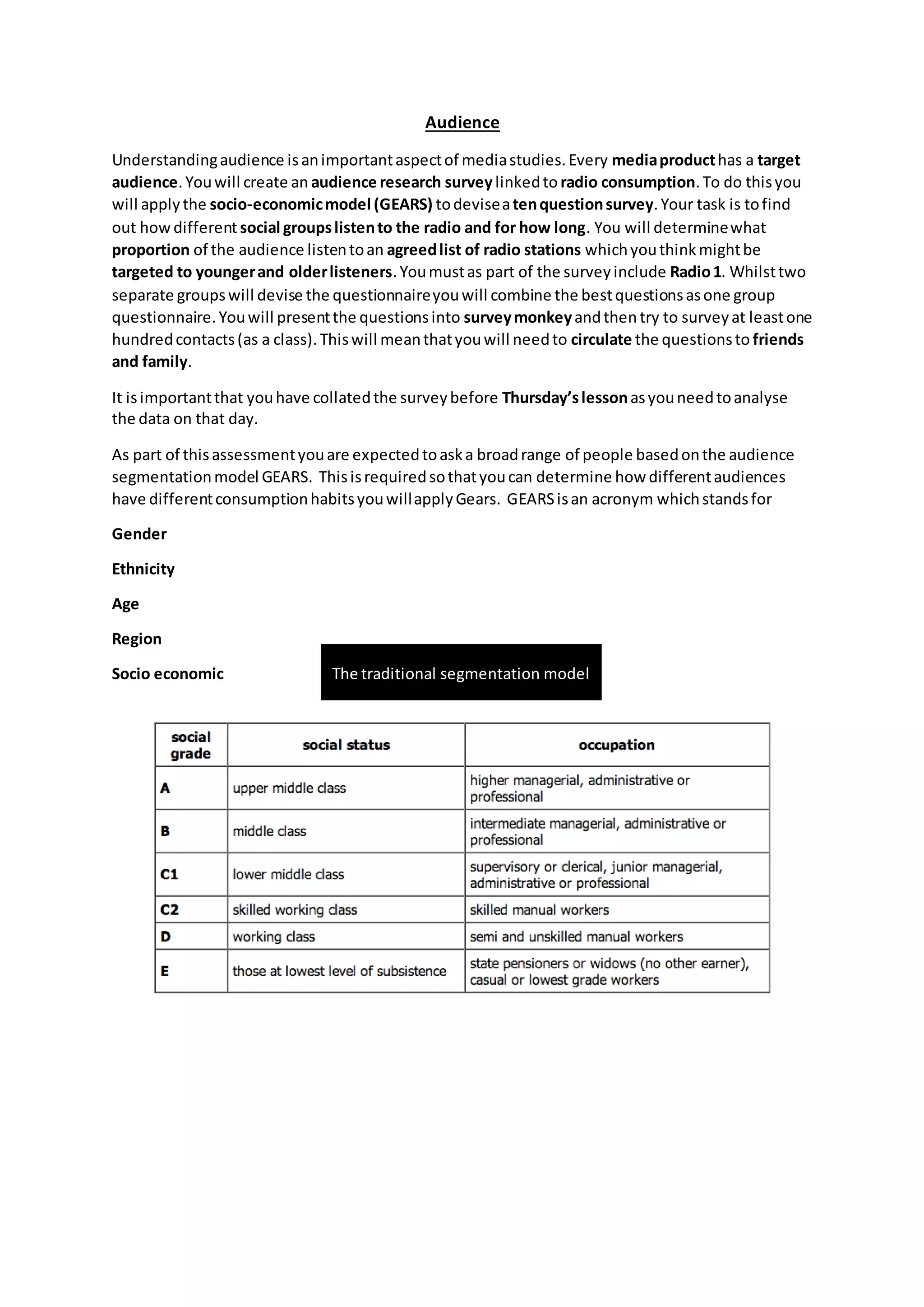
Socio economic The traditional segmentation model
People whohave aLouisVuittonbagare aspirers.
People whohave Applephonesare mainstream.
People whobuyKellogg’sare mainstream.
Uses and Gratification Model
 Developedby Bullmerand Katz.
Main reasonsforusingmedia:
 Personal Identification –todefine whowe are andrelate to a text
 (sometimescalledself-surveillance)
 Information
 Entertainment–includesescapism,distraction
 Social Interaction –to helpus socialise withlike-mindedpeople /subjecttotalkaboutwith
others,feel sympathy/empathywithcharacters.
Analysingthe results:
The resultsshowthat 45.3% of 65 participantssometimeslistentothe
radio.Overall,84.37% of participantslistentothe radio,meaningthatit
isa significantpartof ourlivesandsubsequentlyanimportantmedia
source.
Thisshowsthat 73.85% of 65 participantsare aged16-25. This could
reflectthe age of the surveyresearcher,aswe are alsointhat age
bracketso may have askedfriends/familywhoare asimilarage.The
secondbiggestage bracketis13.85%. Again,people mayhave asked
parentsand carersfor theirtime tocomplete the surveydue tothem
beingpresentinthe shortamountof time we had to complete the task,
whereas contactingorseeinganolderparticipant(e.g.grandparent)
may be more difficulttodo.
There isonlya 7.82% difference betweenfemale andmale participants,
meaningthatthe surveyquestionismore representative of itsradio
listenersbecauseitismore accurate.The smallerdifference showsthat
there wasa more equal balance of people askedaboutwhattheir
opinionsonthe radioare.Thisallowsvalidityforthe survey –creatinga
true picture of whatwe wantedto findout;whichdemographicslistento
whichradiostationsif anyand what that maysay aboutthem.
These resultsshowthatmostparticipantslistentoCapital FMor Heart FM.
Thiscouldbe due to the fact that theytypicallyplaymore modernpop,
R&B, rap and house musicwhichyoungerpeoplecanstereotypicallybe
more interestedin.If the age range variedmore,the resultsforwhichradio
stationislistenedtowouldprobablybe more varied –stationslike Classic
FM andBBC Radio maybe more popularamongstolderpeople.
Thisshowsthat due to the regioninwhichwe live in(Essex),alarge
amountof people whoparticipatedinthe surveyare white-British.
Howeveritalsoshowsthatwe dohave diversityandthatotherethnic
groupsare presentinourregion.
Most participantsinthe surveyare middle class.This couldreflectthe
olderage groupsas theywork andhave a goodeducation.The second
biggestsocial statusgroupisthe workingclass.Thisis representativeof
the age groupof 16-25 year oldsthat maystill be ineducationso
therefore domaynot have a joband earn money.
Most people thatparticipatedinthissurveylistento the radiointhe car.
Thiscouldbe due to the fact that theylistentomusiconSpotifyorapple
musicon theirphonesratherthanan actual radiostationbutlistento the
radioin the car because itisa mainfeature of the car and easyto puton.
The resultsforthe question“howlongdoyoulistentothe radioweekly?”
showthat people donotlistentothe radiotoo frequently.67.69% of the 65
participantslisten tothe radio0-3hoursa week.Thismayanchor the fact
that theymainlylistentothe radiointhe car, and due to the age bracket
beingmostly16-25 year oldstheymaynot be in the car for longenoughto
listentothe radiofor more than 0-3 hours a week.Onthe otherhand,an
olderpersonwhoisretiredmayhave more time andtherefore listentothe
radioa lotmore than a 16-25 yearold.
Lots of people (more thanhalf of all participantssaidthattheyalsolistento
musicon Spotify.Thismaybe a popularalternative forlisteningtomusicdue
to the fact that there isno advertsor talkingfromradiopresenters.
Individualsmayfindthismore beneficial astheycanlistentoany songthey
wishto,downloadsongstolistentowhentheydon’thave dataor Wi-Fi,and
theydon’thave to listentoradioeditedsongswithnoswearing.

Radio survey

  • 1.
    Audience Understandingaudience isanimportantaspectof mediastudies.Everymediaproducthas a target audience.Youwill create an audience research surveylinkedtoradio consumption.To do thisyou will applythe socio-economicmodel (GEARS) todeviseatenquestionsurvey.Your task is tofind out howdifferent social groupslistento the radio and for how long. You will determinewhat proportion of the audience listentoan agreedlist of radio stations whichyouthinkmightbe targeted to youngerand olderlisteners.Youmustas part of the surveyinclude Radio1. Whilsttwo separate groupswill devise the questionnaireyouwill combine the bestquestionsasone group questionnaire.Youwill presentthe questionsinto surveymonkeyandthen try to surveyat leastone hundredcontacts(as a class).Thiswill meanthatyouwill needto circulate the questionsto friends and family. It isimportantthat youhave collatedthe surveybefore Thursday’slessonasyouneedtoanalyse the data on that day. As part of thisassessmentyouare expectedtoaska broadrange of people basedonthe audience segmentationmodel GEARS. Thisisrequiredsothatyoucan determine how differentaudiences have differentconsumptionhabitsyouwillapplyGears. GEARSisan acronym whichstandsfor Gender Ethnicity Age Region Socio economic The traditional segmentation model
  • 3.
    People whohave aLouisVuittonbagareaspirers. People whohave Applephonesare mainstream. People whobuyKellogg’sare mainstream. Uses and Gratification Model  Developedby Bullmerand Katz. Main reasonsforusingmedia:  Personal Identification –todefine whowe are andrelate to a text  (sometimescalledself-surveillance)  Information  Entertainment–includesescapism,distraction  Social Interaction –to helpus socialise withlike-mindedpeople /subjecttotalkaboutwith others,feel sympathy/empathywithcharacters. Analysingthe results: The resultsshowthat 45.3% of 65 participantssometimeslistentothe radio.Overall,84.37% of participantslistentothe radio,meaningthatit isa significantpartof ourlivesandsubsequentlyanimportantmedia source. Thisshowsthat 73.85% of 65 participantsare aged16-25. This could reflectthe age of the surveyresearcher,aswe are alsointhat age bracketso may have askedfriends/familywhoare asimilarage.The secondbiggestage bracketis13.85%. Again,people mayhave asked parentsand carersfor theirtime tocomplete the surveydue tothem beingpresentinthe shortamountof time we had to complete the task, whereas contactingorseeinganolderparticipant(e.g.grandparent) may be more difficulttodo. There isonlya 7.82% difference betweenfemale andmale participants, meaningthatthe surveyquestionismore representative of itsradio listenersbecauseitismore accurate.The smallerdifference showsthat there wasa more equal balance of people askedaboutwhattheir opinionsonthe radioare.Thisallowsvalidityforthe survey –creatinga true picture of whatwe wantedto findout;whichdemographicslistento whichradiostationsif anyand what that maysay aboutthem.
  • 4.
    These resultsshowthatmostparticipantslistentoCapital FMorHeart FM. Thiscouldbe due to the fact that theytypicallyplaymore modernpop, R&B, rap and house musicwhichyoungerpeoplecanstereotypicallybe more interestedin.If the age range variedmore,the resultsforwhichradio stationislistenedtowouldprobablybe more varied –stationslike Classic FM andBBC Radio maybe more popularamongstolderpeople. Thisshowsthat due to the regioninwhichwe live in(Essex),alarge amountof people whoparticipatedinthe surveyare white-British. Howeveritalsoshowsthatwe dohave diversityandthatotherethnic groupsare presentinourregion. Most participantsinthe surveyare middle class.This couldreflectthe olderage groupsas theywork andhave a goodeducation.The second biggestsocial statusgroupisthe workingclass.Thisis representativeof the age groupof 16-25 year oldsthat maystill be ineducationso therefore domaynot have a joband earn money. Most people thatparticipatedinthissurveylistento the radiointhe car. Thiscouldbe due to the fact that theylistentomusiconSpotifyorapple musicon theirphonesratherthanan actual radiostationbutlistento the radioin the car because itisa mainfeature of the car and easyto puton.
  • 5.
    The resultsforthe question“howlongdoyoulistentotheradioweekly?” showthat people donotlistentothe radiotoo frequently.67.69% of the 65 participantslisten tothe radio0-3hoursa week.Thismayanchor the fact that theymainlylistentothe radiointhe car, and due to the age bracket beingmostly16-25 year oldstheymaynot be in the car for longenoughto listentothe radiofor more than 0-3 hours a week.Onthe otherhand,an olderpersonwhoisretiredmayhave more time andtherefore listentothe radioa lotmore than a 16-25 yearold. Lots of people (more thanhalf of all participantssaidthattheyalsolistento musicon Spotify.Thismaybe a popularalternative forlisteningtomusicdue to the fact that there isno advertsor talkingfromradiopresenters. Individualsmayfindthismore beneficial astheycanlistentoany songthey wishto,downloadsongstolistentowhentheydon’thave dataor Wi-Fi,and theydon’thave to listentoradioeditedsongswithnoswearing.