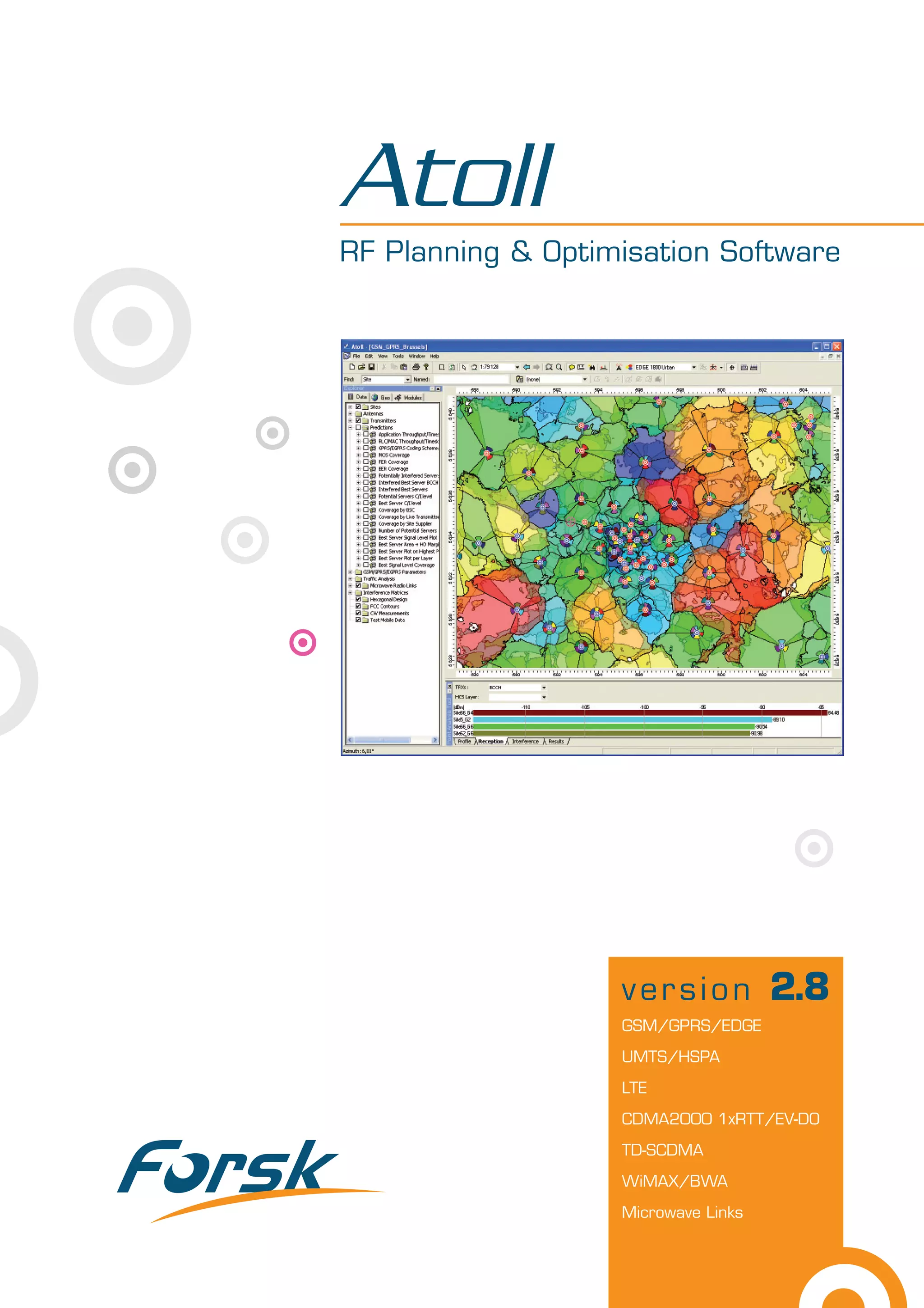
RF Planning & Optimisation Software
version 2.8
GSM/GPRS/EDGE
UMTS/HSPA
LTE
CDMA2000 1xRTT/EV-DO
TD-SCDMA
WiMAX/BWA
Microwave Links
experts in radio network planning
& optimisation tools
Forsk is an independent company providing RF planning and optimisation software solutions to the wireless
industry since 1987. Forsk is completely independent from equipment suppliers and telecom operators.
In 1997, Forsk released the first version of Atoll, its flagship RF planning software. Since then, Atoll has
remained the most advanced RF planning and optimisation platform available and has reached a leading
position in the market with more than 3500 installed licenses.
Forsk’s success with Atoll has come from our commitment to 5 key factors:
Independence
Forsk’s commercial success and strong financial position has ensured its independence of operators,
equipment suppliers and financial institutions. Being independent, Forsk can maintain a long-term strategy
for the developmentof Atoll and its relationships with customers and partners.
R&D
Forsk is totally focused on developing wireless network design and optimisation software. Forsk has a
strong and committed R&D team which both keeps Atoll in line with the latest developments in the industry
and maintains joint R&D projects for Atoll with a number of operators, equipment suppliers and partners.
This R&D effort allowed Forsk to be the 1st on the market with 3G RF planning tools and to remain the
leader in 3G simulation today. In 2008, Forsk was the 1st
on the market with a LTE planning tool.
Software Development Expertise
Forsk uniquely combines in-depth knowledge of network design and software development expertise.Forsk’s
team has an unmatched experience in developing wireless network design and optimisation software, which
enables Forsk to provide its customers with powerful, scalable and user-friendly radio planning products.
Open Platform Concept
Forsk designed Atoll from the start as an open and flexible platform. Since the first version of Atoll, Forsk
has been delivering development tools and partnering with 3rd
party developers able to supply specialised
complementary solutions. More additional solutions are available for Atoll, from the most renowned
suppliers, than for any other RF planning tool.These solutions cover areas such as propagation modelling,
automatic optimisation, dynamic simulation, QoS analysis and automatic frequency planning.
Customer Support
Forsk aims at building and maintaining long-term relationships with its customers in their use of Atoll.The
quality and reactivity of our technical support are key elements of these relationships.
This unique combination of strengths and a long and consistent record make the Forsk difference.
Today, Forsk is a global supplier with 200+ customers in 70 countries and strategic partnerships with
major players in the industry including AT&T,Vodafone, Alcatel-Lucent, Huawei and Nortel.
Forsk distributes and supports Atoll directly from offices and technical support centres in France,
USA and China and also through a world-wide network of distributors and partners.
Highlights
Advanced Network Design Features
Atoll incorporates a high-performance propagation
calculation engine, supports hierarchical networks,
multi-service traffic modelling, automatic frequency/
code planning and optimisation. Atoll supports GSM/
GPRS/EDGE,UMTS/HSPA,LTE,CDMA20001xRTT/
EV-DO, TD-SCDMA, WiMAX and Microwave links.
It also includes support for multi-technology network
planning (e.g., GSM/UMTS/LTE) including inter-
technology handover modelling.
Integrated Optimisation Tools
Atoll includes a set of fully integrated AFP (Automatic
Frequency Planning) and ACP (Automatic Cell
Planning) tools, allowing operators to perform design
and optimisation tasks from a single application using
a single database and IT infrastructure. Optimisation
tools are available for GSM, UMTS, LTE and
WiMAX.
Open and Flexible Architecture
Atoll is an open platform for network design and
optimisation. Atoll supports multi-user environments
through an innovative database architecture that
provides data sharing, data integrity management
and easy integration with other IT systems. Atoll’s
scripting capabilities allow easy automation using
a standard macro language. Atoll also includes an
advanced Software Development Kit (SDK) that
facilitates customisation and IT integration. Atoll also
has the largest range of compatible 3rd
party products
on the market.
State-of-the-art GIS Features
Atollsupportsmulti-format/multi-resolutiongeographical
databases. Large, dense urban and country-wide
databases are supported and displayed interactively
as multiple layers including engineering and prediction
plots. Atoll also features an integrated vector/raster
cartography editor.
Distributed and Parallel Computing
Atoll allows distributing calculations over several
workstations and supports parallel computing on
multi-processor servers, thus dramatically reducing
calculation times and getting the most out of hardware.
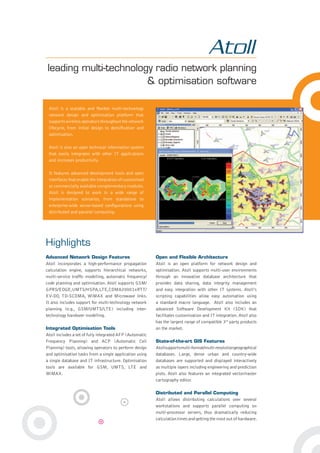
Atoll is a scalable and flexible multi-technology
network design and optimisation platform that
supports wireless operators throughout the network
lifecycle, from initial design to densification and
optimisation.
Atoll is also an open technical information system
that easily integrates with other IT applications
and increases productivity.
It features advanced development tools and open
interfaces that enable the integration of customised
or commercially available complementary modules.
Atoll is designed to work in a wide range of
implementation scenarios, from standalone to
enterprise-wide server-based configurations using
distributed and parallel computing.
leading multi-technology radio network planning
& optimisation software
8pages Atoll 2.8.indd 18pages Atoll 2.8.indd 1 29/01/09 20:14:0929/01/09 20:14:09
modular configuration
Atoll Core is the central module that supports the user interface, the GIS features, the propagation modelling
engine, all data management services, interfaces and software development tools. All technology modules run on
top of Atoll Core.
Atoll 2.8 also features Automatic Frequency Planning tools and Automatic Cell Planning tools that deliver,on top
of the technology modules, a comprehensive set of automatic network design and optimisation functionalities.
In addition to the modules offered by Forsk, specialised products are available from 3rd
party partners for specific
applications such as urban propagation models (WaveSight from Wavecall and Volcano from Siradel), in-building
engineering design software (RF-vu from iBwave) optimisation and post-processing tools.
Atoll Microwave is a comprehensive Microwave Link planning tool. It is based on the Atoll Core platform and
has full database compatibility with Atoll radio-planning configurations. See the Atoll Microwave brochure for
more information about this product.
The technology matrix below shows modules suitable for each technology. Several technology modules can be
combined in the same Atoll configuration for planning integrated multi-technology projects.
Atoll Core
GSM
UMTS
LTE
CDMA2000
TD-SCDMA
WiMAX
Microwave Links
Measurements
AFP
ACP
Atoll
modules
> Technologies > Required > Optional for the selected technology
GSM
/GPRS/EDGE
U
M
TS/H
SPA
LTE
CDM
A2000
1xRTT/EV-DO
TD-SCDM
A
W
iM
AX/BW
A
M
icrow
ave
Links
8pages Atoll 2.8.indd 28pages Atoll 2.8.indd 2 29/01/09 20:14:0929/01/09 20:14:09
GIS Features
Optimised cartographic database supporting Digital
Elevation Models, clutter data (type and height),
3D building data (vector/raster),traffic Data,scanned
maps, vector data, population and climate data.
Integrated cartogra phy editor (vector/raster)
Interface with GIS tools: MapInfo, ArcView,
Google Earth
Support for Web Map Services (WMS)
Propagation Modelling
Support for dual-resolution pathloss matrices:
high resolution results near transmitter and lower
resolution results far from transmitter for interference
calculation
Full support for multi-resolution prediction plots
Comprehensive integrated propagation model library
3rd
party urban/microcell propagation models (optional)
Automatic propagation model tuning using CW
or test mobile data
Pathloss matrix adjustment using prediction/drive
test interpolation
Integration of external propagation models
through an API and a C++ development kit
User and Database Management
Advanced administration module supporting data
access and user privilege management
Flexible database structure allowing integration
of user-defined parameters and custom fields
Multi-user support including database consistency
management, data synchronisation and user
disconnection/reconnection from/to the database
Support for standalone/centralised/distributed
configurations
Advanced import/export features allowing quick
data migration from other RF planning tools
Task Automation and Scripting
Scripting language allowing integration of user-
defined macros
User-defined calculation batch based on macros
and scripts
Distributed Computing
Distributed computing on networked workstations
and servers
Parallel computing on quad- and dual-processor systems
Printing and Reports
Flexible report generator including traffic,
population and clutter-based statistics
User-defined reports based on macros
Export of reports and prediction plots into other software
Any printing devices supported up to A0
Measurements Module
CW measurements
• Import, display and analysis of CW data
• Prediction/measurements comparison
and statistical analysis
• Automatic propagation model tuning using CW
measurements
Test mobile data
• Import,display and analysis of test mobile data
• Call events display and analysis
• Automatic propagation model tuning using test
mobile data
• Pathloss matrix adjustment using prediction/
drive test interpolation
powerful RF design & optimisation platform
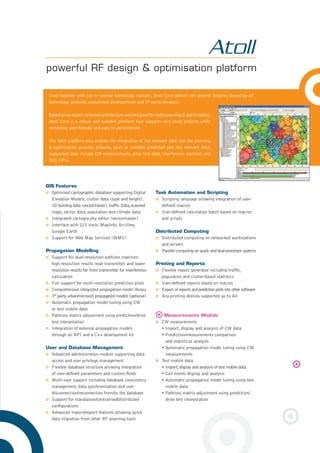
Used together with one or several technology modules, Atoll Core delivers the general features shared by all
technology modules, customised developments and 3rd
party products.
Based on an object-oriented architecture and designed for radio planning & optimisation,
Atoll Core is a robust and scalable platform that supports very large projects while
remaining user-friendly and easy to administrate.
The Atoll platform also enables the integration of live network data into the planning
& optimisation process, allowing users to combine predicted and real network data.
Supported data include CW measurements, drive test data, interference matrices and
OSS KPIs.
8pages Atoll 2.8.indd 38pages Atoll 2.8.indd 3 29/01/09 20:14:0929/01/09 20:14:09
GSM/GPRS/EDGE
Network Modelling
Support of dual-band networks
Support of HCS (Hierarchical Cell Structure)
Support for frequency hopping (baseband &
synthesised), DTX and AMR
Modelling of GPRS and E-GPRS
Advanced service modelling
Service Planning and Analysis
Cell and network coverage analysis
GPRS/EGPRS/EGPRS2 prediction plots
(throughput, coding scheme selection)
Interference analysis
QoS analysis: FER/BER/BLER/MOS
prediction plots
Neighbour planning and handover analysis
Traffic Analysis
Multi-service traffic map generation from
multiple sources: vector, raster and live traffic data
Traffic spreading between cell layers with traffic
overflow modelling
Cell dimensioning for mixed voice/data traffic
and timeslot configurations
Traffic analysis including calculation of KPIs
such as packet delay, blocking rate, etc.
Interference Matrix Generation
Prediction and drive test-based interference
matrices
Support of subcell-based (e.g., BCCH,TCH)
quality thresholds
Open format allowing editing and modifying
interference matrices using 3rd party applications
GSM/UMTS Co-planning
Site sharing
Simultaneous display and analysis of GSM
and UMTS networks
Inter-technology handover modelling based
on proven intra/inter-technology neighbour
allocation algorithms
Inter-technology interference analysis
(e.g GSM 900 and UMTS 900)
Automatic Frequency Planning - AFP
Advanced algorithm based on a soft penalty
approach
User-definable constraints and editable cost
function
Allocation of frequency hopping parameters
(HSN, MAIO, MAL)
Integration with 3rd party AFP tools through
an open API
Automatic Cell Planning - ACP
Automatic optimisation of network parameters
to increase coverage & capacity
Site selection and activation for greenfield
and densification scenarios
Antenna selection & parameter optimisation
(azimuth & tilt)
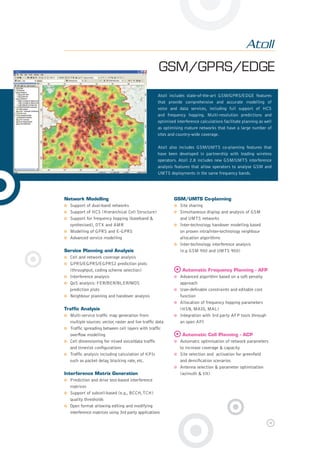
Atoll includes state-of-the-art GSM/GPRS/EDGE features
that provide comprehensive and accurate modelling of
voice and data services, including full support of HCS
and frequency hopping. Multi-resolution predictions and
optimised interference calculations facilitate planning as well
as optimising mature networks that have a large number of
sites and country-wide coverage.
Atoll also includes GSM/UMTS co-planning features that
have been developed in partnership with leading wireless
operators. Atoll 2.8 includes new GSM/UMTS interference
analysis features that allow operators to analyse GSM and
UMTS deployments in the same frequency bands.
8pages Atoll 2.8.indd 48pages Atoll 2.8.indd 4 29/01/09 20:14:0929/01/09 20:14:09
Network Modelling
Support for multiple carriers
UMTS equipment modelling including RRM
and inter-carrier power sharing
Advanced bearer and service modelling
HSPA and HSPA+ modelling
MBMS modelling
MIMO modelling
VoIP modelling
Traffic Modelling
Modelling of multiple circuit and packet
switched services
Modelling of user equipment, user profiles
and environment types
Multi-service traffic map generation from multiple
sources: vector, raster and live traffic data
Simulation and Analysis
State-of-the-art Monte Carlo UMTS/
HSPA/MBMS simulator including DL and UL
power control, RRM, HSDPA/HSUPA to R99
downgrading and carrier allocation algorithms
Real-time point analysis tool
Generation of prediction plots,
based on simulations or on user-defined cell
load figures, including:
• Ec/Io prediction plots
• Downlink and Uplink Eb/Nt prediction plots
• Service areas
• Number of servers
• Handover areas
• Interference and pilot pollution
• BER/FER/BLER
• HSPA prediction plots
• MBMS service area
Neighbour and Scrambling Code Planning
Manual and automatic multi-carrier neighbour
planning
Automatic scrambling code allocation
supporting various allocation strategies
Scrambling code allocation analysis tool
including SC interference plots
GSM/UMTS Co-planning
Site sharing
Simultaneous display and analysis of 2G
and 3G networks
Inter-technology handover modelling based
on proven intra/inter-technology neighbour
allocation algorithms
Inter-technology interference analysis
(e.g GSM 900 and UMTS 900)
Automatic Cell Planning - ACP
Automatic optimisation of network parameters
to increase coverage & capacity
Site selection and activation for greenfield
and densification scenarios
Antenna selection & parameter optimisation
(azimuth & tilt)
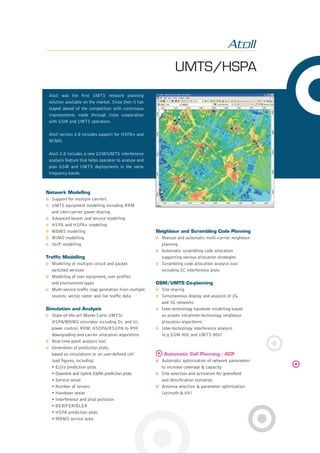
Atoll was the first UMTS network planning
solution available on the market. Since then it has
stayed ahead of the competition with continuous
improvements made through close cooperation
with GSM and UMTS operators.
Atoll version 2.8 includes support for HSPA+ and
MIMO.
Atoll 2.8 includes a new GSM/UMTS interference
analysis feature that helps operator to analyse and
plan GSM and UMTS deployments in the same
frequency bands.
UMTS/HSPA
8pages Atoll 2.8.indd 58pages Atoll 2.8.indd 5 29/01/09 20:14:0929/01/09 20:14:09
LTE
Network and Radio Parameter Modelling
Support of various frequency bands, channel
bandwidths, and sampling frequencies
Support of TDD and FDD duplexing methods
Support of LTE OFDMA (DL) and SC-FDMA
(UL) parameters:
• Frame structure, subframes, slots and cyclic
prefixes
• Resource blocks, subcarrier widths, reference
signals
• Control channel overheads:reference signals,
PDCCH, PUCCH, P-SCH, S-SCH etc.
Support for multiple modulation types
and coding schemes
MIMO modelling: transmit diversity, spatial
multiplexing (SU-MIMO), uplink collaborative
MIMO (MU-MIMO), AMS
Traffic Modelling
Modelling of voice and data services
Multi-service traffic demand maps generated
from multiple sources: vector, raster, and live
traffic data
Subscriber traffic modelling
Simulation and Analysis
LTE Monte-Carlo simulator including
power control, advanced RRM and scheduling
algorithms, support for MIMO
Generation of prediction plots, based on simulation
results or on user-defined cell load figures including:
• Cell and network coverage analysis
• Uplink and downlink interference analysis
• Uplink and downlink bearer coverage predictions
• Uplink and downlink throughput coverage predictions
• Uplink and downlink quality indicator
prediction plot
• Aggregate throughput prediction plot
Capacity Planning
Neighbour and Physical Cell ID Planning
Manual and automatic neighbour planning
Automatic CellID/Cell Group ID planning
GSM/UMTS/LTE
and CDMA2000/LTE co-planning
Site sharing
Simultaneous display and analysis of 2G/3G
and LTE networks
Inter-technology handover modelling
Inter-technology interference analysis
(e.g UMTS/LTE, CDMA2000/LTE)
Automatic Frequency Planning - AFP
Generation of interference matrices
User-definable constraints and editable cost function
Allocation of channels and fractional frequency
planning (FFP)
Automatic Cell Planning - ACP
Automatic optimisation of network parameters
to increase coverage & capacity
Site selection and activation for greenfield
and densification scenarios
Antenna selection & parameter optimisation
(azimuth & tilt)
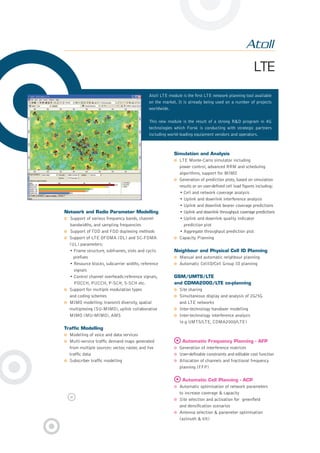
Atoll LTE module is the first LTE network planning tool available
on the market. It is already being used on a number of projects
worldwide.
This new module is the result of a strong R&D program in 4G
technologies which Forsk is conducting with strategic partners
including world-leading equipment vendors and operators.
8pages Atoll 2.8.indd 68pages Atoll 2.8.indd 6 29/01/09 20:14:0929/01/09 20:14:09
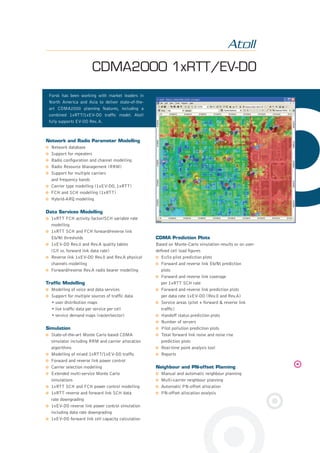
Forsk has been working with market leaders in
North America and Asia to deliver state-of-the-
art CDMA2000 planning features, including a
combined 1xRTT/1xEV-DO traffic model. Atoll
fully supports EV-DO Rev. A.
CDMA2000 1xRTT/EV-DO
Network and Radio Parameter Modelling
Network database
Support for repeaters
Radio configuration and channel modelling
Radio Resource Management (RRM)
Support for multiple carriers
and frequency bands
Carrier type modelling (1xEV-DO, 1xRTT)
FCH and SCH modelling (1xRTT)
Hybrid-ARQ modelling
Data Services Modelling
1xRTT FCH activity factor/SCH variable rate
modelling
1xRTT SCH and FCH forward/reverse link
Eb/Nt thresholds
1xEV-DO Rev.0 and Rev.A quality tables
(C/I vs. forward link data rate)
Reverse link 1xEV-DO Rev.0 and Rev.A physical
channels modelling
Forward/reverse Rev.A radio bearer modelling
Traffic Modelling
Modelling of voice and data services
Support for multiple sources of traffic data
• user distribution maps
• live traffic data per service per cell
• service demand maps (raster/vector)
Simulation
State-of-the-art Monte Carlo based CDMA
simulator including RRM and carrier allocation
algorithms
Modelling of mixed 1xRTT/1xEV-DO traffic
Forward and reverse link power control
Carrier selection modelling
Extended multi-service Monte Carlo
simulations
1xRTT SCH and FCH power control modelling
1xRTT reverse and forward link SCH data
rate downgrading
1xEV-DO reverse link power control simulation
including data rate downgrading
1xEV-DO forward link cell capacity calculation
CDMA Prediction Plots
Based on Monte-Carlo simulation results or on user-
defined cell load figures
Ec/Io pilot prediction plots
Forward and reverse link Eb/Nt prediction
plots
Forward and reverse link coverage
per 1xRTT SCH rate
Forward and reverse link prediction plots
per data rate 1xEV-DO (Rev.0 and Rev.A)
Service areas (pilot + forward & reverse link
traffic)
Handoff status prediction plots
Number of servers
Pilot pollution prediction plots
Total forward link noise and noise rise
prediction plots
Real-time point analysis tool
Reports
Neighbour and PN-offset Planning
Manual and automatic neighbour planning
Multi-carrier neighbour planning
Automatic PN-offset allocation
PN-offset allocation analysis
8pages Atoll 2.8.indd 78pages Atoll 2.8.indd 7 29/01/09 20:14:0929/01/09 20:14:09
Network and Radio Parameter Modelling
Support for TDD and FDD PMP networks
Support for multiple frequency bands
Subcarrier configuration and frame structure
modelling
Support for different permutation zones
Segmentation and permutation zone modelling
WiMAX reception equipment modelling
Site database can be shared with Atoll Microwave
for backhaul planning
Traffic Modelling
Modelling of voice and data services
Support for all WiMAX QoS classes
(UGS, rtPS, ErtPS, nrtPS, and BE)
Modelling of customer premises equipment
and user profiles
Multi-service traffic demand maps generated
from multiple sources: vector, raster,
and live traffic data
Subscriber traffic modelling
Subscriber Modelling
Fixed subscribers database
Subscriber display on map
Automatic & manual connection of subscribers
to serving cells
Analysis of received signal level, interference,
bearer (adaptive MCS) and throughput for
each subscriber
Simulation and Analysis
SUI/Erceg propagation model for WiMAX
WiMAX Monte-Carlo simulator including
power control, advanced RRM and scheduling
algorithms, support for adaptive antenna
systems and MIMO
Generation of prediction plots,
based on simulation results or on user-defined
cell load figures including:
• Cell and network coverage analysis
• Uplink and downlink interference analysis
• Uplink and downlink bearer coverage
predictions
• Uplink and downlink throughput coverage
predictions
• Uplink and downlink quality prediction plot
• Aggregate throughput prediction plot
Neighbour and Preamble Index Planning
Manual and automatic multi-carrier neighbour
planning
Automatic preamble index and segment
assignment (Fractional Frequency Plan, FFP)
Automatic Frequency Planning - AFP
Generation of interference matrices
User-definable constraints and editable cost
function
Allocation of carrier channels and preamble index
Automatic Cell Planning - ACP
Automatic optimisation of network parameters
to increase coverage & capacity
Site selection and activation for greenfield
and densification scenarios
Antenna selection & parameter optimisation
(azimuth & tilt)
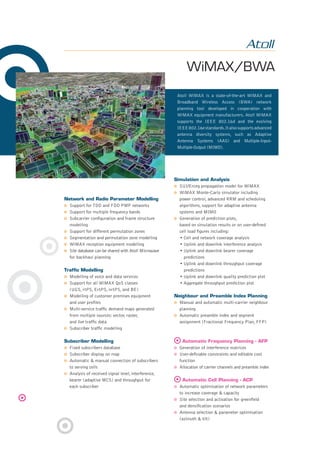
Atoll WiMAX is a state-of-the-art WiMAX and
Broadband Wireless Access (BWA) network
planning tool developed in cooperation with
WiMAX equipment manufacturers. Atoll WiMAX
supports the IEEE 802.16d and the evolving
IEEE802.16estandards.Italsosupportsadvanced
antenna diversity systems, such as Adaptive
Antenna Systems (AAS) and Multiple-Input-
Multiple-Output (MIMO).
WiMAX/BWA
8pages Atoll 2.8.indd 88pages Atoll 2.8.indd 8 29/01/09 20:14:0929/01/09 20:14:09
TD-SCDMA
Network Modelling
Support for multiple carriers
TD-SCDMA equipment modelling including
RRM and capacity parameters
Timeslot configuration modelling including
switching point definition for each carrier
Advanced service modelling
HSDPA modelling
UpPCH shifting modelling
MBMS modelling
Traffic Modelling
Modelling of multiple circuit and packet
switched services
Modelling of user equipment, user profiles
and environment types
Multi-service traffic map generation from
multiple sources: vector, raster and live traffic
data
Simulation and Analysis
TD-SCDMA Monte-Carlo simulator including
timeslot modelling, smart antenna modelling,
and Dynamic Channel Allocation (DCA) modelling
Generation of prediction plots, based on
simulations or on user-defined per-timeslot cell
load figures including:
• P-CCPCH RSCP coverage
• DL and UL Eb/Nt coverage
• Required power
• Effective service areas
• Cell-to-cell interference
• UpPCH interference
• P-CCPCH pollution
• Offered/required capacity per cell
• DwPCH, UpPCH coverage
• Baton handover
• HSDPA prediction plots: CQI, RLC, MAC
and application throughput per pixel
• MBMS service area
Real-time point analysis tool
Smart Antenna Modelling
Switched beam, adaptive beam,
and beamforming smart antennas modelling
Modelling of C/I gains based on smart antenna
parameters and angular spread
Support for user-defined smart antenna
parameters and algorithms
Smart antennas considered in Monte Carlo
simulations and prediction plots
Neighbour and Scrambling Code Planning
Manual and automatic multi-carrier neighbour
planning
Automatic scrambling code allocation
supporting various allocation strategies
Scrambling code allocation analysis tool
2G/3G Co-planning
Site sharing
Simultaneous display and analysis of 2G
and 3G networks
Inter-technology handover modelling based
on advanced inter-technology neighbour
allocation algorithms
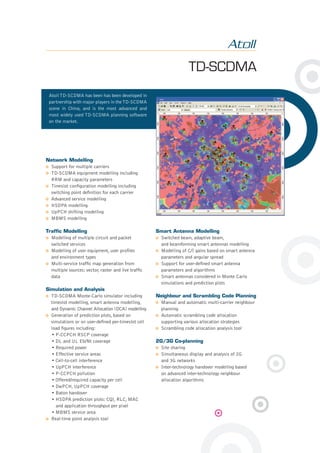
Atoll TD-SCDMA has been has been developed in
partnership with major players in theTD-SCDMA
scene in China, and is the most advanced and
most widely used TD-SCDMA planning software
on the market.
Training & Services
Implementation
Forsk can provide a turn-key implementation of
Atoll on operator premises, including software
installation and system configuration. Forsk can
migrate data from a previous planning tool into
Atoll, therefore delivering a solution that is ‘ready
to use’ right after the installation.
Training
Forsk has a comprehensive training course portfolio
that covers all activities related to Atoll: user
training, administrator training, technology module
and specialised module training (e.g propagation
model calibration).
Training courses can be delivered at our training
centres in Europe, North-America and Asia as well
as on customer premises. Forsk can also deliver
customised training courses upon request.
Mentoring
Forsk provides on-site post-training support in
order to help operators within their first few weeks
of operational use of Atoll. During this phase,
operators get a comprehensive knowledge transfer
from Atoll experts with long experience of similar
situations.
Custom Software Development
Forsk can develop additional modules for Atoll,
in order to meet specific integration or functional
requirements. Such modules are developed using
the standard Atoll Software Development Kit
(SDK) in order to achieve full integration and
make future evolutions and maintenance easy.
Helpdesk & Support Portal
Once the Atoll implementation project has been
completed, operators get a continuous access to
Forsk support through the Atoll Helpdesk and the
Support Portal. The Atoll support portal provides
access to a set of online resources and allows users
to log technical questions to the Forsk helpdesk/
support team.
Forsk offers a complete range of services to operators for a quick
implementation of Atoll and in-depth knowledge transfer to users. These
services enable operators to benefit from the productivity increase
delivered by Atoll in the shortest period of time. Once the implementation
phase is complete, users get assistance through our helpdesk and Forsk
can also provide on-site assistance when needed.
Implementation
Training
Mentoring
Custom Software Development
Helpdesk & Support Portal
Software Development Kit
3rd
Party Products
Atoll Developer’s Toolkit
Atoll is an open platform and includes development tools that allow operators or 3rd
party developers to
customise their working environment and easily integrate Atoll with other IT applications.This key feature
providesflexibilityandacapacitytoquicklyaddcustomisedmodulesthatnootherRFplanningsolutiondelivers.
The Atoll developer’s toolkit includes a general programming interface and some dedicated interfaces:
The general interface provides access to all Atoll project data allowing developers to add their own
functions to the Atoll user interface. This extremely powerful feature enables the integration of a wide
range of applications with Atoll, including simulation, optimisation and configuration tools. It also allows
the automation of tasks in Atoll, such as calculations and simulations, using VBScript.
Dedicated interfaces allow the integration of specialised modules such as propagation models, smart
antenna models and frequency planning applications.
Customisation can be performed using external scripting tools or Atoll’sVisual Studio .NET Software Development Kit.
Forsk also offers training courses and support services for developers.
Technology Partners
Forsk’s “3rd
party developer program” aims at helping developers to integrate their solutions with Atoll
through the Atoll SDK. Forsk has been providing its partners with developer licenses and support for
several years. As a result, a wide range of “best of breed”applications are available to Atoll users. Such
3rd
party applications include urban propagation models, automatic optimisation tools, frequency planning
applications and simulation tools.
Check out the “Partners” section at www.forsk.com for more information about our technology partners.
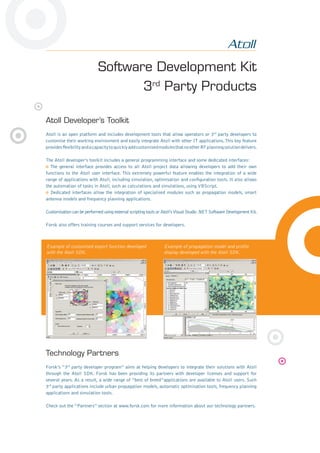
Example of customised export function developed
with the Atoll SDK.
Example of propagation model and profile
display developed with the Atoll SDK.
Hardware
and software requirements
Minimum recommended configuration
for workstations or laptops
• Intel Xeon (or equivalent)
with 2 GB of RAM
• Microsoft Windows 2000,
XP Professional and Vista
Relational Database Management
System (not required for stand alone
configurations)
• Oracle 9i and 10g
• Sybase Adaptive Server V12.5
• Microsoft SQL Server 2005
• Microsoft Access
Head Office
7, rue des Briquetiers
31700 Blagnac - France
Tel: +33 562 747 210
Fax: +33 562 747 211
US Office
200 South Wacker Drive - Suite 3100
Chicago, IL 60606 - USA
Tel: +1 312 674 4846
Fax: +1 312 674 4847
China Office
Suite 302, 3/F,West Tower,
Jiadu Commercial Building,
No.66 Jianzhong Road,
Tianhe Hi-Tech Industrial Zone,
Guangzhou, 510665 P.R. of China
Tel: +86 20 8553 8938
Fax: +86 20 8553 8285
January2009–Databases:courtesyofInfoterra
MOTOROLAandtheStylizedMLogoareregisteredintheU.S.PatentandTrademarkOffice

Radio network planning for 4G LTE

  • 1.
    RF Planning &Optimisation Software version 2.8 GSM/GPRS/EDGE UMTS/HSPA LTE CDMA2000 1xRTT/EV-DO TD-SCDMA WiMAX/BWA Microwave Links
  • 2.
    experts in radionetwork planning & optimisation tools Forsk is an independent company providing RF planning and optimisation software solutions to the wireless industry since 1987. Forsk is completely independent from equipment suppliers and telecom operators. In 1997, Forsk released the first version of Atoll, its flagship RF planning software. Since then, Atoll has remained the most advanced RF planning and optimisation platform available and has reached a leading position in the market with more than 3500 installed licenses. Forsk’s success with Atoll has come from our commitment to 5 key factors: Independence Forsk’s commercial success and strong financial position has ensured its independence of operators, equipment suppliers and financial institutions. Being independent, Forsk can maintain a long-term strategy for the developmentof Atoll and its relationships with customers and partners. R&D Forsk is totally focused on developing wireless network design and optimisation software. Forsk has a strong and committed R&D team which both keeps Atoll in line with the latest developments in the industry and maintains joint R&D projects for Atoll with a number of operators, equipment suppliers and partners. This R&D effort allowed Forsk to be the 1st on the market with 3G RF planning tools and to remain the leader in 3G simulation today. In 2008, Forsk was the 1st on the market with a LTE planning tool. Software Development Expertise Forsk uniquely combines in-depth knowledge of network design and software development expertise.Forsk’s team has an unmatched experience in developing wireless network design and optimisation software, which enables Forsk to provide its customers with powerful, scalable and user-friendly radio planning products. Open Platform Concept Forsk designed Atoll from the start as an open and flexible platform. Since the first version of Atoll, Forsk has been delivering development tools and partnering with 3rd party developers able to supply specialised complementary solutions. More additional solutions are available for Atoll, from the most renowned suppliers, than for any other RF planning tool.These solutions cover areas such as propagation modelling, automatic optimisation, dynamic simulation, QoS analysis and automatic frequency planning. Customer Support Forsk aims at building and maintaining long-term relationships with its customers in their use of Atoll.The quality and reactivity of our technical support are key elements of these relationships. This unique combination of strengths and a long and consistent record make the Forsk difference. Today, Forsk is a global supplier with 200+ customers in 70 countries and strategic partnerships with major players in the industry including AT&T,Vodafone, Alcatel-Lucent, Huawei and Nortel. Forsk distributes and supports Atoll directly from offices and technical support centres in France, USA and China and also through a world-wide network of distributors and partners.
  • 3.
    Highlights Advanced Network DesignFeatures Atoll incorporates a high-performance propagation calculation engine, supports hierarchical networks, multi-service traffic modelling, automatic frequency/ code planning and optimisation. Atoll supports GSM/ GPRS/EDGE,UMTS/HSPA,LTE,CDMA20001xRTT/ EV-DO, TD-SCDMA, WiMAX and Microwave links. It also includes support for multi-technology network planning (e.g., GSM/UMTS/LTE) including inter- technology handover modelling. Integrated Optimisation Tools Atoll includes a set of fully integrated AFP (Automatic Frequency Planning) and ACP (Automatic Cell Planning) tools, allowing operators to perform design and optimisation tasks from a single application using a single database and IT infrastructure. Optimisation tools are available for GSM, UMTS, LTE and WiMAX. Open and Flexible Architecture Atoll is an open platform for network design and optimisation. Atoll supports multi-user environments through an innovative database architecture that provides data sharing, data integrity management and easy integration with other IT systems. Atoll’s scripting capabilities allow easy automation using a standard macro language. Atoll also includes an advanced Software Development Kit (SDK) that facilitates customisation and IT integration. Atoll also has the largest range of compatible 3rd party products on the market. State-of-the-art GIS Features Atollsupportsmulti-format/multi-resolutiongeographical databases. Large, dense urban and country-wide databases are supported and displayed interactively as multiple layers including engineering and prediction plots. Atoll also features an integrated vector/raster cartography editor. Distributed and Parallel Computing Atoll allows distributing calculations over several workstations and supports parallel computing on multi-processor servers, thus dramatically reducing calculation times and getting the most out of hardware. Atoll is a scalable and flexible multi-technology network design and optimisation platform that supports wireless operators throughout the network lifecycle, from initial design to densification and optimisation. Atoll is also an open technical information system that easily integrates with other IT applications and increases productivity. It features advanced development tools and open interfaces that enable the integration of customised or commercially available complementary modules. Atoll is designed to work in a wide range of implementation scenarios, from standalone to enterprise-wide server-based configurations using distributed and parallel computing. leading multi-technology radio network planning & optimisation software 8pages Atoll 2.8.indd 18pages Atoll 2.8.indd 1 29/01/09 20:14:0929/01/09 20:14:09
  • 4.
    modular configuration Atoll Coreis the central module that supports the user interface, the GIS features, the propagation modelling engine, all data management services, interfaces and software development tools. All technology modules run on top of Atoll Core. Atoll 2.8 also features Automatic Frequency Planning tools and Automatic Cell Planning tools that deliver,on top of the technology modules, a comprehensive set of automatic network design and optimisation functionalities. In addition to the modules offered by Forsk, specialised products are available from 3rd party partners for specific applications such as urban propagation models (WaveSight from Wavecall and Volcano from Siradel), in-building engineering design software (RF-vu from iBwave) optimisation and post-processing tools. Atoll Microwave is a comprehensive Microwave Link planning tool. It is based on the Atoll Core platform and has full database compatibility with Atoll radio-planning configurations. See the Atoll Microwave brochure for more information about this product. The technology matrix below shows modules suitable for each technology. Several technology modules can be combined in the same Atoll configuration for planning integrated multi-technology projects. Atoll Core GSM UMTS LTE CDMA2000 TD-SCDMA WiMAX Microwave Links Measurements AFP ACP Atoll modules > Technologies > Required > Optional for the selected technology GSM /GPRS/EDGE U M TS/H SPA LTE CDM A2000 1xRTT/EV-DO TD-SCDM A W iM AX/BW A M icrow ave Links 8pages Atoll 2.8.indd 28pages Atoll 2.8.indd 2 29/01/09 20:14:0929/01/09 20:14:09
  • 5.
    GIS Features Optimised cartographicdatabase supporting Digital Elevation Models, clutter data (type and height), 3D building data (vector/raster),traffic Data,scanned maps, vector data, population and climate data. Integrated cartogra phy editor (vector/raster) Interface with GIS tools: MapInfo, ArcView, Google Earth Support for Web Map Services (WMS) Propagation Modelling Support for dual-resolution pathloss matrices: high resolution results near transmitter and lower resolution results far from transmitter for interference calculation Full support for multi-resolution prediction plots Comprehensive integrated propagation model library 3rd party urban/microcell propagation models (optional) Automatic propagation model tuning using CW or test mobile data Pathloss matrix adjustment using prediction/drive test interpolation Integration of external propagation models through an API and a C++ development kit User and Database Management Advanced administration module supporting data access and user privilege management Flexible database structure allowing integration of user-defined parameters and custom fields Multi-user support including database consistency management, data synchronisation and user disconnection/reconnection from/to the database Support for standalone/centralised/distributed configurations Advanced import/export features allowing quick data migration from other RF planning tools Task Automation and Scripting Scripting language allowing integration of user- defined macros User-defined calculation batch based on macros and scripts Distributed Computing Distributed computing on networked workstations and servers Parallel computing on quad- and dual-processor systems Printing and Reports Flexible report generator including traffic, population and clutter-based statistics User-defined reports based on macros Export of reports and prediction plots into other software Any printing devices supported up to A0 Measurements Module CW measurements • Import, display and analysis of CW data • Prediction/measurements comparison and statistical analysis • Automatic propagation model tuning using CW measurements Test mobile data • Import,display and analysis of test mobile data • Call events display and analysis • Automatic propagation model tuning using test mobile data • Pathloss matrix adjustment using prediction/ drive test interpolation powerful RF design & optimisation platform Used together with one or several technology modules, Atoll Core delivers the general features shared by all technology modules, customised developments and 3rd party products. Based on an object-oriented architecture and designed for radio planning & optimisation, Atoll Core is a robust and scalable platform that supports very large projects while remaining user-friendly and easy to administrate. The Atoll platform also enables the integration of live network data into the planning & optimisation process, allowing users to combine predicted and real network data. Supported data include CW measurements, drive test data, interference matrices and OSS KPIs. 8pages Atoll 2.8.indd 38pages Atoll 2.8.indd 3 29/01/09 20:14:0929/01/09 20:14:09
  • 6.
    GSM/GPRS/EDGE Network Modelling Support ofdual-band networks Support of HCS (Hierarchical Cell Structure) Support for frequency hopping (baseband & synthesised), DTX and AMR Modelling of GPRS and E-GPRS Advanced service modelling Service Planning and Analysis Cell and network coverage analysis GPRS/EGPRS/EGPRS2 prediction plots (throughput, coding scheme selection) Interference analysis QoS analysis: FER/BER/BLER/MOS prediction plots Neighbour planning and handover analysis Traffic Analysis Multi-service traffic map generation from multiple sources: vector, raster and live traffic data Traffic spreading between cell layers with traffic overflow modelling Cell dimensioning for mixed voice/data traffic and timeslot configurations Traffic analysis including calculation of KPIs such as packet delay, blocking rate, etc. Interference Matrix Generation Prediction and drive test-based interference matrices Support of subcell-based (e.g., BCCH,TCH) quality thresholds Open format allowing editing and modifying interference matrices using 3rd party applications GSM/UMTS Co-planning Site sharing Simultaneous display and analysis of GSM and UMTS networks Inter-technology handover modelling based on proven intra/inter-technology neighbour allocation algorithms Inter-technology interference analysis (e.g GSM 900 and UMTS 900) Automatic Frequency Planning - AFP Advanced algorithm based on a soft penalty approach User-definable constraints and editable cost function Allocation of frequency hopping parameters (HSN, MAIO, MAL) Integration with 3rd party AFP tools through an open API Automatic Cell Planning - ACP Automatic optimisation of network parameters to increase coverage & capacity Site selection and activation for greenfield and densification scenarios Antenna selection & parameter optimisation (azimuth & tilt) Atoll includes state-of-the-art GSM/GPRS/EDGE features that provide comprehensive and accurate modelling of voice and data services, including full support of HCS and frequency hopping. Multi-resolution predictions and optimised interference calculations facilitate planning as well as optimising mature networks that have a large number of sites and country-wide coverage. Atoll also includes GSM/UMTS co-planning features that have been developed in partnership with leading wireless operators. Atoll 2.8 includes new GSM/UMTS interference analysis features that allow operators to analyse GSM and UMTS deployments in the same frequency bands. 8pages Atoll 2.8.indd 48pages Atoll 2.8.indd 4 29/01/09 20:14:0929/01/09 20:14:09
  • 7.
    Network Modelling Support formultiple carriers UMTS equipment modelling including RRM and inter-carrier power sharing Advanced bearer and service modelling HSPA and HSPA+ modelling MBMS modelling MIMO modelling VoIP modelling Traffic Modelling Modelling of multiple circuit and packet switched services Modelling of user equipment, user profiles and environment types Multi-service traffic map generation from multiple sources: vector, raster and live traffic data Simulation and Analysis State-of-the-art Monte Carlo UMTS/ HSPA/MBMS simulator including DL and UL power control, RRM, HSDPA/HSUPA to R99 downgrading and carrier allocation algorithms Real-time point analysis tool Generation of prediction plots, based on simulations or on user-defined cell load figures, including: • Ec/Io prediction plots • Downlink and Uplink Eb/Nt prediction plots • Service areas • Number of servers • Handover areas • Interference and pilot pollution • BER/FER/BLER • HSPA prediction plots • MBMS service area Neighbour and Scrambling Code Planning Manual and automatic multi-carrier neighbour planning Automatic scrambling code allocation supporting various allocation strategies Scrambling code allocation analysis tool including SC interference plots GSM/UMTS Co-planning Site sharing Simultaneous display and analysis of 2G and 3G networks Inter-technology handover modelling based on proven intra/inter-technology neighbour allocation algorithms Inter-technology interference analysis (e.g GSM 900 and UMTS 900) Automatic Cell Planning - ACP Automatic optimisation of network parameters to increase coverage & capacity Site selection and activation for greenfield and densification scenarios Antenna selection & parameter optimisation (azimuth & tilt) Atoll was the first UMTS network planning solution available on the market. Since then it has stayed ahead of the competition with continuous improvements made through close cooperation with GSM and UMTS operators. Atoll version 2.8 includes support for HSPA+ and MIMO. Atoll 2.8 includes a new GSM/UMTS interference analysis feature that helps operator to analyse and plan GSM and UMTS deployments in the same frequency bands. UMTS/HSPA 8pages Atoll 2.8.indd 58pages Atoll 2.8.indd 5 29/01/09 20:14:0929/01/09 20:14:09
  • 8.
    LTE Network and RadioParameter Modelling Support of various frequency bands, channel bandwidths, and sampling frequencies Support of TDD and FDD duplexing methods Support of LTE OFDMA (DL) and SC-FDMA (UL) parameters: • Frame structure, subframes, slots and cyclic prefixes • Resource blocks, subcarrier widths, reference signals • Control channel overheads:reference signals, PDCCH, PUCCH, P-SCH, S-SCH etc. Support for multiple modulation types and coding schemes MIMO modelling: transmit diversity, spatial multiplexing (SU-MIMO), uplink collaborative MIMO (MU-MIMO), AMS Traffic Modelling Modelling of voice and data services Multi-service traffic demand maps generated from multiple sources: vector, raster, and live traffic data Subscriber traffic modelling Simulation and Analysis LTE Monte-Carlo simulator including power control, advanced RRM and scheduling algorithms, support for MIMO Generation of prediction plots, based on simulation results or on user-defined cell load figures including: • Cell and network coverage analysis • Uplink and downlink interference analysis • Uplink and downlink bearer coverage predictions • Uplink and downlink throughput coverage predictions • Uplink and downlink quality indicator prediction plot • Aggregate throughput prediction plot Capacity Planning Neighbour and Physical Cell ID Planning Manual and automatic neighbour planning Automatic CellID/Cell Group ID planning GSM/UMTS/LTE and CDMA2000/LTE co-planning Site sharing Simultaneous display and analysis of 2G/3G and LTE networks Inter-technology handover modelling Inter-technology interference analysis (e.g UMTS/LTE, CDMA2000/LTE) Automatic Frequency Planning - AFP Generation of interference matrices User-definable constraints and editable cost function Allocation of channels and fractional frequency planning (FFP) Automatic Cell Planning - ACP Automatic optimisation of network parameters to increase coverage & capacity Site selection and activation for greenfield and densification scenarios Antenna selection & parameter optimisation (azimuth & tilt) Atoll LTE module is the first LTE network planning tool available on the market. It is already being used on a number of projects worldwide. This new module is the result of a strong R&D program in 4G technologies which Forsk is conducting with strategic partners including world-leading equipment vendors and operators. 8pages Atoll 2.8.indd 68pages Atoll 2.8.indd 6 29/01/09 20:14:0929/01/09 20:14:09
  • 9.
    Forsk has beenworking with market leaders in North America and Asia to deliver state-of-the- art CDMA2000 planning features, including a combined 1xRTT/1xEV-DO traffic model. Atoll fully supports EV-DO Rev. A. CDMA2000 1xRTT/EV-DO Network and Radio Parameter Modelling Network database Support for repeaters Radio configuration and channel modelling Radio Resource Management (RRM) Support for multiple carriers and frequency bands Carrier type modelling (1xEV-DO, 1xRTT) FCH and SCH modelling (1xRTT) Hybrid-ARQ modelling Data Services Modelling 1xRTT FCH activity factor/SCH variable rate modelling 1xRTT SCH and FCH forward/reverse link Eb/Nt thresholds 1xEV-DO Rev.0 and Rev.A quality tables (C/I vs. forward link data rate) Reverse link 1xEV-DO Rev.0 and Rev.A physical channels modelling Forward/reverse Rev.A radio bearer modelling Traffic Modelling Modelling of voice and data services Support for multiple sources of traffic data • user distribution maps • live traffic data per service per cell • service demand maps (raster/vector) Simulation State-of-the-art Monte Carlo based CDMA simulator including RRM and carrier allocation algorithms Modelling of mixed 1xRTT/1xEV-DO traffic Forward and reverse link power control Carrier selection modelling Extended multi-service Monte Carlo simulations 1xRTT SCH and FCH power control modelling 1xRTT reverse and forward link SCH data rate downgrading 1xEV-DO reverse link power control simulation including data rate downgrading 1xEV-DO forward link cell capacity calculation CDMA Prediction Plots Based on Monte-Carlo simulation results or on user- defined cell load figures Ec/Io pilot prediction plots Forward and reverse link Eb/Nt prediction plots Forward and reverse link coverage per 1xRTT SCH rate Forward and reverse link prediction plots per data rate 1xEV-DO (Rev.0 and Rev.A) Service areas (pilot + forward & reverse link traffic) Handoff status prediction plots Number of servers Pilot pollution prediction plots Total forward link noise and noise rise prediction plots Real-time point analysis tool Reports Neighbour and PN-offset Planning Manual and automatic neighbour planning Multi-carrier neighbour planning Automatic PN-offset allocation PN-offset allocation analysis 8pages Atoll 2.8.indd 78pages Atoll 2.8.indd 7 29/01/09 20:14:0929/01/09 20:14:09
  • 10.
    Network and RadioParameter Modelling Support for TDD and FDD PMP networks Support for multiple frequency bands Subcarrier configuration and frame structure modelling Support for different permutation zones Segmentation and permutation zone modelling WiMAX reception equipment modelling Site database can be shared with Atoll Microwave for backhaul planning Traffic Modelling Modelling of voice and data services Support for all WiMAX QoS classes (UGS, rtPS, ErtPS, nrtPS, and BE) Modelling of customer premises equipment and user profiles Multi-service traffic demand maps generated from multiple sources: vector, raster, and live traffic data Subscriber traffic modelling Subscriber Modelling Fixed subscribers database Subscriber display on map Automatic & manual connection of subscribers to serving cells Analysis of received signal level, interference, bearer (adaptive MCS) and throughput for each subscriber Simulation and Analysis SUI/Erceg propagation model for WiMAX WiMAX Monte-Carlo simulator including power control, advanced RRM and scheduling algorithms, support for adaptive antenna systems and MIMO Generation of prediction plots, based on simulation results or on user-defined cell load figures including: • Cell and network coverage analysis • Uplink and downlink interference analysis • Uplink and downlink bearer coverage predictions • Uplink and downlink throughput coverage predictions • Uplink and downlink quality prediction plot • Aggregate throughput prediction plot Neighbour and Preamble Index Planning Manual and automatic multi-carrier neighbour planning Automatic preamble index and segment assignment (Fractional Frequency Plan, FFP) Automatic Frequency Planning - AFP Generation of interference matrices User-definable constraints and editable cost function Allocation of carrier channels and preamble index Automatic Cell Planning - ACP Automatic optimisation of network parameters to increase coverage & capacity Site selection and activation for greenfield and densification scenarios Antenna selection & parameter optimisation (azimuth & tilt) Atoll WiMAX is a state-of-the-art WiMAX and Broadband Wireless Access (BWA) network planning tool developed in cooperation with WiMAX equipment manufacturers. Atoll WiMAX supports the IEEE 802.16d and the evolving IEEE802.16estandards.Italsosupportsadvanced antenna diversity systems, such as Adaptive Antenna Systems (AAS) and Multiple-Input- Multiple-Output (MIMO). WiMAX/BWA 8pages Atoll 2.8.indd 88pages Atoll 2.8.indd 8 29/01/09 20:14:0929/01/09 20:14:09
  • 11.
    TD-SCDMA Network Modelling Support formultiple carriers TD-SCDMA equipment modelling including RRM and capacity parameters Timeslot configuration modelling including switching point definition for each carrier Advanced service modelling HSDPA modelling UpPCH shifting modelling MBMS modelling Traffic Modelling Modelling of multiple circuit and packet switched services Modelling of user equipment, user profiles and environment types Multi-service traffic map generation from multiple sources: vector, raster and live traffic data Simulation and Analysis TD-SCDMA Monte-Carlo simulator including timeslot modelling, smart antenna modelling, and Dynamic Channel Allocation (DCA) modelling Generation of prediction plots, based on simulations or on user-defined per-timeslot cell load figures including: • P-CCPCH RSCP coverage • DL and UL Eb/Nt coverage • Required power • Effective service areas • Cell-to-cell interference • UpPCH interference • P-CCPCH pollution • Offered/required capacity per cell • DwPCH, UpPCH coverage • Baton handover • HSDPA prediction plots: CQI, RLC, MAC and application throughput per pixel • MBMS service area Real-time point analysis tool Smart Antenna Modelling Switched beam, adaptive beam, and beamforming smart antennas modelling Modelling of C/I gains based on smart antenna parameters and angular spread Support for user-defined smart antenna parameters and algorithms Smart antennas considered in Monte Carlo simulations and prediction plots Neighbour and Scrambling Code Planning Manual and automatic multi-carrier neighbour planning Automatic scrambling code allocation supporting various allocation strategies Scrambling code allocation analysis tool 2G/3G Co-planning Site sharing Simultaneous display and analysis of 2G and 3G networks Inter-technology handover modelling based on advanced inter-technology neighbour allocation algorithms Atoll TD-SCDMA has been has been developed in partnership with major players in theTD-SCDMA scene in China, and is the most advanced and most widely used TD-SCDMA planning software on the market.
  • 12.
    Training & Services Implementation Forskcan provide a turn-key implementation of Atoll on operator premises, including software installation and system configuration. Forsk can migrate data from a previous planning tool into Atoll, therefore delivering a solution that is ‘ready to use’ right after the installation. Training Forsk has a comprehensive training course portfolio that covers all activities related to Atoll: user training, administrator training, technology module and specialised module training (e.g propagation model calibration). Training courses can be delivered at our training centres in Europe, North-America and Asia as well as on customer premises. Forsk can also deliver customised training courses upon request. Mentoring Forsk provides on-site post-training support in order to help operators within their first few weeks of operational use of Atoll. During this phase, operators get a comprehensive knowledge transfer from Atoll experts with long experience of similar situations. Custom Software Development Forsk can develop additional modules for Atoll, in order to meet specific integration or functional requirements. Such modules are developed using the standard Atoll Software Development Kit (SDK) in order to achieve full integration and make future evolutions and maintenance easy. Helpdesk & Support Portal Once the Atoll implementation project has been completed, operators get a continuous access to Forsk support through the Atoll Helpdesk and the Support Portal. The Atoll support portal provides access to a set of online resources and allows users to log technical questions to the Forsk helpdesk/ support team. Forsk offers a complete range of services to operators for a quick implementation of Atoll and in-depth knowledge transfer to users. These services enable operators to benefit from the productivity increase delivered by Atoll in the shortest period of time. Once the implementation phase is complete, users get assistance through our helpdesk and Forsk can also provide on-site assistance when needed. Implementation Training Mentoring Custom Software Development Helpdesk & Support Portal
  • 13.
    Software Development Kit 3rd PartyProducts Atoll Developer’s Toolkit Atoll is an open platform and includes development tools that allow operators or 3rd party developers to customise their working environment and easily integrate Atoll with other IT applications.This key feature providesflexibilityandacapacitytoquicklyaddcustomisedmodulesthatnootherRFplanningsolutiondelivers. The Atoll developer’s toolkit includes a general programming interface and some dedicated interfaces: The general interface provides access to all Atoll project data allowing developers to add their own functions to the Atoll user interface. This extremely powerful feature enables the integration of a wide range of applications with Atoll, including simulation, optimisation and configuration tools. It also allows the automation of tasks in Atoll, such as calculations and simulations, using VBScript. Dedicated interfaces allow the integration of specialised modules such as propagation models, smart antenna models and frequency planning applications. Customisation can be performed using external scripting tools or Atoll’sVisual Studio .NET Software Development Kit. Forsk also offers training courses and support services for developers. Technology Partners Forsk’s “3rd party developer program” aims at helping developers to integrate their solutions with Atoll through the Atoll SDK. Forsk has been providing its partners with developer licenses and support for several years. As a result, a wide range of “best of breed”applications are available to Atoll users. Such 3rd party applications include urban propagation models, automatic optimisation tools, frequency planning applications and simulation tools. Check out the “Partners” section at www.forsk.com for more information about our technology partners. Example of customised export function developed with the Atoll SDK. Example of propagation model and profile display developed with the Atoll SDK.
  • 14.
    Hardware and software requirements Minimumrecommended configuration for workstations or laptops • Intel Xeon (or equivalent) with 2 GB of RAM • Microsoft Windows 2000, XP Professional and Vista Relational Database Management System (not required for stand alone configurations) • Oracle 9i and 10g • Sybase Adaptive Server V12.5 • Microsoft SQL Server 2005 • Microsoft Access Head Office 7, rue des Briquetiers 31700 Blagnac - France Tel: +33 562 747 210 Fax: +33 562 747 211 US Office 200 South Wacker Drive - Suite 3100 Chicago, IL 60606 - USA Tel: +1 312 674 4846 Fax: +1 312 674 4847 China Office Suite 302, 3/F,West Tower, Jiadu Commercial Building, No.66 Jianzhong Road, Tianhe Hi-Tech Industrial Zone, Guangzhou, 510665 P.R. of China Tel: +86 20 8553 8938 Fax: +86 20 8553 8285 January2009–Databases:courtesyofInfoterra MOTOROLAandtheStylizedMLogoareregisteredintheU.S.PatentandTrademarkOffice