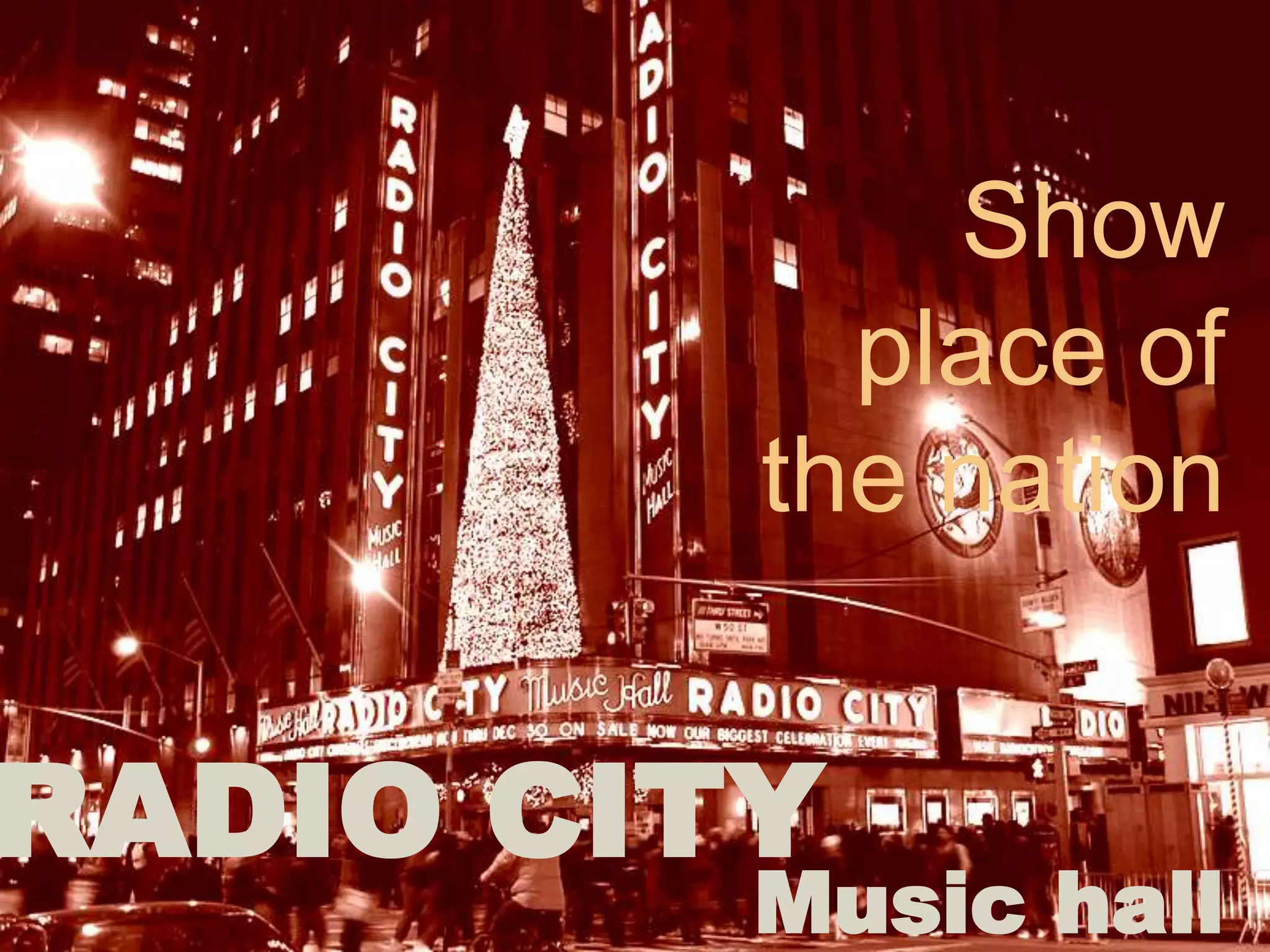
RADIO CITY
Music hall
Show
place of
the nation
Radio City Music Hall is an entertainment
venue located in
Rockefeller Center in New York City. it
was for a time the leading tourist
destination in the city. Its interior was
declared a city landmark in
1978.
 Radio City Music Hall U.S. National
Register of Historic Places
 Area- 2 acres (0.8 ha)
 Capacity-6,015
 Built- 1932
 Architect- Edward Durell Stone,
Donald Deskey
 Architectural style- Art Deco
 Part of Rockefeller Center
Rockefeller Center is a large complex
consisting of 19 highris commercial buildings
covering 22 acres (89,000 m2)
between 48thand 51stStreets in New York
City. Commissioned by the Rockefeller family,
it is located in the center of Midtown
Manhattan, spanning the area between Fifth
Avenue and Sixth Avenue. It was declared
a National Historic Landmark in 1987
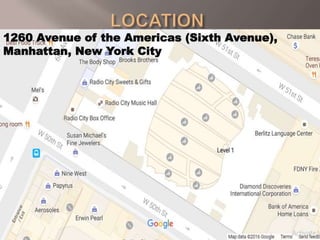
1260 Avenue of the Americas (Sixth Avenue),
Manhattan, New York City
Its originally planned name was International
Music Hall. The names "Radio City" and "Radio
City Music Hall" derive from one of the
complex's first tenants, the Radio Corporation
of America. Radio City Music Hall was a project
of Rockefeller; Samuel Roxy Rothafe, who
previously opened the Roxy Theatre in 1927;
and RCA chairman David Sarnoff. RCA had
developed numerous studios for NBC at 30
Rockefeller Plaza, just to the south of the
Music Hall, and the radio TV complex that lent
the Music Hall its name is still known as the
NBC Radio City Studios.
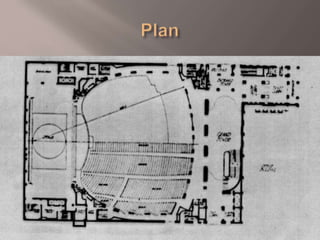
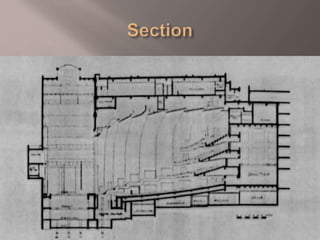
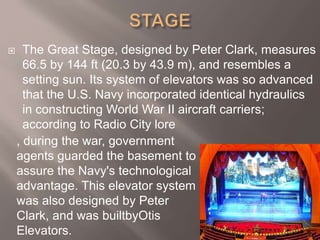
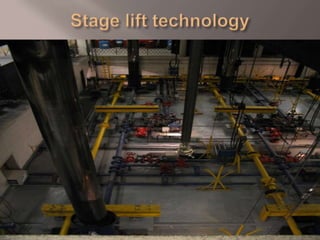
 The Great Stage, designed by Peter Clark, measures
66.5 by 144 ft (20.3 by 43.9 m), and resembles a
setting sun. Its system of elevators was so advanced
that the U.S. Navy incorporated identical hydraulics
in constructing World War II aircraft carriers;
according to Radio City lore
, during the war, government
agents guarded the basement to
assure the Navy's technological
advantage. This elevator system
was also designed by Peter
Clark, and was builtbyOtis
Elevators.
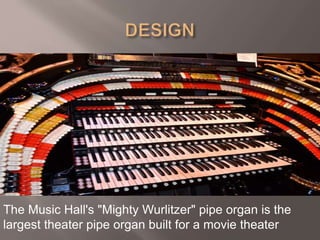
The Music Hall's "Mighty Wurlitzer" pipe organ is the
largest theater pipe organ built for a movie theater
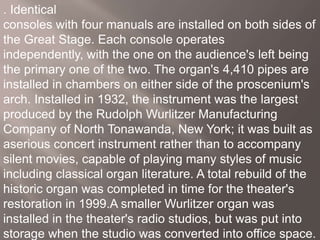
. Identical
consoles with four manuals are installed on both sides of
the Great Stage. Each console operates
independently, with the one on the audience's left being
the primary one of the two. The organ's 4,410 pipes are
installed in chambers on either side of the proscenium's
arch. Installed in 1932, the instrument was the largest
produced by the Rudolph Wurlitzer Manufacturing
Company of North Tonawanda, New York; it was built as
aserious concert instrument rather than to accompany
silent movies, capable of playing many styles of music
including classical organ literature. A total rebuild of the
historic organ was completed in time for the theater's
restoration in 1999.A smaller Wurlitzer organ was
installed in the theater's radio studios, but was put into
storage when the studio was converted into office space.
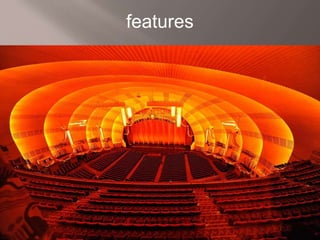
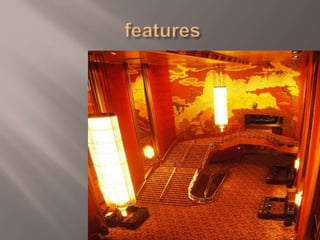
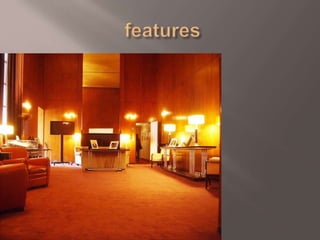
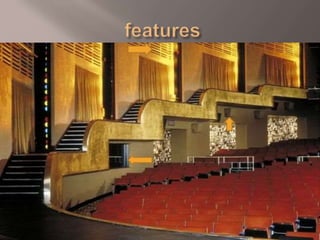
The extraordinary unit of the decorative features in Radio
City Music Hall, from the carpets, wall-coverings, and
murals to the statues, light fixtures and furniture gives
great distinction to the interior. The success of this
concept of design of the total environment in the Music
Hall is due to the skills and imagination of Donald Deskey
and the many artists he commissioned.
features
Radio city hall NEWYORK

Radio city hall NEWYORK

  • 1.
  • 2.
    Radio City MusicHall is an entertainment venue located in Rockefeller Center in New York City. it was for a time the leading tourist destination in the city. Its interior was declared a city landmark in 1978.
  • 3.
     Radio CityMusic Hall U.S. National Register of Historic Places  Area- 2 acres (0.8 ha)  Capacity-6,015  Built- 1932  Architect- Edward Durell Stone, Donald Deskey  Architectural style- Art Deco  Part of Rockefeller Center
  • 4.
    Rockefeller Center isa large complex consisting of 19 highris commercial buildings covering 22 acres (89,000 m2) between 48thand 51stStreets in New York City. Commissioned by the Rockefeller family, it is located in the center of Midtown Manhattan, spanning the area between Fifth Avenue and Sixth Avenue. It was declared a National Historic Landmark in 1987
  • 5.
    1260 Avenue ofthe Americas (Sixth Avenue), Manhattan, New York City
  • 6.
    Its originally plannedname was International Music Hall. The names "Radio City" and "Radio City Music Hall" derive from one of the complex's first tenants, the Radio Corporation of America. Radio City Music Hall was a project of Rockefeller; Samuel Roxy Rothafe, who previously opened the Roxy Theatre in 1927; and RCA chairman David Sarnoff. RCA had developed numerous studios for NBC at 30 Rockefeller Plaza, just to the south of the Music Hall, and the radio TV complex that lent the Music Hall its name is still known as the NBC Radio City Studios.
  • 12.
     The GreatStage, designed by Peter Clark, measures 66.5 by 144 ft (20.3 by 43.9 m), and resembles a setting sun. Its system of elevators was so advanced that the U.S. Navy incorporated identical hydraulics in constructing World War II aircraft carriers; according to Radio City lore , during the war, government agents guarded the basement to assure the Navy's technological advantage. This elevator system was also designed by Peter Clark, and was builtbyOtis Elevators.
  • 14.
    The Music Hall's"Mighty Wurlitzer" pipe organ is the largest theater pipe organ built for a movie theater
  • 15.
    . Identical consoles withfour manuals are installed on both sides of the Great Stage. Each console operates independently, with the one on the audience's left being the primary one of the two. The organ's 4,410 pipes are installed in chambers on either side of the proscenium's arch. Installed in 1932, the instrument was the largest produced by the Rudolph Wurlitzer Manufacturing Company of North Tonawanda, New York; it was built as aserious concert instrument rather than to accompany silent movies, capable of playing many styles of music including classical organ literature. A total rebuild of the historic organ was completed in time for the theater's restoration in 1999.A smaller Wurlitzer organ was installed in the theater's radio studios, but was put into storage when the studio was converted into office space.
  • 16.
    The extraordinary unitof the decorative features in Radio City Music Hall, from the carpets, wall-coverings, and murals to the statues, light fixtures and furniture gives great distinction to the interior. The success of this concept of design of the total environment in the Music Hall is due to the skills and imagination of Donald Deskey and the many artists he commissioned.
  • 17.