Treatment De-escalation strategies in HPV +ve OPC
Available evidence & Novel approach
Dr. Rohit S. Kabre
Radiation Oncology
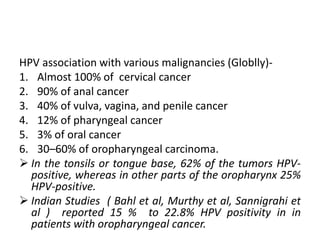
HPV association with various malignancies (Globlly)-
1. Almost 100% of cervical cancer
2. 90% of anal cancer
3. 40% of vulva, vagina, and penile cancer
4. 12% of pharyngeal cancer
5. 3% of oral cancer
6. 30–60% of oropharyngeal carcinoma.
 In the tonsils or tongue base, 62% of the tumors HPV-
positive, whereas in other parts of the oropharynx 25%
HPV-positive.
 Indian Studies ( Bahl et al, Murthy et al, Sannigrahi et
al ) reported 15 % to 22.8% HPV positivity in in
patients with oropharyngeal cancer.
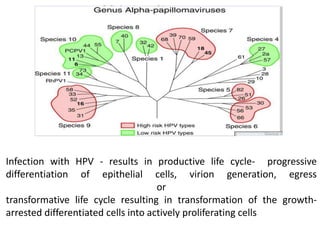
Infection with HPV - results in productive life cycle- progressive
differentiation of epithelial cells, virion generation, egress
or
transformative life cycle resulting in transformation of the growth-
arrested differentiated cells into actively proliferating cells
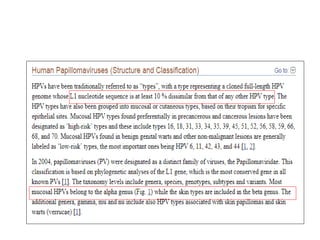
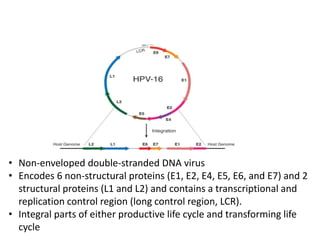
• Non-enveloped double-stranded DNA virus
• Encodes 6 non-structural proteins (E1, E2, E4, E5, E6, and E7) and 2
structural proteins (L1 and L2) and contains a transcriptional and
replication control region (long control region, LCR).
• Integral parts of either productive life cycle and transforming life
cycle
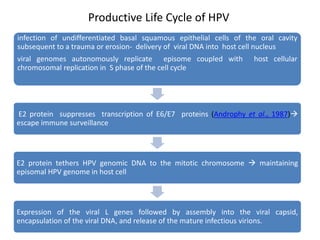
infection of undifferentiated basal squamous epithelial cells of the oral cavity
subsequent to a trauma or erosion- delivery of viral DNA into host cell nucleus
viral genomes autonomously replicate episome coupled with host cellular
chromosomal replication in S phase of the cell cycle
E2 protein suppresses transcription of E6/E7 proteins (Androphy et al., 1987)
escape immune surveillance
E2 protein tethers HPV genomic DNA to the mitotic chromosome  maintaining
episomal HPV genome in host cell
Expression of the viral L genes followed by assembly into the viral capsid,
encapsulation of the viral DNA, and release of the mature infectious virions.
Productive Life Cycle of HPV
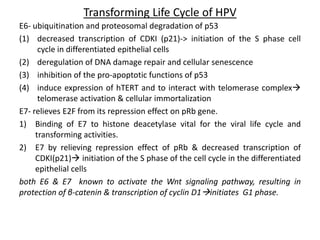
Transforming Life Cycle of HPV
E6- ubiquitination and proteosomal degradation of p53
(1) decreased transcription of CDKI (p21)-> initiation of the S phase cell
cycle in differentiated epithelial cells
(2) deregulation of DNA damage repair and cellular senescence
(3) inhibition of the pro-apoptotic functions of p53
(4) induce expression of hTERT and to interact with telomerase complex
telomerase activation & cellular immortalization
E7- relieves E2F from its repression effect on pRb gene.
1) Binding of E7 to histone deacetylase vital for the viral life cycle and
transforming activities.
2) E7 by relieving repression effect of pRb & decreased transcription of
CDKI(p21) initiation of the S phase of the cell cycle in the differentiated
epithelial cells
both E6 & E7 known to activate the Wnt signaling pathway, resulting in
protection of β-catenin & transcription of cyclin D1initiates G1 phase.
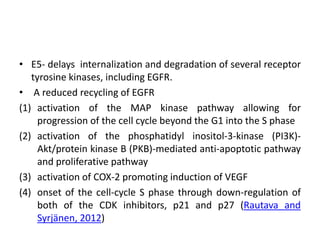
• E5- delays internalization and degradation of several receptor
tyrosine kinases, including EGFR.
• A reduced recycling of EGFR
(1) activation of the MAP kinase pathway allowing for
progression of the cell cycle beyond the G1 into the S phase
(2) activation of the phosphatidyl inositol-3-kinase (PI3K)-
Akt/protein kinase B (PKB)-mediated anti-apoptotic pathway
and proliferative pathway
(3) activation of COX-2 promoting induction of VEGF
(4) onset of the cell-cycle S phase through down-regulation of
both of the CDK inhibitors, p21 and p27 (Rautava and
Syrjänen, 2012)
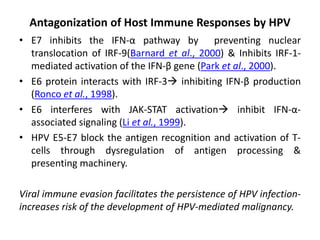
Antagonization of Host Immune Responses by HPV
• E7 inhibits the IFN-α pathway by preventing nuclear
translocation of IRF-9(Barnard et al., 2000) & Inhibits IRF-1-
mediated activation of the IFN-β gene (Park et al., 2000).
• E6 protein interacts with IRF-3 inhibiting IFN-β production
(Ronco et al., 1998).
• E6 interferes with JAK-STAT activation inhibit IFN-α-
associated signaling (Li et al., 1999).
• HPV E5-E7 block the antigen recognition and activation of T-
cells through dysregulation of antigen processing &
presenting machinery.
Viral immune evasion facilitates the persistence of HPV infection-
increases risk of the development of HPV-mediated malignancy.
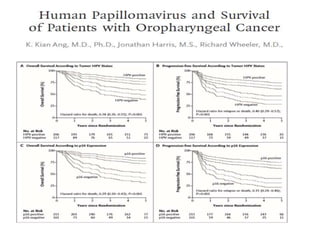
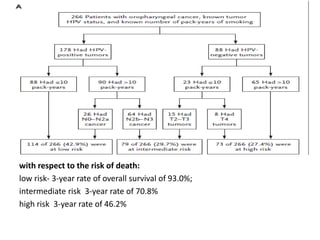
with respect to the risk of death:
low risk- 3-year rate of overall survival of 93.0%;
intermediate risk 3-year rate of 70.8%
high risk 3-year rate of 46.2%
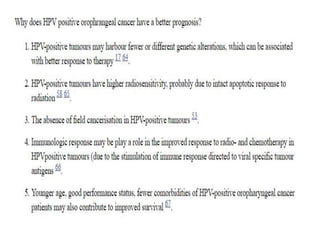
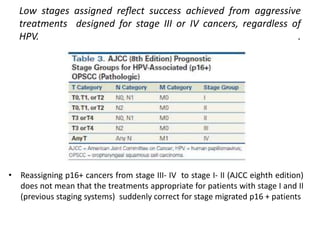
Low stages assigned reflect success achieved from aggressive
treatments designed for stage III or IV cancers, regardless of
HPV. .
• Reassigning p16+ cancers from stage III- IV to stage I- II (AJCC eighth edition)
does not mean that the treatments appropriate for patients with stage I and II
(previous staging systems) suddenly correct for stage migrated p16 + patients
Need for De-Escalation
• High survival rate younger survivors living with treatment
sequelae for a long time
• One third or more have long-term grade 3 or worse toxicities like
xerostomia, dysphagia, neuropathy, neck fibrosis
• Most of these adverse effects due to radiation therapy &
concurrent chemotherapy.
• Combination of severe dysphagia, feeding tube dependence, or
death without cancer progression after RTCT- 43% at 3 years.
• Importance of de-escalating treatment without compromising high
cure rates is clear
• If survival equivalence can be demonstrated, then the end points of
interest will be the acute & late toxicities of treatment.
Different approaches for De-escalation
 Limiting the RT dose
 Using alternatives to cisplatin with RT,
 Modulating the dose of RT according to induction
chemotherapy response
 Dropping chemotherapy in the high risk postoperative setting.
 Integrating minimally invasive surgery with reduced adjuvant
therapy.
Standard of Care- definitive CRT for a total dose of approximately
70 Gy to the primary tumor over 6–7 weeks with concurrent
platinum-based chemotherapy or surgery with postoperative CRT
De-ESCALaTE HPV
• 334 patients with low-risk
• The authors considered the use of cisplatin as the standard of care
and hence substitution with cetuximab could be considered
deviation or de-escalation from the established standard.
• primary outcome- (Grade 3–5) toxicity events
• secondary outcomes- OS , time to recurrence, quality of life, and
swallowing outcomes
• significantly higher number of serious adverse events in the
cisplatin group.
• No difference in overall severe toxicity, QOL or Swallowing otcomes
between the two groups
Far more concerning was the significant reduction in 2-year overall
survival (97·5% vs 89·4%, hazard ratio [HR] 5·0 [95% CI 1·7–14·7],
p=0·0012) and increase in disease recurrence (6·0% vs 16·1%, HR 3·4
[1·6–7·2], p=0·0007) observed in the cetuximab group.
RTOG 1016
• Non- Inferiority trial
• the authors did not consider the substitution of cisplatin with
cetuximab as a deviation from standard of care or a form of
de-escalation
• Recruitment was not limited to low-risk patients. N=849
• After a median follow-up of 4·5 years, RT+cetuximab –did not
meet the criteria for non- inferiority for overall survival (HR
45·1, one-sided 95% upper CI 1·94; p=0·5056)
• Risks of cancer progression or death ( 45%) & loco-regional
failure increased.
• Severe acute and late toxicity similar between the cetuximab
and cisplatin groups
ECOG 1308
First phase II trial to evaluate Induction chemotherapy+
cetuximab followed by weekly cetuximab and low-dose radiation
in favorable responders or standard dose in patients with partial
or no response
1) Three were excluded for receiving only one round of
chemotherapy
2) 13 patients- major protocol violations.
3) Cisplatin dose reduction in 14 due to grade 3 or 4
hematologic toxicity, neuropathy, or tinnitus.
4) Cetuximab dose modification in 18 patients due to of grade
3 or 4 acneiform rash, mucositis, and/or hypomagnesemia.
• benefits of a reduced radiation dose are worth the increased
upfront toxicity of induction chemotherapy?
• Financial toxicity of de-escalation?
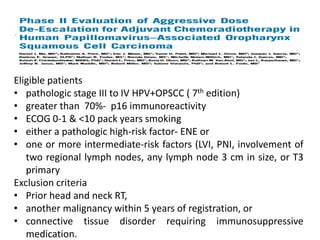
Eligible patients
• pathologic stage III to IV HPV+OPSCC ( 7th edition)
• greater than 70%- p16 immunoreactivity
• ECOG 0-1 & <10 pack years smoking
• either a pathologic high-risk factor- ENE or
• one or more intermediate-risk factors (LVI, PNI, involvement of
two regional lymph nodes, any lymph node 3 cm in size, or T3
primary
Exclusion criteria
• Prior head and neck RT,
• another malignancy within 5 years of registration, or
• connective tissue disorder requiring immunosuppressive
medication.
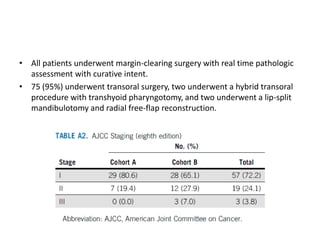
• All patients underwent margin-clearing surgery with real time pathologic
assessment with curative intent.
• 75 (95%) underwent transoral surgery, two underwent a hybrid transoral
procedure with transhyoid pharyngotomy, and two underwent a lip-split
mandibulotomy and radial free-flap reconstruction.
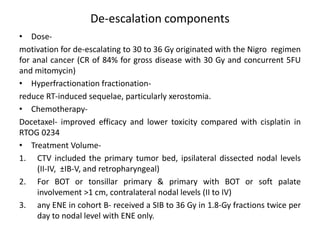
De-escalation components
• Dose-
motivation for de-escalating to 30 to 36 Gy originated with the Nigro regimen
for anal cancer (CR of 84% for gross disease with 30 Gy and concurrent 5FU
and mitomycin)
• Hyperfractionation fractionation-
reduce RT-induced sequelae, particularly xerostomia.
• Chemotherapy-
Docetaxel- improved efficacy and lower toxicity compared with cisplatin in
RTOG 0234
• Treatment Volume-
1. CTV included the primary tumor bed, ipsilateral dissected nodal levels
(II-IV, ±IB-V, and retropharyngeal)
2. For BOT or tonsillar primary & primary with BOT or soft palate
involvement >1 cm, contralateral nodal levels (II to IV)
3. any ENE in cohort B- received a SIB to 36 Gy in 1.8-Gy fractions twice per
day to nodal level with ENE only.
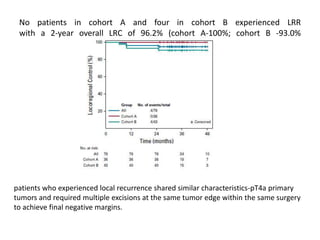
No patients in cohort A and four in cohort B experienced LRR
with a 2-year overall LRC of 96.2% (cohort A-100%; cohort B -93.0%
patients who experienced local recurrence shared similar characteristics-pT4a primary
tumors and required multiple excisions at the same tumor edge within the same surgery
to achieve final negative margins.
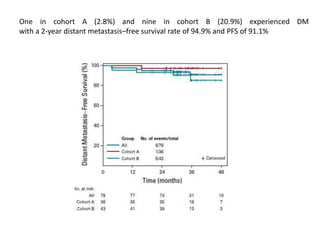
One in cohort A (2.8%) and nine in cohort B (20.9%) experienced DM
with a 2-year distant metastasis–free survival rate of 94.9% and PFS of 91.1%
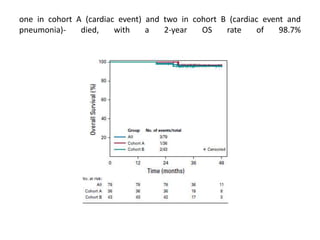
one in cohort A (cardiac event) and two in cohort B (cardiac event and
pneumonia)- died, with a 2-year OS rate of 98.7%
• Grade 2 toxicity rates at pre-RT and 1 and 2 years post-RT were 11.4% and
2.5%, 1.4%
• grade 3 or worse toxicity rates at pre-RT and 1 and 2 years post-RT and
0.0%, and 6.7% and 0.0%
• One patient- PEG tube-immediately after RT &No patient had a PEG tube
after 1 month post-treatment( modern RT series-18 % or higher PEG)
• 33% reduction in RT cost and a 21% reduction in total treatment cost
compared with standard adjuvant therapy.
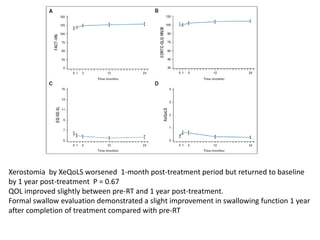
Xerostomia by XeQoLS worsened 1-month post-treatment period but returned to baseline
by 1 year post-treatment P = 0.67
QOL improved slightly between pre-RT and 1 year post-treatment.
Formal swallow evaluation demonstrated a slight improvement in swallowing function 1 year
after completion of treatment compared with pre-RT
• De-escalation not recommended for HPV+ OPC outside
clinical trial
• Patients with advanced T4 primaries, multiple lymph nodes,
and smoking histories of more than 10 PYs have an increased
risk of disease progression and death not suitable for de-
escalation trials
• The modest OS rates of intermediate-risk patients caution
against de-escalation in this group
• Despite HPV+ OPCs- high response rates recurrence rates
remain concerning at 13%–25% at 2 years and 36% at 8 years
distant failure is equivalent to that for HPV− disease
• Multiple Competing Trials With Various Inclusion Criteria,
Primary Endpoints, and Durations-very difficult to compare
outcomes from one de-escalation trial with another
• Patient Preference-most patients are willing to take little to no
risk in survival outcomes
• The overall costs of treatment must be closely scrutinized in
today’s cost-conscious health care landscape- largely ignored
in the development of de-escalation trials.
• Results from recent and ongoing studies used to define
clinical parameters and molecular determinants of prognosis-
to fine tune patient selection in future.

HPV + OPSCC- De-escalation Strategies

  • 1.
    Treatment De-escalation strategiesin HPV +ve OPC Available evidence & Novel approach Dr. Rohit S. Kabre Radiation Oncology
  • 2.
    HPV association withvarious malignancies (Globlly)- 1. Almost 100% of cervical cancer 2. 90% of anal cancer 3. 40% of vulva, vagina, and penile cancer 4. 12% of pharyngeal cancer 5. 3% of oral cancer 6. 30–60% of oropharyngeal carcinoma.  In the tonsils or tongue base, 62% of the tumors HPV- positive, whereas in other parts of the oropharynx 25% HPV-positive.  Indian Studies ( Bahl et al, Murthy et al, Sannigrahi et al ) reported 15 % to 22.8% HPV positivity in in patients with oropharyngeal cancer.
  • 4.
    Infection with HPV- results in productive life cycle- progressive differentiation of epithelial cells, virion generation, egress or transformative life cycle resulting in transformation of the growth- arrested differentiated cells into actively proliferating cells
  • 5.
    • Non-enveloped double-strandedDNA virus • Encodes 6 non-structural proteins (E1, E2, E4, E5, E6, and E7) and 2 structural proteins (L1 and L2) and contains a transcriptional and replication control region (long control region, LCR). • Integral parts of either productive life cycle and transforming life cycle
  • 6.
    infection of undifferentiatedbasal squamous epithelial cells of the oral cavity subsequent to a trauma or erosion- delivery of viral DNA into host cell nucleus viral genomes autonomously replicate episome coupled with host cellular chromosomal replication in S phase of the cell cycle E2 protein suppresses transcription of E6/E7 proteins (Androphy et al., 1987) escape immune surveillance E2 protein tethers HPV genomic DNA to the mitotic chromosome  maintaining episomal HPV genome in host cell Expression of the viral L genes followed by assembly into the viral capsid, encapsulation of the viral DNA, and release of the mature infectious virions. Productive Life Cycle of HPV
  • 7.
    Transforming Life Cycleof HPV E6- ubiquitination and proteosomal degradation of p53 (1) decreased transcription of CDKI (p21)-> initiation of the S phase cell cycle in differentiated epithelial cells (2) deregulation of DNA damage repair and cellular senescence (3) inhibition of the pro-apoptotic functions of p53 (4) induce expression of hTERT and to interact with telomerase complex telomerase activation & cellular immortalization E7- relieves E2F from its repression effect on pRb gene. 1) Binding of E7 to histone deacetylase vital for the viral life cycle and transforming activities. 2) E7 by relieving repression effect of pRb & decreased transcription of CDKI(p21) initiation of the S phase of the cell cycle in the differentiated epithelial cells both E6 & E7 known to activate the Wnt signaling pathway, resulting in protection of β-catenin & transcription of cyclin D1initiates G1 phase.
  • 8.
    • E5- delaysinternalization and degradation of several receptor tyrosine kinases, including EGFR. • A reduced recycling of EGFR (1) activation of the MAP kinase pathway allowing for progression of the cell cycle beyond the G1 into the S phase (2) activation of the phosphatidyl inositol-3-kinase (PI3K)- Akt/protein kinase B (PKB)-mediated anti-apoptotic pathway and proliferative pathway (3) activation of COX-2 promoting induction of VEGF (4) onset of the cell-cycle S phase through down-regulation of both of the CDK inhibitors, p21 and p27 (Rautava and Syrjänen, 2012)
  • 9.
    Antagonization of HostImmune Responses by HPV • E7 inhibits the IFN-α pathway by preventing nuclear translocation of IRF-9(Barnard et al., 2000) & Inhibits IRF-1- mediated activation of the IFN-β gene (Park et al., 2000). • E6 protein interacts with IRF-3 inhibiting IFN-β production (Ronco et al., 1998). • E6 interferes with JAK-STAT activation inhibit IFN-α- associated signaling (Li et al., 1999). • HPV E5-E7 block the antigen recognition and activation of T- cells through dysregulation of antigen processing & presenting machinery. Viral immune evasion facilitates the persistence of HPV infection- increases risk of the development of HPV-mediated malignancy.
  • 11.
    with respect tothe risk of death: low risk- 3-year rate of overall survival of 93.0%; intermediate risk 3-year rate of 70.8% high risk 3-year rate of 46.2%
  • 13.
    Low stages assignedreflect success achieved from aggressive treatments designed for stage III or IV cancers, regardless of HPV. . • Reassigning p16+ cancers from stage III- IV to stage I- II (AJCC eighth edition) does not mean that the treatments appropriate for patients with stage I and II (previous staging systems) suddenly correct for stage migrated p16 + patients
  • 14.
    Need for De-Escalation •High survival rate younger survivors living with treatment sequelae for a long time • One third or more have long-term grade 3 or worse toxicities like xerostomia, dysphagia, neuropathy, neck fibrosis • Most of these adverse effects due to radiation therapy & concurrent chemotherapy. • Combination of severe dysphagia, feeding tube dependence, or death without cancer progression after RTCT- 43% at 3 years. • Importance of de-escalating treatment without compromising high cure rates is clear • If survival equivalence can be demonstrated, then the end points of interest will be the acute & late toxicities of treatment.
  • 15.
    Different approaches forDe-escalation  Limiting the RT dose  Using alternatives to cisplatin with RT,  Modulating the dose of RT according to induction chemotherapy response  Dropping chemotherapy in the high risk postoperative setting.  Integrating minimally invasive surgery with reduced adjuvant therapy. Standard of Care- definitive CRT for a total dose of approximately 70 Gy to the primary tumor over 6–7 weeks with concurrent platinum-based chemotherapy or surgery with postoperative CRT
  • 16.
    De-ESCALaTE HPV • 334patients with low-risk • The authors considered the use of cisplatin as the standard of care and hence substitution with cetuximab could be considered deviation or de-escalation from the established standard. • primary outcome- (Grade 3–5) toxicity events • secondary outcomes- OS , time to recurrence, quality of life, and swallowing outcomes • significantly higher number of serious adverse events in the cisplatin group. • No difference in overall severe toxicity, QOL or Swallowing otcomes between the two groups Far more concerning was the significant reduction in 2-year overall survival (97·5% vs 89·4%, hazard ratio [HR] 5·0 [95% CI 1·7–14·7], p=0·0012) and increase in disease recurrence (6·0% vs 16·1%, HR 3·4 [1·6–7·2], p=0·0007) observed in the cetuximab group.
  • 17.
    RTOG 1016 • Non-Inferiority trial • the authors did not consider the substitution of cisplatin with cetuximab as a deviation from standard of care or a form of de-escalation • Recruitment was not limited to low-risk patients. N=849 • After a median follow-up of 4·5 years, RT+cetuximab –did not meet the criteria for non- inferiority for overall survival (HR 45·1, one-sided 95% upper CI 1·94; p=0·5056) • Risks of cancer progression or death ( 45%) & loco-regional failure increased. • Severe acute and late toxicity similar between the cetuximab and cisplatin groups
  • 18.
    ECOG 1308 First phaseII trial to evaluate Induction chemotherapy+ cetuximab followed by weekly cetuximab and low-dose radiation in favorable responders or standard dose in patients with partial or no response 1) Three were excluded for receiving only one round of chemotherapy 2) 13 patients- major protocol violations. 3) Cisplatin dose reduction in 14 due to grade 3 or 4 hematologic toxicity, neuropathy, or tinnitus. 4) Cetuximab dose modification in 18 patients due to of grade 3 or 4 acneiform rash, mucositis, and/or hypomagnesemia. • benefits of a reduced radiation dose are worth the increased upfront toxicity of induction chemotherapy? • Financial toxicity of de-escalation?
  • 19.
    Eligible patients • pathologicstage III to IV HPV+OPSCC ( 7th edition) • greater than 70%- p16 immunoreactivity • ECOG 0-1 & <10 pack years smoking • either a pathologic high-risk factor- ENE or • one or more intermediate-risk factors (LVI, PNI, involvement of two regional lymph nodes, any lymph node 3 cm in size, or T3 primary Exclusion criteria • Prior head and neck RT, • another malignancy within 5 years of registration, or • connective tissue disorder requiring immunosuppressive medication.
  • 20.
    • All patientsunderwent margin-clearing surgery with real time pathologic assessment with curative intent. • 75 (95%) underwent transoral surgery, two underwent a hybrid transoral procedure with transhyoid pharyngotomy, and two underwent a lip-split mandibulotomy and radial free-flap reconstruction.
  • 22.
    De-escalation components • Dose- motivationfor de-escalating to 30 to 36 Gy originated with the Nigro regimen for anal cancer (CR of 84% for gross disease with 30 Gy and concurrent 5FU and mitomycin) • Hyperfractionation fractionation- reduce RT-induced sequelae, particularly xerostomia. • Chemotherapy- Docetaxel- improved efficacy and lower toxicity compared with cisplatin in RTOG 0234 • Treatment Volume- 1. CTV included the primary tumor bed, ipsilateral dissected nodal levels (II-IV, ±IB-V, and retropharyngeal) 2. For BOT or tonsillar primary & primary with BOT or soft palate involvement >1 cm, contralateral nodal levels (II to IV) 3. any ENE in cohort B- received a SIB to 36 Gy in 1.8-Gy fractions twice per day to nodal level with ENE only.
  • 23.
    No patients incohort A and four in cohort B experienced LRR with a 2-year overall LRC of 96.2% (cohort A-100%; cohort B -93.0% patients who experienced local recurrence shared similar characteristics-pT4a primary tumors and required multiple excisions at the same tumor edge within the same surgery to achieve final negative margins.
  • 24.
    One in cohortA (2.8%) and nine in cohort B (20.9%) experienced DM with a 2-year distant metastasis–free survival rate of 94.9% and PFS of 91.1%
  • 25.
    one in cohortA (cardiac event) and two in cohort B (cardiac event and pneumonia)- died, with a 2-year OS rate of 98.7%
  • 26.
    • Grade 2toxicity rates at pre-RT and 1 and 2 years post-RT were 11.4% and 2.5%, 1.4% • grade 3 or worse toxicity rates at pre-RT and 1 and 2 years post-RT and 0.0%, and 6.7% and 0.0% • One patient- PEG tube-immediately after RT &No patient had a PEG tube after 1 month post-treatment( modern RT series-18 % or higher PEG) • 33% reduction in RT cost and a 21% reduction in total treatment cost compared with standard adjuvant therapy.
  • 27.
    Xerostomia by XeQoLSworsened 1-month post-treatment period but returned to baseline by 1 year post-treatment P = 0.67 QOL improved slightly between pre-RT and 1 year post-treatment. Formal swallow evaluation demonstrated a slight improvement in swallowing function 1 year after completion of treatment compared with pre-RT
  • 28.
    • De-escalation notrecommended for HPV+ OPC outside clinical trial • Patients with advanced T4 primaries, multiple lymph nodes, and smoking histories of more than 10 PYs have an increased risk of disease progression and death not suitable for de- escalation trials • The modest OS rates of intermediate-risk patients caution against de-escalation in this group • Despite HPV+ OPCs- high response rates recurrence rates remain concerning at 13%–25% at 2 years and 36% at 8 years distant failure is equivalent to that for HPV− disease
  • 29.
    • Multiple CompetingTrials With Various Inclusion Criteria, Primary Endpoints, and Durations-very difficult to compare outcomes from one de-escalation trial with another • Patient Preference-most patients are willing to take little to no risk in survival outcomes • The overall costs of treatment must be closely scrutinized in today’s cost-conscious health care landscape- largely ignored in the development of de-escalation trials. • Results from recent and ongoing studies used to define clinical parameters and molecular determinants of prognosis- to fine tune patient selection in future.

Editor's Notes

  • #8 DNA-binding transcription factors (E2F)
  • #11 HPV-positive tumors – 58% reduction in the risk of death
  • #17 Cetuximab for cisplatin as radiosensitiser. RT induces EGFR expression in head and neck cancers, resulting in acquired resistance Targeted EGFR inhibitor, might help overcome this resistance and might also induce antibody-dependent cell-mediated cytotoxicity.