TAMILNADU Dr. J. JAYALALITHAA FISHERIES UNIVERSITY
Dr. M.G.R. FISHERIES COLLEGE AND RESEARCH INSTITUTE
Ponneri-601 204
Presented by:
H. Manimaran MFSc
Department of Aquaculture
HI-TECH AQUACULTURE PRODUCTION
Flow Through System For Aquaculture
Production
INTRODUCTION:
• In aquaculture, a flow-through system is a water management and filtration method
that involves continuously flushing the culture system with fresh, untreated water.
• It is primarily used in open-air systems such as raceways, ponds, and cages.
• Overall, the water enters through an inlet and exits through an outlet into a water
discharge system making use of it only once. Considering the design aspects, it is
certain that flow-through aquaculture can be done only in regions with sufficient water
supply all-round the year and availability of natural slope or pumping mechanism to
pump water in and out of the system.
Operation:
* Water is pumped from a source (e.g., ocean, river, well) into the
culture system.
* Water flows through the system, carrying waste products, uneaten
feed, and pathogens away.
* The water exits the system through discharge pipes or overflow
outlets.
Advantages
High water quality: Continuous flow of fresh water ensures good water
quality and oxygen levels for the cultured organisms.
Low maintenance: Requires less filtration equipment compared to
recirculating systems.
Cost-effective: Does not require expensive filtration and water treatment
systems.
Suitable for large-scale oprations: Can be scaled up easily to accommodate
large volumes of water.
Disadvantages:
Water consumption: Requires a significant amount of water, which can be
a concern in areas with limited water resources.
Nutrient loss: Wastes and nutrients are discharged into the environment,
potentially contributing to eutrophication.
Disease control: Disease outbreaks can spread rapidly due to the constant
flow of water.
Temperature control: Temperature fluctuations can occur as fresh water is
pumped into the system.
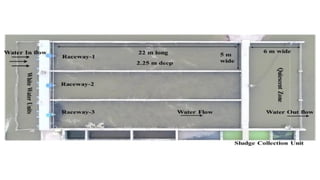
Raceway Fish Culture System
 Raceway are designed to provide a flow-through system to enable rearing of much denser
population of fishes.
 Categorized under the Intensive/ Semi-intensive farming system.
 An abundant flow of good quality, well oxygenated water is essential to provide and flush
out the metabolic waste mainly Ammonia from water.
 Raceway are smaller in size than ponds and occupy much less space.
 Raceway dimensions typically are 50 to 100 ft long, 10 to 30 ft wide, and 3 to 6 ft deep.
 Water flow through raceways usually is adequate to provide three or more exchanges per
hour with a minimum velocity of about 0.1 ft/sec.
Site selection & design considerations:
• Water Source: Raceway require large amounts of water/unit vol.
• Structure should be like that where Water should be move easily. Naturally
the most important consideration is the steady water flow. The main sources
of water are springs, streams, deep well or reservoirs.
• In designing a raceway it is preferable to make use of contour of the land.
• A slope of 1-2% is preferred so that water flowing in at one end can be
removed at the other.
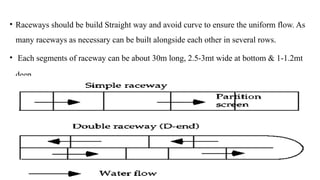
• Raceways should be build Straight way and avoid curve to ensure the uniform flow. As
many raceways as necessary can be built alongside each other in several rows.
• Each segments of raceway can be about 30m long, 2.5-3mt wide at bottom & 1-1.2mt
deep.
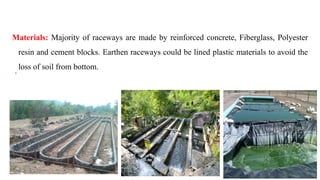
Materials: Majority of raceways are made by reinforced concrete, Fiberglass, Polyester
resin and cement blocks. Earthen raceways could be lined plastic materials to avoid the
loss of soil from bottom.
Inlets & outlets
 As discussed for ponds, the major function of the inlet for tanks and
raceways is to regulate water exchange.
 Generally, water flows into tanks is regulated using a valve, whereas flow
to raceways may be regulated by either valves or sluices.
 The delivery of water into the tank or raceway must be such that it
facilitates an even movement of water throughout the structure, maintaining
uniform water quality.
 In raceways this is often achieved by delivering water at multiple points
along the input end of the raceway either through perforated pipes or over
spillways.
Maintaining uniform water quality may also be assisted by having multiple
inlets along the length of the raceway
The functions of outlets :
• Maintaining Water Level
• Retaining Cultured Animals
• Allowing Drainage Of The Structure
• Removal Of Wastes.
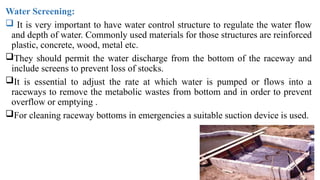
Water Screening:
 It is very important to have water control structure to regulate the water flow
and depth of water. Commonly used materials for those structures are reinforced
plastic, concrete, wood, metal etc.
They should permit the water discharge from the bottom of the raceway and
include screens to prevent loss of stocks.
It is essential to adjust the rate at which water is pumped or flows into a
raceways to remove the metabolic wastes from bottom and in order to prevent
overflow or emptying .
For cleaning raceway bottoms in emergencies a suitable suction device is used.
Species Cultured:
 Freshwater species such as trout, catfish are commonly cultured in
raceways.
Raceways are also used for some marine species which need a constant
water flow, such as juvenile salmon, brackish water sea bass and sea bream
and Shell fishes.
Advantages of raceways
Higher stocking densities
Improved* water quality
Reduced manpower
Ease of harvest
Precise disease treatments
Collection of fish wastes
Integrated multi-trophic aquaculture (IMTA):
The farming, in proximity, of aquaculture species from different trophic levels, and
with complementary ecosystem functions, in a way that allows one species’ uneaten
feed and wastes, nutrients, and by-products to be recaptured and converted into
fertilizer, feed, and energy for the other crops, and to take advantage of synergistic
interactions between species.
Antoine-Laurent de Lavoisier in 1789. “Nothing is created, nothing is lost,
everything is transformed,” he said.
• Farmers combine fed aquaculture (e.g., finfish or shrimps) with extractive aquaculture,
which utilizes the inorganic (e.g., seaweeds or other aquatic vegetation) and organic (e.g.,
suspension- and deposit-feeders) excess nutrients from fed aquaculture for their growth.
• The aim is to ecologically engineer balanced systems for environmental
sustainability (biomitigative services for improved ecosystem health), economic
stability (improved output, lower costs, product diversification, risk reduction, and
job creation in disadvantaged communities) and societal acceptability (better
management practices, improved regulatory governance, and appreciation of
differentiated and safe products).
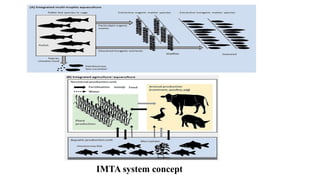
 The IMTA is a cultivation system that utilises species with different
eating habits and trophic levels in the same production system.
 These species are placed in the same compartments or separately in
the waste stream . The goal is to be able to utilize waste that is
reusable.
 The IMTA system generally aims to improve the ecosystem’s
condition in the cultivation environment and produce more excellent
cultivation production than the monoculture model.
IMTA system concept
Components of the IMTA System
• Several essential components in the IMTA system need
attention,including species selection, extractive species (organic and
inorganic extractive species), main species (fed aquaculture), and the
IMTA design .
• Several criteria must be considered in species selection. The selected
species must be able to complement each other with other species in a
system based on the tropic level so that nutrients can be efficiently
produced and able to increase production.
• species must have a good level of adaptation, preferably comefrom local
species, and have a high level of production . Attention must be paid to
cultivation technology and environmental conditions; the selected species have
the ability to improve ecological conditions efficiently (bio-mitigation) and
sustainably .Finally, species that meet market demand
and have commercial value must be used .
Extractive species are species that can utilise and reduce waste in the form of
organic matter (particulates and suspensions) and dissolved inorganic matter
originating from metabolism(ammonium (NH4+), nitrate (NO3-), phosphate
(PO43-) and carbon dioxide (CO2), as well as other by-products derived from
main species (fed species) to be used as a source of energy for growth
. In addition,organic extractive species which function as secondary
consumers are also marketable, although this is not an essential factor .
This production increase is generally used for non-food products and
ecosystem improvement.
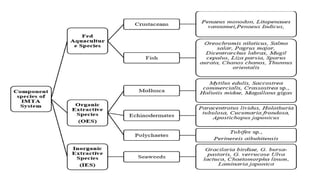
Several extractive species are commonly used in the IMTA system,
including crustaceans, mussels, sea cucumbers, Polychaeta, sponges,
and seaweed
The exemplary system design will affect the effectiveness and success
of cultivating the IMTA system. The method of the IMTA system must
pay attention to the placement, arrangement, and selection of species
to be used. System design and species selection must be engineered so
that organisms with lower multitrophic levels can utilise the waste
from aquaculture activities optimally.
The selection of suitable extractive species is crucial in supporting success in cultivation with the
IMTA system. In general, the use of extractive species in the IMTA system aims not only to improve
environmental conditions but also to provide additional benefits such as minimising the risk of
failure during the cultivation process, having commercial value, complying with market demand and
being accepted by the community .The use of extractive species must also pay attention to growth
rates, densities, characteristics, seasonal cycles, and comparison ratios between species, as well as the
use of local species that aim to facilitate adaptation and reduce the risk of using introduced species .
Another thing that needs to be considered in selecting extractive species is understanding habitat
specifications, because this will affect the growth of the species used. With the growing development
of IMTA cultivation in the world, the use of potential new species has begun to be tried in several
IMTA studies in fresh, brackish, and marine water cultivation.
Freshwater IMTA
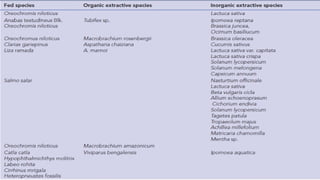
• Freshwater aquaculture using the IMTA system generally uses tilapia and carp. In
addition, the application of the IMTA system in freshwater aquaculture is more
common in tropical
• Climates than in cold or temperate climates. This is due to differences in water
temperature .Along with the development of increasingly modern aquaculture, FIMTA
is alsobeing developed. Aquaponics is one variation of freshwater IMTA cultivation
that is currently widely applied . Aquaponics is one part of the IMTA system because
it utilises at least two species, such as fish and plants. The two species use nutrient
sources and have different roles in aquatic ecosystems
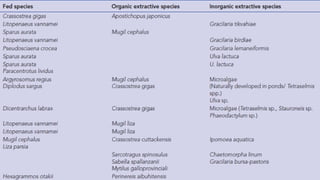
Marine and Brackish Water IMTA
• IMTA system can be applied to freshwater,brackish, marine, open-water,
and land-based aquaculture activities in temperate to tropical climates.
• IMTA system’s application to marine-brackish water improves water
quality in the culture media and increases profitability and balance in the
system. Further research needs to be done using a combination of potential
local extractive species on a larger scale to understand better system
performance, the ratio of species used in the systems,and integration
between IMTA and other systems.
References
• Soderberg, R. W. (2020). Flowing water fish culture. CRC Press.
• Snow, A., Anderson, B., & Wootton, B. (2012). Flow-through land-based
aquaculture wastewater and its treatment in subsurface flow constructed
wetlands. Environmental Reviews, 20(1), 54-69.
• Fornshell, G., Hinshaw, J., & Tidwell, J. H. (2012). Flow-through
raceways. Aquaculture production systems, 173-190.
• Samocha, T. M., Lawrence, A. L., & Bray, W. A. (1993). Design and
operation of an intensive nursery raceway system for penaeid shrimp. CRC
handbook of mariculture: Crustacean aquaculture, 173-210.
• FAO. (2022). Integrated multitrophic aquaculture: lessons from China. Bangkok.
Food and Agriculture Organization of the United Nations,1–8.
• Giangrande, A., Pierri, C., Arduini, D., Borghese, J., Licciano, M., Trani, R., Longo,
C. (2020). An innovative IMTA system: Polychaetes, sponges and macroalgae co-
cultured in a Southern Italian in-shore mariculture plant (Ionian Sea). Journal of
Marine Science and Engineering, 8(10), 1–24. doi: 10.3390/JMSE8100733.
• Granada, L., Sousa, N., Lopes, S., & Lemos, M. F. L. (2016). İs integrated
multitrophic aquaculture the solution to the sector’s significant challenges a
review.pdf. Reviews in Aquaculture, 8, 283–300. doi: 10.1111/raq.12093.
• Azhar, M., & Memiş, D. (2023). Application of the IMTA (Integrated Multi-Trophic
Aquaculture) System in Freshwater, Brackish and Marine Aquaculture. Aquatic
Sciences and Engineering, 38(2), 101-121.
THANK YOU

Raceway and Integrated multi tropic aquaculture

  • 1.
    TAMILNADU Dr. J.JAYALALITHAA FISHERIES UNIVERSITY Dr. M.G.R. FISHERIES COLLEGE AND RESEARCH INSTITUTE Ponneri-601 204 Presented by: H. Manimaran MFSc Department of Aquaculture HI-TECH AQUACULTURE PRODUCTION
  • 2.
    Flow Through SystemFor Aquaculture Production
  • 3.
    INTRODUCTION: • In aquaculture,a flow-through system is a water management and filtration method that involves continuously flushing the culture system with fresh, untreated water. • It is primarily used in open-air systems such as raceways, ponds, and cages. • Overall, the water enters through an inlet and exits through an outlet into a water discharge system making use of it only once. Considering the design aspects, it is certain that flow-through aquaculture can be done only in regions with sufficient water supply all-round the year and availability of natural slope or pumping mechanism to pump water in and out of the system.
  • 4.
    Operation: * Water ispumped from a source (e.g., ocean, river, well) into the culture system. * Water flows through the system, carrying waste products, uneaten feed, and pathogens away. * The water exits the system through discharge pipes or overflow outlets.
  • 5.
    Advantages High water quality:Continuous flow of fresh water ensures good water quality and oxygen levels for the cultured organisms. Low maintenance: Requires less filtration equipment compared to recirculating systems. Cost-effective: Does not require expensive filtration and water treatment systems. Suitable for large-scale oprations: Can be scaled up easily to accommodate large volumes of water.
  • 6.
    Disadvantages: Water consumption: Requiresa significant amount of water, which can be a concern in areas with limited water resources. Nutrient loss: Wastes and nutrients are discharged into the environment, potentially contributing to eutrophication. Disease control: Disease outbreaks can spread rapidly due to the constant flow of water. Temperature control: Temperature fluctuations can occur as fresh water is pumped into the system.
  • 7.
    Raceway Fish CultureSystem  Raceway are designed to provide a flow-through system to enable rearing of much denser population of fishes.  Categorized under the Intensive/ Semi-intensive farming system.  An abundant flow of good quality, well oxygenated water is essential to provide and flush out the metabolic waste mainly Ammonia from water.  Raceway are smaller in size than ponds and occupy much less space.  Raceway dimensions typically are 50 to 100 ft long, 10 to 30 ft wide, and 3 to 6 ft deep.  Water flow through raceways usually is adequate to provide three or more exchanges per hour with a minimum velocity of about 0.1 ft/sec.
  • 9.
    Site selection &design considerations: • Water Source: Raceway require large amounts of water/unit vol. • Structure should be like that where Water should be move easily. Naturally the most important consideration is the steady water flow. The main sources of water are springs, streams, deep well or reservoirs. • In designing a raceway it is preferable to make use of contour of the land. • A slope of 1-2% is preferred so that water flowing in at one end can be removed at the other.
  • 10.
    • Raceways shouldbe build Straight way and avoid curve to ensure the uniform flow. As many raceways as necessary can be built alongside each other in several rows. • Each segments of raceway can be about 30m long, 2.5-3mt wide at bottom & 1-1.2mt deep.
  • 11.
    Materials: Majority ofraceways are made by reinforced concrete, Fiberglass, Polyester resin and cement blocks. Earthen raceways could be lined plastic materials to avoid the loss of soil from bottom.
  • 12.
    Inlets & outlets As discussed for ponds, the major function of the inlet for tanks and raceways is to regulate water exchange.  Generally, water flows into tanks is regulated using a valve, whereas flow to raceways may be regulated by either valves or sluices.
  • 13.
     The deliveryof water into the tank or raceway must be such that it facilitates an even movement of water throughout the structure, maintaining uniform water quality.  In raceways this is often achieved by delivering water at multiple points along the input end of the raceway either through perforated pipes or over spillways. Maintaining uniform water quality may also be assisted by having multiple inlets along the length of the raceway
  • 14.
    The functions ofoutlets : • Maintaining Water Level • Retaining Cultured Animals • Allowing Drainage Of The Structure • Removal Of Wastes.
  • 15.
    Water Screening:  Itis very important to have water control structure to regulate the water flow and depth of water. Commonly used materials for those structures are reinforced plastic, concrete, wood, metal etc. They should permit the water discharge from the bottom of the raceway and include screens to prevent loss of stocks. It is essential to adjust the rate at which water is pumped or flows into a raceways to remove the metabolic wastes from bottom and in order to prevent overflow or emptying . For cleaning raceway bottoms in emergencies a suitable suction device is used.
  • 16.
    Species Cultured:  Freshwaterspecies such as trout, catfish are commonly cultured in raceways. Raceways are also used for some marine species which need a constant water flow, such as juvenile salmon, brackish water sea bass and sea bream and Shell fishes.
  • 17.
    Advantages of raceways Higherstocking densities Improved* water quality Reduced manpower Ease of harvest Precise disease treatments Collection of fish wastes
  • 18.
    Integrated multi-trophic aquaculture(IMTA): The farming, in proximity, of aquaculture species from different trophic levels, and with complementary ecosystem functions, in a way that allows one species’ uneaten feed and wastes, nutrients, and by-products to be recaptured and converted into fertilizer, feed, and energy for the other crops, and to take advantage of synergistic interactions between species. Antoine-Laurent de Lavoisier in 1789. “Nothing is created, nothing is lost, everything is transformed,” he said.
  • 19.
    • Farmers combinefed aquaculture (e.g., finfish or shrimps) with extractive aquaculture, which utilizes the inorganic (e.g., seaweeds or other aquatic vegetation) and organic (e.g., suspension- and deposit-feeders) excess nutrients from fed aquaculture for their growth. • The aim is to ecologically engineer balanced systems for environmental sustainability (biomitigative services for improved ecosystem health), economic stability (improved output, lower costs, product diversification, risk reduction, and job creation in disadvantaged communities) and societal acceptability (better management practices, improved regulatory governance, and appreciation of differentiated and safe products).
  • 20.
     The IMTAis a cultivation system that utilises species with different eating habits and trophic levels in the same production system.  These species are placed in the same compartments or separately in the waste stream . The goal is to be able to utilize waste that is reusable.  The IMTA system generally aims to improve the ecosystem’s condition in the cultivation environment and produce more excellent cultivation production than the monoculture model.
  • 21.
  • 22.
    Components of theIMTA System • Several essential components in the IMTA system need attention,including species selection, extractive species (organic and inorganic extractive species), main species (fed aquaculture), and the IMTA design . • Several criteria must be considered in species selection. The selected species must be able to complement each other with other species in a system based on the tropic level so that nutrients can be efficiently produced and able to increase production.
  • 23.
    • species musthave a good level of adaptation, preferably comefrom local species, and have a high level of production . Attention must be paid to cultivation technology and environmental conditions; the selected species have the ability to improve ecological conditions efficiently (bio-mitigation) and sustainably .Finally, species that meet market demand and have commercial value must be used . Extractive species are species that can utilise and reduce waste in the form of organic matter (particulates and suspensions) and dissolved inorganic matter originating from metabolism(ammonium (NH4+), nitrate (NO3-), phosphate (PO43-) and carbon dioxide (CO2), as well as other by-products derived from main species (fed species) to be used as a source of energy for growth
  • 24.
    . In addition,organicextractive species which function as secondary consumers are also marketable, although this is not an essential factor . This production increase is generally used for non-food products and ecosystem improvement. Several extractive species are commonly used in the IMTA system, including crustaceans, mussels, sea cucumbers, Polychaeta, sponges, and seaweed
  • 25.
    The exemplary systemdesign will affect the effectiveness and success of cultivating the IMTA system. The method of the IMTA system must pay attention to the placement, arrangement, and selection of species to be used. System design and species selection must be engineered so that organisms with lower multitrophic levels can utilise the waste from aquaculture activities optimally.
  • 26.
    The selection ofsuitable extractive species is crucial in supporting success in cultivation with the IMTA system. In general, the use of extractive species in the IMTA system aims not only to improve environmental conditions but also to provide additional benefits such as minimising the risk of failure during the cultivation process, having commercial value, complying with market demand and being accepted by the community .The use of extractive species must also pay attention to growth rates, densities, characteristics, seasonal cycles, and comparison ratios between species, as well as the use of local species that aim to facilitate adaptation and reduce the risk of using introduced species . Another thing that needs to be considered in selecting extractive species is understanding habitat specifications, because this will affect the growth of the species used. With the growing development of IMTA cultivation in the world, the use of potential new species has begun to be tried in several IMTA studies in fresh, brackish, and marine water cultivation.
  • 28.
    Freshwater IMTA • Freshwateraquaculture using the IMTA system generally uses tilapia and carp. In addition, the application of the IMTA system in freshwater aquaculture is more common in tropical • Climates than in cold or temperate climates. This is due to differences in water temperature .Along with the development of increasingly modern aquaculture, FIMTA is alsobeing developed. Aquaponics is one variation of freshwater IMTA cultivation that is currently widely applied . Aquaponics is one part of the IMTA system because it utilises at least two species, such as fish and plants. The two species use nutrient sources and have different roles in aquatic ecosystems
  • 30.
    Marine and BrackishWater IMTA • IMTA system can be applied to freshwater,brackish, marine, open-water, and land-based aquaculture activities in temperate to tropical climates. • IMTA system’s application to marine-brackish water improves water quality in the culture media and increases profitability and balance in the system. Further research needs to be done using a combination of potential local extractive species on a larger scale to understand better system performance, the ratio of species used in the systems,and integration between IMTA and other systems.
  • 32.
    References • Soderberg, R.W. (2020). Flowing water fish culture. CRC Press. • Snow, A., Anderson, B., & Wootton, B. (2012). Flow-through land-based aquaculture wastewater and its treatment in subsurface flow constructed wetlands. Environmental Reviews, 20(1), 54-69. • Fornshell, G., Hinshaw, J., & Tidwell, J. H. (2012). Flow-through raceways. Aquaculture production systems, 173-190. • Samocha, T. M., Lawrence, A. L., & Bray, W. A. (1993). Design and operation of an intensive nursery raceway system for penaeid shrimp. CRC handbook of mariculture: Crustacean aquaculture, 173-210.
  • 33.
    • FAO. (2022).Integrated multitrophic aquaculture: lessons from China. Bangkok. Food and Agriculture Organization of the United Nations,1–8. • Giangrande, A., Pierri, C., Arduini, D., Borghese, J., Licciano, M., Trani, R., Longo, C. (2020). An innovative IMTA system: Polychaetes, sponges and macroalgae co- cultured in a Southern Italian in-shore mariculture plant (Ionian Sea). Journal of Marine Science and Engineering, 8(10), 1–24. doi: 10.3390/JMSE8100733. • Granada, L., Sousa, N., Lopes, S., & Lemos, M. F. L. (2016). İs integrated multitrophic aquaculture the solution to the sector’s significant challenges a review.pdf. Reviews in Aquaculture, 8, 283–300. doi: 10.1111/raq.12093. • Azhar, M., & Memiş, D. (2023). Application of the IMTA (Integrated Multi-Trophic Aquaculture) System in Freshwater, Brackish and Marine Aquaculture. Aquatic Sciences and Engineering, 38(2), 101-121.
  • 34.