RabbitMQ Model and Some
Example Applications
houcheng@gmail.com
CCMA ITRI
Outline
•
•
•
•

RabbitMQ model and standard
Simplified message queue model
3 example code
5 real case studies
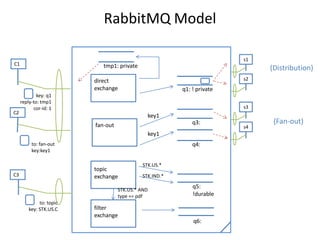
RabbitMQ Model
s1

C1

tmp1: private

(Distribution)
s2

direct
exchange

C2

q1: ! private

key: q1
reply-to: tmp1
cor-id: 1

s3

key1
q3:

fan-out
key1

q4:

to: fan-out
key:key1

topic
exchange

C3

STK.US.*
STK.IND.*

STK.US.* AND
type == pdf
to: topic
key: STK.US.C

filter
exchange

q5:
!durable

q6:

s4

(Fan-out)
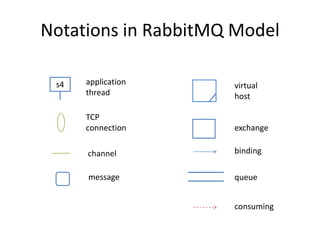
Notations in RabbitMQ Model
s4

application
thread

virtual
host

TCP
connection

exchange

channel

binding

message

queue
consuming
RabbitMQ Model
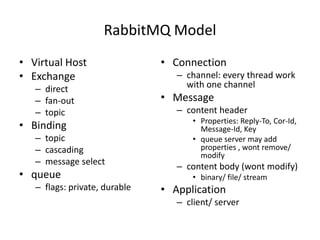
• Virtual Host
• Exchange
– direct
– fan-out
– topic

• Binding
– topic
– cascading
– message select

• queue
– flags: private, durable

• Connection
– channel: every thread work
with one channel

• Message
– content header
• Properties: Reply-To, Cor-Id,
Message-Id, Key
• queue server may add
properties , wont remove/
modify

– content body (wont modify)
• binary/ file/ stream

• Application
– client/ server
Other Items in AMQP 0.8,
not included in Model
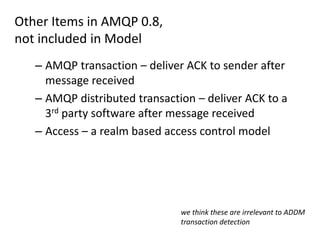
– AMQP transaction – deliver ACK to sender after
message received
– AMQP distributed transaction – deliver ACK to a
3rd party software after message received
– Access – a realm based access control model

we think these are irrelevant to ADDM
transaction detection
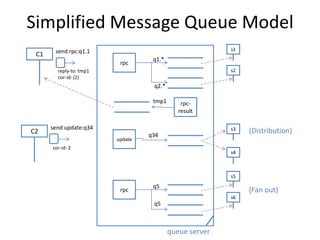
Simplified Message Queue Model
C1

s1

send rpc:q1.1
rpc

q1.*
s2

reply-to: tmp1
cor-id: (2)

q2.*
tmp1

C2

rpcresult

send update:q34

s3
update

q34

cor-id: 2

(Distribution)

s4

s5

rpc

q5

(Fan out)
s6

q5

queue server
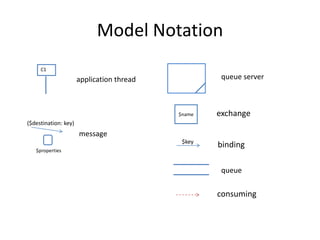
Model Notation
C1

queue server

application thread

$name

exchange

($destination: key)

message
$key
$properties

binding
queue

consuming
3 Example Code
1. RabbitMQ tutorial code (synchronous)
2. RabbitMQ RPC (synchronous)
3. Celery framework (distributed task queue /
asynchronous)
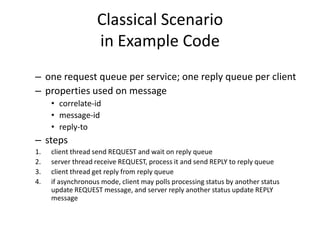
Classical Scenario
in Example Code
– one request queue per service; one reply queue per client
– properties used on message
• correlate-id
• message-id
• reply-to

– steps
1.
2.
3.
4.

client thread send REQUEST and wait on reply queue
server thread receive REQUEST, process it and send REPLY to reply queue
client thread get reply from reply queue
if asynchronous mode, client may polls processing status by another status
update REQUEST message, and server reply another status update REPLY
message
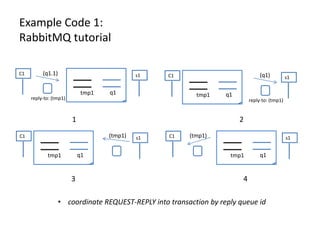
Example Code 1:
RabbitMQ tutorial
C1

(q1.1)

s1

tmp1

reply-to: (tmp1)

(q1)

C1

q1

tmp1

1
(tmp1)
q1

3

reply-to: (tmp1)

2

C1

tmp1

q1

s1

s1

C1

(tmp1)

s1

tmp1

q1

4

• coordinate REQUEST-REPLY into transaction by reply queue id
Example Code 2:
RabbitMQ RPC

(rpcq1)

C1

s1

tmp1

reply-to: (tmp1)
cor-id: (1)

(rpcq1)

C1

rpcq1

tmp1

q1

1

tmp1

rpcq1

reply-to: (tmp1)
cor-id: (1)

2
(tmp1)

C1

cor-id: (1)

s1

C1

(tmp1)

cor-id: (1)

s1

rpcq1

tmp1

3
•

s1

Coordinate REQUEST-REPLY into transaction by correlate-id

4
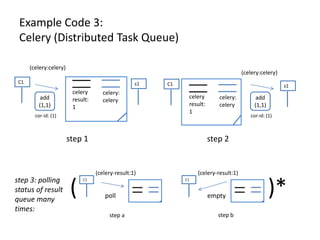
Example Code 3:
Celery (Distributed Task Queue)
(celery:celery)

(celery:celery)

C1

s1

add
(1,1)

celery
result:
1

celery:
celery

cor-id: (1)

C1

s1

celery
result:
1

step 1

(

add
(1,1)
cor-id: (1)

step 2

(celery-result:1)

step 3: polling
status of result
queue many
times:

celery:
celery

C1

(celery-result:1)
C1

poll
step a

empty
step b

)*
Example Code 3:
Celery (Distributed Task Queue)

(celery-result:1)
C1

(celery-result:1)
worker

celeryresult:
1

celery:
celery

step 4

cor-id: (1)

C1

worker

cor-id: (1)

celeryresult:
1

celery:
celery

step 5

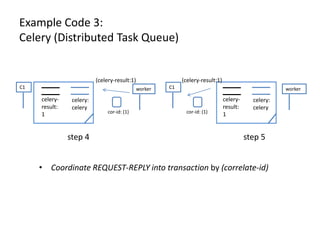
• Coordinate REQUEST-REPLY into transaction by (correlate-id)
Celery: one client application with two worker
w1
service

C1

w1

2+2

1+1

cor-id: (2)

cor-id: (1)

worker thread pool

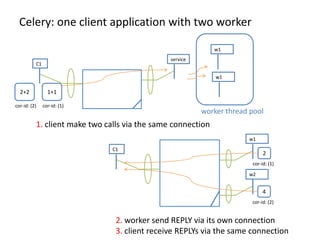
1. client make two calls via the same connection
w1
C1

2
cor-id: (1)
w2

4
cor-id: (2)

2. worker send REPLY via its own connection
3. client receive REPLYs via the same connection
5 Real Cases Study
• Applications use RabbitMQ
1. Zenoss4‘s message bus between daemons (non
transaction app)
2. Nova controller’s RPC call between hosts (transaction app)

• Enterprise use RabbitMQ
3. Instagram : Celery + RabbitMQ
4. MercadoLibre: RabbitMQ
5. Indeed.com
MailboxApp
Case 1: Zenoss 4
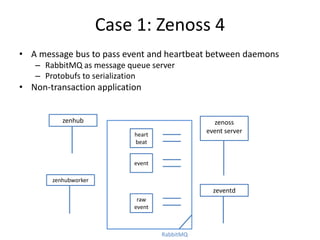
• A message bus to pass event and heartbeat between daemons
– RabbitMQ as message queue server
– Protobufs to serialization

• Non-transaction application

zenhub

zenoss
event server

heart
beat
event
zenhubworker

zeventd
raw
event

RabbitMQ
Heartbeat
zenhub

zeneventd

zenhubwork
er

zenhubworker.py---(1)-->[RabbitMQ]
[RabbitMQ]---(3)-->java
[RabbitMQ]---(3)-->java
[RabbitMQ]---(3)-->java

zenoss
event server

HB

HB

HB

heart
beat

HB

message bus

publish exchange: zenoss.heartbeats key: zenoss.heartbeat.localhost
content header: org.zenoss.protobufs.zep.DaemonHeartbeat
content with len: 33
deliver
content header: org.zenoss.protobufs.zep.DaemonHeartbeat
content with len: 33
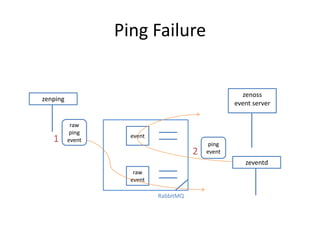
Ping Failure

zenoss
event server

zenping

1

raw
ping
event

event

2

ping
event

zeventd
raw
event
RabbitMQ
Ping Failure Messages
zenping---(1)-->[RabbitMQ]
[RabbitMQ]---(1)-->zeneventd.py
[RabbitMQ]---(1)-->zeneventd.py
[RabbitMQ]---(1)-->zeneventd.py
zeneventd.py---(1)-->[RabbitMQ]
[RabbitMQ]---(1)-->java
[RabbitMQ]---(1)-->java
[RabbitMQ]---(1)-->java
java---(6)-->[RabbitMQ]

publish exchange: zenoss.zenevents.raw key: zenoss.zenevent.status.ping
content header: org.zenoss.protobufs.zep.Event
content with len: 235
deliver
content header: org.zenoss.protobufs.zep.Event
content with len: 235
publish exchange: zenoss.zenevents.zep key: zenoss.zenevent.status.ping
content header: org.zenoss.protobufs.zep.ZepRawEvent
content with len: 432
deliver
content header: org.zenoss.protobufs.zep.ZepRawEvent
content with len: 432
publish exchange: zenoss.zenevents key: zenoss.zenevent.status.ping
content header: org.zenoss.protobufs.zep.EventSummary
content with len: 433
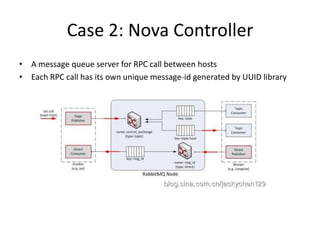
Case 2: Nova Controller
• A message queue server for RPC call between hosts
• Each RPC call has its own unique message-id generated by UUID library
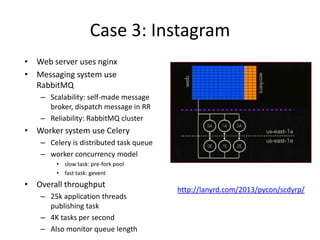
Case 3: Instagram
• Web server uses nginx
• Messaging system use
RabbitMQ
– Scalability: self-made message
broker, dispatch message in RR
– Reliability: RabbitMQ cluster

• Worker system use Celery
– Celery is distributed task queue
– worker concurrency model
• slow task: pre-fork pool
• fast task: gevent

• Overall throughput
– 25k application threads
publishing task
– 4K tasks per second
– Also monitor queue length

http://lanyrd.com/2013/pycon/scdyrp/
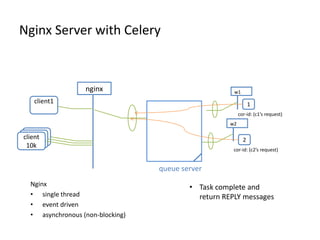
Nginx Server with Celery

nginx

w1

client1

1
cor-id: (c1’s request)
w2

client
client
client
10k
10k
10k

2
cor-id: (c2’s request)

queue server
Nginx
• single thread
• event driven
• asynchronous (non-blocking)

• Task complete and
return REPLY messages
Case 4: MercadoLibre
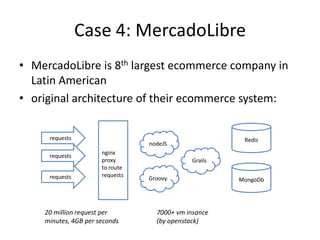
• MercadoLibre is 8th largest ecommerce company in
Latin American
• original architecture of their ecommerce system:
requests
requests
requests

Redis

nodeJS
nginx
proxy
to route
requests

20 million request per
minutes, 4GB per seconds

Grails
Groovy

7000+ vm insance
(by openstack)

MongoDb
Case 4: MercadoLibre
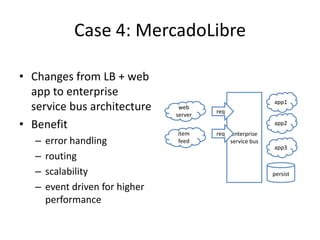
• Changes from LB + web
app to enterprise
service bus architecture
• Benefit
–
–
–
–

error handling
routing
scalability
event driven for higher
performance

web
server

app1
req
app2

item
feed

req

enterprise
service bus

app3

persist
MercadoLibre’s
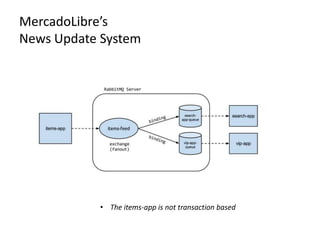
News Update System

• The items-app is not transaction based
MercadoLibre’s
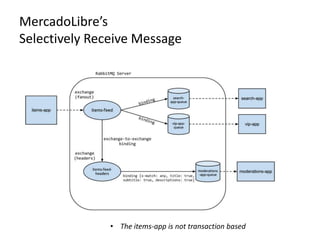
Selectively Receive Message

• The items-app is not transaction based
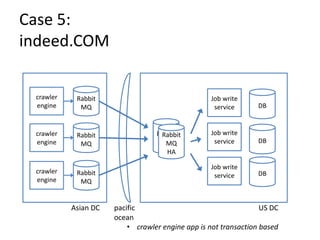
Case 5:
indeed.COM
crawler
engine

Rabbit
MQ

crawler
engine

Rabbit
MQ

crawler
engine

Rabbit
MQ

Asian DC

Job write
service

Job write
service

DB

Job write
service

Rabbit
Rabbit
MQ
MQ
HA

DB

DB

pacific
US DC
ocean
• crawler engine app is not transaction based
Reference
•
•
•
•
•
•
•

RabbitMQ specification 0.8
RabbitMQ Tutorial, example 1/6 and its packet dump
Celery: Distributed Task Queue and its packet dump
Messaging at Scale at Instagram
How is nginx different from apache
Zenoss source code
nova controller source code

RabbitMQ Model and Some Example Applications

  • 1.
    RabbitMQ Model andSome Example Applications houcheng@gmail.com CCMA ITRI
  • 2.
    Outline • • • • RabbitMQ model andstandard Simplified message queue model 3 example code 5 real case studies
  • 3.
    RabbitMQ Model s1 C1 tmp1: private (Distribution) s2 direct exchange C2 q1:! private key: q1 reply-to: tmp1 cor-id: 1 s3 key1 q3: fan-out key1 q4: to: fan-out key:key1 topic exchange C3 STK.US.* STK.IND.* STK.US.* AND type == pdf to: topic key: STK.US.C filter exchange q5: !durable q6: s4 (Fan-out)
  • 4.
    Notations in RabbitMQModel s4 application thread virtual host TCP connection exchange channel binding message queue consuming
  • 5.
    RabbitMQ Model • VirtualHost • Exchange – direct – fan-out – topic • Binding – topic – cascading – message select • queue – flags: private, durable • Connection – channel: every thread work with one channel • Message – content header • Properties: Reply-To, Cor-Id, Message-Id, Key • queue server may add properties , wont remove/ modify – content body (wont modify) • binary/ file/ stream • Application – client/ server
  • 6.
    Other Items inAMQP 0.8, not included in Model – AMQP transaction – deliver ACK to sender after message received – AMQP distributed transaction – deliver ACK to a 3rd party software after message received – Access – a realm based access control model we think these are irrelevant to ADDM transaction detection
  • 7.
    Simplified Message QueueModel C1 s1 send rpc:q1.1 rpc q1.* s2 reply-to: tmp1 cor-id: (2) q2.* tmp1 C2 rpcresult send update:q34 s3 update q34 cor-id: 2 (Distribution) s4 s5 rpc q5 (Fan out) s6 q5 queue server
  • 8.
    Model Notation C1 queue server applicationthread $name exchange ($destination: key) message $key $properties binding queue consuming
  • 9.
    3 Example Code 1.RabbitMQ tutorial code (synchronous) 2. RabbitMQ RPC (synchronous) 3. Celery framework (distributed task queue / asynchronous)
  • 10.
    Classical Scenario in ExampleCode – one request queue per service; one reply queue per client – properties used on message • correlate-id • message-id • reply-to – steps 1. 2. 3. 4. client thread send REQUEST and wait on reply queue server thread receive REQUEST, process it and send REPLY to reply queue client thread get reply from reply queue if asynchronous mode, client may polls processing status by another status update REQUEST message, and server reply another status update REPLY message
  • 11.
    Example Code 1: RabbitMQtutorial C1 (q1.1) s1 tmp1 reply-to: (tmp1) (q1) C1 q1 tmp1 1 (tmp1) q1 3 reply-to: (tmp1) 2 C1 tmp1 q1 s1 s1 C1 (tmp1) s1 tmp1 q1 4 • coordinate REQUEST-REPLY into transaction by reply queue id
  • 12.
    Example Code 2: RabbitMQRPC (rpcq1) C1 s1 tmp1 reply-to: (tmp1) cor-id: (1) (rpcq1) C1 rpcq1 tmp1 q1 1 tmp1 rpcq1 reply-to: (tmp1) cor-id: (1) 2 (tmp1) C1 cor-id: (1) s1 C1 (tmp1) cor-id: (1) s1 rpcq1 tmp1 3 • s1 Coordinate REQUEST-REPLY into transaction by correlate-id 4
  • 13.
    Example Code 3: Celery(Distributed Task Queue) (celery:celery) (celery:celery) C1 s1 add (1,1) celery result: 1 celery: celery cor-id: (1) C1 s1 celery result: 1 step 1 ( add (1,1) cor-id: (1) step 2 (celery-result:1) step 3: polling status of result queue many times: celery: celery C1 (celery-result:1) C1 poll step a empty step b )*
  • 14.
    Example Code 3: Celery(Distributed Task Queue) (celery-result:1) C1 (celery-result:1) worker celeryresult: 1 celery: celery step 4 cor-id: (1) C1 worker cor-id: (1) celeryresult: 1 celery: celery step 5 • Coordinate REQUEST-REPLY into transaction by (correlate-id)
  • 15.
    Celery: one clientapplication with two worker w1 service C1 w1 2+2 1+1 cor-id: (2) cor-id: (1) worker thread pool 1. client make two calls via the same connection w1 C1 2 cor-id: (1) w2 4 cor-id: (2) 2. worker send REPLY via its own connection 3. client receive REPLYs via the same connection
  • 16.
    5 Real CasesStudy • Applications use RabbitMQ 1. Zenoss4‘s message bus between daemons (non transaction app) 2. Nova controller’s RPC call between hosts (transaction app) • Enterprise use RabbitMQ 3. Instagram : Celery + RabbitMQ 4. MercadoLibre: RabbitMQ 5. Indeed.com MailboxApp
  • 17.
    Case 1: Zenoss4 • A message bus to pass event and heartbeat between daemons – RabbitMQ as message queue server – Protobufs to serialization • Non-transaction application zenhub zenoss event server heart beat event zenhubworker zeventd raw event RabbitMQ
  • 18.
    Heartbeat zenhub zeneventd zenhubwork er zenhubworker.py---(1)-->[RabbitMQ] zenhubworker.py---(1)-->[RabbitMQ] zenhubworker.py---(1)-->[RabbitMQ] [RabbitMQ]---(3)-->java [RabbitMQ]---(3)-->java [RabbitMQ]---(3)-->java zenoss event server HB HB HB heart beat HB message bus publishexchange: zenoss.heartbeats key: zenoss.heartbeat.localhost content header: org.zenoss.protobufs.zep.DaemonHeartbeat content with len: 33 deliver content header: org.zenoss.protobufs.zep.DaemonHeartbeat content with len: 33
  • 19.
  • 20.
    Ping Failure Messages zenping---(1)-->[RabbitMQ] zenping---(1)-->[RabbitMQ] zenping---(1)-->[RabbitMQ] [RabbitMQ]---(1)-->zeneventd.py [RabbitMQ]---(1)-->zeneventd.py [RabbitMQ]---(1)-->zeneventd.py zeneventd.py---(1)-->[RabbitMQ] zeneventd.py---(1)-->[RabbitMQ] zeneventd.py---(1)-->[RabbitMQ] [RabbitMQ]---(1)-->java [RabbitMQ]---(1)-->java [RabbitMQ]---(1)-->java java---(6)-->[RabbitMQ] java---(6)-->[RabbitMQ] java---(6)-->[RabbitMQ] publishexchange: zenoss.zenevents.raw key: zenoss.zenevent.status.ping content header: org.zenoss.protobufs.zep.Event content with len: 235 deliver content header: org.zenoss.protobufs.zep.Event content with len: 235 publish exchange: zenoss.zenevents.zep key: zenoss.zenevent.status.ping content header: org.zenoss.protobufs.zep.ZepRawEvent content with len: 432 deliver content header: org.zenoss.protobufs.zep.ZepRawEvent content with len: 432 publish exchange: zenoss.zenevents key: zenoss.zenevent.status.ping content header: org.zenoss.protobufs.zep.EventSummary content with len: 433
  • 21.
    Case 2: NovaController • A message queue server for RPC call between hosts • Each RPC call has its own unique message-id generated by UUID library
  • 22.
    Case 3: Instagram •Web server uses nginx • Messaging system use RabbitMQ – Scalability: self-made message broker, dispatch message in RR – Reliability: RabbitMQ cluster • Worker system use Celery – Celery is distributed task queue – worker concurrency model • slow task: pre-fork pool • fast task: gevent • Overall throughput – 25k application threads publishing task – 4K tasks per second – Also monitor queue length http://lanyrd.com/2013/pycon/scdyrp/
  • 23.
    Nginx Server withCelery nginx w1 client1 1 cor-id: (c1’s request) w2 client client client 10k 10k 10k 2 cor-id: (c2’s request) queue server Nginx • single thread • event driven • asynchronous (non-blocking) • Task complete and return REPLY messages
  • 24.
    Case 4: MercadoLibre •MercadoLibre is 8th largest ecommerce company in Latin American • original architecture of their ecommerce system: requests requests requests Redis nodeJS nginx proxy to route requests 20 million request per minutes, 4GB per seconds Grails Groovy 7000+ vm insance (by openstack) MongoDb
  • 25.
    Case 4: MercadoLibre •Changes from LB + web app to enterprise service bus architecture • Benefit – – – – error handling routing scalability event driven for higher performance web server app1 req app2 item feed req enterprise service bus app3 persist
  • 26.
    MercadoLibre’s News Update System •The items-app is not transaction based
  • 27.
    MercadoLibre’s Selectively Receive Message •The items-app is not transaction based
  • 28.
    Case 5: indeed.COM crawler engine Rabbit MQ crawler engine Rabbit MQ crawler engine Rabbit MQ Asian DC Jobwrite service Job write service DB Job write service Rabbit Rabbit MQ MQ HA DB DB pacific US DC ocean • crawler engine app is not transaction based
  • 29.
    Reference • • • • • • • RabbitMQ specification 0.8 RabbitMQTutorial, example 1/6 and its packet dump Celery: Distributed Task Queue and its packet dump Messaging at Scale at Instagram How is nginx different from apache Zenoss source code nova controller source code