
Comprehensive Sleep Therapy

           AASM Guidelines and what to make
                       of them


1/21/12               Randy Clare and Associates   1
Who is Randy Clare Anyway
• 1990’s – The Silencer
• 2000 – The Diagnostic years
           –   SensorMedics
           –   Viasys
           –   Cardinal Health
           –   CareFusion
           –   CPAP Accessories DME


• 2011 – SleepScholar
           – DDMEonline.com
           – Scottsdalestudyclub.com

1/21/12                     Randy Clare and Associates   2
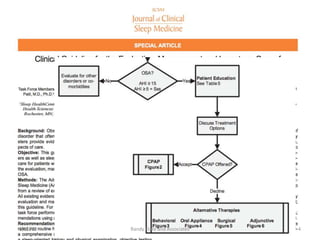
1/21/12   Randy Clare and Associates   3
1/21/12   Randy Clare and Associates   4
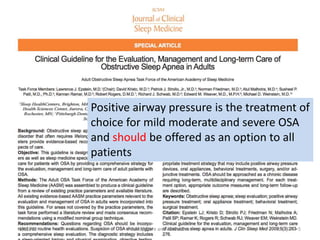
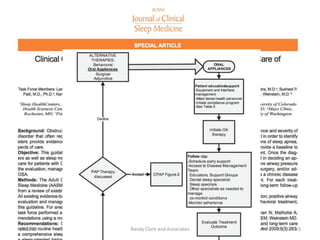
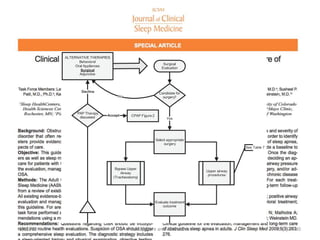
Positive airway pressure is the treatment of
          choice for mild moderate and severe OSA
          and should be offered as an option to all
          patients


1/21/12           Randy Clare and Associates       5
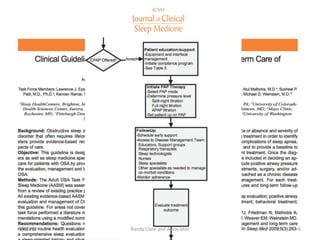
1/21/12   Randy Clare and Associates   6
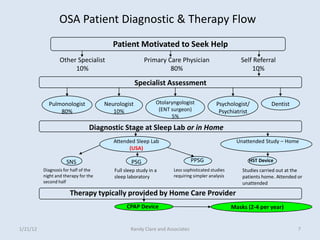
OSA Patient Diagnostic & Therapy Flow
                                         Patient Motivated to Seek Help
                  Other Specialist                     Primary Care Physician                       Self Referral
                       10%                                      80%                                     10%

                                                    Specialist Assessment

            Pulmonologist             Neurologist            Otolaryngologist            Psychologist/           Dentist
                80%                      10%                  (ENT surgeon)               Psychiatrist
                                                                   5%

                                Diagnostic Stage at Sleep Lab or in Home
                                         Attended Sleep Lab                                        Unattended Study – Home
                                               (USA)

                     SNS                         PSG                          PPSG                     HST Device
          Diagnosis for half of the      Full sleep study in a      Less sophisticated studies       Studies carried out at the
          night and therapy for the      sleep laboratory           requiring simpler analysis       patients home. Attended or
          second half                                                                                unattended
                       Therapy typically provided by Home Care Provider
                                               CPAP Device                                       Masks (2-4 per year)


1/21/12                                          Randy Clare and Associates                                                  7
CPAP at DME
• Competitive bidding is driving consolidation of
  providers (easy for payors not easy for
  patients)
• Largest DME providers are
  Lincare, Apria, Rotech
• 15-20% of Sleep Labs are now dispensing
  CPAP


1/21/12            Randy Clare and Associates   8
CPAP at Dental Office?
• Who better than a dentist
• Need an RT due to the Pharmacy Board rules
• 3 month recall
• Steady income Stream
• Unequivocal participation in the medical
  model
• Therapeutic neutrality fits the patient
  expectation of superlative care
1/21/12           Randy Clare and Associates   9
Mask Replacement

•   Ideally every 6 months
•   Minimum yearly
•   Insurance dictates
•   Notify customer
•   Compliance Program
•   Select a reasonably priced mask


1/21/12             Randy Clare and Associates   10
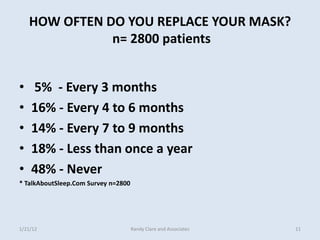
HOW OFTEN DO YOU REPLACE YOUR MASK?
               n= 2800 patients


•   5% - Every 3 months
•   16% - Every 4 to 6 months
•   14% - Every 7 to 9 months
•   18% - Less than once a year
•   48% - Never
* TalkAboutSleep.Com Survey n=2800


1/21/12                              Randy Clare and Associates   11
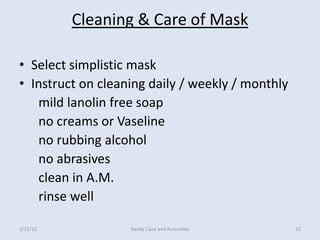
Cleaning & Care of Mask

• Select simplistic mask
• Instruct on cleaning daily / weekly / monthly
   mild lanolin free soap
   no creams or Vaseline
   no rubbing alcohol
   no abrasives
   clean in A.M.
   rinse well

1/21/12            Randy Clare and Associates     12
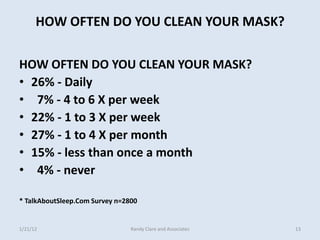
HOW OFTEN DO YOU CLEAN YOUR MASK?

HOW OFTEN DO YOU CLEAN YOUR MASK?
• 26% - Daily
• 7% - 4 to 6 X per week
• 22% - 1 to 3 X per week
• 27% - 1 to 4 X per month
• 15% - less than once a month
• 4% - never

* TalkAboutSleep.Com Survey n=2800


1/21/12                         Randy Clare and Associates   13
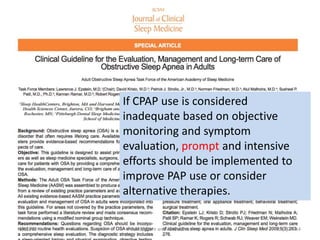
If CPAP use is considered
          inadequate based on objective
          monitoring and symptom
          evaluation, prompt and intensive
          efforts should be implemented to
          improve PAP use or consider
          alternative therapies.

1/21/12    Randy Clare and Associates        14
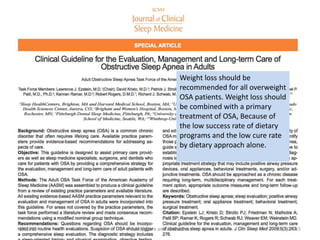
Weight loss should be
                               recommended for all overweight
                               OSA patients. Weight loss should
                               be combined with a primary
                               treatment of OSA, Because of
                               the low success rate of dietary
                               programs and the low cure rate
                               by dietary approach alone.


1/21/12   Randy Clare and Associates                              15
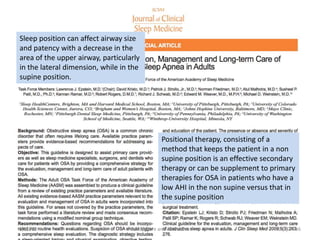
Sleep position can affect airway size
and patency with a decrease in the
area of the upper airway, particularly
in the lateral dimension, while in the
supine position.


                                                Positional therapy, consisting of a
                                                method that keeps the patient in a non
                                                supine position is an effective secondary
                                                therapy or can be supplement to primary
                                                therapies for OSA in patients who have a
                                                low AHI in the non supine versus that in
                                                the supine position


1/21/12                            Randy Clare and Associates                               16
Behavioral Strategies
•   Weight loss
•   Exercise
•   Positional Therapies
•   Avoidance of Alcohol and Sedatives


1/21/12             Randy Clare and Associates   17
Background
• Obesity is the most powerful risk factor for
  obstructive sleep apnea (OSA)
• Obesity is essentially the only reversible risk
  factor
• Potentially modifiable risk factors for OSA also
  include alcohol, smoking, nasal congestion, and
  estrogen depletion in menopause.
• Data suggest that obstructive sleep apnea is
  associated with all these factors, but at present
  the only intervention strategy supported with
  adequate evidence is weight loss. ( Young et al. 2002)
1/21/12                Randy Clare and Associates          18
Obesity and OSA
• About 70% of those with OSA are obese (Malhotra
    et al 2002)

• Prevalence of OSA in obese men and women
  is about 40% (Young et al 2002)
• Higher BMI associated with higher prevalence
      – BMI>30: 26% with AHI>15, 60% with AHI>5
      – BMI>40: 33% with AHI>15, 98% with AHI>5
      (Valencia-flores 2000)


1/21/12                        Randy Clare and Associates   19
Obesity and OSA
• Total body weight, BMI, and fat distribution all
  correlate with odds of having OSA
      – Every 10 kg increase in weight increases risk by 2X
      – Every increase in BMI by 6 increases risk by 4X
      – Every increase in waist or hip circumference by 13
        to 15 cm increases risk by 4X (Young et al 1993)


1/21/12                  Randy Clare and Associates       20
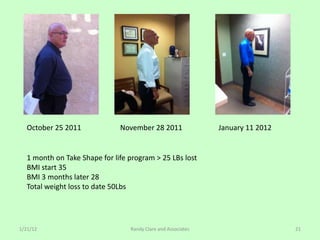
October 25 2011             November 28 2011                January 11 2012


  1 month on Take Shape for life program > 25 LBs lost
  BMI start 35
  BMI 3 months later 28
  Total weight loss to date 50Lbs


1/21/12                          Randy Clare and Associates                     21
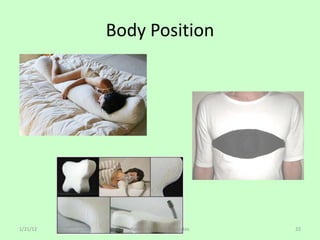
Body Position


1/21/12     Randy Clare and Associates   22
1/21/12   Randy Clare and Associates   23
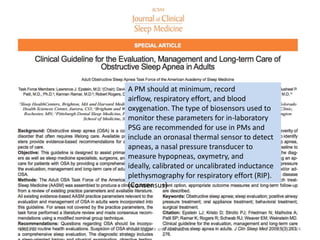
A PM should at minimum, record
          airflow, respiratory effort, and blood
          oxygenation. The type of biosensors used to
          monitor these parameters for in-laboratory
          PSG are recommended for use in PMs and
          include an oronasal thermal sensor to detect
          apneas, a nasal pressure transducer to
          measure hypopneas, oxymetry, and
          ideally, calibrated or uncalibrated inductance
          plethysmography for respiratory effort (RIP).
          (Consensus)


1/21/12   Randy Clare and Associates                       24
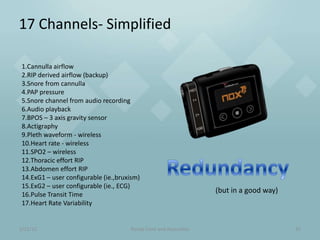
17 Channels- Simplified

1.Cannulla airflow
2.RIP derived airflow (backup)
3.Snore from cannulla
4.PAP pressure
5.Snore channel from audio recording
6.Audio playback
7.BPOS – 3 axis gravity sensor
8.Actigraphy
9.Pleth waveform - wireless
10.Heart rate - wireless
11.SPO2 – wireless
12.Thoracic effort RIP
13.Abdomen effort RIP
14.ExG1 – user configurable (ie.,bruxism)
15.ExG2 – user configurable (ie., ECG)
16.Pulse Transit Time
                                                                  (but in a good way)
17.Heart Rate Variability


1/21/12                              Randy Clare and Associates                         25
Validation Plot for T3-AHI


1/21/12            Randy Clare and Associates   26
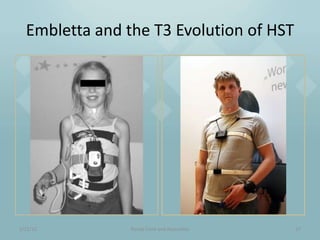
Embletta and the T3 Evolution of HST


1/21/12         Randy Clare and Associates   27
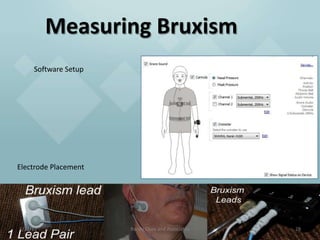
Measuring Bruxism
     Software Setup


Electrode Placement


1/21/12               Randy Clare and Associates   28
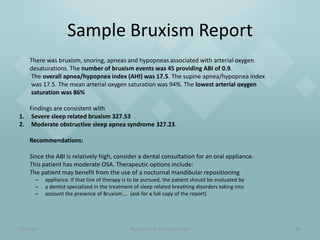
Sample Bruxism Report
    There was bruxism, snoring, apneas and hypopneas associated with arterial oxygen
    desaturations. The number of bruxism events was 45 providing ABI of 0.9.
    The overall apnea/hypopnea index (AHI) was 17.5. The supine apnea/hypopnea index
    was 17.5. The mean arterial oxygen saturation was 94%. The lowest arterial oxygen
    saturation was 86%

   Findings are consistent with
1. Severe sleep related bruxism 327.53
2. Moderate obstructive sleep apnea syndrome 327.23.

    Recommendations:

    Since the ABI is relatively high, consider a dental consultation for an oral appliance.
    This patient has moderate OSA. Therapeutic options include:
    The patient may benefit from the use of a nocturnal mandibular repositioning
      –   appliance. If that line of therapy is to be pursued, the patient should be evaluated by
      –   a dentist specialized in the treatment of sleep related breathing disorders taking into
      –   account the presence of Bruxism…. (ask for a full copy of the report)


1/21/12                                        Randy Clare and Associates                           29
1/21/12   Randy Clare and Associates   30
Three things to consider for Monday
• Do I consider Bruxism when I consult sleep
  patients? Sleep for Bruxism patients?
• When I talk sleep do my eyes wander to Neck?
  Hips and Belly? Do I estimate BMI?
• Should I talk to my office manager about our
  attitude around CPAP? Is there a local DME I
  can work with? Should I consider providing
  CPAP?

1/21/12           Randy Clare and Associates   31

Role of Dentist in Sleep Therapy

  • 1.
    Comprehensive Sleep Therapy AASM Guidelines and what to make of them 1/21/12 Randy Clare and Associates 1
  • 2.
    Who is RandyClare Anyway • 1990’s – The Silencer • 2000 – The Diagnostic years – SensorMedics – Viasys – Cardinal Health – CareFusion – CPAP Accessories DME • 2011 – SleepScholar – DDMEonline.com – Scottsdalestudyclub.com 1/21/12 Randy Clare and Associates 2
  • 3.
    1/21/12 Randy Clare and Associates 3
  • 4.
    1/21/12 Randy Clare and Associates 4
  • 5.
    Positive airway pressureis the treatment of choice for mild moderate and severe OSA and should be offered as an option to all patients 1/21/12 Randy Clare and Associates 5
  • 6.
    1/21/12 Randy Clare and Associates 6
  • 7.
    OSA Patient Diagnostic& Therapy Flow Patient Motivated to Seek Help Other Specialist Primary Care Physician Self Referral 10% 80% 10% Specialist Assessment Pulmonologist Neurologist Otolaryngologist Psychologist/ Dentist 80% 10% (ENT surgeon) Psychiatrist 5% Diagnostic Stage at Sleep Lab or in Home Attended Sleep Lab Unattended Study – Home (USA) SNS PSG PPSG HST Device Diagnosis for half of the Full sleep study in a Less sophisticated studies Studies carried out at the night and therapy for the sleep laboratory requiring simpler analysis patients home. Attended or second half unattended Therapy typically provided by Home Care Provider CPAP Device Masks (2-4 per year) 1/21/12 Randy Clare and Associates 7
  • 8.
    CPAP at DME •Competitive bidding is driving consolidation of providers (easy for payors not easy for patients) • Largest DME providers are Lincare, Apria, Rotech • 15-20% of Sleep Labs are now dispensing CPAP 1/21/12 Randy Clare and Associates 8
  • 9.
    CPAP at DentalOffice? • Who better than a dentist • Need an RT due to the Pharmacy Board rules • 3 month recall • Steady income Stream • Unequivocal participation in the medical model • Therapeutic neutrality fits the patient expectation of superlative care 1/21/12 Randy Clare and Associates 9
  • 10.
    Mask Replacement • Ideally every 6 months • Minimum yearly • Insurance dictates • Notify customer • Compliance Program • Select a reasonably priced mask 1/21/12 Randy Clare and Associates 10
  • 11.
    HOW OFTEN DOYOU REPLACE YOUR MASK? n= 2800 patients • 5% - Every 3 months • 16% - Every 4 to 6 months • 14% - Every 7 to 9 months • 18% - Less than once a year • 48% - Never * TalkAboutSleep.Com Survey n=2800 1/21/12 Randy Clare and Associates 11
  • 12.
    Cleaning & Careof Mask • Select simplistic mask • Instruct on cleaning daily / weekly / monthly mild lanolin free soap no creams or Vaseline no rubbing alcohol no abrasives clean in A.M. rinse well 1/21/12 Randy Clare and Associates 12
  • 13.
    HOW OFTEN DOYOU CLEAN YOUR MASK? HOW OFTEN DO YOU CLEAN YOUR MASK? • 26% - Daily • 7% - 4 to 6 X per week • 22% - 1 to 3 X per week • 27% - 1 to 4 X per month • 15% - less than once a month • 4% - never * TalkAboutSleep.Com Survey n=2800 1/21/12 Randy Clare and Associates 13
  • 14.
    If CPAP useis considered inadequate based on objective monitoring and symptom evaluation, prompt and intensive efforts should be implemented to improve PAP use or consider alternative therapies. 1/21/12 Randy Clare and Associates 14
  • 15.
    Weight loss shouldbe recommended for all overweight OSA patients. Weight loss should be combined with a primary treatment of OSA, Because of the low success rate of dietary programs and the low cure rate by dietary approach alone. 1/21/12 Randy Clare and Associates 15
  • 16.
    Sleep position canaffect airway size and patency with a decrease in the area of the upper airway, particularly in the lateral dimension, while in the supine position. Positional therapy, consisting of a method that keeps the patient in a non supine position is an effective secondary therapy or can be supplement to primary therapies for OSA in patients who have a low AHI in the non supine versus that in the supine position 1/21/12 Randy Clare and Associates 16
  • 17.
    Behavioral Strategies • Weight loss • Exercise • Positional Therapies • Avoidance of Alcohol and Sedatives 1/21/12 Randy Clare and Associates 17
  • 18.
    Background • Obesity isthe most powerful risk factor for obstructive sleep apnea (OSA) • Obesity is essentially the only reversible risk factor • Potentially modifiable risk factors for OSA also include alcohol, smoking, nasal congestion, and estrogen depletion in menopause. • Data suggest that obstructive sleep apnea is associated with all these factors, but at present the only intervention strategy supported with adequate evidence is weight loss. ( Young et al. 2002) 1/21/12 Randy Clare and Associates 18
  • 19.
    Obesity and OSA •About 70% of those with OSA are obese (Malhotra et al 2002) • Prevalence of OSA in obese men and women is about 40% (Young et al 2002) • Higher BMI associated with higher prevalence – BMI>30: 26% with AHI>15, 60% with AHI>5 – BMI>40: 33% with AHI>15, 98% with AHI>5 (Valencia-flores 2000) 1/21/12 Randy Clare and Associates 19
  • 20.
    Obesity and OSA •Total body weight, BMI, and fat distribution all correlate with odds of having OSA – Every 10 kg increase in weight increases risk by 2X – Every increase in BMI by 6 increases risk by 4X – Every increase in waist or hip circumference by 13 to 15 cm increases risk by 4X (Young et al 1993) 1/21/12 Randy Clare and Associates 20
  • 21.
    October 25 2011 November 28 2011 January 11 2012 1 month on Take Shape for life program > 25 LBs lost BMI start 35 BMI 3 months later 28 Total weight loss to date 50Lbs 1/21/12 Randy Clare and Associates 21
  • 22.
    Body Position 1/21/12 Randy Clare and Associates 22
  • 23.
    1/21/12 Randy Clare and Associates 23
  • 24.
    A PM shouldat minimum, record airflow, respiratory effort, and blood oxygenation. The type of biosensors used to monitor these parameters for in-laboratory PSG are recommended for use in PMs and include an oronasal thermal sensor to detect apneas, a nasal pressure transducer to measure hypopneas, oxymetry, and ideally, calibrated or uncalibrated inductance plethysmography for respiratory effort (RIP). (Consensus) 1/21/12 Randy Clare and Associates 24
  • 25.
    17 Channels- Simplified 1.Cannullaairflow 2.RIP derived airflow (backup) 3.Snore from cannulla 4.PAP pressure 5.Snore channel from audio recording 6.Audio playback 7.BPOS – 3 axis gravity sensor 8.Actigraphy 9.Pleth waveform - wireless 10.Heart rate - wireless 11.SPO2 – wireless 12.Thoracic effort RIP 13.Abdomen effort RIP 14.ExG1 – user configurable (ie.,bruxism) 15.ExG2 – user configurable (ie., ECG) 16.Pulse Transit Time (but in a good way) 17.Heart Rate Variability 1/21/12 Randy Clare and Associates 25
  • 26.
    Validation Plot forT3-AHI 1/21/12 Randy Clare and Associates 26
  • 27.
    Embletta and theT3 Evolution of HST 1/21/12 Randy Clare and Associates 27
  • 28.
    Measuring Bruxism Software Setup Electrode Placement 1/21/12 Randy Clare and Associates 28
  • 29.
    Sample Bruxism Report There was bruxism, snoring, apneas and hypopneas associated with arterial oxygen desaturations. The number of bruxism events was 45 providing ABI of 0.9. The overall apnea/hypopnea index (AHI) was 17.5. The supine apnea/hypopnea index was 17.5. The mean arterial oxygen saturation was 94%. The lowest arterial oxygen saturation was 86% Findings are consistent with 1. Severe sleep related bruxism 327.53 2. Moderate obstructive sleep apnea syndrome 327.23. Recommendations: Since the ABI is relatively high, consider a dental consultation for an oral appliance. This patient has moderate OSA. Therapeutic options include: The patient may benefit from the use of a nocturnal mandibular repositioning – appliance. If that line of therapy is to be pursued, the patient should be evaluated by – a dentist specialized in the treatment of sleep related breathing disorders taking into – account the presence of Bruxism…. (ask for a full copy of the report) 1/21/12 Randy Clare and Associates 29
  • 30.
    1/21/12 Randy Clare and Associates 30
  • 31.
    Three things toconsider for Monday • Do I consider Bruxism when I consult sleep patients? Sleep for Bruxism patients? • When I talk sleep do my eyes wander to Neck? Hips and Belly? Do I estimate BMI? • Should I talk to my office manager about our attitude around CPAP? Is there a local DME I can work with? Should I consider providing CPAP? 1/21/12 Randy Clare and Associates 31