C32086- REFRIGERATION & AIR CONDITIONING PRACTICAL
Study exercise
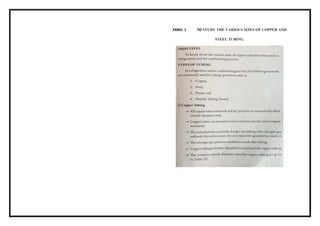
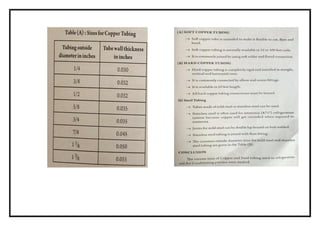
EXNO: 1 TO STUDY THE VARIOUS SIZES OF COPPER AND
STEEL TUBING.
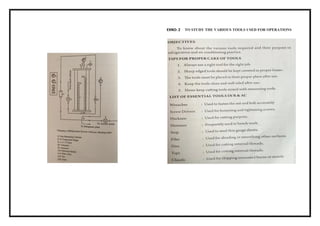
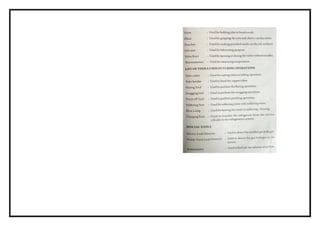
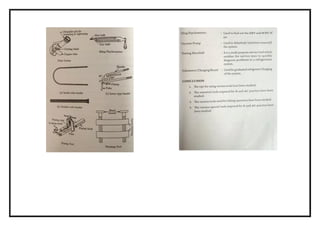
EXNO: 2 TO STUDY THE VARIOUS TOOLS USED FOR OPERATIONS
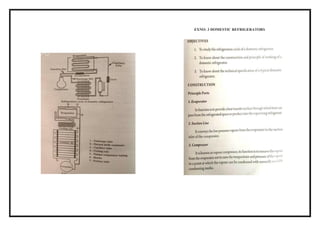
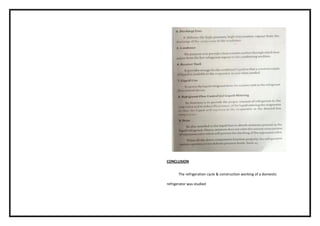
EXNO: 3 DOMESTIC REFRIGERATORS
CONCLUSION
The refrigeration cycle & construction working of a domestic
refrigerator was studied
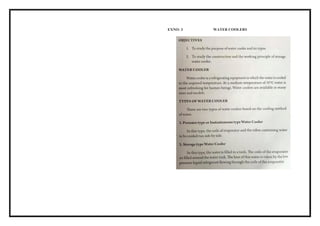
EXNO: 3 WATER COOLERS
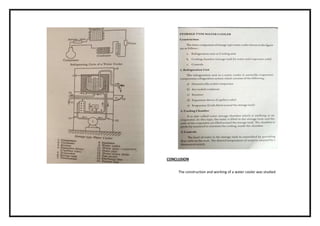
CONCLUSION
The construction and working of a water cooler was studied
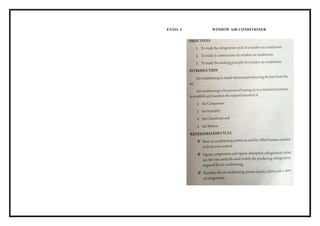
EXNO: 4 WINDOW AIR CONDITIONER
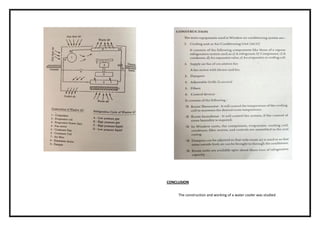
CONCLUSION
The construction and working of a water cooler was studied
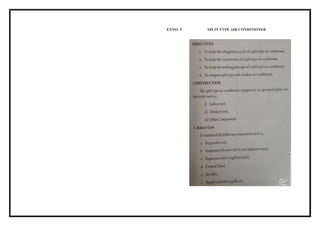
EXNO: 5 SPLIT TYPE AIR CONDITIONER
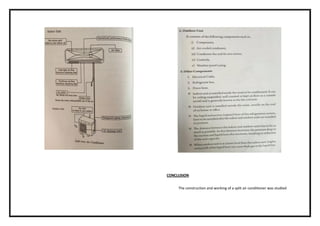
CONCLUSION
The construction and working of a split air conditioner was studied
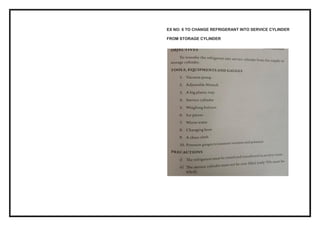
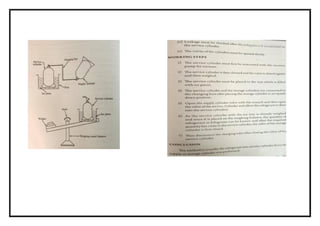
EX NO: 6 TO CHANGE REFRIGERANT INTO SERVICE CYLINDER
FROM STORAGE CYLINDER
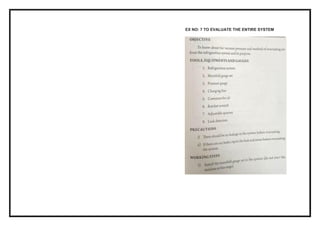
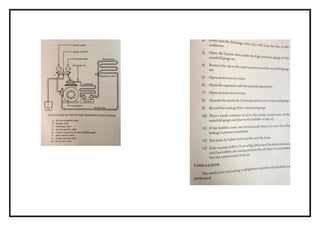
EX NO: 7 TO EVALUATE THE ENTIRE SYSTEM
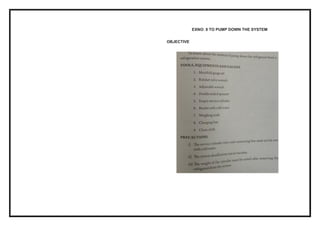
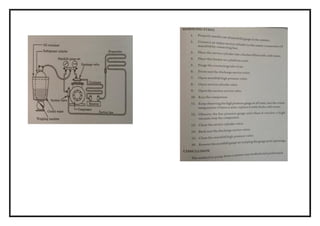
EXNO: 8 TO PUMP DOWN THE SYSTEM
OBJECTIVE
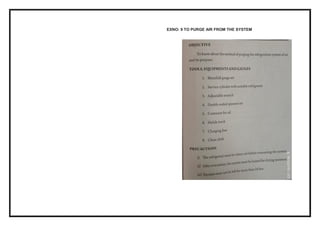
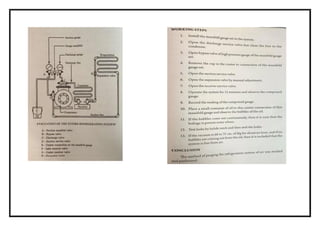
EXNO: 9 TO PURGE AIR FROM THE SYSTEM
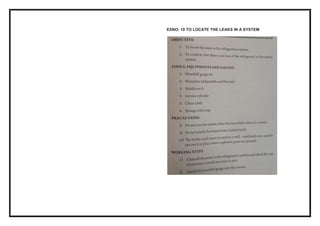
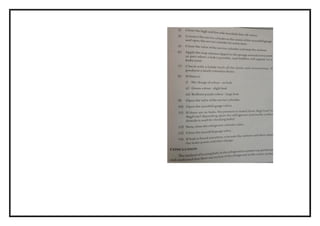
EXNO: 10 TO LOCATE THE LEAKS IN A SYSTEM
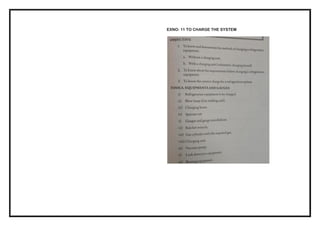
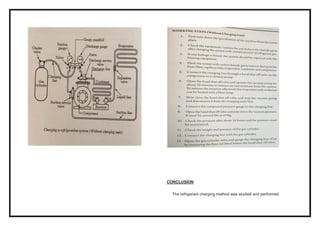
EXNO: 11 TO CHARGE THE SYSTEM
CONCLUSION
The refrigerant charging method was studied and performed
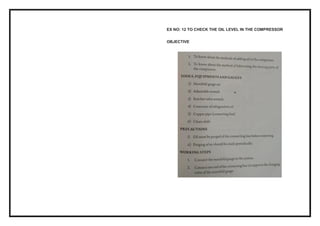
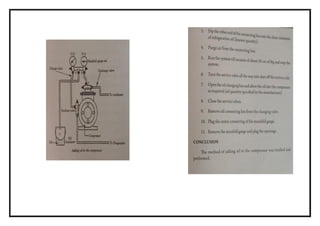
EX NO: 12 TO CHECK THE OIL LEVEL IN THE COMPRESSOR
OBJECTIVE
C32086- REFRIGERATION & AIR CONDITIONING PRACTICAL
MANNUAL
DEPARTMENT OF MECHANICAL ENGINEERING
ER PERUMAL MANIMEKALAI POLYTECHNIC COLEGE, HOSUR
C32086 REFRIGERATION & AIR CONDITIONING PRACTICAL
PREPARED BY
A.KANAKESWARAN.ME.
LECTURER
DEPARTMENT OF MECHANICAL ENGG
ER PERUMAL MANIMEKALAI P OLYTECHINIC COLLEGE, HOSUR
BOARD EXAMINATION MODEDL QUESTION PAPER
PART A
1. Conduct the flaring operation on the given copper and steel tube.
2. Conduct the swaging operation on the given copper and steel tube.
3. Conduct the soldering operation on the given R&AC unit.
4. Conduct the process of setting and adjusting of the given thermostat.
5. Conduct the process of setting and adjusting of the given low pressure and high pressure cut-
outs.
6. Conduct the process of setting and adjusting of the given thermostatic expansion valve.
7. Conduct the process of setting and adjusting of the given automatic expansion valve.
PART B
8. Determine the refrigerating effect, COP and capacity of the open system with the given
thermostatic expansion valve.
9. Determine the refrigerating effect, COP and capacity of the given open system with capillary
tube
10. Determine the refrigerating effect, COP and capacity of the given open system with automatic
expansion valve.
11. Determine the COP of the given sealed system using electrical measurements
12. Determine the capacity of a given window air-conditioner.
13. Determine the efficiency of a given cooling tower.
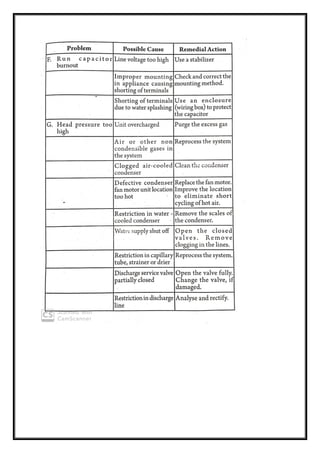
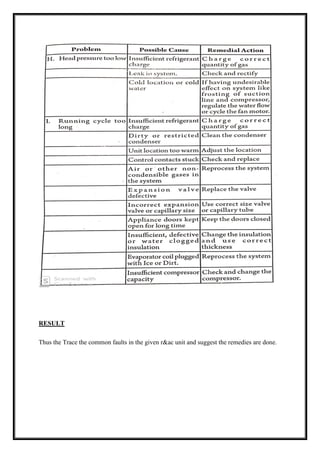
14. Trace the common faults in the given R&AC unit and suggest the remedies.
C32086- REFRIGERATION & AIR CONDITIONING PRACTICAL
SYLLABUS
PART - A
1. BASIC REFRIGERATION WORKSHOP OPERATION
(a) Copper and steel tubing
To study the various sizes of copper and steel tubing.
To study the various tools used for operations.
To become familiar with various operations on copper and steel turbine ,Flaring, Swaging.
(b) Soldering methods used in R & A.C
2. TO STUDY THE CONSTRUCTION FEATURES OF THE FOLLOWING.
(a) Domestic refrigerators
(b) Water coolers
(c) Window Air conditioner
(d) Split Type Air conditioner
3. PROPER METHODS OF SETTING AND ADJUSTING OF
(a) Thermostats
(b) Low pressure and high pressure cut-outs
(c) Thermostatic expansion valve
(d) Automatic Expansion valve
PART - B
TEST PROCEDURES
1. To determine the refrigerating effect, C.O.P. and the compressor capacity of a open type system with
thermostatic expansion valve, Capillary tube,Automatic Expansion valve.
2. To determine the C.O.P. of sealed system by using electrical measurements.
To determine the capacity of a window air conditioner.
To determine the efficiency of a cooling tower. Wiring of refrigerator, water cooler, desert cooler,
room air conditioner, packaged air conditioner, panel board etc.
SERVICE PROCEDURES
1.To change refrigerant into service cylinder from storage cylinder.
2. To evaluate the entire system
3.To pump down the system
4.To purge air from the system
5. To locate the leaks in a system
6.To charge the system
7. To check the oil level in the compressor
8.Tracing the common faults in R & A.C unit and their remedies.
PART A
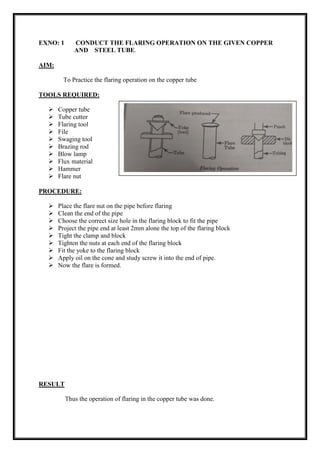
EXNO: 1 CONDUCT THE FLARING OPERATION ON THE GIVEN COPPER
AND STEEL TUBE.
AIM:
To Practice the flaring operation on the copper tube
TOOLS REQUIRED:
 Copper tube
 Tube cutter
 Flaring tool
 File
 Swaging tool
 Brazing rod
 Blow lamp
 Flux material
 Hammer
 Flare nut
PROCEDURE:
 Place the flare nut on the pipe before flaring
 Clean the end of the pipe
 Choose the correct size hole in the flaring block to fit the pipe
 Project the pipe end at least 2mm alone the top of the flaring block
 Tight the clamp and block
 Tighten the nuts at each end of the flaring block
 Fit the yoke to the flaring block
 Apply oil on the cone and study screw it into the end of pipe.
 Now the flare is formed.
RESULT
Thus the operation of flaring in the copper tube was done.
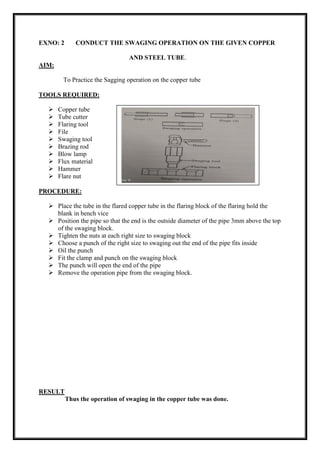
EXNO: 2 CONDUCT THE SWAGING OPERATION ON THE GIVEN COPPER
AND STEEL TUBE.
AIM:
To Practice the Sagging operation on the copper tube
TOOLS REQUIRED:
 Copper tube
 Tube cutter
 Flaring tool
 File
 Swaging tool
 Brazing rod
 Blow lamp
 Flux material
 Hammer
 Flare nut
PROCEDURE:
 Place the tube in the flared copper tube in the flaring block of the flaring hold the
blank in bench vice
 Position the pipe so that the end is the outside diameter of the pipe 3mm above the top
of the swaging block.
 Tighten the nuts at each right size to swaging block
 Choose a punch of the right size to swaging out the end of the pipe fits inside
 Oil the punch
 Fit the clamp and punch on the swaging block
 The punch will open the end of the pipe
 Remove the operation pipe from the swaging block.
RESULT
Thus the operation of swaging in the copper tube was done.
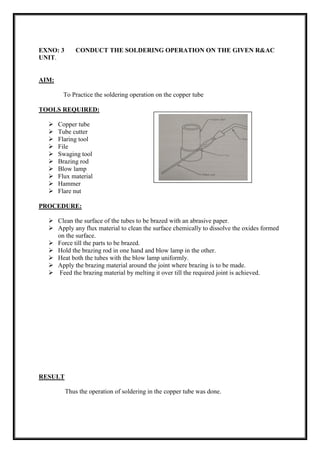
EXNO: 3 CONDUCT THE SOLDERING OPERATION ON THE GIVEN R&AC
UNIT.
AIM:
To Practice the soldering operation on the copper tube
TOOLS REQUIRED:
 Copper tube
 Tube cutter
 Flaring tool
 File
 Swaging tool
 Brazing rod
 Blow lamp
 Flux material
 Hammer
 Flare nut
PROCEDURE:
 Clean the surface of the tubes to be brazed with an abrasive paper.
 Apply any flux material to clean the surface chemically to dissolve the oxides formed
on the surface.
 Force till the parts to be brazed.
 Hold the brazing rod in one hand and blow lamp in the other.
 Heat both the tubes with the blow lamp uniformly.
 Apply the brazing material around the joint where brazing is to be made.
 Feed the brazing material by melting it over till the required joint is achieved.
RESULT
Thus the operation of soldering in the copper tube was done.
EXNO: 4 CONDUCT THE PROCESS OF SETTING AND ADJUSTING OF THE
GIVEN THERMOSTAT.
AIM:
To study the method of setting and adjusting of the given thermostat
PROCEDURE:
 Locate the sensing bulb of the thermostat. Normally it will be fixed firmly to the
evaporator.
 Change the knob position to zero mark.
 Operate the knob and twin to a position at mark 1, allow the
 System to run for 4 to 5 minutes and note the temperature of the evaporator.
 Operate the knob at mark 2 and note the temperature and repeat this action for marks
3, 4 and 5
 To test the thermostatic switch for its automatic working, connect the thermostatic
switch in series to an electric lamp. Now keeps the sensing bulb of the thermostatic
switch in a glass containing ice cubes. As you place this sensing bulb in ice cubes, the
bulb switches off. Now remove the sensing bulb from the glass (containing ice cubes).
The electric bulb will again be lit automatically. This shows that the bellows are
operating correctly and consequently the thermostat switch is alright.
 After this, remove the side covers of the thermostat with a screwdriver.
 Identify the differential screw (marked red) temperature control screw and the main
knob (refer to the diagram).
 Do not operate or tamper with the differential screw (marked rod).
 Turn the knob at mark 1, the compressor does not stop, then twin the temperature
control screw anticlockwise up to three complete turns. Now note the temperature of
the evaporator at the print of the stopping of the compressor.
 If the compressor stops early without achieving proper cooling temperature. In the
evaporator, turn the temperature control screw (2 or 3 turns) in the clockwise direction
and after achieving the required result, note down the temperature of the evaporator.
SLNO
POSITION OF THE
KNOP
TEMPERATURE
1
2
3
4
5
RESULT
Thus the setting and adjusting of a thermostat switch were studied.
EXNO: 5 CONDUCT THE PROCESS OF SETTING AND ADJUSTING OF THE
GIVEN
LOW PRESSURE AND HIGH PRESSURE CUT-OUTS.
AIM:
To study the method of setting and adjusting of the given low pressure and high
pressure cut outs
TOOLS REQUIRED:
 Refrigeration equipments
 High pressure low pressure control
 Screw driver
 Adjustable wrench
PROCEDURE:
LOW PRESUURE CUT OUTS
 Determine the desired cut-out temperature of the refrigerate space.
 Check the corresponding, pressure from the temperature Pressure relationship chart of
the refrigerant already changed in the system.
 Determine the desired cut in temperature of the refrigerated space.
 Check the corresponding, pressure from the temperature pressure relationship chart
for the same refrigerant changed in the system.
 Check the refrigerated space temperature.
 Remove the screw and take off the knob and the locking plate from the top of the LP
control.
 The required starting pressure is now set by means of the regulating spindle -1 (range
adjustment) and scale on the cover of the device.
 Lock the spindle with the plate,
 The required stopping pressure is now set by means of the regulating spindle -2 (cut-
out differential adjustment).
 The scale which indicates the pressure difference between starting and stopping
pressure is the differential i.e. (starting pressure -differential = stopping pressure).
 Fit the knob on the spindle -2 for stopping pressure and secure it with the screw.
 The starting pressure is now fixed.
 The knob can be rotated for adjusting the stopping pressure.
 Start the unit and check the in newly set pressures by means of gauges
 Check the cut-in and cut-out temperatures of the refrigerated space by means of dial
thermometer.
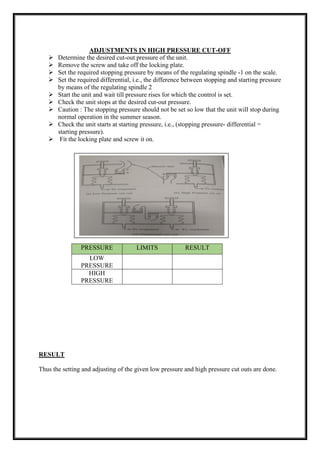
ADJUSTMENTS IN HIGH PRESSURE CUT-OFF
 Determine the desired cut-out pressure of the unit.
 Remove the screw and take off the locking plate.
 Set the required stopping pressure by means of the regulating spindle -1 on the scale.
 Set the required differential, i.e., the difference between stopping and starting pressure
by means of the regulating spindle 2
 Start the unit and wait till pressure rises for which the control is set.
 Check the unit stops at the desired cut-out pressure.
 Caution : The stopping pressure should not be set so low that the unit will stop during
normal operation in the summer season.
 Check the unit starts at starting pressure, i.e., (stopping pressure- differential =
starting pressure).
 Fit the locking plate and screw it on.
RESULT
Thus the setting and adjusting of the given low pressure and high pressure cut outs are done.
PRESSURE LIMITS RESULT
LOW
PRESSURE
HIGH
PRESSURE
EXNO: 6 CONDUCT THE PROCESS OF SETTING AND ADJUSTING OF THE
GIVEN
THERMOSTATIC EXPANSION VALVE
AIM:
To study the method of setting and adjusting of the given thermostatic expansion
valve
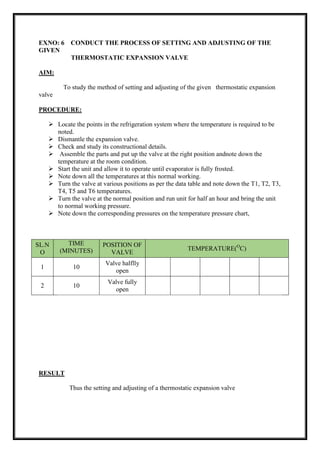
PROCEDURE:
 Locate the points in the refrigeration system where the temperature is required to be
noted.
 Dismantle the expansion valve.
 Check and study its constructional details.
 Assemble the parts and put up the valve at the right position andnote down the
temperature at the room condition.
 Start the unit and allow it to operate until evaporator is fully frosted.
 Note down all the temperatures at this normal working.
 Turn the valve at various positions as per the data table and note down the T1, T2, T3,
T4, T5 and T6 temperatures.
 Turn the valve at the normal position and run unit for half an hour and bring the unit
to normal working pressure.
 Note down the corresponding pressures on the temperature pressure chart,
SL.N
O
TIME
(MINUTES)
POSITION OF
VALVE
TEMPERATURE(O
C)
1 10
Valve halflly
open
2 10
Valve fully
open
RESULT
Thus the setting and adjusting of a thermostatic expansion valve
EXNO: 7 CONDUCT THE PROCESS OF SETTING AND ADJUSTING OF THE
GIVEN
AUTOMATIC EXPANSION VALVE
AIM:
To study the method of setting and adjusting of the given automatic expansion
valve PROCEDURE:
 Locate the points in the refrigeration system where the temperature is required to be
noted.
 Dismantle the expansion valve.
 Check and study its constructional details.
 Assemble the parts and put up the valve at the right position andnote down the
temperature at the room condition.
 Start the unit and allow it to operate until evaporator is fully frosted.
 Note down all the temperatures at this normal working.
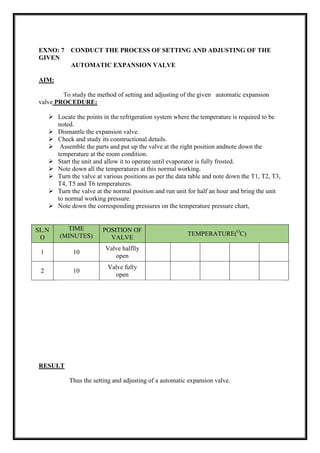
 Turn the valve at various positions as per the data table and note down the T1, T2, T3,
T4, T5 and T6 temperatures.
 Turn the valve at the normal position and run unit for half an hour and bring the unit
to normal working pressure.
 Note down the corresponding pressures on the temperature pressure chart,
SL.N
O
TIME
(MINUTES)
POSITION OF
VALVE
TEMPERATURE(O
C)
1 10
Valve halflly
open
2 10
Valve fully
open
RESULT
Thus the setting and adjusting of a automatic expansion valve.
PART B
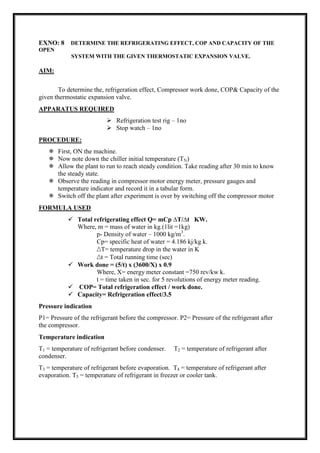
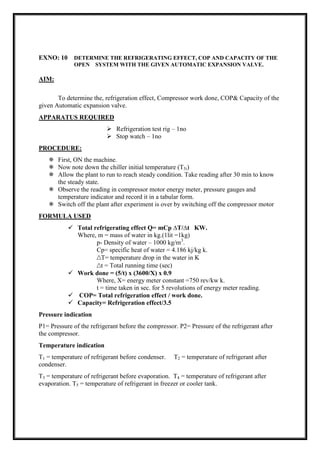
EXNO: 8 DETERMINE THE REFRIGERATING EFFECT, COP AND CAPACITY OF THE
OPEN
SYSTEM WITH THE GIVEN THERMOSTATIC EXPANSION VALVE.
AIM:
To determine the, refrigeration effect, Compressor work done, COP& Capacity of the
given thermostatic expansion valve.
APPARATUS REQUIRED
 Refrigeration test rig – 1no
 Stop watch – 1no
PROCEDURE:
 First, ON the machine.
 Now note down the chiller initial temperature (T5i)
 Allow the plant to run to reach steady condition. Take reading after 30 min to know
the steady state.
 Observe the reading in compressor motor energy meter, pressure gauges and
temperature indicator and record it in a tabular form.
 Switch off the plant after experiment is over by switching off the compressor motor
FORMULA USED
 Total refrigerating effect Q= mCp ∆T/∆t KW.
Where, m = mass of water in kg.(1lit =1kg)
p- Density of water – 1000 kg/m3
.
Cp= specific heat of water = 4.186 kj/kg k.
∆T= temperature drop in the water in K
∆t = Total running time (sec)
 Work done = (5/t) x (3600/X) x 0.9
Where, X= energy meter constant =750 rev/kw k.
t = time taken in sec. for 5 revolutions of energy meter reading.
 COP= Total refrigeration effect / work done.
 Capacity= Refrigeration effect/3.5
Pressure indication
P1= Pressure of the refrigerant before the compressor. P2= Pressure of the refrigerant after
the compressor.
Temperature indication
T1 = temperature of refrigerant before condenser. T2 = temperature of refrigerant after
condenser.
T3 = temperature of refrigerant before evaporation. T4 = temperature of refrigerant after
evaporation. T5 = temperature of refrigerant in freezer or cooler tank.
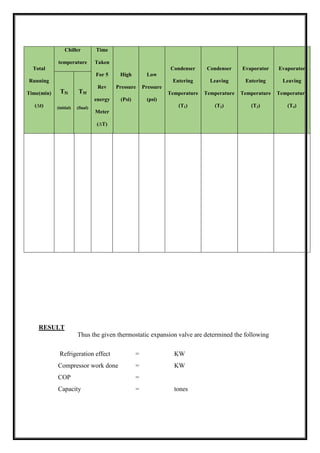
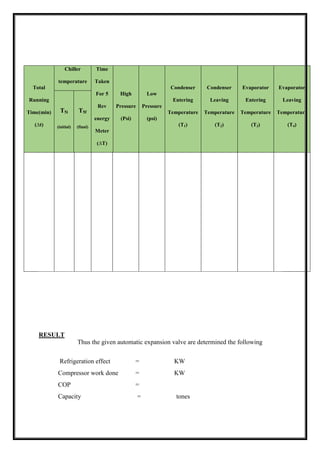
Total
Running
Time(min)
(∆t)
Chiller
temperature
Time
Taken
For 5
Rev
energy
Meter
(∆T)
High
Pressure
(Psi)
Low
Pressure
(psi)
Condenser
Entering
Temperature
(T1)
Condenser
Leaving
Temperature
(T2)
Evaporator
Entering
Temperature
(T3)
Evaporator
Leaving
Temperature
(T4)
T5i
(initial)
T5f
(final)
RESULT
Thus the given thermostatic expansion valve are determined the following
Refrigeration effect = KW
Compressor work done = KW
COP =
Capacity = tones
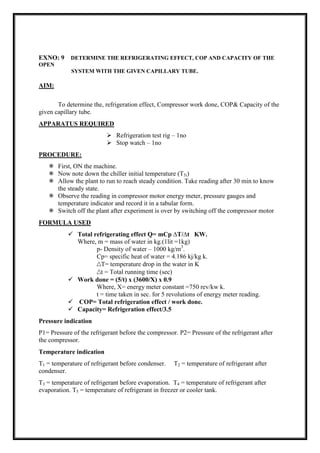
EXNO: 9 DETERMINE THE REFRIGERATING EFFECT, COP AND CAPACITY OF THE
OPEN
SYSTEM WITH THE GIVEN CAPILLARY TUBE.
AIM:
To determine the, refrigeration effect, Compressor work done, COP& Capacity of the
given capillary tube.
APPARATUS REQUIRED
 Refrigeration test rig – 1no
 Stop watch – 1no
PROCEDURE:
 First, ON the machine.
 Now note down the chiller initial temperature (T5i)
 Allow the plant to run to reach steady condition. Take reading after 30 min to know
the steady state.
 Observe the reading in compressor motor energy meter, pressure gauges and
temperature indicator and record it in a tabular form.
 Switch off the plant after experiment is over by switching off the compressor motor
FORMULA USED
 Total refrigerating effect Q= mCp ∆T/∆t KW.
Where, m = mass of water in kg.(1lit =1kg)
p- Density of water – 1000 kg/m3
.
Cp= specific heat of water = 4.186 kj/kg k.
∆T= temperature drop in the water in K
∆t = Total running time (sec)
 Work done = (5/t) x (3600/X) x 0.9
Where, X= energy meter constant =750 rev/kw k.
t = time taken in sec. for 5 revolutions of energy meter reading.
 COP= Total refrigeration effect / work done.
 Capacity= Refrigeration effect/3.5
Pressure indication
P1= Pressure of the refrigerant before the compressor. P2= Pressure of the refrigerant after
the compressor.
Temperature indication
T1 = temperature of refrigerant before condenser. T2 = temperature of refrigerant after
condenser.
T3 = temperature of refrigerant before evaporation. T4 = temperature of refrigerant after
evaporation. T5 = temperature of refrigerant in freezer or cooler tank.
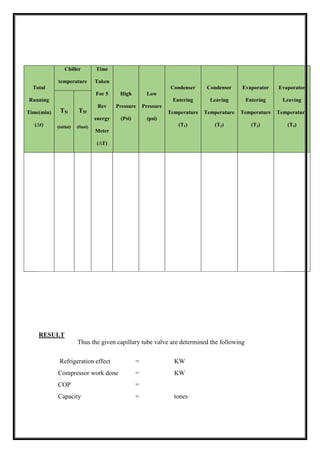
Total
Running
Time(min)
(∆t)
Chiller
temperature
Time
Taken
For 5
Rev
energy
Meter
(∆T)
High
Pressure
(Psi)
Low
Pressure
(psi)
Condenser
Entering
Temperature
(T1)
Condenser
Leaving
Temperature
(T2)
Evaporator
Entering
Temperature
(T3)
Evaporator
Leaving
Temperature
(T4)
T5i
(initial)
T5f
(final)
RESULT
Thus the given capillary tube valve are determined the following
Refrigeration effect = KW
Compressor work done = KW
COP =
Capacity = tones
EXNO: 10 DETERMINE THE REFRIGERATING EFFECT, COP AND CAPACITY OF THE
OPEN SYSTEM WITH THE GIVEN AUTOMATIC EXPANSION VALVE.
AIM:
To determine the, refrigeration effect, Compressor work done, COP& Capacity of the
given Automatic expansion valve.
APPARATUS REQUIRED
 Refrigeration test rig – 1no
 Stop watch – 1no
PROCEDURE:
 First, ON the machine.
 Now note down the chiller initial temperature (T5i)
 Allow the plant to run to reach steady condition. Take reading after 30 min to know
the steady state.
 Observe the reading in compressor motor energy meter, pressure gauges and
temperature indicator and record it in a tabular form.
 Switch off the plant after experiment is over by switching off the compressor motor
FORMULA USED
 Total refrigerating effect Q= mCp ∆T/∆t KW.
Where, m = mass of water in kg.(1lit =1kg)
p- Density of water – 1000 kg/m3
.
Cp= specific heat of water = 4.186 kj/kg k.
∆T= temperature drop in the water in K
∆t = Total running time (sec)
 Work done = (5/t) x (3600/X) x 0.9
Where, X= energy meter constant =750 rev/kw k.
t = time taken in sec. for 5 revolutions of energy meter reading.
 COP= Total refrigeration effect / work done.
 Capacity= Refrigeration effect/3.5
Pressure indication
P1= Pressure of the refrigerant before the compressor. P2= Pressure of the refrigerant after
the compressor.
Temperature indication
T1 = temperature of refrigerant before condenser. T2 = temperature of refrigerant after
condenser.
T3 = temperature of refrigerant before evaporation. T4 = temperature of refrigerant after
evaporation. T5 = temperature of refrigerant in freezer or cooler tank.
Total
Running
Time(min)
(∆t)
Chiller
temperature
Time
Taken
For 5
Rev
energy
Meter
(∆T)
High
Pressure
(Psi)
Low
Pressure
(psi)
Condenser
Entering
Temperature
(T1)
Condenser
Leaving
Temperature
(T2)
Evaporator
Entering
Temperature
(T3)
Evaporator
Leaving
Temperature
(T4)
T5i
(initial)
T5f
(final)
RESULT
Thus the given automatic expansion valve are determined the following
Refrigeration effect = KW
Compressor work done = KW
COP =
Capacity = tones
EXNO: 11 DETERMINE THE COP OF THE GIVEN SEALED SYSTEM USING
ELECTRICAL MEASUREMENTS (WINDOWS AIR CONDITIONER)
AIM
To determine the cop of the given sealed system using electrical measurements
(windows air conditioner)
APPARATUS REQUIRED
 Air – conditioning test rig -1no
 Stop watch -1no
PROCEDURE
 Switch on the mains.
 Switch on the condenser, fan and blower.
 Switch on the compressor and allow the unit to stabilize or 30 min.
 Note down the following.
A] Pressure P1, P2 from the respective pressure gauge.
B] Note the corresponding temperature T1, T2, T3, T4, T5, and T6 at the
respective state points.
C] Note the corresponding voltmeter and ammeter reading.
TABULATION
Total
Running
time
(min)
Voltmeter
reading
(volts)
Ammeter
Reading
(Amps)
Pressure
reading
(psi)
Temp reading (0
C)
Velocity
Of air
P1 P2 T1 T2 T3 T4 T5 T6 m/sec
SPECIFICATION
Compressor details type : 1 ton sealed closed type
Cylinder : single
Refrigerant : R 22
Condenser details : Air cooled
No of passes : 6mm or 1/4”
Pressure drop : 0.5 kg-f / cm2
Expansion device : Capillary tube and thermos tic expansion valve.
Tube material : Copper
Fan : Two nos
230 volts 2 amps : (for condenser and evaporators)
Energy meter : Single phase 230 volts , volt meter and amp.
FORMULA
 Mass of air [m] = ρa x A x Va kg/sec
Where, ρa - density of air = 1.125 kg/m3
A - Area of the duct = LXB in m2
Va - Velocity of air in m/sec
 Refrigeration effect = m [h2 – h1] kW
Where, ma - mass of air kg/sec
h1 - Enthalpy of before compressor (Refer P-h chart for r22)
h2- Enthalpy of After compressor (Refer P- h chart for r22)
 Capacity = Refrigeration effect/3.5
 Compressor Work done = ((V X I)/1000) X P.F
Where,
V - Voltmeter reading in volts
I- Ammeter reading in amps
P.F- Power factor = 0,9
 COP = [h1- h3]/[ h2- h1]
[Where are h1, h2, h3 enthalpies of refrigerant taken from p-h chart for r22]
h1 - Enthalpy of before compressor
(Compare p-h chart in Low pressure, P1and temperature of compressor entering
temperature,T1)
h2- Enthalpy of after compressor
(Compare p-h chart in High pressure, P2 and temperature of compressor leaving temperature,
T2)
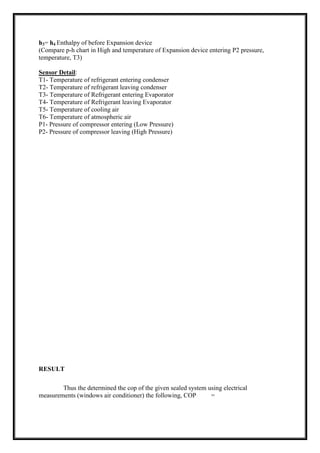
h3= h4 Enthalpy of before Expansion device
(Compare p-h chart in High and temperature of Expansion device entering P2 pressure,
temperature, T3)
Sensor Detail:
T1- Temperature of refrigerant entering condenser
T2- Temperature of refrigerant leaving condenser
T3- Temperature of Refrigerant entering Evaporator
T4- Temperature of Refrigerant leaving Evaporator
T5- Temperature of cooling air
T6- Temperature of atmospheric air
P1- Pressure of compressor entering (Low Pressure)
P2- Pressure of compressor leaving (High Pressure)
RESULT
Thus the determined the cop of the given sealed system using electrical
measurements (windows air conditioner) the following, COP =
EXNO: 12 DETERMINE THE CAPACITY OF A GIVEN WINDOW AIR-
CONDITIONER
AIM
Determine the capacity of a given window air-conditioner
APPARATUS REQUIRED
 Air – conditioning test rig -1no
 Stop watch -1no
PROCEDURE
 Switch on the mains.
 Switch on the condenser, fan and blower.
 Switch on the compressor and allow the unit to stabilize or 30 min.
 Note down the following.
A] Pressure P1, P2 from the respective pressure gauge.
B] Note the corresponding temperature T1, T2, T3, T4, T5, and T6 at the
respective state points.
C] Note the corresponding voltmeter and ammeter reading.
TABULATION
Total
Running
time
(min)
Voltmeter
reading
(volts)
Ammeter
Reading
(Amps)
Pressure
reading
(psi)
Temp reading (0
C)
Velocity
Of air
P1 P2 T1 T2 T3 T4 T5 T6 m/sec
SPECIFICATION
Compressor details type : 1 ton sealed closed type
Cylinder : single
Refrigerant : R 22
Condenser details : Air cooled
No of passes : 6mm or 1/4”
Pressure drop : 0.5 kg-f / cm2
Expansion device : Capillary tube and thermos tic expansion valve.
Tube material : Copper
Fan : Two nos
230 volts 2 amps : (for condenser and evaporators)
Energy meter : Single phase 230 volts , volt meter and amp.
FORMULA
 Mass of air [m] = ρa x A x Va kg/sec
Where, ρa - density of air = 1.125 kg/m3
A - Area of the duct = LXB in m2
Va - Velocity of air in m/sec
 Refrigeration effect = m [h2 – h1] kW
Where, ma - mass of air kg/sec
h1 - Enthalpy of before compressor (Refer P-h chart for r22)
h2- Enthalpy of After compressor (Refer P- h chart for r22)
 Capacity = Refrigeration effect/3.5
 Compressor Work done = ((V X I)/1000) X P.F
Where,
V - Voltmeter reading in volts
I- Ammeter reading in amps
P.F- Power factor = 0.9
 COP = [h1- h3]/[ h2- h1]
[Where are h1, h2, h3 enthalpies of refrigerant taken from p-h chart for r22]
h1 - Enthalpy of before compressor
(Compare p-h chart in Low pressure, P1and temperature of compressor entering
temperature,T1)
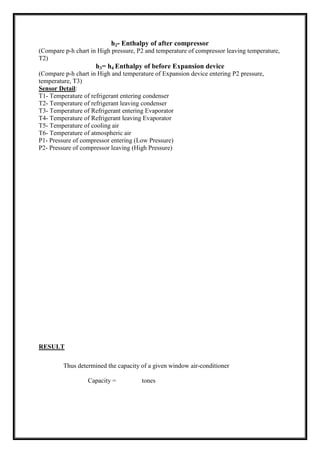
h2- Enthalpy of after compressor
(Compare p-h chart in High pressure, P2 and temperature of compressor leaving temperature,
T2)
h3= h4 Enthalpy of before Expansion device
(Compare p-h chart in High and temperature of Expansion device entering P2 pressure,
temperature, T3)
Sensor Detail:
T1- Temperature of refrigerant entering condenser
T2- Temperature of refrigerant leaving condenser
T3- Temperature of Refrigerant entering Evaporator
T4- Temperature of Refrigerant leaving Evaporator
T5- Temperature of cooling air
T6- Temperature of atmospheric air
P1- Pressure of compressor entering (Low Pressure)
P2- Pressure of compressor leaving (High Pressure)
RESULT
Thus determined the capacity of a given window air-conditioner
Capacity = tones
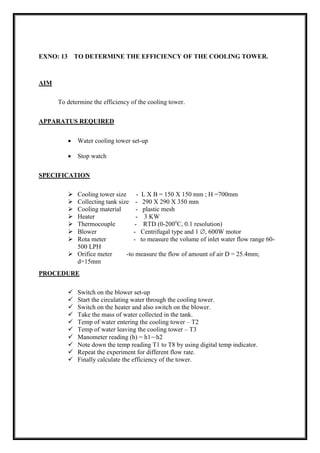
EXNO: 13 TO DETERMINE THE EFFICIENCY OF THE COOLING TOWER.
AIM
To determine the efficiency of the cooling tower.
APPARATUS REQUIRED
 Water cooling tower set-up
 Stop watch
SPECIFICATION
 Cooling tower size - L X B = 150 X 150 mm ; H =700mm
 Collecting tank size - 290 X 290 X 350 mm
 Cooling material - plastic mesh
 Heater - 3 KW
 Thermocouple - RTD (0-200o
C, 0.1 resolution)
 Blower - Centrifugal type and 1 Ø, 600W motor
 Rota meter - to measure the volume of inlet water flow range 60-
500 LPH
 Orifice meter -to measure the flow of amount of air D = 25.4mm;
d=15mm
PROCEDURE
 Switch on the blower set-up
 Start the circulating water through the cooling tower.
 Switch on the heater and also switch on the blower.
 Take the mass of water collected in the tank.
 Temp of water entering the cooling tower – T2
 Temp of water leaving the cooling tower – T3
 Manometer reading (h) = h1~h2
 Note down the temp reading T1 to T8 by using digital temp indicator.
 Repeat the experiment for different flow rate.
 Finally calculate the efficiency of the tower.
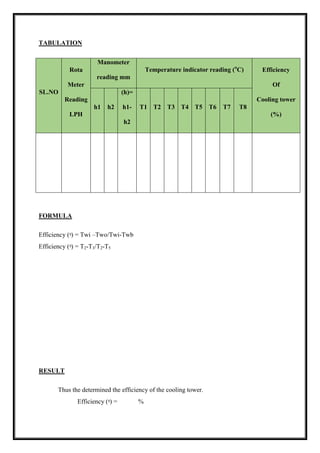
TABULATION
SL.NO
Rota
Meter
Reading
LPH
Manometer
reading mm
Temperature indicator reading (o
C) Efficiency
Of
Cooling tower
(%)
h1 h2
(h)=
h1-
h2
T1 T2 T3 T4 T5 T6 T7 T8
FORMULA
Efficiency (ᵑ) = Twi –Two/Twi-Twb
Efficiency (ᵑ) = T2-T3/T2-T5
RESULT
Thus the determined the efficiency of the cooling tower.
Efficiency (ᵑ) = %
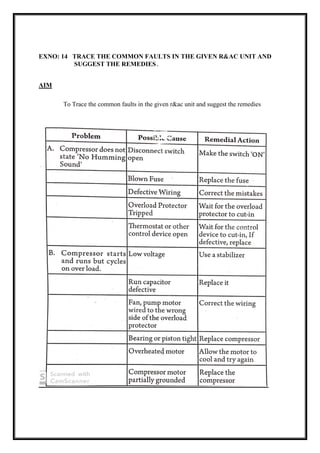
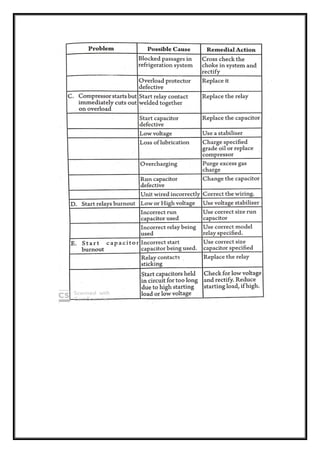
EXNO: 14 TRACE THE COMMON FAULTS IN THE GIVEN R&AC UNIT AND
SUGGEST THE REMEDIES.
AIM
To Trace the common faults in the given r&ac unit and suggest the remedies
RESULT
Thus the Trace the common faults in the given r&ac unit and suggest the remedies are done.
R & AC LAB MANNUAL FINAL.docx.pdf

R & AC LAB MANNUAL FINAL.docx.pdf

  • 1.
    C32086- REFRIGERATION &AIR CONDITIONING PRACTICAL Study exercise
  • 2.
    EXNO: 1 TOSTUDY THE VARIOUS SIZES OF COPPER AND STEEL TUBING.
  • 4.
    EXNO: 2 TOSTUDY THE VARIOUS TOOLS USED FOR OPERATIONS
  • 7.
    EXNO: 3 DOMESTICREFRIGERATORS
  • 8.
    CONCLUSION The refrigeration cycle& construction working of a domestic refrigerator was studied
  • 9.
  • 10.
    CONCLUSION The construction andworking of a water cooler was studied
  • 11.
    EXNO: 4 WINDOWAIR CONDITIONER
  • 12.
    CONCLUSION The construction andworking of a water cooler was studied
  • 13.
    EXNO: 5 SPLITTYPE AIR CONDITIONER
  • 14.
    CONCLUSION The construction andworking of a split air conditioner was studied
  • 15.
    EX NO: 6TO CHANGE REFRIGERANT INTO SERVICE CYLINDER FROM STORAGE CYLINDER
  • 17.
    EX NO: 7TO EVALUATE THE ENTIRE SYSTEM
  • 19.
    EXNO: 8 TOPUMP DOWN THE SYSTEM OBJECTIVE
  • 21.
    EXNO: 9 TOPURGE AIR FROM THE SYSTEM
  • 23.
    EXNO: 10 TOLOCATE THE LEAKS IN A SYSTEM
  • 25.
    EXNO: 11 TOCHARGE THE SYSTEM
  • 26.
    CONCLUSION The refrigerant chargingmethod was studied and performed
  • 27.
    EX NO: 12TO CHECK THE OIL LEVEL IN THE COMPRESSOR OBJECTIVE
  • 30.
    C32086- REFRIGERATION &AIR CONDITIONING PRACTICAL MANNUAL DEPARTMENT OF MECHANICAL ENGINEERING ER PERUMAL MANIMEKALAI POLYTECHNIC COLEGE, HOSUR C32086 REFRIGERATION & AIR CONDITIONING PRACTICAL PREPARED BY A.KANAKESWARAN.ME. LECTURER DEPARTMENT OF MECHANICAL ENGG ER PERUMAL MANIMEKALAI P OLYTECHINIC COLLEGE, HOSUR
  • 31.
    BOARD EXAMINATION MODEDLQUESTION PAPER PART A 1. Conduct the flaring operation on the given copper and steel tube. 2. Conduct the swaging operation on the given copper and steel tube. 3. Conduct the soldering operation on the given R&AC unit. 4. Conduct the process of setting and adjusting of the given thermostat. 5. Conduct the process of setting and adjusting of the given low pressure and high pressure cut- outs. 6. Conduct the process of setting and adjusting of the given thermostatic expansion valve. 7. Conduct the process of setting and adjusting of the given automatic expansion valve. PART B 8. Determine the refrigerating effect, COP and capacity of the open system with the given thermostatic expansion valve. 9. Determine the refrigerating effect, COP and capacity of the given open system with capillary tube 10. Determine the refrigerating effect, COP and capacity of the given open system with automatic expansion valve. 11. Determine the COP of the given sealed system using electrical measurements 12. Determine the capacity of a given window air-conditioner. 13. Determine the efficiency of a given cooling tower. 14. Trace the common faults in the given R&AC unit and suggest the remedies. C32086- REFRIGERATION & AIR CONDITIONING PRACTICAL
  • 32.
    SYLLABUS PART - A 1.BASIC REFRIGERATION WORKSHOP OPERATION (a) Copper and steel tubing To study the various sizes of copper and steel tubing. To study the various tools used for operations. To become familiar with various operations on copper and steel turbine ,Flaring, Swaging. (b) Soldering methods used in R & A.C 2. TO STUDY THE CONSTRUCTION FEATURES OF THE FOLLOWING. (a) Domestic refrigerators (b) Water coolers (c) Window Air conditioner (d) Split Type Air conditioner 3. PROPER METHODS OF SETTING AND ADJUSTING OF (a) Thermostats (b) Low pressure and high pressure cut-outs (c) Thermostatic expansion valve (d) Automatic Expansion valve PART - B TEST PROCEDURES 1. To determine the refrigerating effect, C.O.P. and the compressor capacity of a open type system with thermostatic expansion valve, Capillary tube,Automatic Expansion valve. 2. To determine the C.O.P. of sealed system by using electrical measurements. To determine the capacity of a window air conditioner. To determine the efficiency of a cooling tower. Wiring of refrigerator, water cooler, desert cooler, room air conditioner, packaged air conditioner, panel board etc.
  • 33.
    SERVICE PROCEDURES 1.To changerefrigerant into service cylinder from storage cylinder. 2. To evaluate the entire system 3.To pump down the system 4.To purge air from the system 5. To locate the leaks in a system 6.To charge the system 7. To check the oil level in the compressor 8.Tracing the common faults in R & A.C unit and their remedies.
  • 34.
  • 35.
    EXNO: 1 CONDUCTTHE FLARING OPERATION ON THE GIVEN COPPER AND STEEL TUBE. AIM: To Practice the flaring operation on the copper tube TOOLS REQUIRED:  Copper tube  Tube cutter  Flaring tool  File  Swaging tool  Brazing rod  Blow lamp  Flux material  Hammer  Flare nut PROCEDURE:  Place the flare nut on the pipe before flaring  Clean the end of the pipe  Choose the correct size hole in the flaring block to fit the pipe  Project the pipe end at least 2mm alone the top of the flaring block  Tight the clamp and block  Tighten the nuts at each end of the flaring block  Fit the yoke to the flaring block  Apply oil on the cone and study screw it into the end of pipe.  Now the flare is formed. RESULT Thus the operation of flaring in the copper tube was done.
  • 36.
    EXNO: 2 CONDUCTTHE SWAGING OPERATION ON THE GIVEN COPPER AND STEEL TUBE. AIM: To Practice the Sagging operation on the copper tube TOOLS REQUIRED:  Copper tube  Tube cutter  Flaring tool  File  Swaging tool  Brazing rod  Blow lamp  Flux material  Hammer  Flare nut PROCEDURE:  Place the tube in the flared copper tube in the flaring block of the flaring hold the blank in bench vice  Position the pipe so that the end is the outside diameter of the pipe 3mm above the top of the swaging block.  Tighten the nuts at each right size to swaging block  Choose a punch of the right size to swaging out the end of the pipe fits inside  Oil the punch  Fit the clamp and punch on the swaging block  The punch will open the end of the pipe  Remove the operation pipe from the swaging block. RESULT Thus the operation of swaging in the copper tube was done.
  • 37.
    EXNO: 3 CONDUCTTHE SOLDERING OPERATION ON THE GIVEN R&AC UNIT. AIM: To Practice the soldering operation on the copper tube TOOLS REQUIRED:  Copper tube  Tube cutter  Flaring tool  File  Swaging tool  Brazing rod  Blow lamp  Flux material  Hammer  Flare nut PROCEDURE:  Clean the surface of the tubes to be brazed with an abrasive paper.  Apply any flux material to clean the surface chemically to dissolve the oxides formed on the surface.  Force till the parts to be brazed.  Hold the brazing rod in one hand and blow lamp in the other.  Heat both the tubes with the blow lamp uniformly.  Apply the brazing material around the joint where brazing is to be made.  Feed the brazing material by melting it over till the required joint is achieved. RESULT Thus the operation of soldering in the copper tube was done.
  • 38.
    EXNO: 4 CONDUCTTHE PROCESS OF SETTING AND ADJUSTING OF THE GIVEN THERMOSTAT. AIM: To study the method of setting and adjusting of the given thermostat PROCEDURE:  Locate the sensing bulb of the thermostat. Normally it will be fixed firmly to the evaporator.  Change the knob position to zero mark.  Operate the knob and twin to a position at mark 1, allow the  System to run for 4 to 5 minutes and note the temperature of the evaporator.  Operate the knob at mark 2 and note the temperature and repeat this action for marks 3, 4 and 5  To test the thermostatic switch for its automatic working, connect the thermostatic switch in series to an electric lamp. Now keeps the sensing bulb of the thermostatic switch in a glass containing ice cubes. As you place this sensing bulb in ice cubes, the bulb switches off. Now remove the sensing bulb from the glass (containing ice cubes). The electric bulb will again be lit automatically. This shows that the bellows are operating correctly and consequently the thermostat switch is alright.  After this, remove the side covers of the thermostat with a screwdriver.  Identify the differential screw (marked red) temperature control screw and the main knob (refer to the diagram).  Do not operate or tamper with the differential screw (marked rod).  Turn the knob at mark 1, the compressor does not stop, then twin the temperature control screw anticlockwise up to three complete turns. Now note the temperature of the evaporator at the print of the stopping of the compressor.  If the compressor stops early without achieving proper cooling temperature. In the evaporator, turn the temperature control screw (2 or 3 turns) in the clockwise direction and after achieving the required result, note down the temperature of the evaporator. SLNO POSITION OF THE KNOP TEMPERATURE 1 2 3 4 5 RESULT Thus the setting and adjusting of a thermostat switch were studied.
  • 39.
    EXNO: 5 CONDUCTTHE PROCESS OF SETTING AND ADJUSTING OF THE GIVEN LOW PRESSURE AND HIGH PRESSURE CUT-OUTS. AIM: To study the method of setting and adjusting of the given low pressure and high pressure cut outs TOOLS REQUIRED:  Refrigeration equipments  High pressure low pressure control  Screw driver  Adjustable wrench PROCEDURE: LOW PRESUURE CUT OUTS  Determine the desired cut-out temperature of the refrigerate space.  Check the corresponding, pressure from the temperature Pressure relationship chart of the refrigerant already changed in the system.  Determine the desired cut in temperature of the refrigerated space.  Check the corresponding, pressure from the temperature pressure relationship chart for the same refrigerant changed in the system.  Check the refrigerated space temperature.  Remove the screw and take off the knob and the locking plate from the top of the LP control.  The required starting pressure is now set by means of the regulating spindle -1 (range adjustment) and scale on the cover of the device.  Lock the spindle with the plate,  The required stopping pressure is now set by means of the regulating spindle -2 (cut- out differential adjustment).  The scale which indicates the pressure difference between starting and stopping pressure is the differential i.e. (starting pressure -differential = stopping pressure).  Fit the knob on the spindle -2 for stopping pressure and secure it with the screw.  The starting pressure is now fixed.  The knob can be rotated for adjusting the stopping pressure.  Start the unit and check the in newly set pressures by means of gauges  Check the cut-in and cut-out temperatures of the refrigerated space by means of dial thermometer.
  • 40.
    ADJUSTMENTS IN HIGHPRESSURE CUT-OFF  Determine the desired cut-out pressure of the unit.  Remove the screw and take off the locking plate.  Set the required stopping pressure by means of the regulating spindle -1 on the scale.  Set the required differential, i.e., the difference between stopping and starting pressure by means of the regulating spindle 2  Start the unit and wait till pressure rises for which the control is set.  Check the unit stops at the desired cut-out pressure.  Caution : The stopping pressure should not be set so low that the unit will stop during normal operation in the summer season.  Check the unit starts at starting pressure, i.e., (stopping pressure- differential = starting pressure).  Fit the locking plate and screw it on. RESULT Thus the setting and adjusting of the given low pressure and high pressure cut outs are done. PRESSURE LIMITS RESULT LOW PRESSURE HIGH PRESSURE
  • 41.
    EXNO: 6 CONDUCTTHE PROCESS OF SETTING AND ADJUSTING OF THE GIVEN THERMOSTATIC EXPANSION VALVE AIM: To study the method of setting and adjusting of the given thermostatic expansion valve PROCEDURE:  Locate the points in the refrigeration system where the temperature is required to be noted.  Dismantle the expansion valve.  Check and study its constructional details.  Assemble the parts and put up the valve at the right position andnote down the temperature at the room condition.  Start the unit and allow it to operate until evaporator is fully frosted.  Note down all the temperatures at this normal working.  Turn the valve at various positions as per the data table and note down the T1, T2, T3, T4, T5 and T6 temperatures.  Turn the valve at the normal position and run unit for half an hour and bring the unit to normal working pressure.  Note down the corresponding pressures on the temperature pressure chart, SL.N O TIME (MINUTES) POSITION OF VALVE TEMPERATURE(O C) 1 10 Valve halflly open 2 10 Valve fully open RESULT Thus the setting and adjusting of a thermostatic expansion valve
  • 42.
    EXNO: 7 CONDUCTTHE PROCESS OF SETTING AND ADJUSTING OF THE GIVEN AUTOMATIC EXPANSION VALVE AIM: To study the method of setting and adjusting of the given automatic expansion valve PROCEDURE:  Locate the points in the refrigeration system where the temperature is required to be noted.  Dismantle the expansion valve.  Check and study its constructional details.  Assemble the parts and put up the valve at the right position andnote down the temperature at the room condition.  Start the unit and allow it to operate until evaporator is fully frosted.  Note down all the temperatures at this normal working.  Turn the valve at various positions as per the data table and note down the T1, T2, T3, T4, T5 and T6 temperatures.  Turn the valve at the normal position and run unit for half an hour and bring the unit to normal working pressure.  Note down the corresponding pressures on the temperature pressure chart, SL.N O TIME (MINUTES) POSITION OF VALVE TEMPERATURE(O C) 1 10 Valve halflly open 2 10 Valve fully open RESULT Thus the setting and adjusting of a automatic expansion valve.
  • 43.
  • 44.
    EXNO: 8 DETERMINETHE REFRIGERATING EFFECT, COP AND CAPACITY OF THE OPEN SYSTEM WITH THE GIVEN THERMOSTATIC EXPANSION VALVE. AIM: To determine the, refrigeration effect, Compressor work done, COP& Capacity of the given thermostatic expansion valve. APPARATUS REQUIRED  Refrigeration test rig – 1no  Stop watch – 1no PROCEDURE:  First, ON the machine.  Now note down the chiller initial temperature (T5i)  Allow the plant to run to reach steady condition. Take reading after 30 min to know the steady state.  Observe the reading in compressor motor energy meter, pressure gauges and temperature indicator and record it in a tabular form.  Switch off the plant after experiment is over by switching off the compressor motor FORMULA USED  Total refrigerating effect Q= mCp ∆T/∆t KW. Where, m = mass of water in kg.(1lit =1kg) p- Density of water – 1000 kg/m3 . Cp= specific heat of water = 4.186 kj/kg k. ∆T= temperature drop in the water in K ∆t = Total running time (sec)  Work done = (5/t) x (3600/X) x 0.9 Where, X= energy meter constant =750 rev/kw k. t = time taken in sec. for 5 revolutions of energy meter reading.  COP= Total refrigeration effect / work done.  Capacity= Refrigeration effect/3.5 Pressure indication P1= Pressure of the refrigerant before the compressor. P2= Pressure of the refrigerant after the compressor. Temperature indication T1 = temperature of refrigerant before condenser. T2 = temperature of refrigerant after condenser. T3 = temperature of refrigerant before evaporation. T4 = temperature of refrigerant after evaporation. T5 = temperature of refrigerant in freezer or cooler tank.
  • 45.
  • 46.
    EXNO: 9 DETERMINETHE REFRIGERATING EFFECT, COP AND CAPACITY OF THE OPEN SYSTEM WITH THE GIVEN CAPILLARY TUBE. AIM: To determine the, refrigeration effect, Compressor work done, COP& Capacity of the given capillary tube. APPARATUS REQUIRED  Refrigeration test rig – 1no  Stop watch – 1no PROCEDURE:  First, ON the machine.  Now note down the chiller initial temperature (T5i)  Allow the plant to run to reach steady condition. Take reading after 30 min to know the steady state.  Observe the reading in compressor motor energy meter, pressure gauges and temperature indicator and record it in a tabular form.  Switch off the plant after experiment is over by switching off the compressor motor FORMULA USED  Total refrigerating effect Q= mCp ∆T/∆t KW. Where, m = mass of water in kg.(1lit =1kg) p- Density of water – 1000 kg/m3 . Cp= specific heat of water = 4.186 kj/kg k. ∆T= temperature drop in the water in K ∆t = Total running time (sec)  Work done = (5/t) x (3600/X) x 0.9 Where, X= energy meter constant =750 rev/kw k. t = time taken in sec. for 5 revolutions of energy meter reading.  COP= Total refrigeration effect / work done.  Capacity= Refrigeration effect/3.5 Pressure indication P1= Pressure of the refrigerant before the compressor. P2= Pressure of the refrigerant after the compressor. Temperature indication T1 = temperature of refrigerant before condenser. T2 = temperature of refrigerant after condenser. T3 = temperature of refrigerant before evaporation. T4 = temperature of refrigerant after evaporation. T5 = temperature of refrigerant in freezer or cooler tank.
  • 47.
  • 48.
    EXNO: 10 DETERMINETHE REFRIGERATING EFFECT, COP AND CAPACITY OF THE OPEN SYSTEM WITH THE GIVEN AUTOMATIC EXPANSION VALVE. AIM: To determine the, refrigeration effect, Compressor work done, COP& Capacity of the given Automatic expansion valve. APPARATUS REQUIRED  Refrigeration test rig – 1no  Stop watch – 1no PROCEDURE:  First, ON the machine.  Now note down the chiller initial temperature (T5i)  Allow the plant to run to reach steady condition. Take reading after 30 min to know the steady state.  Observe the reading in compressor motor energy meter, pressure gauges and temperature indicator and record it in a tabular form.  Switch off the plant after experiment is over by switching off the compressor motor FORMULA USED  Total refrigerating effect Q= mCp ∆T/∆t KW. Where, m = mass of water in kg.(1lit =1kg) p- Density of water – 1000 kg/m3 . Cp= specific heat of water = 4.186 kj/kg k. ∆T= temperature drop in the water in K ∆t = Total running time (sec)  Work done = (5/t) x (3600/X) x 0.9 Where, X= energy meter constant =750 rev/kw k. t = time taken in sec. for 5 revolutions of energy meter reading.  COP= Total refrigeration effect / work done.  Capacity= Refrigeration effect/3.5 Pressure indication P1= Pressure of the refrigerant before the compressor. P2= Pressure of the refrigerant after the compressor. Temperature indication T1 = temperature of refrigerant before condenser. T2 = temperature of refrigerant after condenser. T3 = temperature of refrigerant before evaporation. T4 = temperature of refrigerant after evaporation. T5 = temperature of refrigerant in freezer or cooler tank.
  • 49.
  • 50.
    EXNO: 11 DETERMINETHE COP OF THE GIVEN SEALED SYSTEM USING ELECTRICAL MEASUREMENTS (WINDOWS AIR CONDITIONER) AIM To determine the cop of the given sealed system using electrical measurements (windows air conditioner) APPARATUS REQUIRED  Air – conditioning test rig -1no  Stop watch -1no PROCEDURE  Switch on the mains.  Switch on the condenser, fan and blower.  Switch on the compressor and allow the unit to stabilize or 30 min.  Note down the following. A] Pressure P1, P2 from the respective pressure gauge. B] Note the corresponding temperature T1, T2, T3, T4, T5, and T6 at the respective state points. C] Note the corresponding voltmeter and ammeter reading. TABULATION Total Running time (min) Voltmeter reading (volts) Ammeter Reading (Amps) Pressure reading (psi) Temp reading (0 C) Velocity Of air P1 P2 T1 T2 T3 T4 T5 T6 m/sec
  • 51.
    SPECIFICATION Compressor details type: 1 ton sealed closed type Cylinder : single Refrigerant : R 22 Condenser details : Air cooled No of passes : 6mm or 1/4” Pressure drop : 0.5 kg-f / cm2 Expansion device : Capillary tube and thermos tic expansion valve. Tube material : Copper Fan : Two nos 230 volts 2 amps : (for condenser and evaporators) Energy meter : Single phase 230 volts , volt meter and amp. FORMULA  Mass of air [m] = ρa x A x Va kg/sec Where, ρa - density of air = 1.125 kg/m3 A - Area of the duct = LXB in m2 Va - Velocity of air in m/sec  Refrigeration effect = m [h2 – h1] kW Where, ma - mass of air kg/sec h1 - Enthalpy of before compressor (Refer P-h chart for r22) h2- Enthalpy of After compressor (Refer P- h chart for r22)  Capacity = Refrigeration effect/3.5  Compressor Work done = ((V X I)/1000) X P.F Where, V - Voltmeter reading in volts I- Ammeter reading in amps P.F- Power factor = 0,9  COP = [h1- h3]/[ h2- h1] [Where are h1, h2, h3 enthalpies of refrigerant taken from p-h chart for r22] h1 - Enthalpy of before compressor (Compare p-h chart in Low pressure, P1and temperature of compressor entering temperature,T1) h2- Enthalpy of after compressor (Compare p-h chart in High pressure, P2 and temperature of compressor leaving temperature, T2)
  • 52.
    h3= h4 Enthalpyof before Expansion device (Compare p-h chart in High and temperature of Expansion device entering P2 pressure, temperature, T3) Sensor Detail: T1- Temperature of refrigerant entering condenser T2- Temperature of refrigerant leaving condenser T3- Temperature of Refrigerant entering Evaporator T4- Temperature of Refrigerant leaving Evaporator T5- Temperature of cooling air T6- Temperature of atmospheric air P1- Pressure of compressor entering (Low Pressure) P2- Pressure of compressor leaving (High Pressure) RESULT Thus the determined the cop of the given sealed system using electrical measurements (windows air conditioner) the following, COP =
  • 53.
    EXNO: 12 DETERMINETHE CAPACITY OF A GIVEN WINDOW AIR- CONDITIONER AIM Determine the capacity of a given window air-conditioner APPARATUS REQUIRED  Air – conditioning test rig -1no  Stop watch -1no PROCEDURE  Switch on the mains.  Switch on the condenser, fan and blower.  Switch on the compressor and allow the unit to stabilize or 30 min.  Note down the following. A] Pressure P1, P2 from the respective pressure gauge. B] Note the corresponding temperature T1, T2, T3, T4, T5, and T6 at the respective state points. C] Note the corresponding voltmeter and ammeter reading. TABULATION Total Running time (min) Voltmeter reading (volts) Ammeter Reading (Amps) Pressure reading (psi) Temp reading (0 C) Velocity Of air P1 P2 T1 T2 T3 T4 T5 T6 m/sec
  • 54.
    SPECIFICATION Compressor details type: 1 ton sealed closed type Cylinder : single Refrigerant : R 22 Condenser details : Air cooled No of passes : 6mm or 1/4” Pressure drop : 0.5 kg-f / cm2 Expansion device : Capillary tube and thermos tic expansion valve. Tube material : Copper Fan : Two nos 230 volts 2 amps : (for condenser and evaporators) Energy meter : Single phase 230 volts , volt meter and amp. FORMULA  Mass of air [m] = ρa x A x Va kg/sec Where, ρa - density of air = 1.125 kg/m3 A - Area of the duct = LXB in m2 Va - Velocity of air in m/sec  Refrigeration effect = m [h2 – h1] kW Where, ma - mass of air kg/sec h1 - Enthalpy of before compressor (Refer P-h chart for r22) h2- Enthalpy of After compressor (Refer P- h chart for r22)  Capacity = Refrigeration effect/3.5  Compressor Work done = ((V X I)/1000) X P.F Where, V - Voltmeter reading in volts I- Ammeter reading in amps P.F- Power factor = 0.9  COP = [h1- h3]/[ h2- h1] [Where are h1, h2, h3 enthalpies of refrigerant taken from p-h chart for r22] h1 - Enthalpy of before compressor (Compare p-h chart in Low pressure, P1and temperature of compressor entering temperature,T1)
  • 55.
    h2- Enthalpy ofafter compressor (Compare p-h chart in High pressure, P2 and temperature of compressor leaving temperature, T2) h3= h4 Enthalpy of before Expansion device (Compare p-h chart in High and temperature of Expansion device entering P2 pressure, temperature, T3) Sensor Detail: T1- Temperature of refrigerant entering condenser T2- Temperature of refrigerant leaving condenser T3- Temperature of Refrigerant entering Evaporator T4- Temperature of Refrigerant leaving Evaporator T5- Temperature of cooling air T6- Temperature of atmospheric air P1- Pressure of compressor entering (Low Pressure) P2- Pressure of compressor leaving (High Pressure) RESULT Thus determined the capacity of a given window air-conditioner Capacity = tones
  • 56.
    EXNO: 13 TODETERMINE THE EFFICIENCY OF THE COOLING TOWER. AIM To determine the efficiency of the cooling tower. APPARATUS REQUIRED  Water cooling tower set-up  Stop watch SPECIFICATION  Cooling tower size - L X B = 150 X 150 mm ; H =700mm  Collecting tank size - 290 X 290 X 350 mm  Cooling material - plastic mesh  Heater - 3 KW  Thermocouple - RTD (0-200o C, 0.1 resolution)  Blower - Centrifugal type and 1 Ø, 600W motor  Rota meter - to measure the volume of inlet water flow range 60- 500 LPH  Orifice meter -to measure the flow of amount of air D = 25.4mm; d=15mm PROCEDURE  Switch on the blower set-up  Start the circulating water through the cooling tower.  Switch on the heater and also switch on the blower.  Take the mass of water collected in the tank.  Temp of water entering the cooling tower – T2  Temp of water leaving the cooling tower – T3  Manometer reading (h) = h1~h2  Note down the temp reading T1 to T8 by using digital temp indicator.  Repeat the experiment for different flow rate.  Finally calculate the efficiency of the tower.
  • 57.
    TABULATION SL.NO Rota Meter Reading LPH Manometer reading mm Temperature indicatorreading (o C) Efficiency Of Cooling tower (%) h1 h2 (h)= h1- h2 T1 T2 T3 T4 T5 T6 T7 T8 FORMULA Efficiency (ᵑ) = Twi –Two/Twi-Twb Efficiency (ᵑ) = T2-T3/T2-T5 RESULT Thus the determined the efficiency of the cooling tower. Efficiency (ᵑ) = %
  • 58.
    EXNO: 14 TRACETHE COMMON FAULTS IN THE GIVEN R&AC UNIT AND SUGGEST THE REMEDIES. AIM To Trace the common faults in the given r&ac unit and suggest the remedies
  • 61.
    RESULT Thus the Tracethe common faults in the given r&ac unit and suggest the remedies are done.