Course title :- Refrigerator Biomedical engineer/Technician
level training
Medical device:- Refrigerator Samsung RS26
Venue: HUCSH CPD center
Date: Feb-2023
Refrigerator
2/18/2023
Contents
 Introduction
 Functional principle
 Parts of the device
 Installation
 Safety and Accuracy Consideration
 Preventive Maintenance
 Troubleshoot
Introduction
Purpose of the device
 Refrigerator is used to preserve laboratory substance in a
controlled environment
 Its purpose is to reduce risk of possible contamination and
destruction of hazardous items
1
Laboratory procedure
1. Connect the power plug to the main power socket
2. Turn on the device
3. Set the themprature controller at the required temprature
4. Allow the unit to reach th required temprature
5. load th product by following the saftey rule
6. Set the alarm value if any
7. Check the temprature twice daily
Functional principle and the technology
 It basically works by transferring heat from a region of low
temperature to a region of high temperature.
 The technology was realized by using the second law of
thermodynamics
‘It is impossible for a self acting machine unless energy is provided by any
external agency, to transer heat from a body having lower temprature to another at
higher temprature’
2
 The working principle depends on the type of regrigerator
Types of Laboratory Refrigerator
Based on their refrigeration system
 Compressor and
Absorption
Functional principle of absorpation type
 The control of heat transfer processes is less precise than
electrical control
 It takes much longer to produce a desired temperature change
within an absorption refrigerator.
 Absorption systems rely on heat transfer, chemical processes,
and gravity flow of fluids
 It is driven by heat, either from an electric element, a bottled
gas flame or a kerosene wick burner.
Functional principal of compressor type
 Compression system uses compressors to drive the cooling
process
 The compressor draws cool refrigerant gas in through the
suction line from the evaporator coils
 At the same time, it compresses the gas and pumps it into the
discharge line.
3
 The high pressure and temprature gas from the compessor
passes to the condensor
 The condenser is the cooling coil for the hot refrigerant gas.
 In the condenser, the heat is expelled into the room air outside
the cabinet.
 The refrigerant gas gives up the heat it removed from inside the
cabinet and changes into a liquid state.
 The hot refrigerant liquid leaves the condenser and enter the
capillary tube
In between a filter-drier removes any moisture or impurities.
 From the capillary tube the refregrant enters in to the
evaporator
 In the evaporator, the refrigerant temperature drops and
changes to a mixture of liquid and gas
 The refrigerant absorbs heat from the storage area and is
changed from a liquid and gas mixture to a gas
 The low-pressure refrigerant gas leaving the evaporator coil
now enters the accumulator,
 The accumulator designed to trap any refrigerant liquid that
may not have changed to gas in the evaporator.
 It works in a closed circulatory system
14
 Based on the temperature they maintain
 Freezer and Refrigerator
 Freezers operates at temperatures between -80ºC and -
10ºC
 Refrigerator operate at temperatures from 1⁰C to 10⁰C.
Fuctional Components of Refrigerator
Most decice components are assembled during manufacturing
Refrigerant
 A gas that are used in a cooling system
 It changes from a gas to a liquid and back to a gas inside the
compartment
4
Compressor
 Is a motor that used to compress the refrigerant gas to have a
higher temperature and pressure
Hermetic compressor
Suction line
Process line
Discharge line
Terminal connector
5
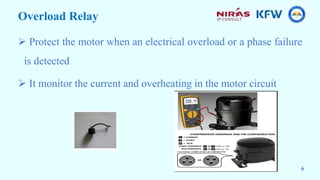
Overload Relay
 Protect the motor when an electrical overload or a phase failure
is detected
 It monitor the current and overheating in the motor circuit
6
Starting Relay
 Used to connects and/or disconnects starting winding of
electrical motor
Starting Capacitor
 It gives the compressor a high starting torque
7
Condenser
 The hot refrigerant vapor cools as heat transfers by conduction
through the metal walls
 Condensing medium
 Air: convection or Water: inner water pipe
8
Condenser
Condenser fan
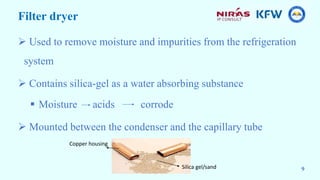
Filter dryer
 Used to remove moisture and impurities from the refrigeration
system
 Contains silica-gel as a water absorbing substance
 Moisture acids corrode
 Mounted between the condenser and the capillary tube
Copper housing
Silica gel/sand 9
Capillary tube (Expansion Valve)
 Is an expansion device that uses to reduce the pressure of the
refrigerant
 Results the refrigerant to converts in to liquid and gas mixture
10
Evaporator
 Used to absorb heat from the refrigerator cabinet (product
storage)
 The refrigerant changes from a liquid and gas mixture to a gas.
11
Accumulator
 Used to trap any refrigerant liquid that may not have changed
to gas in the evaporator
 It prevented from entering the suction line to the compressor.
12
Thermostat
 Used to regulate the running periods of the compressor
 It helps to maintain the temperature inside the refrigerator or
freezer
13
Fans
Condenser fan
Evaporator fan
Technical considerations of operational
requirements
 The power requirment of the device needs to be checked before
operating to prevent device damage
 The maximum weight capacity of the device to store needs to
be considered to prevent device malfunctioning
 Accessories that is recommended by the manufacturer should
be used during repair replacement
Assemblies for Installation
Step 1. Equipment unpacking
Check the accessories per the packing list
Check the refrigerator and accessories for any physical
damage
Step 2. Place the refrigerator in a well vente place
Step 3. Install the tempered glass shelf
Step 4. Connecting the Power cord and turn on
Step 5. Put the temperature as required
Technical Aspect of device operation
Safety and Accuracy Considerations
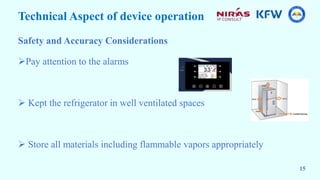
Pay attention to the alarms
 Kept the refrigerator in well ventilated spaces
 Store all materials including flammable vapors appropriately
15
Cont.
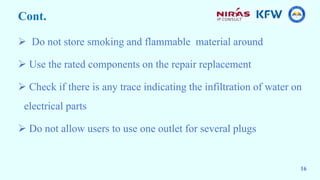
 Do not store smoking and flammable material around
 Use the rated components on the repair replacement
 Check if there is any trace indicating the infiltration of water on
electrical parts
 Do not allow users to use one outlet for several plugs
16
Cont.
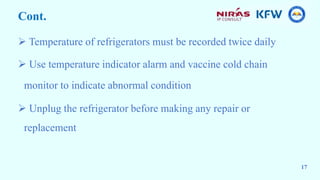
 Temperature of refrigerators must be recorded twice daily
 Use temperature indicator alarm and vaccine cold chain
monitor to indicate abnormal condition
 Unplug the refrigerator before making any repair or
replacement
17
 Use stand-alone unit that works freeze or refrigerate
 Regular temprature monitoring is required
 Use a calibrated digital data logger with valid certificate of
calibration
Controls for device operation
 A control system can be used to incerase the accuracy and
saftey of the device
1. Temprature control
 Be designed to control the temprature of the device using
sensor
 when the temprature of the exceed or lowered the requied
value
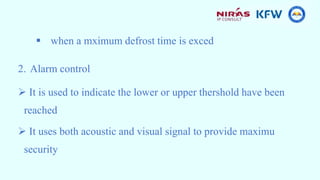
 when a mximum defrost time is exced
2. Alarm control
 It is used to indicate the lower or upper thershold have been
reached
 It uses both acoustic and visual signal to provide maximu
security
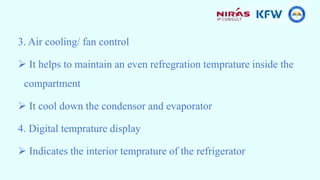
3. Air cooling/ fan control
 It helps to maintain an even refregration temprature inside the
compartment
 It cool down the condensor and evaporator
4. Digital temprature display
 Indicates the interior temprature of the refrigerator
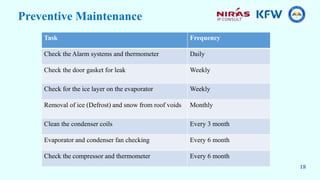
Preventive Maintenance
Task Frequency
Check the Alarm systems and thermometer Daily
Check the door gasket for leak Weekly
Check for the ice layer on the evaporator Weekly
Removal of ice (Defrost) and snow from roof voids Monthly
Clean the condenser coils Every 3 month
Evaporator and condenser fan checking Every 6 month
Check the compressor and thermometer Every 6 month
18
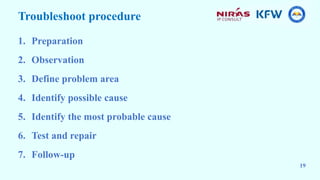
Troubleshoot procedure
1. Preparation
2. Observation
3. Define problem area
4. Identify possible cause
5. Identify the most probable cause
6. Test and repair
7. Follow-up
19
Corrective Maintenance
Trouble Common cause Remedy
1. Unit will not run  Defective power cord
 Low Voltage
 Blown fuse
 Broken temperature control
 Broken relay
 Broken overload
 Broken timer
 Broken compressor
 Check the power cord and the outlet with voltmeter
should check 220v plus or minus 10 %.
 Replace fuse.
 (Check the thermostat) Jumper across terminals of
control. If unit runs and connections are all tight,
replace control.
 Check relay, overload , timer and compressor for
proper functioning or replace if necessary.
2. Refrigerator
section too cold,
No frost
 Refrigerator section airflow
control Knob turned to coldest
position.
 Airflow control broken or
remains open
 Turn control knob to warmer position.
 Replace control or remove obstruction.
20
Cont.
3. Freezer section too cold. (no frost
refrigerator)
 Cold control knob improperly set.
 Cold control capillary not properly
clamped to evaporator
 Turn knob to warmer position.
 Tighten clamp or reposition.
 Check control replace if necessary.
4. Unit runs but does not cool or get
the required temperature
 Not enough air circulation around
Cabinet or air circulation is
restricted.
 Poor door seal.
 Under charge or over charge
 Room temperature too warm.
 Cold control.
 Relocate cabinet or provide proper
clearances around cabinets- remove
restriction.
 Check and make necessary
adjustments.
 Check, evacuate and re–charge with
proper charge.
 Ventilate room as much as possible.
 Check control; if it allows unit to
operate all the time, replace control.
 Use instruct customer
21
Cont.
5. Noisy operation.  Loose flooring or floor not firm.
 Cabinet not level.
 Tubing contacting cabinet or other
tubing.
 Drip trey vibrating.
 Compressor, condenser or
 Tighten flooring or brace floor.
 Level cabinet, Move tubing, Move
treys, place on Styrofoam pad if
necessary.
 Check and try to tight all parts, if the
problem is in the internal mechanical
part of the compressor or fan replace if
necessary.
6. Refrigerator not cooling
at all
 Electric power cut off
 Fuse blown/circuit breaker open the
line
 Thermostat doesn’t cut in
 Refrigerator not leveled
 Check and connect line
 Check and replace fuse /close circuit
breaker
 Check and replace thermostat
 Level the refrigerator
22
Cont.
7. Refrigerator too cold  Thermostat knob not in proper
position
 Thermostat sensor (capillary tube)
end not fitted properly to evaporator
 Faulty thermostat
 Put the thermostat knob to the warmest
position.
 Fasten the sensor (capillary tube) end
properly to the evaporator
 Check and replace thermostat
8. Refrigerator not cold enough  Control knob not in coldest position
 Evaporator frosted
 Door not closing properly
 Low airflow inside and around the
refrigerator
 Over loaded refrigerator
 Refrigerator not level
 Dust on condenser
 Turn the control knob to coldest
position
 Deforest it
 Check door gasket or adjust door
 Improve installation and rearrange
vaccine
 Take some load out
 Level the refrigerator
 Clean condenser
23
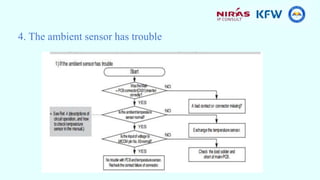
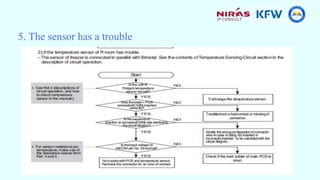
Faultfinding tactics and application
1. If the lamps of freezer / refrigerator fail in lighting
2. If Cool Select Zone temperature isn’t operated normally
(RS267LA, RS269LA)
3. The Panel PCB key isn’t selected:
4. The ambient sensor has trouble
5. The sensor has a trouble
Tools for maintenance
Accessories
Multi-meter
 Clamp meter
 Set of brazing tool kit
(Oxyacetylene
 Air Blower 220 V ~ 50/60Hz
min 450Watt
 Refrigerant leak detector
 Set of screw driver
24
Reference
1. MOH medical equipment manual
2. Samsung rs 26 service manual
25
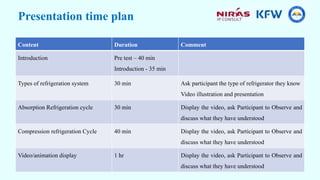
Presentation time plan
Content Duration Comment
Introduction Pre test – 40 min
Introduction - 35 min
Types of refrigeration system 30 min Ask participant the type of refrigerator they know
Video illustration and presentation
Absorption Refrigeration cycle 30 min Display the video, ask Participant to Observe and
discuss what they have understood
Compression refrigeration Cycle 40 min Display the video, ask Participant to Observe and
discuss what they have understood
Video/animation display 1 hr Display the video, ask Participant to Observe and
discuss what they have understood
Principal parts of Compression
refrigeration
50 min Ask Participant to mention major parts, list
down and discuss again the principal part to
ensure all are fully mentioned and understood
Condenser cooling system 30 min Ask participants what they know about cooling
system and Display the slide and discuss
Auxiliary Electrical parts 50 min Ask participants to list down electrical parts
and discuss the function of each part
Troubleshooting 1 hr Display the slide and invite participants for a
Group discussion
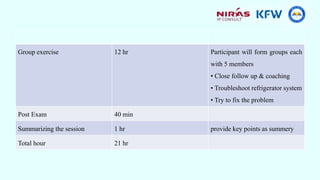
Group exercise 12 hr Participant will form groups each
with 5 members
• Close follow up & coaching
• Troubleshoot refrigerator system
• Try to fix the problem
Post Exam 40 min
Summarizing the session 1 hr provide key points as summery
Total hour 21 hr

Rerrigrator_Training.pptx

  • 1.
    Course title :-Refrigerator Biomedical engineer/Technician level training Medical device:- Refrigerator Samsung RS26 Venue: HUCSH CPD center Date: Feb-2023
  • 2.
  • 3.
    Contents  Introduction  Functionalprinciple  Parts of the device  Installation  Safety and Accuracy Consideration  Preventive Maintenance  Troubleshoot
  • 4.
    Introduction Purpose of thedevice  Refrigerator is used to preserve laboratory substance in a controlled environment  Its purpose is to reduce risk of possible contamination and destruction of hazardous items 1
  • 5.
    Laboratory procedure 1. Connectthe power plug to the main power socket 2. Turn on the device 3. Set the themprature controller at the required temprature
  • 6.
    4. Allow theunit to reach th required temprature 5. load th product by following the saftey rule 6. Set the alarm value if any 7. Check the temprature twice daily
  • 7.
    Functional principle andthe technology  It basically works by transferring heat from a region of low temperature to a region of high temperature.  The technology was realized by using the second law of thermodynamics ‘It is impossible for a self acting machine unless energy is provided by any external agency, to transer heat from a body having lower temprature to another at higher temprature’ 2
  • 8.
     The workingprinciple depends on the type of regrigerator Types of Laboratory Refrigerator Based on their refrigeration system  Compressor and Absorption
  • 9.
    Functional principle ofabsorpation type  The control of heat transfer processes is less precise than electrical control  It takes much longer to produce a desired temperature change within an absorption refrigerator.  Absorption systems rely on heat transfer, chemical processes, and gravity flow of fluids
  • 10.
     It isdriven by heat, either from an electric element, a bottled gas flame or a kerosene wick burner.
  • 11.
    Functional principal ofcompressor type  Compression system uses compressors to drive the cooling process  The compressor draws cool refrigerant gas in through the suction line from the evaporator coils  At the same time, it compresses the gas and pumps it into the discharge line. 3
  • 12.
     The highpressure and temprature gas from the compessor passes to the condensor  The condenser is the cooling coil for the hot refrigerant gas.  In the condenser, the heat is expelled into the room air outside the cabinet.
  • 13.
     The refrigerantgas gives up the heat it removed from inside the cabinet and changes into a liquid state.  The hot refrigerant liquid leaves the condenser and enter the capillary tube In between a filter-drier removes any moisture or impurities.
  • 14.
     From thecapillary tube the refregrant enters in to the evaporator  In the evaporator, the refrigerant temperature drops and changes to a mixture of liquid and gas  The refrigerant absorbs heat from the storage area and is changed from a liquid and gas mixture to a gas
  • 15.
     The low-pressurerefrigerant gas leaving the evaporator coil now enters the accumulator,  The accumulator designed to trap any refrigerant liquid that may not have changed to gas in the evaporator.
  • 16.
     It worksin a closed circulatory system 14
  • 17.
     Based onthe temperature they maintain  Freezer and Refrigerator  Freezers operates at temperatures between -80ºC and - 10ºC
  • 18.
     Refrigerator operateat temperatures from 1⁰C to 10⁰C.
  • 19.
    Fuctional Components ofRefrigerator Most decice components are assembled during manufacturing Refrigerant  A gas that are used in a cooling system  It changes from a gas to a liquid and back to a gas inside the compartment 4
  • 20.
    Compressor  Is amotor that used to compress the refrigerant gas to have a higher temperature and pressure Hermetic compressor Suction line Process line Discharge line Terminal connector 5
  • 21.
    Overload Relay  Protectthe motor when an electrical overload or a phase failure is detected  It monitor the current and overheating in the motor circuit 6
  • 22.
    Starting Relay  Usedto connects and/or disconnects starting winding of electrical motor Starting Capacitor  It gives the compressor a high starting torque 7
  • 23.
    Condenser  The hotrefrigerant vapor cools as heat transfers by conduction through the metal walls  Condensing medium  Air: convection or Water: inner water pipe 8 Condenser Condenser fan
  • 24.
    Filter dryer  Usedto remove moisture and impurities from the refrigeration system  Contains silica-gel as a water absorbing substance  Moisture acids corrode  Mounted between the condenser and the capillary tube Copper housing Silica gel/sand 9
  • 25.
    Capillary tube (ExpansionValve)  Is an expansion device that uses to reduce the pressure of the refrigerant  Results the refrigerant to converts in to liquid and gas mixture 10
  • 26.
    Evaporator  Used toabsorb heat from the refrigerator cabinet (product storage)  The refrigerant changes from a liquid and gas mixture to a gas. 11
  • 27.
    Accumulator  Used totrap any refrigerant liquid that may not have changed to gas in the evaporator  It prevented from entering the suction line to the compressor. 12
  • 28.
    Thermostat  Used toregulate the running periods of the compressor  It helps to maintain the temperature inside the refrigerator or freezer 13
  • 29.
  • 30.
    Technical considerations ofoperational requirements  The power requirment of the device needs to be checked before operating to prevent device damage  The maximum weight capacity of the device to store needs to be considered to prevent device malfunctioning  Accessories that is recommended by the manufacturer should be used during repair replacement
  • 31.
    Assemblies for Installation Step1. Equipment unpacking Check the accessories per the packing list Check the refrigerator and accessories for any physical damage Step 2. Place the refrigerator in a well vente place
  • 32.
    Step 3. Installthe tempered glass shelf Step 4. Connecting the Power cord and turn on Step 5. Put the temperature as required
  • 33.
    Technical Aspect ofdevice operation Safety and Accuracy Considerations Pay attention to the alarms  Kept the refrigerator in well ventilated spaces  Store all materials including flammable vapors appropriately 15
  • 34.
    Cont.  Do notstore smoking and flammable material around  Use the rated components on the repair replacement  Check if there is any trace indicating the infiltration of water on electrical parts  Do not allow users to use one outlet for several plugs 16
  • 35.
    Cont.  Temperature ofrefrigerators must be recorded twice daily  Use temperature indicator alarm and vaccine cold chain monitor to indicate abnormal condition  Unplug the refrigerator before making any repair or replacement 17
  • 36.
     Use stand-aloneunit that works freeze or refrigerate  Regular temprature monitoring is required  Use a calibrated digital data logger with valid certificate of calibration
  • 37.
    Controls for deviceoperation  A control system can be used to incerase the accuracy and saftey of the device 1. Temprature control  Be designed to control the temprature of the device using sensor  when the temprature of the exceed or lowered the requied value
  • 38.
     when amximum defrost time is exced 2. Alarm control  It is used to indicate the lower or upper thershold have been reached  It uses both acoustic and visual signal to provide maximu security
  • 39.
    3. Air cooling/fan control  It helps to maintain an even refregration temprature inside the compartment  It cool down the condensor and evaporator 4. Digital temprature display  Indicates the interior temprature of the refrigerator
  • 40.
    Preventive Maintenance Task Frequency Checkthe Alarm systems and thermometer Daily Check the door gasket for leak Weekly Check for the ice layer on the evaporator Weekly Removal of ice (Defrost) and snow from roof voids Monthly Clean the condenser coils Every 3 month Evaporator and condenser fan checking Every 6 month Check the compressor and thermometer Every 6 month 18
  • 41.
    Troubleshoot procedure 1. Preparation 2.Observation 3. Define problem area 4. Identify possible cause 5. Identify the most probable cause 6. Test and repair 7. Follow-up 19
  • 42.
    Corrective Maintenance Trouble Commoncause Remedy 1. Unit will not run  Defective power cord  Low Voltage  Blown fuse  Broken temperature control  Broken relay  Broken overload  Broken timer  Broken compressor  Check the power cord and the outlet with voltmeter should check 220v plus or minus 10 %.  Replace fuse.  (Check the thermostat) Jumper across terminals of control. If unit runs and connections are all tight, replace control.  Check relay, overload , timer and compressor for proper functioning or replace if necessary. 2. Refrigerator section too cold, No frost  Refrigerator section airflow control Knob turned to coldest position.  Airflow control broken or remains open  Turn control knob to warmer position.  Replace control or remove obstruction. 20
  • 43.
    Cont. 3. Freezer sectiontoo cold. (no frost refrigerator)  Cold control knob improperly set.  Cold control capillary not properly clamped to evaporator  Turn knob to warmer position.  Tighten clamp or reposition.  Check control replace if necessary. 4. Unit runs but does not cool or get the required temperature  Not enough air circulation around Cabinet or air circulation is restricted.  Poor door seal.  Under charge or over charge  Room temperature too warm.  Cold control.  Relocate cabinet or provide proper clearances around cabinets- remove restriction.  Check and make necessary adjustments.  Check, evacuate and re–charge with proper charge.  Ventilate room as much as possible.  Check control; if it allows unit to operate all the time, replace control.  Use instruct customer 21
  • 44.
    Cont. 5. Noisy operation. Loose flooring or floor not firm.  Cabinet not level.  Tubing contacting cabinet or other tubing.  Drip trey vibrating.  Compressor, condenser or  Tighten flooring or brace floor.  Level cabinet, Move tubing, Move treys, place on Styrofoam pad if necessary.  Check and try to tight all parts, if the problem is in the internal mechanical part of the compressor or fan replace if necessary. 6. Refrigerator not cooling at all  Electric power cut off  Fuse blown/circuit breaker open the line  Thermostat doesn’t cut in  Refrigerator not leveled  Check and connect line  Check and replace fuse /close circuit breaker  Check and replace thermostat  Level the refrigerator 22
  • 45.
    Cont. 7. Refrigerator toocold  Thermostat knob not in proper position  Thermostat sensor (capillary tube) end not fitted properly to evaporator  Faulty thermostat  Put the thermostat knob to the warmest position.  Fasten the sensor (capillary tube) end properly to the evaporator  Check and replace thermostat 8. Refrigerator not cold enough  Control knob not in coldest position  Evaporator frosted  Door not closing properly  Low airflow inside and around the refrigerator  Over loaded refrigerator  Refrigerator not level  Dust on condenser  Turn the control knob to coldest position  Deforest it  Check door gasket or adjust door  Improve installation and rearrange vaccine  Take some load out  Level the refrigerator  Clean condenser 23
  • 46.
    Faultfinding tactics andapplication 1. If the lamps of freezer / refrigerator fail in lighting
  • 47.
    2. If CoolSelect Zone temperature isn’t operated normally (RS267LA, RS269LA)
  • 48.
    3. The PanelPCB key isn’t selected:
  • 49.
    4. The ambientsensor has trouble
  • 50.
    5. The sensorhas a trouble
  • 51.
    Tools for maintenance Accessories Multi-meter Clamp meter  Set of brazing tool kit (Oxyacetylene  Air Blower 220 V ~ 50/60Hz min 450Watt  Refrigerant leak detector  Set of screw driver 24
  • 52.
    Reference 1. MOH medicalequipment manual 2. Samsung rs 26 service manual 25
  • 54.
    Presentation time plan ContentDuration Comment Introduction Pre test – 40 min Introduction - 35 min Types of refrigeration system 30 min Ask participant the type of refrigerator they know Video illustration and presentation Absorption Refrigeration cycle 30 min Display the video, ask Participant to Observe and discuss what they have understood Compression refrigeration Cycle 40 min Display the video, ask Participant to Observe and discuss what they have understood Video/animation display 1 hr Display the video, ask Participant to Observe and discuss what they have understood
  • 55.
    Principal parts ofCompression refrigeration 50 min Ask Participant to mention major parts, list down and discuss again the principal part to ensure all are fully mentioned and understood Condenser cooling system 30 min Ask participants what they know about cooling system and Display the slide and discuss Auxiliary Electrical parts 50 min Ask participants to list down electrical parts and discuss the function of each part Troubleshooting 1 hr Display the slide and invite participants for a Group discussion
  • 56.
    Group exercise 12hr Participant will form groups each with 5 members • Close follow up & coaching • Troubleshoot refrigerator system • Try to fix the problem Post Exam 40 min Summarizing the session 1 hr provide key points as summery Total hour 21 hr