Science Quiz Competition
By
Sachin Narwadiya
Scientist C
Vigyan Prasar
sachin@vigyanprasar.gov.in
Round I
General
Terms and conditions
• Each team will get two questions with multiple choice.
• If unanswered, question will not PASS ON to next team.
• Each question will have 10 points.
• Answer time is 10 second.
TEAM- A
Team A:
What is the periderm of a plant also known
as ?
a) roots
b) stem
c) bark
d) leaves
TEAM- B
Which scientist discovered neutron?
a) James Chandwick
b) John Dalton
c) Rutherford
d) J.J.Thomson
TEAM- C
How many moons did Venus have?
a) 3
d) 2
b) 0
c) 1
TEAM- D
The sum of proton and neutrons
present in the nucleus of any atom
is called as____________
a) Avogadro's Number
b) Mass Number
c) Atomic Number
d) Valency
TEAM- E
Which disease is not caused by a virus?
a) Rabies
b) Small pox
c) Measles
d) gonorrhoea
TEAM- F
In which solution gold is soluble?
a) In Aqua-ragia
b) In acids
c) In alkalis
d) In silver nitrite
TEAM- A
The metal that is present in Photo
Films is
a) Mercury
b) Platinum
c) Magnesium
d) Silver
TEAM- B
An alloy used in making heating elements
for electric heating devices is —
a) Nichrome
d) German Silver
b) Solder
c) Alloy steel
TEAM- C
Limes became part of the British
Royal Navy's diet in an attempt to
prevent what?
a) Influenza
d) Rickets
b) Scurvy
c) Melanomas
TEAM- D
Hygrometer is an instrument
used to measure_________
a) Rainfall
b) Humidity
c) Snow fall
d) Heat
TEAM- E
From 21st march to 23rd September
______hemisphere of Earth closer to Sun
a) Northern
b) Eastern
c) Western
d) Southern
TEAM- F
Which gas is filled in packet-
packed snacks like potato chips?
a) Nitrogen
b) Oxygen
c) Neon
d) Carbon dioxide
Audience Questions
1. Rheumatism affects which part of the
body?
2. Oxides of non metals are _______ in
nature
3. DOTs treatment is related to which
disease?
4. Rickets disease caused due to lack of
____Vitamin.
Round II
Terms and conditions
• Each team will get two questions with 10 point to
each question.
• If unanswered, question will PASS ON to next team
carrying 5 bonus point.
• Answer time is 30 seconds.
TEAM- A
What is the biggest planet in our
solar system?
Jupitor
TEAM- B
Galvanised iron sheets have a
coating of
Zinc
TEAM- C
What is 0 degrees Celsius on the
Fahrenheit scale?
32F
TEAM- D
Phenolphthalein and methyl
orange are used as…………
indicators
TEAM- E
The functional unit of kidney is…..
Nephron
TEAM- A
What is the name of the closest
star to the earth?
Sun
TEAM- B
An acid which is called as king
of chemicals…………………..
Sulphuric acid
TEAM- C
The element common to all
acids is
Hydrogen
TEAM- D
Non stick cooking utensils are
coated with____________
Teflon
TEAM- E
The primary mode of heat
transfer in fluids is called as…..
Convection
TEAM- F
The molten rock that comes
from a volcano after it has
erupted is known as what?
Lava
Audience Questions
• What is unit of illumination?
• Which is the hottest planet in solar system?
• Speed of wind is measured by instrument
called as………
• The year 2015 celebrated as the international
year of………….
Round IV
Photo Identification Round
Terms and conditions
• Each team will get one question
• Picture of Sceintist will be shown on the screen.
•If identified without any clue then 10 points will be
awarded.
• 2 points for each clue will be deducted for next four clues.
• If unanswered, question WILL NOT pass on to next team.
TEAM-A
1. Indian geneticist and international
administrator, renowned for his leading
role in India's Green Revolution
4. In 1999, Time magazine placed him in the 'Time
20' list of most influential Asian people of the 20th
century
2. He is known as "Indian Father of Green
Revolution"
3. He served as Director General of the
International Rice Research Institute (1982–88)
Mankombu Sambasivan Swaminathan
TEAM-B
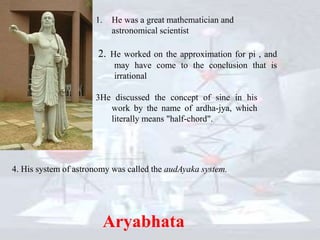
1. He was a great mathematician and
astronomical scientist
2. He worked on the approximation for pi , and
may have come to the conclusion that is
irrational
Aryabhata
3He discussed the concept of sine in his
work by the name of ardha-jya, which
literally means "half-chord".
4. His system of astronomy was called the audAyaka system.
TEAM-C
2 He was born in Raipur, British India (today
Tehsil Kabirwala, Punjab, Pakistan)
4. He was elected a Foreign Member of the Royal Society (ForMemRS) in 1978
1. He was an Indian-American biochemist
who shared the 1968 Nobel Prize for
Physiology or Medicine with Marshall
W. Nirenberg and Robert W. Holley
3. He and his team had established that the
mother of all codes, the biological language
common to all living organisms, is spelled
out in three-letter words: each set of three
nucleotides codes for a specific amino acid
Har Gobind Khorana
TEAM-D
Jagadish Chandra Bose
He was a Bengali polymath, physicist,
biologist, botanist, archaeologist, as
well as an early writer of science
fiction
He pioneered the investigation of
radio and microwave optics
He made a number of pioneering
discoveries in plant physiology
He used his own invention, the crescograph, to measure plant
response to various stimuli
TEAM-E
Yellapragada Subbarow
After earning a diploma from the Harvard Medical School he
joined Harvard as a junior faculty member.
His colleague, George Hitchings, who
shared the 1988 Nobel Prize in
Physiology or Medicine with
Gertrude Elion
Most of his career spend in USA
He is a Indian Biochemist discovered
function of ATP as energy
molecule
TEAM-F
Salim Ali
Eha's Common birds of Bombay, encouraged him to make a
collection of birds and offered to train him in skinning and
preservation
He was introduced to the serious study
of birds by W. S. Millard, secretary of
the Bombay Natural History Society
(BNHS)
He was a famous bird watcher-
Ornithologist
He was born into a Sulaimani Bohra
Muslim family of Bombay
• Each team will be asked continuous questions for 1
minute or maximum eight question.
• Answer should be given in True or False.
• Each question will carry 5 points.
Terms and conditions
Round V
Science in General
01. Lipids in diet are mainly triacylglycerols.
2. Tetraethyl lead is used as petrol additive
3. 0.85% NaCl is the concentration in Normal Saline
04. 40g NaOH in 1 Litre water constitutes 1 Molar
solution.
05. Proteins are polypeptides.
06. Radium has atomic number 88
07. Inner transition series in periodic table is called as
lanthenide series
08. Buffer resists change in pH
09.Solutions having pH more than 7 are acids.
10. Chlofluorocarbon can deplete ozone layer
11. RBCs formed in bone marrow
12. Washing soda is sodium carbonate
13. 36km/hr can also expressed as 10m/s
14. DDT, Aldrin, Chlordan are pesticides
15. Grass rich in cellulose
16. Frogs have 3 chambered heart.
17. Crescograph is the instrument that measures the growth of plants
18. Kossel and Lewis in 1916 developed electron theory of chemical
bonding.
21. Proton acceptor is an acid
22. Common salt is NaCl
23. Lime water turns blue when carbon dioxide passed through it.
24. Formation of gas bubbles is a chemical change.
19. Iodine acts on starch to give blue colour
20. Hyaluronic acid present in synovial fluid.
25. RBCs swells in isotonic solutions.
26.Skin is longest organ of human body.
27. Cancer is contagious disease
28. Ductility is property of metals
29. Electrons are larger than molecules
30. The Atlantic Ocean is the biggest ocean on Earth
31. The chemical make up food often changes when you cook it.
32. Sharks are mammals.
34. Atoms are most stable when their outer shells are
full
35. Filtration separates mixtures based upon their
particle size
36. Venus is the closest planet to the Sun
37. Conductors have low resistance.
38. Molecules can have atoms from more than one
chemical element.
39. Water is an example of a chemical element.
40. The study of birds is known as ornithology
33. The human body has four lungs
41. Mount Kilimanjaro is the tallest mountain in the
world
42. Floatation separates mixtures based on density
43. Herbivores eat meat.
44. Atomic bombs work by atomic fission
45. Molecules are chemically bonded
46. Spiders have six legs
47. Kelvin is a measure of temperature
48. The human skeleton is made up of less than
100 bones

Quiz final-school-ghps

  • 1.
    Science Quiz Competition By SachinNarwadiya Scientist C Vigyan Prasar sachin@vigyanprasar.gov.in
  • 2.
    Round I General Terms andconditions • Each team will get two questions with multiple choice. • If unanswered, question will not PASS ON to next team. • Each question will have 10 points. • Answer time is 10 second.
  • 3.
  • 4.
    Team A: What isthe periderm of a plant also known as ? a) roots b) stem c) bark d) leaves
  • 5.
  • 6.
    Which scientist discoveredneutron? a) James Chandwick b) John Dalton c) Rutherford d) J.J.Thomson
  • 7.
  • 8.
    How many moonsdid Venus have? a) 3 d) 2 b) 0 c) 1
  • 9.
  • 10.
    The sum ofproton and neutrons present in the nucleus of any atom is called as____________ a) Avogadro's Number b) Mass Number c) Atomic Number d) Valency
  • 11.
  • 12.
    Which disease isnot caused by a virus? a) Rabies b) Small pox c) Measles d) gonorrhoea
  • 13.
  • 14.
    In which solutiongold is soluble? a) In Aqua-ragia b) In acids c) In alkalis d) In silver nitrite
  • 15.
  • 16.
    The metal thatis present in Photo Films is a) Mercury b) Platinum c) Magnesium d) Silver
  • 17.
  • 18.
    An alloy usedin making heating elements for electric heating devices is — a) Nichrome d) German Silver b) Solder c) Alloy steel
  • 19.
  • 20.
    Limes became partof the British Royal Navy's diet in an attempt to prevent what? a) Influenza d) Rickets b) Scurvy c) Melanomas
  • 21.
  • 22.
    Hygrometer is aninstrument used to measure_________ a) Rainfall b) Humidity c) Snow fall d) Heat
  • 23.
  • 24.
    From 21st marchto 23rd September ______hemisphere of Earth closer to Sun a) Northern b) Eastern c) Western d) Southern
  • 25.
  • 26.
    Which gas isfilled in packet- packed snacks like potato chips? a) Nitrogen b) Oxygen c) Neon d) Carbon dioxide
  • 27.
    Audience Questions 1. Rheumatismaffects which part of the body? 2. Oxides of non metals are _______ in nature 3. DOTs treatment is related to which disease? 4. Rickets disease caused due to lack of ____Vitamin.
  • 28.
    Round II Terms andconditions • Each team will get two questions with 10 point to each question. • If unanswered, question will PASS ON to next team carrying 5 bonus point. • Answer time is 30 seconds.
  • 29.
  • 30.
    What is thebiggest planet in our solar system? Jupitor
  • 31.
  • 32.
    Galvanised iron sheetshave a coating of Zinc
  • 33.
  • 34.
    What is 0degrees Celsius on the Fahrenheit scale? 32F
  • 35.
  • 36.
    Phenolphthalein and methyl orangeare used as………… indicators
  • 37.
  • 38.
    The functional unitof kidney is….. Nephron
  • 39.
  • 40.
    What is thename of the closest star to the earth? Sun
  • 41.
  • 42.
    An acid whichis called as king of chemicals………………….. Sulphuric acid
  • 43.
  • 44.
    The element commonto all acids is Hydrogen
  • 45.
  • 46.
    Non stick cookingutensils are coated with____________ Teflon
  • 47.
  • 48.
    The primary modeof heat transfer in fluids is called as….. Convection
  • 49.
  • 50.
    The molten rockthat comes from a volcano after it has erupted is known as what? Lava
  • 51.
    Audience Questions • Whatis unit of illumination? • Which is the hottest planet in solar system? • Speed of wind is measured by instrument called as……… • The year 2015 celebrated as the international year of………….
  • 52.
    Round IV Photo IdentificationRound Terms and conditions • Each team will get one question • Picture of Sceintist will be shown on the screen. •If identified without any clue then 10 points will be awarded. • 2 points for each clue will be deducted for next four clues. • If unanswered, question WILL NOT pass on to next team.
  • 53.
  • 54.
    1. Indian geneticistand international administrator, renowned for his leading role in India's Green Revolution 4. In 1999, Time magazine placed him in the 'Time 20' list of most influential Asian people of the 20th century 2. He is known as "Indian Father of Green Revolution" 3. He served as Director General of the International Rice Research Institute (1982–88) Mankombu Sambasivan Swaminathan
  • 55.
  • 56.
    1. He wasa great mathematician and astronomical scientist 2. He worked on the approximation for pi , and may have come to the conclusion that is irrational Aryabhata 3He discussed the concept of sine in his work by the name of ardha-jya, which literally means "half-chord". 4. His system of astronomy was called the audAyaka system.
  • 57.
  • 58.
    2 He wasborn in Raipur, British India (today Tehsil Kabirwala, Punjab, Pakistan) 4. He was elected a Foreign Member of the Royal Society (ForMemRS) in 1978 1. He was an Indian-American biochemist who shared the 1968 Nobel Prize for Physiology or Medicine with Marshall W. Nirenberg and Robert W. Holley 3. He and his team had established that the mother of all codes, the biological language common to all living organisms, is spelled out in three-letter words: each set of three nucleotides codes for a specific amino acid Har Gobind Khorana
  • 59.
  • 60.
    Jagadish Chandra Bose Hewas a Bengali polymath, physicist, biologist, botanist, archaeologist, as well as an early writer of science fiction He pioneered the investigation of radio and microwave optics He made a number of pioneering discoveries in plant physiology He used his own invention, the crescograph, to measure plant response to various stimuli
  • 61.
  • 62.
    Yellapragada Subbarow After earninga diploma from the Harvard Medical School he joined Harvard as a junior faculty member. His colleague, George Hitchings, who shared the 1988 Nobel Prize in Physiology or Medicine with Gertrude Elion Most of his career spend in USA He is a Indian Biochemist discovered function of ATP as energy molecule
  • 63.
  • 64.
    Salim Ali Eha's Commonbirds of Bombay, encouraged him to make a collection of birds and offered to train him in skinning and preservation He was introduced to the serious study of birds by W. S. Millard, secretary of the Bombay Natural History Society (BNHS) He was a famous bird watcher- Ornithologist He was born into a Sulaimani Bohra Muslim family of Bombay
  • 65.
    • Each teamwill be asked continuous questions for 1 minute or maximum eight question. • Answer should be given in True or False. • Each question will carry 5 points. Terms and conditions Round V Science in General
  • 66.
    01. Lipids indiet are mainly triacylglycerols. 2. Tetraethyl lead is used as petrol additive 3. 0.85% NaCl is the concentration in Normal Saline 04. 40g NaOH in 1 Litre water constitutes 1 Molar solution. 05. Proteins are polypeptides. 06. Radium has atomic number 88 07. Inner transition series in periodic table is called as lanthenide series 08. Buffer resists change in pH
  • 67.
    09.Solutions having pHmore than 7 are acids. 10. Chlofluorocarbon can deplete ozone layer 11. RBCs formed in bone marrow 12. Washing soda is sodium carbonate 13. 36km/hr can also expressed as 10m/s 14. DDT, Aldrin, Chlordan are pesticides 15. Grass rich in cellulose 16. Frogs have 3 chambered heart.
  • 68.
    17. Crescograph isthe instrument that measures the growth of plants 18. Kossel and Lewis in 1916 developed electron theory of chemical bonding. 21. Proton acceptor is an acid 22. Common salt is NaCl 23. Lime water turns blue when carbon dioxide passed through it. 24. Formation of gas bubbles is a chemical change. 19. Iodine acts on starch to give blue colour 20. Hyaluronic acid present in synovial fluid.
  • 69.
    25. RBCs swellsin isotonic solutions. 26.Skin is longest organ of human body. 27. Cancer is contagious disease 28. Ductility is property of metals 29. Electrons are larger than molecules 30. The Atlantic Ocean is the biggest ocean on Earth 31. The chemical make up food often changes when you cook it. 32. Sharks are mammals.
  • 70.
    34. Atoms aremost stable when their outer shells are full 35. Filtration separates mixtures based upon their particle size 36. Venus is the closest planet to the Sun 37. Conductors have low resistance. 38. Molecules can have atoms from more than one chemical element. 39. Water is an example of a chemical element. 40. The study of birds is known as ornithology 33. The human body has four lungs
  • 71.
    41. Mount Kilimanjarois the tallest mountain in the world 42. Floatation separates mixtures based on density 43. Herbivores eat meat. 44. Atomic bombs work by atomic fission 45. Molecules are chemically bonded 46. Spiders have six legs 47. Kelvin is a measure of temperature 48. The human skeleton is made up of less than 100 bones