Peter Brooks 13SGN
Mies En scene
 My documentary follows many of the typical codes
and conventions of documentaries. To begin, my
documentary has a linear and multi strand narrative.
These types of narratives are also seen in many
documentaries such as Supersize Me, Death Row
Dogs, Frozen Planet S1 EP3 and many more. The
reason why I used this narrative in my documentary is
because that way it is easier for the general audience to
follow and also helps answer multiple questions and
gives the spectators something to think about.
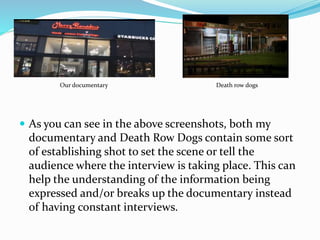
 As you can see in the above screenshots, both my
documentary and Death Row Dogs contain some sort
of establishing shot to set the scene or tell the
audience where the interview is taking place. This can
help the understanding of the information being
expressed and/or breaks up the documentary instead
of having constant interviews.
Our documentary Death row dogs
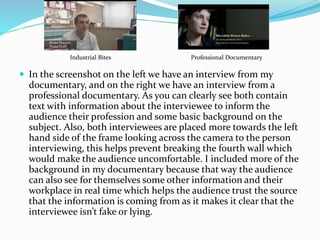
 In the screenshot on the left we have an interview from my
documentary, and on the right we have an interview from a
professional documentary. As you can clearly see both contain
text with information about the interviewee to inform the
audience their profession and some basic background on the
subject. Also, both interviewees are placed more towards the left
hand side of the frame looking across the camera to the person
interviewing, this helps prevent breaking the fourth wall which
would make the audience uncomfortable. I included more of the
background in my documentary because that way the audience
can also see for themselves some other information and their
workplace in real time which helps the audience trust the source
that the information is coming from as it makes it clear that the
interviewee isn’t fake or lying.
Industrial Bites Professional Documentary
 The code of attire of Brian also puts across that he is a chef due
to the fact that he is wearing his chef uniform from Harry
Ramsden’s. This is important for the audience as it helps them
understand the position of the interviewee and also helps
reinforce what the interviewee is saying because they can trust
where the information is coming from.

On the other hand, the screenshot from the professional
documentary shows the code of attire of the interviewee from
that particular documentary. What we can see from this is that
the code of attire doesn’t necessarily have to be a uniform of sort
just something which emphasises the points being made, the
woman in the screenshot is wearing darker colours which
portrays the topic of drama as we associate the genre of drama
and theatre with.
Sound
 In my documentary we used a narrator. This was done to help glue
together my documentary and give extra facts and explain what is going
on. I only used the narrator behind cutaways and archive footage as if it
was over the interviews the audio would be unclear and the audience
would have to chose who they were listening to. Also, I used the
narrator behind the cutaways to help anchor what the narrator was
saying as it is easier to understand a visual plus audio rather than just
audio.

Putting music behind the narrator is also a code and convention used
in documentaries. This helps make the narration less boring and sound
less plain. I used slow music with no lyrics to prevent the audience
from being distracted from what the narrator was saying. If I used
music with lyrics or with a fast pace it would have drawn the audience’s
attention away from the documentary itself and more towards the
music behind the narration.
Editing
 Throughout the documentary I used mainly cuts and
some fades. The reason for this is to keep the
documentary basis as well as professional. In most
documentaries that I have watched in the past, such as
Frozen Planet, you don’t see many transitions other
than cuts and fades. This helps keep the audience's
attention so I used this technique in my documentary
to help keep our audiences attention. Things such as a
video swiping off the screen or flying in would distract
the audience and maybe even cause a discussion
between individuals in the audience about what they
just seen.
Camerawork
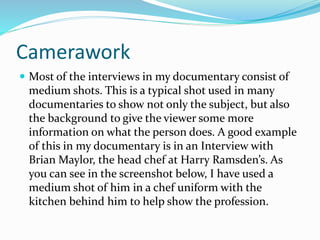
 Most of the interviews in my documentary consist of
medium shots. This is a typical shot used in many
documentaries to show not only the subject, but also
the background to give the viewer some more
information on what the person does. A good example
of this in my documentary is in an Interview with
Brian Maylor, the head chef at Harry Ramsden’s. As
you can see in the screenshot below, I have used a
medium shot of him in a chef uniform with the
kitchen behind him to help show the profession.
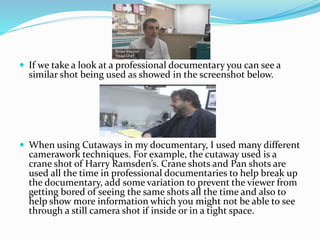
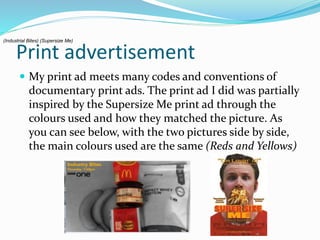
 If we take a look at a professional documentary you can see a
similar shot being used as showed in the screenshot below.
 When using Cutaways in my documentary, I used many different
camerawork techniques. For example, the cutaway used is a
crane shot of Harry Ramsden’s. Crane shots and Pan shots are
used all the time in professional documentaries to help break up
the documentary, add some variation to prevent the viewer from
getting bored of seeing the same shots all the time and also to
help show more information which you might not be able to see
through a still camera shot if inside or in a tight space.
Print advertisement
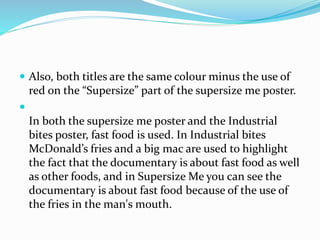
 My print ad meets many codes and conventions of
documentary print ads. The print ad I did was partially
inspired by the Supersize Me print ad through the
colours used and how they matched the picture. As
you can see below, with the two pictures side by side,
the main colours used are the same (Reds and Yellows)
(Industrial Bites) (Supersize Me)
 Also, both titles are the same colour minus the use of
red on the “Supersize” part of the supersize me poster.

In both the supersize me poster and the Industrial
bites poster, fast food is used. In Industrial bites
McDonald’s fries and a big mac are used to highlight
the fact that the documentary is about fast food as well
as other foods, and in Supersize Me you can see the
documentary is about fast food because of the use of
the fries in the man's mouth.
 The fact that I included the BBC one logo underneath
the title is another code and convention of print
advertisements. The logo of the channel is used on
pretty much all posters about documentaries as it puts
the channel stamp on the documentary and most of
the time the channel actually fund the documentary so
they want to have some credit for the documentary. It
is also an easy way to tell the audience the channel that
it's on without having boring text explaining it, for
example, on the Industrial bites poster the BBC one
logo is used instead of putting the words as the logo is
more attractive to the eye than some basic text.
Radio Trailer
The radio trailer for Industrial bites meets a lot of the conventional codes and
conventions of typical radio trailers. The radio trailer uses clips from the
documentary, all from interviews, which helps explain to the audience what the
documentary is about, has music in the background which is food related
which also helps express the genre and topic of the documentary, and lastly has
a narrator explaining all of the little details such as the time and channel of the
documentary as well as gluing the whole radio trailer together by asking
rhetorical questions and leaving the audience with enigmas.
Also, the Industrial bites radio trailer also is about 30 seconds long, which is how
long usual radio trailers are,
All of the above techniques are used to draw the audience in and are used in
many radio ads not just for documentaries. For example, Chris Kelly has there
own song and if you hear the song on its own you can instantly recognise who
the song represents and sometimes remember things about their radio trailer
like the number to ring as that is part of the song. Also, the Chris Kelly
advertisement is about 30 seconds long. What this does is makes the
advertisement a lot less boring and is more likely to draw the audience in.

Question one

  • 1.
  • 2.
    Mies En scene My documentary follows many of the typical codes and conventions of documentaries. To begin, my documentary has a linear and multi strand narrative. These types of narratives are also seen in many documentaries such as Supersize Me, Death Row Dogs, Frozen Planet S1 EP3 and many more. The reason why I used this narrative in my documentary is because that way it is easier for the general audience to follow and also helps answer multiple questions and gives the spectators something to think about.
  • 3.
     As youcan see in the above screenshots, both my documentary and Death Row Dogs contain some sort of establishing shot to set the scene or tell the audience where the interview is taking place. This can help the understanding of the information being expressed and/or breaks up the documentary instead of having constant interviews. Our documentary Death row dogs
  • 4.
     In thescreenshot on the left we have an interview from my documentary, and on the right we have an interview from a professional documentary. As you can clearly see both contain text with information about the interviewee to inform the audience their profession and some basic background on the subject. Also, both interviewees are placed more towards the left hand side of the frame looking across the camera to the person interviewing, this helps prevent breaking the fourth wall which would make the audience uncomfortable. I included more of the background in my documentary because that way the audience can also see for themselves some other information and their workplace in real time which helps the audience trust the source that the information is coming from as it makes it clear that the interviewee isn’t fake or lying. Industrial Bites Professional Documentary
  • 5.
     The codeof attire of Brian also puts across that he is a chef due to the fact that he is wearing his chef uniform from Harry Ramsden’s. This is important for the audience as it helps them understand the position of the interviewee and also helps reinforce what the interviewee is saying because they can trust where the information is coming from.  On the other hand, the screenshot from the professional documentary shows the code of attire of the interviewee from that particular documentary. What we can see from this is that the code of attire doesn’t necessarily have to be a uniform of sort just something which emphasises the points being made, the woman in the screenshot is wearing darker colours which portrays the topic of drama as we associate the genre of drama and theatre with.
  • 6.
    Sound  In mydocumentary we used a narrator. This was done to help glue together my documentary and give extra facts and explain what is going on. I only used the narrator behind cutaways and archive footage as if it was over the interviews the audio would be unclear and the audience would have to chose who they were listening to. Also, I used the narrator behind the cutaways to help anchor what the narrator was saying as it is easier to understand a visual plus audio rather than just audio.  Putting music behind the narrator is also a code and convention used in documentaries. This helps make the narration less boring and sound less plain. I used slow music with no lyrics to prevent the audience from being distracted from what the narrator was saying. If I used music with lyrics or with a fast pace it would have drawn the audience’s attention away from the documentary itself and more towards the music behind the narration.
  • 7.
    Editing  Throughout thedocumentary I used mainly cuts and some fades. The reason for this is to keep the documentary basis as well as professional. In most documentaries that I have watched in the past, such as Frozen Planet, you don’t see many transitions other than cuts and fades. This helps keep the audience's attention so I used this technique in my documentary to help keep our audiences attention. Things such as a video swiping off the screen or flying in would distract the audience and maybe even cause a discussion between individuals in the audience about what they just seen.
  • 8.
    Camerawork  Most ofthe interviews in my documentary consist of medium shots. This is a typical shot used in many documentaries to show not only the subject, but also the background to give the viewer some more information on what the person does. A good example of this in my documentary is in an Interview with Brian Maylor, the head chef at Harry Ramsden’s. As you can see in the screenshot below, I have used a medium shot of him in a chef uniform with the kitchen behind him to help show the profession.
  • 9.
     If wetake a look at a professional documentary you can see a similar shot being used as showed in the screenshot below.  When using Cutaways in my documentary, I used many different camerawork techniques. For example, the cutaway used is a crane shot of Harry Ramsden’s. Crane shots and Pan shots are used all the time in professional documentaries to help break up the documentary, add some variation to prevent the viewer from getting bored of seeing the same shots all the time and also to help show more information which you might not be able to see through a still camera shot if inside or in a tight space.
  • 10.
    Print advertisement  Myprint ad meets many codes and conventions of documentary print ads. The print ad I did was partially inspired by the Supersize Me print ad through the colours used and how they matched the picture. As you can see below, with the two pictures side by side, the main colours used are the same (Reds and Yellows) (Industrial Bites) (Supersize Me)
  • 11.
     Also, bothtitles are the same colour minus the use of red on the “Supersize” part of the supersize me poster.  In both the supersize me poster and the Industrial bites poster, fast food is used. In Industrial bites McDonald’s fries and a big mac are used to highlight the fact that the documentary is about fast food as well as other foods, and in Supersize Me you can see the documentary is about fast food because of the use of the fries in the man's mouth.
  • 12.
     The factthat I included the BBC one logo underneath the title is another code and convention of print advertisements. The logo of the channel is used on pretty much all posters about documentaries as it puts the channel stamp on the documentary and most of the time the channel actually fund the documentary so they want to have some credit for the documentary. It is also an easy way to tell the audience the channel that it's on without having boring text explaining it, for example, on the Industrial bites poster the BBC one logo is used instead of putting the words as the logo is more attractive to the eye than some basic text.
  • 13.
    Radio Trailer The radiotrailer for Industrial bites meets a lot of the conventional codes and conventions of typical radio trailers. The radio trailer uses clips from the documentary, all from interviews, which helps explain to the audience what the documentary is about, has music in the background which is food related which also helps express the genre and topic of the documentary, and lastly has a narrator explaining all of the little details such as the time and channel of the documentary as well as gluing the whole radio trailer together by asking rhetorical questions and leaving the audience with enigmas. Also, the Industrial bites radio trailer also is about 30 seconds long, which is how long usual radio trailers are, All of the above techniques are used to draw the audience in and are used in many radio ads not just for documentaries. For example, Chris Kelly has there own song and if you hear the song on its own you can instantly recognise who the song represents and sometimes remember things about their radio trailer like the number to ring as that is part of the song. Also, the Chris Kelly advertisement is about 30 seconds long. What this does is makes the advertisement a lot less boring and is more likely to draw the audience in.