Question 5
How did you attract/address your audience?
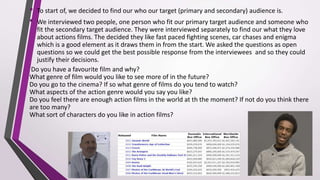
• To start of, we decided to find our who our target (primary and secondary) audience is.
• We interviewed two people, one person who fit our primary target audience and someone who
fit the secondary target audience. They were interviewed separately to find our what they love
about actions films. The decided they like fast paced fighting scenes, car chases and enigma
which is a good element as it draws them in from the start. We asked the questions as open
questions so we could get the best possible response from the interviewees and so they could
justify their decisions.
Do you have a favourite film and why?
What genre of film would you like to see more of in the future?
Do you go to the cinema? If so what genre of films do you tend to watch?
What aspects of the action genre would you say you like?
Do you feel there are enough action films in the world at th the moment? If not do you think there
are too many?
What sort of characters do you like in action films?
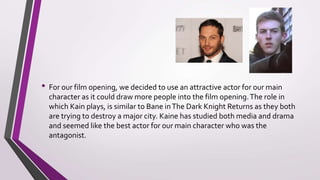
For our film opening, we decided to use an attractive actor for our main
character as it could draw more people into the film opening.The role in which
Kaine Stones plays, is similar to Bane inThe Dark Knight Returns as they both
are trying to destroy a major city. Kaine has studied both media and drama
and seemed like the best actor for our main character who was the antagonist.
From our target audience research, an interviewee had said they like to see a
strong female lead but because we needed a male to portray the main
character, we had to stick with Kaine but most action films have male
characters and action movies appeal more to males than females.
Casting
The plot for our film opening:
• The antagonist shows up to a barn which contains hostages; a couple of the
wealthiest people in their city.The antagonist talks about how if they die,
the entire city will descend into anarchy. But the antagonist has ulterior
motives to what he is doing.
• This is similar in a way to “The Dark Knight Returns” as both films have an
antagonist who is trying to change/destroy a city.
• The setting of our film opening was an abandoned almost empty barn which
took away the distractions from something which would have background
to take the minds of our audience away from the content taking place.The
use of the setting helped the audience understand what was happening.
The name of our film opening is “Retundum” which simply
means revolution in Latin, we used this as it built enigma as to
what it means and links to the plot of the story, of how the
antagonist wants to kill the rich of the city and lead the city to
destruction, anarchy and chaos which in his own minds is the
revolution and the title of the film causes enigma for the
audience as they might have their own ideas as to what it
means, and those who work it out will understand how deep
the antagonist is and almost how insane he can think.
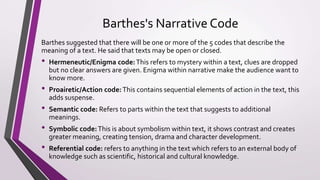
Barthes's Narrative Code
Barthes suggested that there will be one or more of the 5 codes that describe the
meaning of a text. He said that texts may be open or closed.
• Hermeneutic/Enigma code:This refers to mystery within a text, clues are dropped
but no clear answers are given. Enigma within narrative make the audience want to
know more.
• Proairetic/Action code:This contains sequential elements of action in the text, this
adds suspense.
• Semantic code: Refers to parts within the text that suggests to additional
meanings.
• Symbolic code:This is about symbolism within text, it shows contrast and creates
greater meaning, creating tension, drama and character development.
• Referential code: refers to anything in the text which refers to an external body of
knowledge such as scientific, historical and cultural knowledge.
The Barthes Narrative code applies to our film opening as it contains quite enigma,
hints but no answers are given which leaves the audience wanting to know more and
draws them into the film opening. An example of this is the two hostages and short
clip of someone getting shot makes the audience wonder as to why they are being
killed which can lead them to have their own ideas on their actual motives.
There is also the action code which is linked to the murder towards the beginning and
builds up suspense to the murder at the end of the opening.
Symbolic code is also used as the main two characters are quite mysterious and you
can see the anger shown within the main antagonist as he snaps at the victim and
shoots him.This could lead to the character development but will not be seen as we
only have the film opening.
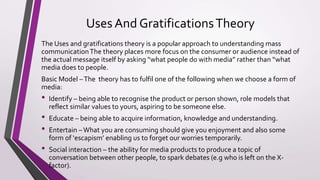
Uses And GratificationsTheory
The Uses and gratifications theory is a popular approach to understanding mass
communicationThe theory places more focus on the consumer or audience instead of
the actual message itself by asking “what people do with media” rather than “what
media does to people.
Basic Model –The theory has to fulfil one of the following when we choose a form of
media:
• Identify – being able to recognise the product or person shown, role models that
reflect similar values to yours, aspiring to be someone else.
• Educate – being able to acquire information, knowledge and understanding.
• Entertain –What you are consuming should give you enjoyment and also some
form of ‘escapism’ enabling us to forget our worries temporarily.
• Social interaction – the ability for media products to produce a topic of
conversation between other people, to spark debates (e.g who is left on the X-
factor).
The Uses and Gratifications theory applies to our film opening to
entertain our audience rather than educate or our audience identify
with the characters within the film opening. It entertains our
audience and almost helps them escape from the normal everyday
as the things which happen in our film opening is not something
will hear about or see everyday or even at all.
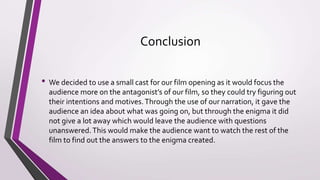
Conclusion
• We decided to use a small cast for our film opening as it would focus the
audience more on the antagonist’s of our film, so they could try figuring out
their intentions and motives.The non-diegetic music used throughout the
opening, abandoned setting and small cast helps keep the focus of our
audience only to what we think is important and rather than filling the
screen with distractions as we want their undivided attention to the content
and what is taking place in the scenes. Through the use of our narration, it
gave the audience an idea about what was going on, but through the
enigma it did not give a lot away which would leave the audience with
questions unanswered.This would make the audience want to watch the
rest of the film to find out the answers to the enigma created.

Question 5 - Evaluation

  • 1.
    Question 5 How didyou attract/address your audience?
  • 2.
    • To startof, we decided to find our who our target (primary and secondary) audience is. • We interviewed two people, one person who fit our primary target audience and someone who fit the secondary target audience. They were interviewed separately to find our what they love about actions films. The decided they like fast paced fighting scenes, car chases and enigma which is a good element as it draws them in from the start. We asked the questions as open questions so we could get the best possible response from the interviewees and so they could justify their decisions. Do you have a favourite film and why? What genre of film would you like to see more of in the future? Do you go to the cinema? If so what genre of films do you tend to watch? What aspects of the action genre would you say you like? Do you feel there are enough action films in the world at th the moment? If not do you think there are too many? What sort of characters do you like in action films?
  • 3.
    For our filmopening, we decided to use an attractive actor for our main character as it could draw more people into the film opening.The role in which Kaine Stones plays, is similar to Bane inThe Dark Knight Returns as they both are trying to destroy a major city. Kaine has studied both media and drama and seemed like the best actor for our main character who was the antagonist. From our target audience research, an interviewee had said they like to see a strong female lead but because we needed a male to portray the main character, we had to stick with Kaine but most action films have male characters and action movies appeal more to males than females. Casting
  • 4.
    The plot forour film opening: • The antagonist shows up to a barn which contains hostages; a couple of the wealthiest people in their city.The antagonist talks about how if they die, the entire city will descend into anarchy. But the antagonist has ulterior motives to what he is doing. • This is similar in a way to “The Dark Knight Returns” as both films have an antagonist who is trying to change/destroy a city. • The setting of our film opening was an abandoned almost empty barn which took away the distractions from something which would have background to take the minds of our audience away from the content taking place.The use of the setting helped the audience understand what was happening.
  • 5.
    The name ofour film opening is “Retundum” which simply means revolution in Latin, we used this as it built enigma as to what it means and links to the plot of the story, of how the antagonist wants to kill the rich of the city and lead the city to destruction, anarchy and chaos which in his own minds is the revolution and the title of the film causes enigma for the audience as they might have their own ideas as to what it means, and those who work it out will understand how deep the antagonist is and almost how insane he can think.
  • 6.
    Barthes's Narrative Code Barthessuggested that there will be one or more of the 5 codes that describe the meaning of a text. He said that texts may be open or closed. • Hermeneutic/Enigma code:This refers to mystery within a text, clues are dropped but no clear answers are given. Enigma within narrative make the audience want to know more. • Proairetic/Action code:This contains sequential elements of action in the text, this adds suspense. • Semantic code: Refers to parts within the text that suggests to additional meanings. • Symbolic code:This is about symbolism within text, it shows contrast and creates greater meaning, creating tension, drama and character development. • Referential code: refers to anything in the text which refers to an external body of knowledge such as scientific, historical and cultural knowledge.
  • 7.
    The Barthes Narrativecode applies to our film opening as it contains quite enigma, hints but no answers are given which leaves the audience wanting to know more and draws them into the film opening. An example of this is the two hostages and short clip of someone getting shot makes the audience wonder as to why they are being killed which can lead them to have their own ideas on their actual motives. There is also the action code which is linked to the murder towards the beginning and builds up suspense to the murder at the end of the opening. Symbolic code is also used as the main two characters are quite mysterious and you can see the anger shown within the main antagonist as he snaps at the victim and shoots him.This could lead to the character development but will not be seen as we only have the film opening.
  • 8.
    Uses And GratificationsTheory TheUses and gratifications theory is a popular approach to understanding mass communicationThe theory places more focus on the consumer or audience instead of the actual message itself by asking “what people do with media” rather than “what media does to people. Basic Model –The theory has to fulfil one of the following when we choose a form of media: • Identify – being able to recognise the product or person shown, role models that reflect similar values to yours, aspiring to be someone else. • Educate – being able to acquire information, knowledge and understanding. • Entertain –What you are consuming should give you enjoyment and also some form of ‘escapism’ enabling us to forget our worries temporarily. • Social interaction – the ability for media products to produce a topic of conversation between other people, to spark debates (e.g who is left on the X- factor).
  • 9.
    The Uses andGratifications theory applies to our film opening to entertain our audience rather than educate or our audience identify with the characters within the film opening. It entertains our audience and almost helps them escape from the normal everyday as the things which happen in our film opening is not something will hear about or see everyday or even at all.
  • 10.
    Conclusion • We decidedto use a small cast for our film opening as it would focus the audience more on the antagonist’s of our film, so they could try figuring out their intentions and motives.The non-diegetic music used throughout the opening, abandoned setting and small cast helps keep the focus of our audience only to what we think is important and rather than filling the screen with distractions as we want their undivided attention to the content and what is taking place in the scenes. Through the use of our narration, it gave the audience an idea about what was going on, but through the enigma it did not give a lot away which would leave the audience with questions unanswered.This would make the audience want to watch the rest of the film to find out the answers to the enigma created.