QUESTION 3
i. Explain the accounting justification for debiting purchases in the
purchases in the purchase book and crediting sales in the sales
book
Answer:
It is simply the golden rule of debit receiver, credit giver. In the event of
purchase, the purchasing account is seen as the receiver from either
cash or capital account and hence it is debited in the purchase book.
While when goods are sold, the sales account of the company is seen
as giving out to either the cash account or account payable (in the case
of sales on credit) and as such, the sales account is credited while the
cash account is debited in the sales book.
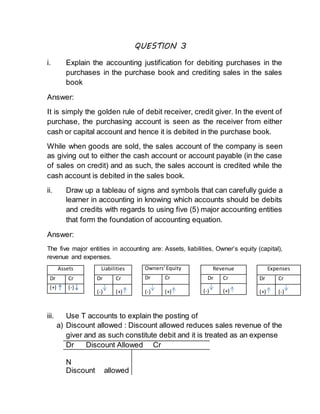
ii. Draw up a tableau of signs and symbols that can carefully guide a
learner in accounting in knowing which accounts should be debits
and credits with regards to using five (5) major accounting entities
that form the foundation of accounting equation.
Answer:
The five major entities in accounting are: Assets, liabilities, Owner’s equity (capital),
revenue and expenses.
iii. Use T accounts to explain the posting of
a) Discount allowed : Discount allowed reduces sales revenue of the
giver and as such constitute debit and it is treated as an expense
Dr Discount Allowed Cr
N
Discount allowed
Assets
Dr Cr
(+) (-)
Liabilities
Dr Cr
(-) (+)
Owners’Equity
Dr Cr
(-) (+)
Revenue
Dr Cr
(-) (+)
Expenses
Dr Cr
(+) (-)
(xxx)
(debit giver)
b) Discount received: discount received increases revenue (owners
equity) thereby constituting credit. It is treated as an income
Dr Discount Received
Cr
N
Discount Received
(xxx)
(Credit receiver)
c) Accounts receivable :
Dr Accounts receivable
Cr
N
Accounts Payable
(xxx)
(credit receiver)
d) Accounts payable:
Dr Accounts payable Cr
N
Accounts
receivable
(xxx)
(debit giver)
e) Carriage outwards:
Dr Carriage outwards Cr
N
Carriage outwards
xxx
f) Carriage Inward
Dr Carriage Inward Cr
N
Carriage Inward
xxx
g) Return Inward
Dr Return Inward
Cr
N
Return Inward
xxx
h) Return Outward:
Dr Return Outward Cr
N
Return Outward
(xxx)
iv) use appropriate balance sheet format to explain:
a) Order of permanency: in this variety, the elements are ordered in the
descending sequence the item can last.
Balance sheet as at 31st
December,2015
₦ ₦ ₦ ₦
Capital xx Fixed Assets
Long Term Liability Land Xx
10 year loan from
UBA
xx Machinery &
plant
xx
5 yr loan from GTB xx xx Furniture Xx
Motor vans Xx Xx
Current Liability CurrentAssets
Creditors xx Stock Xx
Bank over draft
(O/D)
xx xx Debtors Xx
Cash in hand Xx Xx
xx Xx
b) Order of Liquidity: in this typology, assets are shown first and the most
permanent asset are shown last. After the assets, current liabilities , before
long term liabilities are entered. Example
Balance sheet as at 31st
December,2015
N N N N
Current Liability Current Assets
Bank over draft (O/D) xx Stock xx
Creditors xx xx Debtors xx
Long Term Liability Cash in hand xx Xx
10 year loan from UBA xx Fixed Assets
5 yr loan from GTB xx xx Land xx
Machinery & plant xx
Furniture xx
Capital xx Motor vans xx Xx
xx Xx
c) Traditional Approach: under this approach, assets are written in the LHS
and liabilities are written in the RHS.
Balance sheet as at 31st
December,2015
Liabilities N N Assets N N
Capital xx Fixed Assets
Long Term Liability Land Xx
10 year loan from UBA xx Machinery & plant Xx
5 yr loan from GTB xx xx Furniture Xx
Motor vans Xx Xx
Current Liability Current Assets
Creditors xx xxx Stock Xx
Bank over draft (O/D) xx Debtors Xx
Cash in hand xx Xxx
xx Xxx
d) The vertical approach :: under this scheme, the assets are listed on
top while the liabilities and capital are listed below
Balance Sheet as at 31st
December, 2015
₦ ₦
Assets
Fixed Assets Xxx
Land Xxx
Building Xxx
Machines Xxx
Others Xxx xxx
Current assets
Stock Xxx
Cash at hand Xxx
Others Xxx xxx
xxx
Liabilities
Capital Xxx
Retained earning xxx Xxx
Long term liability
Loan Xxx
Current Liability
Creditors Xxx xxx
iv) Distinguish among cost accounting, management accounting, financial
accounting
Cost accounting
It is a branch of general accounting adapted to registering the costs of
labour, materials and overhead on item-by-item basis as a means of
determining the cost of production. It focuses on internal decision making
and it is needful for ascertaining the economic well being of manufacturing
firms.
Management accounting
This aspect of accounting deals with reporting economic transactions
needful for management of the firm. It deals with concept and methods
used to provide information to an organization’s internal user eg manager.
Financial Accounting
This is a reporting system that uses ground rules to convey economic
information concerning the performance of an organization in such a
manner that the information is relevant to both internal and external users.
(B) Explain the term transaction analysis
Transaction analysis
This is the purpose of reviewing the source documents to determine the dual effect on the accounting and
the specific elements involved. The principles of transaction analysis state that:
1. Every transaction affects at least two accounts. This is known as the duality effect. It is therefore
critical to identify correctly the accounts affected in the direction of the effect.
2. The accounting equation must remain balanced after each transaction.
(c)(i) Why do businesses conduct trading, profit and loss account?
Businesses conduct trading accounts and profit and loss account so as to ascertain the cost of goods
sold. The manufacturing cost is carried forward to the trading account where it is deducted from the net
sales to arrive at gross profit. The gross profit is then carried forward to the profit and loss account where
after the distribution, selling and administrative overheads are deducted, the balance thus obtained
represents the net profit for the year. From this statement we can then see that
1. Trading accounts are conducted to determine the value of the gross profit
2. Profit and loss accounts are conducted to determine the value of the net profit
(ii) Develop a framework for drawing up a typical profit and loss account
Dr Profit and Loss Account Cr
(iii) What is income statement intended for? Develop the structure of the
income statement showing its basic elements
The income statement, also called an earnings statement or a profit and loss
statement, is an accounting statement that matches a company’s revenues with its
expenses over a period of time, usually a quarter or a year. The components of the
income statement involve a company’s recognition of income and the expenses
related to earning this income. Revenue less expenses results in a profit or loss.
Salaries xx Gross Profit b/d xx
Office rent xx Add Income xx
Discount allowed xx Discount Received xx
Rates xx Bad debt recoverable xx
Repair xx Bill receivable xx
Wages xx
Advertising xx
Depreciation xx
Insurance xx
The income statement is a flow measure statement meaning that each value on an
income statement represents the cumulative amount of that item through the given
accounting period.
Thus, the revenue on a first quarter income statement equals the cumulated amount
of all sales during the first three months of the firm’s fiscal year. The revenue on
the second quarter income statement equals the cumulated amount of all sales
during the second three months of the firm’s fiscal year. The same applies to
expenses and therefore profits.
The primary purposeof an income statement is to report an organisation’s earnings
to investors over a specific period of time. It provides important insights on how
effectively management is controlling expenses, the amount of interest on income
and expense and taxes paid.

Question 3

  • 1.
    QUESTION 3 i. Explainthe accounting justification for debiting purchases in the purchases in the purchase book and crediting sales in the sales book Answer: It is simply the golden rule of debit receiver, credit giver. In the event of purchase, the purchasing account is seen as the receiver from either cash or capital account and hence it is debited in the purchase book. While when goods are sold, the sales account of the company is seen as giving out to either the cash account or account payable (in the case of sales on credit) and as such, the sales account is credited while the cash account is debited in the sales book. ii. Draw up a tableau of signs and symbols that can carefully guide a learner in accounting in knowing which accounts should be debits and credits with regards to using five (5) major accounting entities that form the foundation of accounting equation. Answer: The five major entities in accounting are: Assets, liabilities, Owner’s equity (capital), revenue and expenses. iii. Use T accounts to explain the posting of a) Discount allowed : Discount allowed reduces sales revenue of the giver and as such constitute debit and it is treated as an expense Dr Discount Allowed Cr N Discount allowed Assets Dr Cr (+) (-) Liabilities Dr Cr (-) (+) Owners’Equity Dr Cr (-) (+) Revenue Dr Cr (-) (+) Expenses Dr Cr (+) (-)
  • 2.
    (xxx) (debit giver) b) Discountreceived: discount received increases revenue (owners equity) thereby constituting credit. It is treated as an income Dr Discount Received Cr N Discount Received (xxx) (Credit receiver) c) Accounts receivable : Dr Accounts receivable Cr N Accounts Payable (xxx) (credit receiver) d) Accounts payable: Dr Accounts payable Cr N Accounts receivable (xxx) (debit giver) e) Carriage outwards: Dr Carriage outwards Cr N Carriage outwards xxx
  • 3.
    f) Carriage Inward DrCarriage Inward Cr N Carriage Inward xxx g) Return Inward Dr Return Inward Cr N Return Inward xxx h) Return Outward: Dr Return Outward Cr N Return Outward (xxx) iv) use appropriate balance sheet format to explain: a) Order of permanency: in this variety, the elements are ordered in the descending sequence the item can last. Balance sheet as at 31st December,2015 ₦ ₦ ₦ ₦ Capital xx Fixed Assets Long Term Liability Land Xx 10 year loan from UBA xx Machinery & plant xx 5 yr loan from GTB xx xx Furniture Xx Motor vans Xx Xx Current Liability CurrentAssets
  • 4.
    Creditors xx StockXx Bank over draft (O/D) xx xx Debtors Xx Cash in hand Xx Xx xx Xx b) Order of Liquidity: in this typology, assets are shown first and the most permanent asset are shown last. After the assets, current liabilities , before long term liabilities are entered. Example Balance sheet as at 31st December,2015 N N N N Current Liability Current Assets Bank over draft (O/D) xx Stock xx Creditors xx xx Debtors xx Long Term Liability Cash in hand xx Xx 10 year loan from UBA xx Fixed Assets 5 yr loan from GTB xx xx Land xx Machinery & plant xx Furniture xx Capital xx Motor vans xx Xx xx Xx c) Traditional Approach: under this approach, assets are written in the LHS and liabilities are written in the RHS. Balance sheet as at 31st December,2015 Liabilities N N Assets N N Capital xx Fixed Assets Long Term Liability Land Xx 10 year loan from UBA xx Machinery & plant Xx 5 yr loan from GTB xx xx Furniture Xx Motor vans Xx Xx Current Liability Current Assets Creditors xx xxx Stock Xx Bank over draft (O/D) xx Debtors Xx Cash in hand xx Xxx xx Xxx
  • 5.
    d) The verticalapproach :: under this scheme, the assets are listed on top while the liabilities and capital are listed below Balance Sheet as at 31st December, 2015 ₦ ₦ Assets Fixed Assets Xxx Land Xxx Building Xxx Machines Xxx Others Xxx xxx Current assets Stock Xxx Cash at hand Xxx Others Xxx xxx xxx Liabilities Capital Xxx Retained earning xxx Xxx Long term liability Loan Xxx Current Liability Creditors Xxx xxx iv) Distinguish among cost accounting, management accounting, financial accounting Cost accounting It is a branch of general accounting adapted to registering the costs of labour, materials and overhead on item-by-item basis as a means of determining the cost of production. It focuses on internal decision making
  • 6.
    and it isneedful for ascertaining the economic well being of manufacturing firms. Management accounting This aspect of accounting deals with reporting economic transactions needful for management of the firm. It deals with concept and methods used to provide information to an organization’s internal user eg manager. Financial Accounting This is a reporting system that uses ground rules to convey economic information concerning the performance of an organization in such a manner that the information is relevant to both internal and external users. (B) Explain the term transaction analysis Transaction analysis This is the purpose of reviewing the source documents to determine the dual effect on the accounting and the specific elements involved. The principles of transaction analysis state that: 1. Every transaction affects at least two accounts. This is known as the duality effect. It is therefore critical to identify correctly the accounts affected in the direction of the effect. 2. The accounting equation must remain balanced after each transaction. (c)(i) Why do businesses conduct trading, profit and loss account? Businesses conduct trading accounts and profit and loss account so as to ascertain the cost of goods sold. The manufacturing cost is carried forward to the trading account where it is deducted from the net sales to arrive at gross profit. The gross profit is then carried forward to the profit and loss account where after the distribution, selling and administrative overheads are deducted, the balance thus obtained represents the net profit for the year. From this statement we can then see that 1. Trading accounts are conducted to determine the value of the gross profit 2. Profit and loss accounts are conducted to determine the value of the net profit (ii) Develop a framework for drawing up a typical profit and loss account Dr Profit and Loss Account Cr
  • 7.
    (iii) What isincome statement intended for? Develop the structure of the income statement showing its basic elements The income statement, also called an earnings statement or a profit and loss statement, is an accounting statement that matches a company’s revenues with its expenses over a period of time, usually a quarter or a year. The components of the income statement involve a company’s recognition of income and the expenses related to earning this income. Revenue less expenses results in a profit or loss. Salaries xx Gross Profit b/d xx Office rent xx Add Income xx Discount allowed xx Discount Received xx Rates xx Bad debt recoverable xx Repair xx Bill receivable xx Wages xx Advertising xx Depreciation xx Insurance xx
  • 8.
    The income statementis a flow measure statement meaning that each value on an income statement represents the cumulative amount of that item through the given accounting period. Thus, the revenue on a first quarter income statement equals the cumulated amount of all sales during the first three months of the firm’s fiscal year. The revenue on the second quarter income statement equals the cumulated amount of all sales during the second three months of the firm’s fiscal year. The same applies to expenses and therefore profits. The primary purposeof an income statement is to report an organisation’s earnings to investors over a specific period of time. It provides important insights on how effectively management is controlling expenses, the amount of interest on income and expense and taxes paid.