How effective is the combination
of your main product and ancillary
texts?
EVALUATION –
QUESTION 2
Combination
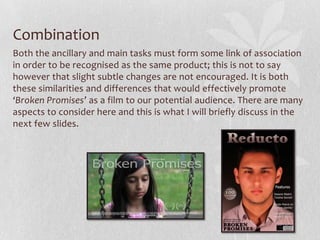
Both the ancillary and main tasks must form some link of association
in order to be recognised as the same product; this is not to say
however that slight subtle changes are not encouraged. It is both
these similarities and differences that would effectively promote
‘Broken Promises’ as a film to our potential audience. There are many
aspects to consider here and this is what I will briefly discuss in the
next few slides.
Text
Font
First and foremost we have the text, which although a minute detail -
does hold strong visual importance. In general terms, the two ancillary
tasks use identical fonts but this trend does not seem congruent in the
trailer and the reasons for this are simple.
The poster and magazine make use of the ‘Tahoma’ font style and this
works well due to its simplicity and clarity. Unlike fonts such as Arial; it
has a slightly more appealing style and so was used when being
aesthetically pleasing was fundamentally important [i.e. in the poster
and magazine]. On the trailer however – where we wanted the focus
drawn away from the text – a plainer font of Arial was used. The
consistency between the poster and magazine within themselves
however, was achieved effectively so that the audience can recognise
their link and so their individual marketing strategies are combined.
Colour
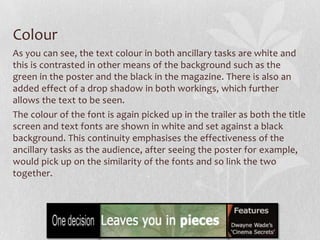
As you can see, the text colour in both ancillary tasks are white and
this is contrasted in other means of the background such as the
green in the poster and the black in the magazine. There is also an
added effect of a drop shadow in both workings, which further
allows the text to be seen.
The colour of the font is again picked up in the trailer as both the title
screen and text fonts are shown in white and set against a black
background. This continuity emphasises the effectiveness of the
ancillary tasks as the audience, after seeing the poster for example,
would pick up on the similarity of the fonts and so link the two
together.
Theme Colours
Colours
• The next aspect of the three tasks that I will discuss, is the use of
colours. The conventional idea in the filming and marketing industry
is to stay within a colour theme and this would be apparent in the
magazine, poster, trailer and film.
• My group and I chose to take this approach from a different angle
as we presented the poster and magazine in complete conflicting
colours. Although this may seem strange at first glance; it was
consciously done for several reasons.
Reasons for this contrast…
• The most important perhaps, is that the poster and magazine feature
two different characters and just like the colours in their individual
workings; they are shown in the film to be very conflictive. In other
words, Sheela [shown in the poster] is almost the protagonist, whilst
Isaac, who features in the magazine, is clearly the kidnapper and
antagonist of the film. The contrast in colours would therefore serve
to emphasise this.
• Another advantage of this emphasised difference is that it presents
not only the two different perspectives of the trailer, but also the two
genres that make up the story line of the film. The drama genre is
depicted through the depressing poster, whilst the thriller side is
suggested by the intenseness of the magazine. This would therefore
help in promoting the film and trailer as it would relate to a wider
range of audience. We believe that the different colour
representations in the poster and magazine work very well together
for the marketing of the film.
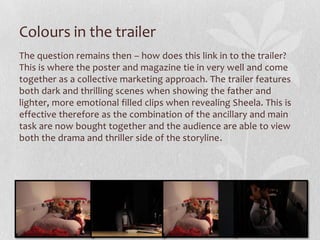
Colours in the trailer
The question remains then – how does this link in to the trailer?
This is where the poster and magazine tie in very well and come
together as a collective marketing approach. The trailer features
both dark and thrilling scenes when showing the father and
lighter, more emotional filled clips when revealing Sheela. This is
effective therefore as the combination of the ancillary and main
task are now bought together and the audience are able to view
both the drama and thriller side of the storyline.
Images
Type of image to use
• I will now look into the effectiveness of the images that we used in
the ancillary tasks and how this combined with our trailer is effective
in promoting our film. The first question therefore is what images we
had used and to begin with I will analyse the choice made on the
poster.
• There were many ideas that were discussed when deciding how to
approach this aspect of the ancillary task. We wanted our image to
directly represent the emotional side of the trailer, so that the
audience would be able to sympathise with our harsh storyline and
almost build a scheme of expectations before watching the film or
trailer. We had two options here – one of which was using the image
of a landscape and depending on the chosen location, this could
create a specifically effective atmosphere.
Landscape Image
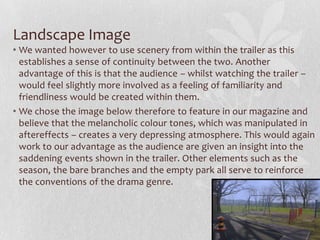
• We wanted however to use scenery from within the trailer as this
establishes a sense of continuity between the two. Another
advantage of this is that the audience – whilst watching the trailer –
would feel slightly more involved as a feeling of familiarity and
friendliness would be created within them.
• We chose the image below therefore to feature in our magazine and
believe that the melancholic colour tones, which was manipulated in
aftereffects – creates a very depressing atmosphere. This would again
work to our advantage as the audience are given an insight into the
saddening events shown in the trailer. Other elements such as the
season, the bare branches and the empty park all serve to reinforce
the conventions of the drama genre.
Character Image
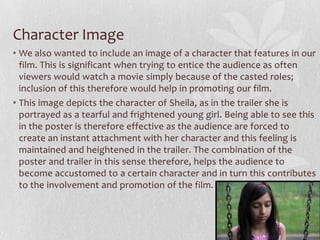
• We also wanted to include an image of a character that features in our
film. This is significant when trying to entice the audience as often
viewers would watch a movie simply because of the casted roles;
inclusion of this therefore would help in promoting our film.
• This image depicts the character of Sheila, as in the trailer she is
portrayed as a tearful and frightened young girl. Being able to see this
in the poster is therefore effective as the audience are forced to
create an instant attachment with her character and this feeling is
maintained and heightened in the trailer. The combination of the
poster and trailer in this sense therefore, helps the audience to
become accustomed to a certain character and in turn this contributes
to the involvement and promotion of the film.
Blending
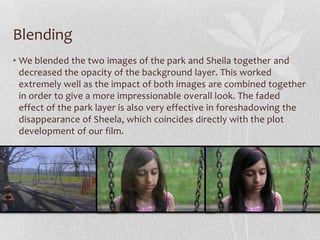
• We blended the two images of the park and Sheila together and
decreased the opacity of the background layer. This worked
extremely well as the impact of both images are combined together
in order to give a more impressionable overall look. The faded
effect of the park layer is also very effective in foreshadowing the
disappearance of Sheela, which coincides directly with the plot
development of our film.
Magazine
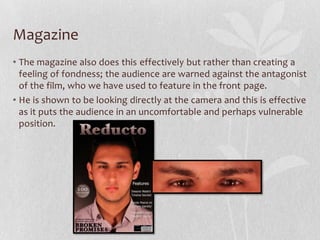
• The magazine also does this effectively but rather than creating a
feeling of fondness; the audience are warned against the antagonist
of the film, who we have used to feature in the front page.
• He is shown to be looking directly at the camera and this is effective
as it puts the audience in an uncomfortable and perhaps vulnerable
position.
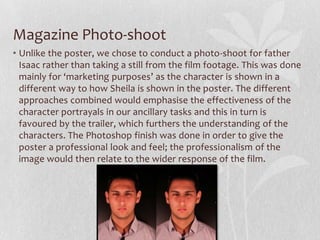
Magazine Photo-shoot
• Unlike the poster, we chose to conduct a photo-shoot for father
Isaac rather than taking a still from the film footage. This was done
mainly for ‘marketing purposes’ as the character is shown in a
different way to how Sheila is shown in the poster. The different
approaches combined would emphasise the effectiveness of the
character portrayals in our ancillary tasks and this in turn is
favoured by the trailer, which furthers the understanding of the
characters. The Photoshop finish was done in order to give the
poster a professional look and feel; the professionalism of the
image would then relate to the wider response of the film.
Conclusion
To Conclude…
• As you can see from the previous points therefore, the combination of the
two ancillary tasks along with the main trailer is extremely effective for
several reasons. They could be used to portray different aspects of the
film for example – as we done with the poster and magazine or they could
represent and emphasise the same moral message – idea of separation.
The public are able to take in all three forms as different strategies of
marketing and so the film is more effectively promoted.
• A final benefit and perhaps the most important is to consider where each
individual task would appear – a trailer for example would be seen on
television or on the internet and so would be exposed only to those who
have the specific channel or own a computer. A poster may be placed on a
billboard for example and so would attract pedestrians and drivers. A
magazine on the other hand would be available for purchase in local
shops and so would again bring in a different sort of audience. It the
combination of the three therefore that would allow a wider range of
audience to see our film and without the three together, it simply would
not be as effectively promoted.

Question 3

  • 1.
    How effective isthe combination of your main product and ancillary texts? EVALUATION – QUESTION 2
  • 2.
    Combination Both the ancillaryand main tasks must form some link of association in order to be recognised as the same product; this is not to say however that slight subtle changes are not encouraged. It is both these similarities and differences that would effectively promote ‘Broken Promises’ as a film to our potential audience. There are many aspects to consider here and this is what I will briefly discuss in the next few slides.
  • 3.
  • 4.
    Font First and foremostwe have the text, which although a minute detail - does hold strong visual importance. In general terms, the two ancillary tasks use identical fonts but this trend does not seem congruent in the trailer and the reasons for this are simple. The poster and magazine make use of the ‘Tahoma’ font style and this works well due to its simplicity and clarity. Unlike fonts such as Arial; it has a slightly more appealing style and so was used when being aesthetically pleasing was fundamentally important [i.e. in the poster and magazine]. On the trailer however – where we wanted the focus drawn away from the text – a plainer font of Arial was used. The consistency between the poster and magazine within themselves however, was achieved effectively so that the audience can recognise their link and so their individual marketing strategies are combined.
  • 5.
    Colour As you cansee, the text colour in both ancillary tasks are white and this is contrasted in other means of the background such as the green in the poster and the black in the magazine. There is also an added effect of a drop shadow in both workings, which further allows the text to be seen. The colour of the font is again picked up in the trailer as both the title screen and text fonts are shown in white and set against a black background. This continuity emphasises the effectiveness of the ancillary tasks as the audience, after seeing the poster for example, would pick up on the similarity of the fonts and so link the two together.
  • 6.
  • 7.
    Colours • The nextaspect of the three tasks that I will discuss, is the use of colours. The conventional idea in the filming and marketing industry is to stay within a colour theme and this would be apparent in the magazine, poster, trailer and film. • My group and I chose to take this approach from a different angle as we presented the poster and magazine in complete conflicting colours. Although this may seem strange at first glance; it was consciously done for several reasons.
  • 8.
    Reasons for thiscontrast… • The most important perhaps, is that the poster and magazine feature two different characters and just like the colours in their individual workings; they are shown in the film to be very conflictive. In other words, Sheela [shown in the poster] is almost the protagonist, whilst Isaac, who features in the magazine, is clearly the kidnapper and antagonist of the film. The contrast in colours would therefore serve to emphasise this. • Another advantage of this emphasised difference is that it presents not only the two different perspectives of the trailer, but also the two genres that make up the story line of the film. The drama genre is depicted through the depressing poster, whilst the thriller side is suggested by the intenseness of the magazine. This would therefore help in promoting the film and trailer as it would relate to a wider range of audience. We believe that the different colour representations in the poster and magazine work very well together for the marketing of the film.
  • 9.
    Colours in thetrailer The question remains then – how does this link in to the trailer? This is where the poster and magazine tie in very well and come together as a collective marketing approach. The trailer features both dark and thrilling scenes when showing the father and lighter, more emotional filled clips when revealing Sheela. This is effective therefore as the combination of the ancillary and main task are now bought together and the audience are able to view both the drama and thriller side of the storyline.
  • 10.
  • 11.
    Type of imageto use • I will now look into the effectiveness of the images that we used in the ancillary tasks and how this combined with our trailer is effective in promoting our film. The first question therefore is what images we had used and to begin with I will analyse the choice made on the poster. • There were many ideas that were discussed when deciding how to approach this aspect of the ancillary task. We wanted our image to directly represent the emotional side of the trailer, so that the audience would be able to sympathise with our harsh storyline and almost build a scheme of expectations before watching the film or trailer. We had two options here – one of which was using the image of a landscape and depending on the chosen location, this could create a specifically effective atmosphere.
  • 12.
    Landscape Image • Wewanted however to use scenery from within the trailer as this establishes a sense of continuity between the two. Another advantage of this is that the audience – whilst watching the trailer – would feel slightly more involved as a feeling of familiarity and friendliness would be created within them. • We chose the image below therefore to feature in our magazine and believe that the melancholic colour tones, which was manipulated in aftereffects – creates a very depressing atmosphere. This would again work to our advantage as the audience are given an insight into the saddening events shown in the trailer. Other elements such as the season, the bare branches and the empty park all serve to reinforce the conventions of the drama genre.
  • 13.
    Character Image • Wealso wanted to include an image of a character that features in our film. This is significant when trying to entice the audience as often viewers would watch a movie simply because of the casted roles; inclusion of this therefore would help in promoting our film. • This image depicts the character of Sheila, as in the trailer she is portrayed as a tearful and frightened young girl. Being able to see this in the poster is therefore effective as the audience are forced to create an instant attachment with her character and this feeling is maintained and heightened in the trailer. The combination of the poster and trailer in this sense therefore, helps the audience to become accustomed to a certain character and in turn this contributes to the involvement and promotion of the film.
  • 14.
    Blending • We blendedthe two images of the park and Sheila together and decreased the opacity of the background layer. This worked extremely well as the impact of both images are combined together in order to give a more impressionable overall look. The faded effect of the park layer is also very effective in foreshadowing the disappearance of Sheela, which coincides directly with the plot development of our film.
  • 15.
    Magazine • The magazinealso does this effectively but rather than creating a feeling of fondness; the audience are warned against the antagonist of the film, who we have used to feature in the front page. • He is shown to be looking directly at the camera and this is effective as it puts the audience in an uncomfortable and perhaps vulnerable position.
  • 16.
    Magazine Photo-shoot • Unlikethe poster, we chose to conduct a photo-shoot for father Isaac rather than taking a still from the film footage. This was done mainly for ‘marketing purposes’ as the character is shown in a different way to how Sheila is shown in the poster. The different approaches combined would emphasise the effectiveness of the character portrayals in our ancillary tasks and this in turn is favoured by the trailer, which furthers the understanding of the characters. The Photoshop finish was done in order to give the poster a professional look and feel; the professionalism of the image would then relate to the wider response of the film.
  • 17.
  • 18.
    To Conclude… • Asyou can see from the previous points therefore, the combination of the two ancillary tasks along with the main trailer is extremely effective for several reasons. They could be used to portray different aspects of the film for example – as we done with the poster and magazine or they could represent and emphasise the same moral message – idea of separation. The public are able to take in all three forms as different strategies of marketing and so the film is more effectively promoted. • A final benefit and perhaps the most important is to consider where each individual task would appear – a trailer for example would be seen on television or on the internet and so would be exposed only to those who have the specific channel or own a computer. A poster may be placed on a billboard for example and so would attract pedestrians and drivers. A magazine on the other hand would be available for purchase in local shops and so would again bring in a different sort of audience. It the combination of the three therefore that would allow a wider range of audience to see our film and without the three together, it simply would not be as effectively promoted.