Question 1: In what ways does you media product use, develop or challenge forms and conventions of real media products? With our teaser trailer finished and displayed on the blog it is now important for each of us to evaluate and analysis the teaser trailer, to see if it is fit for purpose and also whether the teaser sticks to typical convention or if it strays. I will also aim to look at other areas including the films posters and magazine front cover, what I have learned from audience feedback and how the media has aided me in research, planning and the evaluation stages.
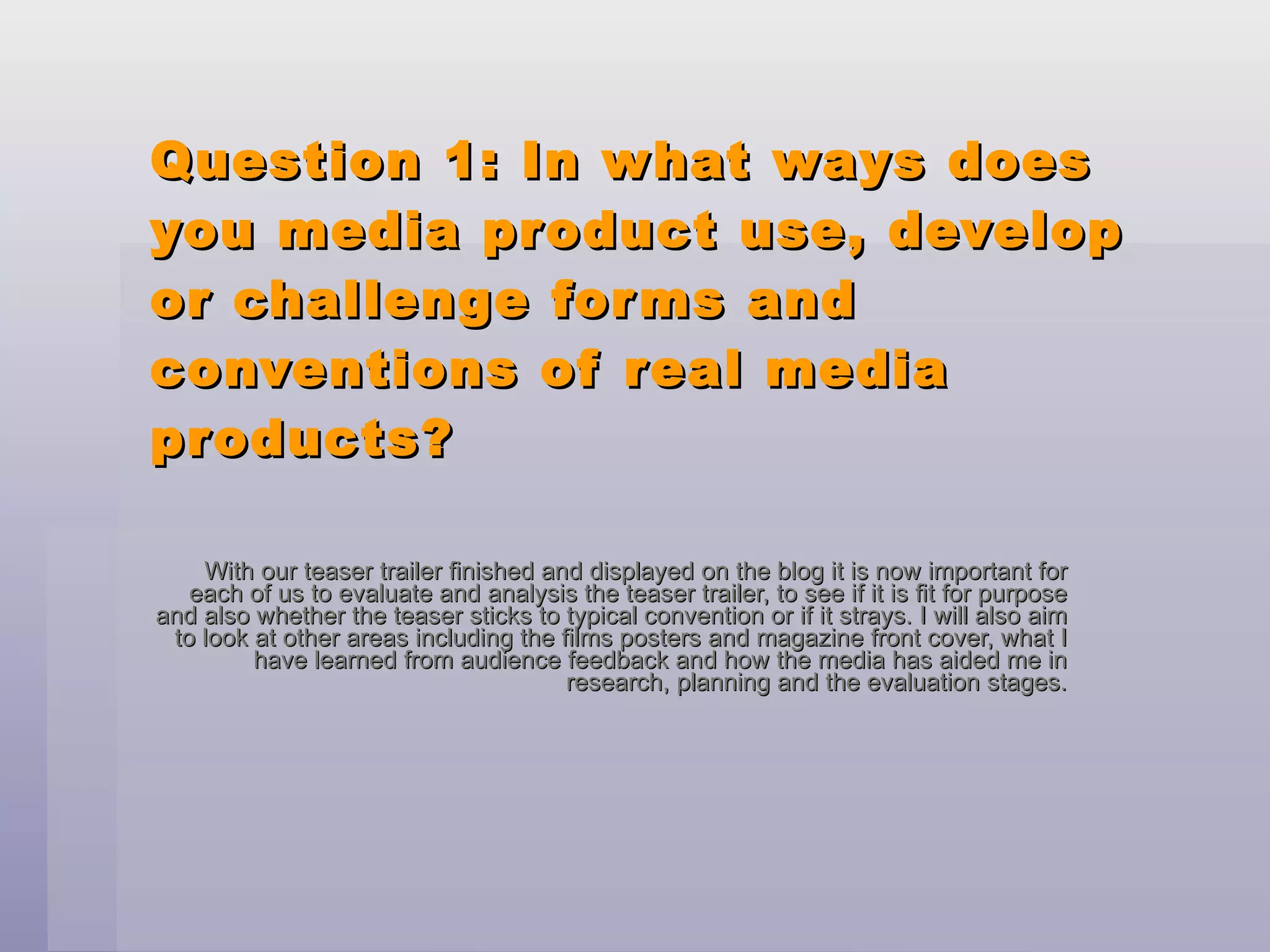
Narrative Throughout the project I have had a grasp of the fundament codes and conventions of the horror thriller genre, such as, the narrative. Typically this includes a group of teenagers going on a holiday, becoming lost in a forest, with each one being killed off by an unknown entity and finally one or two survivors live to tell the tale. Although most of the narrative for my teaser trailer has remained the same I have introduced a couple of new ideas; to bring something new to the genre. These new ideas revolved around the murderer, primarily, with a second theme being introduced later on. Traditionally murderers in horror films are middle age, male and athletic or possibly physically impaired, for example, Michael Myers in the Halloween franchise. To ‘break the mould’ we, as a group, decided that a young girl should be cast for this role, both to raise enigmas and to turn what most people see as a harmless child into something to be feared. This is not to that this is the only time a young girl has been cast as a horror icon (Silent Hill) but it is very rare, which will enhance the appeal. The second difference to our teaser trailer is that none of the main characters survive the ordeal in the woods. Generally horror films tend to have a few survivors to tell the tale but not this time; this is similar to Blair Witch.
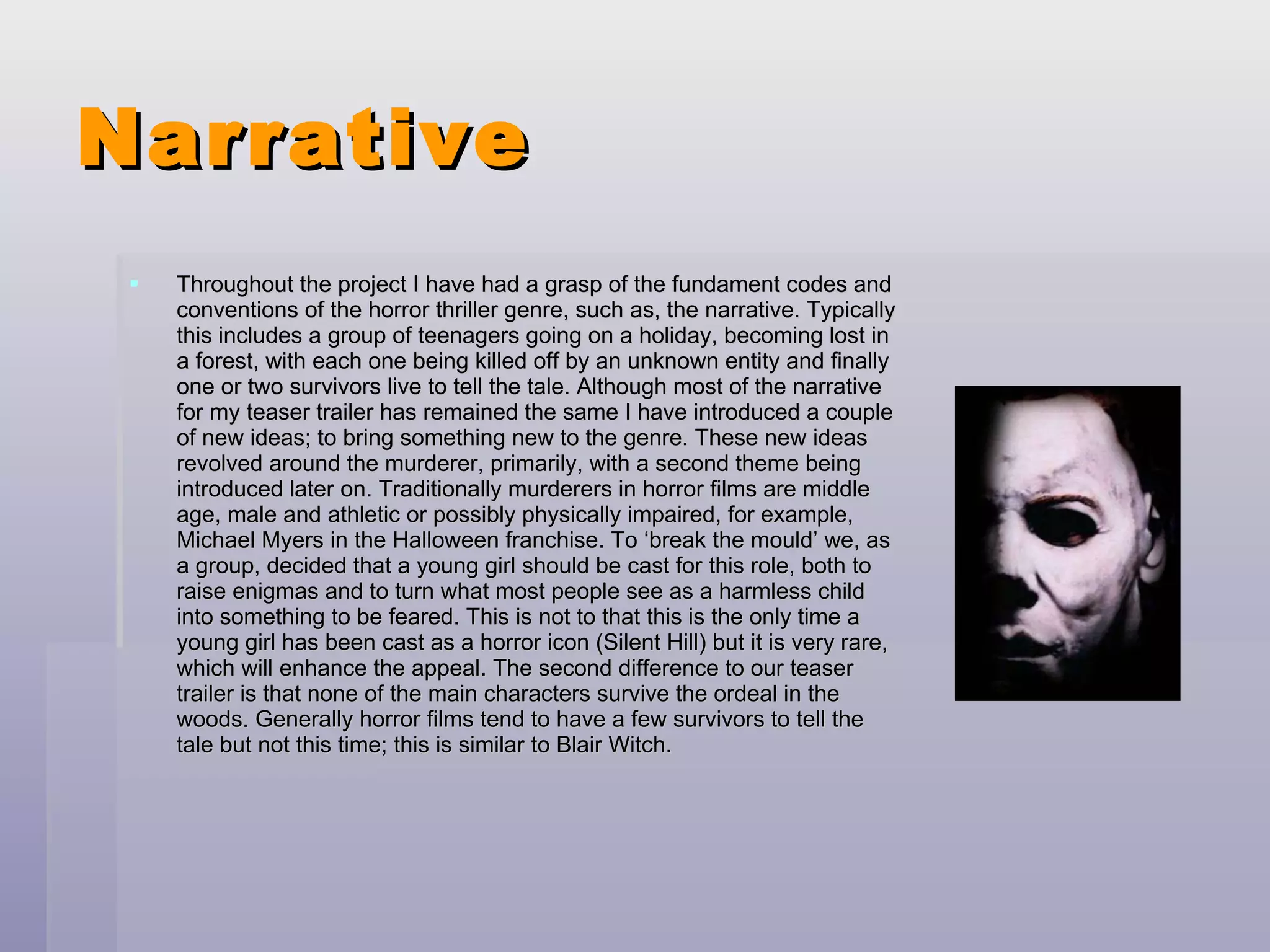
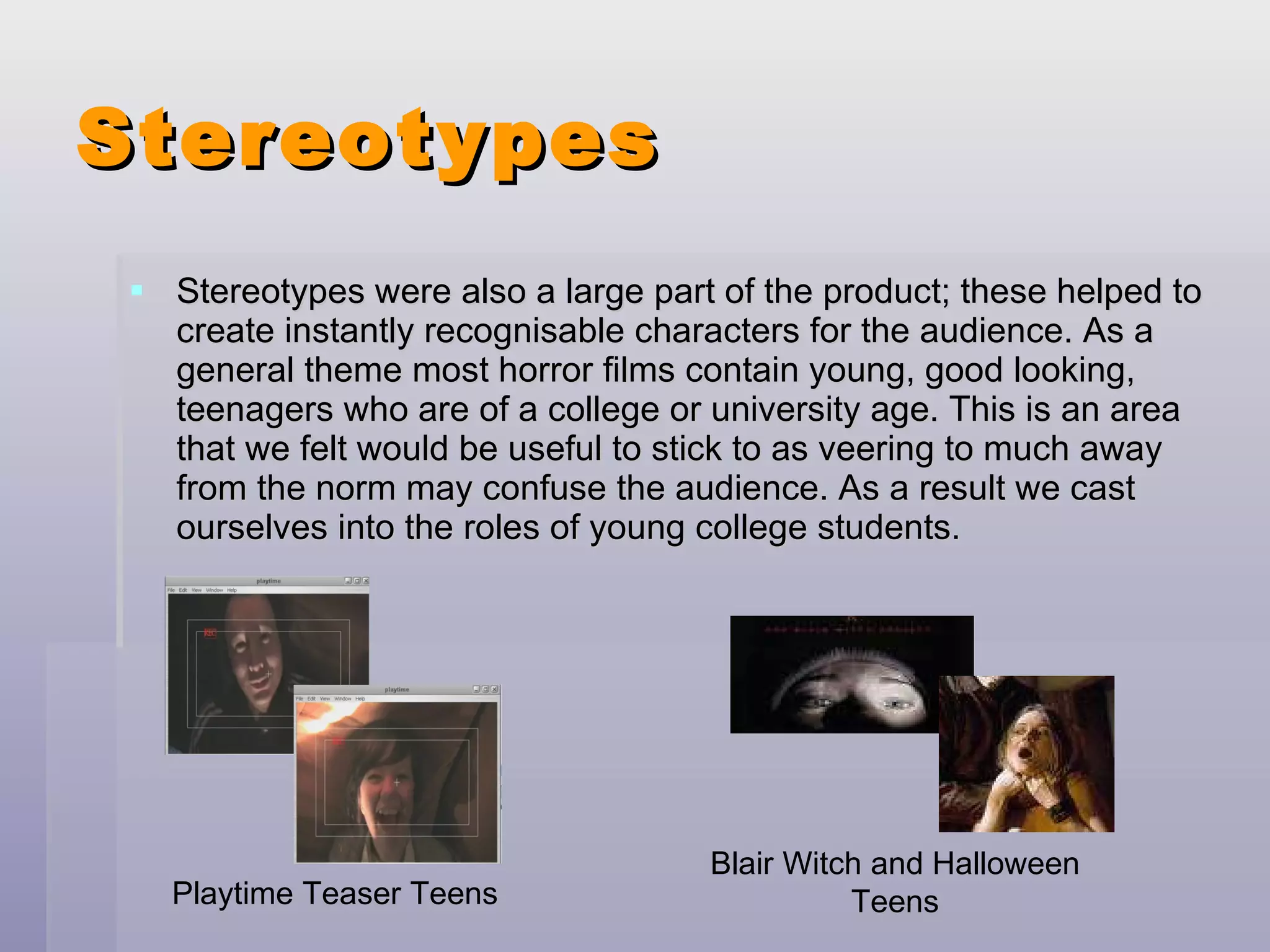
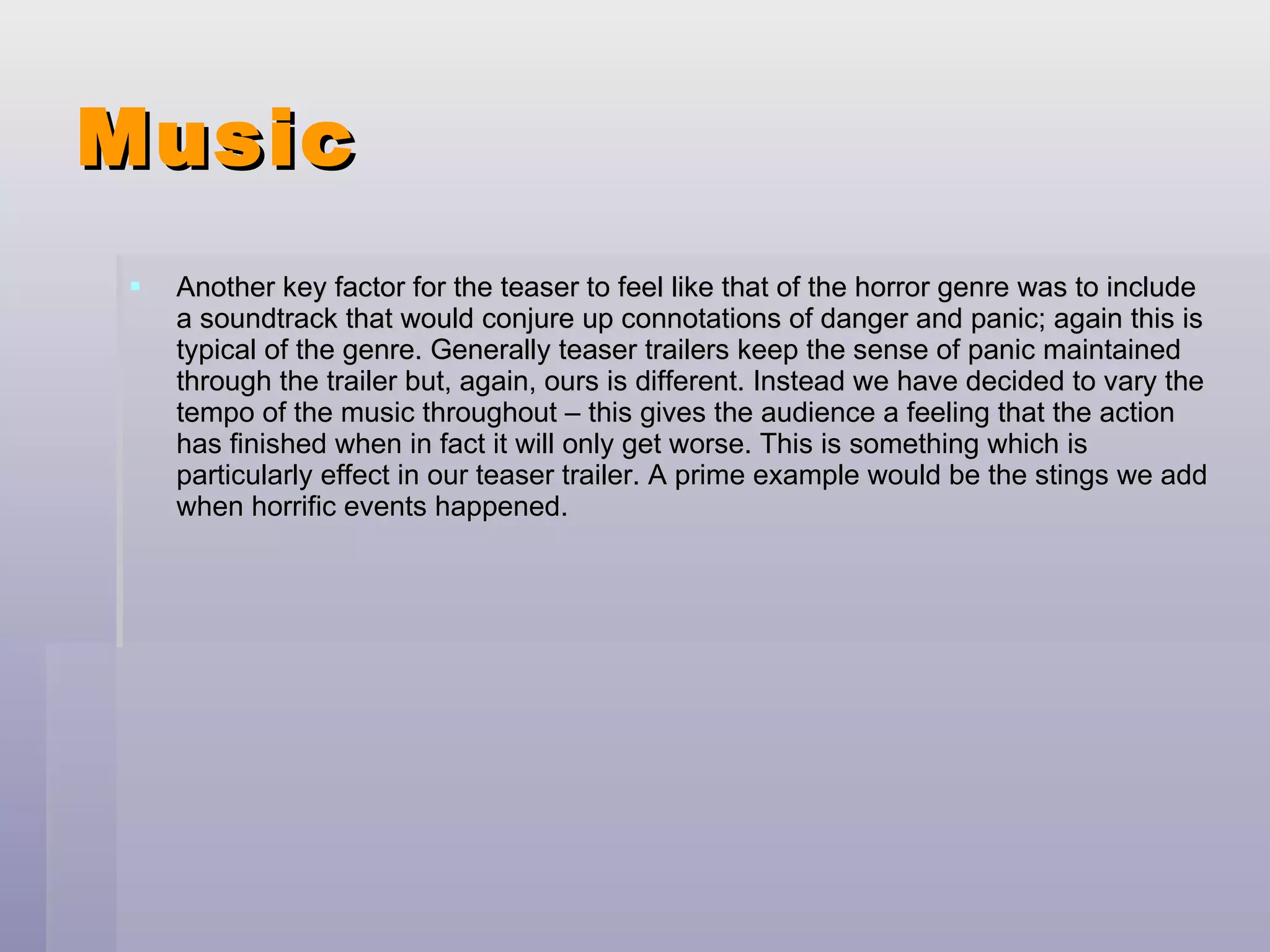
Stereotypes Stereotypes were also a large part of the product; these helped to create instantly recognisable characters for the audience. As a general theme most horror films contain young, good looking, teenagers who are of a college or university age. This is an area that we felt would be useful to stick to as veering to much away from the norm may confuse the audience. As a result we cast ourselves into the roles of young college students. Playtime Teaser Teens Blair Witch and Halloween Teens
Music Another key factor for the teaser to feel like that of the horror genre was to include a soundtrack that would conjure up connotations of danger and panic; again this is typical of the genre. Generally teaser trailers keep the sense of panic maintained through the trailer but, again, ours is different. Instead we have decided to vary the tempo of the music throughout – this gives the audience a feeling that the action has finished when in fact it will only get worse. This is something which is particularly effect in our teaser trailer. A prime example would be the stings we add when horrific events happened.
Lighting and Captions Further conventions have remained the same, such as, lighting. The norm for horror is for lighting to be eerie, abstract and an overall feel of darkness. There are many examples of the use of, or in some cases lack of lighting in horror movies; Saw and Hostel. Again we included this technique in our product by utilising the weather elements, including, fog, sunsets and introducing additional light with the help of a torch. This intensified the feel of the final product and helped lend itself to the genre. The use of captions and titles throughout teaser trailers are not only used within the horror genre but can be seen throughout the film industry. These captions are used to create tension for the audience and primarily keep them hooked on what they are watching. Deviating from the norm we decided to only include the title and ‘coming soon’ at the end of the teaser trailer, this enabled us to condense all of the important and relevant details of the film into a time slot of 90 seconds (the typical length of a teaser trailer). Attempting to limit the number of captions does not, however, reduce tension in the product. To counteract the lack of captions we introduced a soundtrack, establishing shots and utilised camera speeds and angles.
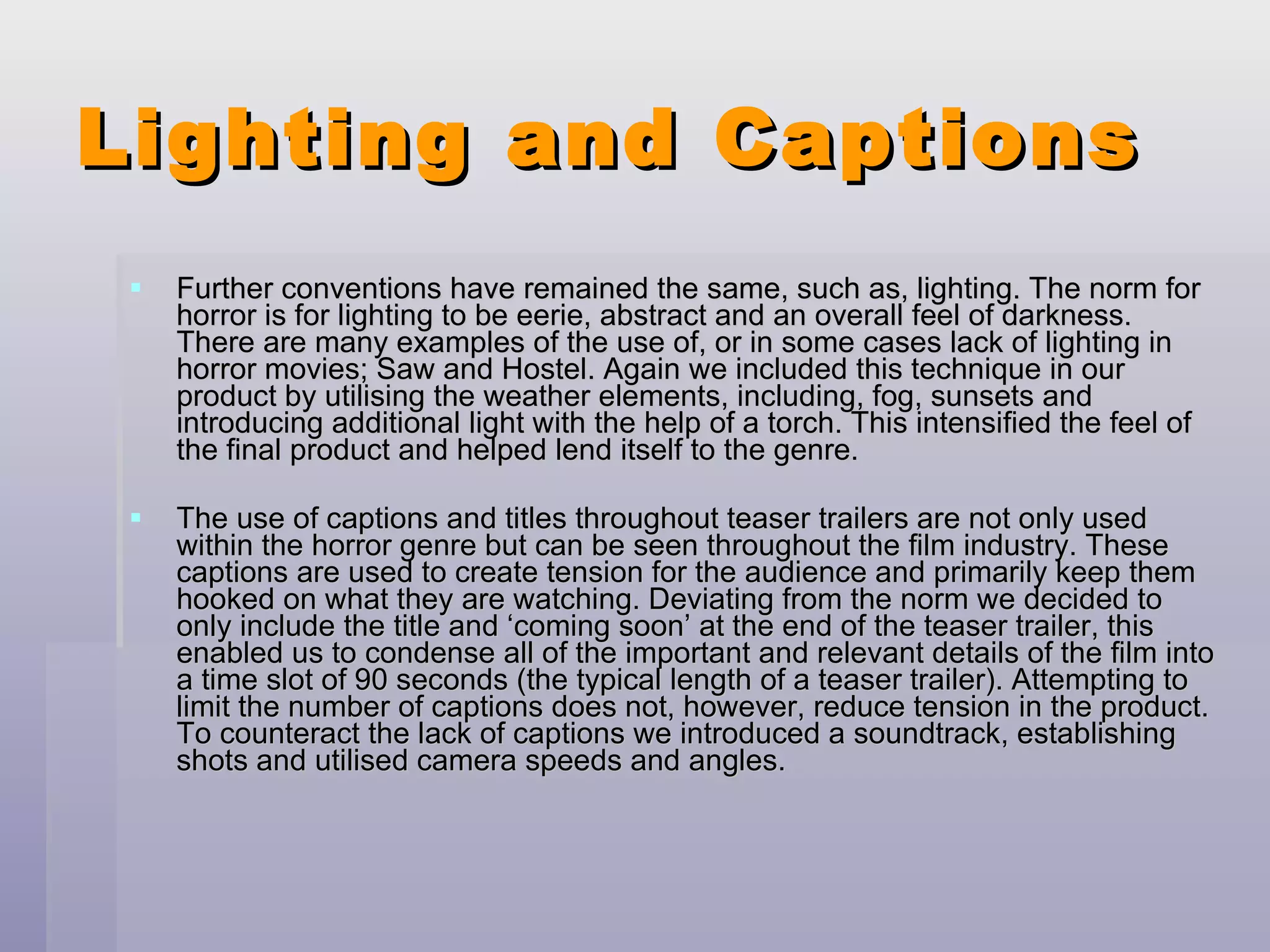
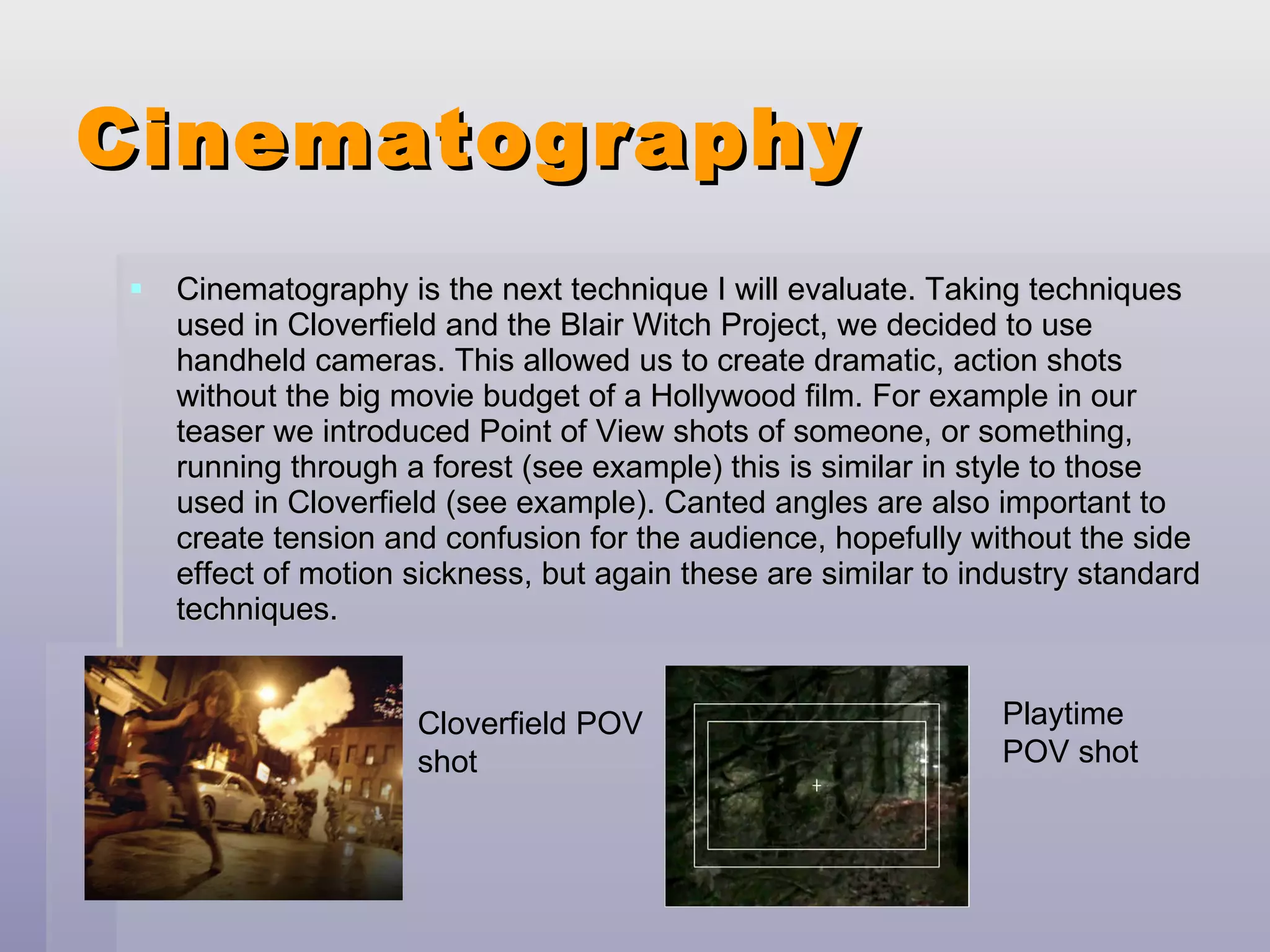
Cinematography Cinematography is the next technique I will evaluate. Taking techniques used in Cloverfield and the Blair Witch Project, we decided to use handheld cameras. This allowed us to create dramatic, action shots without the big movie budget of a Hollywood film. For example in our teaser we introduced Point of View shots of someone, or something, running through a forest (see example) this is similar in style to those used in Cloverfield (see example). Canted angles are also important to create tension and confusion for the audience, hopefully without the side effect of motion sickness, but again these are similar to industry standard techniques. Cloverfield POV shot Playtime  POV shot
Why have some familiar elements been kept? There are a number of reasons why some familiar elements have been kept. Firstly, it is important from an audience perspective to be able to instantly recognise whether a film is going to be one they will enjoy i.e. of a particular genre. Generally audiences will continue to watch the same style of genres because as an audience they understand what they like. As a result we needed to keep some of the elements true to the horror genre, such as, stereotypes, lighting and cinematography.

Question 1

  • 1.
    Question 1: Inwhat ways does you media product use, develop or challenge forms and conventions of real media products? With our teaser trailer finished and displayed on the blog it is now important for each of us to evaluate and analysis the teaser trailer, to see if it is fit for purpose and also whether the teaser sticks to typical convention or if it strays. I will also aim to look at other areas including the films posters and magazine front cover, what I have learned from audience feedback and how the media has aided me in research, planning and the evaluation stages.
  • 2.
    Narrative Throughout theproject I have had a grasp of the fundament codes and conventions of the horror thriller genre, such as, the narrative. Typically this includes a group of teenagers going on a holiday, becoming lost in a forest, with each one being killed off by an unknown entity and finally one or two survivors live to tell the tale. Although most of the narrative for my teaser trailer has remained the same I have introduced a couple of new ideas; to bring something new to the genre. These new ideas revolved around the murderer, primarily, with a second theme being introduced later on. Traditionally murderers in horror films are middle age, male and athletic or possibly physically impaired, for example, Michael Myers in the Halloween franchise. To ‘break the mould’ we, as a group, decided that a young girl should be cast for this role, both to raise enigmas and to turn what most people see as a harmless child into something to be feared. This is not to that this is the only time a young girl has been cast as a horror icon (Silent Hill) but it is very rare, which will enhance the appeal. The second difference to our teaser trailer is that none of the main characters survive the ordeal in the woods. Generally horror films tend to have a few survivors to tell the tale but not this time; this is similar to Blair Witch.
  • 3.
    Stereotypes Stereotypes werealso a large part of the product; these helped to create instantly recognisable characters for the audience. As a general theme most horror films contain young, good looking, teenagers who are of a college or university age. This is an area that we felt would be useful to stick to as veering to much away from the norm may confuse the audience. As a result we cast ourselves into the roles of young college students. Playtime Teaser Teens Blair Witch and Halloween Teens
  • 4.
    Music Another keyfactor for the teaser to feel like that of the horror genre was to include a soundtrack that would conjure up connotations of danger and panic; again this is typical of the genre. Generally teaser trailers keep the sense of panic maintained through the trailer but, again, ours is different. Instead we have decided to vary the tempo of the music throughout – this gives the audience a feeling that the action has finished when in fact it will only get worse. This is something which is particularly effect in our teaser trailer. A prime example would be the stings we add when horrific events happened.
  • 5.
    Lighting and CaptionsFurther conventions have remained the same, such as, lighting. The norm for horror is for lighting to be eerie, abstract and an overall feel of darkness. There are many examples of the use of, or in some cases lack of lighting in horror movies; Saw and Hostel. Again we included this technique in our product by utilising the weather elements, including, fog, sunsets and introducing additional light with the help of a torch. This intensified the feel of the final product and helped lend itself to the genre. The use of captions and titles throughout teaser trailers are not only used within the horror genre but can be seen throughout the film industry. These captions are used to create tension for the audience and primarily keep them hooked on what they are watching. Deviating from the norm we decided to only include the title and ‘coming soon’ at the end of the teaser trailer, this enabled us to condense all of the important and relevant details of the film into a time slot of 90 seconds (the typical length of a teaser trailer). Attempting to limit the number of captions does not, however, reduce tension in the product. To counteract the lack of captions we introduced a soundtrack, establishing shots and utilised camera speeds and angles.
  • 6.
    Cinematography Cinematography isthe next technique I will evaluate. Taking techniques used in Cloverfield and the Blair Witch Project, we decided to use handheld cameras. This allowed us to create dramatic, action shots without the big movie budget of a Hollywood film. For example in our teaser we introduced Point of View shots of someone, or something, running through a forest (see example) this is similar in style to those used in Cloverfield (see example). Canted angles are also important to create tension and confusion for the audience, hopefully without the side effect of motion sickness, but again these are similar to industry standard techniques. Cloverfield POV shot Playtime POV shot
  • 7.
    Why have somefamiliar elements been kept? There are a number of reasons why some familiar elements have been kept. Firstly, it is important from an audience perspective to be able to instantly recognise whether a film is going to be one they will enjoy i.e. of a particular genre. Generally audiences will continue to watch the same style of genres because as an audience they understand what they like. As a result we needed to keep some of the elements true to the horror genre, such as, stereotypes, lighting and cinematography.