SCIENCE VI
CONTENT STANDARD
Infer how friction and gravity affect the
movements of a different object
OBJECTIVES
•Understands the nature
of gravity
•Discovers the properties
of gravity
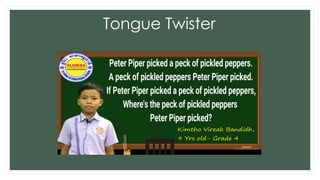
Tongue Twister
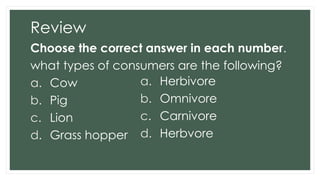
Review
Choose the correct answer in each number.
what types of consumers are the following?
a. Cow
b. Pig
c. Lion
d. Grass hopper
a. Herbivore
b. Omnivore
c. Carnivore
d. Herbvore
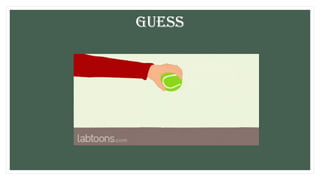
GUESS
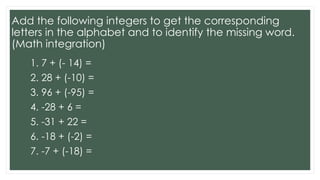
Add the following integers to get the corresponding
letters in the alphabet and to identify the missing word.
(Math integration)
1. 7 + (- 14) =
2. 28 + (-10) =
3. 96 + (-95) =
4. -28 + 6 =
5. -31 + 22 =
6. -18 + (-2) =
7. -7 + (-18) =
Question
•What have you seen on the video?
•What happened to the women in outer space?
•What would be the force that is absent in outer
space?
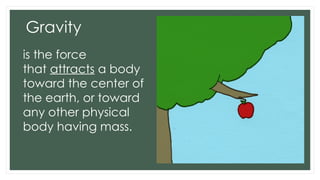
Gravity
is the force
that attracts a body
toward the center of
the earth, or toward
any other physical
body having mass.
What will fall first?
1.Which of the two objects will hit the ground first?
2.Do the weight of the object affects its rate?
3.What is the force acting on the objects to fall on the
ground?
4.What would be the reason why objects hit the ground at a
different rate?
5.Do the weight and size of an object affect its rate? Why or
why not?
ACTIVITY 1
“Directions for the Gravity”
• Materials for Gravity Experiment
• Small dowel or stick
• String
• Paperclips
• Scissors
• Tape
• Strong magnets (Use either neodymium magnets .5 inch or bigger or
ceramic magnets .75 inch or larger. Regular craft magnets won’t work.)
• Metal ruler (or wooden ruler with tape)
• Blocks, books, or other material for stacking
ACTIVITY 2
PROCEDURE
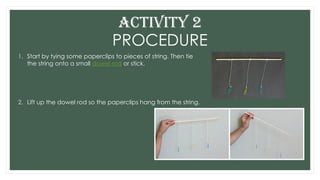
1. Start by tying some paperclips to pieces of string. Then tie
the string onto a small dowel rod or stick.
2. Lift up the dowel rod so the paperclips hang from the string.
ACTIVITY 2
Question
•Which direction do the paperclips point?
•What happens if you tilt the stick?
•Why does the pin remain pointing toward
the ground even if it was tilted?
ACTIVITY 2
Materials for Gravity Experiment
• Small dowel or stick
• String
• Paperclips
• Scissors
• Tape
• Strong magnets (Use either neodymium magnets .5 inch or bigger or
ceramic magnets .75 inch or larger. Regular craft magnets won’t work.)
• Metal ruler (or wooden ruler with tape)
• Blocks, books, or other material for stacking
ACTIVITY 3
“Earth’s gravity and other forces
PROCEDURE
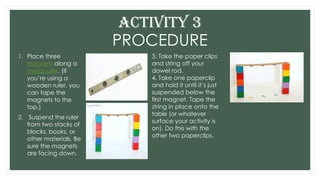
1. Place three
magnets along a
metal ruler. (If
you’re using a
wooden ruler, you
can tape the
magnets to the
top.)
2. Suspend the ruler
from two stacks of
blocks, books, or
other materials. Be
sure the magnets
are facing down.
ACTIVITY 3
3. Take the paper clips
and string off your
dowel rod.
4. Take one paperclip
and hold it until it’s just
suspended below the
first magnet. Tape the
string in place onto the
table (or whatever
surface your activity is
on). Do this with the
other two paperclips.
PROCEDURE
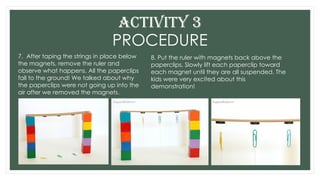
7. After taping the strings in place below
the magnets, remove the ruler and
observe what happens. All the paperclips
fall to the ground! We talked about why
the paperclips were not going up into the
air after we removed the magnets.
ACTIVITY 3
8. Put the ruler with magnets back above the
paperclips. Slowly lift each paperclip toward
each magnet until they are all suspended. The
kids were very excited about this
demonstration!
Question
• What is the position of the pins in the absence of the magnet?
• Do the pins remain on the ground?
• What happened to the pins after the magnet was put on top
of the pins?
• Why does the magnet affect the pull of gravity toward the pin?
• What happened with the pin after the ruler with the magnet
was removed?
• Does the distance between the object and the force acting on
it affect its direction?
ACTIVITY 3
(Relating mass, weight and distance of an objects)
•make predictions about what will happen when you
drop various objects, two different objects that have
different weights and distances simultaneously.
•One pair will do the dropping and the other pair will
note their observation on a sheet of paper and
discuss it with your other classmates.
Think pair and share
Question
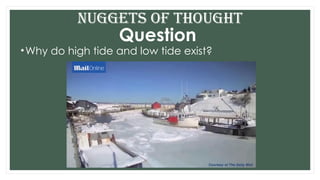
•Why do high tide and low tide exist?
Nuggets of THOUGHT
Question
•Does gravity play a significant role in this
natural phenomenon? Why? or why not?
•What is the importance of gravity?
Nuggets of THOUGHT
Question
•What is gravity?
•What are the properties of gravity?
•Does distance affect gravitational force?
•Why does gravity make objects fall rather than up?
•What might happen if there is no gravity?
Nuggets of THOUGHT
Choose the letter of the correct answer.
Assessment
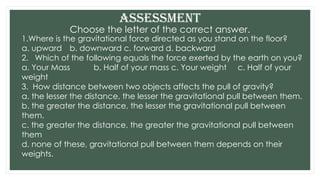
1.Where is the gravitational force directed as you stand on the floor?
a. upward b. downward c. forward d. backward
2. Which of the following equals the force exerted by the earth on you?
a. Your Mass b. Half of your mass c. Your weight c. Half of your
weight
3. How distance between two objects affects the pull of gravity?
a. the lesser the distance, the lesser the gravitational pull between them.
b. the greater the distance, the lesser the gravitational pull between
them.
c. the greater the distance, the greater the gravitational pull between
them
d. none of these, gravitational pull between them depends on their
weights.
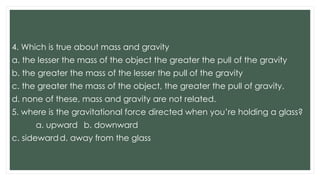
4. Which is true about mass and gravity
a. the lesser the mass of the object the greater the pull of the gravity
b. the greater the mass of the lesser the pull of the gravity
c. the greater the mass of the object, the greater the pull of gravity.
d. none of these, mass and gravity are not related.
5. where is the gravitational force directed when you’re holding a glass?
a. upward b. downward
c. sidewardd. away from the glass
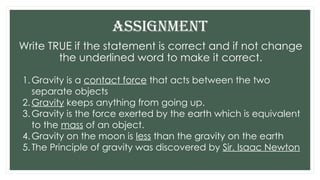
Write TRUE if the statement is correct and if not change
the underlined word to make it correct.
ASSIGNMENT
1.Gravity is a contact force that acts between the two
separate objects
2.Gravity keeps anything from going up.
3.Gravity is the force exerted by the earth which is equivalent
to the mass of an object.
4.Gravity on the moon is less than the gravity on the earth
5.The Principle of gravity was discovered by Sir. Isaac Newton

QUARTER THREE WEEK ONE SCIENCE VI.pptx

  • 1.
  • 2.
    CONTENT STANDARD Infer howfriction and gravity affect the movements of a different object
  • 3.
    OBJECTIVES •Understands the nature ofgravity •Discovers the properties of gravity
  • 4.
  • 5.
    Review Choose the correctanswer in each number. what types of consumers are the following? a. Cow b. Pig c. Lion d. Grass hopper a. Herbivore b. Omnivore c. Carnivore d. Herbvore
  • 6.
  • 7.
    Add the followingintegers to get the corresponding letters in the alphabet and to identify the missing word. (Math integration) 1. 7 + (- 14) = 2. 28 + (-10) = 3. 96 + (-95) = 4. -28 + 6 = 5. -31 + 22 = 6. -18 + (-2) = 7. -7 + (-18) =
  • 9.
    Question •What have youseen on the video? •What happened to the women in outer space? •What would be the force that is absent in outer space?
  • 10.
    Gravity is the force thatattracts a body toward the center of the earth, or toward any other physical body having mass.
  • 11.
    What will fallfirst? 1.Which of the two objects will hit the ground first? 2.Do the weight of the object affects its rate? 3.What is the force acting on the objects to fall on the ground? 4.What would be the reason why objects hit the ground at a different rate? 5.Do the weight and size of an object affect its rate? Why or why not? ACTIVITY 1
  • 12.
    “Directions for theGravity” • Materials for Gravity Experiment • Small dowel or stick • String • Paperclips • Scissors • Tape • Strong magnets (Use either neodymium magnets .5 inch or bigger or ceramic magnets .75 inch or larger. Regular craft magnets won’t work.) • Metal ruler (or wooden ruler with tape) • Blocks, books, or other material for stacking ACTIVITY 2
  • 13.
    PROCEDURE 1. Start bytying some paperclips to pieces of string. Then tie the string onto a small dowel rod or stick. 2. Lift up the dowel rod so the paperclips hang from the string. ACTIVITY 2
  • 14.
    Question •Which direction dothe paperclips point? •What happens if you tilt the stick? •Why does the pin remain pointing toward the ground even if it was tilted? ACTIVITY 2
  • 15.
    Materials for GravityExperiment • Small dowel or stick • String • Paperclips • Scissors • Tape • Strong magnets (Use either neodymium magnets .5 inch or bigger or ceramic magnets .75 inch or larger. Regular craft magnets won’t work.) • Metal ruler (or wooden ruler with tape) • Blocks, books, or other material for stacking ACTIVITY 3 “Earth’s gravity and other forces
  • 16.
    PROCEDURE 1. Place three magnetsalong a metal ruler. (If you’re using a wooden ruler, you can tape the magnets to the top.) 2. Suspend the ruler from two stacks of blocks, books, or other materials. Be sure the magnets are facing down. ACTIVITY 3 3. Take the paper clips and string off your dowel rod. 4. Take one paperclip and hold it until it’s just suspended below the first magnet. Tape the string in place onto the table (or whatever surface your activity is on). Do this with the other two paperclips.
  • 17.
    PROCEDURE 7. After tapingthe strings in place below the magnets, remove the ruler and observe what happens. All the paperclips fall to the ground! We talked about why the paperclips were not going up into the air after we removed the magnets. ACTIVITY 3 8. Put the ruler with magnets back above the paperclips. Slowly lift each paperclip toward each magnet until they are all suspended. The kids were very excited about this demonstration!
  • 18.
    Question • What isthe position of the pins in the absence of the magnet? • Do the pins remain on the ground? • What happened to the pins after the magnet was put on top of the pins? • Why does the magnet affect the pull of gravity toward the pin? • What happened with the pin after the ruler with the magnet was removed? • Does the distance between the object and the force acting on it affect its direction? ACTIVITY 3
  • 19.
    (Relating mass, weightand distance of an objects) •make predictions about what will happen when you drop various objects, two different objects that have different weights and distances simultaneously. •One pair will do the dropping and the other pair will note their observation on a sheet of paper and discuss it with your other classmates. Think pair and share
  • 20.
    Question •Why do hightide and low tide exist? Nuggets of THOUGHT
  • 21.
    Question •Does gravity playa significant role in this natural phenomenon? Why? or why not? •What is the importance of gravity? Nuggets of THOUGHT
  • 22.
    Question •What is gravity? •Whatare the properties of gravity? •Does distance affect gravitational force? •Why does gravity make objects fall rather than up? •What might happen if there is no gravity? Nuggets of THOUGHT
  • 24.
    Choose the letterof the correct answer. Assessment 1.Where is the gravitational force directed as you stand on the floor? a. upward b. downward c. forward d. backward 2. Which of the following equals the force exerted by the earth on you? a. Your Mass b. Half of your mass c. Your weight c. Half of your weight 3. How distance between two objects affects the pull of gravity? a. the lesser the distance, the lesser the gravitational pull between them. b. the greater the distance, the lesser the gravitational pull between them. c. the greater the distance, the greater the gravitational pull between them d. none of these, gravitational pull between them depends on their weights.
  • 25.
    4. Which istrue about mass and gravity a. the lesser the mass of the object the greater the pull of the gravity b. the greater the mass of the lesser the pull of the gravity c. the greater the mass of the object, the greater the pull of gravity. d. none of these, mass and gravity are not related. 5. where is the gravitational force directed when you’re holding a glass? a. upward b. downward c. sidewardd. away from the glass
  • 26.
    Write TRUE ifthe statement is correct and if not change the underlined word to make it correct. ASSIGNMENT 1.Gravity is a contact force that acts between the two separate objects 2.Gravity keeps anything from going up. 3.Gravity is the force exerted by the earth which is equivalent to the mass of an object. 4.Gravity on the moon is less than the gravity on the earth 5.The Principle of gravity was discovered by Sir. Isaac Newton