•A FORCE is a push or a pull.
•GRAVITY is a force that pulls objects
toward one another. It pulls objects
towards Earth.
•Try jumping in the air. What happens?
Gravity pulls you back to Earth.
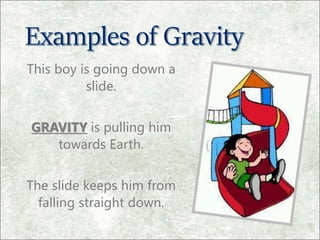
This boy is going down a
slide.
GRAVITY is pulling him
towards Earth.
The slide keeps him from
falling straight down.
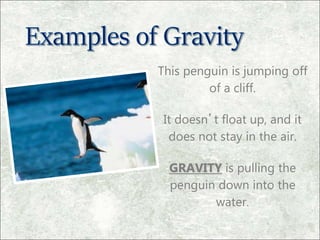
This penguin is jumping off
of a cliff.
It doesn’t float up, and it
does not stay in the air.
GRAVITY is pulling the
penguin down into the
water.
What are some other real-world
examples of gravity in action? What
have you experienced?
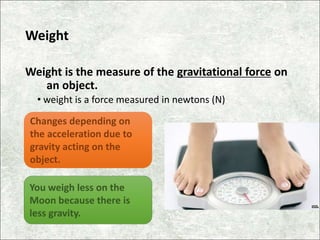
Weight
Weight is the measure of the gravitational force on
an object.
• weight is a force measured in newtons (N)
Changes depending on
the acceleration due to
gravity acting on the
object.
You weigh less on the
Moon because there is
less gravity.
Weight Formula
Units: W = weight in newtons (N)
m = mass in kilograms (kg)
g = acceleration due to gravity (m/s2)
weight (w) = mass (m) X gravity (g)
Acceleration Due to Gravity (g)
An object falling (on Earth) has an acceleration due to
gravity (g) of 9.8 m/s2.
All objects near the surface of the Earth fall with the
same rate of acceleration
https://www.youtube.com/watch?v=E43-CfukEgs
Air Resistance
•Type of fluid friction (doesn’t have to be
liquid, can be air)
•Causes things to reach a terminal velocity –
when the force of the air resistance and the
weight of an object are equal and balanced
forces, so things are not accelerating, but
moving at a constant velocity toward the
ground.
Air Resistance (cont.)
•heavy objects have a higher
terminal velocity than lighter
objects
•Things that have a bigger surface
area will have a lower terminal
velocity that things with a smaller
surface area.
You know that gravity is a force.
Other forces can oppose, or act
against, gravity.
Think of catching a ball. Your hand
stops the ball from falling to the
ground. This means gravity has been
opposed.
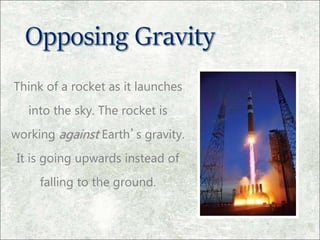
Think of a rocket as it launches
into the sky. The rocket is
working against Earth’s gravity.
It is going upwards instead of
falling to the ground.
What are some other real-world
examples of gravity being opposed?
What have you experienced?
 An object must travel 7 miles a second to escape
Earth’s gravitational pull.
 Although gravity is a force, it always pulls;
gravity will never push.
 Gravity keeps the Moon around the Earth, and
the Earth around the Sun. This is because each
has its own gravitational force pulling one
another.

15801257.ppt

  • 2.
    •A FORCE isa push or a pull. •GRAVITY is a force that pulls objects toward one another. It pulls objects towards Earth. •Try jumping in the air. What happens? Gravity pulls you back to Earth.
  • 3.
    This boy isgoing down a slide. GRAVITY is pulling him towards Earth. The slide keeps him from falling straight down.
  • 4.
    This penguin isjumping off of a cliff. It doesn’t float up, and it does not stay in the air. GRAVITY is pulling the penguin down into the water.
  • 5.
    What are someother real-world examples of gravity in action? What have you experienced?
  • 6.
    Weight Weight is themeasure of the gravitational force on an object. • weight is a force measured in newtons (N) Changes depending on the acceleration due to gravity acting on the object. You weigh less on the Moon because there is less gravity.
  • 7.
    Weight Formula Units: W= weight in newtons (N) m = mass in kilograms (kg) g = acceleration due to gravity (m/s2) weight (w) = mass (m) X gravity (g)
  • 8.
    Acceleration Due toGravity (g) An object falling (on Earth) has an acceleration due to gravity (g) of 9.8 m/s2. All objects near the surface of the Earth fall with the same rate of acceleration https://www.youtube.com/watch?v=E43-CfukEgs
  • 9.
    Air Resistance •Type offluid friction (doesn’t have to be liquid, can be air) •Causes things to reach a terminal velocity – when the force of the air resistance and the weight of an object are equal and balanced forces, so things are not accelerating, but moving at a constant velocity toward the ground.
  • 10.
    Air Resistance (cont.) •heavyobjects have a higher terminal velocity than lighter objects •Things that have a bigger surface area will have a lower terminal velocity that things with a smaller surface area.
  • 11.
    You know thatgravity is a force. Other forces can oppose, or act against, gravity. Think of catching a ball. Your hand stops the ball from falling to the ground. This means gravity has been opposed.
  • 12.
    Think of arocket as it launches into the sky. The rocket is working against Earth’s gravity. It is going upwards instead of falling to the ground.
  • 13.
    What are someother real-world examples of gravity being opposed? What have you experienced?
  • 14.
     An objectmust travel 7 miles a second to escape Earth’s gravitational pull.  Although gravity is a force, it always pulls; gravity will never push.  Gravity keeps the Moon around the Earth, and the Earth around the Sun. This is because each has its own gravitational force pulling one another.