Sarah Bramall
3rd Grade
Gravity
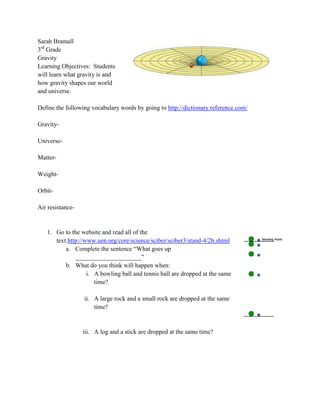
Learning Objectives: Students
will learn what gravity is and
how gravity shapes our world
and universe.

Define the following vocabulary words by going to http://dictionary.reference.com/

Gravity-

Universe-

Matter-

Weight-

Orbit-

Air resistance-


   1. Go to the website and read all of the
      text.http://www.uen.org/core/science/sciber/sciber3/stand-4/2b.shtml
          a. Complete the sentence “What goes up
              _____________________”
          b. What do you think will happen when:
                   i. A bowling ball and tennis ball are dropped at the same
                      time?

                  ii. A large rock and a small rock are dropped at the same
                      time?


                  iii. A log and a stick are dropped at the same time?
2. Go to the website and read the passages. The website will ask you to predict what you
   think will happen in certain situations. Click on the picture you think represents the right
   answer. http://www.uen.org/core/science/sciber/sciber3/stand-4/2a.shtml#Coaster#4
       a. What did you learn from this page that you didn’t know before?


3. http://idahoptv.org/dialogue4kids/season12/gravity/facts.cfmScroll down to the second
   green box titled “Mass or Weight”
       a. Define weight in your own words:


       b. Define mass in your own words:


4. On the same website, scroll down to the green box titled “Falling Objects” (Note: on this
   page if you hover your mouse over the bold and underlined words, a definition will pop
   up.)
       a. Who was Galileo Galilei?


       b. What is wind resistance?


       c. Now after you have read this bit about wind resistance, would you change your
          answers for question #1a 1, 2, and 3? If so, what would you change the answers
          to?


5. Still on the same site, scroll down to the green box titled “Centripetal and Centrifugal
   Force”
       a. What does centripetal mean in the Latin language?


       b. What does centrifugal mean in the Latin language?
6. Go to the website and scroll down to the middle of the page where it says “They Always
   Ask About Feathers”http://www.physics4kids.com/files/motion_gravity.html
      a. What would happen if a feather and a ball were dropped in a vacuum?


                  7. Go to the website and begin reading on the bullet point
             listhttp://www.sciencekids.co.nz/sciencefacts/scientists/isaacnewton.html
                         a. Where was Isaac Newton born?


                        b. What did you think was interesting about Newton?


8. Go to the website and read the passages and answer these questions from the
   passages:http://www.uen.org/core/science/sciber/sciber3/stand-4/2c.shtml#hint
      a. What things do you do on the playground where gravity helps you move?


       b. What things do you do on the playground where gravity slows you down? (Hint:
          look at the pictures)


9. Answer the three questions on the bottom of the same page by clicking on the answer you
   think is correct.
       a. What other questions can you come up with about gravity and forces?


10. Go to the website and begin reading at the second paragraph answer the
    following:http://scienceforkids.kidipede.com/physics/space/gravity.htm
        a. What do you think keeps the planets in orbit around the stars?
11. On the same website, read the paragraph that begins with “On Earth”
       a. What are two things does gravity does on Earth?


12. http://www.exploratorium.edu/ronh/weight/
        a. Go to the website and enter your weight in pounds:
               i. What is your weight on Earth?

               ii. What is your weight on the Moon?

              iii. What is your weight on Jupiter?

              iv. What is your weight on the Sun?


       b. If you weighed less on the Moon than you did on the Earth, does that mean there
          is more or less gravity on the Moon? Why?


13. Click on the link. Make sure that your sound is muted or that it is very
    soft:http://www.primarygames.com/arcade/skill/gravity/
        a. The object of this game is to get the alien onto the little platform. Use what you
            know about gravity and its power to draw objects with smaller mass toward
            objects with greater mass.

       b. What surprised you about this game?


14. Click on the link. Make sure that your sound is muted or that it is very
    soft:http://sciencenetlinks.com/media/filer/2011/10/13/gravity_launch26.swf
        a. The object of this game is to change the thrust bar (which controls how much
            power the spaceship has) and the angle (which controls the angle at which the
            rocket is placed) to get the ship on the moon.

       b. What did you notice about the relationship between the thrust and the angle? For
          example, if the moon was far away, would you use more thrust or make the angle
          greater?
Answer Key:
1.       a. “Must come down”
         b. Answers vary
2.       a. Answers vary
3.       a. Result of gravity pulling on mass
         b. The stuff matter is made of
4.       a. Italian scientist who lived in the late 16th and the early 17th century.
         b. The drag or push of air against a moving object.
         c. Answers vary
5.       a. Towards the center
         b. Fleeing from the center.
6.       a. They would fall at the same time
7.       a. England
         b. Answers vary
8.       a. Answers vary
         b. Answers vary
9.       a. Answers vary
10.      a. Gravity
11.      a. On Earth, gravity keeps the air around us (and everything else) from drifting off into
space. Gravity also causes things to fall to the ground, and causes the ocean's tides, and causes
hot air to rise while colder air falls (which in turn causes wind).
12.      a. Answers vary
         b. Less
13.      a. Game
         b. Answers vary but may include something about the relationship of how the ship moved
when the arrow keys were pressed.
14.      a. Game
         b. Answers vary but may include something about the trust and the angle having to be
figured out. Also, if there was an object of greater mass in the way then the ship would go
toward that object.

Webquest

  • 1.
    Sarah Bramall 3rd Grade Gravity LearningObjectives: Students will learn what gravity is and how gravity shapes our world and universe. Define the following vocabulary words by going to http://dictionary.reference.com/ Gravity- Universe- Matter- Weight- Orbit- Air resistance- 1. Go to the website and read all of the text.http://www.uen.org/core/science/sciber/sciber3/stand-4/2b.shtml a. Complete the sentence “What goes up _____________________” b. What do you think will happen when: i. A bowling ball and tennis ball are dropped at the same time? ii. A large rock and a small rock are dropped at the same time? iii. A log and a stick are dropped at the same time?
  • 2.
    2. Go tothe website and read the passages. The website will ask you to predict what you think will happen in certain situations. Click on the picture you think represents the right answer. http://www.uen.org/core/science/sciber/sciber3/stand-4/2a.shtml#Coaster#4 a. What did you learn from this page that you didn’t know before? 3. http://idahoptv.org/dialogue4kids/season12/gravity/facts.cfmScroll down to the second green box titled “Mass or Weight” a. Define weight in your own words: b. Define mass in your own words: 4. On the same website, scroll down to the green box titled “Falling Objects” (Note: on this page if you hover your mouse over the bold and underlined words, a definition will pop up.) a. Who was Galileo Galilei? b. What is wind resistance? c. Now after you have read this bit about wind resistance, would you change your answers for question #1a 1, 2, and 3? If so, what would you change the answers to? 5. Still on the same site, scroll down to the green box titled “Centripetal and Centrifugal Force” a. What does centripetal mean in the Latin language? b. What does centrifugal mean in the Latin language?
  • 3.
    6. Go tothe website and scroll down to the middle of the page where it says “They Always Ask About Feathers”http://www.physics4kids.com/files/motion_gravity.html a. What would happen if a feather and a ball were dropped in a vacuum? 7. Go to the website and begin reading on the bullet point listhttp://www.sciencekids.co.nz/sciencefacts/scientists/isaacnewton.html a. Where was Isaac Newton born? b. What did you think was interesting about Newton? 8. Go to the website and read the passages and answer these questions from the passages:http://www.uen.org/core/science/sciber/sciber3/stand-4/2c.shtml#hint a. What things do you do on the playground where gravity helps you move? b. What things do you do on the playground where gravity slows you down? (Hint: look at the pictures) 9. Answer the three questions on the bottom of the same page by clicking on the answer you think is correct. a. What other questions can you come up with about gravity and forces? 10. Go to the website and begin reading at the second paragraph answer the following:http://scienceforkids.kidipede.com/physics/space/gravity.htm a. What do you think keeps the planets in orbit around the stars?
  • 4.
    11. On thesame website, read the paragraph that begins with “On Earth” a. What are two things does gravity does on Earth? 12. http://www.exploratorium.edu/ronh/weight/ a. Go to the website and enter your weight in pounds: i. What is your weight on Earth? ii. What is your weight on the Moon? iii. What is your weight on Jupiter? iv. What is your weight on the Sun? b. If you weighed less on the Moon than you did on the Earth, does that mean there is more or less gravity on the Moon? Why? 13. Click on the link. Make sure that your sound is muted or that it is very soft:http://www.primarygames.com/arcade/skill/gravity/ a. The object of this game is to get the alien onto the little platform. Use what you know about gravity and its power to draw objects with smaller mass toward objects with greater mass. b. What surprised you about this game? 14. Click on the link. Make sure that your sound is muted or that it is very soft:http://sciencenetlinks.com/media/filer/2011/10/13/gravity_launch26.swf a. The object of this game is to change the thrust bar (which controls how much power the spaceship has) and the angle (which controls the angle at which the rocket is placed) to get the ship on the moon. b. What did you notice about the relationship between the thrust and the angle? For example, if the moon was far away, would you use more thrust or make the angle greater?
  • 5.
    Answer Key: 1. a. “Must come down” b. Answers vary 2. a. Answers vary 3. a. Result of gravity pulling on mass b. The stuff matter is made of 4. a. Italian scientist who lived in the late 16th and the early 17th century. b. The drag or push of air against a moving object. c. Answers vary 5. a. Towards the center b. Fleeing from the center. 6. a. They would fall at the same time 7. a. England b. Answers vary 8. a. Answers vary b. Answers vary 9. a. Answers vary 10. a. Gravity 11. a. On Earth, gravity keeps the air around us (and everything else) from drifting off into space. Gravity also causes things to fall to the ground, and causes the ocean's tides, and causes hot air to rise while colder air falls (which in turn causes wind). 12. a. Answers vary b. Less 13. a. Game b. Answers vary but may include something about the relationship of how the ship moved when the arrow keys were pressed. 14. a. Game b. Answers vary but may include something about the trust and the angle having to be figured out. Also, if there was an object of greater mass in the way then the ship would go toward that object.