Chemistry and Materials Research www.iiste.org 
ISSN 2224- 3224 (Print) ISSN 2225- 0956 (Online) 
Vol.6 No.8, 2014 
Quantum Mechanical Study the Kinetics, Mechanisms and 
Thermodynamics of the Gas-Phase Pyrolysis of Isopropyl 
Bromide 
ADEBOYE, OMOLARA OLUBUNMI 
Email: moadeb5848@yahoo.com 
ABSTRACT 
Computational studies of the kinetics, mechanisms and thermodynamics of the gas-phase pyrolysis of isopropyl 
bromide at 623K was studied using PM3 in the semi-empirical and DFT with B3LYP at 6-31G* level methods 
of calculation. The reaction proved to be a unimolecular reaction and followed a first order rate equation. The 
calculation showed that the pyrolysis of isopropyl bromide proceeds through a four-membered cyclic transition 
state which involved a C8-H11 and C4-Br6 bond breaking and H11-Br6 bond making. The Arrhenius parameters, 
log A (13.6 and 13.8) obtained for both methods are in good agreement with experimental result (13.6). 
Keywords: semi-empirical, isopropyl bromide, gas-phase, kinetics. 
Introduction 
The presence of C – H on the alkyl side of an organic halide such as hydrogen bromide, chloride and iodide 
gives gas–phase elimination through a four–centered cyclic transition state mechanism. Gas–phase unimolecular 
reactions appeared to take place through a 4-centered and 6-centered cyclic activated complex ((O’Neal and 
Benson, 1967). Hydrogen halide elimination from the alkyl halides to produce olefins is usually four centered 
reactions. This reaction involves Markovnikov’s addition reaction which goes through a four - centered 
transition states. The main aim of this study is to use semi-empirical and density functional computational 
approach in SPARTAN to predict the kinetics, thermodynamics and the mechanism of the thermal 
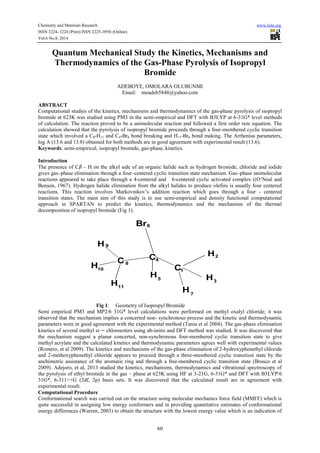
decomposition of isopropyl bromide (Fig 1). 
60 
C C 
C 
H 
H 
H 
H 
H 
H 
H 
Br 
11 
8 
10 
9 
4 
5 
6 
1 
7 
2 
3 
Fig 1: Geometry of Isopropyl Bromide 
Semi empirical PM3 and MP2/6 31G* level calculations were performed on methyl oxalyl chloride; it was 
observed that the mechanism implies a concerted non- synchronous process and the kinetic and thermodynamic 
parameters were in good agreement with the experimental method (Tania et al 2004). The gas-phase elimination 
kinetics of several methyl chloroesters using ab-initio and DFT method was studied. It was discovered that 
the mechanism suggest a planar concerted, non-synchronous four-membered cyclic transition state to give 
methyl acrylate and the calculated kinetics and thermodynamic parameters agrees well with experimental values 
(Romero, et al 2009). The kinetics and mechanisms of the gas-phase elimination of 2-hydroxyphenethyl chloride 
and 2-methoxyphenethyl chloride appears to proceed through a three-membered cyclic transition state by the 
anchimetric assistance of the aromatic ring and through a free-membered cyclic transition state (Brusco et al 
2009). Adejoro, et al, 2013 studied the kinetics, mechanisms, thermodynamics and vibrational spectroscopy of 
the pyrolysis of ethyl bromide in the gas – phase at 623K using HF at 3-21G, 6-31G* and DFT with B3LYP/6 
31G*, 6-311++G (2df, 2p) basis sets. It was discovered that the calculated result are in agreement with 
experimental result. 
Computational Procedure 
Conformational search was carried out on the structure using molecular mechanics force field (MMFF) which is 
quite successful in assigning low energy conformers and in providing quantitative estimates of conformational 
energy differences (Warren, 2003) to obtain the structure with the lowest energy value which is an indication of
Chemistry and Materials Research www.iiste.org 
ISSN 2224- 3224 (Print) ISSN 2225- 0956 (Online) 
Vol.6 No.8, 2014 
the stability of the molecule. Geometry optimization was performed on the ground state (GS), the transition state 
(TS) and the products to obtain the geometric parameters such as bond length, bond angle, dihedral, bond order 
and atomic charges, the data obtained were used to calculate the other thermodynamics parameters. H11 is the 
hydrogen atom to be eliminated. 
Reaction path calculations were performed on the optimized geometry of the isopropyl bromide under study 
using as the reaction coordinate. The internal coordinate was varied from its initial distance of 
3.765 in the stable reactants form to its value 1.20 in the product molecule. This inter atomic distance is 
slowly altered throughout the reaction path calculation taking the value from 3.765 (initial value) to 1.20 
Angstroms its approximate value in the stable product molecule in 20 steps. 
Using the guess-transition state in Spartan on the suggested mechanism of the transition state structure was 
optimized and was subjected to the two tests needs to be performed in order to verify that a practical geometry 
corresponds to a saddle point (transition structure) and that this saddle point corresponds to the reactants and 
products. The tests are: 
That the Hessian matrix of second – energy derivations with respect to coordinates yields one and only one 
imaginary frequency which will be in the range of 400-2000 c and the normal coordinates corresponds to the 
imaginary frequency smoothly corrects reactants and products. This could be achieved by animating the normal 
coordinate. The intrinsic reaction coordinates method was also used by optimizing the molecule subject to a 
fixed position along the reaction coordinate (Warren, 2003). The transition state was confirmed using the IRC 
method. Two IRC calculations were performed. The first one a positive perturbation was done by an initial 
perturbation on the atomic coordinates in the direction of the single negative frequency while the other one a 
negative perturbation performed along the same normal coordinates. 
Thermodynamic calculations were obtained for isopropyl bromide through calculation on the ground state GS, 
Transition TS and the product. The statistical mechanically calculated enthalpy and entropy were used which is 
not the true representative of the total energy of the molecule, knowing that the large portion of the enthalpy in a 
molecule is contained in its bonds and physical conformation hence the sum of the ground state energy (GSE) 
and the statistical mechanically calculated enthalpy are used to arrive at a closer approximation of the true 
energy of the molecule. With the said modified version of the heat of reaction the equation is given as shown 
below (Spartan Guide to calculations). The enthalpy of a species will be defined as: 
Where the superscript ‘sm’ is the statistical mechanically calculated enthalpy. Substitute this into the initial 
definition of the heat of reaction we have: 
The enthalpy of reaction was calculated at 623K. 
Activation energy (Ea) was calculated according to the transition state theory for a unimolecular reaction at 
623K. 
The entropy of the reaction was calculated by taking the difference of product and reactant entropies that is 
The Gibbs free energy was calculated using the modified version of the heat of reaction equation. Knowing that 
The first order coefficient k (T) was calculated using transition State theory (TST) Benson, 1960 assuming that 
the transition coefficient is unity as shown in the following equation 
Where is the Gibbs free energy change between the reactant and the transition state and and h are the 
Boltzmann and Planck’s constants respectively. 
Arrhenius rate equation is given as 
61 
[Benson, 1960] 
RESULT AND DISCUSSION 
Geometry Optimization 
Isopropyl bromide has only one conformer and the energy is 2.708kJmol-1. Geometry optimization was 
performed on the ground state (GS), the transition state (TS) and the products to obtain the geometric parameters 
such as bond length, bond angle, dihedral, bond order and atomic charges, the data obtained were used to 
calculate the other thermodynamics parameters. H11 is the hydrogen atom to be eliminated. Bond length and 
atomic charges are shown in Tables 1 and 2.
Chemistry and Materials Research www.iiste.org 
ISSN 2224- 3224 (Print) ISSN 2225- 0956 (Online) 
Vol.6 No.8, 2014 
Reaction Path Studies 
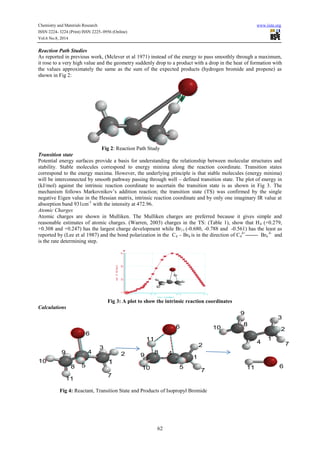
As reported in previous work, (Mclever et al 1971) instead of the energy to pass smoothly through a maximum, 
it rose to a very high value and the geometry suddenly drop to a product with a drop in the heat of formation with 
the values approximately the same as the sum of the expected products (hydrogen bromide and propene) as 
shown in Fig 2: 
Fig 2: Reaction Path Study 
Transition state 
Potential energy surfaces provide a basis for understanding the relationship between molecular structures and 
stability. Stable molecules correspond to energy minima along the reaction coordinate. Transition states 
correspond to the energy maxima. However, the underlying principle is that stable molecules (energy minima) 
will be interconnected by smooth pathway passing through well – defined transition state. The plot of energy in 
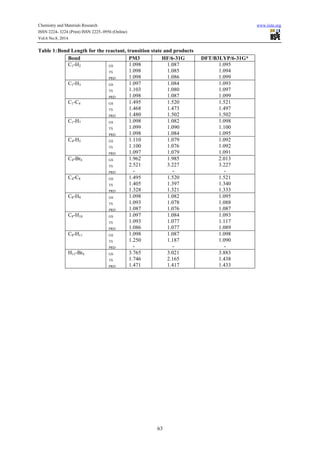
(kJ/mol) against the intrinsic reaction coordinate to ascertain the transition state is as shown in Fig 3. The 
mechanism follows Markovnikov’s addition reaction; the transition state (TS) was confirmed by the single 
negative Eigen value in the Hessian matrix, intrinsic reaction coordinate and by only one imaginary IR value at 
absorption band 931cm-1 with the intensity at 472.96. 
Atomic Charges 
Atomic charges are shown in Mulliken. The Mulliken charges are preferred because it gives simple and 
reasonable estimates of atomic charges. (Warren, 2003) charges in the TS: (Table 1), show that H4 (+0.279, 
+0.308 and +0.247) has the largest charge development while Br11 (-0.680, -0.788 and -0.561) has the least as 
reported by (Lee et al 1987) and the bond polarization in the C4 – Br6 is in the direction of C4 
62 
δ+------- Br6 
δ- and 
is the rate determining step. 
Fig 3: A plot to show the intrinsic reaction coordinates 
Calculations 
2 
7 
3 
4 
5 
6 
8 
9 
10 
11 
11 
1 
2 
7 
5 
8 4 
9 
9 
8 
4 
10 
1 
3 
10 11 6 
7 
2 
1 
6 
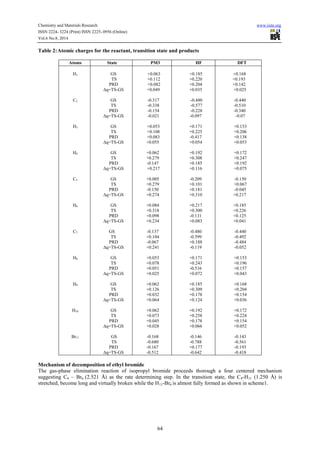
Fig 4: Reactant, Transition State and Products of Isopropyl Bromide
Chemistry and Materials Research www.iiste.org 
ISSN 2224- 3224 (Print) ISSN 2225- 0956 (Online) 
Vol.6 No.8, 2014 
Table 1: Bond Length for the reactant, transition state and products 
Bond PM3 HF/6-31G DFT/B3LYP/6-31G* 
C1-H2 GS 
63 
TS 
PRD 
1.098 
1.098 
1.098 
1.087 
1.085 
1.086 
1.095 
1.094 
1.099 
C1-H3 
GS 
TS 
PRD 
1.097 
1.103 
1.098 
1.084 
1.080 
1.087 
1.093 
1.097 
1.099 
C1-C4 
GS 
TS 
PRD 
1.495 
1.468 
1.480 
1.520 
1.473 
1.502 
1.521 
1.497 
1.502 
C1-H7 
GS 
TS 
PRD 
1.098 
1.099 
1.098 
1.082 
1.090 
1.084 
1.098 
1.100 
1.095 
C4-H5 
GS 
TS 
PRD 
1.110 
1.100 
1.097 
1.079 
1.076 
1.079 
1.092 
1.092 
1.091 
C4-Br6 
GS 
TS 
PRD 
1.962 
2.521 
- 
1.985 
3.227 
- 
2.013 
3.227 
- 
C4-C8 
GS 
TS 
PRD 
1.495 
1.405 
1.328 
1.520 
1.397 
1.321 
1.521 
1.340 
1.333 
C8-H9 GS 
TS 
PRD 
1.098 
1.093 
1.087 
1.082 
1.078 
1.076 
1.095 
1.088 
1.087 
C8-H10 
GS 
TS 
PRD 
1.097 
1.093 
1.086 
1.084 
1.077 
1.077 
1.093 
1.117 
1.089 
C8-H11 
GS 
TS 
PRD 
1.098 
1.250 
- 
1.087 
1.187 
- 
1.098 
1.090 
- 
H11-Br6 
GS 
TS 
PRD 
3.765 
1.746 
1.471 
3.021 
2.165 
1.417 
3.883 
1.438 
1.433
Chemistry and Materials Research www.iiste.org 
ISSN 2224- 3224 (Print) ISSN 2225- 0956 (Online) 
Vol.6 No.8, 2014 
Table 2: Atomic charges for the reactant, transition state and products 
Atoms State PM3 HF DFT 
64 
H1 
C2 
H3 
H4 
C5 
H6 
C7 
H8 
H9 
H10 
Br11 
GS 
TS 
PRD 
Δq=TS-GS 
GS 
TS 
PRD 
Δq=TS-GS 
GS 
TS 
PRD 
Δq=TS-GS 
GS 
TS 
PRD 
Δq=TS-GS 
GS 
TS 
PRD 
Δq=TS-GS 
GS 
TS 
PRD 
Δq=TS-GS 
GS 
TS 
PRD 
Δq=TS-GS 
GS 
TS 
PRD 
Δq=TS-GS 
GS 
TS 
PRD 
Δq=TS-GS 
GS 
TS 
PRD 
Δq=TS-GS 
GS 
TS 
PRD 
Δq=TS-GS 
+0.063 
+0.112 
+0.082 
+0.049 
-0.317 
-0.338 
-0.154 
-0.021 
+0.053 
+0.108 
+0.083 
+0.055 
+0.062 
+0.279 
-0.147 
+0.217 
+0.005 
+0.279 
-0.150 
+0.274 
+0.084 
+0.318 
+0.098 
+0.234 
-0.137 
+0.104 
-0.067 
+0.241 
+0.053 
+0.078 
+0.051 
+0.025 
+0.062 
+0.126 
+0.032 
+0.064 
+0.062 
+0.073 
+0.045 
+0.028 
-0.168 
-0.680 
-0.167 
-0.512 
+0.185 
+0.220 
+0.204 
+0.035 
-0.480 
-0.577 
-0.228 
-0.097 
+0.171 
+0.225 
-0.417 
+0.054 
+0.192 
+0.308 
+0.185 
+0.116 
-0.209 
+0.101 
+0.181 
+0.310 
+0.217 
+0.300 
-0.131 
+0.083 
-0.480 
-0.599 
+0.188 
-0.119 
+0.171 
+0.243 
-0.516 
+0.072 
+0.185 
+0.309 
+0.178 
+0.124 
+0.192 
+0.258 
+0.178 
+0.066 
-0.146 
-0.788 
+0.177 
-0.642 
+0.168 
+0.193 
+0.142 
+0.025 
-0.440 
-0.510 
-0.340 
-0.07 
+0.153 
+0.206 
+0.138 
+0.053 
+0.172 
+0.247 
+0.192 
+0.075 
-0.150 
+0.067 
-0.045 
+0.217 
+0.185 
+0.226 
+0.125 
+0.041 
-0.440 
-0.492 
-0.484 
-0.052 
+0.153 
+0.196 
+0.157 
+0.043 
+0.168 
+0.204 
+0.154 
+0.036 
+0.172 
+0.224 
+0.154 
+0.052 
-0.143 
-0.561 
-0.193 
-0.418 
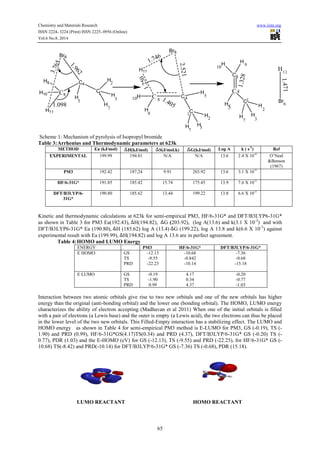
Mechanism of decomposition of ethyl bromide 
The gas-phase elimination reaction of isopropyl bromide proceeds thorough a four centered mechanism 
suggesting C4 – Br6 (2.521 Å) as the rate determining step. In the transition state, the C8-H11 (1.250 Å) is 
stretched, become long and virtually broken while the H11-Br6 is almost fully formed as shown in scheme1.
Chemistry and Materials Research www.iiste.org 
ISSN 2224- 3224 (Print) ISSN 2225- 0956 (Online) 
Vol.6 No.8, 2014 
65 
C8 
C4 
C 
H 
2 
H 
H 
H 
H9 
H10 
H11 
Br6 
C C 
C 
Br6 
H11 
H 
H 
H 
H H 
H 
H H 
C 
C 
C 
H H 
H H 
H 
1 
3 
11 
5 Br 
7 
8 4 
9 
10 
1 
7 
3 
2 
5 
8 
4 
5 
1 
7 3 
2 
9 
10 
6 
3.765 
1.250 
1.098 
1.746 
1.962 
2.521 
1.328 
1.471 
1.405 
Scheme 1: Mechanism of pyrolysis of Isopropyl bromide 
Table 3: Arrhenius and Thermodynamic parameters at 623k 
METHOD Ea (kJ/mol) H(kJ/mol) S(J/mol.k) G(kJ/mol) Log A k ( s-1) Ref 
EXPERIMENTAL 199.99 194.81 N/A N/A 13.6 2.4 X 10⁻⁴ O’Neal 
&Benson 
(1967) 
PM3 
192.42 
187.24 
9.91 
203.92 
13.6 
3.1 X 10⁻³ 
HF/6-31G* 191.85 185.42 15.74 175.45 13.9 7.6 X 10⁻³ 
DFT/B3LYP/6- 
31G* 
190.80 
185.62 13.44 
199.22 
13.8 
6.6 X 10⁻³ 
Kinetic and thermodynamic calculations at 623k for semi-empirical PM3, HF/6-31G* and DFT/B3LYP6-31G* 
as shown in Table 3 for PM3 Ea(192.43), H(194.82), G (203.92), (log A(13.6) and k(3.1 X 10⁻³) and with 
DFT/B3LYP6-31G* Ea (190.80), H (185.62) log A (13.4) G (199.22), log A 13.8 and k(6.6 X 10⁻³) against 
experimental result with Ea (199.99), H(194.82) and log A 13.6 are in perfect agreement. 
Table 4: HOMO and LUMO Energy 
ENERGY PM3 HF/6-31G* DFT/B3LYP/6-31G* 
E HOMO GS 
TS 
PRD 
-12.13 
-9.55 
-22.23 
-10.68 
-0.842 
-10.14 
-7.36 
-0.68 
-15.18 
E LUMO GS 
TS 
PRD 
-0.19 
-1.90 
0.99 
4.17 
0.34 
4.37 
-0.20 
-0.77 
-1.03 
Interaction between two atomic orbitals give rise to two new orbitals and one of the new orbitals has higher 
energy than the original (anti-bonding orbital) and the lower one (bonding orbital). The HOMO, LUMO energy 
characterizes the ability of electron accepting (Madhavan et al 2011) When one of the initial orbitals is filled 
with a pair of electrons (a Lewis base) and the outer is empty (a Lewis acid), the two electrons can thus be placed 
in the lower level of the two new orbitals. This Filled-Empty interaction has a stabilizing effect. The LUMO and 
HOMO energy as shown in Table 4 for semi-empirical PM3 method is E-LUMO for PM3, GS (-0.19), TS (- 
1.90) and PRD (0.99), HF/6-31G*GS(4.17)TS(0.34) and PRD (4.37), DFT/B3LYP/6-31G* GS (-0.20) TS (- 
0.77), PDR (1.03) and the E-HOMO (eV) for GS (-12.13), TS (-9.55) and PRD (-22.25), for HF/6-31G* GS (- 
10.68) TS(-8.42) and PRD(-10.14) for DFT/B3LYP/6-31G* GS (-7.36) TS (-0.68), PDR (15.18). 
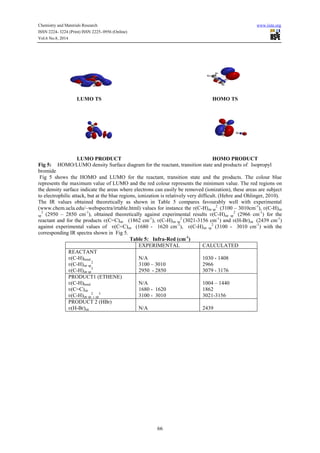
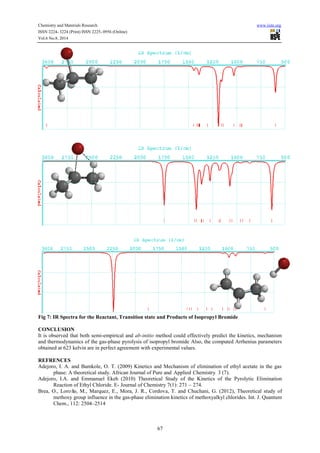
LUMO REACTANT HOMO REACTANT
Chemistry and Materials Research www.iiste.org 
ISSN 2224- 3224 (Print) ISSN 2225- 0956 (Online) 
Vol.6 No.8, 2014 
LUMO TS HOMO TS 
LUMO PRODUCT HOMO PRODUCT 
Fig 5: HOMO/LUMO density Surface diagram for the reactant, transition state and products of Isopropyl 
bromide 
Fig 5 shows the HOMO and LUMO for the reactant, transition state and the products. The colour blue 
represents the maximum value of LUMO and the red colour represents the minimum value. The red regions on 
the density surface indicate the areas where electrons can easily be removed (ionization), these areas are subject 
to electrophilic attack, but at the blue regions, ionization is relatively very difficult. (Hehre and Ohlinger, 2010). 
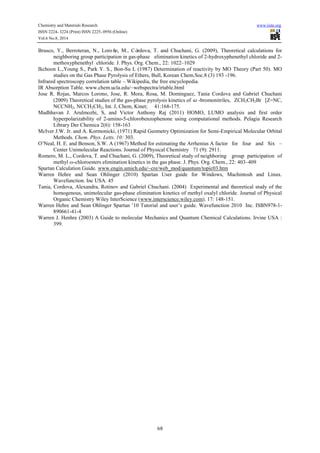
The IR values obtained theoretically as shown in Table 5 compares favourably well with experimental 
(www.chem.ucla.edu/~webspectra/irtable.html) values for instance the ʋ(C-H)str sp 
3 (2950 – 2850 cm-1), obtained theoretically against experimental results ʋ(C-H)str sp 
66 
2 (3100 – 3010cm-1), ʋ(C-H)str 
sp 
2 (2966 cm-1) for the 
reactant and for the products ʋ(C=C)str (1862 cm-1), ʋ(C-H)str sp 
2 
(3021-3156 cm-1) and ʋ(H-Br)str (2439 cm-1) 
against experimental values of ʋ(C=C)str (1680 - 1620 cm-1), ʋ(C-H)str sp 
2 
(3100 - 3010 cm-1) with the 
corresponding IR spectra shown in Fig 5. 
Table 5: Infra-Red (cm-1) 
EXPERIMENTAL CALCULATED 
REACTANT 
ʋ(C-H)bend 
ʋ(C-H)2 
str sp 
ʋ(C-H)str sp 
3 
N/A 
3100 – 3010 
2950 - 2850 
1030 - 1408 
2966 
3079 - 3176 
PRODUCT1 (ETHENE) 
ʋ(C-H)bend 
ʋ(C=C)str 
ʋ(C-H)2, 3 
str sp 
sp 
N/A 
1680 - 1620 
3100 - 3010 
1004 – 1440 
1862 
3021-3156 
PRODUCT 2 (HBr) 
ʋ(H-Br)str 
N/A 
2439
Chemistry and Materials Research www.iiste.org 
ISSN 2224- 3224 (Print) ISSN 2225- 0956 (Online) 
Vol.6 No.8, 2014 
Fig 7: IR Spectra for the Reactant, Transition state and Products of Isopropyl Bromide 
CONCLUSION 
It is observed that both semi-empirical and ab-initio method could effectively predict the kinetics, mechanism 
and thermodynamics of the gas-phase pyrolysis of isopropyl bromide Also, the computed Arrhenius parameters 
obtained at 623 kelvin are in perfect agreement with experimental values. 
REFRENCES 
Adejoro, I. A. and Bamkole, O. T. (2009) Kinetics and Mechanism of elimination of ethyl acetate in the gas 
phase: A theoretical study. African Journal of Pure and Applied Chemistry. 3 (7). 
Adejoro, I.A. and Emmanuel Ekeh (2010) Theoretical Study of the Kinetics of the Pyrolytic Elimination 
Reaction of Ethyl Chloride. E- Journal of Chemistry 7(1): 271 – 274. 
Brea, O., Loroño, M., Marquez, E., Mora, J. R., Cordova, T. and Chuchani, G. (2012), Theoretical study of 
methoxy group influence in the gas-phase elimination kinetics of methoxyalkyl chlorides. Int. J. Quantum 
Chem., 112: 2504–2514 
67
Chemistry and Materials Research www.iiste.org 
ISSN 2224- 3224 (Print) ISSN 2225- 0956 (Online) 
Vol.6 No.8, 2014 
Brusco, Y., Berroteran, N., Loroño, M., Córdova, T. and Chuchani, G. (2009), Theoretical calculations for 
neighboring group participation in gas-phase elimination kinetics of 2-hydroxyphenethyl chloride and 2- 
methoxyphenethyl chloride. J. Phys. Org. Chem., 22: 1022–1029 
Ikchoon L.,Young S., Park Y. S., Bon-Su L (1987) Determination of reactivity by MO Theory (Part 50). MO 
studies on the Gas Phase Pyrolysis of Ethers, Bull, Korean Chem.Soc.8 (3) 193 -196. 
Infrared spectroscopy correlation table – Wikipedia, the free encyclopedia. 
IR Absorption Table. www.chem.ucla.edu/~webspectra/irtable.html 
Jose R. Rojas, Marcos Lorono, Jose, R. Mora, Rosa, M. Dominguez, Tania Cordova and Gabriel Chuchani 
(2009) Theoretical studies of the gas-phase pyrolysis kinetics of -bromonitriles, ZCH2CH2Br [Z=NC, 
NCCNH2, NCCH2CH2, Int. J, Chem, Kinet; 41:168-175. 
Madhhavan J. Arulmozhi, S, and Victor Anthony Raj (2011) HOMO, LUMO analysis and first order 
hyperpolarizability of 2-amino-5-chlorobenzophenone using computational methods. Pelagia Research 
Library Der Chemica 2(6): 158-163 
McIver J.W. Jr. and A. Kormonicki, (1971) Rapid Geometry Optimization for Semi-Empirical Molecular Orbital 
68 
Methods. Chem. Phys. Letts. 10: 303. 
O’Neal, H. E. and Benson, S.W. A (1967) Method for estimating the Arrhenius A factor for four and Six – 
Center Unimolecular Reactions. Journal of Physical Chemistry 71 (9): 2911. 
Romero, M. L., Cordova, T. and Chuchani, G. (2009), Theoretical study of neighboring group participation of 
methyl ω-chloroesters elimination kinetics in the gas phase. J. Phys. Org. Chem., 22: 403–409 
Spartan Calculation Guide. www.engin.umich.edu/~cre/web_mod/quantum/topic03.htm 
Warren Hehre and Sean Ohlinger (2010) Spartan User guide for Windows, Machintosh and Linux. 
Wavefunction. Inc USA. 45 
Tania, Cordova, Alexandra, Rotinov and Gabriel Chuchani. (2004) Experimental and theoretical study of the 
homogenous, unimolecular gas-phase elimination kinetics of methyl oxalyl chloride. Journal of Physical 
Organic Chemistry Wiley InterScience (www.interscience.wiley.com). 17: 148-151. 
Warren Hehre and Sean Ohlinger Spartan ’10 Tutorial and user’s guide. Wavefunction 2010 Inc. ISBN978-1- 
890661-41-4 
Warren J. Henhre (2003) A Guide to molecular Mechanics and Quantum Chemical Calculations. Irvine USA : 
399.
The IISTE is a pioneer in the Open-Access hosting service and academic event 
management. The aim of the firm is Accelerating Global Knowledge Sharing. 
More information about the firm can be found on the homepage: 
http://www.iiste.org 
CALL FOR JOURNAL PAPERS 
There are more than 30 peer-reviewed academic journals hosted under the hosting 
platform. 
Prospective authors of journals can find the submission instruction on the 
following page: http://www.iiste.org/journals/ All the journals articles are available 
online to the readers all over the world without financial, legal, or technical barriers 
other than those inseparable from gaining access to the internet itself. Paper version 
of the journals is also available upon request of readers and authors. 
MORE RESOURCES 
Book publication information: http://www.iiste.org/book/ 
IISTE Knowledge Sharing Partners 
EBSCO, Index Copernicus, Ulrich's Periodicals Directory, JournalTOCS, PKP Open 
Archives Harvester, Bielefeld Academic Search Engine, Elektronische 
Zeitschriftenbibliothek EZB, Open J-Gate, OCLC WorldCat, Universe Digtial 
Library , NewJour, Google Scholar

Quantum mechanical study the kinetics, mechanisms and

  • 1.
    Chemistry and MaterialsResearch www.iiste.org ISSN 2224- 3224 (Print) ISSN 2225- 0956 (Online) Vol.6 No.8, 2014 Quantum Mechanical Study the Kinetics, Mechanisms and Thermodynamics of the Gas-Phase Pyrolysis of Isopropyl Bromide ADEBOYE, OMOLARA OLUBUNMI Email: moadeb5848@yahoo.com ABSTRACT Computational studies of the kinetics, mechanisms and thermodynamics of the gas-phase pyrolysis of isopropyl bromide at 623K was studied using PM3 in the semi-empirical and DFT with B3LYP at 6-31G* level methods of calculation. The reaction proved to be a unimolecular reaction and followed a first order rate equation. The calculation showed that the pyrolysis of isopropyl bromide proceeds through a four-membered cyclic transition state which involved a C8-H11 and C4-Br6 bond breaking and H11-Br6 bond making. The Arrhenius parameters, log A (13.6 and 13.8) obtained for both methods are in good agreement with experimental result (13.6). Keywords: semi-empirical, isopropyl bromide, gas-phase, kinetics. Introduction The presence of C – H on the alkyl side of an organic halide such as hydrogen bromide, chloride and iodide gives gas–phase elimination through a four–centered cyclic transition state mechanism. Gas–phase unimolecular reactions appeared to take place through a 4-centered and 6-centered cyclic activated complex ((O’Neal and Benson, 1967). Hydrogen halide elimination from the alkyl halides to produce olefins is usually four centered reactions. This reaction involves Markovnikov’s addition reaction which goes through a four - centered transition states. The main aim of this study is to use semi-empirical and density functional computational approach in SPARTAN to predict the kinetics, thermodynamics and the mechanism of the thermal decomposition of isopropyl bromide (Fig 1). 60 C C C H H H H H H H Br 11 8 10 9 4 5 6 1 7 2 3 Fig 1: Geometry of Isopropyl Bromide Semi empirical PM3 and MP2/6 31G* level calculations were performed on methyl oxalyl chloride; it was observed that the mechanism implies a concerted non- synchronous process and the kinetic and thermodynamic parameters were in good agreement with the experimental method (Tania et al 2004). The gas-phase elimination kinetics of several methyl chloroesters using ab-initio and DFT method was studied. It was discovered that the mechanism suggest a planar concerted, non-synchronous four-membered cyclic transition state to give methyl acrylate and the calculated kinetics and thermodynamic parameters agrees well with experimental values (Romero, et al 2009). The kinetics and mechanisms of the gas-phase elimination of 2-hydroxyphenethyl chloride and 2-methoxyphenethyl chloride appears to proceed through a three-membered cyclic transition state by the anchimetric assistance of the aromatic ring and through a free-membered cyclic transition state (Brusco et al 2009). Adejoro, et al, 2013 studied the kinetics, mechanisms, thermodynamics and vibrational spectroscopy of the pyrolysis of ethyl bromide in the gas – phase at 623K using HF at 3-21G, 6-31G* and DFT with B3LYP/6 31G*, 6-311++G (2df, 2p) basis sets. It was discovered that the calculated result are in agreement with experimental result. Computational Procedure Conformational search was carried out on the structure using molecular mechanics force field (MMFF) which is quite successful in assigning low energy conformers and in providing quantitative estimates of conformational energy differences (Warren, 2003) to obtain the structure with the lowest energy value which is an indication of
  • 2.
    Chemistry and MaterialsResearch www.iiste.org ISSN 2224- 3224 (Print) ISSN 2225- 0956 (Online) Vol.6 No.8, 2014 the stability of the molecule. Geometry optimization was performed on the ground state (GS), the transition state (TS) and the products to obtain the geometric parameters such as bond length, bond angle, dihedral, bond order and atomic charges, the data obtained were used to calculate the other thermodynamics parameters. H11 is the hydrogen atom to be eliminated. Reaction path calculations were performed on the optimized geometry of the isopropyl bromide under study using as the reaction coordinate. The internal coordinate was varied from its initial distance of 3.765 in the stable reactants form to its value 1.20 in the product molecule. This inter atomic distance is slowly altered throughout the reaction path calculation taking the value from 3.765 (initial value) to 1.20 Angstroms its approximate value in the stable product molecule in 20 steps. Using the guess-transition state in Spartan on the suggested mechanism of the transition state structure was optimized and was subjected to the two tests needs to be performed in order to verify that a practical geometry corresponds to a saddle point (transition structure) and that this saddle point corresponds to the reactants and products. The tests are: That the Hessian matrix of second – energy derivations with respect to coordinates yields one and only one imaginary frequency which will be in the range of 400-2000 c and the normal coordinates corresponds to the imaginary frequency smoothly corrects reactants and products. This could be achieved by animating the normal coordinate. The intrinsic reaction coordinates method was also used by optimizing the molecule subject to a fixed position along the reaction coordinate (Warren, 2003). The transition state was confirmed using the IRC method. Two IRC calculations were performed. The first one a positive perturbation was done by an initial perturbation on the atomic coordinates in the direction of the single negative frequency while the other one a negative perturbation performed along the same normal coordinates. Thermodynamic calculations were obtained for isopropyl bromide through calculation on the ground state GS, Transition TS and the product. The statistical mechanically calculated enthalpy and entropy were used which is not the true representative of the total energy of the molecule, knowing that the large portion of the enthalpy in a molecule is contained in its bonds and physical conformation hence the sum of the ground state energy (GSE) and the statistical mechanically calculated enthalpy are used to arrive at a closer approximation of the true energy of the molecule. With the said modified version of the heat of reaction the equation is given as shown below (Spartan Guide to calculations). The enthalpy of a species will be defined as: Where the superscript ‘sm’ is the statistical mechanically calculated enthalpy. Substitute this into the initial definition of the heat of reaction we have: The enthalpy of reaction was calculated at 623K. Activation energy (Ea) was calculated according to the transition state theory for a unimolecular reaction at 623K. The entropy of the reaction was calculated by taking the difference of product and reactant entropies that is The Gibbs free energy was calculated using the modified version of the heat of reaction equation. Knowing that The first order coefficient k (T) was calculated using transition State theory (TST) Benson, 1960 assuming that the transition coefficient is unity as shown in the following equation Where is the Gibbs free energy change between the reactant and the transition state and and h are the Boltzmann and Planck’s constants respectively. Arrhenius rate equation is given as 61 [Benson, 1960] RESULT AND DISCUSSION Geometry Optimization Isopropyl bromide has only one conformer and the energy is 2.708kJmol-1. Geometry optimization was performed on the ground state (GS), the transition state (TS) and the products to obtain the geometric parameters such as bond length, bond angle, dihedral, bond order and atomic charges, the data obtained were used to calculate the other thermodynamics parameters. H11 is the hydrogen atom to be eliminated. Bond length and atomic charges are shown in Tables 1 and 2.
  • 3.
    Chemistry and MaterialsResearch www.iiste.org ISSN 2224- 3224 (Print) ISSN 2225- 0956 (Online) Vol.6 No.8, 2014 Reaction Path Studies As reported in previous work, (Mclever et al 1971) instead of the energy to pass smoothly through a maximum, it rose to a very high value and the geometry suddenly drop to a product with a drop in the heat of formation with the values approximately the same as the sum of the expected products (hydrogen bromide and propene) as shown in Fig 2: Fig 2: Reaction Path Study Transition state Potential energy surfaces provide a basis for understanding the relationship between molecular structures and stability. Stable molecules correspond to energy minima along the reaction coordinate. Transition states correspond to the energy maxima. However, the underlying principle is that stable molecules (energy minima) will be interconnected by smooth pathway passing through well – defined transition state. The plot of energy in (kJ/mol) against the intrinsic reaction coordinate to ascertain the transition state is as shown in Fig 3. The mechanism follows Markovnikov’s addition reaction; the transition state (TS) was confirmed by the single negative Eigen value in the Hessian matrix, intrinsic reaction coordinate and by only one imaginary IR value at absorption band 931cm-1 with the intensity at 472.96. Atomic Charges Atomic charges are shown in Mulliken. The Mulliken charges are preferred because it gives simple and reasonable estimates of atomic charges. (Warren, 2003) charges in the TS: (Table 1), show that H4 (+0.279, +0.308 and +0.247) has the largest charge development while Br11 (-0.680, -0.788 and -0.561) has the least as reported by (Lee et al 1987) and the bond polarization in the C4 – Br6 is in the direction of C4 62 δ+------- Br6 δ- and is the rate determining step. Fig 3: A plot to show the intrinsic reaction coordinates Calculations 2 7 3 4 5 6 8 9 10 11 11 1 2 7 5 8 4 9 9 8 4 10 1 3 10 11 6 7 2 1 6 Fig 4: Reactant, Transition State and Products of Isopropyl Bromide
  • 4.
    Chemistry and MaterialsResearch www.iiste.org ISSN 2224- 3224 (Print) ISSN 2225- 0956 (Online) Vol.6 No.8, 2014 Table 1: Bond Length for the reactant, transition state and products Bond PM3 HF/6-31G DFT/B3LYP/6-31G* C1-H2 GS 63 TS PRD 1.098 1.098 1.098 1.087 1.085 1.086 1.095 1.094 1.099 C1-H3 GS TS PRD 1.097 1.103 1.098 1.084 1.080 1.087 1.093 1.097 1.099 C1-C4 GS TS PRD 1.495 1.468 1.480 1.520 1.473 1.502 1.521 1.497 1.502 C1-H7 GS TS PRD 1.098 1.099 1.098 1.082 1.090 1.084 1.098 1.100 1.095 C4-H5 GS TS PRD 1.110 1.100 1.097 1.079 1.076 1.079 1.092 1.092 1.091 C4-Br6 GS TS PRD 1.962 2.521 - 1.985 3.227 - 2.013 3.227 - C4-C8 GS TS PRD 1.495 1.405 1.328 1.520 1.397 1.321 1.521 1.340 1.333 C8-H9 GS TS PRD 1.098 1.093 1.087 1.082 1.078 1.076 1.095 1.088 1.087 C8-H10 GS TS PRD 1.097 1.093 1.086 1.084 1.077 1.077 1.093 1.117 1.089 C8-H11 GS TS PRD 1.098 1.250 - 1.087 1.187 - 1.098 1.090 - H11-Br6 GS TS PRD 3.765 1.746 1.471 3.021 2.165 1.417 3.883 1.438 1.433
  • 5.
    Chemistry and MaterialsResearch www.iiste.org ISSN 2224- 3224 (Print) ISSN 2225- 0956 (Online) Vol.6 No.8, 2014 Table 2: Atomic charges for the reactant, transition state and products Atoms State PM3 HF DFT 64 H1 C2 H3 H4 C5 H6 C7 H8 H9 H10 Br11 GS TS PRD Δq=TS-GS GS TS PRD Δq=TS-GS GS TS PRD Δq=TS-GS GS TS PRD Δq=TS-GS GS TS PRD Δq=TS-GS GS TS PRD Δq=TS-GS GS TS PRD Δq=TS-GS GS TS PRD Δq=TS-GS GS TS PRD Δq=TS-GS GS TS PRD Δq=TS-GS GS TS PRD Δq=TS-GS +0.063 +0.112 +0.082 +0.049 -0.317 -0.338 -0.154 -0.021 +0.053 +0.108 +0.083 +0.055 +0.062 +0.279 -0.147 +0.217 +0.005 +0.279 -0.150 +0.274 +0.084 +0.318 +0.098 +0.234 -0.137 +0.104 -0.067 +0.241 +0.053 +0.078 +0.051 +0.025 +0.062 +0.126 +0.032 +0.064 +0.062 +0.073 +0.045 +0.028 -0.168 -0.680 -0.167 -0.512 +0.185 +0.220 +0.204 +0.035 -0.480 -0.577 -0.228 -0.097 +0.171 +0.225 -0.417 +0.054 +0.192 +0.308 +0.185 +0.116 -0.209 +0.101 +0.181 +0.310 +0.217 +0.300 -0.131 +0.083 -0.480 -0.599 +0.188 -0.119 +0.171 +0.243 -0.516 +0.072 +0.185 +0.309 +0.178 +0.124 +0.192 +0.258 +0.178 +0.066 -0.146 -0.788 +0.177 -0.642 +0.168 +0.193 +0.142 +0.025 -0.440 -0.510 -0.340 -0.07 +0.153 +0.206 +0.138 +0.053 +0.172 +0.247 +0.192 +0.075 -0.150 +0.067 -0.045 +0.217 +0.185 +0.226 +0.125 +0.041 -0.440 -0.492 -0.484 -0.052 +0.153 +0.196 +0.157 +0.043 +0.168 +0.204 +0.154 +0.036 +0.172 +0.224 +0.154 +0.052 -0.143 -0.561 -0.193 -0.418 Mechanism of decomposition of ethyl bromide The gas-phase elimination reaction of isopropyl bromide proceeds thorough a four centered mechanism suggesting C4 – Br6 (2.521 Å) as the rate determining step. In the transition state, the C8-H11 (1.250 Å) is stretched, become long and virtually broken while the H11-Br6 is almost fully formed as shown in scheme1.
  • 6.
    Chemistry and MaterialsResearch www.iiste.org ISSN 2224- 3224 (Print) ISSN 2225- 0956 (Online) Vol.6 No.8, 2014 65 C8 C4 C H 2 H H H H9 H10 H11 Br6 C C C Br6 H11 H H H H H H H H C C C H H H H H 1 3 11 5 Br 7 8 4 9 10 1 7 3 2 5 8 4 5 1 7 3 2 9 10 6 3.765 1.250 1.098 1.746 1.962 2.521 1.328 1.471 1.405 Scheme 1: Mechanism of pyrolysis of Isopropyl bromide Table 3: Arrhenius and Thermodynamic parameters at 623k METHOD Ea (kJ/mol) H(kJ/mol) S(J/mol.k) G(kJ/mol) Log A k ( s-1) Ref EXPERIMENTAL 199.99 194.81 N/A N/A 13.6 2.4 X 10⁻⁴ O’Neal &Benson (1967) PM3 192.42 187.24 9.91 203.92 13.6 3.1 X 10⁻³ HF/6-31G* 191.85 185.42 15.74 175.45 13.9 7.6 X 10⁻³ DFT/B3LYP/6- 31G* 190.80 185.62 13.44 199.22 13.8 6.6 X 10⁻³ Kinetic and thermodynamic calculations at 623k for semi-empirical PM3, HF/6-31G* and DFT/B3LYP6-31G* as shown in Table 3 for PM3 Ea(192.43), H(194.82), G (203.92), (log A(13.6) and k(3.1 X 10⁻³) and with DFT/B3LYP6-31G* Ea (190.80), H (185.62) log A (13.4) G (199.22), log A 13.8 and k(6.6 X 10⁻³) against experimental result with Ea (199.99), H(194.82) and log A 13.6 are in perfect agreement. Table 4: HOMO and LUMO Energy ENERGY PM3 HF/6-31G* DFT/B3LYP/6-31G* E HOMO GS TS PRD -12.13 -9.55 -22.23 -10.68 -0.842 -10.14 -7.36 -0.68 -15.18 E LUMO GS TS PRD -0.19 -1.90 0.99 4.17 0.34 4.37 -0.20 -0.77 -1.03 Interaction between two atomic orbitals give rise to two new orbitals and one of the new orbitals has higher energy than the original (anti-bonding orbital) and the lower one (bonding orbital). The HOMO, LUMO energy characterizes the ability of electron accepting (Madhavan et al 2011) When one of the initial orbitals is filled with a pair of electrons (a Lewis base) and the outer is empty (a Lewis acid), the two electrons can thus be placed in the lower level of the two new orbitals. This Filled-Empty interaction has a stabilizing effect. The LUMO and HOMO energy as shown in Table 4 for semi-empirical PM3 method is E-LUMO for PM3, GS (-0.19), TS (- 1.90) and PRD (0.99), HF/6-31G*GS(4.17)TS(0.34) and PRD (4.37), DFT/B3LYP/6-31G* GS (-0.20) TS (- 0.77), PDR (1.03) and the E-HOMO (eV) for GS (-12.13), TS (-9.55) and PRD (-22.25), for HF/6-31G* GS (- 10.68) TS(-8.42) and PRD(-10.14) for DFT/B3LYP/6-31G* GS (-7.36) TS (-0.68), PDR (15.18). LUMO REACTANT HOMO REACTANT
  • 7.
    Chemistry and MaterialsResearch www.iiste.org ISSN 2224- 3224 (Print) ISSN 2225- 0956 (Online) Vol.6 No.8, 2014 LUMO TS HOMO TS LUMO PRODUCT HOMO PRODUCT Fig 5: HOMO/LUMO density Surface diagram for the reactant, transition state and products of Isopropyl bromide Fig 5 shows the HOMO and LUMO for the reactant, transition state and the products. The colour blue represents the maximum value of LUMO and the red colour represents the minimum value. The red regions on the density surface indicate the areas where electrons can easily be removed (ionization), these areas are subject to electrophilic attack, but at the blue regions, ionization is relatively very difficult. (Hehre and Ohlinger, 2010). The IR values obtained theoretically as shown in Table 5 compares favourably well with experimental (www.chem.ucla.edu/~webspectra/irtable.html) values for instance the ʋ(C-H)str sp 3 (2950 – 2850 cm-1), obtained theoretically against experimental results ʋ(C-H)str sp 66 2 (3100 – 3010cm-1), ʋ(C-H)str sp 2 (2966 cm-1) for the reactant and for the products ʋ(C=C)str (1862 cm-1), ʋ(C-H)str sp 2 (3021-3156 cm-1) and ʋ(H-Br)str (2439 cm-1) against experimental values of ʋ(C=C)str (1680 - 1620 cm-1), ʋ(C-H)str sp 2 (3100 - 3010 cm-1) with the corresponding IR spectra shown in Fig 5. Table 5: Infra-Red (cm-1) EXPERIMENTAL CALCULATED REACTANT ʋ(C-H)bend ʋ(C-H)2 str sp ʋ(C-H)str sp 3 N/A 3100 – 3010 2950 - 2850 1030 - 1408 2966 3079 - 3176 PRODUCT1 (ETHENE) ʋ(C-H)bend ʋ(C=C)str ʋ(C-H)2, 3 str sp sp N/A 1680 - 1620 3100 - 3010 1004 – 1440 1862 3021-3156 PRODUCT 2 (HBr) ʋ(H-Br)str N/A 2439
  • 8.
    Chemistry and MaterialsResearch www.iiste.org ISSN 2224- 3224 (Print) ISSN 2225- 0956 (Online) Vol.6 No.8, 2014 Fig 7: IR Spectra for the Reactant, Transition state and Products of Isopropyl Bromide CONCLUSION It is observed that both semi-empirical and ab-initio method could effectively predict the kinetics, mechanism and thermodynamics of the gas-phase pyrolysis of isopropyl bromide Also, the computed Arrhenius parameters obtained at 623 kelvin are in perfect agreement with experimental values. REFRENCES Adejoro, I. A. and Bamkole, O. T. (2009) Kinetics and Mechanism of elimination of ethyl acetate in the gas phase: A theoretical study. African Journal of Pure and Applied Chemistry. 3 (7). Adejoro, I.A. and Emmanuel Ekeh (2010) Theoretical Study of the Kinetics of the Pyrolytic Elimination Reaction of Ethyl Chloride. E- Journal of Chemistry 7(1): 271 – 274. Brea, O., Loroño, M., Marquez, E., Mora, J. R., Cordova, T. and Chuchani, G. (2012), Theoretical study of methoxy group influence in the gas-phase elimination kinetics of methoxyalkyl chlorides. Int. J. Quantum Chem., 112: 2504–2514 67
  • 9.
    Chemistry and MaterialsResearch www.iiste.org ISSN 2224- 3224 (Print) ISSN 2225- 0956 (Online) Vol.6 No.8, 2014 Brusco, Y., Berroteran, N., Loroño, M., Córdova, T. and Chuchani, G. (2009), Theoretical calculations for neighboring group participation in gas-phase elimination kinetics of 2-hydroxyphenethyl chloride and 2- methoxyphenethyl chloride. J. Phys. Org. Chem., 22: 1022–1029 Ikchoon L.,Young S., Park Y. S., Bon-Su L (1987) Determination of reactivity by MO Theory (Part 50). MO studies on the Gas Phase Pyrolysis of Ethers, Bull, Korean Chem.Soc.8 (3) 193 -196. Infrared spectroscopy correlation table – Wikipedia, the free encyclopedia. IR Absorption Table. www.chem.ucla.edu/~webspectra/irtable.html Jose R. Rojas, Marcos Lorono, Jose, R. Mora, Rosa, M. Dominguez, Tania Cordova and Gabriel Chuchani (2009) Theoretical studies of the gas-phase pyrolysis kinetics of -bromonitriles, ZCH2CH2Br [Z=NC, NCCNH2, NCCH2CH2, Int. J, Chem, Kinet; 41:168-175. Madhhavan J. Arulmozhi, S, and Victor Anthony Raj (2011) HOMO, LUMO analysis and first order hyperpolarizability of 2-amino-5-chlorobenzophenone using computational methods. Pelagia Research Library Der Chemica 2(6): 158-163 McIver J.W. Jr. and A. Kormonicki, (1971) Rapid Geometry Optimization for Semi-Empirical Molecular Orbital 68 Methods. Chem. Phys. Letts. 10: 303. O’Neal, H. E. and Benson, S.W. A (1967) Method for estimating the Arrhenius A factor for four and Six – Center Unimolecular Reactions. Journal of Physical Chemistry 71 (9): 2911. Romero, M. L., Cordova, T. and Chuchani, G. (2009), Theoretical study of neighboring group participation of methyl ω-chloroesters elimination kinetics in the gas phase. J. Phys. Org. Chem., 22: 403–409 Spartan Calculation Guide. www.engin.umich.edu/~cre/web_mod/quantum/topic03.htm Warren Hehre and Sean Ohlinger (2010) Spartan User guide for Windows, Machintosh and Linux. Wavefunction. Inc USA. 45 Tania, Cordova, Alexandra, Rotinov and Gabriel Chuchani. (2004) Experimental and theoretical study of the homogenous, unimolecular gas-phase elimination kinetics of methyl oxalyl chloride. Journal of Physical Organic Chemistry Wiley InterScience (www.interscience.wiley.com). 17: 148-151. Warren Hehre and Sean Ohlinger Spartan ’10 Tutorial and user’s guide. Wavefunction 2010 Inc. ISBN978-1- 890661-41-4 Warren J. Henhre (2003) A Guide to molecular Mechanics and Quantum Chemical Calculations. Irvine USA : 399.
  • 10.
    The IISTE isa pioneer in the Open-Access hosting service and academic event management. The aim of the firm is Accelerating Global Knowledge Sharing. More information about the firm can be found on the homepage: http://www.iiste.org CALL FOR JOURNAL PAPERS There are more than 30 peer-reviewed academic journals hosted under the hosting platform. Prospective authors of journals can find the submission instruction on the following page: http://www.iiste.org/journals/ All the journals articles are available online to the readers all over the world without financial, legal, or technical barriers other than those inseparable from gaining access to the internet itself. Paper version of the journals is also available upon request of readers and authors. MORE RESOURCES Book publication information: http://www.iiste.org/book/ IISTE Knowledge Sharing Partners EBSCO, Index Copernicus, Ulrich's Periodicals Directory, JournalTOCS, PKP Open Archives Harvester, Bielefeld Academic Search Engine, Elektronische Zeitschriftenbibliothek EZB, Open J-Gate, OCLC WorldCat, Universe Digtial Library , NewJour, Google Scholar