Slide 1pharmaSOL - All Rights Reserved
Dr Marc A. Zittartz, pharmaSOL
Designing an efficient Pharmacovigilance System
02. April 2014, München, Germany
• Signal Detection has become the focus of
Pharmacovigilance activities in the last years. Computer
models have been developed to automatically detect signals
based on Adverse Event Report Systems, like FDA AERS.
However, the vast amount of information available on social
media has not been fully used so far, as this information
does not fit in the traditional Pharmacovigilance model.
• In 2008 Google, together with the Centers for Disease
Control and Prevention (CDC), developed a computer model
using Google search queries to detect outbreaks of the flu
across the world.
• This presentation explains the model developed by Google
Flu Trends, the benefits and challenges experienced so far,
and how it could supplement traditional signal detection
methods in Pharmacovigilance.
pharmaSOL - All Rights Reserved Slide 2
pharmaSOL - All Rights Reserved Slide 3
• Disruption of the pharma business model by the
internet so far is minor.
• Exchange with or usage of social media is limited
• Patients use the Internet
• Prior to a doctor visit to seek information and/or to decide
whether they need professional help;
• After the doctor visit for reassurance or because of
dissatisfaction with the information provided.
Patient Educ Couns. 2006 Oct;63(1-2):24-8. Epub 2006 Jan 6.
pharmaSOL - All Rights Reserved Slide 4
pharmaSOL - All Rights Reserved Slide 5
• From the guidance:
“Example 4: A sales representative acting on behalf of
a firm posts comments about the innovative release
mechanism of the firm’s product on an independent
third-party site. Because the sales representative is
acting on behalf of the firm, the firm is responsible for
submitting the comments to FDA to meet the
postmarketing submission requirements.”
pharmaSOL - All Rights Reserved Slide 6
• Several unknowns about the safety profile of a new
drug exist following Clinical Development
• Rare adverse events
• Specific populations (paediatric, pregnancies, elderly)
• Interactions with other drugs
• Long time exposure
pharmaSOL - All Rights Reserved Slide 7
• Qualitative
• Individual Case Processing
• Case Series Review
• PSUR/DSUR Review
• Literature
• Health Authorities
• Quantitative
• Frequency analysis
• Disproportionality analysis
• Origin
• Public Database
• FDA AERS
• WHO Vigibase
• (EudraVigilance)
• Company Database
pharmaSOL - All Rights Reserved Slide 8
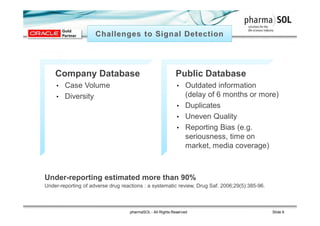
• Company Database
• Case Volume
• Diversity
• Public Database
• Outdated information
(delay of 6 months or more)
• Duplicates
• Uneven Quality
• Reporting Bias (e.g.
seriousness, time on
market, media coverage)
pharmaSOL - All Rights Reserved Slide 9
Under-reporting estimated more than 90%
Under-reporting of adverse drug reactions : a systematic review, Drug Saf. 2006;29(5):385-96.
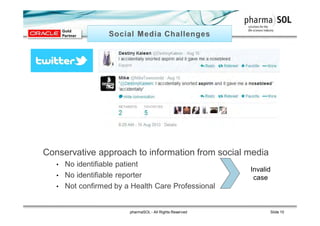
Conservative approach to information from social media
• No identifiable patient
• No identifiable reporter
• Not confirmed by a Health Care Professional
pharmaSOL - All Rights Reserved Slide 10
Invalid
case
• USA: Centers for Disease Control and
Prevention (CDC)
• Collects data from thousands of Health
Care Providers
• Publishes data on a 1 weekly basis
• Typical Reporting lag: 1-2 weeks
pharmaSOL - All Rights Reserved Slide 11
• In 2008 Google.org started a collaboration with the
CDC
• Google provides data from Google Search and the
algorithm.
• keywords and phrases related to the flu, including
thermometer, flu symptoms, muscle aches, chest congestion.
• CDC provides historic influenza data collected in the
USA
Detecting influenza epidemics using search engine query data (Nature 457, 1012-1014)
pharmaSOL - All Rights Reserved Slide 12
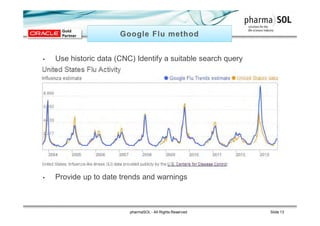
• Use historic data (CNC) Identify a suitable search query
• Provide up to date trends and warnings
pharmaSOL - All Rights Reserved Slide 13
pharmaSOL - All Rights Reserved Slide 14
pharmaSOL - All Rights Reserved Slide 15
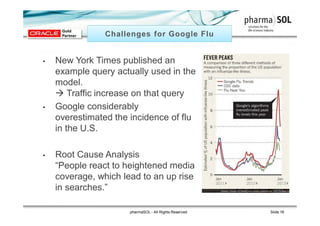
• New York Times published an
example query actually used in the
model.
 Traffic increase on that query
• Google considerably
overestimated the incidence of flu
in the U.S.
• Root Cause Analysis
“People react to heightened media
coverage, which lead to an up rise
in searches.”
pharmaSOL - All Rights Reserved Slide 16
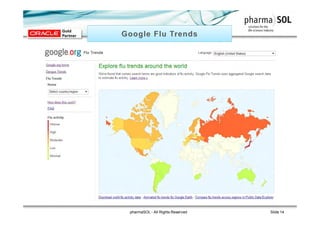
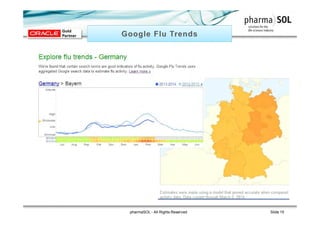
• Google.org shows that Signal Detection on internet
search data significantly reduces the time delay
experienced in traditional influenza surveillance
• Current development focuses on predictive
algorithms to detect peaks in the future
• Google expanded to identify Dengue Fever trends
• The influence of media coverage must not be
underestimated and needs to be taken into account for
the algorithm
pharmaSOL - All Rights Reserved Slide 17
pharmaSOL - All Rights Reserved Slide 18
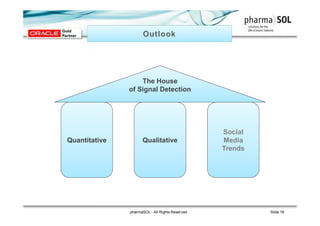
The House
of Signal Detection
Quantitative Qualitative
Social
Media
Trends

05 zittartz presentation_ph_v_day_2014

  • 1.
    Slide 1pharmaSOL -All Rights Reserved Dr Marc A. Zittartz, pharmaSOL Designing an efficient Pharmacovigilance System 02. April 2014, München, Germany
  • 2.
    • Signal Detectionhas become the focus of Pharmacovigilance activities in the last years. Computer models have been developed to automatically detect signals based on Adverse Event Report Systems, like FDA AERS. However, the vast amount of information available on social media has not been fully used so far, as this information does not fit in the traditional Pharmacovigilance model. • In 2008 Google, together with the Centers for Disease Control and Prevention (CDC), developed a computer model using Google search queries to detect outbreaks of the flu across the world. • This presentation explains the model developed by Google Flu Trends, the benefits and challenges experienced so far, and how it could supplement traditional signal detection methods in Pharmacovigilance. pharmaSOL - All Rights Reserved Slide 2
  • 3.
    pharmaSOL - AllRights Reserved Slide 3
  • 4.
    • Disruption ofthe pharma business model by the internet so far is minor. • Exchange with or usage of social media is limited • Patients use the Internet • Prior to a doctor visit to seek information and/or to decide whether they need professional help; • After the doctor visit for reassurance or because of dissatisfaction with the information provided. Patient Educ Couns. 2006 Oct;63(1-2):24-8. Epub 2006 Jan 6. pharmaSOL - All Rights Reserved Slide 4
  • 5.
    pharmaSOL - AllRights Reserved Slide 5
  • 6.
    • From theguidance: “Example 4: A sales representative acting on behalf of a firm posts comments about the innovative release mechanism of the firm’s product on an independent third-party site. Because the sales representative is acting on behalf of the firm, the firm is responsible for submitting the comments to FDA to meet the postmarketing submission requirements.” pharmaSOL - All Rights Reserved Slide 6
  • 7.
    • Several unknownsabout the safety profile of a new drug exist following Clinical Development • Rare adverse events • Specific populations (paediatric, pregnancies, elderly) • Interactions with other drugs • Long time exposure pharmaSOL - All Rights Reserved Slide 7
  • 8.
    • Qualitative • IndividualCase Processing • Case Series Review • PSUR/DSUR Review • Literature • Health Authorities • Quantitative • Frequency analysis • Disproportionality analysis • Origin • Public Database • FDA AERS • WHO Vigibase • (EudraVigilance) • Company Database pharmaSOL - All Rights Reserved Slide 8
  • 9.
    • Company Database •Case Volume • Diversity • Public Database • Outdated information (delay of 6 months or more) • Duplicates • Uneven Quality • Reporting Bias (e.g. seriousness, time on market, media coverage) pharmaSOL - All Rights Reserved Slide 9 Under-reporting estimated more than 90% Under-reporting of adverse drug reactions : a systematic review, Drug Saf. 2006;29(5):385-96.
  • 10.
    Conservative approach toinformation from social media • No identifiable patient • No identifiable reporter • Not confirmed by a Health Care Professional pharmaSOL - All Rights Reserved Slide 10 Invalid case
  • 11.
    • USA: Centersfor Disease Control and Prevention (CDC) • Collects data from thousands of Health Care Providers • Publishes data on a 1 weekly basis • Typical Reporting lag: 1-2 weeks pharmaSOL - All Rights Reserved Slide 11
  • 12.
    • In 2008Google.org started a collaboration with the CDC • Google provides data from Google Search and the algorithm. • keywords and phrases related to the flu, including thermometer, flu symptoms, muscle aches, chest congestion. • CDC provides historic influenza data collected in the USA Detecting influenza epidemics using search engine query data (Nature 457, 1012-1014) pharmaSOL - All Rights Reserved Slide 12
  • 13.
    • Use historicdata (CNC) Identify a suitable search query • Provide up to date trends and warnings pharmaSOL - All Rights Reserved Slide 13
  • 14.
    pharmaSOL - AllRights Reserved Slide 14
  • 15.
    pharmaSOL - AllRights Reserved Slide 15
  • 16.
    • New YorkTimes published an example query actually used in the model.  Traffic increase on that query • Google considerably overestimated the incidence of flu in the U.S. • Root Cause Analysis “People react to heightened media coverage, which lead to an up rise in searches.” pharmaSOL - All Rights Reserved Slide 16
  • 17.
    • Google.org showsthat Signal Detection on internet search data significantly reduces the time delay experienced in traditional influenza surveillance • Current development focuses on predictive algorithms to detect peaks in the future • Google expanded to identify Dengue Fever trends • The influence of media coverage must not be underestimated and needs to be taken into account for the algorithm pharmaSOL - All Rights Reserved Slide 17
  • 18.
    pharmaSOL - AllRights Reserved Slide 18 The House of Signal Detection Quantitative Qualitative Social Media Trends