Quantitative Research
PRK23MS1017
S.BERYL STEFFIN
Quantitative Research
Typically involves counting or measuring
Often statistical tests are applied to
detect or confirm trends
Purpose is to get clear-cut, precise and
accurate results, factually reflecting the
situation under study
Questionnaire is one of the popular tools
for the quantitative research
Questionnaire Survey - Steps
1. Define the problem/ survey topic
2. Use previous studies & expert advice
3. Define research questions objectives
4. Define study population and sample size
5. Develop a preliminary questionnaire
6. Pretest the questionnaire
7. Cover letter
8. Stamped & self-addressed envelop
9. Follow-up letter for non-respondents
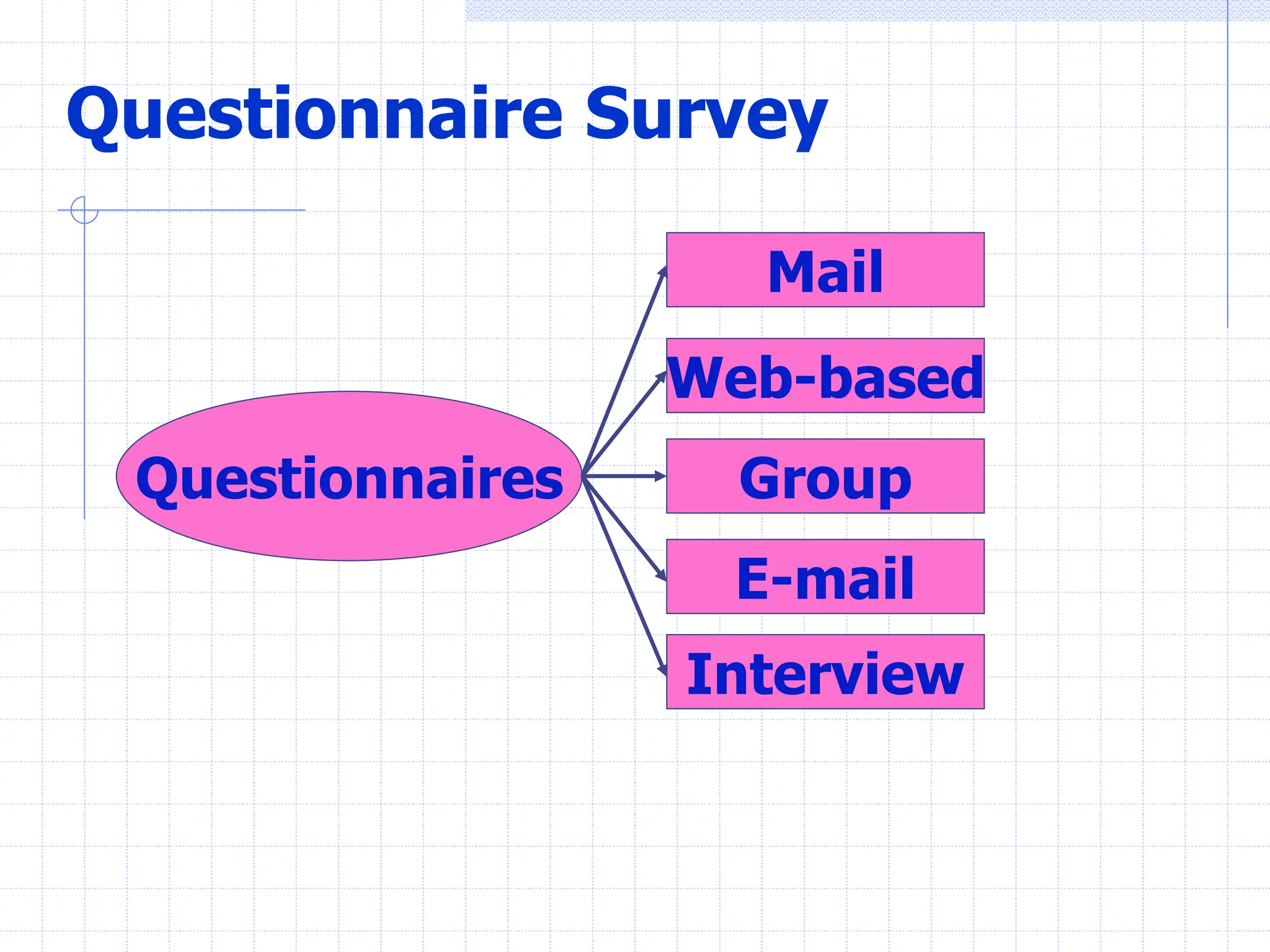
Questionnaire Survey
Questionnaires
Mail
Web-based
Group
E-mail
Interview
Advantages
Broad coverage (local, national, international)
Frank and anonymous answers
Economical for large population
Less Time consuming
Quantitative data
Filling at a convenient time
Easy to respond
Good for sensitive & ego-related Qs.
Original hard-to-obtain data
Disadvantages
No clarification for ambiguous questions
Inadequate motivation to respond
Poorly worded or direct questions
Unattractive style and format
Low response rate
Inaccurate responses – no verification
Limited fixed responses
Cannot uncover causes or relationships
for attitudes, beliefs, actions
THANK YOU

QUANTITATIVE METHOD IN BUSINESS RESEARCH

  • 1.
  • 2.
    Quantitative Research Typically involvescounting or measuring Often statistical tests are applied to detect or confirm trends Purpose is to get clear-cut, precise and accurate results, factually reflecting the situation under study Questionnaire is one of the popular tools for the quantitative research
  • 3.
    Questionnaire Survey -Steps 1. Define the problem/ survey topic 2. Use previous studies & expert advice 3. Define research questions objectives 4. Define study population and sample size 5. Develop a preliminary questionnaire 6. Pretest the questionnaire 7. Cover letter 8. Stamped & self-addressed envelop 9. Follow-up letter for non-respondents
  • 4.
  • 5.
    Advantages Broad coverage (local,national, international) Frank and anonymous answers Economical for large population Less Time consuming Quantitative data Filling at a convenient time Easy to respond Good for sensitive & ego-related Qs. Original hard-to-obtain data
  • 6.
    Disadvantages No clarification forambiguous questions Inadequate motivation to respond Poorly worded or direct questions Unattractive style and format Low response rate Inaccurate responses – no verification Limited fixed responses Cannot uncover causes or relationships for attitudes, beliefs, actions
  • 7.