NAMA KELOMPOK :
1. Josua Putra Pratama Manurung
2. Lanang Bagas Adi Candra
3. Dhafin Izzudin
4. Venna Vincencia
5. Thirza Frigia Grace Manurung
❑ Forecasting is a tool used for predicting future
demand based on past demand information.
❑ A forecast is only as good as the information
included in the forecast (past data).
❑Forecasting is a based on the assumption that the
past predicts the future.
▪That is forecasting based on sales data in the past.
Forecasting results are made very dependet on the
method used in the forecasting.The use of different
method will get different results.
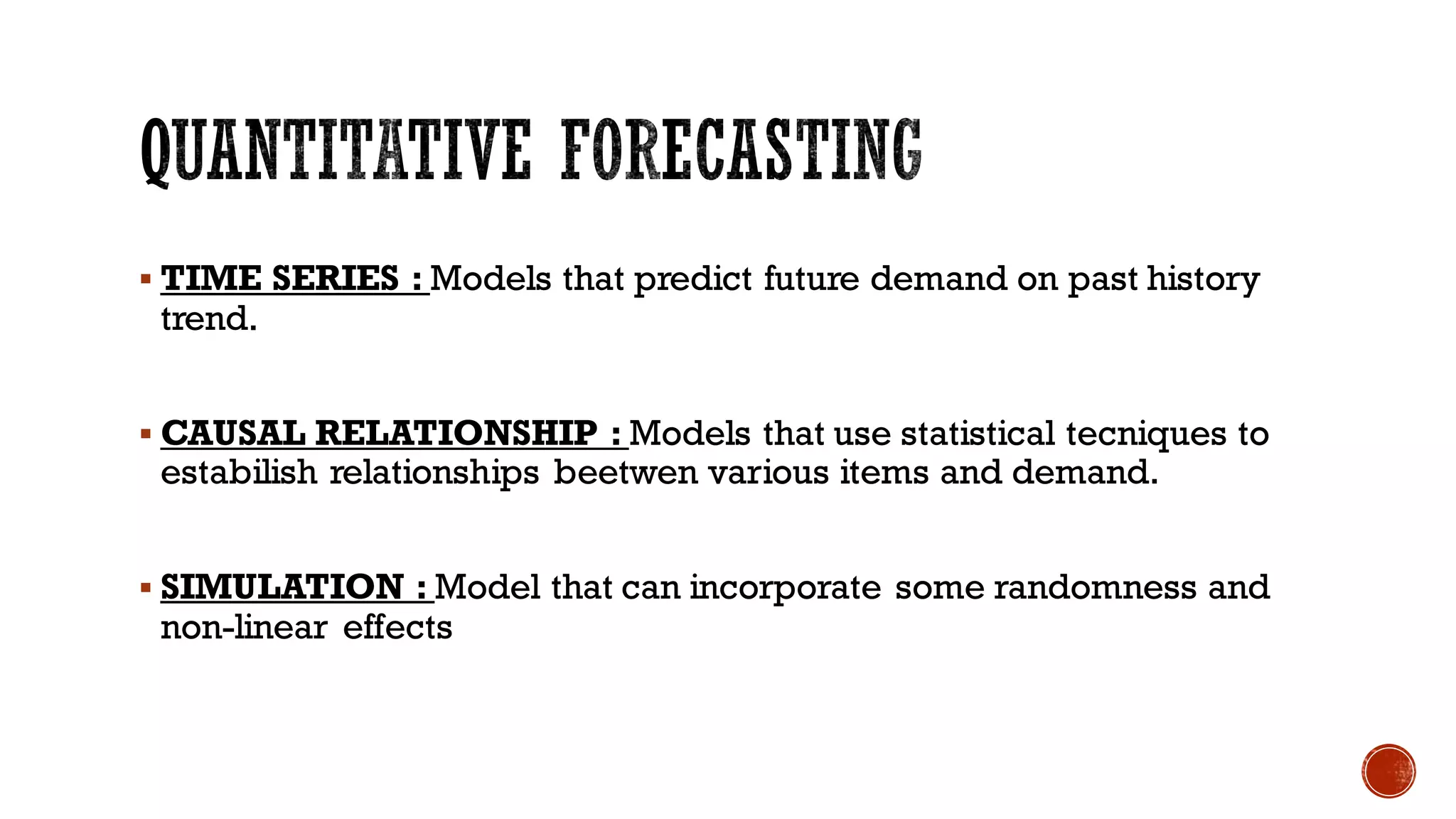
▪ TIME SERIES : Models that predict future demand on past history
trend.
▪ CAUSAL RELATIONSHIP : Models that use statistical tecniques to
estabilish relationships beetwen various items and demand.
▪ SIMULATION : Model that can incorporate some randomness and
non-linear effects
𝑡 is the current period
𝐹𝑡+1 is the forecast for next period
𝑛 is the forecasting horizon (how far back we look)
𝐴 is the actual sales figure from each period
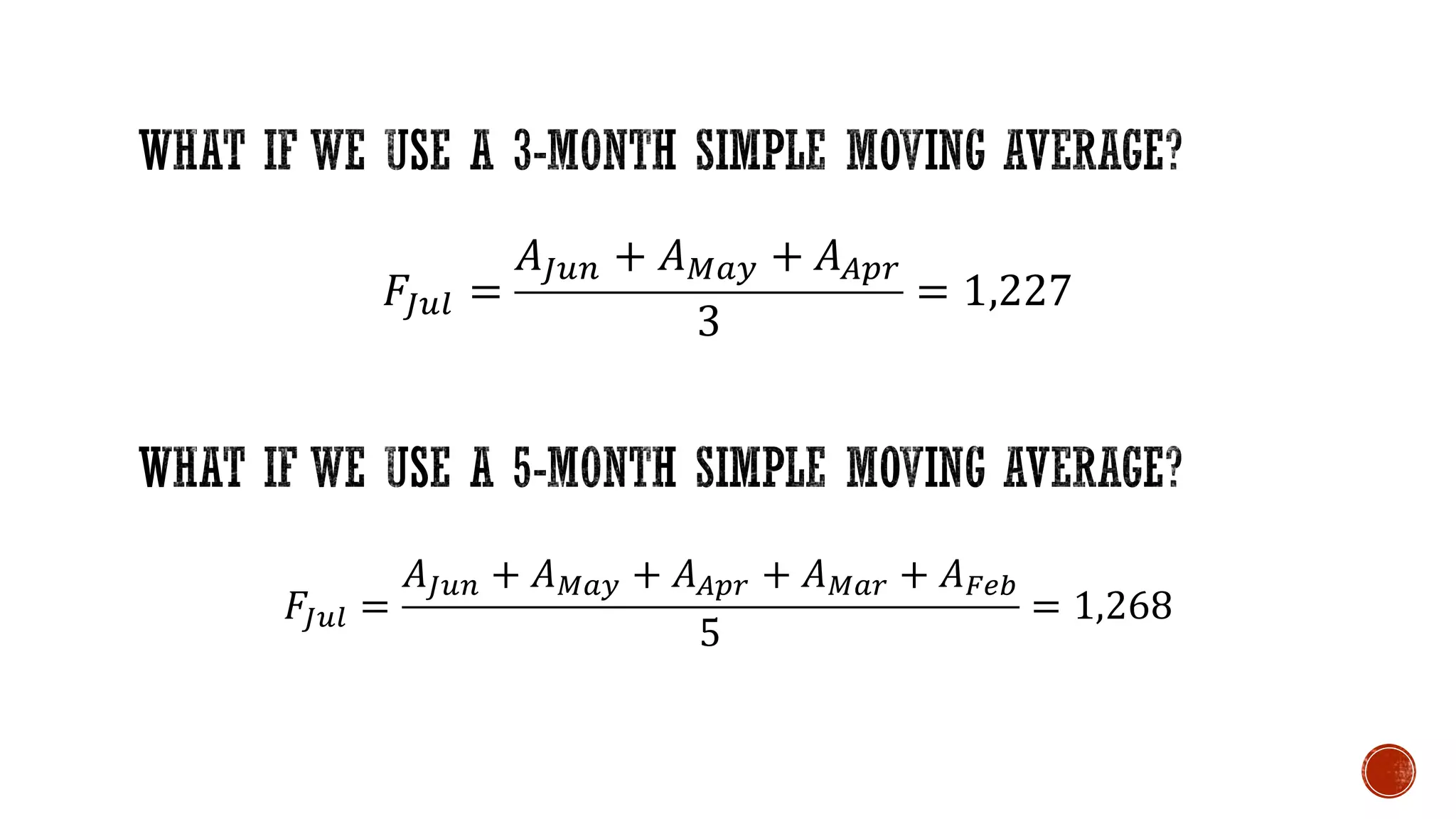
Month Bottles
Jan 1,325
Feb 1,353
Mar 1,305
Apr 1,275
May 1,210
Jun 1,195
Jul ?
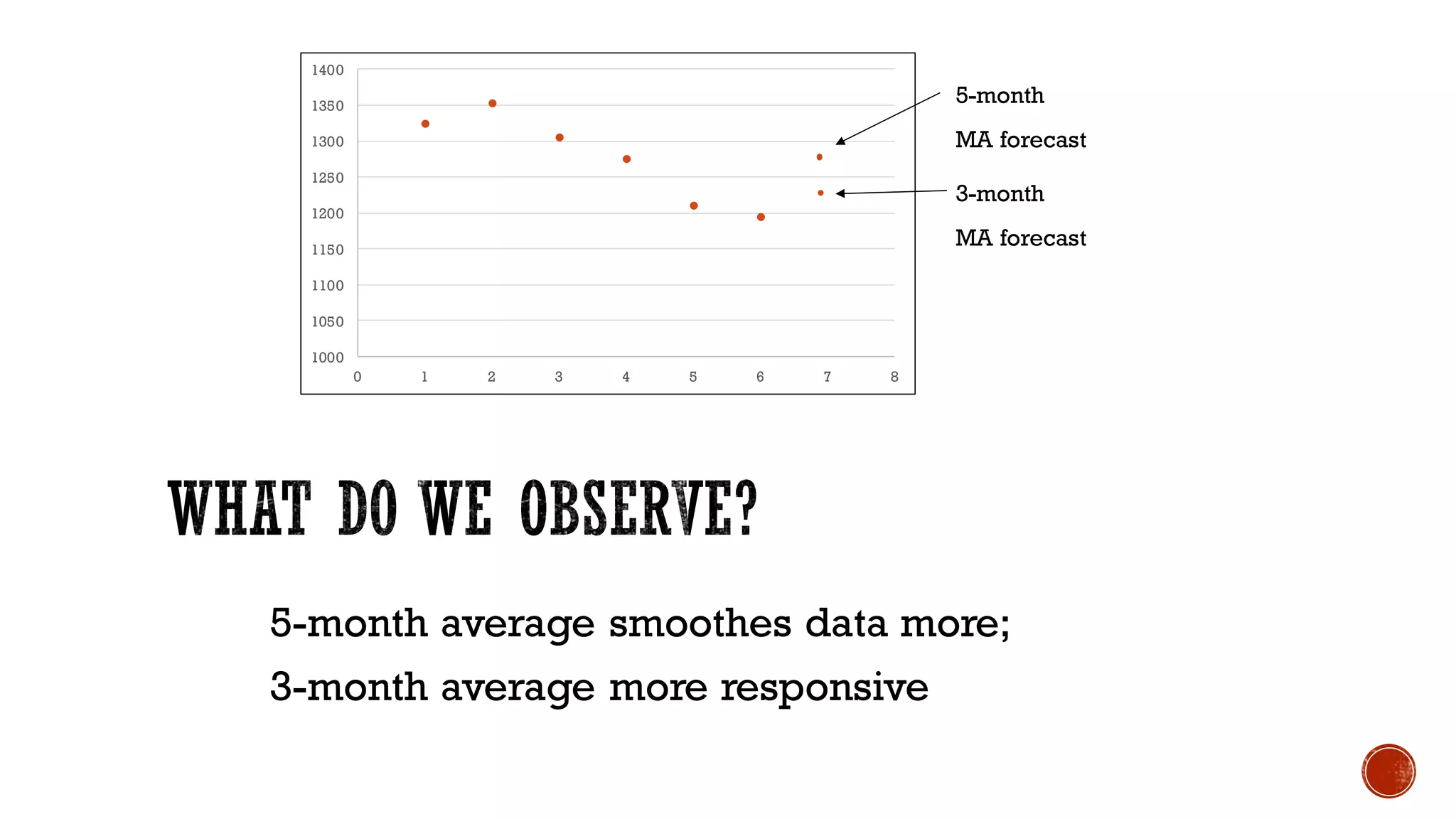
1000
1050
1100
1150
1200
1250
1300
1350
1400
0 1 2 3 4 5 6 7 8
5-month
MA forecast
3-month
MA forecast
5-month average smoothes data more;
3-month average more responsive
𝑡 is the current period
𝐹𝑡+1 is the forecast for next period
𝑛 is the forecasting horizon (how far back we look)
𝐴 is the actual sales figure from each period
𝑤 is the importance (weight) was give to each period
𝐹𝑡+1 = 𝑤𝑡 𝐴 𝑡 + 𝑤𝑡−1 𝐴 𝑡−1 + … + 𝑤𝑡−𝑛 𝐴 𝑡−𝑛 𝑤𝑡 + 𝑤𝑡−1 + … + 𝑤𝑡−𝑛 = 1
Make the weight for the last three months more
than the first three months…
Month Bottles
Jan 1,325
Feb 1,353
Mar 1,305
Apr 1,275
May 1,210
Jun 1,195
Jul ?
The higher the importance we give to recent
data, the more we pick up the declining trend in
our forecast.
6-month SMA
WMA
40%/60%
WMA
30%/70%
WMA
20%/80%
July Forecast 1,277 1,267 1,257 1,247
Assume that we are currently in period 𝑡.We calculated the forecast
for the last period (𝐹𝑡+1) and we know the actual demand last period
(𝐴 𝑡−1) …
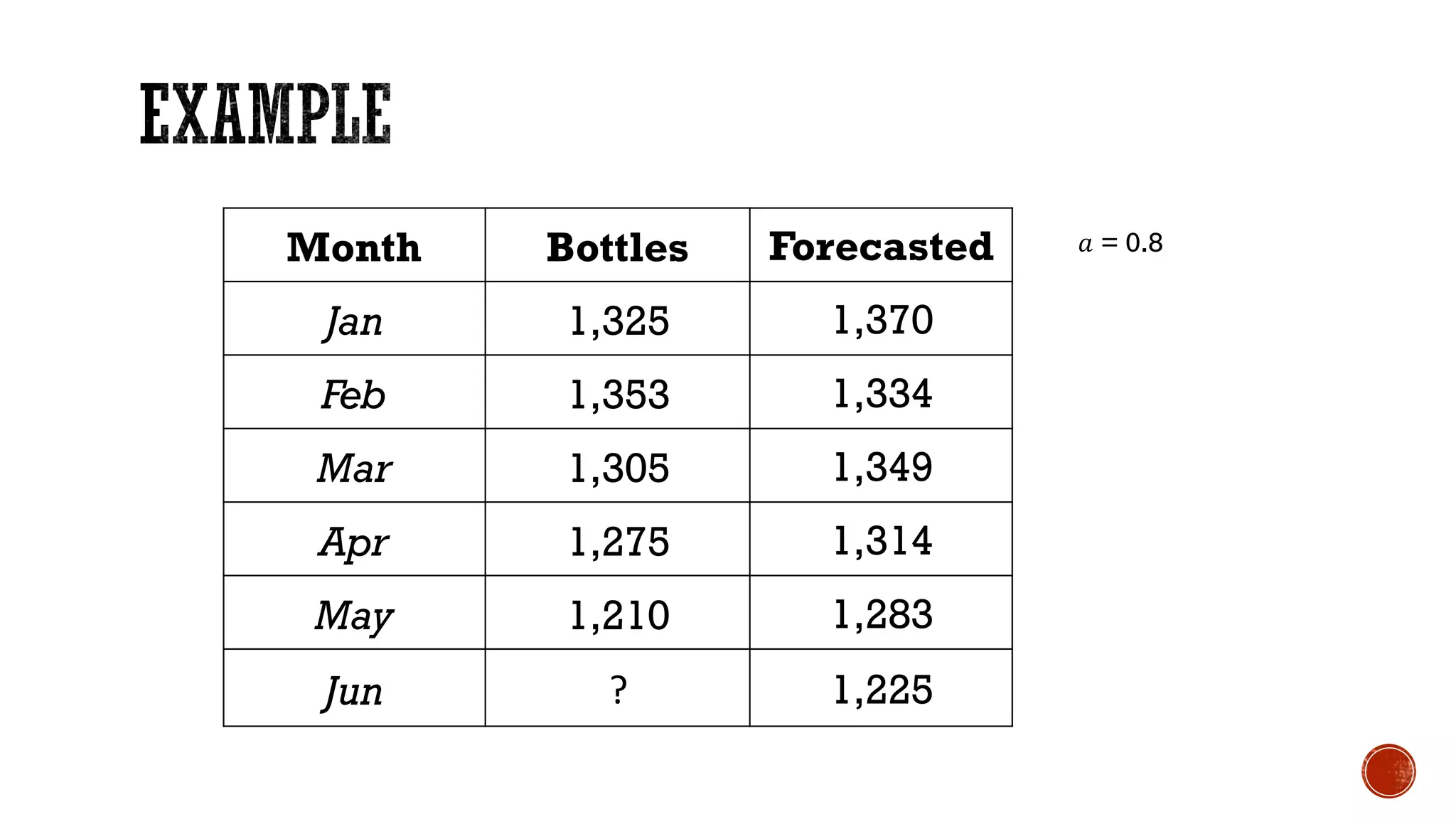
𝐹1 = 𝐹𝑡−1 + 𝑎(𝐴𝑡−1−𝐹𝑡−1)
The smoothing constant 𝑎 expresses how much our forecast will react
to observed differences…
If 𝑎 is low : there is little reaction to differences.
If 𝑎 is high : there is a lot of reaction to differences.
Month Bottles Forecasted
Jan 1,325 1,370
Feb 1,353 1,361
Mar 1,305 1,359
Apr 1,275 1,349
May 1,210 1,334
Jun ? 1,309
𝑎 = 0.2
𝑎 = 0.8Month Bottles Forecasted
Jan 1,325 1,370
Feb 1,353 1,334
Mar 1,305 1,349
Apr 1,275 1,314
May 1,210 1,283
Jun ? 1,225
1,200
1,220
1,240
1,260
1,280
1,300
1,320
1,340
1,360
1,380
1 2 3 4 5 6 7
Actual
a=0,2
a=0,8
Linear regression is based on
1. Fitting a straight line to data
2. Explaining the change in one variable through changes in other variables.
Depend variable = a + b × (independent variable)
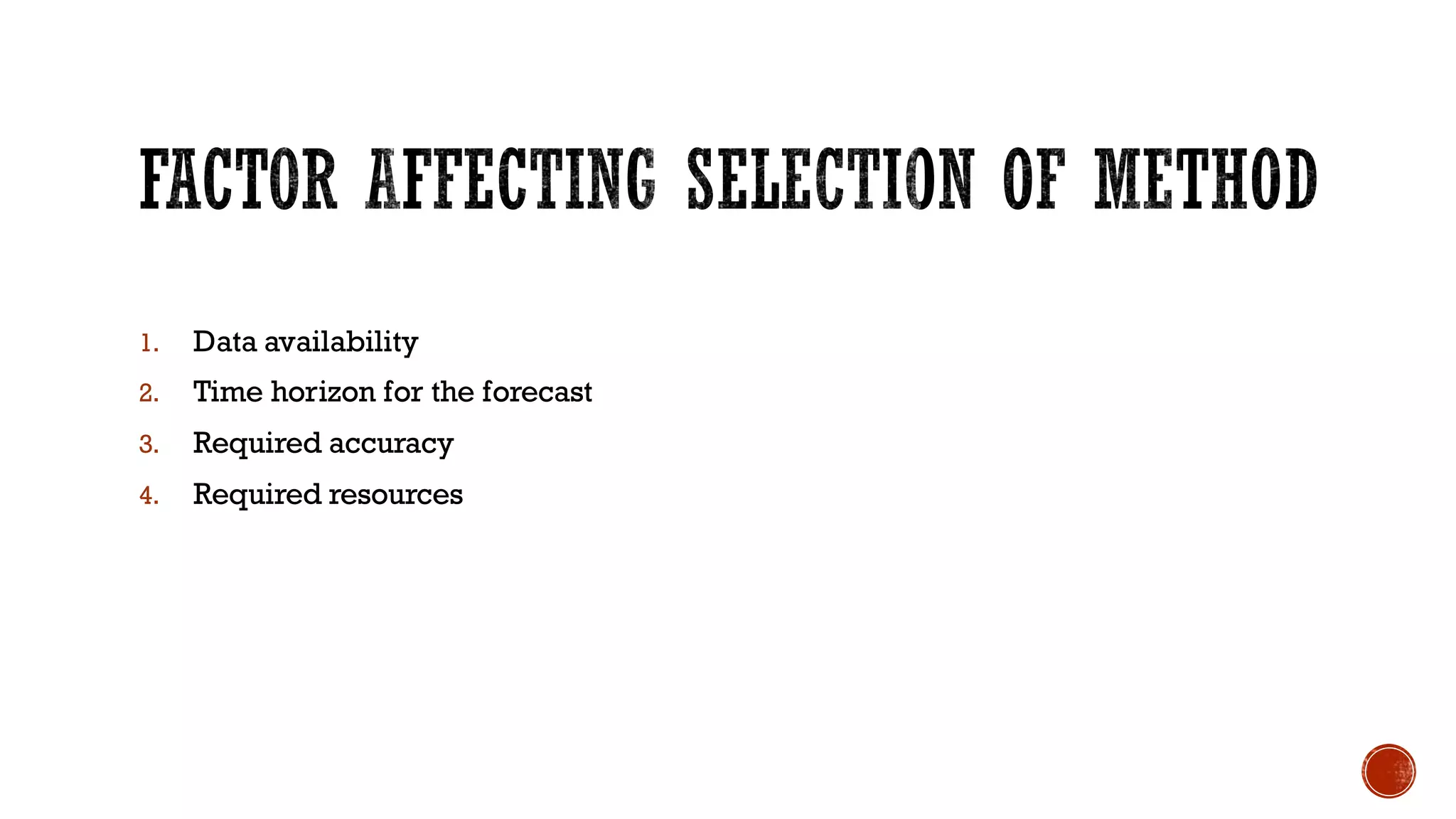
1. Data availability
2. Time horizon for the forecast
3. Required accuracy
4. Required resources
➢ www.csb.uncw.edu
➢ www.prism.gatech.edu
➢ web.calstatela.edu
➢ www.forecasters.org
➢ www.csun.edu

QUANTITATIVE APPROACHES TO FORECASTING

  • 1.
    NAMA KELOMPOK : 1.Josua Putra Pratama Manurung 2. Lanang Bagas Adi Candra 3. Dhafin Izzudin 4. Venna Vincencia 5. Thirza Frigia Grace Manurung
  • 2.
    ❑ Forecasting isa tool used for predicting future demand based on past demand information. ❑ A forecast is only as good as the information included in the forecast (past data). ❑Forecasting is a based on the assumption that the past predicts the future.
  • 3.
    ▪That is forecastingbased on sales data in the past. Forecasting results are made very dependet on the method used in the forecasting.The use of different method will get different results.
  • 4.
    ▪ TIME SERIES: Models that predict future demand on past history trend. ▪ CAUSAL RELATIONSHIP : Models that use statistical tecniques to estabilish relationships beetwen various items and demand. ▪ SIMULATION : Model that can incorporate some randomness and non-linear effects
  • 5.
    𝑡 is thecurrent period 𝐹𝑡+1 is the forecast for next period 𝑛 is the forecasting horizon (how far back we look) 𝐴 is the actual sales figure from each period
  • 6.
    Month Bottles Jan 1,325 Feb1,353 Mar 1,305 Apr 1,275 May 1,210 Jun 1,195 Jul ?
  • 8.
    1000 1050 1100 1150 1200 1250 1300 1350 1400 0 1 23 4 5 6 7 8 5-month MA forecast 3-month MA forecast 5-month average smoothes data more; 3-month average more responsive
  • 9.
    𝑡 is thecurrent period 𝐹𝑡+1 is the forecast for next period 𝑛 is the forecasting horizon (how far back we look) 𝐴 is the actual sales figure from each period 𝑤 is the importance (weight) was give to each period 𝐹𝑡+1 = 𝑤𝑡 𝐴 𝑡 + 𝑤𝑡−1 𝐴 𝑡−1 + … + 𝑤𝑡−𝑛 𝐴 𝑡−𝑛 𝑤𝑡 + 𝑤𝑡−1 + … + 𝑤𝑡−𝑛 = 1
  • 10.
    Make the weightfor the last three months more than the first three months… Month Bottles Jan 1,325 Feb 1,353 Mar 1,305 Apr 1,275 May 1,210 Jun 1,195 Jul ? The higher the importance we give to recent data, the more we pick up the declining trend in our forecast. 6-month SMA WMA 40%/60% WMA 30%/70% WMA 20%/80% July Forecast 1,277 1,267 1,257 1,247
  • 11.
    Assume that weare currently in period 𝑡.We calculated the forecast for the last period (𝐹𝑡+1) and we know the actual demand last period (𝐴 𝑡−1) … 𝐹1 = 𝐹𝑡−1 + 𝑎(𝐴𝑡−1−𝐹𝑡−1) The smoothing constant 𝑎 expresses how much our forecast will react to observed differences… If 𝑎 is low : there is little reaction to differences. If 𝑎 is high : there is a lot of reaction to differences.
  • 12.
    Month Bottles Forecasted Jan1,325 1,370 Feb 1,353 1,361 Mar 1,305 1,359 Apr 1,275 1,349 May 1,210 1,334 Jun ? 1,309 𝑎 = 0.2
  • 13.
    𝑎 = 0.8MonthBottles Forecasted Jan 1,325 1,370 Feb 1,353 1,334 Mar 1,305 1,349 Apr 1,275 1,314 May 1,210 1,283 Jun ? 1,225
  • 14.
  • 15.
    Linear regression isbased on 1. Fitting a straight line to data 2. Explaining the change in one variable through changes in other variables. Depend variable = a + b × (independent variable)
  • 16.
    1. Data availability 2.Time horizon for the forecast 3. Required accuracy 4. Required resources
  • 17.
    ➢ www.csb.uncw.edu ➢ www.prism.gatech.edu ➢web.calstatela.edu ➢ www.forecasters.org ➢ www.csun.edu