Quantitative assessment
measures for developing
Green Economy/SCP strategic
policies
What is the Green Economy/Sustainable
Consumption and Production?
• Customized definition, depending on country
context and needs
• As a result, various models could be used to
analyze it, some are static and some
dynamic.
• Available options covering economy,
environment and society:
– Indicators, Input-Output, Social Accounting
Matrix (SAM), Geographic Information System
(GIS);
– Econometrics, optimization, system dynamics.
What is the gap (opportunity) for a
Green Economy model?
• Need to support policy formulation and
evaluation
• Need to assess policies and investments
according to their impact across sectors
(improving the performance of the system,
rather than focusing on single indicators).
What’s “behind” the
Green Economy/SCP model?
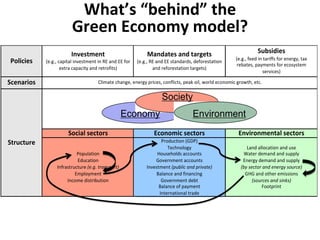
• A correct (although simplified) representation
of reality demands careful consideration of :
– Policy
• What interventions are being examined? What are the
expected impacts?
– Structure
• How is the problem being influenced by (and/or
impacting) the system?
– Science/Knowledge
• What do we know about the problem?
• What is causing it, and how?
Policies
Investment
(e.g., capital investment in RE and EE for
extra capacity and retrofits)
Mandates and targets
(e.g., RE and EE standards, deforestation
and reforestation targets)
Subsidies
(e.g., feed in tariffs for energy, tax
rebates, payments for ecosystem
services)
Scenarios Climate change, energy prices, conflicts, peak oil, world economic growth, etc.
Structure
Social sectors Economic sectors Environmental sectors
Population
Education
Infrastructure (e.g. transport)
Employment
Income distribution
Production (GDP)
Technology
Households accounts
Government accounts
Investment (public and private)
Balance and financing
Government debt
Balance of payment
International trade
Land allocation and use
Water demand and supply
Energy demand and supply
(by sector and energy source)
GHG and other emissions
(sources and sinks)
Footprint
Society
Economy Environment
What’s “behind” the 
Green Economy model?
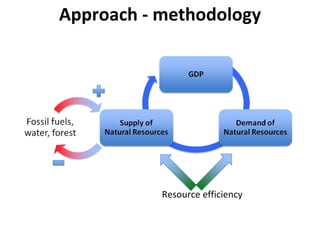
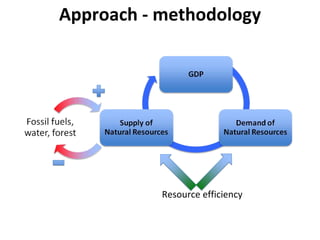
Resource efficiency
Approach ‐ methodology
What’s “behind” the
Green Economy model?
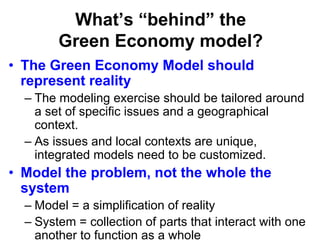
• The Green Economy Model should
represent reality
– The modeling exercise should be tailored around
a set of specific issues and a geographical
context.
– As issues and local contexts are unique,
integrated models need to be customized.
• Model the problem, not the whole the
system
– Model = a simplification of reality
– System = collection of parts that interact with one
another to function as a whole
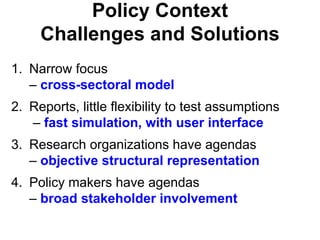
Policy Context
Challenges and Solutions
1. Narrow focus
– cross-sectoral model
2. Reports, little flexibility to test assumptions
– fast simulation, with user interface
3. Research organizations have agendas
– objective structural representation
4. Policy makers have agendas
– broad stakeholder involvement
Green Economy scenarios
• The modeling work includes biophysical and economic 
variables for human, economic and natural capital, and 
can estimate:
– Avoided costs (e.g., reduced fish landings from over‐
exploitation of marine resources and coral bleaching, and 
resulting avoided employment losses)
– Added benefits (e.g., higher biodiversity and production 
of NTFP, ecotourism revenues and employment from 
forest conservation).
Approach ‐ methodology
Resource efficiency
Approach ‐ methodology
pib
investissement
+
emploi
+
stabilite
politique
climat des
affaires
+
+procedure ad
ministrative +
legislation fiscale
fiscalite
+
-
+
+
education
productivite
de l'emploi+
-
+
+
terre
agricole
+
changement
climatique
securite
+
+
-
investissement
adaptation climatique
+
productivite
agricole
+ -
population
+
+
-
espace
urbain
+
-
foret
-
biodiversite
+
- -
+
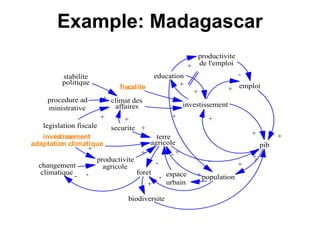
Example: Madagascar
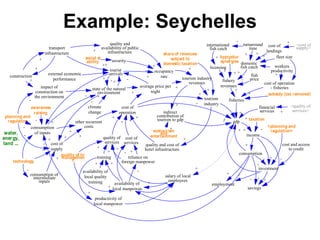
Example: Seychelles
gdp
tourism
industry
fisheries
+
+
average price per
night
+
occupancy
rate
-
+
state of the natural
environment +
quality and cost of
hotel infrastructure
quality of
services
+
+
cost of
operation
-
construction
+
security
+
climate
change
-
planning and
regulation
-
impact of
construction on
the environment -
transport
infrastructure
quality and
availability of public
infrastructure+
+
+
+ tourist
arrivals
+
-
social st
ability
+
+
tourism industry
revenues
+
+
share of revenues
subject to
domestic taxation
+
external economic
performance +
indirect
contribution of
tourism to gdp
+
+
availability of
local manpower
other recurrent
costs
cost of
services
+
training
availability of
local quality
training
+
+
+
reliance on
foreign manpower
-
+-
+
salary of local
employees+
quality of hr
managemen
t
+
+
-
productivity of
local manpower
+
+
+
+
+
consumption
of inputs
cost of
supply
+
+
+
-
technology
consumption of
intermediate
inputs
+
+
-
awareness
raising
-
-
-
ecotourism
and
entertainment
+
income
consumption
+
+
taxation
-
investment
+
-
<planning and
regulation>
+
savings
+- -
-
+
-
++
employment
+ +
-
cost and access
to credit
-
+
water,
energy,
land ...
financial
services
+
<quality of
services>+
cost of operation
- fisheries
-
fishery
revenues
+
fish
price
domestic
fish catch
-
+
turnaround
time
+
fleet size
workers
productivity
+
+
+
subsidy (tax removed)+
international
fish catch
-
licensing
+
+
cost of
landings
+
<cost of
supply>
+
byproduc
tsynergies
+
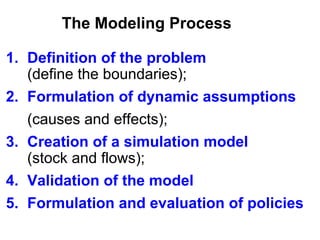
The Modeling Process
1. Definition of the problem
(define the boundaries);
2. Formulation of dynamic assumptions
(causes and effects);
3. Creation of a simulation model
(stock and flows);
4. Validation of the model
5. Formulation and evaluation of policies
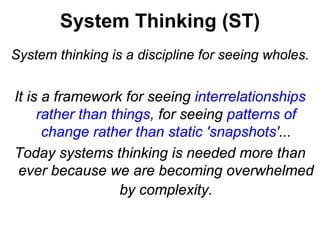
System thinking is a discipline for seeing wholes.
It is a framework for seeing interrelationships
rather than things, for seeing patterns of
change rather than static 'snapshots'...
Today systems thinking is needed more than
ever because we are becoming overwhelmed
by complexity.
System Thinking (ST)
Examples of analysis results
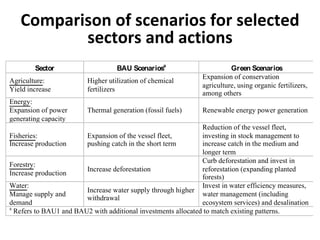
Comparison of scenarios for selected 
sectors and actions
Sector BAU Scenariosa
Green Scenarios
Agriculture:
Yield increase
Higher utilization of chemical
fertilizers
Expansion of conservation
agriculture, using organic fertilizers,
among others
Energy:
Expansion of power
generating capacity
Thermal generation (fossil fuels) Renewable energy power generation
Fisheries:
Increase production
Expansion of the vessel fleet,
pushing catch in the short term
Reduction of the vessel fleet,
investing in stock management to
increase catch in the medium and
longer term
Forestry:
Increase production
Increase deforestation
Curb deforestation and invest in
reforestation (expanding planted
forests)
Water:
Manage supply and
demand
Increase water supply through higher
withdrawal
Invest in water efficiency measures,
water management (including
ecosystem services) and desalination
a
Refers to BAU1 and BAU2 with additional investments allocated to match existing patterns.
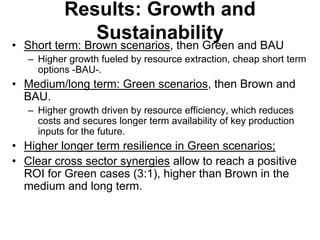
Results: Growth and
Sustainability
• Short term: Brown scenarios, then Green and BAU
– Higher growth fueled by resource extraction, cheap short term
options -BAU-.
• Medium/long term: Green scenarios, then Brown and
BAU.
– Higher growth driven by resource efficiency, which reduces
costs and secures longer term availability of key production
inputs for the future.
• Higher longer term resilience in Green scenarios;
• Clear cross sector synergies allow to reach a positive
ROI for Green cases (3:1), higher than Brown in the
medium and long term.
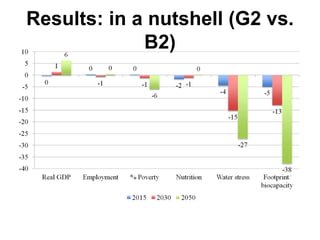
Results: in a nutshell (G2 vs.
B2)
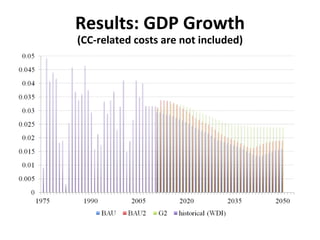
Results: GDP Growth 
(CC‐related costs are not included)
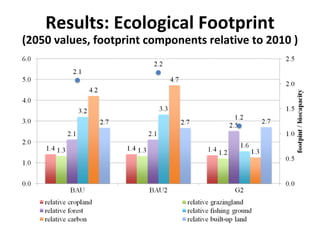
Results: Ecological Footprint 
(2050 values, footprint components relative to 2010 )
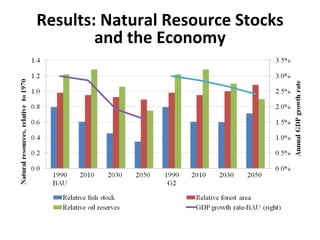
Results: Natural Resource Stocks 
and the Economy
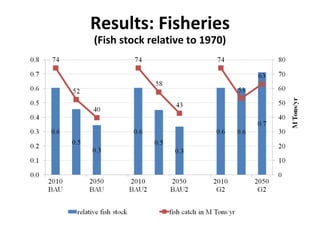
Results: Fisheries
(Fish stock relative to 1970)
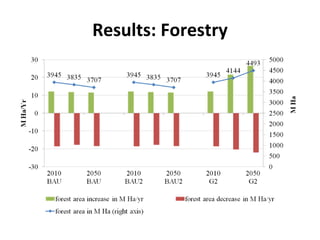
Results: Forestry
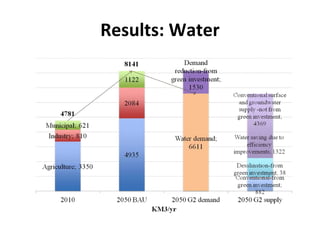
Results: Water
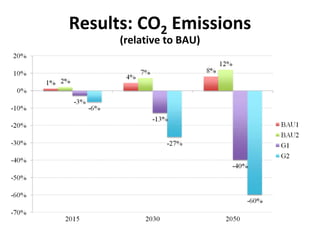
Results: CO2 Emissions
(relative to BAU)
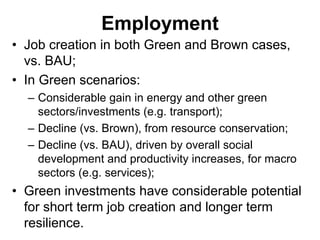
Employment
• Job creation in both Green and Brown cases,
vs. BAU;
• In Green scenarios:
– Considerable gain in energy and other green
sectors/investments (e.g. transport);
– Decline (vs. Brown), from resource conservation;
– Decline (vs. BAU), driven by overall social
development and productivity increases, for macro
sectors (e.g. services);
• Green investments have considerable potential
for short term job creation and longer term
resilience.
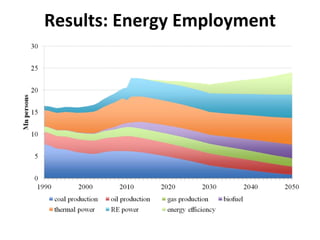
Results: Energy Employment
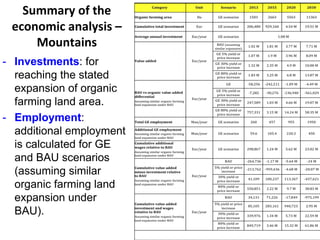
Summary of the 
economic analysis –
Mountains
- Investments: for
reaching the stated
expansion of organic
farming land area.
- Employment:
additional employment
is calculated for GE
and BAU scenarios
(assuming similar
organic farming land
expansion under
BAU).
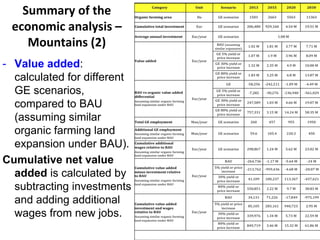
- Value added:
calculated for different
GE scenarios,
compared to BAU
(assuming similar
organic farming land
expansion under BAU).
Cumulative net value
added is calculated by
subtracting investments
and adding additional
wages from new jobs.
Summary of the 
economic analysis –
Mountains (2)
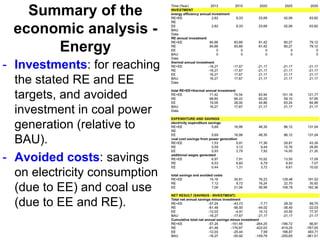
Summary of the
economic analysis -
Energy
- Investments: for reaching
the stated RE and EE
targets, and avoided
investment in coal power
generation (relative to
BAU).
- Avoided costs: savings
on electricity consumption
(due to EE) and coal use
(due to EE and RE).
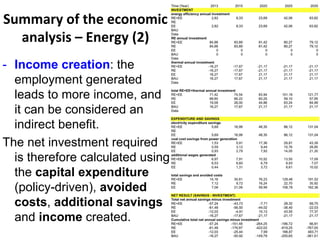
- Income creation: the
employment generated
leads to more income, and
it can be considered an
indirect benefit.
The net investment required
is therefore calculated using
the capital expenditure
(policy-driven), avoided
costs, additional savings
and income created.
Summary of the economic 
analysis – Energy (2)

Quantiative assessment measures for developing Green Economy

  • 1.
    Quantitative assessment measures fordeveloping Green Economy/SCP strategic policies
  • 2.
    What is theGreen Economy/Sustainable Consumption and Production? • Customized definition, depending on country context and needs • As a result, various models could be used to analyze it, some are static and some dynamic. • Available options covering economy, environment and society: – Indicators, Input-Output, Social Accounting Matrix (SAM), Geographic Information System (GIS); – Econometrics, optimization, system dynamics.
  • 3.
    What is thegap (opportunity) for a Green Economy model? • Need to support policy formulation and evaluation • Need to assess policies and investments according to their impact across sectors (improving the performance of the system, rather than focusing on single indicators).
  • 4.
    What’s “behind” the GreenEconomy/SCP model? • A correct (although simplified) representation of reality demands careful consideration of : – Policy • What interventions are being examined? What are the expected impacts? – Structure • How is the problem being influenced by (and/or impacting) the system? – Science/Knowledge • What do we know about the problem? • What is causing it, and how?
  • 5.
    Policies Investment (e.g., capital investmentin RE and EE for extra capacity and retrofits) Mandates and targets (e.g., RE and EE standards, deforestation and reforestation targets) Subsidies (e.g., feed in tariffs for energy, tax rebates, payments for ecosystem services) Scenarios Climate change, energy prices, conflicts, peak oil, world economic growth, etc. Structure Social sectors Economic sectors Environmental sectors Population Education Infrastructure (e.g. transport) Employment Income distribution Production (GDP) Technology Households accounts Government accounts Investment (public and private) Balance and financing Government debt Balance of payment International trade Land allocation and use Water demand and supply Energy demand and supply (by sector and energy source) GHG and other emissions (sources and sinks) Footprint Society Economy Environment What’s “behind” the  Green Economy model?
  • 6.
  • 7.
    What’s “behind” the GreenEconomy model? • The Green Economy Model should represent reality – The modeling exercise should be tailored around a set of specific issues and a geographical context. – As issues and local contexts are unique, integrated models need to be customized. • Model the problem, not the whole the system – Model = a simplification of reality – System = collection of parts that interact with one another to function as a whole
  • 8.
    Policy Context Challenges andSolutions 1. Narrow focus – cross-sectoral model 2. Reports, little flexibility to test assumptions – fast simulation, with user interface 3. Research organizations have agendas – objective structural representation 4. Policy makers have agendas – broad stakeholder involvement
  • 9.
  • 10.
    • The modeling work includes biophysical and economic  variables for human, economic and natural capital, and  can estimate: –Avoided costs (e.g., reduced fish landings from over‐ exploitation of marine resources and coral bleaching, and  resulting avoided employment losses) – Added benefits (e.g., higher biodiversity and production  of NTFP, ecotourism revenues and employment from  forest conservation). Approach ‐ methodology
  • 11.
  • 12.
    pib investissement + emploi + stabilite politique climat des affaires + +procedure ad ministrative+ legislation fiscale fiscalite + - + + education productivite de l'emploi+ - + + terre agricole + changement climatique securite + + - investissement adaptation climatique + productivite agricole + - population + + - espace urbain + - foret - biodiversite + - - + Example: Madagascar
  • 13.
    Example: Seychelles gdp tourism industry fisheries + + average priceper night + occupancy rate - + state of the natural environment + quality and cost of hotel infrastructure quality of services + + cost of operation - construction + security + climate change - planning and regulation - impact of construction on the environment - transport infrastructure quality and availability of public infrastructure+ + + + tourist arrivals + - social st ability + + tourism industry revenues + + share of revenues subject to domestic taxation + external economic performance + indirect contribution of tourism to gdp + + availability of local manpower other recurrent costs cost of services + training availability of local quality training + + + reliance on foreign manpower - +- + salary of local employees+ quality of hr managemen t + + - productivity of local manpower + + + + + consumption of inputs cost of supply + + + - technology consumption of intermediate inputs + + - awareness raising - - - ecotourism and entertainment + income consumption + + taxation - investment + - <planning and regulation> + savings +- - - + - ++ employment + + - cost and access to credit - + water, energy, land ... financial services + <quality of services>+ cost of operation - fisheries - fishery revenues + fish price domestic fish catch - + turnaround time + fleet size workers productivity + + + subsidy (tax removed)+ international fish catch - licensing + + cost of landings + <cost of supply> + byproduc tsynergies +
  • 14.
    The Modeling Process 1.Definition of the problem (define the boundaries); 2. Formulation of dynamic assumptions (causes and effects); 3. Creation of a simulation model (stock and flows); 4. Validation of the model 5. Formulation and evaluation of policies
  • 15.
    System thinking isa discipline for seeing wholes. It is a framework for seeing interrelationships rather than things, for seeing patterns of change rather than static 'snapshots'... Today systems thinking is needed more than ever because we are becoming overwhelmed by complexity. System Thinking (ST)
  • 16.
  • 17.
    Comparison of scenarios for selected  sectors and actions Sector BAU Scenariosa GreenScenarios Agriculture: Yield increase Higher utilization of chemical fertilizers Expansion of conservation agriculture, using organic fertilizers, among others Energy: Expansion of power generating capacity Thermal generation (fossil fuels) Renewable energy power generation Fisheries: Increase production Expansion of the vessel fleet, pushing catch in the short term Reduction of the vessel fleet, investing in stock management to increase catch in the medium and longer term Forestry: Increase production Increase deforestation Curb deforestation and invest in reforestation (expanding planted forests) Water: Manage supply and demand Increase water supply through higher withdrawal Invest in water efficiency measures, water management (including ecosystem services) and desalination a Refers to BAU1 and BAU2 with additional investments allocated to match existing patterns.
  • 18.
    Results: Growth and Sustainability •Short term: Brown scenarios, then Green and BAU – Higher growth fueled by resource extraction, cheap short term options -BAU-. • Medium/long term: Green scenarios, then Brown and BAU. – Higher growth driven by resource efficiency, which reduces costs and secures longer term availability of key production inputs for the future. • Higher longer term resilience in Green scenarios; • Clear cross sector synergies allow to reach a positive ROI for Green cases (3:1), higher than Brown in the medium and long term.
  • 19.
    Results: in anutshell (G2 vs. B2)
  • 20.
  • 21.
  • 22.
  • 23.
  • 24.
  • 25.
  • 26.
  • 27.
    Employment • Job creationin both Green and Brown cases, vs. BAU; • In Green scenarios: – Considerable gain in energy and other green sectors/investments (e.g. transport); – Decline (vs. Brown), from resource conservation; – Decline (vs. BAU), driven by overall social development and productivity increases, for macro sectors (e.g. services); • Green investments have considerable potential for short term job creation and longer term resilience.
  • 28.
  • 29.
    Summary of the  economic analysis – Mountains - Investments: for reachingthe stated expansion of organic farming land area. - Employment: additional employment is calculated for GE and BAU scenarios (assuming similar organic farming land expansion under BAU).
  • 30.
    - Value added: calculatedfor different GE scenarios, compared to BAU (assuming similar organic farming land expansion under BAU). Cumulative net value added is calculated by subtracting investments and adding additional wages from new jobs. Summary of the  economic analysis – Mountains (2)
  • 31.
    Summary of the economicanalysis - Energy - Investments: for reaching the stated RE and EE targets, and avoided investment in coal power generation (relative to BAU). - Avoided costs: savings on electricity consumption (due to EE) and coal use (due to EE and RE).
  • 32.
    - Income creation:the employment generated leads to more income, and it can be considered an indirect benefit. The net investment required is therefore calculated using the capital expenditure (policy-driven), avoided costs, additional savings and income created. Summary of the economic  analysis – Energy (2)