Social Media Readiness for Healthcare Organizations

                                 Sean Cranbury
               Director, Communications and Social Media
                           Monkeytree Creative
Twitter: @seancranbury | @monkeycreates Email: sean@monkeytreecreative.com Cell: 778-987-8774
About My Work:                                           Sean Cranbury
Social Media Strategy + Communications
                                                     Twitter: @seancranbury
Healthcare Orgs, Non-Profits, IPE/C
                                         Email: sean@monkeytreecreative.com
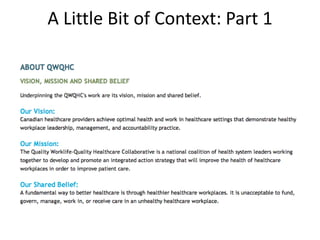
A Little Bit of Context: Part 1
A Little Bit of Context: Part 2
It is no longer an exaggeration to say that the internet is profoundly changing the way
that people and organizations communicate.

Today’s world of mass, instantaneous digital communication can seem overwhelming.

Social media channels like blogs, Facebook, Twitter, YouTube and Skype are expanding
possibilities for connecting, collaborating and sharing information globally.

The public has already embraced these channels. The patient is using the web and
mobile technology to access and share information like never before.

The same is true for many healthcare professionals across Canada and around the
world.

This presentation will explore how social media may be used to increase the quality of
our work-life relationships and the quality of the healthcare that we provide while
delivering to us useful data and metrics for future improvement.
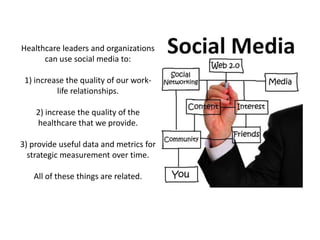
Healthcare leaders and organizations
      can use social media to:

 1) increase the quality of our work-
          life relationships.

    2) increase the quality of the
    healthcare that we provide.

3) provide useful data and metrics for
  strategic measurement over time.

   All of these things are related.
Healthcare leaders and
organizations can use social media
 to help increase quality worklife
        and healthcare by:

1) Creating Open Communication
        and Collaboration

 2) Being Responsive, Embracing
             Mobile

    3) Measuring and Adapting

* this is not an exhaustive list, there are many
  more ideas and strategies to be explored.
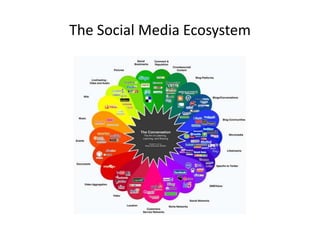
The Social Media Ecosystem
Open Communication and Collaboration
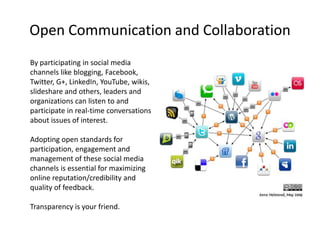
By participating in social media
channels like blogging, Facebook,
Twitter, G+, LinkedIn, YouTube, wikis,
slideshare and others, leaders and
organizations can listen to and
participate in real-time conversations
about issues of interest.

Adopting open standards for
participation, engagement and
management of these social media
channels is essential for maximizing
online reputation/credibility and
quality of feedback.

Transparency is your friend.
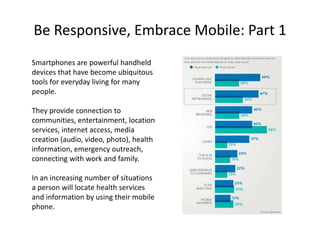
Be Responsive, Embrace Mobile: Part 1
Smartphones are powerful handheld
devices that have become ubiquitous
tools for everyday living for many
people.

They provide connection to
communities, entertainment, location
services, internet access, media
creation (audio, video, photo), health
information, emergency outreach,
connecting with work and family.

In an increasing number of situations
a person will locate health services
and information by using their mobile
phone.
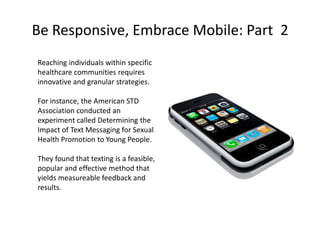
Be Responsive, Embrace Mobile: Part 2
Reaching individuals within specific
healthcare communities requires
innovative and granular strategies.

For instance, the American STD
Association conducted an
experiment called Determining the
Impact of Text Messaging for Sexual
Health Promotion to Young People.

They found that texting is a feasible,
popular and effective method that
yields measureable feedback and
results.
Measure and Adapt
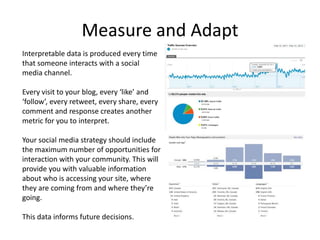
Interpretable data is produced every time
that someone interacts with a social
media channel.

Every visit to your blog, every ‘like’ and
‘follow’, every retweet, every share, every
comment and response creates another
metric for you to interpret.

Your social media strategy should include
the maximum number of opportunities for
interaction with your community. This will
provide you with valuable information
about who is accessing your site, where
they are coming from and where they’re
going.

This data informs future decisions.
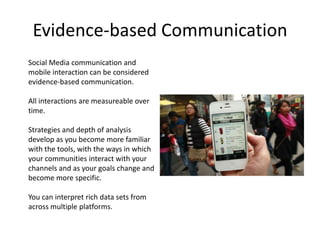
Evidence-based Communication
Social Media communication and
mobile interaction can be considered
evidence-based communication.

All interactions are measureable over
time.

Strategies and depth of analysis
develop as you become more familiar
with the tools, with the ways in which
your communities interact with your
channels and as your goals change and
become more specific.

You can interpret rich data sets from
across multiple platforms.
Social Media Readiness
• Open Communication promotes
  engagement, credibility,
  discoverability and respect.

• Embracing Mobile connects you to
  colleagues and patients in real
  time 24/7.

• Measuring and Adapting allows
  you to understand you
  communities, see opportunities
  for growth, and deliver specific
  improvements based on real
  interactions.
About My Work:                                           Sean Cranbury
Social Media Strategy + Communications               Twitter: @seancranbury
Healthcare Orgs, Non-Profits, IPE/C      Email: sean@monkeytreecreative.com

Quality Worklife Quality Healthcare Collaborative Presentation

  • 1.
    Social Media Readinessfor Healthcare Organizations Sean Cranbury Director, Communications and Social Media Monkeytree Creative Twitter: @seancranbury | @monkeycreates Email: sean@monkeytreecreative.com Cell: 778-987-8774
  • 2.
    About My Work: Sean Cranbury Social Media Strategy + Communications Twitter: @seancranbury Healthcare Orgs, Non-Profits, IPE/C Email: sean@monkeytreecreative.com
  • 3.
    A Little Bitof Context: Part 1
  • 4.
    A Little Bitof Context: Part 2 It is no longer an exaggeration to say that the internet is profoundly changing the way that people and organizations communicate. Today’s world of mass, instantaneous digital communication can seem overwhelming. Social media channels like blogs, Facebook, Twitter, YouTube and Skype are expanding possibilities for connecting, collaborating and sharing information globally. The public has already embraced these channels. The patient is using the web and mobile technology to access and share information like never before. The same is true for many healthcare professionals across Canada and around the world. This presentation will explore how social media may be used to increase the quality of our work-life relationships and the quality of the healthcare that we provide while delivering to us useful data and metrics for future improvement.
  • 5.
    Healthcare leaders andorganizations can use social media to: 1) increase the quality of our work- life relationships. 2) increase the quality of the healthcare that we provide. 3) provide useful data and metrics for strategic measurement over time. All of these things are related.
  • 6.
    Healthcare leaders and organizationscan use social media to help increase quality worklife and healthcare by: 1) Creating Open Communication and Collaboration 2) Being Responsive, Embracing Mobile 3) Measuring and Adapting * this is not an exhaustive list, there are many more ideas and strategies to be explored.
  • 7.
  • 8.
    Open Communication andCollaboration By participating in social media channels like blogging, Facebook, Twitter, G+, LinkedIn, YouTube, wikis, slideshare and others, leaders and organizations can listen to and participate in real-time conversations about issues of interest. Adopting open standards for participation, engagement and management of these social media channels is essential for maximizing online reputation/credibility and quality of feedback. Transparency is your friend.
  • 9.
    Be Responsive, EmbraceMobile: Part 1 Smartphones are powerful handheld devices that have become ubiquitous tools for everyday living for many people. They provide connection to communities, entertainment, location services, internet access, media creation (audio, video, photo), health information, emergency outreach, connecting with work and family. In an increasing number of situations a person will locate health services and information by using their mobile phone.
  • 10.
    Be Responsive, EmbraceMobile: Part 2 Reaching individuals within specific healthcare communities requires innovative and granular strategies. For instance, the American STD Association conducted an experiment called Determining the Impact of Text Messaging for Sexual Health Promotion to Young People. They found that texting is a feasible, popular and effective method that yields measureable feedback and results.
  • 11.
    Measure and Adapt Interpretabledata is produced every time that someone interacts with a social media channel. Every visit to your blog, every ‘like’ and ‘follow’, every retweet, every share, every comment and response creates another metric for you to interpret. Your social media strategy should include the maximum number of opportunities for interaction with your community. This will provide you with valuable information about who is accessing your site, where they are coming from and where they’re going. This data informs future decisions.
  • 12.
    Evidence-based Communication Social Mediacommunication and mobile interaction can be considered evidence-based communication. All interactions are measureable over time. Strategies and depth of analysis develop as you become more familiar with the tools, with the ways in which your communities interact with your channels and as your goals change and become more specific. You can interpret rich data sets from across multiple platforms.
  • 13.
    Social Media Readiness •Open Communication promotes engagement, credibility, discoverability and respect. • Embracing Mobile connects you to colleagues and patients in real time 24/7. • Measuring and Adapting allows you to understand you communities, see opportunities for growth, and deliver specific improvements based on real interactions.
  • 14.
    About My Work: Sean Cranbury Social Media Strategy + Communications Twitter: @seancranbury Healthcare Orgs, Non-Profits, IPE/C Email: sean@monkeytreecreative.com