Quality Control
Protocol for
Preparation Batch
Processing
WASTE WATER ANALYSIS
SUMMARY
Each analytical batch contains quality control samples such as method
blank, laboratory control sample/duplicate, sample duplicate and
sample/duplicate which is according to the Quality Control Section of
analysis’ standard operating procedures.
For analysis wherein Standard Method for Water and Wastewater
was used as reference, quality control samples are based on the quality
control practices Table 2020 of SMEWW.
PREPARATION
OF BATCH
 A group of samples of like matrices processed
together as a group within the same shift using the
same reagents. Each batch must minimally contain a
method blank, a laboratory control sample, and a
laboratory control sample duplicate. A batch can be
defined as one of the following:
 A set of field samples, less than or equal to 20 in
number, from multiple work orders that are processed
together, or
 A set of field samples, less than or equal to 20 in
number, from one work order that are processed
together
METHOD
BLANK
 The method blank is an interference free matrix to
which all reagents are added in the same volumes or
proportions as used in sample processing. The
method blank must be carried through the complete
sample preparation and analytical procedure. The
method blank is used to document the
presence/absence of contamination resulting from
the analytical process.
 As a minimum include one reagent blank with each
sample set (batch) or on a 5% basis, whichever is more
frequent.
METHOD
BLANK
 EVALUATION OF BLANK
 If the reagent blank is less than the MDL and
sample results are greater than the MQL, then no
qualification is required.
 If the blank is greater than the MDL, but less
than the MQL and sample results are greater
than the MQL, then qualify the results to indicate
the analyte was detected in the reagent blank
 If the reagent blank is greater than the MQL,
further corrective action and qualification is
required.
LABORATORY
CONTROL
SAMPLE/
DUPLICATE
(LCS/LCSD)
 An interference free matrix spiked with a known
concentration of target analyte(s) prior to sample
preparation and analysis. The Laboratory Control
Sample is used to assess analytical accuracy
independent of matrix interference.
 At least10 times the MDL
 Midpoint calibration
 Analyzed every batch of analysis
LABORATORY CONTROL SAMPLE/DUPLICATE
(LCS/LCSD)
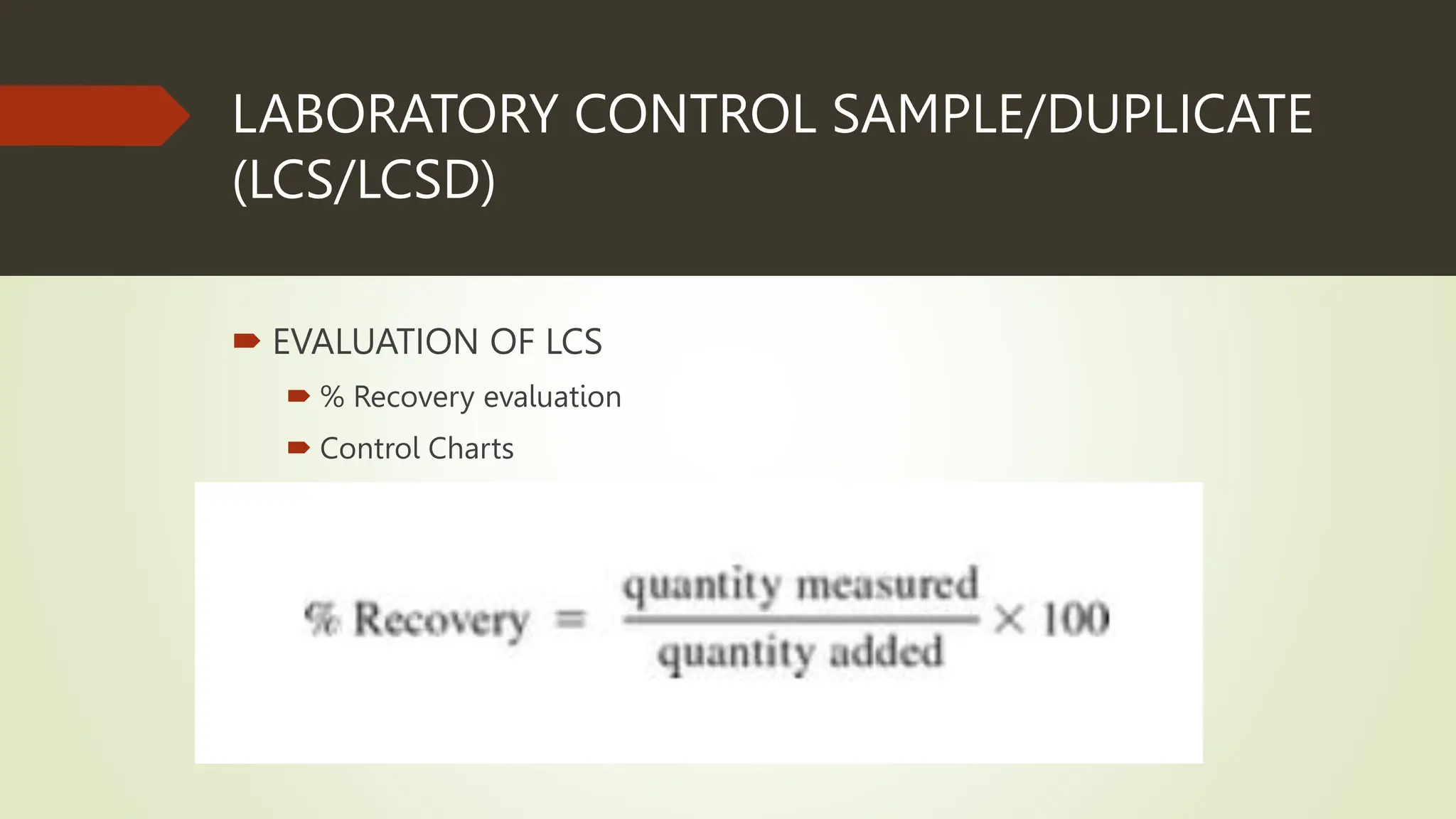
 EVALUATION OF LCS
 % Recovery evaluation
 Control Charts
LABORATORY-
FORTIFIED
MATRIX (LFM)
 An additional portion of a sample to which a known
amount of the analyte of interest is added before
sample preparation.
 Some analytes are not appropriate for LFM analysis.
 At least one LFM per batch
LABORATORY- FORTIFIED MATRIX (LFM)
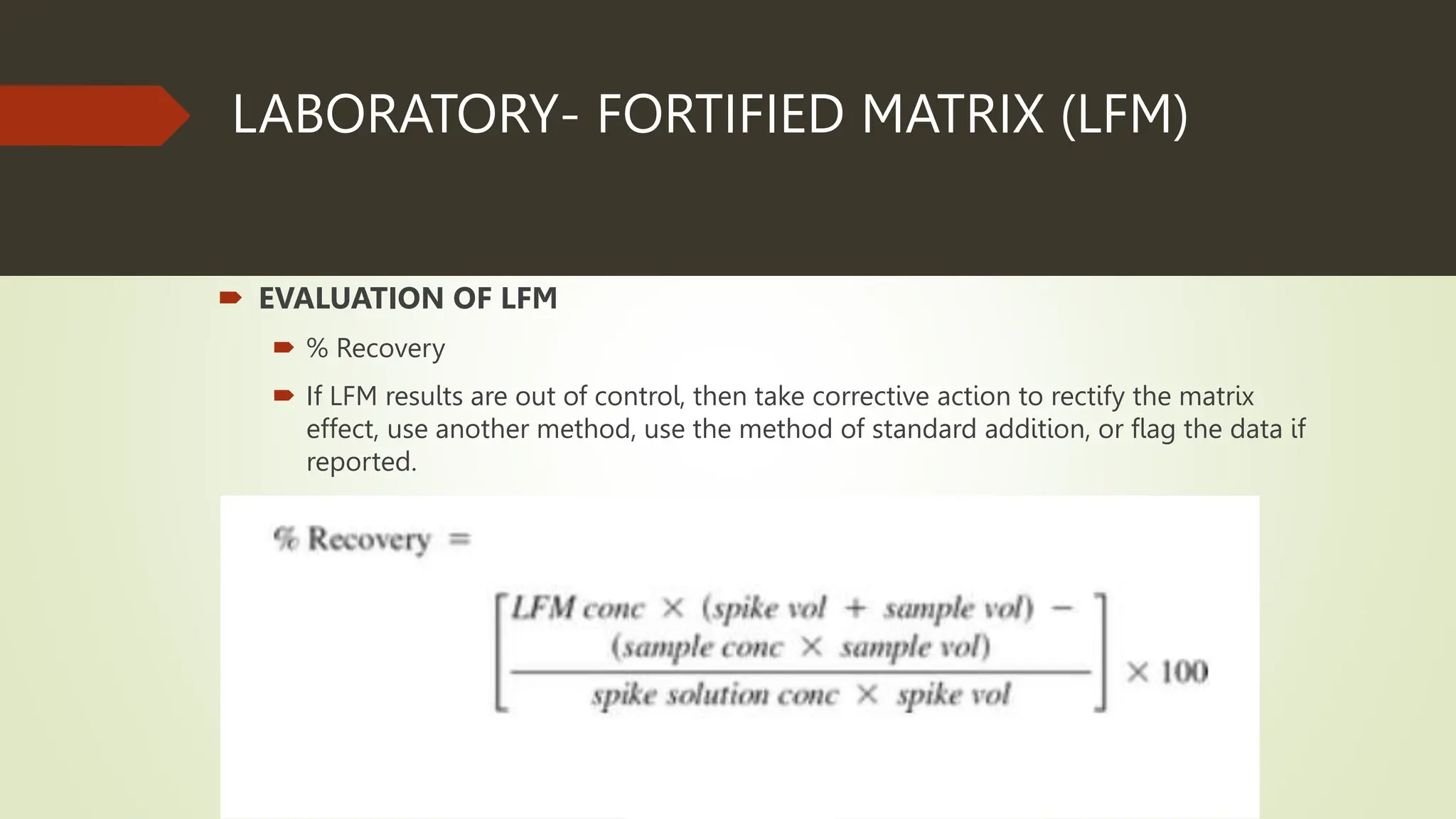
 EVALUATION OF LFM
 % Recovery
 If LFM results are out of control, then take corrective action to rectify the matrix
effect, use another method, use the method of standard addition, or flag the data if
reported.
SAMPLE
DUPLICATE (DUP)
 A duplicate aliquot of field sample
processed as a separate sample. The
duplicate is used to assess precision of the
analytical process and monitor sample
homogeneity.
 Gravimetric- one duplicate every 10 samples
(LOW and HIGH)
 Spectrophotometric – one every batch
 Titrimetric – one every batch
 Electrometric and Others– one duplicate every
10 samples
SAMPLE DUPLICATE (DUP)
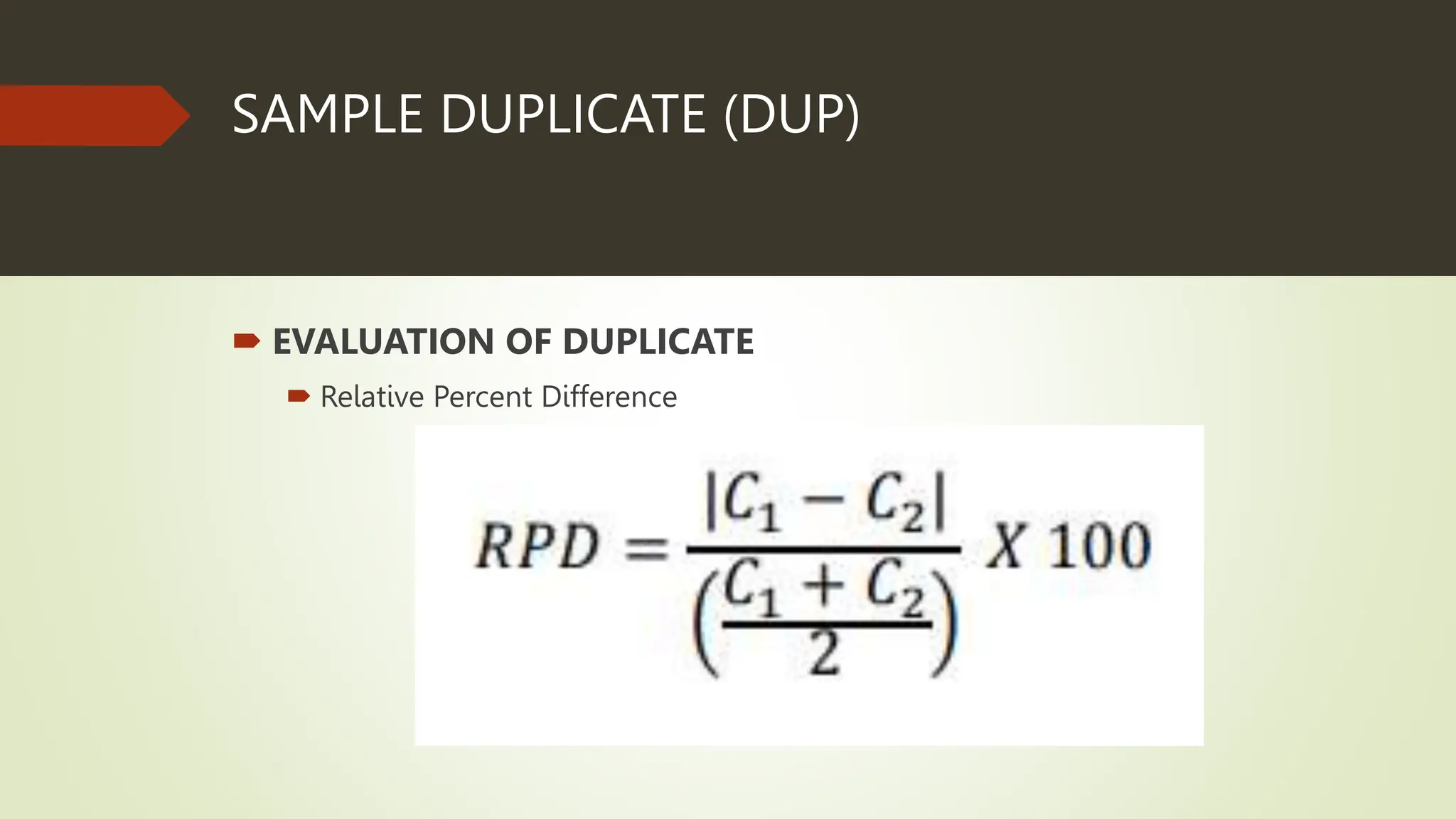
 EVALUATION OF DUPLICATE
 Relative Percent Difference
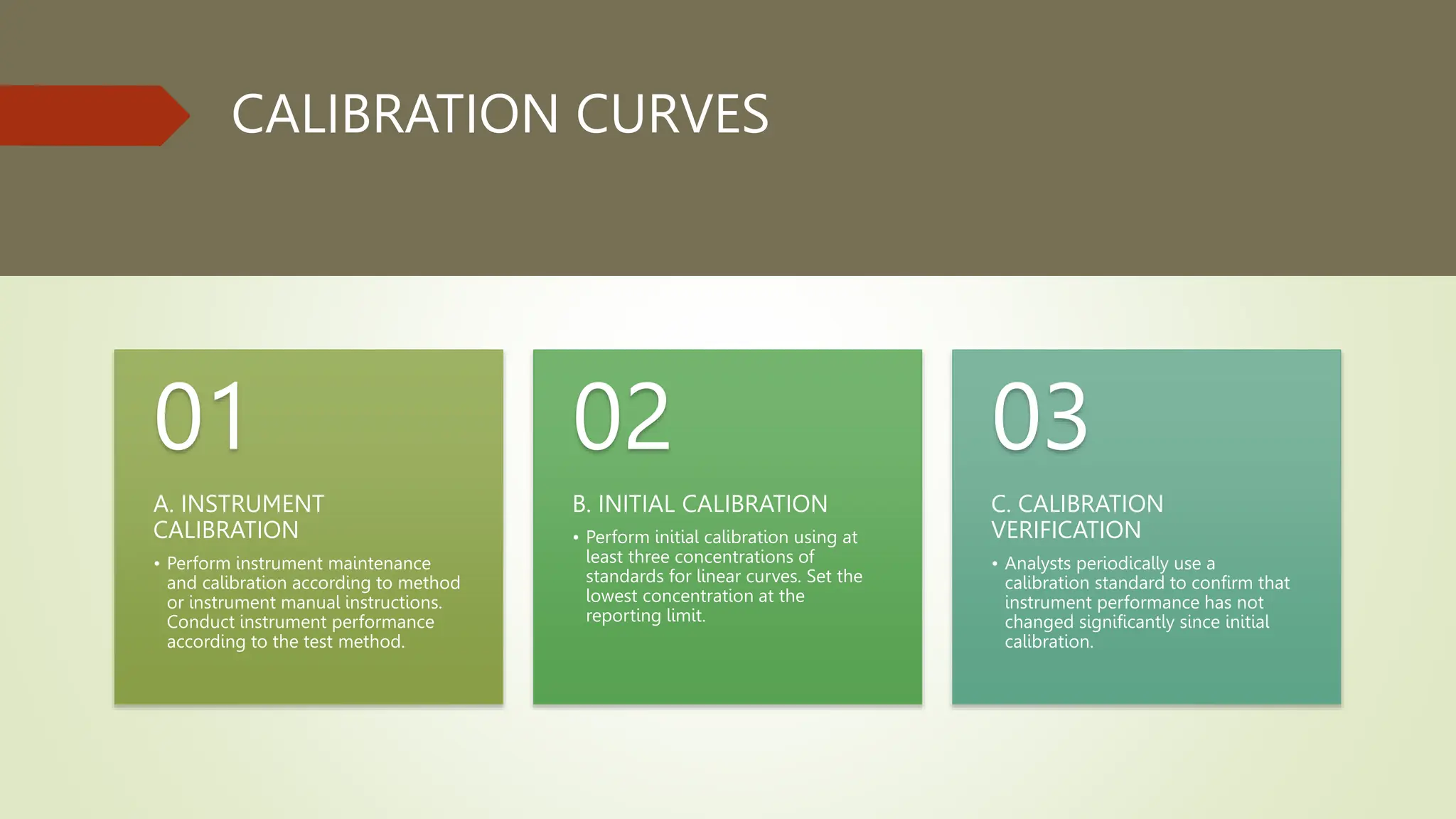
CALIBRATION CURVES
A. INSTRUMENT
CALIBRATION
• Perform instrument maintenance
and calibration according to method
or instrument manual instructions.
Conduct instrument performance
according to the test method.
01
B. INITIAL CALIBRATION
• Perform initial calibration using at
least three concentrations of
standards for linear curves. Set the
lowest concentration at the
reporting limit.
02
C. CALIBRATION
VERIFICATION
• Analysts periodically use a
calibration standard to confirm that
instrument performance has not
changed significantly since initial
calibration.
03
CALIBRATION CURVES
 EVALUATION OF CURVES
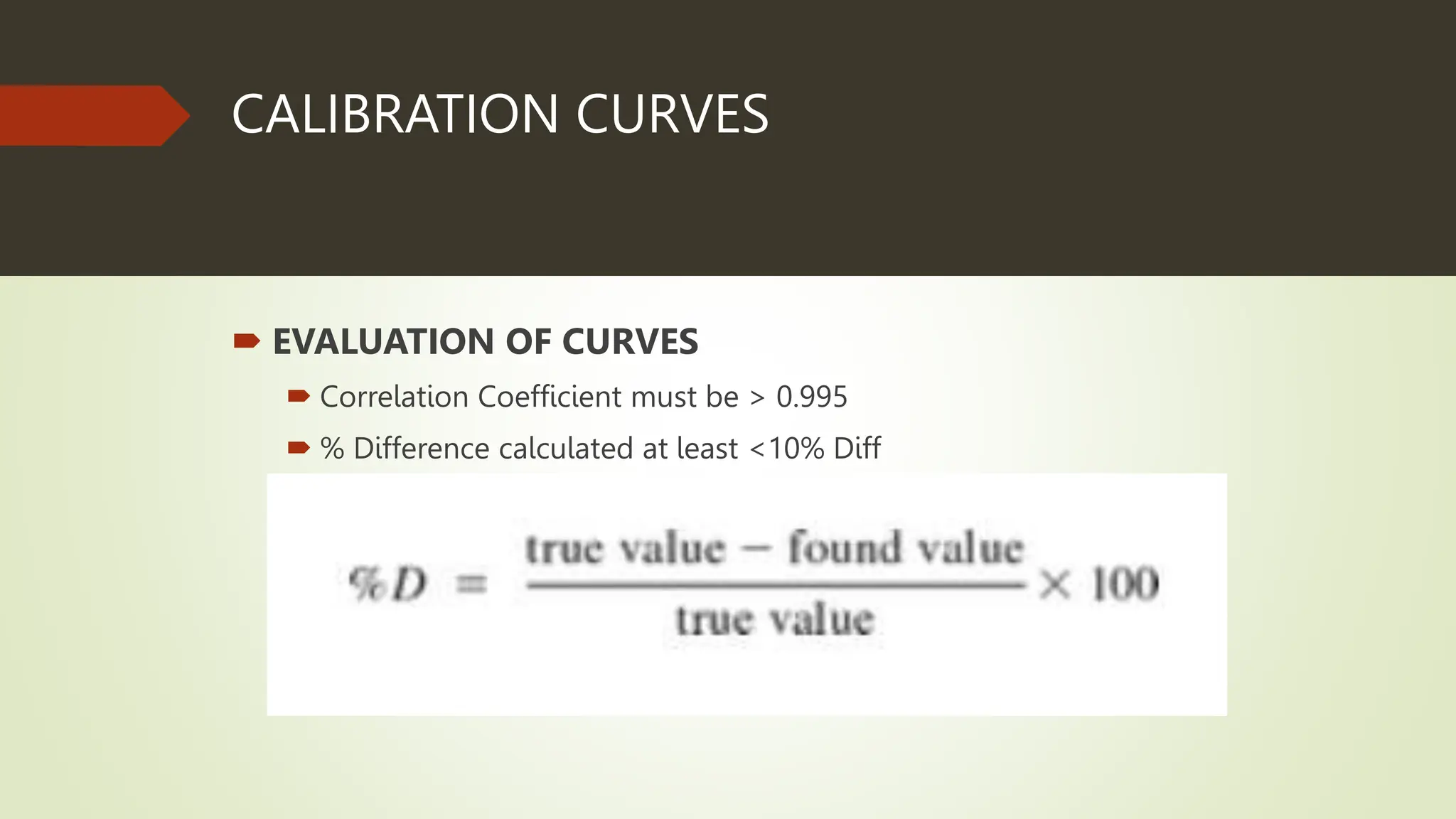
 Correlation Coefficient must be > 0.995
 % Difference calculated at least <10% Diff
CALIBRATION
VERIFICATION
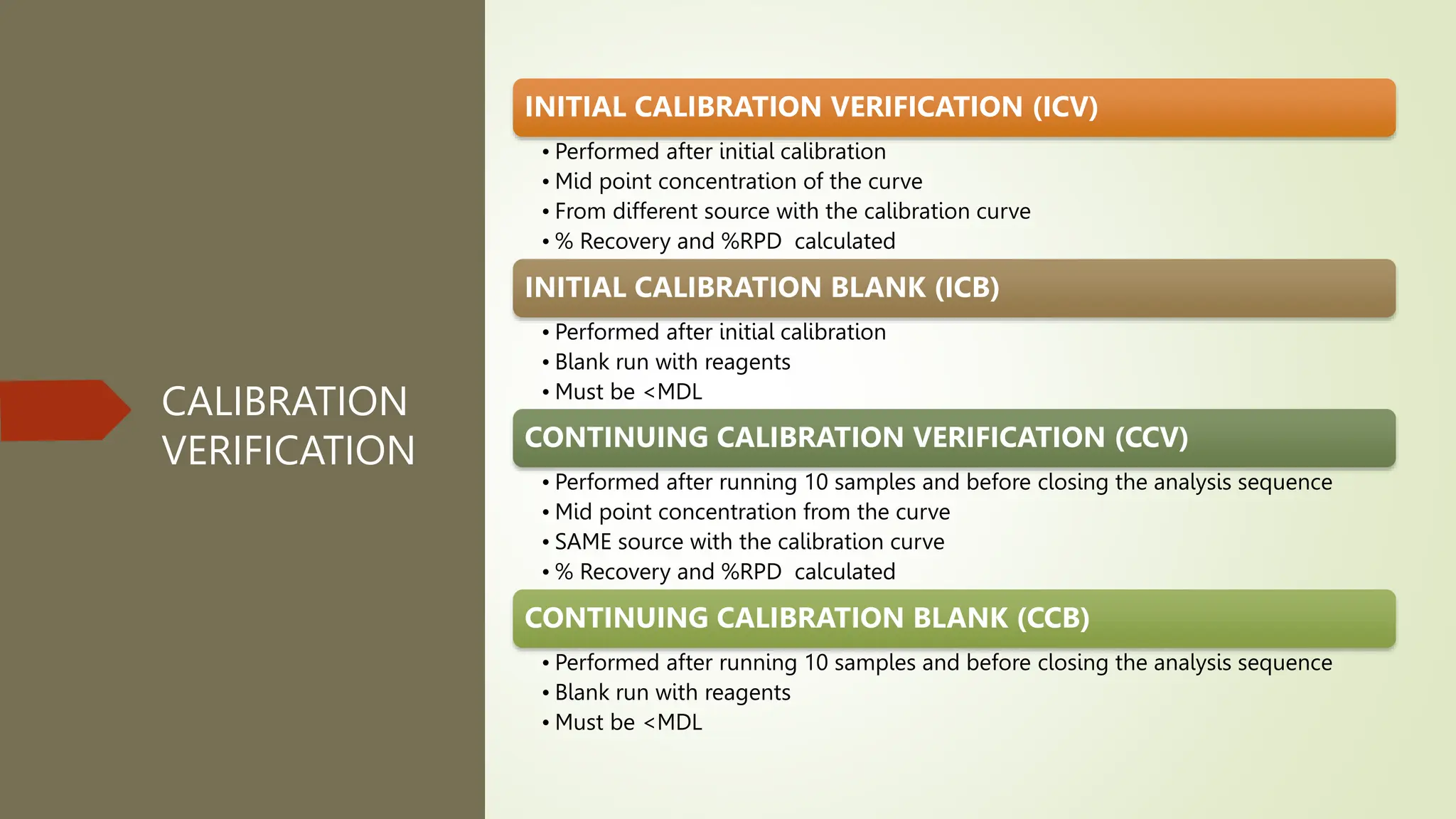
INITIAL CALIBRATION VERIFICATION (ICV)
• Performed after initial calibration
• Mid point concentration of the curve
• From different source with the calibration curve
• % Recovery and %RPD calculated
INITIAL CALIBRATION BLANK (ICB)
• Performed after initial calibration
• Blank run with reagents
• Must be <MDL
CONTINUING CALIBRATION VERIFICATION (CCV)
• Performed after running 10 samples and before closing the analysis sequence
• Mid point concentration from the curve
• SAME source with the calibration curve
• % Recovery and %RPD calculated
CONTINUING CALIBRATION BLANK (CCB)
• Performed after running 10 samples and before closing the analysis sequence
• Blank run with reagents
• Must be <MDL

Quality Control and Batch Processing.pptx

  • 1.
    Quality Control Protocol for PreparationBatch Processing WASTE WATER ANALYSIS
  • 2.
    SUMMARY Each analytical batchcontains quality control samples such as method blank, laboratory control sample/duplicate, sample duplicate and sample/duplicate which is according to the Quality Control Section of analysis’ standard operating procedures. For analysis wherein Standard Method for Water and Wastewater was used as reference, quality control samples are based on the quality control practices Table 2020 of SMEWW.
  • 3.
    PREPARATION OF BATCH  Agroup of samples of like matrices processed together as a group within the same shift using the same reagents. Each batch must minimally contain a method blank, a laboratory control sample, and a laboratory control sample duplicate. A batch can be defined as one of the following:  A set of field samples, less than or equal to 20 in number, from multiple work orders that are processed together, or  A set of field samples, less than or equal to 20 in number, from one work order that are processed together
  • 4.
    METHOD BLANK  The methodblank is an interference free matrix to which all reagents are added in the same volumes or proportions as used in sample processing. The method blank must be carried through the complete sample preparation and analytical procedure. The method blank is used to document the presence/absence of contamination resulting from the analytical process.  As a minimum include one reagent blank with each sample set (batch) or on a 5% basis, whichever is more frequent.
  • 5.
    METHOD BLANK  EVALUATION OFBLANK  If the reagent blank is less than the MDL and sample results are greater than the MQL, then no qualification is required.  If the blank is greater than the MDL, but less than the MQL and sample results are greater than the MQL, then qualify the results to indicate the analyte was detected in the reagent blank  If the reagent blank is greater than the MQL, further corrective action and qualification is required.
  • 6.
    LABORATORY CONTROL SAMPLE/ DUPLICATE (LCS/LCSD)  An interferencefree matrix spiked with a known concentration of target analyte(s) prior to sample preparation and analysis. The Laboratory Control Sample is used to assess analytical accuracy independent of matrix interference.  At least10 times the MDL  Midpoint calibration  Analyzed every batch of analysis
  • 7.
    LABORATORY CONTROL SAMPLE/DUPLICATE (LCS/LCSD) EVALUATION OF LCS  % Recovery evaluation  Control Charts
  • 8.
    LABORATORY- FORTIFIED MATRIX (LFM)  Anadditional portion of a sample to which a known amount of the analyte of interest is added before sample preparation.  Some analytes are not appropriate for LFM analysis.  At least one LFM per batch
  • 9.
    LABORATORY- FORTIFIED MATRIX(LFM)  EVALUATION OF LFM  % Recovery  If LFM results are out of control, then take corrective action to rectify the matrix effect, use another method, use the method of standard addition, or flag the data if reported.
  • 10.
    SAMPLE DUPLICATE (DUP)  Aduplicate aliquot of field sample processed as a separate sample. The duplicate is used to assess precision of the analytical process and monitor sample homogeneity.  Gravimetric- one duplicate every 10 samples (LOW and HIGH)  Spectrophotometric – one every batch  Titrimetric – one every batch  Electrometric and Others– one duplicate every 10 samples
  • 11.
    SAMPLE DUPLICATE (DUP) EVALUATION OF DUPLICATE  Relative Percent Difference
  • 12.
    CALIBRATION CURVES A. INSTRUMENT CALIBRATION •Perform instrument maintenance and calibration according to method or instrument manual instructions. Conduct instrument performance according to the test method. 01 B. INITIAL CALIBRATION • Perform initial calibration using at least three concentrations of standards for linear curves. Set the lowest concentration at the reporting limit. 02 C. CALIBRATION VERIFICATION • Analysts periodically use a calibration standard to confirm that instrument performance has not changed significantly since initial calibration. 03
  • 13.
    CALIBRATION CURVES  EVALUATIONOF CURVES  Correlation Coefficient must be > 0.995  % Difference calculated at least <10% Diff
  • 14.
    CALIBRATION VERIFICATION INITIAL CALIBRATION VERIFICATION(ICV) • Performed after initial calibration • Mid point concentration of the curve • From different source with the calibration curve • % Recovery and %RPD calculated INITIAL CALIBRATION BLANK (ICB) • Performed after initial calibration • Blank run with reagents • Must be <MDL CONTINUING CALIBRATION VERIFICATION (CCV) • Performed after running 10 samples and before closing the analysis sequence • Mid point concentration from the curve • SAME source with the calibration curve • % Recovery and %RPD calculated CONTINUING CALIBRATION BLANK (CCB) • Performed after running 10 samples and before closing the analysis sequence • Blank run with reagents • Must be <MDL