QUALIFICATION and
VALIDATION
Vinod Chauhan
M. Pharm (Quality Assurance Professional)
 .
 .
 .
 .
 .
 .
VALIDATION MASTER PLAN (VMP)
The Validation Master Plan (VMP) is a document providing information on the company’s
qualification & validation programme. It should define details of and timescales for the
validation work to be performed.
 A VMP helps management: - to know what the validation programme involves with respect
to time, people and money.
 A VMP helps all members of the validation team: - to know their tasks and responsibilities.
 A VMP helps GMP inspectors: - to understand the approach of qualification & validation
activities.
 A VMP helps to Provides a structured overview of all validation efforts across the site or
project.
 .
 .
 .
 .
 .
 .
VALIDATION MASTER PLAN (VMP)
 .
 .
 .
 .
 .
 .
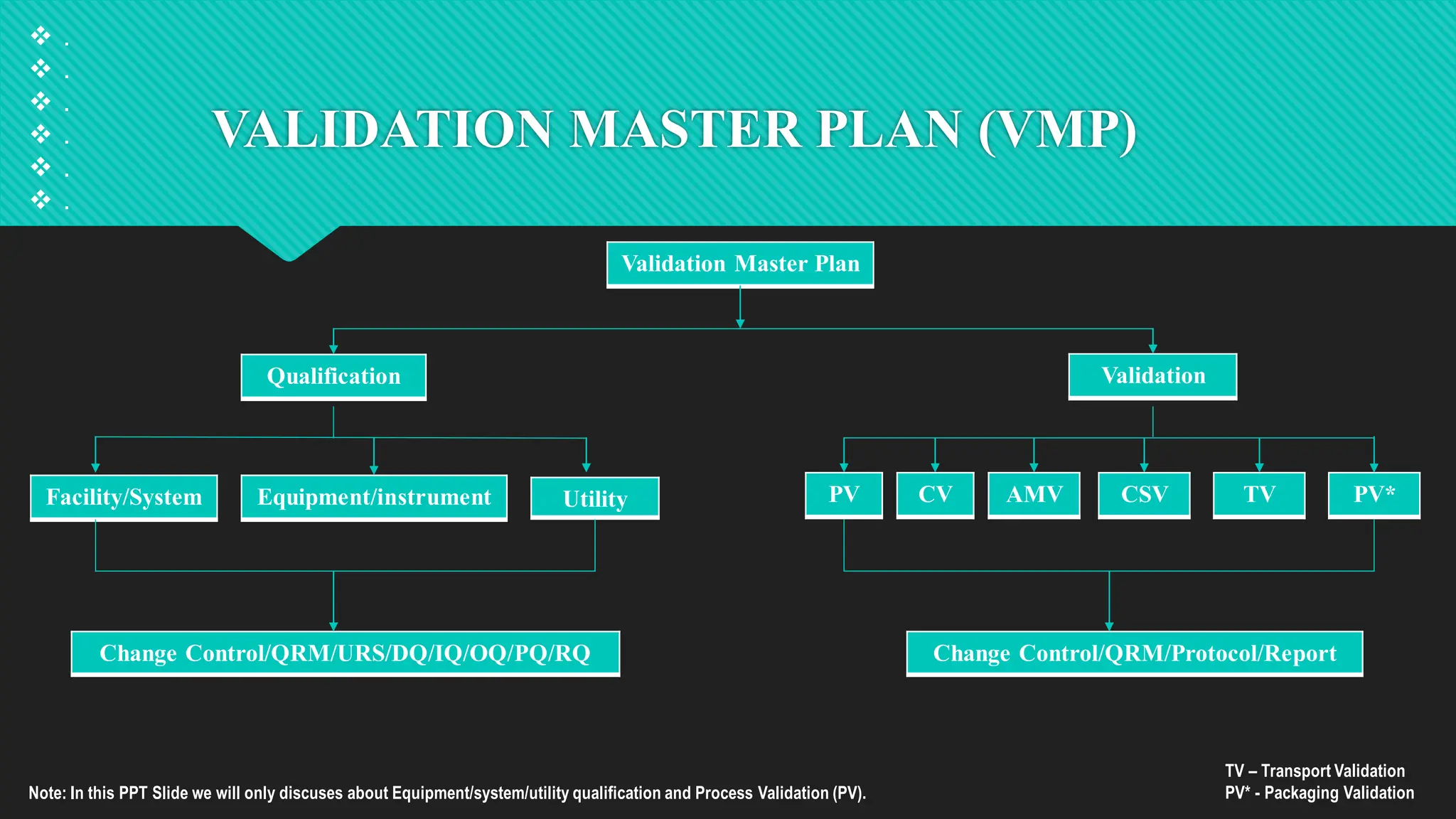
Validation Master Plan
Qualification Validation
Facility/System Equipment/instrument Utility PV CV AMV CSV TV PV*
Change Control/QRM/Protocol/Report
Change Control/QRM/URS/DQ/IQ/OQ/PQ/RQ
Note: In this PPT Slide we will only discuses about Equipment/system/utility qualification and Process Validation (PV).
TV – Transport Validation
PV* - Packaging Validation
DEFINITION
Qualification: “Qualification is the documented process of demonstrating
that equipment or systems are properly installed, operate correctly, and
consistently produce the expected results” (EU GMP Annex. 15)
Validation: “Validation is the Collection and evaluation of scientific data
providing a high degree of assurance that a process, procedure, or method
consistently produces the expected results”
(WHO TRS, No. 937 Annex. 4)
 .
 .
 .
 .
 .
 .
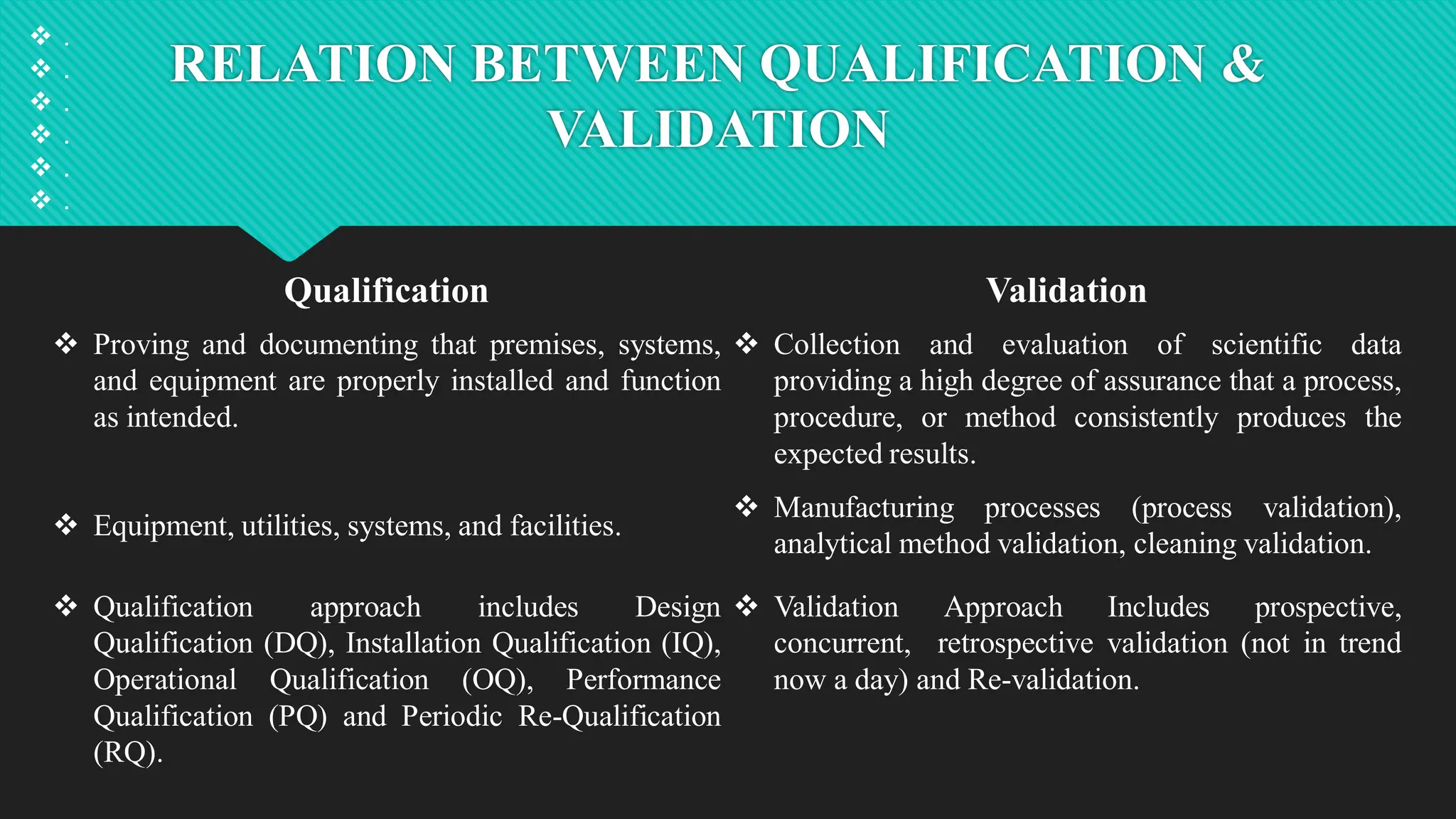
Qualification Validation
 Proving and documenting that premises, systems,
and equipment are properly installed and function
as intended.
 Collection and evaluation of scientific data
providing a high degree of assurance that a process,
procedure, or method consistently produces the
expected results.
 Equipment, utilities, systems, and facilities.
 Manufacturing processes (process validation),
analytical method validation, cleaning validation.
 Qualification approach includes Design
Qualification (DQ), Installation Qualification (IQ),
Operational Qualification (OQ), Performance
Qualification (PQ) and Periodic Re-Qualification
(RQ).
 Validation Approach Includes prospective,
concurrent, retrospective validation (not in trend
now a day) and Re-validation.
RELATION BETWEEN QUALIFICATION &
VALIDATION
 .
 .
 .
 .
 .
 .
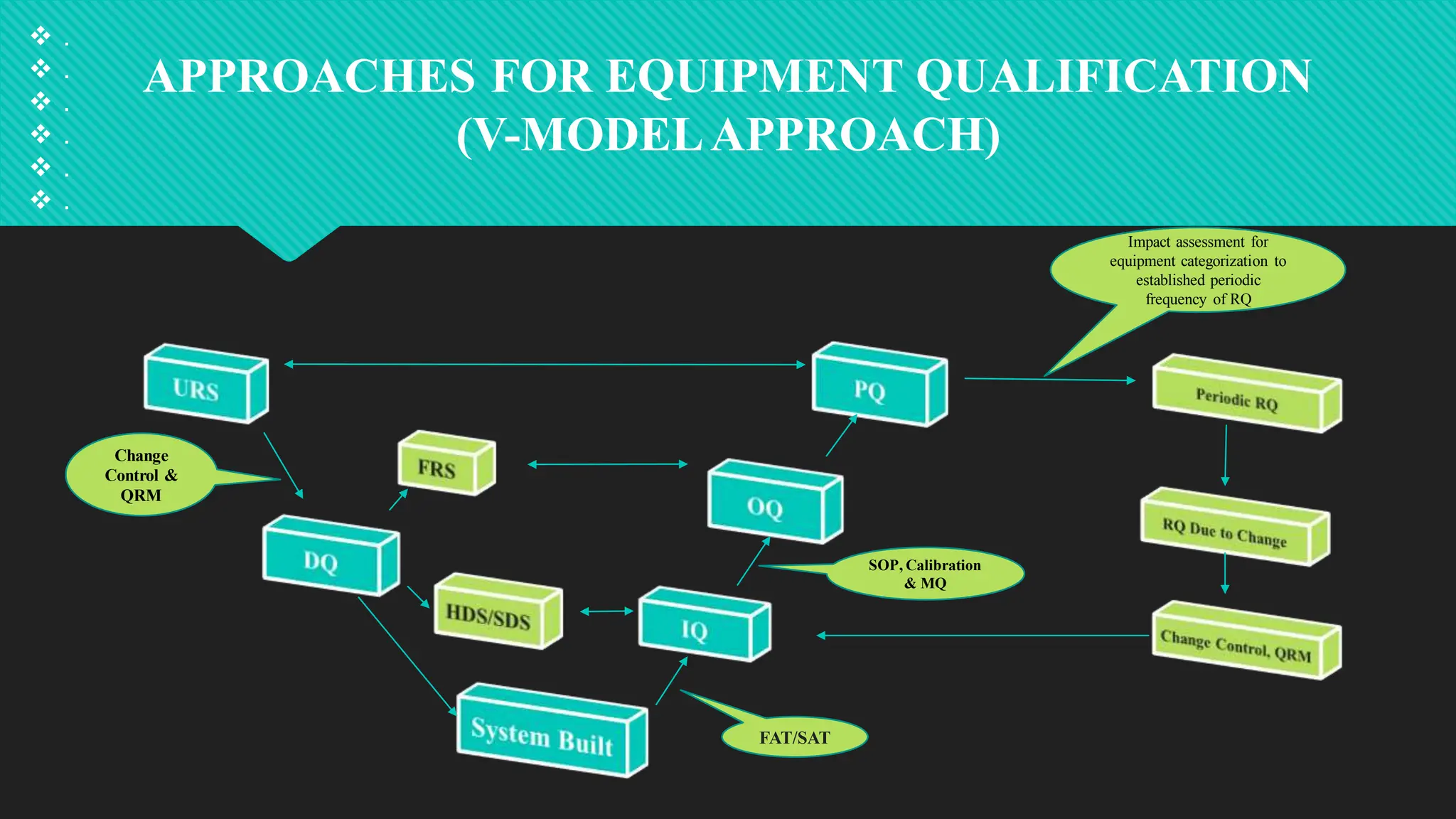
APPROACHES FOR EQUIPMENT QUALIFICATION
(V-MODELAPPROACH)
FAT/SAT
SOP, Calibration
& MQ
Change
Control &
QRM
Impact assessment for
equipment categorization to
established periodic
frequency of RQ
 .
 .
 .
 .
 .
 .
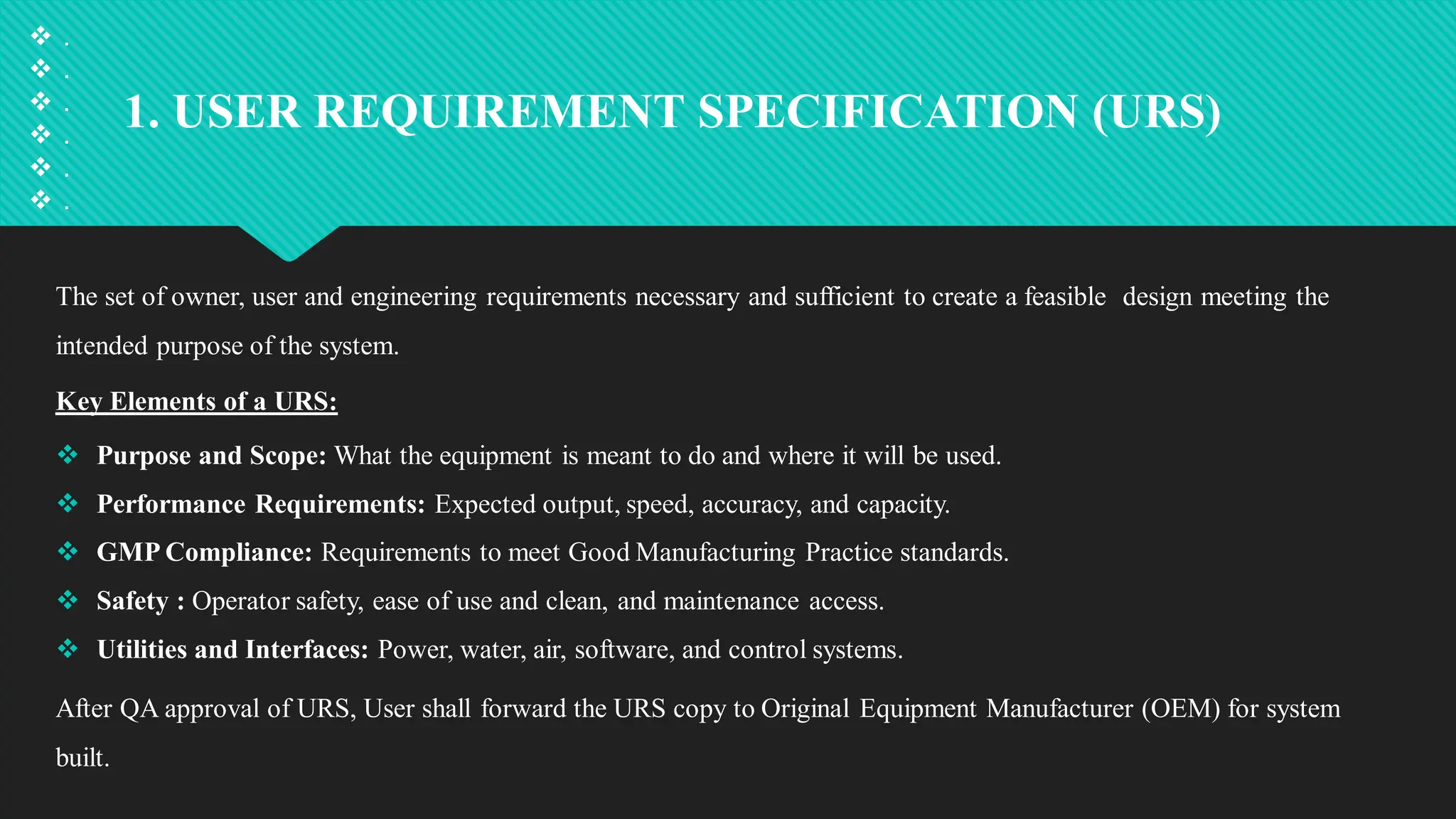
1. USER REQUIREMENT SPECIFICATION (URS)
The set of owner, user and engineering requirements necessary and sufficient to create a feasible design meeting the
intended purpose of the system.
Key Elements of a URS:
 Purpose and Scope: What the equipment is meant to do and where it will be used.
 Performance Requirements: Expected output, speed, accuracy, and capacity.
 GMP Compliance: Requirements to meet Good Manufacturing Practice standards.
 Safety : Operator safety, ease of use and clean, and maintenance access.
 Utilities and Interfaces: Power, water, air, software, and control systems.
After QA approval of URS, User shall forward the URS copy to Original Equipment Manufacturer (OEM) for system
built.
 .
 .
 .
 .
 .
 .
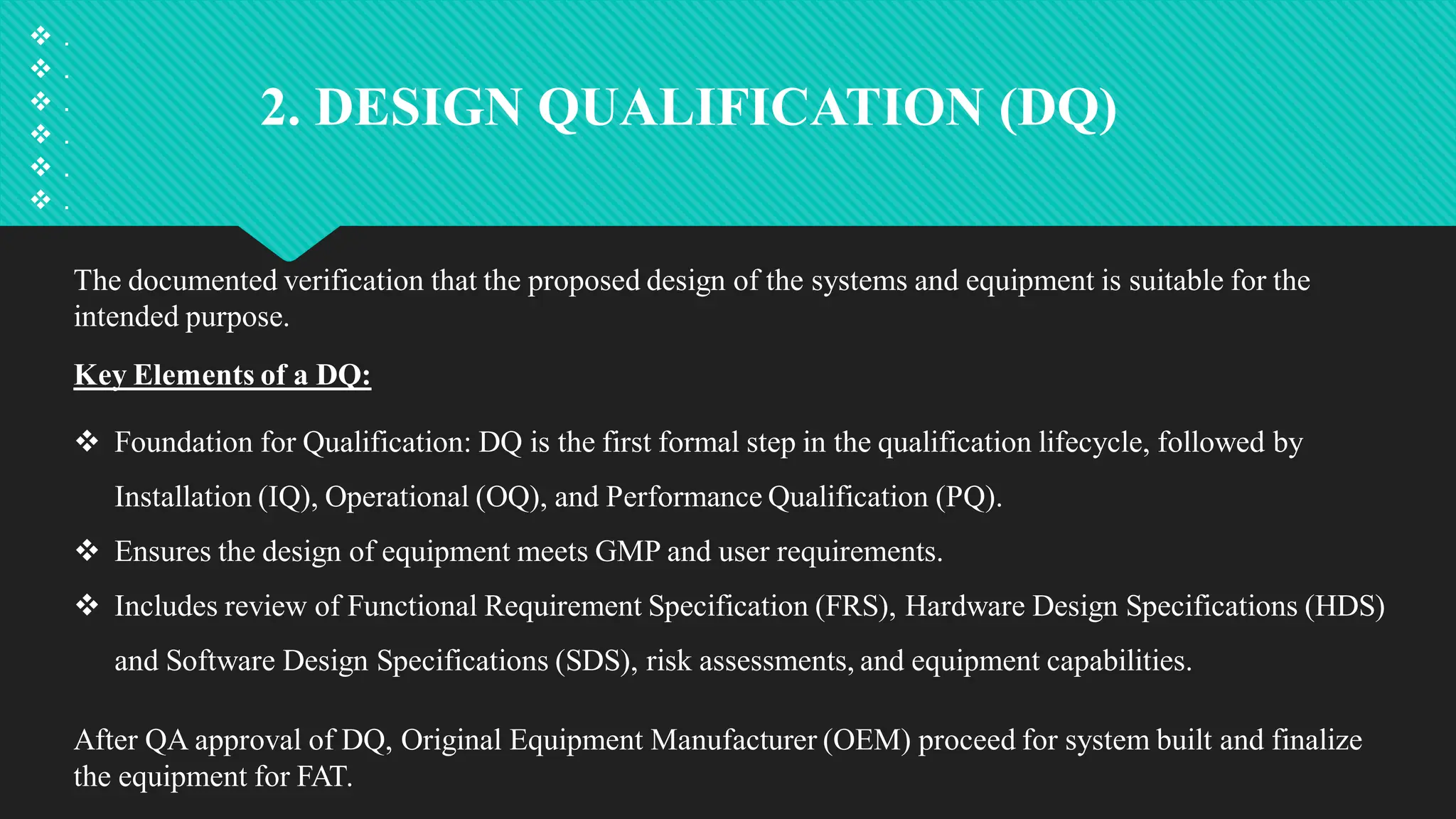
2. DESIGN QUALIFICATION (DQ)
The documented verification that the proposed design of the systems and equipment is suitable for the
intended purpose.
Key Elements of a DQ:
 Foundation for Qualification: DQ is the first formal step in the qualification lifecycle, followed by
Installation (IQ), Operational (OQ), and Performance Qualification (PQ).
 Ensures the design of equipment meets GMP and user requirements.
 Includes review of Functional Requirement Specification (FRS), Hardware Design Specifications (HDS)
and Software Design Specifications (SDS), risk assessments, and equipment capabilities.
After QA approval of DQ, Original Equipment Manufacturer (OEM) proceed for system built and finalize
the equipment for FAT.
 .
 .
 .
 .
 .
 .
3. FACTORY ACCEPTANCE TEST (FAT)
Factory Acceptance Testing is a formal process conducted at the manufacturer's site (OEM) to verify that
equipment or systems meet all the specifications and functional requirements as per DQ before delivery at the
user's facility.
Key Element of FAT:
 Ensure the equipment is built and configured correctly.
 Verify functionality, safety features, and compliance with design specifications.
 Documentation review (manuals, drawings, certificates, IQ, OQ & PQ) and training to the end user.
 Witness testing by the customer or third-party inspectors (Where applicable).
 Identify and resolve any issues before shipment.
After QA approval of FAT report, Original Equipment Manufacturer (OEM) proceed for system dispatched to the
user’s facility.
 .
 .
 .
 .
 .
 .
4. INSTALLATION QUALIFICATION (IQ)
Installation Qualification (IQ) is the documented verification that equipment, systems, or utilities have been installed correctly
according to approved design specifications and manufacturer recommendations.
Key Elements of IQ:
 Ensures all components, instruments, and connections are installed per drawings and specifications.
 Instruments and sensors are calibrated and verified.
 Confirms that materials (MOC) used meet GMP and safety requirements.
 Checks that power, water, air, and other utility services are properly connected.
 Equipment is clearly labeled (Name and ID of the equipment).
 Ready the pre-requisite of OQ (e.g. Draft SOP, calibration of instruments & Preventive Maintenance check list)
After QA approval of IQ report, Proceed for OQ activities.
 .
 .
 .
 .
 .
 .
5. OPERATIONAL QUALIFICATION (OQ)
Operational Qualification (OQ) is the documented verification that equipment, systems, or utilities perform as intended
throughout all anticipated operating ranges. It ensures that the equipment functions correctly under normal and worst-case
conditions.
Key Elements of OQ:
 Functional Testing: Verifies that all controls, alarms, interlocks, and displays operate as designed.
 Operating Limits: Confirms performance across upper and lower operating ranges, including worst-case scenarios.
 Process Simulation: May include dry runs or use of simulated materials to mimic actual production conditions.
 Standard Operating Procedures (SOPs): Finalizes SOPs for operation, cleaning, and maintenance.
 Training and Documentation: Ensures operators are trained and documentation is complete.
Note: OQ normally follows IQ but depending on the complexity of the equipment, it may be performed as a combined
Installation/Operation Qualification (IOQ).
After QA approval of OQ report, ready the pre-requisite of PQ and Proceed for activities.
 .
 .
 .
 .
 .
 .
6. PERFORMANCE QUALIFICATION (PQ)
Performance Qualification (PQ) is the documented verification that equipment, systems, or utilities consistently perform
according to predefined specifications under routine operating conditions.
Key Elements of PQ:
 Routine Use Testing: Confirms that the equipment performs reliably during actual production.
 Reproducibility: Demonstrates consistent results over time and across multiple runs (triplicate run at each speed).
 Acceptance Criteria: Results must meet predefined specifications and quality standards.
 Data Collection: Includes monitoring of critical parameters and performance metrics.
 Worst-Case Conditions: May include testing under stress or edge-of-range conditions to ensure robustness.
Note: PQ should follow the successful completion of IQ and OQ. However, it may in some cases be appropriate to perform it in
conjunction with OQ or Process Validation (EU GMP Annex. 15).
After QA approval of PQ report, equipment should be release for its intended purpose.
 .
 .
 .
 .
 .
 .
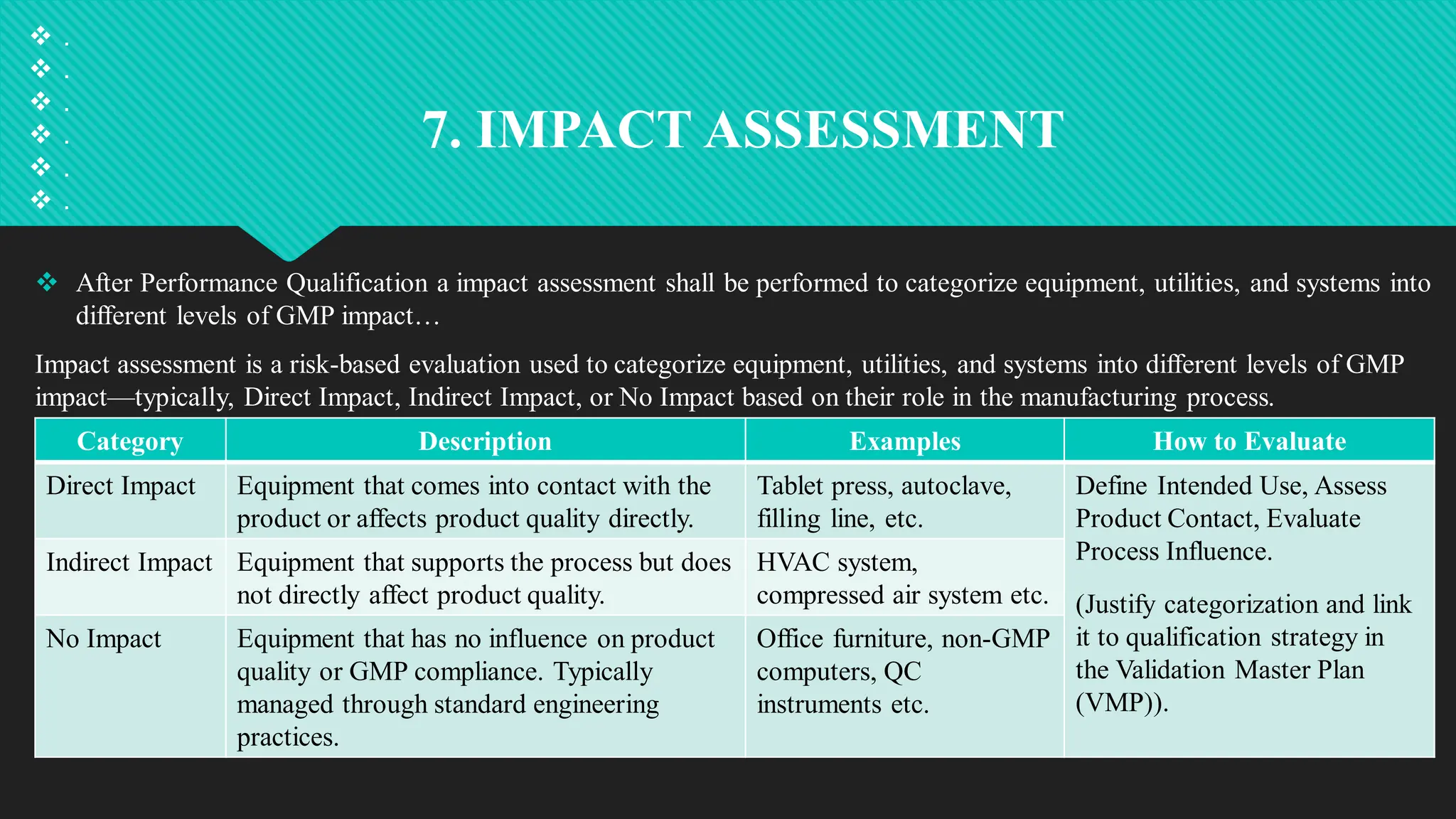
7. IMPACT ASSESSMENT
 After Performance Qualification a impact assessment shall be performed to categorize equipment, utilities, and systems into
different levels of GMP impact…
Impact assessment is a risk-based evaluation used to categorize equipment, utilities, and systems into different levels of GMP
impact—typically, Direct Impact, Indirect Impact, or No Impact based on their role in the manufacturing process.
 .
 .
 .
 .
 .
 .
Category Description Examples How to Evaluate
Direct Impact Equipment that comes into contact with the
product or affects product quality directly.
Tablet press, autoclave,
filling line, etc.
Define Intended Use, Assess
Product Contact, Evaluate
Process Influence.
(Justify categorization and link
it to qualification strategy in
the Validation Master Plan
(VMP)).
Indirect Impact Equipment that supports the process but does
not directly affect product quality.
HVAC system,
compressed air system etc.
No Impact Equipment that has no influence on product
quality or GMP compliance. Typically
managed through standard engineering
practices.
Office furniture, non-GMP
computers, QC
instruments etc.
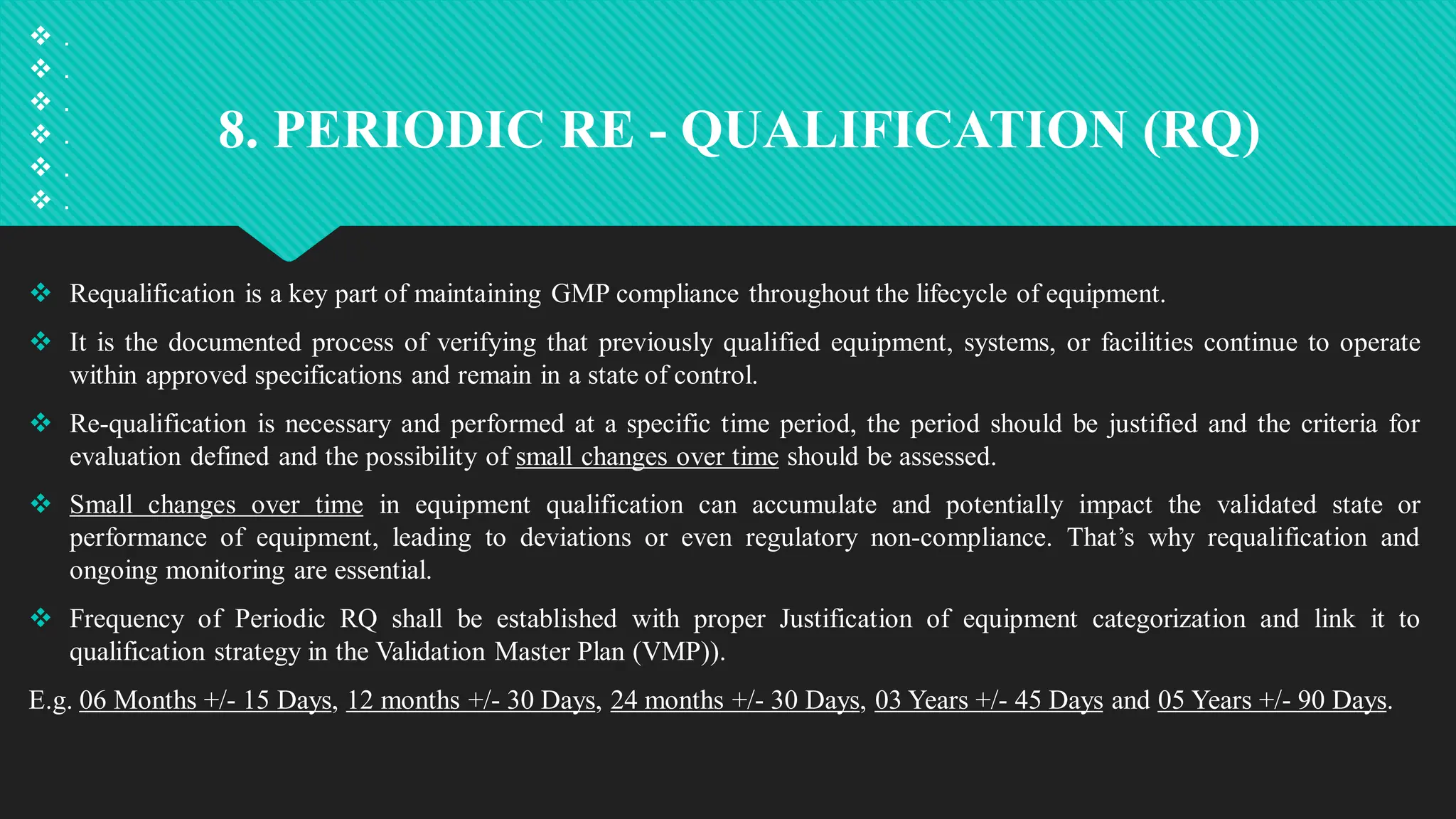
8. PERIODIC RE - QUALIFICATION (RQ)
 Requalification is a key part of maintaining GMP compliance throughout the lifecycle of equipment.
 It is the documented process of verifying that previously qualified equipment, systems, or facilities continue to operate
within approved specifications and remain in a state of control.
 Re-qualification is necessary and performed at a specific time period, the period should be justified and the criteria for
evaluation defined and the possibility of small changes over time should be assessed.
 Small changes over time in equipment qualification can accumulate and potentially impact the validated state or
performance of equipment, leading to deviations or even regulatory non-compliance. That’s why requalification and
ongoing monitoring are essential.
 Frequency of Periodic RQ shall be established with proper Justification of equipment categorization and link it to
qualification strategy in the Validation Master Plan (VMP)).
E.g. 06 Months +/- 15 Days, 12 months +/- 30 Days, 24 months +/- 30 Days, 03 Years +/- 45 Days and 05 Years +/- 90 Days.
 .
 .
 .
 .
 .
 .
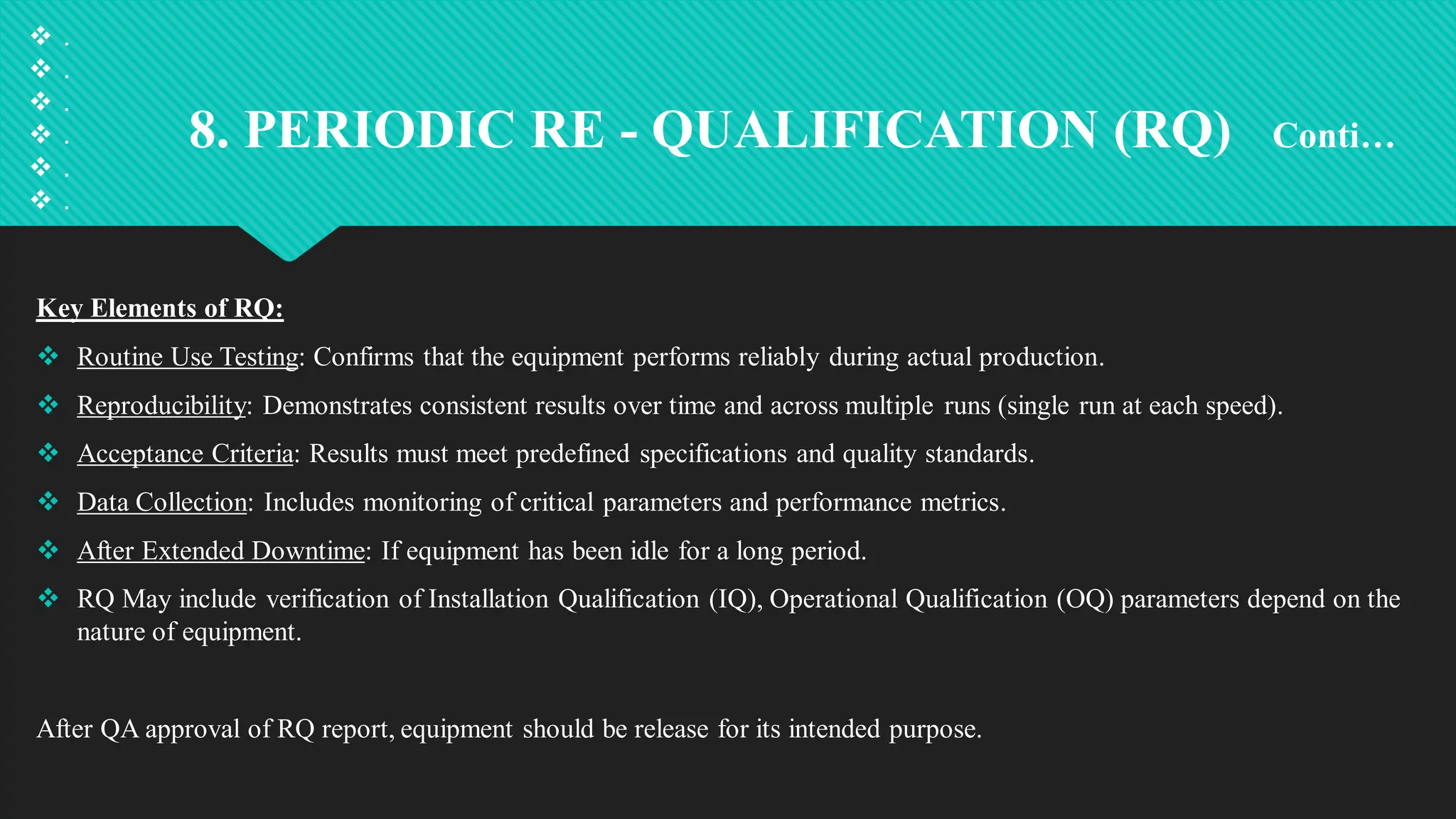
8. PERIODIC RE - QUALIFICATION (RQ) Conti…
Key Elements of RQ:
 Routine Use Testing: Confirms that the equipment performs reliably during actual production.
 Reproducibility: Demonstrates consistent results over time and across multiple runs (single run at each speed).
 Acceptance Criteria: Results must meet predefined specifications and quality standards.
 Data Collection: Includes monitoring of critical parameters and performance metrics.
 After Extended Downtime: If equipment has been idle for a long period.
 RQ May include verification of Installation Qualification (IQ), Operational Qualification (OQ) parameters depend on the
nature of equipment.
After QA approval of RQ report, equipment should be release for its intended purpose.
 .
 .
 .
 .
 .
 .
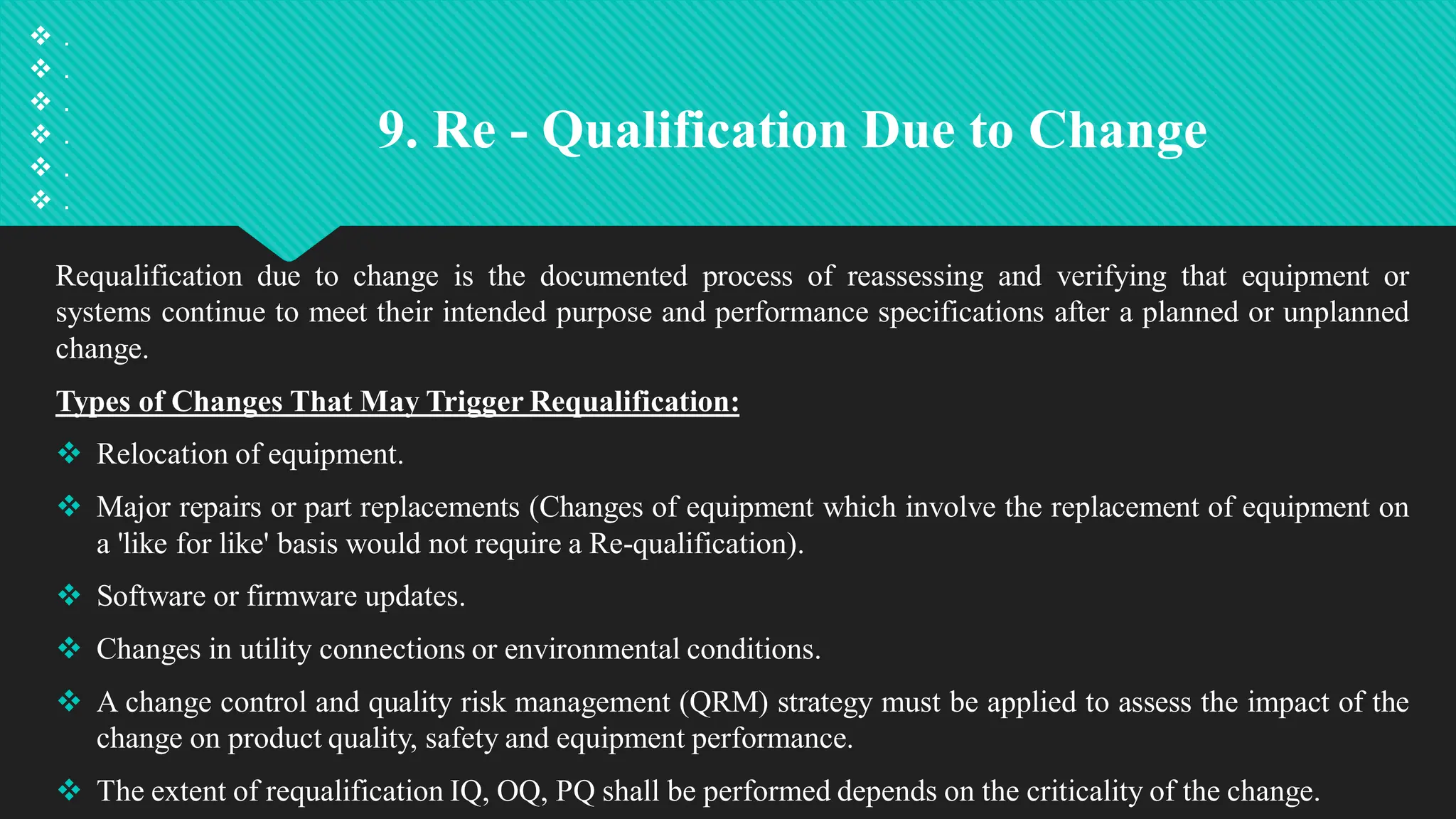
9. Re - Qualification Due to Change
Requalification due to change is the documented process of reassessing and verifying that equipment or
systems continue to meet their intended purpose and performance specifications after a planned or unplanned
change.
Types of Changes That May Trigger Requalification:
 Relocation of equipment.
 Major repairs or part replacements (Changes of equipment which involve the replacement of equipment on
a 'like for like' basis would not require a Re-qualification).
 Software or firmware updates.
 Changes in utility connections or environmental conditions.
 A change control and quality risk management (QRM) strategy must be applied to assess the impact of the
change on product quality, safety and equipment performance.
 The extent of requalification IQ, OQ, PQ shall be performed depends on the criticality of the change.
 .
 .
 .
 .
 .
 .
RETIREMENT OF EQUIPMENT & SYSTEM
Retirement of equipment and systems in a GMP-regulated environment must be handled with care to ensure compliance,
traceability, and protection of product quality.
Overview of the Steps Involved in Retiring Equipment and Systems:
 Raise a formal change control request to document the intent to retire the equipment/system Include justification, impact
assessment, and proposed retirement plan.
 Perform Risk Assessment to evaluate the impact on product quality and safety and other system linked to it.
 Develop a Decommissioning Protocol that outlines:
 Complete qualification of equipment/system to ensure the quality and safety of products previously manufactured in
this equipment/system.
 Data backup and archiving (for computerized systems)
 After QA approval of decommissioning report, handover the equipment to engineering and dispose as per safety norm.
 .
 .
 .
 .
 .
 .
PROCESS VALIDATION (PV)
What is Process Validation?
Process validation is a fundamental requirement in pharmaceutical manufacturing. It is the documented
evidence that a manufacturing process, when operated within established parameters, ensures that a process
consistently produces a product that meets its predetermined specifications and quality attributes.
Why Do we Perform PV ?
 Confirm process consistency and product quality.
 Ensure regulatory compliance.
 Support product release and market authorization.
 Maintain a state of control throughout the product lifecycle.
 .
 .
 .
 .
 .
 .
STAGES OF PROCESS VALIDATION (PV)
 .
 .
 .
 .
 .
 .
Stage-1 Process Design:
 The manufacturing process is defined during this stage based on knowledge gained through development and scale-up
activities.
 The goal of this stage is to design a process suitable for routine commercial manufacturing that can consistently deliver a
product that meets its quality attributes.
Key Elements of Process Design :
 Building and Capturing Process Knowledge and Understanding.
 Process design experiments do not need to be performed under the CGMP conditions often performed at small-scale
laboratories.
 Establishing a Strategy for Process Control.
STAGES OF PROCESS VALIDATION (PV)
 .
 .
 .
 .
 .
 .
Stage-2 Process Qualification:
 During this stage, the process design is evaluated to determine if the process is capable of reproducible
commercial manufacturing or Demonstrate that the process works as intended in the actual production
environment.
Key Elements of Process Design :
 Design of a Facility and Qualification of Utilities and Equipment.
 Verifying that utility systems and equipment are installed in compliance with the design specifications and
equipment operate in accordance with the process requirements in all anticipated operating ranges.
 The process performance qualification (PPQ) combines the actual facility, utilities, equipment and the trained
personnel.
STAGES OF PROCESS VALIDATION (PV)
 .
 .
 .
 .
 .
 .
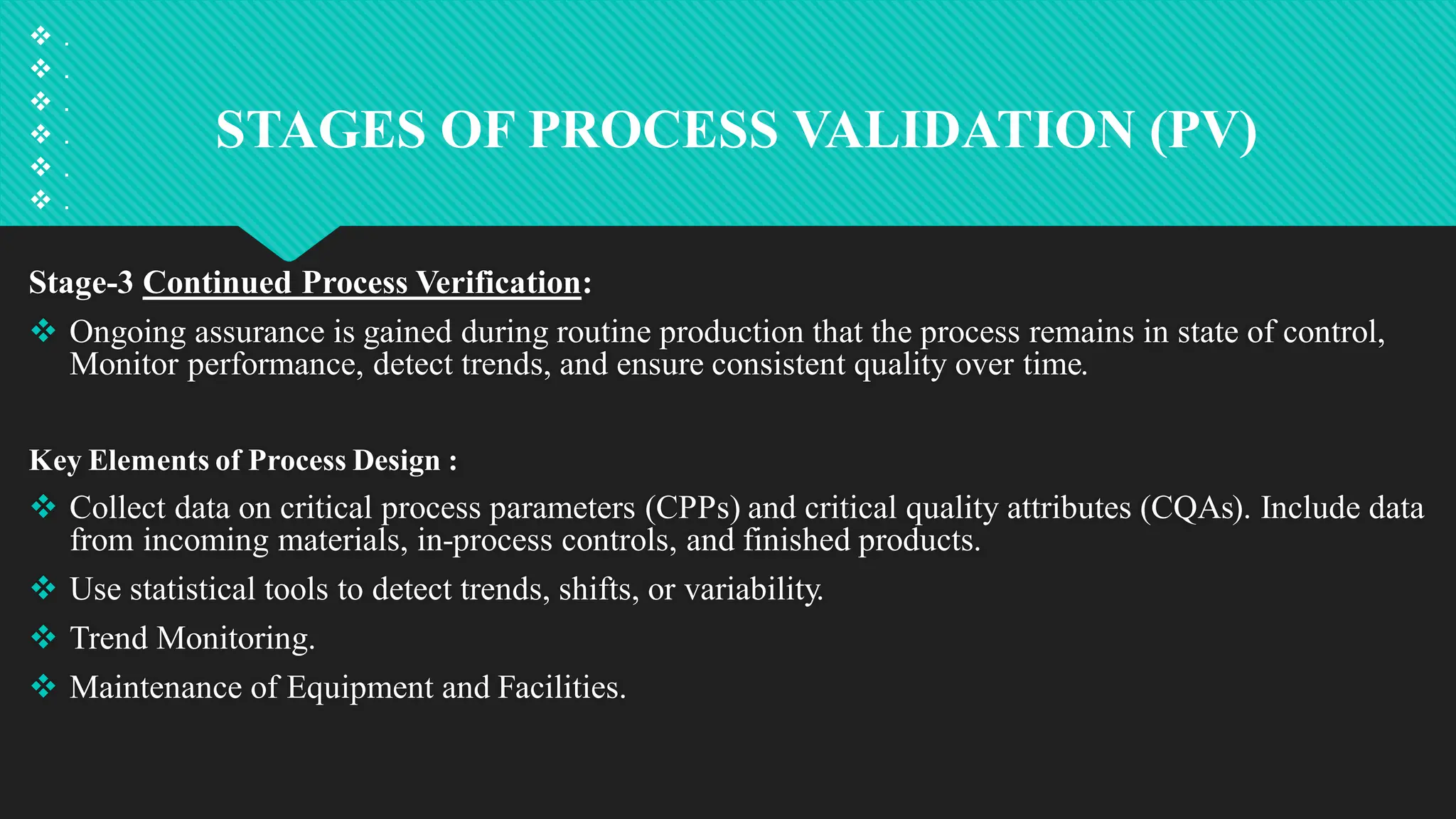
Stage-3 Continued Process Verification:
 Ongoing assurance is gained during routine production that the process remains in state of control,
Monitor performance, detect trends, and ensure consistent quality over time.
Key Elements of Process Design :
 Collect data on critical process parameters (CPPs) and critical quality attributes (CQAs). Include data
from incoming materials, in-process controls, and finished products.
 Use statistical tools to detect trends, shifts, or variability.
 Trend Monitoring.
 Maintenance of Equipment and Facilities.
APPROACH FOR PROCESS VALIDATION (PV)
 .
 .
 .
 .
 .
 .
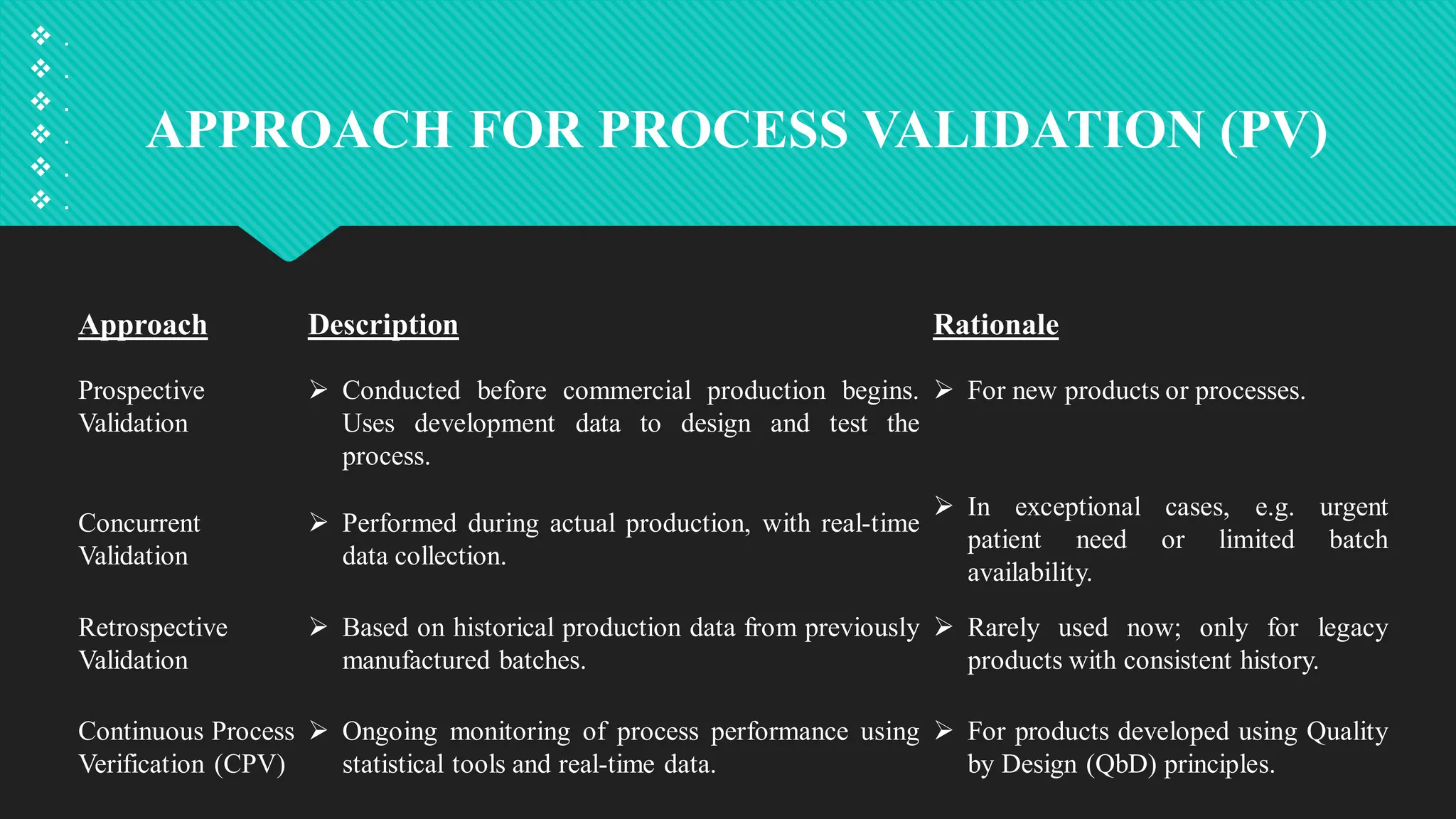
Approach Description Rationale
Prospective
Validation
 Conducted before commercial production begins.
Uses development data to design and test the
process.
 For new products or processes.
Concurrent
Validation
 Performed during actual production, with real-time
data collection.
 In exceptional cases, e.g. urgent
patient need or limited batch
availability.
Retrospective
Validation
 Based on historical production data from previously
manufactured batches.
 Rarely used now; only for legacy
products with consistent history.
Continuous Process
Verification (CPV)
 Ongoing monitoring of process performance using
statistical tools and real-time data.
 For products developed using Quality
by Design (QbD) principles.
REVALIDATION
 .
 .
 .
 .
 .
 .
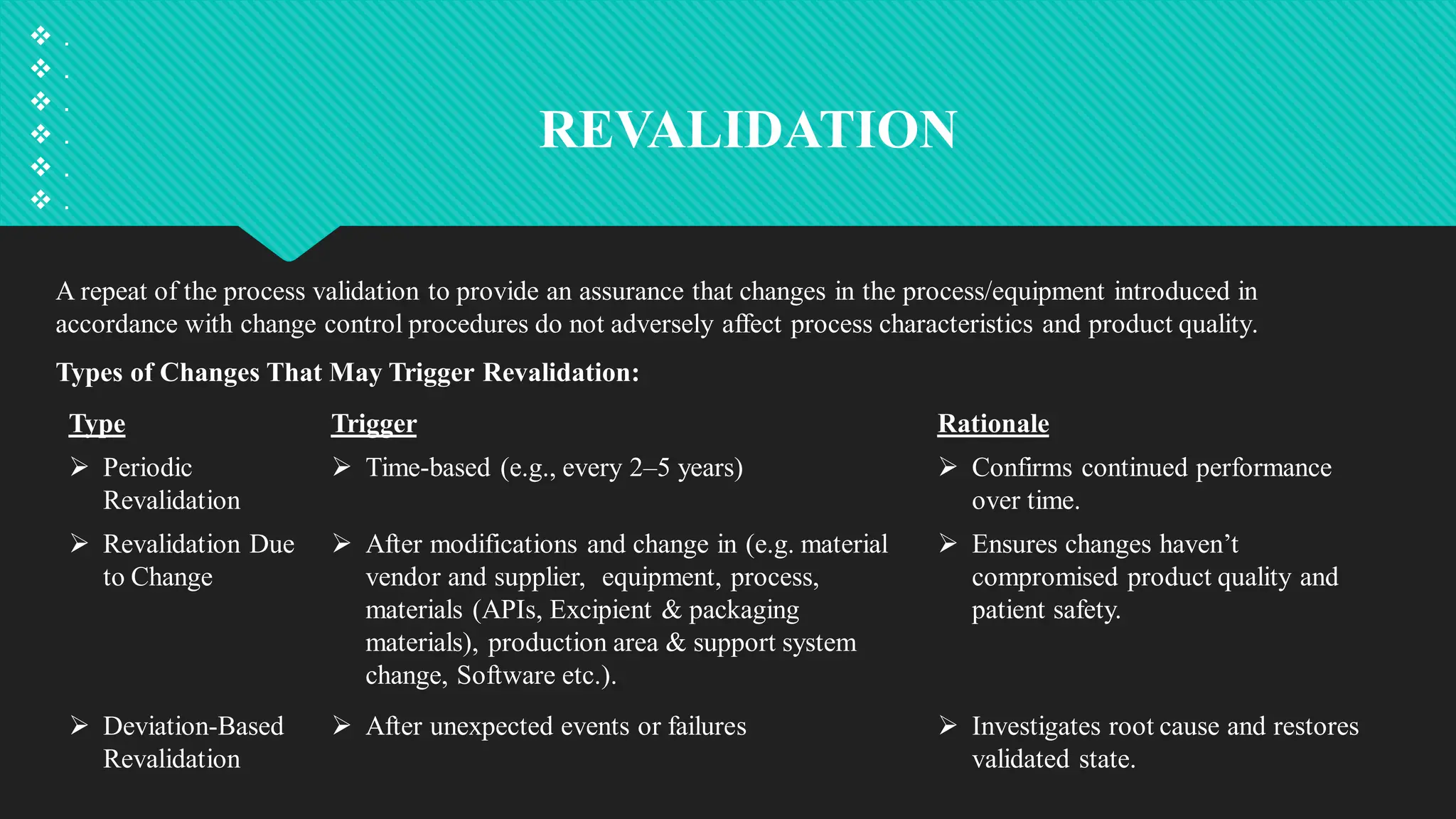
A repeat of the process validation to provide an assurance that changes in the process/equipment introduced in
accordance with change control procedures do not adversely affect process characteristics and product quality.
Types of Changes That May Trigger Revalidation:
Type Trigger Rationale
 Periodic
Revalidation
 Time-based (e.g., every 2–5 years)  Confirms continued performance
over time.
 Revalidation Due
to Change
 After modifications and change in (e.g. material
vendor and supplier, equipment, process,
materials (APIs, Excipient & packaging
materials), production area & support system
change, Software etc.).
 Ensures changes haven’t
compromised product quality and
patient safety.
 Deviation-Based
Revalidation
 After unexpected events or failures  Investigates root cause and restores
validated state.
REFERENCES
 .
 .
 .
 .
 .
 .
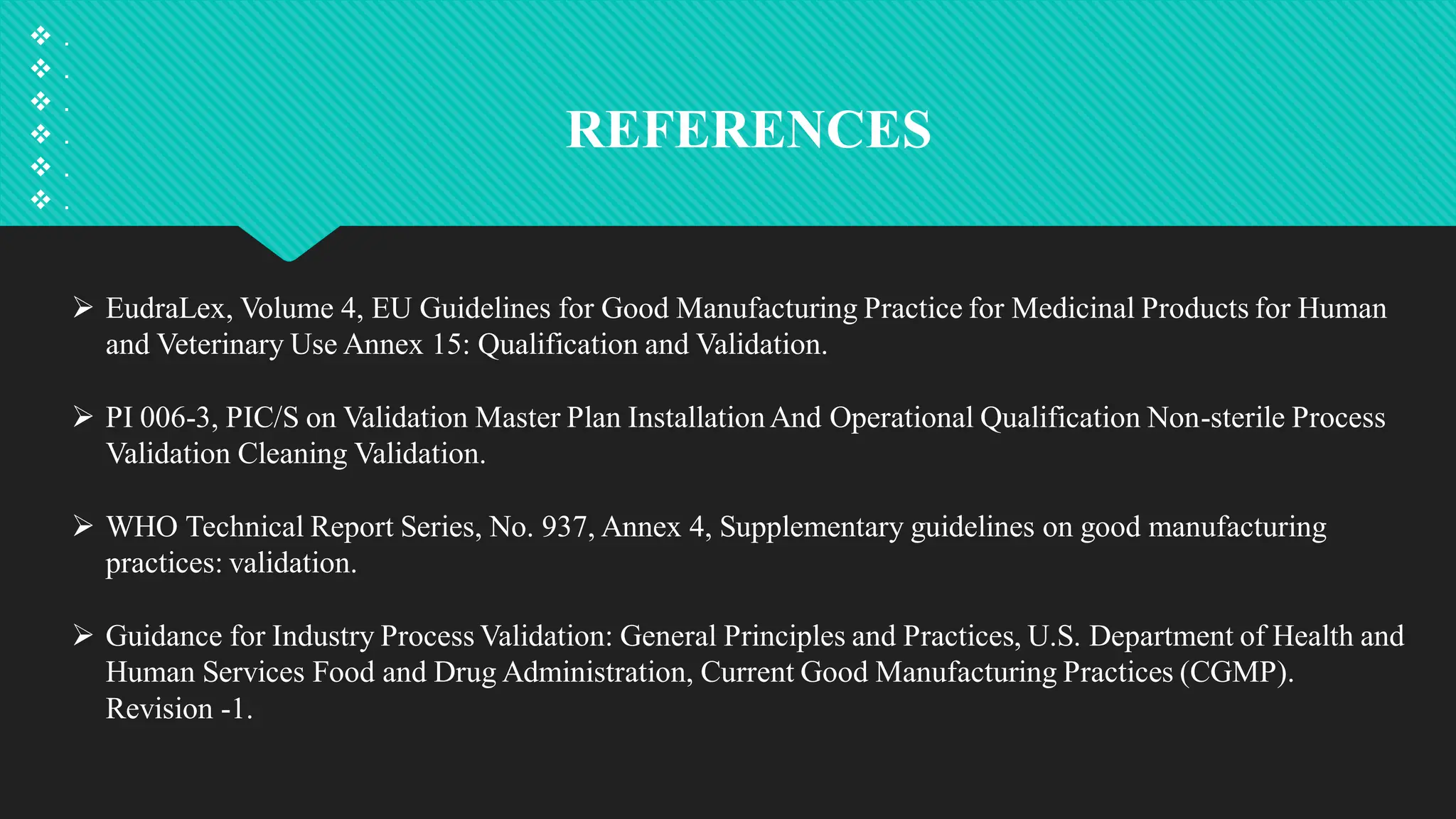
 EudraLex, Volume 4, EU Guidelines for Good Manufacturing Practice for Medicinal Products for Human
and Veterinary Use Annex 15: Qualification and Validation.
 PI 006-3, PIC/S on Validation Master Plan InstallationAnd Operational Qualification Non-sterile Process
Validation Cleaning Validation.
 WHO Technical Report Series, No. 937, Annex 4, Supplementary guidelines on good manufacturing
practices: validation.
 Guidance for Industry Process Validation: General Principles and Practices, U.S. Department of Health and
Human Services Food and Drug Administration, Current Good Manufacturing Practices (CGMP).
Revision -1.
End of Slide…..

Qualification and Validation : the best practice

  • 1.
    QUALIFICATION and VALIDATION Vinod Chauhan M.Pharm (Quality Assurance Professional)  .  .  .  .  .  .
  • 2.
    VALIDATION MASTER PLAN(VMP) The Validation Master Plan (VMP) is a document providing information on the company’s qualification & validation programme. It should define details of and timescales for the validation work to be performed.  A VMP helps management: - to know what the validation programme involves with respect to time, people and money.  A VMP helps all members of the validation team: - to know their tasks and responsibilities.  A VMP helps GMP inspectors: - to understand the approach of qualification & validation activities.  A VMP helps to Provides a structured overview of all validation efforts across the site or project.  .  .  .  .  .  .
  • 3.
    VALIDATION MASTER PLAN(VMP)  .  .  .  .  .  . Validation Master Plan Qualification Validation Facility/System Equipment/instrument Utility PV CV AMV CSV TV PV* Change Control/QRM/Protocol/Report Change Control/QRM/URS/DQ/IQ/OQ/PQ/RQ Note: In this PPT Slide we will only discuses about Equipment/system/utility qualification and Process Validation (PV). TV – Transport Validation PV* - Packaging Validation
  • 4.
    DEFINITION Qualification: “Qualification isthe documented process of demonstrating that equipment or systems are properly installed, operate correctly, and consistently produce the expected results” (EU GMP Annex. 15) Validation: “Validation is the Collection and evaluation of scientific data providing a high degree of assurance that a process, procedure, or method consistently produces the expected results” (WHO TRS, No. 937 Annex. 4)  .  .  .  .  .  .
  • 5.
    Qualification Validation  Provingand documenting that premises, systems, and equipment are properly installed and function as intended.  Collection and evaluation of scientific data providing a high degree of assurance that a process, procedure, or method consistently produces the expected results.  Equipment, utilities, systems, and facilities.  Manufacturing processes (process validation), analytical method validation, cleaning validation.  Qualification approach includes Design Qualification (DQ), Installation Qualification (IQ), Operational Qualification (OQ), Performance Qualification (PQ) and Periodic Re-Qualification (RQ).  Validation Approach Includes prospective, concurrent, retrospective validation (not in trend now a day) and Re-validation. RELATION BETWEEN QUALIFICATION & VALIDATION  .  .  .  .  .  .
  • 6.
    APPROACHES FOR EQUIPMENTQUALIFICATION (V-MODELAPPROACH) FAT/SAT SOP, Calibration & MQ Change Control & QRM Impact assessment for equipment categorization to established periodic frequency of RQ  .  .  .  .  .  .
  • 7.
    1. USER REQUIREMENTSPECIFICATION (URS) The set of owner, user and engineering requirements necessary and sufficient to create a feasible design meeting the intended purpose of the system. Key Elements of a URS:  Purpose and Scope: What the equipment is meant to do and where it will be used.  Performance Requirements: Expected output, speed, accuracy, and capacity.  GMP Compliance: Requirements to meet Good Manufacturing Practice standards.  Safety : Operator safety, ease of use and clean, and maintenance access.  Utilities and Interfaces: Power, water, air, software, and control systems. After QA approval of URS, User shall forward the URS copy to Original Equipment Manufacturer (OEM) for system built.  .  .  .  .  .  .
  • 8.
    2. DESIGN QUALIFICATION(DQ) The documented verification that the proposed design of the systems and equipment is suitable for the intended purpose. Key Elements of a DQ:  Foundation for Qualification: DQ is the first formal step in the qualification lifecycle, followed by Installation (IQ), Operational (OQ), and Performance Qualification (PQ).  Ensures the design of equipment meets GMP and user requirements.  Includes review of Functional Requirement Specification (FRS), Hardware Design Specifications (HDS) and Software Design Specifications (SDS), risk assessments, and equipment capabilities. After QA approval of DQ, Original Equipment Manufacturer (OEM) proceed for system built and finalize the equipment for FAT.  .  .  .  .  .  .
  • 9.
    3. FACTORY ACCEPTANCETEST (FAT) Factory Acceptance Testing is a formal process conducted at the manufacturer's site (OEM) to verify that equipment or systems meet all the specifications and functional requirements as per DQ before delivery at the user's facility. Key Element of FAT:  Ensure the equipment is built and configured correctly.  Verify functionality, safety features, and compliance with design specifications.  Documentation review (manuals, drawings, certificates, IQ, OQ & PQ) and training to the end user.  Witness testing by the customer or third-party inspectors (Where applicable).  Identify and resolve any issues before shipment. After QA approval of FAT report, Original Equipment Manufacturer (OEM) proceed for system dispatched to the user’s facility.  .  .  .  .  .  .
  • 10.
    4. INSTALLATION QUALIFICATION(IQ) Installation Qualification (IQ) is the documented verification that equipment, systems, or utilities have been installed correctly according to approved design specifications and manufacturer recommendations. Key Elements of IQ:  Ensures all components, instruments, and connections are installed per drawings and specifications.  Instruments and sensors are calibrated and verified.  Confirms that materials (MOC) used meet GMP and safety requirements.  Checks that power, water, air, and other utility services are properly connected.  Equipment is clearly labeled (Name and ID of the equipment).  Ready the pre-requisite of OQ (e.g. Draft SOP, calibration of instruments & Preventive Maintenance check list) After QA approval of IQ report, Proceed for OQ activities.  .  .  .  .  .  .
  • 11.
    5. OPERATIONAL QUALIFICATION(OQ) Operational Qualification (OQ) is the documented verification that equipment, systems, or utilities perform as intended throughout all anticipated operating ranges. It ensures that the equipment functions correctly under normal and worst-case conditions. Key Elements of OQ:  Functional Testing: Verifies that all controls, alarms, interlocks, and displays operate as designed.  Operating Limits: Confirms performance across upper and lower operating ranges, including worst-case scenarios.  Process Simulation: May include dry runs or use of simulated materials to mimic actual production conditions.  Standard Operating Procedures (SOPs): Finalizes SOPs for operation, cleaning, and maintenance.  Training and Documentation: Ensures operators are trained and documentation is complete. Note: OQ normally follows IQ but depending on the complexity of the equipment, it may be performed as a combined Installation/Operation Qualification (IOQ). After QA approval of OQ report, ready the pre-requisite of PQ and Proceed for activities.  .  .  .  .  .  .
  • 12.
    6. PERFORMANCE QUALIFICATION(PQ) Performance Qualification (PQ) is the documented verification that equipment, systems, or utilities consistently perform according to predefined specifications under routine operating conditions. Key Elements of PQ:  Routine Use Testing: Confirms that the equipment performs reliably during actual production.  Reproducibility: Demonstrates consistent results over time and across multiple runs (triplicate run at each speed).  Acceptance Criteria: Results must meet predefined specifications and quality standards.  Data Collection: Includes monitoring of critical parameters and performance metrics.  Worst-Case Conditions: May include testing under stress or edge-of-range conditions to ensure robustness. Note: PQ should follow the successful completion of IQ and OQ. However, it may in some cases be appropriate to perform it in conjunction with OQ or Process Validation (EU GMP Annex. 15). After QA approval of PQ report, equipment should be release for its intended purpose.  .  .  .  .  .  .
  • 13.
    7. IMPACT ASSESSMENT After Performance Qualification a impact assessment shall be performed to categorize equipment, utilities, and systems into different levels of GMP impact… Impact assessment is a risk-based evaluation used to categorize equipment, utilities, and systems into different levels of GMP impact—typically, Direct Impact, Indirect Impact, or No Impact based on their role in the manufacturing process.  .  .  .  .  .  . Category Description Examples How to Evaluate Direct Impact Equipment that comes into contact with the product or affects product quality directly. Tablet press, autoclave, filling line, etc. Define Intended Use, Assess Product Contact, Evaluate Process Influence. (Justify categorization and link it to qualification strategy in the Validation Master Plan (VMP)). Indirect Impact Equipment that supports the process but does not directly affect product quality. HVAC system, compressed air system etc. No Impact Equipment that has no influence on product quality or GMP compliance. Typically managed through standard engineering practices. Office furniture, non-GMP computers, QC instruments etc.
  • 14.
    8. PERIODIC RE- QUALIFICATION (RQ)  Requalification is a key part of maintaining GMP compliance throughout the lifecycle of equipment.  It is the documented process of verifying that previously qualified equipment, systems, or facilities continue to operate within approved specifications and remain in a state of control.  Re-qualification is necessary and performed at a specific time period, the period should be justified and the criteria for evaluation defined and the possibility of small changes over time should be assessed.  Small changes over time in equipment qualification can accumulate and potentially impact the validated state or performance of equipment, leading to deviations or even regulatory non-compliance. That’s why requalification and ongoing monitoring are essential.  Frequency of Periodic RQ shall be established with proper Justification of equipment categorization and link it to qualification strategy in the Validation Master Plan (VMP)). E.g. 06 Months +/- 15 Days, 12 months +/- 30 Days, 24 months +/- 30 Days, 03 Years +/- 45 Days and 05 Years +/- 90 Days.  .  .  .  .  .  .
  • 15.
    8. PERIODIC RE- QUALIFICATION (RQ) Conti… Key Elements of RQ:  Routine Use Testing: Confirms that the equipment performs reliably during actual production.  Reproducibility: Demonstrates consistent results over time and across multiple runs (single run at each speed).  Acceptance Criteria: Results must meet predefined specifications and quality standards.  Data Collection: Includes monitoring of critical parameters and performance metrics.  After Extended Downtime: If equipment has been idle for a long period.  RQ May include verification of Installation Qualification (IQ), Operational Qualification (OQ) parameters depend on the nature of equipment. After QA approval of RQ report, equipment should be release for its intended purpose.  .  .  .  .  .  .
  • 16.
    9. Re -Qualification Due to Change Requalification due to change is the documented process of reassessing and verifying that equipment or systems continue to meet their intended purpose and performance specifications after a planned or unplanned change. Types of Changes That May Trigger Requalification:  Relocation of equipment.  Major repairs or part replacements (Changes of equipment which involve the replacement of equipment on a 'like for like' basis would not require a Re-qualification).  Software or firmware updates.  Changes in utility connections or environmental conditions.  A change control and quality risk management (QRM) strategy must be applied to assess the impact of the change on product quality, safety and equipment performance.  The extent of requalification IQ, OQ, PQ shall be performed depends on the criticality of the change.  .  .  .  .  .  .
  • 17.
    RETIREMENT OF EQUIPMENT& SYSTEM Retirement of equipment and systems in a GMP-regulated environment must be handled with care to ensure compliance, traceability, and protection of product quality. Overview of the Steps Involved in Retiring Equipment and Systems:  Raise a formal change control request to document the intent to retire the equipment/system Include justification, impact assessment, and proposed retirement plan.  Perform Risk Assessment to evaluate the impact on product quality and safety and other system linked to it.  Develop a Decommissioning Protocol that outlines:  Complete qualification of equipment/system to ensure the quality and safety of products previously manufactured in this equipment/system.  Data backup and archiving (for computerized systems)  After QA approval of decommissioning report, handover the equipment to engineering and dispose as per safety norm.  .  .  .  .  .  .
  • 18.
    PROCESS VALIDATION (PV) Whatis Process Validation? Process validation is a fundamental requirement in pharmaceutical manufacturing. It is the documented evidence that a manufacturing process, when operated within established parameters, ensures that a process consistently produces a product that meets its predetermined specifications and quality attributes. Why Do we Perform PV ?  Confirm process consistency and product quality.  Ensure regulatory compliance.  Support product release and market authorization.  Maintain a state of control throughout the product lifecycle.  .  .  .  .  .  .
  • 19.
    STAGES OF PROCESSVALIDATION (PV)  .  .  .  .  .  . Stage-1 Process Design:  The manufacturing process is defined during this stage based on knowledge gained through development and scale-up activities.  The goal of this stage is to design a process suitable for routine commercial manufacturing that can consistently deliver a product that meets its quality attributes. Key Elements of Process Design :  Building and Capturing Process Knowledge and Understanding.  Process design experiments do not need to be performed under the CGMP conditions often performed at small-scale laboratories.  Establishing a Strategy for Process Control.
  • 20.
    STAGES OF PROCESSVALIDATION (PV)  .  .  .  .  .  . Stage-2 Process Qualification:  During this stage, the process design is evaluated to determine if the process is capable of reproducible commercial manufacturing or Demonstrate that the process works as intended in the actual production environment. Key Elements of Process Design :  Design of a Facility and Qualification of Utilities and Equipment.  Verifying that utility systems and equipment are installed in compliance with the design specifications and equipment operate in accordance with the process requirements in all anticipated operating ranges.  The process performance qualification (PPQ) combines the actual facility, utilities, equipment and the trained personnel.
  • 21.
    STAGES OF PROCESSVALIDATION (PV)  .  .  .  .  .  . Stage-3 Continued Process Verification:  Ongoing assurance is gained during routine production that the process remains in state of control, Monitor performance, detect trends, and ensure consistent quality over time. Key Elements of Process Design :  Collect data on critical process parameters (CPPs) and critical quality attributes (CQAs). Include data from incoming materials, in-process controls, and finished products.  Use statistical tools to detect trends, shifts, or variability.  Trend Monitoring.  Maintenance of Equipment and Facilities.
  • 22.
    APPROACH FOR PROCESSVALIDATION (PV)  .  .  .  .  .  . Approach Description Rationale Prospective Validation  Conducted before commercial production begins. Uses development data to design and test the process.  For new products or processes. Concurrent Validation  Performed during actual production, with real-time data collection.  In exceptional cases, e.g. urgent patient need or limited batch availability. Retrospective Validation  Based on historical production data from previously manufactured batches.  Rarely used now; only for legacy products with consistent history. Continuous Process Verification (CPV)  Ongoing monitoring of process performance using statistical tools and real-time data.  For products developed using Quality by Design (QbD) principles.
  • 23.
    REVALIDATION  .  . .  .  .  . A repeat of the process validation to provide an assurance that changes in the process/equipment introduced in accordance with change control procedures do not adversely affect process characteristics and product quality. Types of Changes That May Trigger Revalidation: Type Trigger Rationale  Periodic Revalidation  Time-based (e.g., every 2–5 years)  Confirms continued performance over time.  Revalidation Due to Change  After modifications and change in (e.g. material vendor and supplier, equipment, process, materials (APIs, Excipient & packaging materials), production area & support system change, Software etc.).  Ensures changes haven’t compromised product quality and patient safety.  Deviation-Based Revalidation  After unexpected events or failures  Investigates root cause and restores validated state.
  • 24.
    REFERENCES  .  . .  .  .  .  EudraLex, Volume 4, EU Guidelines for Good Manufacturing Practice for Medicinal Products for Human and Veterinary Use Annex 15: Qualification and Validation.  PI 006-3, PIC/S on Validation Master Plan InstallationAnd Operational Qualification Non-sterile Process Validation Cleaning Validation.  WHO Technical Report Series, No. 937, Annex 4, Supplementary guidelines on good manufacturing practices: validation.  Guidance for Industry Process Validation: General Principles and Practices, U.S. Department of Health and Human Services Food and Drug Administration, Current Good Manufacturing Practices (CGMP). Revision -1.
  • 25.