1
CONTENTS
 VALIDATION
 QUALIFICATION
 ADVANTAGES OF VALIDATION
 STREAMLINING OF VALIDATION & QUALIFICATION
 VALIDATION MASTER PLAN
 USER REQUIREMENT SPECIFICATION
 DESIGN QUALIFICATION
 FAT/SAT
 INSTALLATION QUALIFICATION
 OPERATIONAL QUALIFICATION
 PERFORMANCE QUALIFICATION
2
VALIDATION
“Validation means conformation by examination and
provision of objective evidence that a particular
requirements for a specific intended use can be
consistently fulfilled.”
3
QUALIFICATION
“Qualification is the documented evidence that a
specific equipment, facility/system is fit / ready
for intended use”.
4
Validation vs Qualification
Validation Qualification
 is the documented evidence
which provides a high degree
of assurance that a specific
process will consistently meet
its predetermined
specifications and quality
attributes.
 Proves that the process is
under control.
 It is a sub-set of validation
and applies to equipment,
instrument, facilities,
software, control systems and
utility systems that support or
affect a GMP process.
 For validation to occur
appropriate qualification
must be successfully
completed.
5
Need for validation
 Basic requirement for the product quality system.
 Assure every lot of each product meet all the quality
requirements.
 It is capable of achieving the intended results.
 For taking appropriate actions in case of non-compliance.
6
Advantages of validation
 Conformation to GMP requirements.
 To identify root cause of problems.
 Makes process better understand.
 Reduces the risk of problems.
 Reduces defect cost.
 Assures smooth running of the process.
 Documents that process or activity is in control.
 Maintains a company’s public image.
 Documents that the final product has followed reliable
manufacturing process.
7
Streamlining of qualification and
validation
 Set of strategies, mostly risk and science based, to
transform or standardize validation activities and
documentation.
 Typically reduces resources such as time, personnel, and
cost.
 The practice enhances reliability, cost, and quality of the
product.
8
Validation Master Plan(VMP)
 It is a comprehensive document describing the applicable
validation requirements for the facility, and providing a
plan for meeting those requirements.
 Brief, concise and clear.
 Comprise
: prospective validation
: concurrent validation
: Retrospective validation
:Re-validation .
9
10
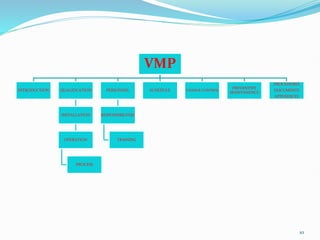
VMP
INTRODUCTION QUALIFICATION
INSTALLATION
OPERATION
PROCESS
PERSONNEL
RESPONSIBILITIES
TRAINING
SCHEDULE CHANGE CONTROL
PREVENTIVE
MAINTANENCE
PROCEDURES
DOCUMENTS
APPENDICES
Validation Report
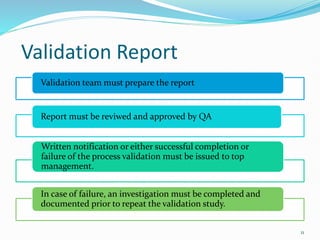
Validation team must prepare the report
Report must be reviwed and approved by QA
Written notification or either successful completion or
failure of the process validation must be issued to top
management.
In case of failure, an investigation must be completed and
documented prior to repeat the validation study.
11
User requirement specification
 URS defines the functions to be carried out, the data on
which the system will operate, and the operating
environment.
 Reduces the total system effort and cost.
 Provides the input to user acceptance test specifications.
 Serves as a reference.
 URS must be kept updated.
12
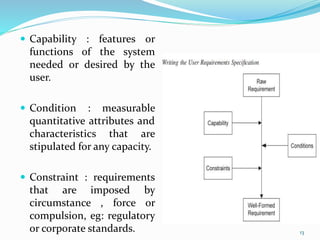
 Capability : features or
functions of the system
needed or desired by the
user.
 Condition : measurable
quantitative attributes and
characteristics that are
stipulated for any capacity.
 Constraint : requirements
that are imposed by
circumstance , force or
compulsion, eg: regulatory
or corporate standards. 13
VALIDATION PROCESS
TYPES:
: Process validation.
: Computer(process controller) validation.
: Cleaning validation.
: Analytical method validation .
14
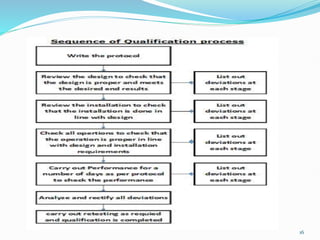
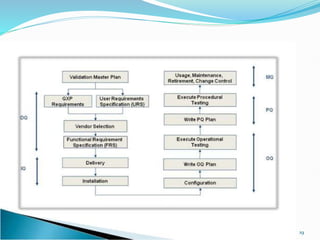
Process validation
 Establishing documentary evidence that a process
does what it purports to do.
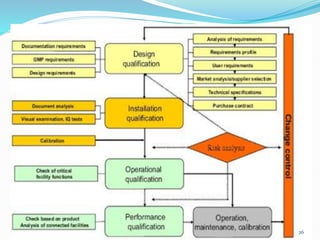
 Qualification accomplished are :
:Design qualification
:Installation qualification
:Operational qualification
:Performance qualification.
15
16
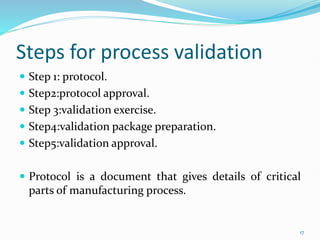
Steps for process validation
 Step 1: protocol.
 Step2:protocol approval.
 Step 3:validation exercise.
 Step4:validation package preparation.
 Step5:validation approval.
 Protocol is a document that gives details of critical
parts of manufacturing process.
17
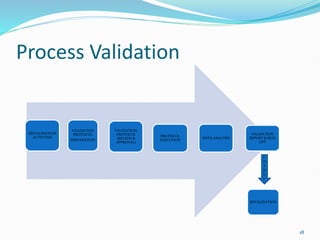
Process Validation
PREVALIDATION
ACTIVITIES
VALIDATION
PROTOCOL
PREPARATION
VALIDATION
PROTOCOL
(REVIEW &
APPROVAL)
PROTOCOL
EXECUTION
DATA ANALYSIS
VALIDATION
REPORT & SIGN
OFF
REVALIDATION
C
H
A
N
G
E
18
19
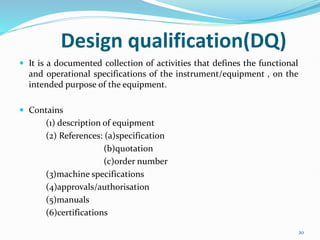
Design qualification(DQ)
 It is a documented collection of activities that defines the functional
and operational specifications of the instrument/equipment , on the
intended purpose of the equipment.
 Contains
(1) description of equipment
(2) References: (a)specification
(b)quotation
(c)order number
(3)machine specifications
(4)approvals/authorisation
(5)manuals
(6)certifications
20
FAT
 Documented evidence that a piece of equipment or
system has been adequately tested at the
manufacturer’s facility and performed to the end user’s
expectations prior to delivery to the end user.
 Executed during final part of design and engineering
phase before final installation.
 Performed at manufacturers work shop.
21
SAT
 Site Acceptance Test.
 Documented evidence that a piece of equipment or
system has not been affected in the transportation and
has been adequately tested at the end user’s facility
and performed to end user’s expectation
22
Installation qualification(IQ)
 “Documented verification which confirms that all key
aspects of installation adhere to appropriate codes and
approved design intentions and that the manufacturers
recommendations are suitably considered”.
 Properly installed with no hazards.
 Information needed:
:Identification information.
:Utility requirements
:Safety features
:Supporting documents.
Conducted using an approved protocol.
23
Operational qualification (OQ)
 Establishing confidence that process equipment and
sub systems are capable of consistently operating
within stated limits of tolerance.
 Process controls are qualified during OQ.
 SOPs for use, maintenance, calibration , cleaning of
the plant, schedules for maintenance and calibration
are developed.
.
24
Performance qualification(PQ)
 Documented collection of activities necessary to
demonstrate that an equipment/system consistently
perform according to the specifications defined by the user,
and is appropriate for the intended use.
 Qualify the entire plant with respect to the production
process.
 All necessary SOPs should be approved.
25
26
27

validationqualification-200524131037.pptx

  • 1.
  • 2.
    CONTENTS  VALIDATION  QUALIFICATION ADVANTAGES OF VALIDATION  STREAMLINING OF VALIDATION & QUALIFICATION  VALIDATION MASTER PLAN  USER REQUIREMENT SPECIFICATION  DESIGN QUALIFICATION  FAT/SAT  INSTALLATION QUALIFICATION  OPERATIONAL QUALIFICATION  PERFORMANCE QUALIFICATION 2
  • 3.
    VALIDATION “Validation means conformationby examination and provision of objective evidence that a particular requirements for a specific intended use can be consistently fulfilled.” 3
  • 4.
    QUALIFICATION “Qualification is thedocumented evidence that a specific equipment, facility/system is fit / ready for intended use”. 4
  • 5.
    Validation vs Qualification ValidationQualification  is the documented evidence which provides a high degree of assurance that a specific process will consistently meet its predetermined specifications and quality attributes.  Proves that the process is under control.  It is a sub-set of validation and applies to equipment, instrument, facilities, software, control systems and utility systems that support or affect a GMP process.  For validation to occur appropriate qualification must be successfully completed. 5
  • 6.
    Need for validation Basic requirement for the product quality system.  Assure every lot of each product meet all the quality requirements.  It is capable of achieving the intended results.  For taking appropriate actions in case of non-compliance. 6
  • 7.
    Advantages of validation Conformation to GMP requirements.  To identify root cause of problems.  Makes process better understand.  Reduces the risk of problems.  Reduces defect cost.  Assures smooth running of the process.  Documents that process or activity is in control.  Maintains a company’s public image.  Documents that the final product has followed reliable manufacturing process. 7
  • 8.
    Streamlining of qualificationand validation  Set of strategies, mostly risk and science based, to transform or standardize validation activities and documentation.  Typically reduces resources such as time, personnel, and cost.  The practice enhances reliability, cost, and quality of the product. 8
  • 9.
    Validation Master Plan(VMP) It is a comprehensive document describing the applicable validation requirements for the facility, and providing a plan for meeting those requirements.  Brief, concise and clear.  Comprise : prospective validation : concurrent validation : Retrospective validation :Re-validation . 9
  • 10.
  • 11.
    Validation Report Validation teammust prepare the report Report must be reviwed and approved by QA Written notification or either successful completion or failure of the process validation must be issued to top management. In case of failure, an investigation must be completed and documented prior to repeat the validation study. 11
  • 12.
    User requirement specification URS defines the functions to be carried out, the data on which the system will operate, and the operating environment.  Reduces the total system effort and cost.  Provides the input to user acceptance test specifications.  Serves as a reference.  URS must be kept updated. 12
  • 13.
     Capability :features or functions of the system needed or desired by the user.  Condition : measurable quantitative attributes and characteristics that are stipulated for any capacity.  Constraint : requirements that are imposed by circumstance , force or compulsion, eg: regulatory or corporate standards. 13
  • 14.
    VALIDATION PROCESS TYPES: : Processvalidation. : Computer(process controller) validation. : Cleaning validation. : Analytical method validation . 14
  • 15.
    Process validation  Establishingdocumentary evidence that a process does what it purports to do.  Qualification accomplished are : :Design qualification :Installation qualification :Operational qualification :Performance qualification. 15
  • 16.
  • 17.
    Steps for processvalidation  Step 1: protocol.  Step2:protocol approval.  Step 3:validation exercise.  Step4:validation package preparation.  Step5:validation approval.  Protocol is a document that gives details of critical parts of manufacturing process. 17
  • 18.
  • 19.
  • 20.
    Design qualification(DQ)  Itis a documented collection of activities that defines the functional and operational specifications of the instrument/equipment , on the intended purpose of the equipment.  Contains (1) description of equipment (2) References: (a)specification (b)quotation (c)order number (3)machine specifications (4)approvals/authorisation (5)manuals (6)certifications 20
  • 21.
    FAT  Documented evidencethat a piece of equipment or system has been adequately tested at the manufacturer’s facility and performed to the end user’s expectations prior to delivery to the end user.  Executed during final part of design and engineering phase before final installation.  Performed at manufacturers work shop. 21
  • 22.
    SAT  Site AcceptanceTest.  Documented evidence that a piece of equipment or system has not been affected in the transportation and has been adequately tested at the end user’s facility and performed to end user’s expectation 22
  • 23.
    Installation qualification(IQ)  “Documentedverification which confirms that all key aspects of installation adhere to appropriate codes and approved design intentions and that the manufacturers recommendations are suitably considered”.  Properly installed with no hazards.  Information needed: :Identification information. :Utility requirements :Safety features :Supporting documents. Conducted using an approved protocol. 23
  • 24.
    Operational qualification (OQ) Establishing confidence that process equipment and sub systems are capable of consistently operating within stated limits of tolerance.  Process controls are qualified during OQ.  SOPs for use, maintenance, calibration , cleaning of the plant, schedules for maintenance and calibration are developed. . 24
  • 25.
    Performance qualification(PQ)  Documentedcollection of activities necessary to demonstrate that an equipment/system consistently perform according to the specifications defined by the user, and is appropriate for the intended use.  Qualify the entire plant with respect to the production process.  All necessary SOPs should be approved. 25
  • 26.
  • 27.