Martin-Gay, Developmental Mathematics 1
Solving Quadratic Equations by Completing
the Square
Martin-Gay, Developmental Mathematics 2
Completing the Square
This method will work to solve ALL quadratic
equations; however,
it is “messy” to solve quadratic equations by
completing the square if a ≠ 1 and/or b is an odd
number.
Completing the square is a great choice for solving
quadratic equations if a = 1 and b is an even
number.
It involves creating a trinomial that is a perfect
square, setting the factored trinomial equal to a
constant, then using the square root property from
the previous lesson.
Martin-Gay, Developmental Mathematics 3
Solving a Quadratic Equation by Completing a Square
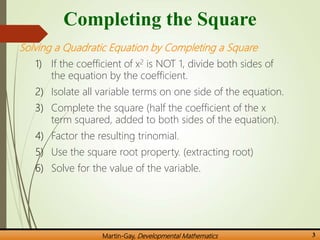
1) If the coefficient of x2 is NOT 1, divide both sides of
the equation by the coefficient.
2) Isolate all variable terms on one side of the equation.
3) Complete the square (half the coefficient of the x
term squared, added to both sides of the equation).
4) Factor the resulting trinomial.
5) Use the square root property. (extracting root)
6) Solve for the value of the variable.
Completing the Square
Martin-Gay, Developmental Mathematics 4
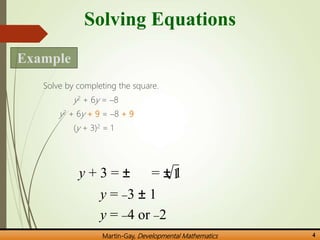
Solve by completing the square.
y2 + 6y = 8
y2 + 6y + 9 = 8 + 9
(y + 3)2 = 1
y = 3 ± 1
y = 4 or 2
y + 3 = ± = ± 1
1
Solving Equations
Example
Martin-Gay, Developmental Mathematics 5
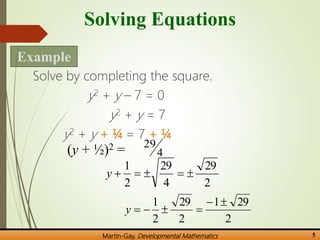
Solve by completing the square.
y2 + y – 7 = 0
y2 + y = 7
y2 + y + ¼ = 7 + ¼
2
29
4
29
2
1





y
2
29
1
2
29
2
1 





y
(y + ½)2 = 4
29
Solving Equations
Example
Martin-Gay, Developmental Mathematics 6
Solve by completing the square.
2x2 + 14x – 1 = 0
2x2 + 14x = 1
x2 + 7x = ½
2
51
4
51
2
7





x
2
51
7
2
51
2
7 





x
x2 + 7x + = ½ +
4
49
4
49
(x + )2 =
4
51
2
7
Solving Equations
Example
Martin-Gay, Developmental Mathematics 7
 Example
a ≠ 1, b is not even
3x
2
– 5x + 2 = 0
2 5 2 0
3 3
x x
  
2 5 25 2 25
3 36 3 36
x x
   
2
5 1
6 36
x
 
 
 
 
 
5 1
6 6
x 
5 1
6 6
x 
5 1
6 6
x 
x = 1 OR x = ⅔
Martin-Gay, Developmental Mathematics 8
Solving Quadratic Equations by the
Quadratic Formula
Martin-Gay, Developmental Mathematics 9
The Quadratic Formula
Another technique for solving quadratic equations is to use
the quadratic formula.
The formula is derived from completing the square of a
general quadratic equation.
Martin-Gay, Developmental Mathematics 10
The Quadratic Formula
A quadratic equation written in standard form, ax2 + bx + c = 0, has
the solutions.
a
ac
b
b
x
2
4
2




Martin-Gay, Developmental Mathematics 11
The Quadratic Formula
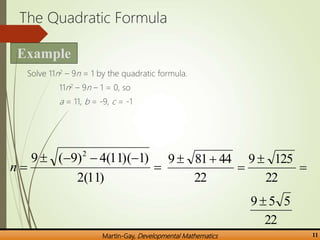
Solve 11n2 – 9n = 1 by the quadratic formula.
11n2 – 9n – 1 = 0, so
a = 11, b = -9, c = -1






)
11
(
2
)
1
)(
11
(
4
)
9
(
9 2
n 


22
44
81
9


22
125
9
22
5
5
9 
Example
Martin-Gay, Developmental Mathematics 12






)
1
(
2
)
20
)(
1
(
4
)
8
(
8 2
x 



2
80
64
8



2
144
8



2
12
8 20 4
or , 10 or 2
2 2


x2 + 8x – 20 = 0 (multiply both sides by 8)
a = 1, b = 8, c = 20
8
1
2
5
Solve x2 + x – = 0 by the quadratic formula.
The Quadratic Formula
Example
Martin-Gay, Developmental Mathematics 13
The Quadratic Formula
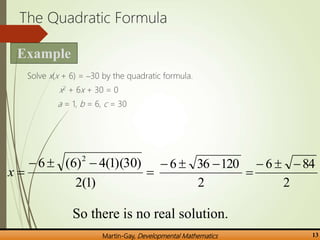
Solve x(x + 6) = 30 by the quadratic formula.
x2 + 6x + 30 = 0
a = 1, b = 6, c = 30





)
1
(
2
)
30
)(
1
(
4
)
6
(
6 2
x 



2
120
36
6
2
84
6 


So there is no real solution.
Example

quadratic equation-completing square.ppt

  • 1.
    Martin-Gay, Developmental Mathematics1 Solving Quadratic Equations by Completing the Square
  • 2.
    Martin-Gay, Developmental Mathematics2 Completing the Square This method will work to solve ALL quadratic equations; however, it is “messy” to solve quadratic equations by completing the square if a ≠ 1 and/or b is an odd number. Completing the square is a great choice for solving quadratic equations if a = 1 and b is an even number. It involves creating a trinomial that is a perfect square, setting the factored trinomial equal to a constant, then using the square root property from the previous lesson.
  • 3.
    Martin-Gay, Developmental Mathematics3 Solving a Quadratic Equation by Completing a Square 1) If the coefficient of x2 is NOT 1, divide both sides of the equation by the coefficient. 2) Isolate all variable terms on one side of the equation. 3) Complete the square (half the coefficient of the x term squared, added to both sides of the equation). 4) Factor the resulting trinomial. 5) Use the square root property. (extracting root) 6) Solve for the value of the variable. Completing the Square
  • 4.
    Martin-Gay, Developmental Mathematics4 Solve by completing the square. y2 + 6y = 8 y2 + 6y + 9 = 8 + 9 (y + 3)2 = 1 y = 3 ± 1 y = 4 or 2 y + 3 = ± = ± 1 1 Solving Equations Example
  • 5.
    Martin-Gay, Developmental Mathematics5 Solve by completing the square. y2 + y – 7 = 0 y2 + y = 7 y2 + y + ¼ = 7 + ¼ 2 29 4 29 2 1      y 2 29 1 2 29 2 1       y (y + ½)2 = 4 29 Solving Equations Example
  • 6.
    Martin-Gay, Developmental Mathematics6 Solve by completing the square. 2x2 + 14x – 1 = 0 2x2 + 14x = 1 x2 + 7x = ½ 2 51 4 51 2 7      x 2 51 7 2 51 2 7       x x2 + 7x + = ½ + 4 49 4 49 (x + )2 = 4 51 2 7 Solving Equations Example
  • 7.
    Martin-Gay, Developmental Mathematics7  Example a ≠ 1, b is not even 3x 2 – 5x + 2 = 0 2 5 2 0 3 3 x x    2 5 25 2 25 3 36 3 36 x x     2 5 1 6 36 x           5 1 6 6 x  5 1 6 6 x  5 1 6 6 x  x = 1 OR x = ⅔
  • 8.
    Martin-Gay, Developmental Mathematics8 Solving Quadratic Equations by the Quadratic Formula
  • 9.
    Martin-Gay, Developmental Mathematics9 The Quadratic Formula Another technique for solving quadratic equations is to use the quadratic formula. The formula is derived from completing the square of a general quadratic equation.
  • 10.
    Martin-Gay, Developmental Mathematics10 The Quadratic Formula A quadratic equation written in standard form, ax2 + bx + c = 0, has the solutions. a ac b b x 2 4 2    
  • 11.
    Martin-Gay, Developmental Mathematics11 The Quadratic Formula Solve 11n2 – 9n = 1 by the quadratic formula. 11n2 – 9n – 1 = 0, so a = 11, b = -9, c = -1       ) 11 ( 2 ) 1 )( 11 ( 4 ) 9 ( 9 2 n    22 44 81 9   22 125 9 22 5 5 9  Example
  • 12.
    Martin-Gay, Developmental Mathematics12       ) 1 ( 2 ) 20 )( 1 ( 4 ) 8 ( 8 2 x     2 80 64 8    2 144 8    2 12 8 20 4 or , 10 or 2 2 2   x2 + 8x – 20 = 0 (multiply both sides by 8) a = 1, b = 8, c = 20 8 1 2 5 Solve x2 + x – = 0 by the quadratic formula. The Quadratic Formula Example
  • 13.
    Martin-Gay, Developmental Mathematics13 The Quadratic Formula Solve x(x + 6) = 30 by the quadratic formula. x2 + 6x + 30 = 0 a = 1, b = 6, c = 30      ) 1 ( 2 ) 30 )( 1 ( 4 ) 6 ( 6 2 x     2 120 36 6 2 84 6    So there is no real solution. Example