For QTP Scripts & QTP Documents visit: www.gcreddy.com


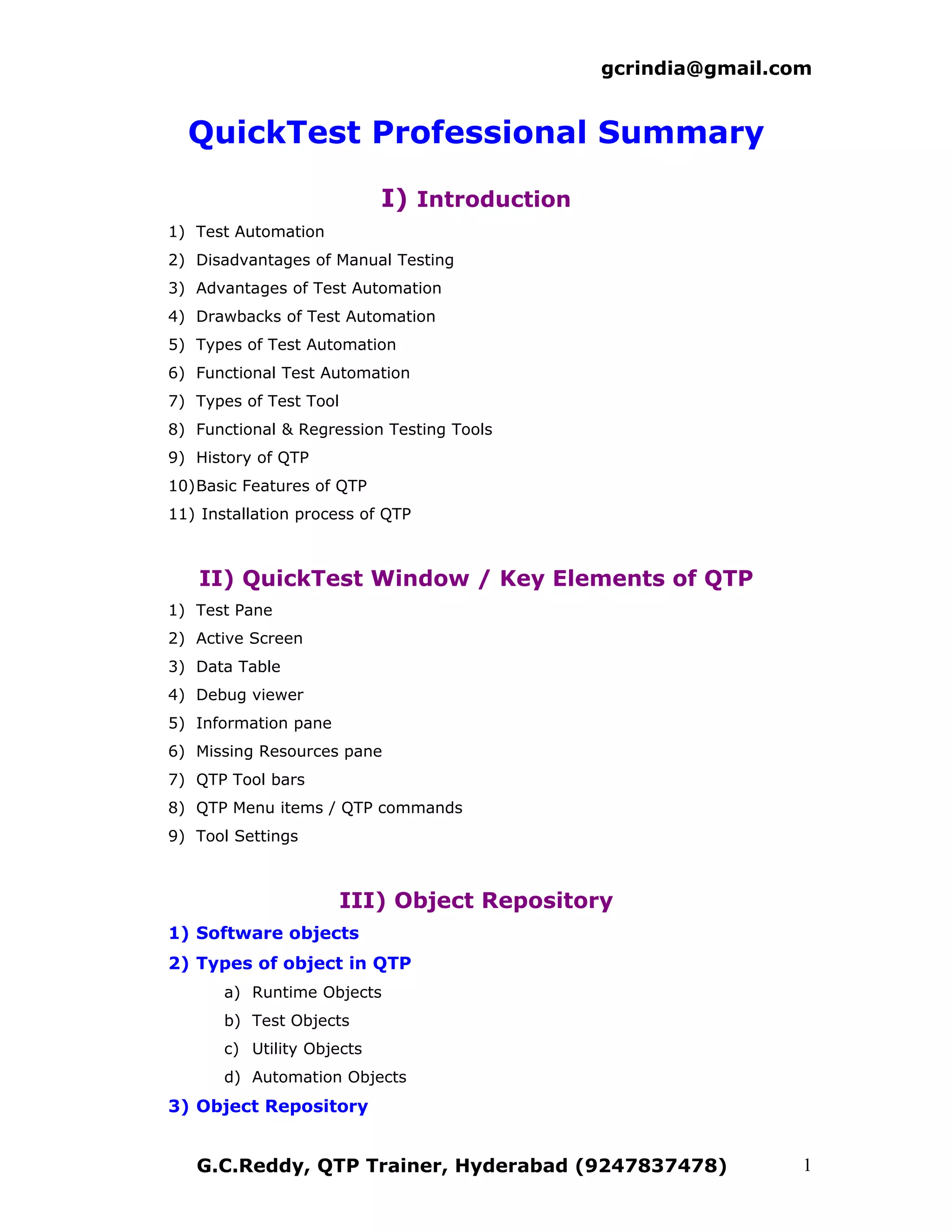
      QuickTest Window / Key Elements of QTP

1) Test Pane
2) Active Screen
3) Data Table
4) Debug viewer
5) Information pane
6) Missing Resources pane
7) QTP commands


                      III) Object Repository
1) Software objects
2) Types of object in QTP
      a) Runtime Objects
      b) Test Objects
      c) Utility Objects
      d) Automation Objects
3) Object Repository
      a) Local Repository
      b) Shared Repository
4) Operations on Object Repository
      a) Adding Objects
      b) Renaming Objects
      c) Deleting Objects
      d) Associating Object Repositories to an Action
      e) Exporting Local Objects
      f) Merging Repositories
      g) View Options
      h) Spying Objects
      i)   Importing and Exporting Repositories using XML


                    IV) QTP Testing Process
1) Planning

For QTP Scripts & QTP Documents visit: www.gcreddy.com 1
For QTP Scripts & QTP Documents visit: www.gcreddy.com

     a) Analyzing the AUT
     b) Implementing Automation Framework
     c) Creating/Selecting Test cases
     d) Collecting Test Data
     e) Object Identification Configuration
         i.      Normal Identification
                    1. Mandatory Properties
                    2. Assertive Properties
        ii.      Smart Identification
                   1. Base filter Properties
                   2. Option filter properties
       iii.      Ordinal Identifier
       iv.       Making Tool Settings Global
2) Generating the basic Test
     a) Recording
        i.      Normal Recording
       ii.      Analog Recording
      iii.      Low Level Recording
      iv.       Record and Run Settings
     b) Keyword driven methodology/Shared object repository
             method/Preparing the script manually
     c) Descriptive programming/Programmatic Descriptions
        i.      Entering Programmatic Descriptions Directly into Statements
       ii.      Using Description Objects for Programmatic Descriptions
      iii.      Retrieving Child Objects
      iv.       Using the Index Property in Programmatic Descriptions
       v.       Creating Checkpoints Programmatically
3) Enhancing the Test
     a) Inserting Check points
        i.      Standard Checkpoint
       ii.      Text Checkpoint
      iii.      Text Area Checkpoint
      iv.       Bitmap Checkpoint
       v.       Database Checkpoint
      vi.       Accessibility Checkpoint
      vii.      XML Checkpoint (From Application)

For QTP Scripts & QTP Documents visit: www.gcreddy.com 2
For QTP Scripts & QTP Documents visit: www.gcreddy.com

     viii.    XML Checkpoint (From Resource)
      ix.     Page Checkpoint
       x.     Image Checkpoint
      xi.     Table Checkpoint
     b) Inserting Output values
        i.    Standard Output value
       ii.    Text Output value
      iii.    Text Area Output value
      iv.     Database Output value
       v.     XML Output value (From Resource)
     c) Adding Comments
     d) Synchronization
        i.    Inserting Wait Statement
       ii.    Inserting Synchronization Point
      iii.    Increasing Tool Default Synchronization Time
      iv.     Sync method (only for web)
       v.     Selecting appropriate method
     e) Parameterization
        i.    Data Driven Testing through Loop statements
       ii.    Dynamic Test Data Submission through Looping
      iii.    Data Driven Testing through Data Table
      iv.     Importing Test Data from External files
       v.     Creating a Database, Tables and Entering Data
      vi.     Creating DSN
     vii.     Importing Test Data from Databases
     f) Inserting Programmatic statements
         i.   Inserting Conditional Statements
        ii.   Inserting Loop statements
       iii.   Using VB Script Built-in Functions
     g) Generating steps through Step Generator
     h) Inserting Transaction points
        i.    Start Transaction
       ii.    End Transaction
     i) Enhancing Tests with the windows API
4) Debugging the Test


For QTP Scripts & QTP Documents visit: www.gcreddy.com 3
For QTP Scripts & QTP Documents visit: www.gcreddy.com

     a) Debug Commands
        i.    Step Into
       ii.    Step Over
       iii.   Step Out
     b) Inserting/Removing Brake Points
     c) Watching variables
     d) Changing Variable values
5) Running the Test
     a) Normal execution
     b) Test Batch execution
        i.    Test batch formation
       ii.    Batch execution
       iii.   Partial Batch execution
6) Analyzing the Test Results
     a) Test Result Viewer
     b) Analyzing Test Results
     c) Exporting Test Results
     d) Test Results Deletion
7) Reporting Defects
     a) Manual Defect Reporting
     b) Tool based Defect Reporting
     c) Integration with Quality Center


                  V) QTP Advanced Features
1) Regular expressions
2) Environment Variables
   a) Built-in Variables
   b) User Defined Variables
   c) Defining, modifying and associating environment variables
3) Methods
     a) QTP Methods
     b) VB Script Methods
4) Actions
  a) Types of actions
        i.    Non-reusable Actions

For QTP Scripts & QTP Documents visit: www.gcreddy.com 4
For QTP Scripts & QTP Documents visit: www.gcreddy.com

        ii.    Re-Usable actions
        iii.   External Actions
  b) Creating an Action
  c) Splitting Actions
  d) Renaming an Action
  e) Deleting an Action
  f) Making an Reusable/Non-Reusable
  g) Calling an existing Action
  h) Copying an Actions
  i)   Action Parameters
5) Functions
  a) Preparing Procedures
  b) Associating Procedures to QTP tests
  c) Modifying Procedures
  d) Calling Procedures
6) Dynamic Handling of Object Repositories
  a) Loading Repositories directly through Utility Object
  b) Finding Repository Position
  c) Removing Repositories
7) Data Driven Testing through Scripting
  a) Importing Data from Flat files
  b) Importing Data from spread sheets
  c) Importing Data from Databases
         i.    Ms Access
        ii.    SQL Server
        iii.   Oracle
8) File System Operations
  a) File system Object
  b) Creating Files
  c) Reading Data
  d) Writing Data
  e) Creating Folders
  f) Creating Drives
9) Recovery Scenarios
  a) Trigger events


For QTP Scripts & QTP Documents visit: www.gcreddy.com 5
For QTP Scripts & QTP Documents visit: www.gcreddy.com

            i.    Pop-Up window
        ii.       Object State
        iii.      Test Run Error
       iv.        Application Crash
  b) Recovery Operations
      i.         Keyboard or Mouse Operation
     ii.         Close Application Process
     iii.        Function Call
     iv.         Restart Microsoft Windows
  c) Creating Recovery Scenarios
  d) Associating Recovery Scenarios
10)Virtual Object Configuration
  a) Virtual Object Manager
  b) Defining a Virtual Object
  c) Removing or Disabling Virtual Object Definitions
11)Test Automation Frameworks
  a) Automation Framework
  b) Record & Playback or Linear Framework
  c) Modular Driven framework
  d) Keyword Driven framework
  e) Hybrid driven Framework
12)Automation Object Model


                           VI) VB Script for QTP
1) Introduction
     a) Introducing VB Script
     b) Windows Script Host (WSH)
     c) Crating a script with Note pad
     d) Hosting Environments & Script engines
     e) Available Script engines
2) Comments
     a) Purpose of Comments
     b) Syntax
     c) Comment/Uncomment a block of statements
3) VB Script Variables

For QTP Scripts & QTP Documents visit: www.gcreddy.com 6
For QTP Scripts & QTP Documents visit: www.gcreddy.com

     a) Declaring Variables
     b) Option Explicit Statement
     c) Naming restrictions for Variables
     d) Scope of Variables
     e) Life time of Variables
     f) Assigning values to Variables
     g) Scalar Variables and Array Variables
     h) Dimensional Arrays
     i)   Dynamic Arrays
4) VB Script Data Types
     a) Variant Sub types
5) VB Script Operators
     a) Operator precedence
     b) Arithmetic Operators
     c) Comparison Operators
     d) Concatenation Operators
     e) Logical Operators
6) Input/Output Operations
     a) Inputbox Function
     b) Msgbox Function
7) Constants
     a) Creating Constants
     b) Using Constants
     c) Modifying Constants
8) Conditional Statements
     a) If…Then…Else Statement
     b) Select Case Statement
     c) Making Decisions Using If...Then...Else
     d) Running a Statement if a Condition is True (single statement)
     e) Running Statements if a Condition is True (multiple statements)
     f) Running Certain Statements if a Condition is True and Running Others
        if a Condition is False
     g) Deciding Between Several Alternatives
     h) Executing a certain block of statements when two / more conditions
        are True (Nested If...)
     i)   Making Decisions with Select Case

For QTP Scripts & QTP Documents visit: www.gcreddy.com 7
For QTP Scripts & QTP Documents visit: www.gcreddy.com

     j)   Other Examples
9) Looping Through Code
     a) Loop statements
     b) Do Loops
     c) While…wend statement
     d) For…Next statement
     e) For Each…Next statement
10)Other Statements
11)Procedures
     a) Sub Procedures
     b) Function Procedures
     c) Getting Data into and out of procedures
     d) Using Sub and Function procedures in code
12)VB Script Built-in Functions
     a) Conversions
     b) Dates/Times
     c) Formatting Strings
     d) Input/Output
     e) Math
     f) Miscellaneous
     g) Rounding
     h) Strings
     i)   Variants
13)Methods
14)Objects
     a) ADODB connection
     b) Dictionary
     c) Excel Application
     d) File system Object
     e) Network
     f) Shell
     g) Word Application
     h) XML Document
15)Classes
16)Keywords

For QTP Scripts & QTP Documents visit: www.gcreddy.com 8
For QTP Scripts & QTP Documents visit: www.gcreddy.com

17)Errors
     a) VB Script Runtime Errors
     b) VB script Syntax Errors
18)VBScript syntax rules and guidelines


For QTP Scripts & QTP Documents visit: www.gcreddy.com 9

Qtp Summary

  • 1.
    For QTP Scripts& QTP Documents visit: www.gcreddy.com QuickTest Window / Key Elements of QTP 1) Test Pane 2) Active Screen 3) Data Table 4) Debug viewer 5) Information pane 6) Missing Resources pane 7) QTP commands III) Object Repository 1) Software objects 2) Types of object in QTP a) Runtime Objects b) Test Objects c) Utility Objects d) Automation Objects 3) Object Repository a) Local Repository b) Shared Repository 4) Operations on Object Repository a) Adding Objects b) Renaming Objects c) Deleting Objects d) Associating Object Repositories to an Action e) Exporting Local Objects f) Merging Repositories g) View Options h) Spying Objects i) Importing and Exporting Repositories using XML IV) QTP Testing Process 1) Planning For QTP Scripts & QTP Documents visit: www.gcreddy.com 1
  • 2.
    For QTP Scripts& QTP Documents visit: www.gcreddy.com a) Analyzing the AUT b) Implementing Automation Framework c) Creating/Selecting Test cases d) Collecting Test Data e) Object Identification Configuration i. Normal Identification 1. Mandatory Properties 2. Assertive Properties ii. Smart Identification 1. Base filter Properties 2. Option filter properties iii. Ordinal Identifier iv. Making Tool Settings Global 2) Generating the basic Test a) Recording i. Normal Recording ii. Analog Recording iii. Low Level Recording iv. Record and Run Settings b) Keyword driven methodology/Shared object repository method/Preparing the script manually c) Descriptive programming/Programmatic Descriptions i. Entering Programmatic Descriptions Directly into Statements ii. Using Description Objects for Programmatic Descriptions iii. Retrieving Child Objects iv. Using the Index Property in Programmatic Descriptions v. Creating Checkpoints Programmatically 3) Enhancing the Test a) Inserting Check points i. Standard Checkpoint ii. Text Checkpoint iii. Text Area Checkpoint iv. Bitmap Checkpoint v. Database Checkpoint vi. Accessibility Checkpoint vii. XML Checkpoint (From Application) For QTP Scripts & QTP Documents visit: www.gcreddy.com 2
  • 3.
    For QTP Scripts& QTP Documents visit: www.gcreddy.com viii. XML Checkpoint (From Resource) ix. Page Checkpoint x. Image Checkpoint xi. Table Checkpoint b) Inserting Output values i. Standard Output value ii. Text Output value iii. Text Area Output value iv. Database Output value v. XML Output value (From Resource) c) Adding Comments d) Synchronization i. Inserting Wait Statement ii. Inserting Synchronization Point iii. Increasing Tool Default Synchronization Time iv. Sync method (only for web) v. Selecting appropriate method e) Parameterization i. Data Driven Testing through Loop statements ii. Dynamic Test Data Submission through Looping iii. Data Driven Testing through Data Table iv. Importing Test Data from External files v. Creating a Database, Tables and Entering Data vi. Creating DSN vii. Importing Test Data from Databases f) Inserting Programmatic statements i. Inserting Conditional Statements ii. Inserting Loop statements iii. Using VB Script Built-in Functions g) Generating steps through Step Generator h) Inserting Transaction points i. Start Transaction ii. End Transaction i) Enhancing Tests with the windows API 4) Debugging the Test For QTP Scripts & QTP Documents visit: www.gcreddy.com 3
  • 4.
    For QTP Scripts& QTP Documents visit: www.gcreddy.com a) Debug Commands i. Step Into ii. Step Over iii. Step Out b) Inserting/Removing Brake Points c) Watching variables d) Changing Variable values 5) Running the Test a) Normal execution b) Test Batch execution i. Test batch formation ii. Batch execution iii. Partial Batch execution 6) Analyzing the Test Results a) Test Result Viewer b) Analyzing Test Results c) Exporting Test Results d) Test Results Deletion 7) Reporting Defects a) Manual Defect Reporting b) Tool based Defect Reporting c) Integration with Quality Center V) QTP Advanced Features 1) Regular expressions 2) Environment Variables a) Built-in Variables b) User Defined Variables c) Defining, modifying and associating environment variables 3) Methods a) QTP Methods b) VB Script Methods 4) Actions a) Types of actions i. Non-reusable Actions For QTP Scripts & QTP Documents visit: www.gcreddy.com 4
  • 5.
    For QTP Scripts& QTP Documents visit: www.gcreddy.com ii. Re-Usable actions iii. External Actions b) Creating an Action c) Splitting Actions d) Renaming an Action e) Deleting an Action f) Making an Reusable/Non-Reusable g) Calling an existing Action h) Copying an Actions i) Action Parameters 5) Functions a) Preparing Procedures b) Associating Procedures to QTP tests c) Modifying Procedures d) Calling Procedures 6) Dynamic Handling of Object Repositories a) Loading Repositories directly through Utility Object b) Finding Repository Position c) Removing Repositories 7) Data Driven Testing through Scripting a) Importing Data from Flat files b) Importing Data from spread sheets c) Importing Data from Databases i. Ms Access ii. SQL Server iii. Oracle 8) File System Operations a) File system Object b) Creating Files c) Reading Data d) Writing Data e) Creating Folders f) Creating Drives 9) Recovery Scenarios a) Trigger events For QTP Scripts & QTP Documents visit: www.gcreddy.com 5
  • 6.
    For QTP Scripts& QTP Documents visit: www.gcreddy.com i. Pop-Up window ii. Object State iii. Test Run Error iv. Application Crash b) Recovery Operations i. Keyboard or Mouse Operation ii. Close Application Process iii. Function Call iv. Restart Microsoft Windows c) Creating Recovery Scenarios d) Associating Recovery Scenarios 10)Virtual Object Configuration a) Virtual Object Manager b) Defining a Virtual Object c) Removing or Disabling Virtual Object Definitions 11)Test Automation Frameworks a) Automation Framework b) Record & Playback or Linear Framework c) Modular Driven framework d) Keyword Driven framework e) Hybrid driven Framework 12)Automation Object Model VI) VB Script for QTP 1) Introduction a) Introducing VB Script b) Windows Script Host (WSH) c) Crating a script with Note pad d) Hosting Environments & Script engines e) Available Script engines 2) Comments a) Purpose of Comments b) Syntax c) Comment/Uncomment a block of statements 3) VB Script Variables For QTP Scripts & QTP Documents visit: www.gcreddy.com 6
  • 7.
    For QTP Scripts& QTP Documents visit: www.gcreddy.com a) Declaring Variables b) Option Explicit Statement c) Naming restrictions for Variables d) Scope of Variables e) Life time of Variables f) Assigning values to Variables g) Scalar Variables and Array Variables h) Dimensional Arrays i) Dynamic Arrays 4) VB Script Data Types a) Variant Sub types 5) VB Script Operators a) Operator precedence b) Arithmetic Operators c) Comparison Operators d) Concatenation Operators e) Logical Operators 6) Input/Output Operations a) Inputbox Function b) Msgbox Function 7) Constants a) Creating Constants b) Using Constants c) Modifying Constants 8) Conditional Statements a) If…Then…Else Statement b) Select Case Statement c) Making Decisions Using If...Then...Else d) Running a Statement if a Condition is True (single statement) e) Running Statements if a Condition is True (multiple statements) f) Running Certain Statements if a Condition is True and Running Others if a Condition is False g) Deciding Between Several Alternatives h) Executing a certain block of statements when two / more conditions are True (Nested If...) i) Making Decisions with Select Case For QTP Scripts & QTP Documents visit: www.gcreddy.com 7
  • 8.
    For QTP Scripts& QTP Documents visit: www.gcreddy.com j) Other Examples 9) Looping Through Code a) Loop statements b) Do Loops c) While…wend statement d) For…Next statement e) For Each…Next statement 10)Other Statements 11)Procedures a) Sub Procedures b) Function Procedures c) Getting Data into and out of procedures d) Using Sub and Function procedures in code 12)VB Script Built-in Functions a) Conversions b) Dates/Times c) Formatting Strings d) Input/Output e) Math f) Miscellaneous g) Rounding h) Strings i) Variants 13)Methods 14)Objects a) ADODB connection b) Dictionary c) Excel Application d) File system Object e) Network f) Shell g) Word Application h) XML Document 15)Classes 16)Keywords For QTP Scripts & QTP Documents visit: www.gcreddy.com 8
  • 9.
    For QTP Scripts& QTP Documents visit: www.gcreddy.com 17)Errors a) VB Script Runtime Errors b) VB script Syntax Errors 18)VBScript syntax rules and guidelines For QTP Scripts & QTP Documents visit: www.gcreddy.com 9