1
Equipment
- Required for Mfg & many other operations
- Can affect the quality of drug products
- Selection procedure should be well defined &
evaluated
- Cleaning & maintenance procedure should be
evaluated, validated, recorded
2
Selection & purchase specifications
• - Has strategic and financial impact on business
• Affects cost & quality of products, safety &
environment of facility
Factors for selection:
1. Operating criteria
2. Availability of spares & servicing
3. Maintenance
4. Environmental issues
5. Availability of design & maintenance manuals
6. Cost
3
Equipment design, size & maintenance
• Used in Mfg., Processing, packing, holding of drug
product- Proper design, size & suitable location for
intended use, easy cleaning, mainten.
• Design & operation manuals from suppliers for
validation, qualification & maintenance is imp.
Equipments construction:
• Surfaces in contact with drug/components should be
inert-safety, identity, strength, quality, purity of drug
• Parts in direct contact should be autoclavable, washable
• Lubricating agents should not come in contact with
drug products, containers, closures etc
4
• Purchase specification of equipment:
• Specifications of equipments like size, weight, performance
parameters, safety req. etc must be defined.
• General considerations for purchase (Sch M):
• Equip., be located, designed, constructed, adapted &
maintained to suit the operations
• Layout & design of equip., aims to minimize risk of errors,
permit effective cleaning & maintenance, avoid cross
contamination
• Log book of equipment
• Balances, other measuring devices proper range, accuracy,
precision- in material stores, production, process control
operations
• Should be calibrated periodically as per SOP
5
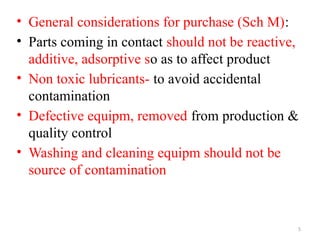
• General considerations for purchase (Sch M):
• Parts coming in contact should not be reactive,
additive, adsorptive so as to affect product
• Non toxic lubricants- to avoid accidental
contamination
• Defective equipm, removed from production &
quality control
• Washing and cleaning equipm should not be
source of contamination
6
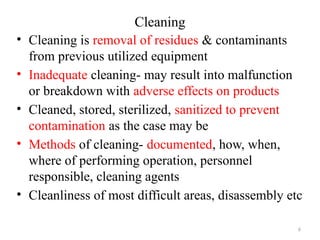
Cleaning
• Cleaning is removal of residues & contaminants
from previous utilized equipment
• Inadequate cleaning- may result into malfunction
or breakdown with adverse effects on products
• Cleaned, stored, sterilized, sanitized to prevent
contamination as the case may be
• Methods of cleaning- documented, how, when,
where of performing operation, personnel
responsible, cleaning agents
• Cleanliness of most difficult areas, disassembly etc
7
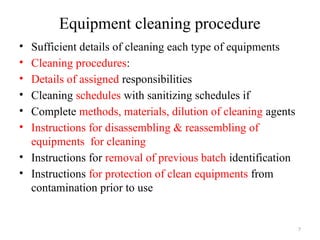
Equipment cleaning procedure
• Sufficient details of cleaning each type of equipments
• Cleaning procedures:
• Details of assigned responsibilities
• Cleaning schedules with sanitizing schedules if
• Complete methods, materials, dilution of cleaning agents
• Instructions for disassembling & reassembling of
equipments for cleaning
• Instructions for removal of previous batch identification
• Instructions for protection of clean equipments from
contamination prior to use
8
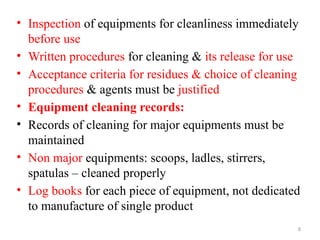
• Inspection of equipments for cleanliness immediately
before use
• Written procedures for cleaning & its release for use
• Acceptance criteria for residues & choice of cleaning
procedures & agents must be justified
• Equipment cleaning records:
• Records of cleaning for major equipments must be
maintained
• Non major equipments: scoops, ladles, stirrers,
spatulas – cleaned properly
• Log books for each piece of equipment, not dedicated
to manufacture of single product
9
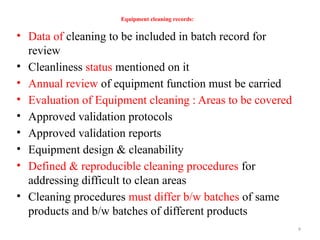
Equipment cleaning records:
• Data of cleaning to be included in batch record for
review
• Cleanliness status mentioned on it
• Annual review of equipment function must be carried
• Evaluation of Equipment cleaning : Areas to be covered
• Approved validation protocols
• Approved validation reports
• Equipment design & cleanability
• Defined & reproducible cleaning procedures for
addressing difficult to clean areas
• Cleaning procedures must differ b/w batches of same
products and b/w batches of different products
10
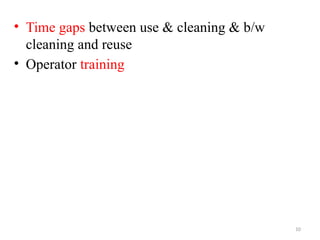
• Time gaps between use & cleaning & b/w
cleaning and reuse
• Operator training
11
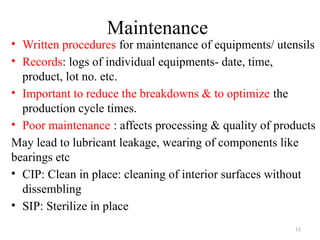
Maintenance
• Written procedures for maintenance of equipments/ utensils
• Records: logs of individual equipments- date, time,
product, lot no. etc.
• Important to reduce the breakdowns & to optimize the
production cycle times.
• Poor maintenance : affects processing & quality of products
May lead to lubricant leakage, wearing of components like
bearings etc
• CIP: Clean in place: cleaning of interior surfaces without
dissembling
• SIP: Sterilize in place
12
13
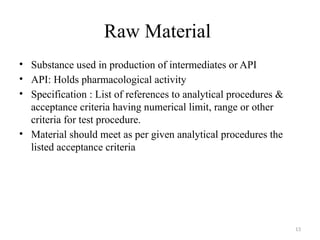
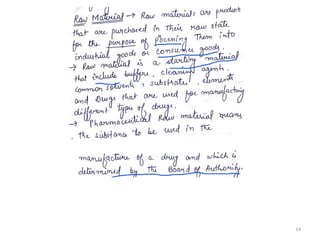
Raw Material
• Substance used in production of intermediates or API
• API: Holds pharmacological activity
• Specification : List of references to analytical procedures &
acceptance criteria having numerical limit, range or other
criteria for test procedure.
• Material should meet as per given analytical procedures the
listed acceptance criteria
14
15
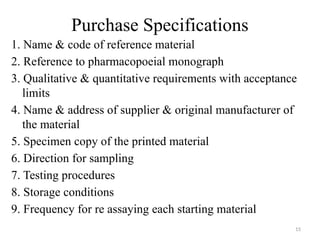
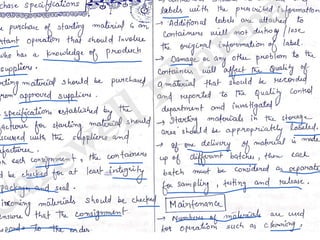
Purchase Specifications
1. Name & code of reference material
2. Reference to pharmacopoeial monograph
3. Qualitative & quantitative requirements with acceptance
limits
4. Name & address of supplier & original manufacturer of
the material
5. Specimen copy of the printed material
6. Direction for sampling
7. Testing procedures
8. Storage conditions
9. Frequency for re assaying each starting material
16
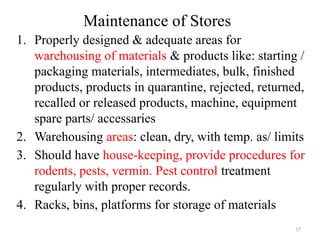
17
Maintenance of Stores
1. Properly designed & adequate areas for
warehousing of materials & products like: starting /
packaging materials, intermediates, bulk, finished
products, products in quarantine, rejected, returned,
recalled or released products, machine, equipment
spare parts/ accessaries
2. Warehousing areas: clean, dry, with temp. as/ limits
3. Should have house-keeping, provide procedures for
rodents, pests, vermin. Pest control treatment
regularly with proper records.
4. Racks, bins, platforms for storage of materials
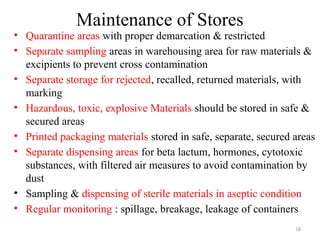
18
• Quarantine areas with proper demarcation & restricted
• Separate sampling areas in warehousing area for raw materials &
excipients to prevent cross contamination
• Separate storage for rejected, recalled, returned materials, with
marking
• Hazardous, toxic, explosive Materials should be stored in safe &
secured areas
• Printed packaging materials stored in safe, separate, secured areas
• Separate dispensing areas for beta lactum, hormones, cytotoxic
substances, with filtered air measures to avoid contamination by
dust
• Sampling & dispensing of sterile materials in aseptic condition
• Regular monitoring : spillage, breakage, leakage of containers
Maintenance of Stores

QA notes Equipments and Raw-Materials-1.pptx

  • 1.
    1 Equipment - Required forMfg & many other operations - Can affect the quality of drug products - Selection procedure should be well defined & evaluated - Cleaning & maintenance procedure should be evaluated, validated, recorded
  • 2.
    2 Selection & purchasespecifications • - Has strategic and financial impact on business • Affects cost & quality of products, safety & environment of facility Factors for selection: 1. Operating criteria 2. Availability of spares & servicing 3. Maintenance 4. Environmental issues 5. Availability of design & maintenance manuals 6. Cost
  • 3.
    3 Equipment design, size& maintenance • Used in Mfg., Processing, packing, holding of drug product- Proper design, size & suitable location for intended use, easy cleaning, mainten. • Design & operation manuals from suppliers for validation, qualification & maintenance is imp. Equipments construction: • Surfaces in contact with drug/components should be inert-safety, identity, strength, quality, purity of drug • Parts in direct contact should be autoclavable, washable • Lubricating agents should not come in contact with drug products, containers, closures etc
  • 4.
    4 • Purchase specificationof equipment: • Specifications of equipments like size, weight, performance parameters, safety req. etc must be defined. • General considerations for purchase (Sch M): • Equip., be located, designed, constructed, adapted & maintained to suit the operations • Layout & design of equip., aims to minimize risk of errors, permit effective cleaning & maintenance, avoid cross contamination • Log book of equipment • Balances, other measuring devices proper range, accuracy, precision- in material stores, production, process control operations • Should be calibrated periodically as per SOP
  • 5.
    5 • General considerationsfor purchase (Sch M): • Parts coming in contact should not be reactive, additive, adsorptive so as to affect product • Non toxic lubricants- to avoid accidental contamination • Defective equipm, removed from production & quality control • Washing and cleaning equipm should not be source of contamination
  • 6.
    6 Cleaning • Cleaning isremoval of residues & contaminants from previous utilized equipment • Inadequate cleaning- may result into malfunction or breakdown with adverse effects on products • Cleaned, stored, sterilized, sanitized to prevent contamination as the case may be • Methods of cleaning- documented, how, when, where of performing operation, personnel responsible, cleaning agents • Cleanliness of most difficult areas, disassembly etc
  • 7.
    7 Equipment cleaning procedure •Sufficient details of cleaning each type of equipments • Cleaning procedures: • Details of assigned responsibilities • Cleaning schedules with sanitizing schedules if • Complete methods, materials, dilution of cleaning agents • Instructions for disassembling & reassembling of equipments for cleaning • Instructions for removal of previous batch identification • Instructions for protection of clean equipments from contamination prior to use
  • 8.
    8 • Inspection ofequipments for cleanliness immediately before use • Written procedures for cleaning & its release for use • Acceptance criteria for residues & choice of cleaning procedures & agents must be justified • Equipment cleaning records: • Records of cleaning for major equipments must be maintained • Non major equipments: scoops, ladles, stirrers, spatulas – cleaned properly • Log books for each piece of equipment, not dedicated to manufacture of single product
  • 9.
    9 Equipment cleaning records: •Data of cleaning to be included in batch record for review • Cleanliness status mentioned on it • Annual review of equipment function must be carried • Evaluation of Equipment cleaning : Areas to be covered • Approved validation protocols • Approved validation reports • Equipment design & cleanability • Defined & reproducible cleaning procedures for addressing difficult to clean areas • Cleaning procedures must differ b/w batches of same products and b/w batches of different products
  • 10.
    10 • Time gapsbetween use & cleaning & b/w cleaning and reuse • Operator training
  • 11.
    11 Maintenance • Written proceduresfor maintenance of equipments/ utensils • Records: logs of individual equipments- date, time, product, lot no. etc. • Important to reduce the breakdowns & to optimize the production cycle times. • Poor maintenance : affects processing & quality of products May lead to lubricant leakage, wearing of components like bearings etc • CIP: Clean in place: cleaning of interior surfaces without dissembling • SIP: Sterilize in place
  • 12.
  • 13.
    13 Raw Material • Substanceused in production of intermediates or API • API: Holds pharmacological activity • Specification : List of references to analytical procedures & acceptance criteria having numerical limit, range or other criteria for test procedure. • Material should meet as per given analytical procedures the listed acceptance criteria
  • 14.
  • 15.
    15 Purchase Specifications 1. Name& code of reference material 2. Reference to pharmacopoeial monograph 3. Qualitative & quantitative requirements with acceptance limits 4. Name & address of supplier & original manufacturer of the material 5. Specimen copy of the printed material 6. Direction for sampling 7. Testing procedures 8. Storage conditions 9. Frequency for re assaying each starting material
  • 16.
  • 17.
    17 Maintenance of Stores 1.Properly designed & adequate areas for warehousing of materials & products like: starting / packaging materials, intermediates, bulk, finished products, products in quarantine, rejected, returned, recalled or released products, machine, equipment spare parts/ accessaries 2. Warehousing areas: clean, dry, with temp. as/ limits 3. Should have house-keeping, provide procedures for rodents, pests, vermin. Pest control treatment regularly with proper records. 4. Racks, bins, platforms for storage of materials
  • 18.
    18 • Quarantine areaswith proper demarcation & restricted • Separate sampling areas in warehousing area for raw materials & excipients to prevent cross contamination • Separate storage for rejected, recalled, returned materials, with marking • Hazardous, toxic, explosive Materials should be stored in safe & secured areas • Printed packaging materials stored in safe, separate, secured areas • Separate dispensing areas for beta lactum, hormones, cytotoxic substances, with filtered air measures to avoid contamination by dust • Sampling & dispensing of sterile materials in aseptic condition • Regular monitoring : spillage, breakage, leakage of containers Maintenance of Stores