4
Lesson Exemplar
for Science
for Science
Lesson
2
Quarter 1
Lesson 1
Quarter 4
Lesson Exemplar for Science 4
Quarter 4: Lesson 2 (Week 2)
S.Y. 2024-2025
This material is intended exclusively for the use of teachers participating in the implementation of the MATATAG K to 10 Curriculum during the School
Year 2024-2025. It aims to assist in delivering the curriculum content, standards, and lesson competencies. Any unauthorized reproduction, distribution,
modification, or utilization of this material beyond the designated scope is strictly prohibited and may result in appropriate legal actions and disciplinary measures.
Borrowed content included in this material are owned by their respective copyright holders. Every effort has been made to locate and obtain permission
to use these materials from their respective copyright owners. The publisher and development team do not represent nor claim ownership over them.
Every care has been taken to ensure the accuracy of the information provided in this material. For inquiries or feedback, please write or call the Office
of the Director of the Bureau of Learning Resources via telephone numbers (02) 8634-1072 and 8631-6922 or by email at blr.od@deped.gov.ph.
Development Team
Writer:
• Jason L. De Vera (Philippine Normal University)
Validator:
• Dr. Randel D. Estacio (Quezon City University)
Management Team
Philippine Normal University
Research Institute for Teacher Quality
SiMERR National Research Centre
1
SCIENCE (EARTH AND SPACE SCIENCE) / QUARTER 4 / GRADE 4
I. CURRICULUM CONTENT, STANDARDS, AND LESSON COMPETENCIES
A. Content
Standards
The learners learn that:
1. Soil and water resources are needed by plants and animals to live and grow.
2. Characteristics of the weather can be observed and measured.
3. The Sun is a ball of hot gases about 100 times the size of Earth, which radiates energy needed by living things.
B. Performance
Standards
By the end of the Quarter, learners use simple equipment to identify how types of soil hold water to support growth of
plants. They use instruments and secondary sources to measure and describe the characteristics of weather and use
the information to make predictions about weather patterns in their local area. They demonstrate appreciation for the
dangers of extreme weather events and use safe practice to protect themselves if they are caught in bad weather.
Learners use personal observations and reliable secondary information sources to describe the Sun and explain its
importance to life on Earth.
C. Learning
Competencies
and Objectives
Learning Competencies
recognize that water is one of the basic needs of plants and animals;
C. Content Water as Basic Need of Living Things
D. Integration ● Creativity and innovation
● Environmental awareness (Environmental Literacy)
● Collaboration
● Clean Water and Sanitation (SDG 6)
II. LEARNING RESOURCES
Needs OS living things. What five basic things do living things need to survive? (2021, September 27). Eschooltoday | Learn something new
today. https://eschooltoday.com/learn/introduction-to-needs-of-living-things/
Science grade 4 q4 week 2 sources of water [Video]. (2021, June 14). YouTube. https://youtu.be/eS8l_KU7D7k?si=fBPHq25yO36XidNN
Uses of water | Importance of water | Water and it's uses | Uses of water for kids | Use of water [Video]. (2020, September 29). YouTube.
https://youtu.be/rUQEm3UYu5M?si=Cu3v2tVv2HmGsWpq
2
III. TEACHING AND LEARNING PROCEDURE NOTES TO TEACHERS
A. Activating Prior
Knowledge
DAY 1:
1. Short Review: Water, Our Lifesaver! Video Exploration
Today, we will investigate the significance of water for all living organisms. We will
begin by viewing a unique video that demonstrates the crucial importance of water
for animals, plants, and humans. Following the film, we will engage in a discussion
and then participate in a creative brainstorming session. Are you ready to explore
the mysteries of water? Let's get started!
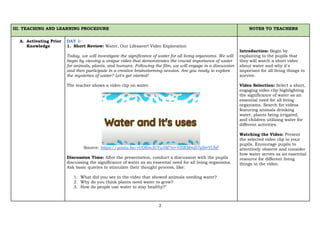
The teacher shows a video clip on water.
Source: https://youtu.be/rUQEm3UYu5M?si=VISKMmB7gSrrYUbF
Discussion Time: After the presentation, conduct a discussion with the pupils
discussing the significance of water as an essential need for all living organisms.
Ask basic queries to stimulate their thought process, like:
1. What did you see in the video that showed animals needing water?
2. Why do you think plants need water to grow?
3. How do people use water to stay healthy?"
Introduction: Begin by
explaining to the pupils that
they will watch a short video
about water and why it's
important for all living things to
survive.
Video Selection: Select a short,
engaging video clip highlighting
the significance of water as an
essential need for all living
organisms. Search for videos
featuring animals drinking
water, plants being irrigated,
and children utilizing water for
different activities.
Watching the Video: Present
the selected video clip to your
pupils. Encourage pupils to
attentively observe and consider
how water serves as an essential
resource for different living
things in the video.
3
B. Establishing
Lesson Purpose
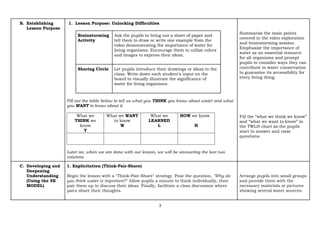
1. Lesson Purpose: Unlocking Difficulties
Brainstorming
Activity
Ask the pupils to bring out a sheet of paper and
tell them to draw or write one example from the
video demonstrating the importance of water for
living organisms. Encourage them to utilize colors
and images to express their ideas.
Sharing Circle Let pupils introduce their drawings or ideas to the
class. Write down each student's input on the
board to visually illustrate the significance of
water for living organisms.
Fill out the table below to tell us what you THINK you know about water and what
you WANT to know about it.
What we
THINK we
know
T
What we WANT
to know
W
What we
LEARNED
L
HOW we know
H
Later on, when we are done with our lesson, we will be answering the last two
columns.
Summarize the main points
covered in the video exploration
and brainstorming session.
Emphasize the importance of
water as an essential resource
for all organisms and prompt
pupils to consider ways they can
contribute to water conservation
to guarantee its accessibility for
every living thing.
Fill the “what we think we know”
and “what we want to know” in
the TWLH chart as the pupils
start to answer and raise
questions.
C. Developing and
Deepening
Understanding
(Using the 5E
MODEL)
1. Explicitation (Think-Pair-Share)
Begin the lesson with a "Think-Pair-Share" strategy. Pose the question, "Why do
you think water is important?" Allow pupils a minute to think individually, then
pair them up to discuss their ideas. Finally, facilitate a class discussion where
pairs share their thoughts.
Arrange pupils into small groups
and provide them with the
necessary materials or pictures
showing several water sources.
4
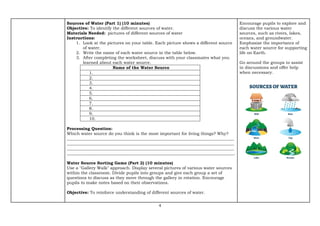
Sources of Water (Part 1) (10 minutes)
Objective: To identify the different sources of water.
Materials Needed: pictures of different sources of water
Instructions:
1. Look at the pictures on your table. Each picture shows a different source
of water.
2. Write the name of each water source in the table below.
3. After completing the worksheet, discuss with your classmates what you
learned about each water source.
Name of the Water Source
1.
2.
3.
4.
5.
6.
7.
8.
9.
10.
Processing Question:
Which water source do you think is the most important for living things? Why?
________________________________________________________________________________
________________________________________________________________________________
________________________________________________________________________________
________________________________________________________________________________.
Water Source Sorting Game (Part 2) (10 minutes)
Use a "Gallery Walk" approach. Display several pictures of various water sources
within the classroom. Divide pupils into groups and give each group a set of
questions to discuss as they move through the gallery in rotation. Encourage
pupils to make notes based on their observations.
Objective: To reinforce understanding of different sources of water.
Encourage pupils to explore and
discuss the various water
sources, such as rivers, lakes,
oceans, and groundwater.
Emphasize the importance of
each water source for supporting
life on Earth.
Go around the groups to assist
in discussions and offer help
when necessary.
5
Instructions:
1. Divide the class into small groups.
2. Post pictures of various water sources, such as rivers, lakes, oceans,
rain, and water pipes.
3. Show the pictures to each group and ask them to group them into two
groups: "natural water source" and "man-made water."
4. Discuss with each group why they sorted the pictures the way they did
and talk about why each water source is important.
Water Sources
Natural Water source Man-made Water
Processing Questions:
What did you learn about the different sources of water from this activity?
________________________________________________________________________________
________________________________________________________________________________
________________________________________________________________________________.
Why is it important to have both natural and man-made sources of water?
________________________________________________________________________________
________________________________________________________________________________
________________________________________________________________________________.
2. Worked Example:
Plant Watering Experiment (Advance preparation is required)
Objective: To understand the importance of water for plant growth.
Materials Needed: Germinated mongo plant from last week's activity; Water and
small cup
Ask the pupils to describe the
difference between natural and
man-made water sources.
Hello, pupils! Today, we'll look at
something really cool: how water
helps plants grow big and
healthy! So, today, we'll do a fun
experiment using two plants:
Plant A and Plant B. Plant A will
6
Instructions:
1. With your group, you will conduct a plant watering experiment.
2. You will use your germinated mongo plant's last activity in soil.
3. Label two small pots as "Plant A" and "Plant B."
4. Water Plant A for the whole day until the next morning, but do not water
Plant B.
5. Observe the plants. Describe what you see happening to each plant.
6. Discuss with your group what you learned about the importance of water
for plants.
Drawing:
Plant A Plant B
Processing Questions:
1. What differences did you observe between Plant A (watered regularly) and
Plant B (not watered)?
_____________________________________________________________________________
_____________________________________________________________________________
_____________________________________________________________________________
2. How does this show the importance of water for plants?
_____________________________________________________________________________
_____________________________________________________________________________
_____________________________________________________________________________
receive water, but Plant B will
not. We're going to observe what
happens to each plant over time.
Are you excited to be a plant
scientist beside me?
Before we begin, let's make a
guess: What do you think will
happen to a plant without water?
What about a plant that gets
enough water? Let's discuss our
observations, and then get ready
to investigate!
Conduct a hands-on activity
where pupils observe and
discuss the effects of watering on
plant growth using germinated
seeds or potted plants.
Remind pupils to record their
observations while learning the
importance of water in plant
development and health.
Encourage pupils to consider
how plants use water and the
importance of watering them on
a regular basis.
7
DAY 2:
3. Lesson Activity
Animal Habitat Exploration (20 mins)
Objective: To understand how water is essential for different animals and their
habitats.
Materials Needed: pictures of various animals and their habitats
Instructions:
1. Work in a group.
2. Together with your teammates, perform the activity.
3. Provide each student with a worksheet containing pictures of various
animals and their habitats, such as a lion in the savannah, a fish in the
ocean, a frog in a pond, and a camel in the desert.
4. Ask pupils to observe each picture and identify how water is important for
the survival of the animal in its habitat.
5. Encourage pupils to discuss with their classmates and share their
observations.
6. After completing the worksheet, facilitate a class discussion to review the
importance of water for animals in different habitats and how they adapt
to obtain water.
Processing Questions:
1. How do animals in different habitats obtain water to survive?
_____________________________________________________________________________
_____________________________________________________________________________
_____________________________________________________________________________
_____________________________________________________________________________
2. Why is water important for animals living in deserts, forests, oceans, and
other habitats?
_____________________________________________________________________________
_____________________________________________________________________________
_____________________________________________________________________________
_____________________________________________________________________________
Give pictures of different animals
and habitats for students to look
at and discuss. Encourage
pupils to take a look at how
different animals obtain water
and why it is so important to
their being alive.
Get your pupils to think about
how the animals' activities are
related to their needs for water.
Encourage groups to ask
questions and talk about them.
8
Water Usage Chart
Follow the "Think-Pair-Share" method. After presenting the water usage charts,
tell pupils to consider the individual ways they use water during the day. Then,
we organize them in pairs to compare the differences between their lists. Finally,
arrange a class discussion in which partners share their findings.
Objective(s): To illustrate how water is used in daily life and understand the
importance of water conservation.
Materials Needed: Record notebook or Chart
Instructions:
1. Use the chart below to track your water usage for one day.
2. Record how much water you drink and use for washing hands, bathing,
and any other activities.
Activity Amount of Water Used (in cups or liters)
Drinking
Brushing Teeth
Washing Hands
Shower/Bath
Cleaning
Other (specify)
Total
After filling out the chart, answer the following questions:
1. Why is it important to drink water?
____________________________________________________________________
2. How do you use water to keep yourself clean and healthy?
____________________________________________________________________
3. What are some ways you can save water at home?
____________________________________________________________________
Distribute water usage charts to
pupils and encourage them to
record their water usage for one
day, including activities like
drinking, bathing, and hand
washing.
Facilitate a class discussion
about the need of water
conservation using the students'
recorded observations.
Encourage pupils to think about
how they might save water in
their daily lives.
This chart provides a simple and
structured way for pupils to
track their water usage
throughout the day, helping
them understand how water is
used in various activities and
promoting awareness of the
importance of water
conservation.
9
Processing Question:
List down the different ways to save water.
________________________________________________________________________________
________________________________________________________________________________
________________________________________________________________________________.
D. Making
Generalizations
DAY 3:
1. Learners’ Takeaways
Think Big! Making Generalizations
Start with Examples: Begin by showing pupils specific examples or situations
related to the topic, such as different ways water is used at home or at school.
Find Similarities: Help pupils look for things that are the same or similar in each
example.
Ask questions like:
"What do you notice about all these examples?"
"Do you see any patterns or things that are alike?"
Make a Big Idea: Once pupils identify similarities, guide them to come up with a
broad idea that connects all the examples. Keep it simple and easy to understand.
For example:
"We use water for many things every day."
"Saving water helps our planet."
Test the Big Idea: Have pupils think of new examples to see if the big idea still
fits. Discuss whether it works in different situations.
Think Again: Encourage pupils to think about their big idea and whether it still
makes sense.
Ask questions like:
"Does our idea work for everything we talked about?"
"Is there anything else we should consider?"
Summarize the main ideas
discussed in the lesson and
emphasize the significance of
water for living organisms.
Emphasize the importance of
conserving water as a valuable
resource to guarantee its
availability for future
generations.
Aside from the strategy used, the
teacher can also use the
following:
1. real-life scenario analysis
2. role playing for synthesis
3. concept map
4. poster
10
2. Reflection on Learning
Go back to the TWLH Chart. Let the pupils reflect and check if their answers in the
THINK column are correct. Ask them also if their answers in the WANT column
were addressed during the conduct of the various activities. Finally, let them
accomplish the LEARNED and HOW column.
What we THINK
we know
T
What we WANT
to know
W
What we
LEARNED
L
HOW we know
H
IV. EVALUATING LEARNING: STUDENT ASSESSMENT AND TEACHER’S REFLECTION NOTES TO TEACHERS
A. Evaluating
Learning
DAY 4:
Performance Task
Water Usage Story (30 mins)
Objective: To illustrate how water is used in daily life and understand the
importance of water conservation.
Materials Needed: Paper; pen; art materials
Instructions:
1. Write a short story or draw a comic strip showing how water is used in
your home and community.
2. Include different activities where water is used, such as drinking, cooking,
bathing, and watering plants.
3. Think about ways you can save water in each activity and include them in
your story or comic strip.
4. Share your story or comic strip with your classmates and discuss how
everyone can help conserve water.
Assessment should be carried
out throughout the lesson in
the form of discussions and the
written responses to the
various activities.
Give examples and useful tips
for saving water, such as
turning off the tap when
brushing your teeth or taking
shorter showers. Emphasize the
long-term effects of small
changes in water-use habits.
11
Processing Questions:
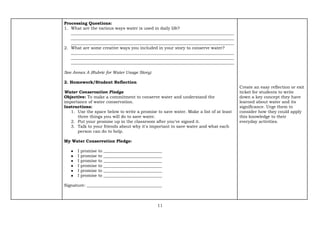
1. What are the various ways water is used in daily life?
______________________________________________________________________________
______________________________________________________________________________
______________________________________________________________________________
2. What are some creative ways you included in your story to conserve water?
______________________________________________________________________________
______________________________________________________________________________
______________________________________________________________________________
See Annex A (Rubric for Water Usage Story)
2. Homework/Student Reflection
Water Conservation Pledge
Objective: To make a commitment to conserve water and understand the
importance of water conservation.
Instructions:
1. Use the space below to write a promise to save water. Make a list of at least
three things you will do to save water.
2. Put your promise up in the classroom after you've signed it.
3. Talk to your friends about why it's important to save water and what each
person can do to help.
My Water Conservation Pledge:
● I promise to ____________________________
Signature: ____________________________________
Create an easy reflection or exit
ticket for students to write
down a key concept they have
learned about water and its
significance. Urge them to
consider how they could apply
this knowledge to their
everyday activities.
12
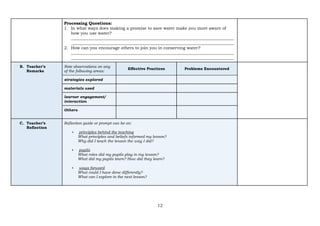
Processing Questions:
1. In what ways does making a promise to save water make you more aware of
how you use water?
______________________________________________________________________________
______________________________________________________________________________
2. How can you encourage others to join you in conserving water?
______________________________________________________________________________
______________________________________________________________________________
B. Teacher’s
Remarks
Note observations on any
of the following areas:
Effective Practices Problems Encountered
strategies explored
materials used
learner engagement/
interaction
Others
C. Teacher’s
Reflection
Reflection guide or prompt can be on:
▪ principles behind the teaching
What principles and beliefs informed my lesson?
Why did I teach the lesson the way I did?
▪ pupils
What roles did my pupils play in my lesson?
What did my pupils learn? How did they learn?
▪ ways forward
What could I have done differently?
What can I explore in the next lesson?

Q4_LE_Science-4_Lesson-2_Week-2.pdfmnans

  • 1.
    4 Lesson Exemplar for Science forScience Lesson 2 Quarter 1 Lesson 1 Quarter 4
  • 2.
    Lesson Exemplar forScience 4 Quarter 4: Lesson 2 (Week 2) S.Y. 2024-2025 This material is intended exclusively for the use of teachers participating in the implementation of the MATATAG K to 10 Curriculum during the School Year 2024-2025. It aims to assist in delivering the curriculum content, standards, and lesson competencies. Any unauthorized reproduction, distribution, modification, or utilization of this material beyond the designated scope is strictly prohibited and may result in appropriate legal actions and disciplinary measures. Borrowed content included in this material are owned by their respective copyright holders. Every effort has been made to locate and obtain permission to use these materials from their respective copyright owners. The publisher and development team do not represent nor claim ownership over them. Every care has been taken to ensure the accuracy of the information provided in this material. For inquiries or feedback, please write or call the Office of the Director of the Bureau of Learning Resources via telephone numbers (02) 8634-1072 and 8631-6922 or by email at blr.od@deped.gov.ph. Development Team Writer: • Jason L. De Vera (Philippine Normal University) Validator: • Dr. Randel D. Estacio (Quezon City University) Management Team Philippine Normal University Research Institute for Teacher Quality SiMERR National Research Centre
  • 3.
    1 SCIENCE (EARTH ANDSPACE SCIENCE) / QUARTER 4 / GRADE 4 I. CURRICULUM CONTENT, STANDARDS, AND LESSON COMPETENCIES A. Content Standards The learners learn that: 1. Soil and water resources are needed by plants and animals to live and grow. 2. Characteristics of the weather can be observed and measured. 3. The Sun is a ball of hot gases about 100 times the size of Earth, which radiates energy needed by living things. B. Performance Standards By the end of the Quarter, learners use simple equipment to identify how types of soil hold water to support growth of plants. They use instruments and secondary sources to measure and describe the characteristics of weather and use the information to make predictions about weather patterns in their local area. They demonstrate appreciation for the dangers of extreme weather events and use safe practice to protect themselves if they are caught in bad weather. Learners use personal observations and reliable secondary information sources to describe the Sun and explain its importance to life on Earth. C. Learning Competencies and Objectives Learning Competencies recognize that water is one of the basic needs of plants and animals; C. Content Water as Basic Need of Living Things D. Integration ● Creativity and innovation ● Environmental awareness (Environmental Literacy) ● Collaboration ● Clean Water and Sanitation (SDG 6) II. LEARNING RESOURCES Needs OS living things. What five basic things do living things need to survive? (2021, September 27). Eschooltoday | Learn something new today. https://eschooltoday.com/learn/introduction-to-needs-of-living-things/ Science grade 4 q4 week 2 sources of water [Video]. (2021, June 14). YouTube. https://youtu.be/eS8l_KU7D7k?si=fBPHq25yO36XidNN Uses of water | Importance of water | Water and it's uses | Uses of water for kids | Use of water [Video]. (2020, September 29). YouTube. https://youtu.be/rUQEm3UYu5M?si=Cu3v2tVv2HmGsWpq
  • 4.
    2 III. TEACHING ANDLEARNING PROCEDURE NOTES TO TEACHERS A. Activating Prior Knowledge DAY 1: 1. Short Review: Water, Our Lifesaver! Video Exploration Today, we will investigate the significance of water for all living organisms. We will begin by viewing a unique video that demonstrates the crucial importance of water for animals, plants, and humans. Following the film, we will engage in a discussion and then participate in a creative brainstorming session. Are you ready to explore the mysteries of water? Let's get started! The teacher shows a video clip on water. Source: https://youtu.be/rUQEm3UYu5M?si=VISKMmB7gSrrYUbF Discussion Time: After the presentation, conduct a discussion with the pupils discussing the significance of water as an essential need for all living organisms. Ask basic queries to stimulate their thought process, like: 1. What did you see in the video that showed animals needing water? 2. Why do you think plants need water to grow? 3. How do people use water to stay healthy?" Introduction: Begin by explaining to the pupils that they will watch a short video about water and why it's important for all living things to survive. Video Selection: Select a short, engaging video clip highlighting the significance of water as an essential need for all living organisms. Search for videos featuring animals drinking water, plants being irrigated, and children utilizing water for different activities. Watching the Video: Present the selected video clip to your pupils. Encourage pupils to attentively observe and consider how water serves as an essential resource for different living things in the video.
  • 5.
    3 B. Establishing Lesson Purpose 1.Lesson Purpose: Unlocking Difficulties Brainstorming Activity Ask the pupils to bring out a sheet of paper and tell them to draw or write one example from the video demonstrating the importance of water for living organisms. Encourage them to utilize colors and images to express their ideas. Sharing Circle Let pupils introduce their drawings or ideas to the class. Write down each student's input on the board to visually illustrate the significance of water for living organisms. Fill out the table below to tell us what you THINK you know about water and what you WANT to know about it. What we THINK we know T What we WANT to know W What we LEARNED L HOW we know H Later on, when we are done with our lesson, we will be answering the last two columns. Summarize the main points covered in the video exploration and brainstorming session. Emphasize the importance of water as an essential resource for all organisms and prompt pupils to consider ways they can contribute to water conservation to guarantee its accessibility for every living thing. Fill the “what we think we know” and “what we want to know” in the TWLH chart as the pupils start to answer and raise questions. C. Developing and Deepening Understanding (Using the 5E MODEL) 1. Explicitation (Think-Pair-Share) Begin the lesson with a "Think-Pair-Share" strategy. Pose the question, "Why do you think water is important?" Allow pupils a minute to think individually, then pair them up to discuss their ideas. Finally, facilitate a class discussion where pairs share their thoughts. Arrange pupils into small groups and provide them with the necessary materials or pictures showing several water sources.
  • 6.
    4 Sources of Water(Part 1) (10 minutes) Objective: To identify the different sources of water. Materials Needed: pictures of different sources of water Instructions: 1. Look at the pictures on your table. Each picture shows a different source of water. 2. Write the name of each water source in the table below. 3. After completing the worksheet, discuss with your classmates what you learned about each water source. Name of the Water Source 1. 2. 3. 4. 5. 6. 7. 8. 9. 10. Processing Question: Which water source do you think is the most important for living things? Why? ________________________________________________________________________________ ________________________________________________________________________________ ________________________________________________________________________________ ________________________________________________________________________________. Water Source Sorting Game (Part 2) (10 minutes) Use a "Gallery Walk" approach. Display several pictures of various water sources within the classroom. Divide pupils into groups and give each group a set of questions to discuss as they move through the gallery in rotation. Encourage pupils to make notes based on their observations. Objective: To reinforce understanding of different sources of water. Encourage pupils to explore and discuss the various water sources, such as rivers, lakes, oceans, and groundwater. Emphasize the importance of each water source for supporting life on Earth. Go around the groups to assist in discussions and offer help when necessary.
  • 7.
    5 Instructions: 1. Divide theclass into small groups. 2. Post pictures of various water sources, such as rivers, lakes, oceans, rain, and water pipes. 3. Show the pictures to each group and ask them to group them into two groups: "natural water source" and "man-made water." 4. Discuss with each group why they sorted the pictures the way they did and talk about why each water source is important. Water Sources Natural Water source Man-made Water Processing Questions: What did you learn about the different sources of water from this activity? ________________________________________________________________________________ ________________________________________________________________________________ ________________________________________________________________________________. Why is it important to have both natural and man-made sources of water? ________________________________________________________________________________ ________________________________________________________________________________ ________________________________________________________________________________. 2. Worked Example: Plant Watering Experiment (Advance preparation is required) Objective: To understand the importance of water for plant growth. Materials Needed: Germinated mongo plant from last week's activity; Water and small cup Ask the pupils to describe the difference between natural and man-made water sources. Hello, pupils! Today, we'll look at something really cool: how water helps plants grow big and healthy! So, today, we'll do a fun experiment using two plants: Plant A and Plant B. Plant A will
  • 8.
    6 Instructions: 1. With yourgroup, you will conduct a plant watering experiment. 2. You will use your germinated mongo plant's last activity in soil. 3. Label two small pots as "Plant A" and "Plant B." 4. Water Plant A for the whole day until the next morning, but do not water Plant B. 5. Observe the plants. Describe what you see happening to each plant. 6. Discuss with your group what you learned about the importance of water for plants. Drawing: Plant A Plant B Processing Questions: 1. What differences did you observe between Plant A (watered regularly) and Plant B (not watered)? _____________________________________________________________________________ _____________________________________________________________________________ _____________________________________________________________________________ 2. How does this show the importance of water for plants? _____________________________________________________________________________ _____________________________________________________________________________ _____________________________________________________________________________ receive water, but Plant B will not. We're going to observe what happens to each plant over time. Are you excited to be a plant scientist beside me? Before we begin, let's make a guess: What do you think will happen to a plant without water? What about a plant that gets enough water? Let's discuss our observations, and then get ready to investigate! Conduct a hands-on activity where pupils observe and discuss the effects of watering on plant growth using germinated seeds or potted plants. Remind pupils to record their observations while learning the importance of water in plant development and health. Encourage pupils to consider how plants use water and the importance of watering them on a regular basis.
  • 9.
    7 DAY 2: 3. LessonActivity Animal Habitat Exploration (20 mins) Objective: To understand how water is essential for different animals and their habitats. Materials Needed: pictures of various animals and their habitats Instructions: 1. Work in a group. 2. Together with your teammates, perform the activity. 3. Provide each student with a worksheet containing pictures of various animals and their habitats, such as a lion in the savannah, a fish in the ocean, a frog in a pond, and a camel in the desert. 4. Ask pupils to observe each picture and identify how water is important for the survival of the animal in its habitat. 5. Encourage pupils to discuss with their classmates and share their observations. 6. After completing the worksheet, facilitate a class discussion to review the importance of water for animals in different habitats and how they adapt to obtain water. Processing Questions: 1. How do animals in different habitats obtain water to survive? _____________________________________________________________________________ _____________________________________________________________________________ _____________________________________________________________________________ _____________________________________________________________________________ 2. Why is water important for animals living in deserts, forests, oceans, and other habitats? _____________________________________________________________________________ _____________________________________________________________________________ _____________________________________________________________________________ _____________________________________________________________________________ Give pictures of different animals and habitats for students to look at and discuss. Encourage pupils to take a look at how different animals obtain water and why it is so important to their being alive. Get your pupils to think about how the animals' activities are related to their needs for water. Encourage groups to ask questions and talk about them.
  • 10.
    8 Water Usage Chart Followthe "Think-Pair-Share" method. After presenting the water usage charts, tell pupils to consider the individual ways they use water during the day. Then, we organize them in pairs to compare the differences between their lists. Finally, arrange a class discussion in which partners share their findings. Objective(s): To illustrate how water is used in daily life and understand the importance of water conservation. Materials Needed: Record notebook or Chart Instructions: 1. Use the chart below to track your water usage for one day. 2. Record how much water you drink and use for washing hands, bathing, and any other activities. Activity Amount of Water Used (in cups or liters) Drinking Brushing Teeth Washing Hands Shower/Bath Cleaning Other (specify) Total After filling out the chart, answer the following questions: 1. Why is it important to drink water? ____________________________________________________________________ 2. How do you use water to keep yourself clean and healthy? ____________________________________________________________________ 3. What are some ways you can save water at home? ____________________________________________________________________ Distribute water usage charts to pupils and encourage them to record their water usage for one day, including activities like drinking, bathing, and hand washing. Facilitate a class discussion about the need of water conservation using the students' recorded observations. Encourage pupils to think about how they might save water in their daily lives. This chart provides a simple and structured way for pupils to track their water usage throughout the day, helping them understand how water is used in various activities and promoting awareness of the importance of water conservation.
  • 11.
    9 Processing Question: List downthe different ways to save water. ________________________________________________________________________________ ________________________________________________________________________________ ________________________________________________________________________________. D. Making Generalizations DAY 3: 1. Learners’ Takeaways Think Big! Making Generalizations Start with Examples: Begin by showing pupils specific examples or situations related to the topic, such as different ways water is used at home or at school. Find Similarities: Help pupils look for things that are the same or similar in each example. Ask questions like: "What do you notice about all these examples?" "Do you see any patterns or things that are alike?" Make a Big Idea: Once pupils identify similarities, guide them to come up with a broad idea that connects all the examples. Keep it simple and easy to understand. For example: "We use water for many things every day." "Saving water helps our planet." Test the Big Idea: Have pupils think of new examples to see if the big idea still fits. Discuss whether it works in different situations. Think Again: Encourage pupils to think about their big idea and whether it still makes sense. Ask questions like: "Does our idea work for everything we talked about?" "Is there anything else we should consider?" Summarize the main ideas discussed in the lesson and emphasize the significance of water for living organisms. Emphasize the importance of conserving water as a valuable resource to guarantee its availability for future generations. Aside from the strategy used, the teacher can also use the following: 1. real-life scenario analysis 2. role playing for synthesis 3. concept map 4. poster
  • 12.
    10 2. Reflection onLearning Go back to the TWLH Chart. Let the pupils reflect and check if their answers in the THINK column are correct. Ask them also if their answers in the WANT column were addressed during the conduct of the various activities. Finally, let them accomplish the LEARNED and HOW column. What we THINK we know T What we WANT to know W What we LEARNED L HOW we know H IV. EVALUATING LEARNING: STUDENT ASSESSMENT AND TEACHER’S REFLECTION NOTES TO TEACHERS A. Evaluating Learning DAY 4: Performance Task Water Usage Story (30 mins) Objective: To illustrate how water is used in daily life and understand the importance of water conservation. Materials Needed: Paper; pen; art materials Instructions: 1. Write a short story or draw a comic strip showing how water is used in your home and community. 2. Include different activities where water is used, such as drinking, cooking, bathing, and watering plants. 3. Think about ways you can save water in each activity and include them in your story or comic strip. 4. Share your story or comic strip with your classmates and discuss how everyone can help conserve water. Assessment should be carried out throughout the lesson in the form of discussions and the written responses to the various activities. Give examples and useful tips for saving water, such as turning off the tap when brushing your teeth or taking shorter showers. Emphasize the long-term effects of small changes in water-use habits.
  • 13.
    11 Processing Questions: 1. Whatare the various ways water is used in daily life? ______________________________________________________________________________ ______________________________________________________________________________ ______________________________________________________________________________ 2. What are some creative ways you included in your story to conserve water? ______________________________________________________________________________ ______________________________________________________________________________ ______________________________________________________________________________ See Annex A (Rubric for Water Usage Story) 2. Homework/Student Reflection Water Conservation Pledge Objective: To make a commitment to conserve water and understand the importance of water conservation. Instructions: 1. Use the space below to write a promise to save water. Make a list of at least three things you will do to save water. 2. Put your promise up in the classroom after you've signed it. 3. Talk to your friends about why it's important to save water and what each person can do to help. My Water Conservation Pledge: ● I promise to ____________________________ ● I promise to ____________________________ ● I promise to ____________________________ ● I promise to ____________________________ ● I promise to ____________________________ ● I promise to ____________________________ Signature: ____________________________________ Create an easy reflection or exit ticket for students to write down a key concept they have learned about water and its significance. Urge them to consider how they could apply this knowledge to their everyday activities.
  • 14.
    12 Processing Questions: 1. Inwhat ways does making a promise to save water make you more aware of how you use water? ______________________________________________________________________________ ______________________________________________________________________________ 2. How can you encourage others to join you in conserving water? ______________________________________________________________________________ ______________________________________________________________________________ B. Teacher’s Remarks Note observations on any of the following areas: Effective Practices Problems Encountered strategies explored materials used learner engagement/ interaction Others C. Teacher’s Reflection Reflection guide or prompt can be on: ▪ principles behind the teaching What principles and beliefs informed my lesson? Why did I teach the lesson the way I did? ▪ pupils What roles did my pupils play in my lesson? What did my pupils learn? How did they learn? ▪ ways forward What could I have done differently? What can I explore in the next lesson?