Investment Update

January 2011


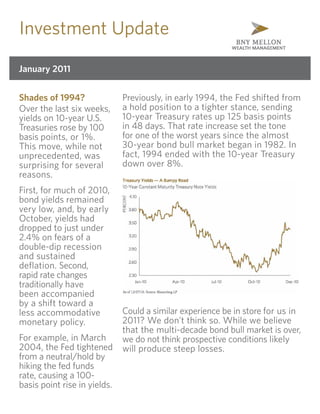
Shades of 1994?               Previously, in early 1994, the Fed shifted from
Over the last six weeks,      a hold position to a tighter stance, sending
yields on 10-year U.S.        10-year Treasury rates up 125 basis points
Treasuries rose by 100        in 48 days. That rate increase set the tone
basis points, or 1%.          for one of the worst years since the almost
This move, while not          30-year bond bull market began in 1982. In
unprecedented, was            fact, 1994 ended with the 10-year Treasury
surprising for several        down over 8%.
reasons.
First, for much of 2010,
bond yields remained
very low, and, by early
October, yields had
dropped to just under
2.4% on fears of a
double-dip recession
and sustained
deflation. Second,
rapid rate changes
traditionally have
been accompanied
by a shift toward a
less accommodative            Could a similar experience be in store for us in
monetary policy.              2011? We don’t think so. While we believe
                              that the multi-decade bond bull market is over,
For example, in March         we do not think prospective conditions likely
2004, the Fed tightened       will produce steep losses.
from a neutral/hold by
hiking the fed funds
rate, causing a 100-
basis point rise in yields.
Most of the upward adjustment in rates            Several times last year,
reflects improving economic data, waning          we cautioned against
concerns of another recession, reduced            the continued strong
uncertainty following the mid-year election       inflows into bond
results and an improved tone toward               mutual funds because
business in general. In other words, the rate     we felt that rates were
increase represents a re-normalization of         at inappropriately
rates, bringing them closer to the 4% range,      low levels. In 2011,
where they were in April 2010 before we           we continue to
experienced a scare, albeit temporary, of         recommend a below
weakened growth.                                  average exposure to
                                                  fixed income, but our
While growth has continued to improve,            recommendation
we do not think that GDP growth will be           more reflects the
sufficient to generate significant near-term      opportunity we see
inflationary pressure. While the tax cuts         in equities than an
and unemployment extensions will further          expectation of much
widen the deficit, they will not change the       higher rates. We do not
budget deficit’s long-term trajectory, which      think that rates will rise
remains a significant, imminent concern.          significantly enough
Also, despite our seemingly well-placed           to become headwinds
cynicism about the deficit reduction              to equities — at least
commission report and the response since          until economic growth
its release (which has been about what            further accelerates and
we expected), the possibility remains that        thus increases the risk
some meaningful first steps will be taken to      of inflation.
address the deficit and possibly simplify tax
policy. Some degree of real progress could
help reduce upward pressure on rates. As
such, while we do expect rates to move higher
over time, we do not expect 2011 to represent
a major sea change. Investors may look at the
recent rise as a wake-up call that the trend of
ever lower long-term rates likely is behind us.
Advice from Experts                                  For example, consider
In light of his role in crafting the Fed’s initial   Bernanke’s comment
response to the financial crisis, we have            from a July 1, 2005
great respect for Ben Bernanke. However, we          CNBC interview:
have been dismayed to see him hold forth             “We’ve never had a
on prime time television recently. While his         decline in housing
efforts to ensure clarity and transparency           prices on a nationwide
are laudable, from our experience the sound          basis. What I think
bite-oriented format of TV is not well suited        is more likely is that
to the complicated task of communicating             house prices will slow,
central bank policy. It becomes far too              maybe stabilize…. I
easy for armchair chairmen and economic              don’t think it’s going
comedians — a rare breed indeed — to                 to drive the economy
cause embarrassment by pointing out                  too far from its full-
seeming or actual contradictions between             employment path,
comments from prior appearances and more             though.” At another
recent ones. We feel these appearances               time, he expressed his
diminish the credibility of the Fed and do           feeling that the
nothing to quell the considerable internal           sub-prime mortgage
debate over the efficacy and advisability of         crisis would remain
ongoing quantitative easing.                         contained. While we
                                                     know experts can fall
At one point during his recent 60 Minutes            into the same traps
appearance, Chairman Bernanke responded              as everyone else, we
to a question about his degree of confidence         would prefer to see
that raising rates will control inflation by         them preserve some
saying, “One hundred percent.” While we              semblance of great
want our policymakers to be certain of their         and infallible wisdom
actions, this comment was disconcerting              rather than reveal their
in light of his prior expressions of confidence      all-to-human shortfalls
around numerous housing-related issues.              for the world to see.
Another example of                                Looking Ahead
these transgressions                              While some municipalities will default, we
also aired on 60                                  feel that far fewer than the number this
Minutes recently. An                              “expert” predicted will fall into such dire
analyst created quite a                           straits. Further, debt levels for most local and
stir when she predicted                           state governments are relatively low, and debt
that there would be                               service is a small portion of most municipal
50 to 100 significant                             budgets. All considered, we feel that forgoing
municipal defaults in                             payment on what would represent such a
2011. she predicted                               small savings would not solve a budget
that there would be                               problem and would create far greater future
50 to 100 significant                             financing struggles.
municipal defaults in
2011.to 100 significant                           While being armed with such insights
municipal defaults in                             does not insure immunity from difficulties,
2011. Immediately,                                well-prepared investors will do their
investors began selling                           homework and select bonds they
municipal bonds, some                             understand and believe will be able to
questioning whether                               meet their debt obligations. After all, we
they should own any                               are again able to find bonds we think are
such bonds at all. In                             stable at yields that compare very favorably
reality, the precarious                           to Treasuries and other taxable bonds. While
state of municipal                                caution is warranted and some areas should
finances is not a                                 be avoided, outright selling does not appear
new story and is well                             appropriate.
understood by most
professional investors in
this space.

                                                  Christopher Sheldon
                                                  Director of Investment Strategy


© 2010 The Bank of New York Mellon Corporation.

January 2011 Investment Update

  • 1.
    Investment Update January 2011 Shadesof 1994? Previously, in early 1994, the Fed shifted from Over the last six weeks, a hold position to a tighter stance, sending yields on 10-year U.S. 10-year Treasury rates up 125 basis points Treasuries rose by 100 in 48 days. That rate increase set the tone basis points, or 1%. for one of the worst years since the almost This move, while not 30-year bond bull market began in 1982. In unprecedented, was fact, 1994 ended with the 10-year Treasury surprising for several down over 8%. reasons. First, for much of 2010, bond yields remained very low, and, by early October, yields had dropped to just under 2.4% on fears of a double-dip recession and sustained deflation. Second, rapid rate changes traditionally have been accompanied by a shift toward a less accommodative Could a similar experience be in store for us in monetary policy. 2011? We don’t think so. While we believe that the multi-decade bond bull market is over, For example, in March we do not think prospective conditions likely 2004, the Fed tightened will produce steep losses. from a neutral/hold by hiking the fed funds rate, causing a 100- basis point rise in yields.
  • 2.
    Most of theupward adjustment in rates Several times last year, reflects improving economic data, waning we cautioned against concerns of another recession, reduced the continued strong uncertainty following the mid-year election inflows into bond results and an improved tone toward mutual funds because business in general. In other words, the rate we felt that rates were increase represents a re-normalization of at inappropriately rates, bringing them closer to the 4% range, low levels. In 2011, where they were in April 2010 before we we continue to experienced a scare, albeit temporary, of recommend a below weakened growth. average exposure to fixed income, but our While growth has continued to improve, recommendation we do not think that GDP growth will be more reflects the sufficient to generate significant near-term opportunity we see inflationary pressure. While the tax cuts in equities than an and unemployment extensions will further expectation of much widen the deficit, they will not change the higher rates. We do not budget deficit’s long-term trajectory, which think that rates will rise remains a significant, imminent concern. significantly enough Also, despite our seemingly well-placed to become headwinds cynicism about the deficit reduction to equities — at least commission report and the response since until economic growth its release (which has been about what further accelerates and we expected), the possibility remains that thus increases the risk some meaningful first steps will be taken to of inflation. address the deficit and possibly simplify tax policy. Some degree of real progress could help reduce upward pressure on rates. As such, while we do expect rates to move higher over time, we do not expect 2011 to represent a major sea change. Investors may look at the recent rise as a wake-up call that the trend of ever lower long-term rates likely is behind us.
  • 3.
    Advice from Experts For example, consider In light of his role in crafting the Fed’s initial Bernanke’s comment response to the financial crisis, we have from a July 1, 2005 great respect for Ben Bernanke. However, we CNBC interview: have been dismayed to see him hold forth “We’ve never had a on prime time television recently. While his decline in housing efforts to ensure clarity and transparency prices on a nationwide are laudable, from our experience the sound basis. What I think bite-oriented format of TV is not well suited is more likely is that to the complicated task of communicating house prices will slow, central bank policy. It becomes far too maybe stabilize…. I easy for armchair chairmen and economic don’t think it’s going comedians — a rare breed indeed — to to drive the economy cause embarrassment by pointing out too far from its full- seeming or actual contradictions between employment path, comments from prior appearances and more though.” At another recent ones. We feel these appearances time, he expressed his diminish the credibility of the Fed and do feeling that the nothing to quell the considerable internal sub-prime mortgage debate over the efficacy and advisability of crisis would remain ongoing quantitative easing. contained. While we know experts can fall At one point during his recent 60 Minutes into the same traps appearance, Chairman Bernanke responded as everyone else, we to a question about his degree of confidence would prefer to see that raising rates will control inflation by them preserve some saying, “One hundred percent.” While we semblance of great want our policymakers to be certain of their and infallible wisdom actions, this comment was disconcerting rather than reveal their in light of his prior expressions of confidence all-to-human shortfalls around numerous housing-related issues. for the world to see.
  • 4.
    Another example of Looking Ahead these transgressions While some municipalities will default, we also aired on 60 feel that far fewer than the number this Minutes recently. An “expert” predicted will fall into such dire analyst created quite a straits. Further, debt levels for most local and stir when she predicted state governments are relatively low, and debt that there would be service is a small portion of most municipal 50 to 100 significant budgets. All considered, we feel that forgoing municipal defaults in payment on what would represent such a 2011. she predicted small savings would not solve a budget that there would be problem and would create far greater future 50 to 100 significant financing struggles. municipal defaults in 2011.to 100 significant While being armed with such insights municipal defaults in does not insure immunity from difficulties, 2011. Immediately, well-prepared investors will do their investors began selling homework and select bonds they municipal bonds, some understand and believe will be able to questioning whether meet their debt obligations. After all, we they should own any are again able to find bonds we think are such bonds at all. In stable at yields that compare very favorably reality, the precarious to Treasuries and other taxable bonds. While state of municipal caution is warranted and some areas should finances is not a be avoided, outright selling does not appear new story and is well appropriate. understood by most professional investors in this space. Christopher Sheldon Director of Investment Strategy © 2010 The Bank of New York Mellon Corporation.