QUARTER 1 Lesson 1
Clean, Maintain Kitchen
Tools, Utensils and Premises
Objectives:
At the end of the lesson, you are
expected to:
1. Clean, sanitize and store kitchen
tools and equipment
2. Clean and sanitize kitchen
premises.
• is a vital in every kitchen where food is prepared,
cooked and served.
• Cleanliness
• In order to avoid food contamination, kitchen tools,
utensils, equipment used in the preparation of food as
well as the premises should be cleaned and sanitized,
and store properly after each use.
Given the scrambled letters below, unscramble
them to get a word or a group of words related
to cleaning and maintaining kitchen premises.
Write your answer opposite each item.
1. AINSZTEI - ________________________
2. NGILCAEN - ________________________
3. CNKTIEH - ________________________
4. LCEHIMAC - ________________________
5. NEGTDETRE - ________________________
Given the scrambled letters below, unscramble
them to get a word or a group of words related
to cleaning and maintaining kitchen premises.
Write your answer opposite each item.
1. AINSZTEI - SANITIZE
2. NGILCAEN - CLEANING
3. CNKTIEH - KITCHEN
4. LCEHIMAC - CHEMICAL
5. NEGTDETRE - DETERGENT
Lesson 1
Learning Outcome 1
CLEAN, SANITIZE AND STORE KITCHEN TOOLS AND
EQUIPMENT
Objectives:
At the end of this lesson, you are expected to:
1. Recognize kitchen tools, utensils and equipment to be cleaned and
sanitized.
2. Identify the chemicals to be utilized in cleaning and sanitizing kitchen
tools, utensils and equipment.
3. Prepare cleaning agents in accordance with the manufacturer’
instruction/procedure.
4. Clean, sanitize kitchen tools, utensils and equipment
5. Store cleaned kitchen tools, utensils and equipment.
Cleaning and sanitizing kitchen tools and
equipment must be part of the standard
operating procedures that make up your
food safety program. Improper cleaning
and sanitizing kitchen surfaces allow
harmful microorganisms to be transferred
from one food to another.
Explain briefly in your own words the following terms below and give one
example of household task you encountered at home using the given terms.
(5 points each).
1. Cleaning
____________________________________________________________________
_____
____________________________________________________________________
_____
2. Sanitizing
____________________________________________________________________
_____
____________________________________________________________________
_____
3. Disinfecting
____________________________________________________________________
____________________________________________________________________
Types of Chemicals Used in Cleaning and Sanitizing
Kitchen Tools and Equipment
In maintaining the kitchen tools and equipment, it should be
cleaned and sanitized using the right chemical agents to make it
useful for a long period of time. By doing so, we can save time,
energy, and money for its repair and worse its replacement.
• Being familiar with the tools and equipment
used in food laboratory and knowing their
classification and uses are not enough.
Maintaining tools and equipment for these to
function well is one of the important tasks of a
food handler; it is not enough to acquire and
discard them when they are no longer useful
and then purchase new ones.
• To make them last for a long time and serve us
well, proper care is needed. Acquiring tools and
equipment to be used in the food laboratory is
no joke, especially now that the prices of
commodities keep on rising and purchasing new
sets of tools and equipment for replacement
sometimes takes time and not that easy to be
granted.
When it comes to cleaning our kitchen
premises there are some dirt which cannot be
clean by just wiping or washing. Like for
instance burn syrup on top of our stove. In this
case what helpful tips you may suggest in
cleaning this kind of dirt?
Give some helpful cleaning materials that you may
see in your own kitchen, which may be helpful in
cleaning and sanitizing our kitchen tools and equipment.
You may give at least 5 examples and give its uses.
Ex. Dishwashing liquid- used primarily
for removing food from used dishes
and tableware.
The following are list of
cooking materials, kitchen
utensils and equipment that
are commonly found in the
kitchen.
Cooking Materials
•Identify the use of the different tools and
equipment
•Familiarize the different tool and equipment
Knife Set
• Chef’s Knife- is an all-purpose knife used for chopping,
slicing and mincing.
• Paring Knife-is used for peeling and paring fruits and
vegetables
Knife Set
• Tourné Knife- is used for fruits and vegetables; similar
to paring knife
• Boning/Filleting Knife-is used to separate meat from
bone;use to fillet fish
Knife Set
• Cleaver- is somewhat heavy and has rectangular shape
• Meat Slicer- used to slice roasted meats, ham, and
thick solid cuts of meat
Knife Set
• Bread Knife – used to slice or divide breads and
pastries
• Dinner Knife – knife used during meal;
Measuring Tools
• Mass Scale – use to measure the mass of an ingredient;
can be operated manually or digitally
Measuring Tools
• Instant-read Thermometer - is used to measure the
temperature of food to know if it has been cooked
properly or being stored at the right temperature
Measuring Tools
• Measuring Cups – use to measure wet and dry
ingredients
Measuring Tools
• Measuring Spoons - are used to hold specific amounts
of dry and wet ingredients; varying in sizes from a dash
to 1 tablespoon or 15ml
Strainers
• Strainer– is used to separate liquid from solid
ingredients, sift fine grains, remove lumps, and rinse
food
Strainers
• Colander– a bowl-shaped strainer with holes. It used to
drain food such as pasta
Strainers
• Drum Sieve or Tamis – it is shaped somewhat like a
snare drum, with a low-walled cylindrical frame, made of
metal or wood that supports a disc of fine metal, nylon
or cheesecloth mesh.
Strainers
• Cheesecloth– is loosely woven gauze-like cotton cloth
used primarily in cheese making. It is used as straining
cloth.
Strainers
• Chinois (shin-wahs)– conical sieve with an extremely
fine mesh. It is usually used to strain custards, purees,
soups, and sauces, making them very smooth; used
also for sifting powdered sugar.
Strainers
• Food Mill – it is used to grind, mash, puree, and sieve
soft food.
Cookwares
• Stockpot– is a cylindrical,
deep, heavy-bottomed,
straight-sided pot for
preparing, cooking, and
storing stocks, soups, and
stews.
Cookwares
• Saucepan – it is a medium-deep pot with a flat
bottom, commonly used to make sauces and gravies.
Cookwares
• Casserole – it’s an oval, four-sided or round dish or
pan made of stainless steel, ceramic, or glass where
food may be cooked and served.
Cookwares
• Roasting Pan – it is a large rectangular pan, often with
a lid and a meat rack. It’s used to roast meat and fish.
Cookwares
• Nonstick Pan – is coated with materials that prevent
food from sticking to the surface while cooking or
frying.
Cookwares
• Baking Sheet – is a rectangular shape shallow metal
pan used to bake bread and pastries.
Cookwares
• Cake Pan – is a metal or glass(heat-proof) pan usually
of different sizes, shapes, and designs used to bake
cakes.
Cookwares
• Cast-iron Skillet – is a heavy, thick-bottomed frying
pan used when steady and even heat is needed in
cooking.
Cookwares
• Wok or Carajay – is often for stir-frying, steaming, pan
frying, deep frying, poaching, boiling, braising, searing,
making soup, smoking and roasting nuts.
Cooking Utensils
that every Kitchen
Needs
Kitchen Tools
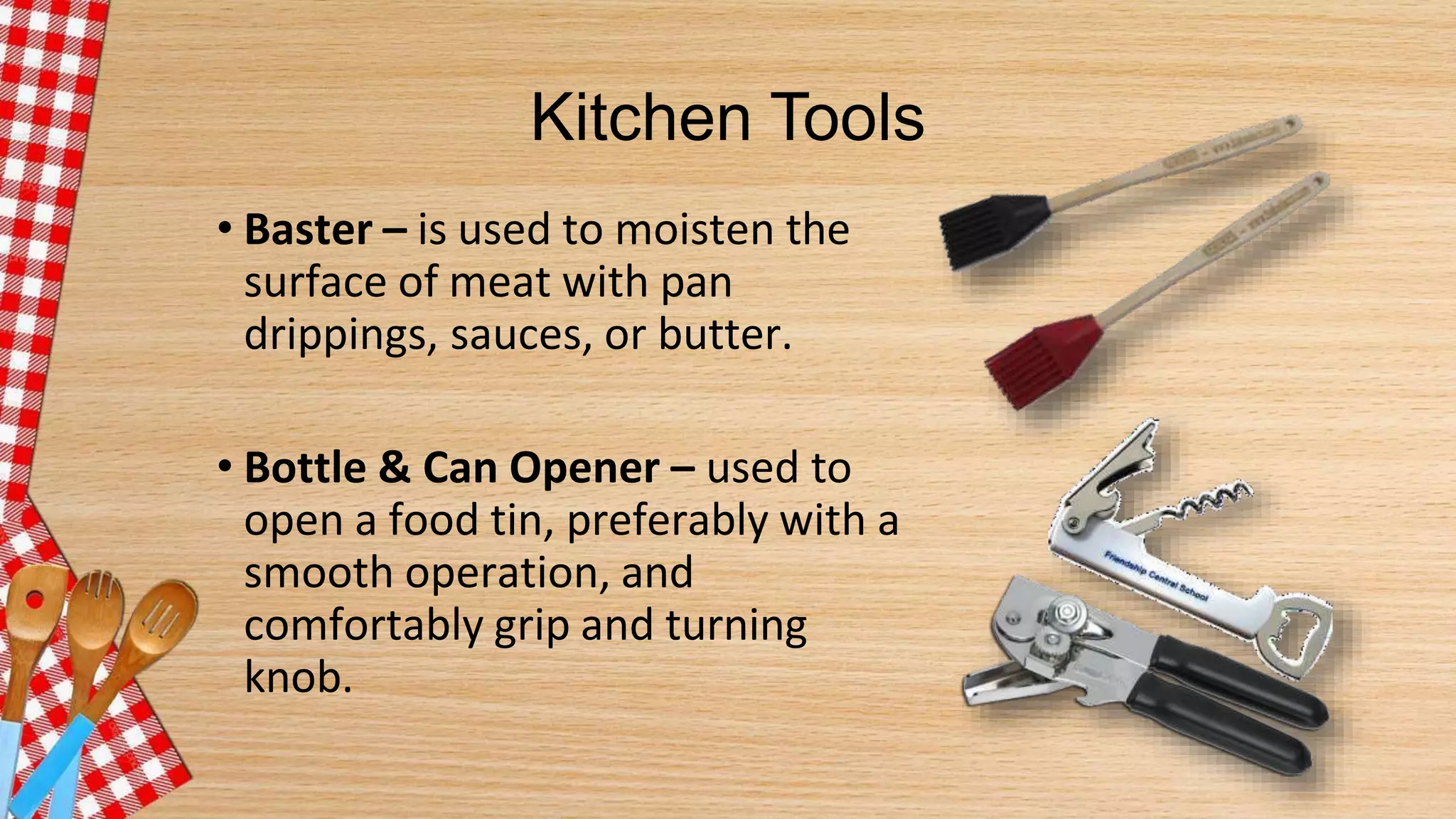
• Baster – is used to moisten the
surface of meat with pan
drippings, sauces, or butter.
• Bottle & Can Opener – used to
open a food tin, preferably with a
smooth operation, and
comfortably grip and turning
knob.
Kitchen Tools
• Cutting or Chopping Board – is a durable board on
which food may be cut and chopped.
Kitchen Tools
• Dredger/Shaker – is a container with holes that is used
to hold flour, herbs, salt, pepper and other same
ingredients that are sprinkled on foods that are being
prepared.
Kitchen Tools
• Emery Boards and Sharpening
Steel – used to sharpen knives
• Flipper – is used to flip or turn
and lift pancakes, fillets, patties,
and other kinds of food while
frying and grilling.
Kitchen Tools
• Funnels – is used to pour without
spillage liquid or small-grained
ingredients into containers with
small openings.
• Garlic Press – is used to crash
garlic cloves efficiently by forcing
them through a grid of small holes.
Kitchen Tools
• Grater – is used to grate, shred, and slice food such as
carrots, cabbage, and cheese.
Kitchen Tools
• Handy Poultry and Roasting Tools make easier it easier
to lift a hot roasted poultry form the roaster to the
serving platter, without it falling apart.
Kitchen Tools
• Kitchen Shears – are used for
cutting , snipping, and cracking
nuts.
• Pasta Spoon or Server– used
to transfer a little or much
cooked pasta to a
plate/container without a
mess.
Kitchen Tools
• Soup Ladle –
Kitchen Tools
• Potato Masher – is used for
mashing cooked potatoes,
turnips, carrots or other soft
cooked vegetables
• Peeler – used to peel off or
remove skin of fruits and
vegetables
Kitchen Tools
• Scraper - used to blend or scrape
food from the bowl or pan
• Spatula – is a broad, flat, flexible
scraper with unsharpened edges
used for spreading and smoothing
icings on cakes, mixing ingredients,
lifting and flipping and scraping
bowls.
Kitchen Tools
• Tongs – are used to lift, turn,
and transfer food
• Two-tine Fork – used to hold
meats while slicing, and to
turn solid pieces of meat
while browning.
Kitchen Tools
• Whisk or Wire Whip – consists of loops of stainless
steel wire fastened to a handle. It used to beat, fold,
blend, and whip ingredients.
Kitchen Equipment
• Refrigerator and Freezer – are
used to keep food fresh, prevent
food spoilage, and inhibit the
growth of bacteria.
Kitchen Equipment
• Oven – is a thermally insulated
chamber used for baking and
cooking. It can be electric oven,
gas oven, or a microwave oven.
Kitchen Equipment
• Stove – stoves rely on the application of direct heat
for the cooking process.
Kitchen Equipment
• Range – refers to the
combination of
stovetop and oven into
one kitchen equipment
Kitchen Equipment
• Steamer – generally used for
steaming food like siopao,
siomai, and fish.
• Turbo Broiler – used for broiling
and roasting.
Kitchen Equipment
• Blender – used to grate, grind,
stir, blend, mix, whip puree and
liquefy different kinds of food.
• Mixer– used for beating, folding,
and whipping ingredients.
ends here!
Question???
if you Have No
more questions,
test yourself…
Click Here
Thank You

Q1 W1-TOOLS UTENSILS.pptx

  • 1.
    QUARTER 1 Lesson1 Clean, Maintain Kitchen Tools, Utensils and Premises
  • 2.
    Objectives: At the endof the lesson, you are expected to: 1. Clean, sanitize and store kitchen tools and equipment 2. Clean and sanitize kitchen premises.
  • 3.
    • is avital in every kitchen where food is prepared, cooked and served. • Cleanliness • In order to avoid food contamination, kitchen tools, utensils, equipment used in the preparation of food as well as the premises should be cleaned and sanitized, and store properly after each use.
  • 4.
    Given the scrambledletters below, unscramble them to get a word or a group of words related to cleaning and maintaining kitchen premises. Write your answer opposite each item. 1. AINSZTEI - ________________________ 2. NGILCAEN - ________________________ 3. CNKTIEH - ________________________ 4. LCEHIMAC - ________________________ 5. NEGTDETRE - ________________________
  • 5.
    Given the scrambledletters below, unscramble them to get a word or a group of words related to cleaning and maintaining kitchen premises. Write your answer opposite each item. 1. AINSZTEI - SANITIZE 2. NGILCAEN - CLEANING 3. CNKTIEH - KITCHEN 4. LCEHIMAC - CHEMICAL 5. NEGTDETRE - DETERGENT
  • 6.
    Lesson 1 Learning Outcome1 CLEAN, SANITIZE AND STORE KITCHEN TOOLS AND EQUIPMENT Objectives: At the end of this lesson, you are expected to: 1. Recognize kitchen tools, utensils and equipment to be cleaned and sanitized. 2. Identify the chemicals to be utilized in cleaning and sanitizing kitchen tools, utensils and equipment. 3. Prepare cleaning agents in accordance with the manufacturer’ instruction/procedure. 4. Clean, sanitize kitchen tools, utensils and equipment 5. Store cleaned kitchen tools, utensils and equipment.
  • 7.
    Cleaning and sanitizingkitchen tools and equipment must be part of the standard operating procedures that make up your food safety program. Improper cleaning and sanitizing kitchen surfaces allow harmful microorganisms to be transferred from one food to another.
  • 8.
    Explain briefly inyour own words the following terms below and give one example of household task you encountered at home using the given terms. (5 points each). 1. Cleaning ____________________________________________________________________ _____ ____________________________________________________________________ _____ 2. Sanitizing ____________________________________________________________________ _____ ____________________________________________________________________ _____ 3. Disinfecting ____________________________________________________________________ ____________________________________________________________________
  • 9.
    Types of ChemicalsUsed in Cleaning and Sanitizing Kitchen Tools and Equipment In maintaining the kitchen tools and equipment, it should be cleaned and sanitized using the right chemical agents to make it useful for a long period of time. By doing so, we can save time, energy, and money for its repair and worse its replacement.
  • 10.
    • Being familiarwith the tools and equipment used in food laboratory and knowing their classification and uses are not enough. Maintaining tools and equipment for these to function well is one of the important tasks of a food handler; it is not enough to acquire and discard them when they are no longer useful and then purchase new ones.
  • 11.
    • To makethem last for a long time and serve us well, proper care is needed. Acquiring tools and equipment to be used in the food laboratory is no joke, especially now that the prices of commodities keep on rising and purchasing new sets of tools and equipment for replacement sometimes takes time and not that easy to be granted.
  • 12.
    When it comesto cleaning our kitchen premises there are some dirt which cannot be clean by just wiping or washing. Like for instance burn syrup on top of our stove. In this case what helpful tips you may suggest in cleaning this kind of dirt?
  • 13.
    Give some helpfulcleaning materials that you may see in your own kitchen, which may be helpful in cleaning and sanitizing our kitchen tools and equipment. You may give at least 5 examples and give its uses. Ex. Dishwashing liquid- used primarily for removing food from used dishes and tableware.
  • 15.
    The following arelist of cooking materials, kitchen utensils and equipment that are commonly found in the kitchen.
  • 16.
    Cooking Materials •Identify theuse of the different tools and equipment •Familiarize the different tool and equipment
  • 18.
    Knife Set • Chef’sKnife- is an all-purpose knife used for chopping, slicing and mincing. • Paring Knife-is used for peeling and paring fruits and vegetables
  • 19.
    Knife Set • TournéKnife- is used for fruits and vegetables; similar to paring knife • Boning/Filleting Knife-is used to separate meat from bone;use to fillet fish
  • 20.
    Knife Set • Cleaver-is somewhat heavy and has rectangular shape • Meat Slicer- used to slice roasted meats, ham, and thick solid cuts of meat
  • 21.
    Knife Set • BreadKnife – used to slice or divide breads and pastries • Dinner Knife – knife used during meal;
  • 23.
    Measuring Tools • MassScale – use to measure the mass of an ingredient; can be operated manually or digitally
  • 24.
    Measuring Tools • Instant-readThermometer - is used to measure the temperature of food to know if it has been cooked properly or being stored at the right temperature
  • 25.
    Measuring Tools • MeasuringCups – use to measure wet and dry ingredients
  • 26.
    Measuring Tools • MeasuringSpoons - are used to hold specific amounts of dry and wet ingredients; varying in sizes from a dash to 1 tablespoon or 15ml
  • 28.
    Strainers • Strainer– isused to separate liquid from solid ingredients, sift fine grains, remove lumps, and rinse food
  • 29.
    Strainers • Colander– abowl-shaped strainer with holes. It used to drain food such as pasta
  • 30.
    Strainers • Drum Sieveor Tamis – it is shaped somewhat like a snare drum, with a low-walled cylindrical frame, made of metal or wood that supports a disc of fine metal, nylon or cheesecloth mesh.
  • 31.
    Strainers • Cheesecloth– isloosely woven gauze-like cotton cloth used primarily in cheese making. It is used as straining cloth.
  • 32.
    Strainers • Chinois (shin-wahs)–conical sieve with an extremely fine mesh. It is usually used to strain custards, purees, soups, and sauces, making them very smooth; used also for sifting powdered sugar.
  • 33.
    Strainers • Food Mill– it is used to grind, mash, puree, and sieve soft food.
  • 35.
    Cookwares • Stockpot– isa cylindrical, deep, heavy-bottomed, straight-sided pot for preparing, cooking, and storing stocks, soups, and stews.
  • 36.
    Cookwares • Saucepan –it is a medium-deep pot with a flat bottom, commonly used to make sauces and gravies.
  • 37.
    Cookwares • Casserole –it’s an oval, four-sided or round dish or pan made of stainless steel, ceramic, or glass where food may be cooked and served.
  • 38.
    Cookwares • Roasting Pan– it is a large rectangular pan, often with a lid and a meat rack. It’s used to roast meat and fish.
  • 39.
    Cookwares • Nonstick Pan– is coated with materials that prevent food from sticking to the surface while cooking or frying.
  • 40.
    Cookwares • Baking Sheet– is a rectangular shape shallow metal pan used to bake bread and pastries.
  • 41.
    Cookwares • Cake Pan– is a metal or glass(heat-proof) pan usually of different sizes, shapes, and designs used to bake cakes.
  • 42.
    Cookwares • Cast-iron Skillet– is a heavy, thick-bottomed frying pan used when steady and even heat is needed in cooking.
  • 43.
    Cookwares • Wok orCarajay – is often for stir-frying, steaming, pan frying, deep frying, poaching, boiling, braising, searing, making soup, smoking and roasting nuts.
  • 44.
  • 45.
    Kitchen Tools • Baster– is used to moisten the surface of meat with pan drippings, sauces, or butter. • Bottle & Can Opener – used to open a food tin, preferably with a smooth operation, and comfortably grip and turning knob.
  • 46.
    Kitchen Tools • Cuttingor Chopping Board – is a durable board on which food may be cut and chopped.
  • 47.
    Kitchen Tools • Dredger/Shaker– is a container with holes that is used to hold flour, herbs, salt, pepper and other same ingredients that are sprinkled on foods that are being prepared.
  • 48.
    Kitchen Tools • EmeryBoards and Sharpening Steel – used to sharpen knives • Flipper – is used to flip or turn and lift pancakes, fillets, patties, and other kinds of food while frying and grilling.
  • 49.
    Kitchen Tools • Funnels– is used to pour without spillage liquid or small-grained ingredients into containers with small openings. • Garlic Press – is used to crash garlic cloves efficiently by forcing them through a grid of small holes.
  • 50.
    Kitchen Tools • Grater– is used to grate, shred, and slice food such as carrots, cabbage, and cheese.
  • 51.
    Kitchen Tools • HandyPoultry and Roasting Tools make easier it easier to lift a hot roasted poultry form the roaster to the serving platter, without it falling apart.
  • 52.
    Kitchen Tools • KitchenShears – are used for cutting , snipping, and cracking nuts. • Pasta Spoon or Server– used to transfer a little or much cooked pasta to a plate/container without a mess.
  • 53.
  • 54.
    Kitchen Tools • PotatoMasher – is used for mashing cooked potatoes, turnips, carrots or other soft cooked vegetables • Peeler – used to peel off or remove skin of fruits and vegetables
  • 55.
    Kitchen Tools • Scraper- used to blend or scrape food from the bowl or pan • Spatula – is a broad, flat, flexible scraper with unsharpened edges used for spreading and smoothing icings on cakes, mixing ingredients, lifting and flipping and scraping bowls.
  • 56.
    Kitchen Tools • Tongs– are used to lift, turn, and transfer food • Two-tine Fork – used to hold meats while slicing, and to turn solid pieces of meat while browning.
  • 57.
    Kitchen Tools • Whiskor Wire Whip – consists of loops of stainless steel wire fastened to a handle. It used to beat, fold, blend, and whip ingredients.
  • 59.
    Kitchen Equipment • Refrigeratorand Freezer – are used to keep food fresh, prevent food spoilage, and inhibit the growth of bacteria.
  • 60.
    Kitchen Equipment • Oven– is a thermally insulated chamber used for baking and cooking. It can be electric oven, gas oven, or a microwave oven.
  • 61.
    Kitchen Equipment • Stove– stoves rely on the application of direct heat for the cooking process.
  • 62.
    Kitchen Equipment • Range– refers to the combination of stovetop and oven into one kitchen equipment
  • 63.
    Kitchen Equipment • Steamer– generally used for steaming food like siopao, siomai, and fish. • Turbo Broiler – used for broiling and roasting.
  • 64.
    Kitchen Equipment • Blender– used to grate, grind, stir, blend, mix, whip puree and liquefy different kinds of food. • Mixer– used for beating, folding, and whipping ingredients.
  • 65.
  • 66.
  • 67.
    if you HaveNo more questions, test yourself… Click Here
  • 68.