Function – Defining Rules
• Function defined as: def function_name():
• Any input parameters or arguments should be placed within these parentheses.
• You also can define parameters inside these parentheses.
• The code block within every function starts with a colon (:) and is indented.
• The statement return [expression] exits a function.
• A return statement with no arguments is the same as return None.
Defining & Calling Function
# define function
def test():
print “hii"
return;
# Call function
test()
Pass by Reference or Value
def myFun(x):
x[0] = 20
lst = [10, 11, 12, 13, 14, 15]
print(lst)
#pass reference
myFun(lst);
print(lst)
[10, 11, 12, 13, 14, 15]
[20, 11, 12, 13, 14, 15]
def swap(x, y):
temp = x;
x = y;
y = temp;
x = 2
y = 3
swap(x, y)
print(x)
print(y)
2
3
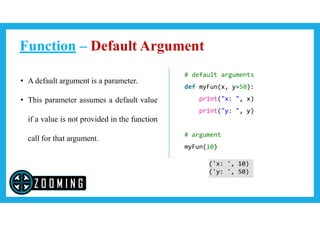
Function – Default Argument
• A default argument is a parameter.
• This parameter assumes a default value
if a value is not provided in the function
call for that argument.
# default arguments
def myFun(x, y=50):
print("x: ", x)
print("y: ", y)
# argument
myFun(10)
('x: ', 10)
('y: ', 50)
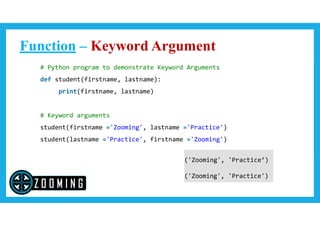
Function – Keyword Argument
# Python program to demonstrate Keyword Arguments
def student(firstname, lastname):
print(firstname, lastname)
# Keyword arguments
student(firstname ='Zooming', lastname ='Practice')
student(lastname ='Practice', firstname ='Zooming')
('Zooming', 'Practice’)
('Zooming', 'Practice')
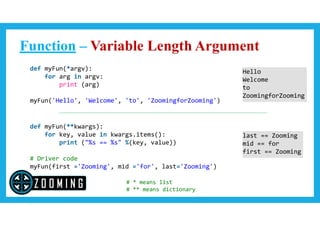
Function – Variable Length Argument
def myFun(*argv):
for arg in argv:
print (arg)
myFun('Hello', 'Welcome', 'to', 'ZoomingforZooming')
Hello
Welcome
to
ZoomingforZooming
def myFun(**kwargs):
for key, value in kwargs.items():
print ("%s == %s" %(key, value))
# Driver code
myFun(first ='Zooming', mid ='for', last='Zooming')
# * means list
# ** means dictionary
last == Zooming
mid == for
first == Zooming
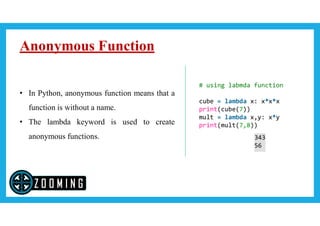
Anonymous Function
• In Python, anonymous function means that a
function is without a name.
• The lambda keyword is used to create
anonymous functions.
# using labmda function
cube = lambda x: x*x*x
print(cube(7))
mult = lambda x,y: x*y
print(mult(7,8))
343
56

Python Function

  • 2.
    Function – DefiningRules • Function defined as: def function_name(): • Any input parameters or arguments should be placed within these parentheses. • You also can define parameters inside these parentheses. • The code block within every function starts with a colon (:) and is indented. • The statement return [expression] exits a function. • A return statement with no arguments is the same as return None.
  • 3.
    Defining & CallingFunction # define function def test(): print “hii" return; # Call function test()
  • 4.
    Pass by Referenceor Value def myFun(x): x[0] = 20 lst = [10, 11, 12, 13, 14, 15] print(lst) #pass reference myFun(lst); print(lst) [10, 11, 12, 13, 14, 15] [20, 11, 12, 13, 14, 15] def swap(x, y): temp = x; x = y; y = temp; x = 2 y = 3 swap(x, y) print(x) print(y) 2 3
  • 5.
    Function – DefaultArgument • A default argument is a parameter. • This parameter assumes a default value if a value is not provided in the function call for that argument. # default arguments def myFun(x, y=50): print("x: ", x) print("y: ", y) # argument myFun(10) ('x: ', 10) ('y: ', 50)
  • 6.
    Function – KeywordArgument # Python program to demonstrate Keyword Arguments def student(firstname, lastname): print(firstname, lastname) # Keyword arguments student(firstname ='Zooming', lastname ='Practice') student(lastname ='Practice', firstname ='Zooming') ('Zooming', 'Practice’) ('Zooming', 'Practice')
  • 7.
    Function – VariableLength Argument def myFun(*argv): for arg in argv: print (arg) myFun('Hello', 'Welcome', 'to', 'ZoomingforZooming') Hello Welcome to ZoomingforZooming def myFun(**kwargs): for key, value in kwargs.items(): print ("%s == %s" %(key, value)) # Driver code myFun(first ='Zooming', mid ='for', last='Zooming') # * means list # ** means dictionary last == Zooming mid == for first == Zooming
  • 8.
    Anonymous Function • InPython, anonymous function means that a function is without a name. • The lambda keyword is used to create anonymous functions. # using labmda function cube = lambda x: x*x*x print(cube(7)) mult = lambda x,y: x*y print(mult(7,8)) 343 56