by
Younus S B S
M.Phil., Computer Science
Sadakathullah Appa College
Under the Guidance of
Dr.S.Shajun Nisha, MCA, M.Phil, MBA, M.Tech,
Ph.D, MISTE,
Assistant Professor & Head
PG & Research Department of Computer
Science
Sadakathullah Appa College
Language
Programming language
Python
Data Science
Language
 Communication-Sharing of Information
 Language-a way or a method to make communication
Programming Language
 A programming language is a set of commands,
instructions, and other syntax use to create a software
program
 Command: a word that makes system to do something
 Instruction: sequence of commands
 Syntax: Structure of program
 Why we need programming language…?
Python
 Python is a high-level programming language
designed to be easy to read and simple to implement.
It is open source
High Level Language
 A high-level language (HLL) is a programming
language that enables a programmer to write programs
that are more or less independent of a particular type
of computer. Such languages are considered high-level
because they are closer to human languages and
further from machine languages.
Open Source
 Program’s source code is freely available to the public
unlike Commercial Software
 3-Types of Software:
 Freeware : Free to use
 Shareware: Free but limited resource(pay for additional
resource)
 Commercial Software: pay amount before use
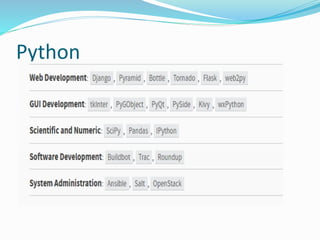
Python
Django
 Django is a high-level Python Web framework that
encourages rapid development and clean, pragmatic
design
 Follows MVT model
 Terminologies:
 Bootstrap
 Jinja
 Pycharm
Bootstrap
 Bootstrap is a CSS framework that makes it easier to
create website and web application user interfaces.
 Bootstrap 4 is the newest version of Bootstrap.
 Bootstrap 4 supports all major browsers except
Internet Explorer 9.
 If you require support for IE9 or IE8, you must use
Bootstrap 3.
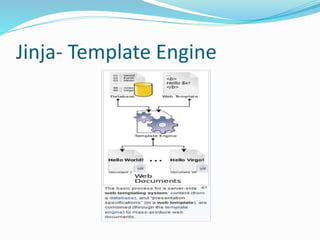
Jinja- Template Engine
Pycharm
There are 2-types of Software,
 System Software
 Application Software
Pycharm-Editor (System
Software)
Data Science
 Sexiest job of 21st century
 Data science is an interdisciplinary field that uses
scientific methods, processes, algorithms and systems
to extract knowledge and insights from data in various
forms, both structured and unstructured (?)
 Data Mining is just obtain useful information from
massive amount of data
 What is a difference between data & information
Massive Data
 According to a paper from IBM, about 2.5 billion
gigabytes of data had been generated on a daily basis
in the year 2012. Another article from Forbes informs
us that data is growing at a pace which is faster than
ever. The same article suggests that by the year 2020,
about 1.7 billion of new information will be developed
per second for all the human inhabitants on this
planet
Data Science Algorithms
 Linear Regression
 Logistic Regression
 Linear Discriminant Analysis
 Classification and Regression Trees
 Naive Bayes
Algorithms (contd….)
 K-Nearest Neighbors
 Learning Vector Quantization
 Support Vector Machines
 Bagging and Random Forest
 Boosting and AdaBoost
Data Science-Main Applications
 Artificial Intelligence
 Machine Learning-Learn from data by algorithms
 Deep Learning- improved ML by Artificial Neural
Ntworks
Data Science & ML in Python
 Data Science
 Numpy and Pandas
 ML
 Scikit-Learn
 Typically, these packages developed by Scientists and
implemented by Engineers
Applications Internet Search
 Digital Advertisements (Targeted Advertising and re-
targeting)
 Recommender Systems
 Image Recognition
 Speech Recognition
 Gaming
 Price Comparison Websites
 Fraud and Risk Detection
 Delivery logistics
Python & Data Science

Python & Data Science

  • 1.
    by Younus S BS M.Phil., Computer Science Sadakathullah Appa College Under the Guidance of Dr.S.Shajun Nisha, MCA, M.Phil, MBA, M.Tech, Ph.D, MISTE, Assistant Professor & Head PG & Research Department of Computer Science Sadakathullah Appa College
  • 2.
  • 3.
    Language  Communication-Sharing ofInformation  Language-a way or a method to make communication
  • 4.
    Programming Language  Aprogramming language is a set of commands, instructions, and other syntax use to create a software program  Command: a word that makes system to do something  Instruction: sequence of commands  Syntax: Structure of program  Why we need programming language…?
  • 5.
    Python  Python isa high-level programming language designed to be easy to read and simple to implement. It is open source
  • 6.
    High Level Language A high-level language (HLL) is a programming language that enables a programmer to write programs that are more or less independent of a particular type of computer. Such languages are considered high-level because they are closer to human languages and further from machine languages.
  • 7.
    Open Source  Program’ssource code is freely available to the public unlike Commercial Software  3-Types of Software:  Freeware : Free to use  Shareware: Free but limited resource(pay for additional resource)  Commercial Software: pay amount before use
  • 8.
  • 9.
    Django  Django isa high-level Python Web framework that encourages rapid development and clean, pragmatic design  Follows MVT model  Terminologies:  Bootstrap  Jinja  Pycharm
  • 10.
    Bootstrap  Bootstrap isa CSS framework that makes it easier to create website and web application user interfaces.  Bootstrap 4 is the newest version of Bootstrap.  Bootstrap 4 supports all major browsers except Internet Explorer 9.  If you require support for IE9 or IE8, you must use Bootstrap 3.
  • 11.
  • 12.
    Pycharm There are 2-typesof Software,  System Software  Application Software Pycharm-Editor (System Software)
  • 13.
    Data Science  Sexiestjob of 21st century  Data science is an interdisciplinary field that uses scientific methods, processes, algorithms and systems to extract knowledge and insights from data in various forms, both structured and unstructured (?)  Data Mining is just obtain useful information from massive amount of data  What is a difference between data & information
  • 14.
    Massive Data  Accordingto a paper from IBM, about 2.5 billion gigabytes of data had been generated on a daily basis in the year 2012. Another article from Forbes informs us that data is growing at a pace which is faster than ever. The same article suggests that by the year 2020, about 1.7 billion of new information will be developed per second for all the human inhabitants on this planet
  • 15.
    Data Science Algorithms Linear Regression  Logistic Regression  Linear Discriminant Analysis  Classification and Regression Trees  Naive Bayes
  • 16.
    Algorithms (contd….)  K-NearestNeighbors  Learning Vector Quantization  Support Vector Machines  Bagging and Random Forest  Boosting and AdaBoost
  • 17.
    Data Science-Main Applications Artificial Intelligence  Machine Learning-Learn from data by algorithms  Deep Learning- improved ML by Artificial Neural Ntworks
  • 18.
    Data Science &ML in Python  Data Science  Numpy and Pandas  ML  Scikit-Learn  Typically, these packages developed by Scientists and implemented by Engineers
  • 19.
    Applications Internet Search Digital Advertisements (Targeted Advertising and re- targeting)  Recommender Systems  Image Recognition  Speech Recognition  Gaming  Price Comparison Websites  Fraud and Risk Detection  Delivery logistics