Mastering Python: Your
Gateway to Modern
Development
Python stands as one of the most widely adopted programming languages
globally. Celebrated for its simplicity, readability, and extensive versatility, it
has become the preferred choice for both novice and seasoned programmers.
From robust web development to cutting-edge artificial intelligence and
intricate data science, Python is the engine behind countless innovations.
This presentation offers an in-depth exploration of Python development,
tracing its history, highlighting its core features, showcasing its diverse
applications, and delving into essential tools. Discover why Python is not just
a language, but a fundamental skill in today's technology-driven world.
Introduction
What is Python?
Python is a high-level, interpreted, and general-purpose programming language. It was created by Guido
van Rossum and first released in 1991. Python was designed to emphasize code readability and simplicity,
allowing developers to express concepts in fewer lines of code than other programming languages like Java
or C++.
The name "Python" does not come from the snake—it was inspired by the British comedy group Monty
Python’s Flying Circus, reflecting van Rossum’s desire to make programming fun and approachable.
Core Strengths
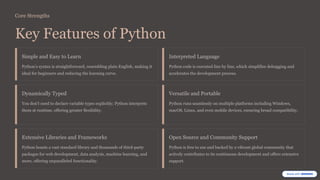
Key Features of Python
Simple and Easy to Learn
Python’s syntax is straightforward, resembling plain English, making it
ideal for beginners and reducing the learning curve.
Interpreted Language
Python code is executed line by line, which simplifies debugging and
accelerates the development process.
Dynamically Typed
You don’t need to declare variable types explicitly; Python interprets
them at runtime, offering greater flexibility.
Versatile and Portable
Python runs seamlessly on multiple platforms including Windows,
macOS, Linux, and even mobile devices, ensuring broad compatibility.
Extensive Libraries and Frameworks
Python boasts a vast standard library and thousands of third-party
packages for web development, data analysis, machine learning, and
more, offering unparalleled functionality.
Open Source and Community Support
Python is free to use and backed by a vibrant global community that
actively contributes to its continuous development and offers extensive
support.
Tooling
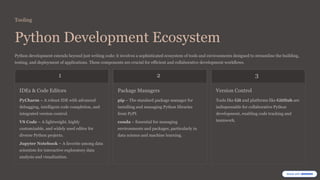
Python Development Ecosystem
Python development extends beyond just writing code; it involves a sophisticated ecosystem of tools and environments designed to streamline the building,
testing, and deployment of applications. These components are crucial for efficient and collaborative development workflows.
1
IDEs & Code Editors
PyCharm – A robust IDE with advanced
debugging, intelligent code completion, and
integrated version control.
VS Code – A lightweight, highly
customizable, and widely used editor for
diverse Python projects.
Jupyter Notebook – A favorite among data
scientists for interactive exploratory data
analysis and visualization.
2
Package Managers
pip – The standard package manager for
installing and managing Python libraries
from PyPI.
conda – Essential for managing
environments and packages, particularly in
data science and machine learning.
3
Version Control
Tools like Git and platforms like GitHub are
indispensable for collaborative Python
development, enabling code tracking and
teamwork.
Real-World Impact
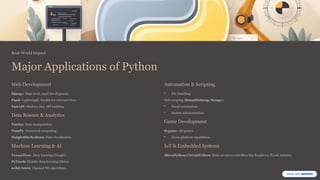
Major Applications of Python
Web Development
Django: High-level, rapid development.
Flask: Lightweight, flexible for microservices.
FastAPI: Modern, fast, API building.
Data Science & Analytics
Pandas: Data manipulation.
NumPy: Numerical computing.
Matplotlib/Seaborn: Data visualization.
Machine Learning & AI
TensorFlow: Deep learning (Google).
PyTorch: Flexible deep learning (Meta).
scikit-learn: Classical ML algorithms.
Automation & Scripting
• File handling.
Web scraping (BeautifulSoup, Scrapy).
• Email automation.
• System administration.
Game Development
Pygame: 2D games.
• Cross-platform capabilities.
IoT & Embedded Systems
MicroPython/CircuitPython: Runs on microcontrollers like Raspberry Pi and Arduino.
Industry Adoption
Python's Impact in Industry
Python’s simplicity and power have garnered widespread adoption across leading companies globally:
Google uses Python extensively for system building, data analysis, and internal tools.
Instagram and Pinterest rely on Django, a Python-based framework, for their robust backend infrastructure.
Netflix leverages Python for its vast automation needs, data analysis, and critical backend services.
NASA employs Python in various scientific applications, data processing, and space mission control systems.
Its integral role in data science, automation, and web development makes it a critical technology across diverse sectors
including finance, healthcare, education, and technology.
Pathways
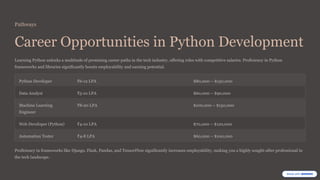
Career Opportunities in Python Development
Learning Python unlocks a multitude of promising career paths in the tech industry, offering roles with competitive salaries. Proficiency in Python
frameworks and libraries significantly boosts employability and earning potential.
Python Developer ₹6-12 LPA $80,000 – $130,000
Data Analyst ₹5-10 LPA $60,000 – $90,000
Machine Learning
Engineer
₹8-20 LPA $100,000 – $150,000
Web Developer (Python) ₹4-10 LPA $70,000 – $120,000
Automation Tester ₹4-8 LPA $60,000 – $100,000
Proficiency in frameworks like Django, Flask, Pandas, and TensorFlow significantly increases employability, making you a highly sought-after professional in
the tech landscape.
Why Python?
Advantages for Developers
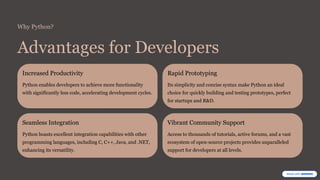
Increased Productivity
Python enables developers to achieve more functionality
with significantly less code, accelerating development cycles.
Rapid Prototyping
Its simplicity and concise syntax make Python an ideal
choice for quickly building and testing prototypes, perfect
for startups and R&D.
Seamless Integration
Python boasts excellent integration capabilities with other
programming languages, including C, C++, Java, and .NET,
enhancing its versatility.
Vibrant Community Support
Access to thousands of tutorials, active forums, and a vast
ecosystem of open-source projects provides unparalleled
support for developers at all levels.
Considerations
Challenges of Python
Development
While Python offers numerous benefits, it's important to acknowledge its limitations:
Speed: As an interpreted language, Python can be slower in execution compared to
compiled languages like C++ for performance-critical applications.
Mobile Development: Python is generally not the preferred choice for native mobile
application development, though frameworks exist for specific use cases.
Memory Usage: Python can be memory-intensive, which might pose challenges for very
large-scale applications or systems with limited resources.
Despite these drawbacks, Python remains a top choice for a vast majority of modern
software development needs due to its extensive ecosystem and developer-friendly
features.
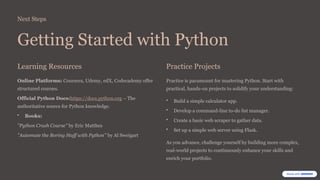
Next Steps
Getting Started with Python
Learning Resources
Online Platforms: Coursera, Udemy, edX, Codecademy offer
structured courses.
Official Python Docs:https://docs.python.org – The
authoritative source for Python knowledge.
• Books:
"Python Crash Course" by Eric Matthes
"Automate the Boring Stuff with Python" by Al Sweigart
Practice Projects
Practice is paramount for mastering Python. Start with
practical, hands-on projects to solidify your understanding:
• Build a simple calculator app.
• Develop a command-line to-do list manager.
• Create a basic web scraper to gather data.
• Set up a simple web server using Flask.
As you advance, challenge yourself by building more complex,
real-world projects to continuously enhance your skills and
enrich your portfolio.

Mastering-Python-Your-Gateway-to-Modern-Development.pptx

  • 1.
    Mastering Python: Your Gatewayto Modern Development Python stands as one of the most widely adopted programming languages globally. Celebrated for its simplicity, readability, and extensive versatility, it has become the preferred choice for both novice and seasoned programmers. From robust web development to cutting-edge artificial intelligence and intricate data science, Python is the engine behind countless innovations. This presentation offers an in-depth exploration of Python development, tracing its history, highlighting its core features, showcasing its diverse applications, and delving into essential tools. Discover why Python is not just a language, but a fundamental skill in today's technology-driven world.
  • 2.
    Introduction What is Python? Pythonis a high-level, interpreted, and general-purpose programming language. It was created by Guido van Rossum and first released in 1991. Python was designed to emphasize code readability and simplicity, allowing developers to express concepts in fewer lines of code than other programming languages like Java or C++. The name "Python" does not come from the snake—it was inspired by the British comedy group Monty Python’s Flying Circus, reflecting van Rossum’s desire to make programming fun and approachable.
  • 3.
    Core Strengths Key Featuresof Python Simple and Easy to Learn Python’s syntax is straightforward, resembling plain English, making it ideal for beginners and reducing the learning curve. Interpreted Language Python code is executed line by line, which simplifies debugging and accelerates the development process. Dynamically Typed You don’t need to declare variable types explicitly; Python interprets them at runtime, offering greater flexibility. Versatile and Portable Python runs seamlessly on multiple platforms including Windows, macOS, Linux, and even mobile devices, ensuring broad compatibility. Extensive Libraries and Frameworks Python boasts a vast standard library and thousands of third-party packages for web development, data analysis, machine learning, and more, offering unparalleled functionality. Open Source and Community Support Python is free to use and backed by a vibrant global community that actively contributes to its continuous development and offers extensive support.
  • 4.
    Tooling Python Development Ecosystem Pythondevelopment extends beyond just writing code; it involves a sophisticated ecosystem of tools and environments designed to streamline the building, testing, and deployment of applications. These components are crucial for efficient and collaborative development workflows. 1 IDEs & Code Editors PyCharm – A robust IDE with advanced debugging, intelligent code completion, and integrated version control. VS Code – A lightweight, highly customizable, and widely used editor for diverse Python projects. Jupyter Notebook – A favorite among data scientists for interactive exploratory data analysis and visualization. 2 Package Managers pip – The standard package manager for installing and managing Python libraries from PyPI. conda – Essential for managing environments and packages, particularly in data science and machine learning. 3 Version Control Tools like Git and platforms like GitHub are indispensable for collaborative Python development, enabling code tracking and teamwork.
  • 5.
    Real-World Impact Major Applicationsof Python Web Development Django: High-level, rapid development. Flask: Lightweight, flexible for microservices. FastAPI: Modern, fast, API building. Data Science & Analytics Pandas: Data manipulation. NumPy: Numerical computing. Matplotlib/Seaborn: Data visualization. Machine Learning & AI TensorFlow: Deep learning (Google). PyTorch: Flexible deep learning (Meta). scikit-learn: Classical ML algorithms. Automation & Scripting • File handling. Web scraping (BeautifulSoup, Scrapy). • Email automation. • System administration. Game Development Pygame: 2D games. • Cross-platform capabilities. IoT & Embedded Systems MicroPython/CircuitPython: Runs on microcontrollers like Raspberry Pi and Arduino.
  • 6.
    Industry Adoption Python's Impactin Industry Python’s simplicity and power have garnered widespread adoption across leading companies globally: Google uses Python extensively for system building, data analysis, and internal tools. Instagram and Pinterest rely on Django, a Python-based framework, for their robust backend infrastructure. Netflix leverages Python for its vast automation needs, data analysis, and critical backend services. NASA employs Python in various scientific applications, data processing, and space mission control systems. Its integral role in data science, automation, and web development makes it a critical technology across diverse sectors including finance, healthcare, education, and technology.
  • 7.
    Pathways Career Opportunities inPython Development Learning Python unlocks a multitude of promising career paths in the tech industry, offering roles with competitive salaries. Proficiency in Python frameworks and libraries significantly boosts employability and earning potential. Python Developer ₹6-12 LPA $80,000 – $130,000 Data Analyst ₹5-10 LPA $60,000 – $90,000 Machine Learning Engineer ₹8-20 LPA $100,000 – $150,000 Web Developer (Python) ₹4-10 LPA $70,000 – $120,000 Automation Tester ₹4-8 LPA $60,000 – $100,000 Proficiency in frameworks like Django, Flask, Pandas, and TensorFlow significantly increases employability, making you a highly sought-after professional in the tech landscape.
  • 8.
    Why Python? Advantages forDevelopers Increased Productivity Python enables developers to achieve more functionality with significantly less code, accelerating development cycles. Rapid Prototyping Its simplicity and concise syntax make Python an ideal choice for quickly building and testing prototypes, perfect for startups and R&D. Seamless Integration Python boasts excellent integration capabilities with other programming languages, including C, C++, Java, and .NET, enhancing its versatility. Vibrant Community Support Access to thousands of tutorials, active forums, and a vast ecosystem of open-source projects provides unparalleled support for developers at all levels.
  • 9.
    Considerations Challenges of Python Development WhilePython offers numerous benefits, it's important to acknowledge its limitations: Speed: As an interpreted language, Python can be slower in execution compared to compiled languages like C++ for performance-critical applications. Mobile Development: Python is generally not the preferred choice for native mobile application development, though frameworks exist for specific use cases. Memory Usage: Python can be memory-intensive, which might pose challenges for very large-scale applications or systems with limited resources. Despite these drawbacks, Python remains a top choice for a vast majority of modern software development needs due to its extensive ecosystem and developer-friendly features.
  • 10.
    Next Steps Getting Startedwith Python Learning Resources Online Platforms: Coursera, Udemy, edX, Codecademy offer structured courses. Official Python Docs:https://docs.python.org – The authoritative source for Python knowledge. • Books: "Python Crash Course" by Eric Matthes "Automate the Boring Stuff with Python" by Al Sweigart Practice Projects Practice is paramount for mastering Python. Start with practical, hands-on projects to solidify your understanding: • Build a simple calculator app. • Develop a command-line to-do list manager. • Create a basic web scraper to gather data. • Set up a simple web server using Flask. As you advance, challenge yourself by building more complex, real-world projects to continuously enhance your skills and enrich your portfolio.