

Code Quality to Monitoring production: 
use cases and best practices 
David Melamed 
Pyweb meetup - September 21, 2014
Agenda 
What is good code? 
How to measure quality code? 
Continuous Integration 
How to efficiently monitor production?
About me 
Full-stack developer at Cloudlock 
Fond of technology & automation 
Code Quality Evangelist 
Geek on my free time
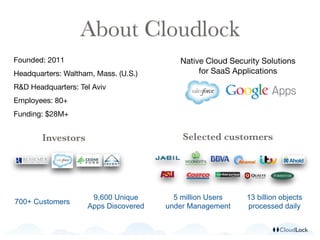
About Cloudlock 
Founded: 2011 
Headquarters: Waltham, Mass. (U.S.) 
R&D Headquarters: Tel Aviv 
Employees: 80+ 
Funding: $28M+ 
Investors Selected customers 
700+ Customers 9,600 Unique 
Apps Discovered 
Native Cloud Security Solutions 
for SaaS Applications 
5 million Users 
under Management 
13 billion objects 
processed daily
What is good code?
Good code is… 
Easy to read & understand 
Easy to extend 
Easy to maintain 
Testable
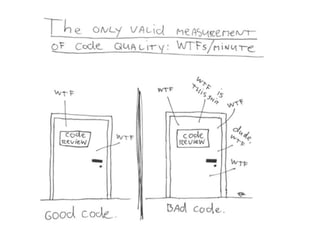
How to write good code?
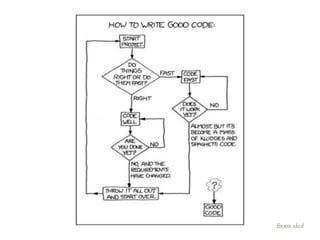
from xkcd
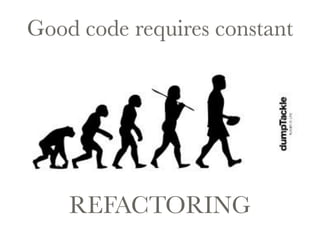
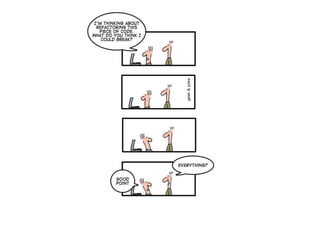
Good code requires constant 
REFACTORING
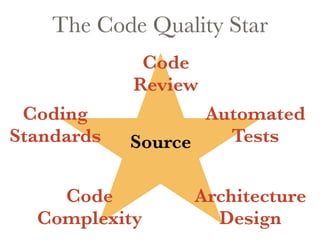
The Code Quality Star 
Coding 
Standards 
Code 
Review 
Automated 
Tests 
Code 
Complexity 
Architecture 
Design 
Source
Code should be easy to read
Code should be readable 
Avoid comments but avoid obvious ones (the code 
should be self-explanatory) 
Avoid comments too verbose 
Comments need to be maintained
Coding Standards
The Zen of Python (PEP20) 
Beautiful is better than ugly 
Explicit is better than implicit 
Simple is better than complex 
Complex is better than complicated 
Readability counts
Coding Style: Readability Counts 
“Programs must be written for people to read, and 
only incidentally for machines to execute.” 
Abelson & Sussman, Structure and Interpretation of Computer Programs
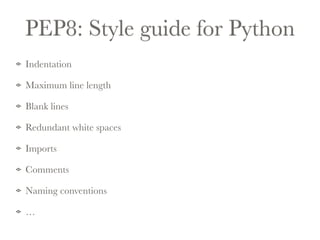
PEP8: Style guide for Python 
Indentation 
Maximum line length 
Blank lines 
Redundant white spaces 
Imports 
Comments 
Naming conventions 
…
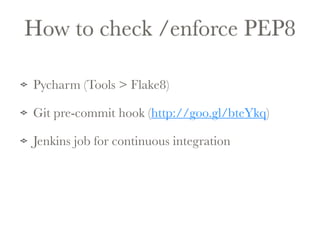
How to check /enforce PEP8 
Pycharm (Tools > Flake8) 
Git pre-commit hook (http://goo.gl/bteYkq) 
Jenkins job for continuous integration
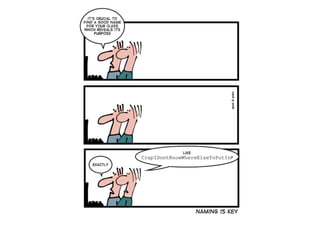
Naming is key
Naming best practises 
Adopt a convention and stick with it (fetch vs. retrieve vs. get) 
Use intention-revealing names 
Avoid misleading readers 
Make meaningful distinctions 
Use searchable names 
Avoid mental mapping 
Use domain names 
From Clean code, R. Martin
Code Architecture
Best Practices in Code Architecture 
OOP 
DRY 
SOLID 
Loose Coupling
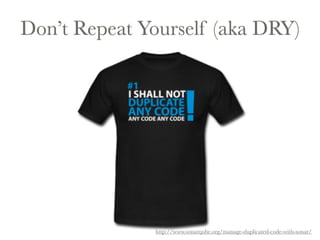
Don’t Repeat Yourself (aka DRY) 
http://www.sonarqube.org/manage-duplicated-code-with-sonar/
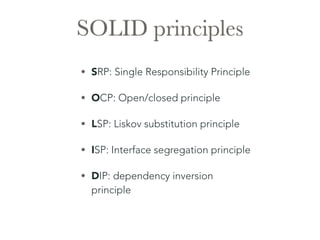
SOLID principles 
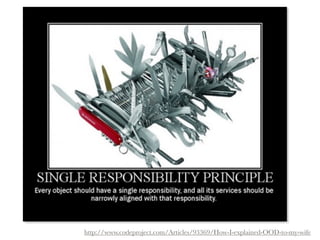
• SRP: Single Responsibility Principle 
• OCP: Open/closed principle 
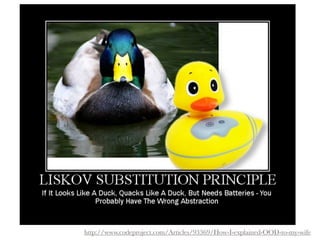
• LSP: Liskov substitution principle 
• ISP: Interface segregation principle 
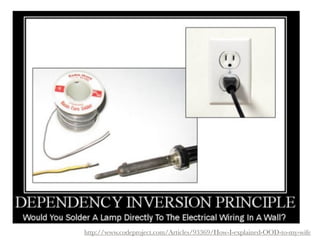
• DIP: dependency inversion 
principle
http://www.codeproject.com/Articles/93369/How-I-explained-OOD-to-my-wife
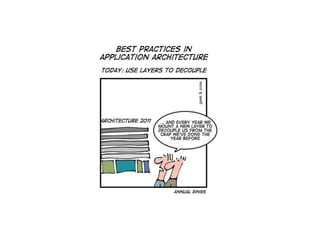
Loosely Coupled Components
Main principles 
Split components into repositories 
Web app: use clean layers 
view / endpoint (presentation) 
service (business logic) 
DAO (model) 
Use message bus for communication inter-components (i.e. RabbitMQ) 
Use daemons / workers for long-running tasks 
Use events / signals to decouple unrelated actions 
Microservices
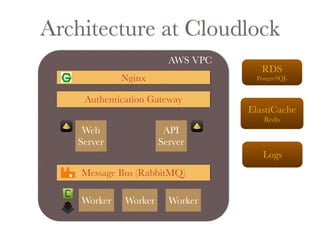
Architecture at Cloudlock 
Nginx 
AWS VPC 
Web 
Server 
API 
Server 
Message Bus (RabbitMQ) 
RDS 
PostgreSQL 
ElastiCache 
Redis 
Authentication Gateway 
Worker Worker Worker 
Logs
Code Reviews
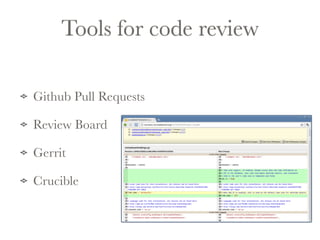
Tools for code review 
Github Pull Requests 
Review Board 
Gerrit 
Crucible
Code documentation
Code Testing
Different types of tests 
Manual Test 
Unit Test 
Integration Test 
System Test 
Acceptance/Regression Test (end-to-end) 
Smoke Test
Unit Test 
Test if small, distinct and isolated portions of code 
are working as expected, provided some input 
Mock your dependencies (database, logger, service) 
Should be very fast 
No need to test EVERYTHING (i.e. private methods) 
Frameworks: unittest, pytest and nose
Pytest 
No need for base class (works both for classes and methods) 
More pythonic than unittest 
Fixtures (conftest.py) 
Parametrized tests 
Markers 
Various plugins for coverage, bdd, django, twisted… 
Used for unit tests, integration tests and end to end tests
Integration Tests 
Test communication between services 
You may mock some of the dependencies depending on 
what you test
System Tests 
Global test, more functional of the whole system 
TestApp (Pyramid app) using a test database 
Call the API and test the expected response code
End-to-end tests 
Splinter: web driver abstraction (firefox, selenium) 
splinter-pytest: fixtures for browser 
Plugin for rerun flaky tests, tests with steps 
Use Selenium Grid to test several browsers
Smoke Tests 
Make sure the system is alive 
Tests that the components are working 
Tests that the components can communicate 
Health check / status page
Measuring code quality
Code Quality Metrics 
Code Standards Violations (pylint /flake8/pyflakes) 
LOC (Lines Of Code) 
Cyclomatic Complexity 
Unit Tests Coverage
Code Coverage 
Makes sense only for unit tests 
Calculates the coverage based on the paths run by 
the tests 
100% coverage is not a goal on its own 
May be misleading regarding the code quality
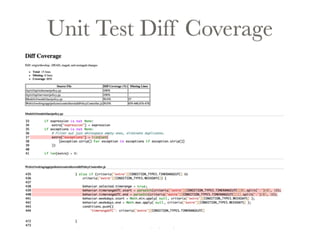
Unit Test Diff Coverage
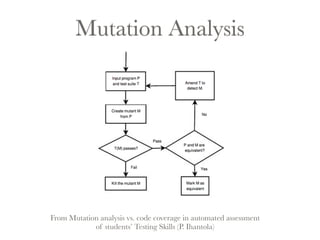
Mutation Analysis 
From Mutation analysis vs. code coverage in automated assessment 
of students’ Testing Skills (P. Ihantola)
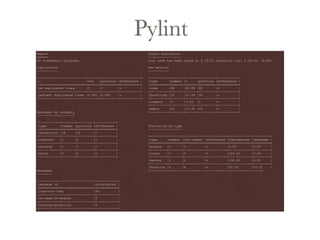
Pylint 
Report 
====== 
85 statements analysed. ! 
Duplication 
----------- ! 
+-------------------------+------+---------+-----------+ 
| |now |previous |difference | 
+=========================+======+=========+===========+ 
|nb duplicated lines |0 |0 |= | 
+-------------------------+------+---------+-----------+ 
|percent duplicated lines |0.000 |0.000 |= | 
+-------------------------+------+---------+-----------+ !!! 
Messages by category 
-------------------- ! 
+-----------+-------+---------+-----------+ 
|type |number |previous |difference | 
+===========+=======+=========+===========+ 
|convention |18 |18 |= | 
+-----------+-------+---------+-----------+ 
|refactor |2 |2 |= | 
+-----------+-------+---------+-----------+ 
|warning |1 |1 |= | 
+-----------+-------+---------+-----------+ 
|error |4 |4 |= | 
+-----------+-------+---------+-----------+ !!! 
Messages 
-------- ! 
+-----------------------------+------------+ 
|message id |occurrences | 
+=============================+============+ 
|line-too-long |10 | 
+-----------------------------+------------+ 
|no-name-in-module |4 | 
+-----------------------------+------------+ 
|missing-docstring |4 | 
+-----------------------------+------------+ 
Global evaluation 
----------------- 
Your code has been rated at 5.18/10 (previous run: 5.18/10, +0.00) ! 
Raw metrics 
----------- ! 
+----------+-------+------+---------+-----------+ 
|type |number |% |previous |difference | 
+==========+=======+======+=========+===========+ 
|code |90 |63.83 |90 |= | 
+----------+-------+------+---------+-----------+ 
|docstring |30 |21.28 |30 |= | 
+----------+-------+------+---------+-----------+ 
|comment |5 |3.55 |5 |= | 
+----------+-------+------+---------+-----------+ 
|empty |16 |11.35 |16 |= | 
+----------+-------+------+---------+-----------+ !!! 
Statistics by type 
------------------ ! 
+---------+-------+-----------+-----------+------------+---------+ 
|type |number |old number |difference |%documented |%badname | 
+=========+=======+===========+===========+============+=========+ 
|module |1 |1 |= |0.00 |0.00 | 
+---------+-------+-----------+-----------+------------+---------+ 
|class |2 |2 |= |100.00 |0.00 | 
+---------+-------+-----------+-----------+------------+---------+ 
|method |1 |1 |= |100.00 |0.00 | 
+---------+-------+-----------+-----------+------------+---------+ 
|function |6 |6 |= |50.00 |33.33 | 
+————+-------+-----------+-----------+------------+---------+ !!!!!!!!!!
Test Automation
Why do you need automated tests? 
! 
Optimise speed, efficiency and quality 
Catch the bugs upfront 
Safety net for refactoring
On the Road to 
Continuous Integration
Several “Continuous” processes 
Continuous Integration 
Continuous Deployment 
Continuous Delivery
Several platforms for CI 
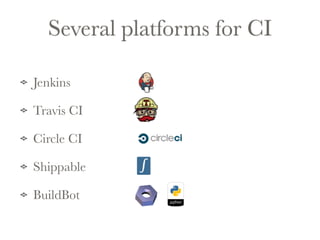
Jenkins 
Travis CI 
Circle CI 
Shippable 
BuildBot
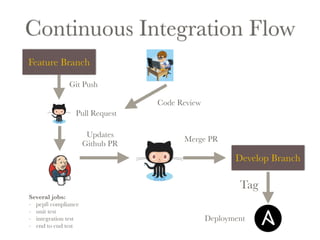
Continuous Integration Flow 
Feature Branch 
Develop Branch 
Git Push 
Updates 
Github PR 
Several jobs: 
- pep8 compliance 
- unit test 
- integration test 
- end to end test 
Merge PR 
Pull Request 
Tag 
Deployment 
Code Review
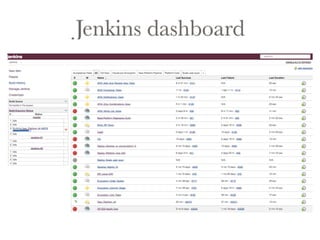
Jenkins dashboard
Automated Deployment
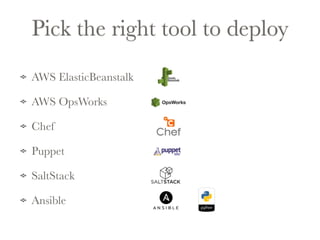
Pick the right tool to deploy 
AWS ElasticBeanstalk 
AWS OpsWorks 
Chef 
Puppet 
SaltStack 
Ansible
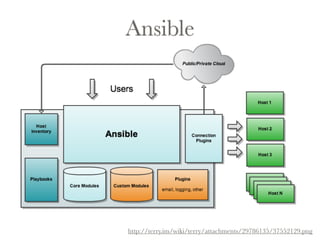
Ansible 
http://terry.im/wiki/terry/attachments/29786135/37552129.png
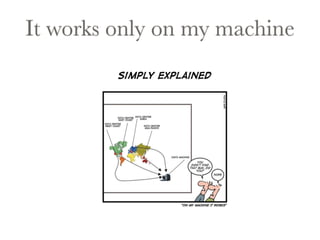
It works only on my machine
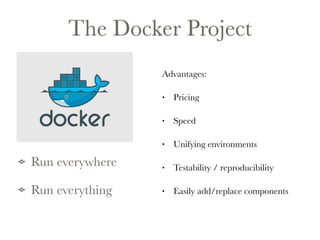
The Docker Project 
Run everywhere 
Run everything 
Advantages: 
• Pricing 
• Speed 
• Unifying environments 
• Testability / reproducibility 
• Easily add/replace components
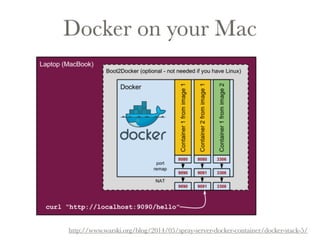
Docker on your Mac 
http://www.warski.org/blog/2014/05/spray-server-docker-container/docker-stack-5/
Production Monitoring
Production Monitoring 
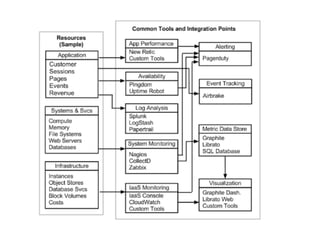
AWS CloudWatch 
End-to-end tests running in Jenkins 
StackDriver 
Log analysis (streams)
Questions?
Python developers WANTED 
Contact: dmelamed@cloudlock.com

Python - code quality and production monitoring

  • 1.
    Code Quality toMonitoring production: use cases and best practices David Melamed Pyweb meetup - September 21, 2014
  • 2.
    Agenda What isgood code? How to measure quality code? Continuous Integration How to efficiently monitor production?
  • 3.
    About me Full-stackdeveloper at Cloudlock Fond of technology & automation Code Quality Evangelist Geek on my free time
  • 4.
    About Cloudlock Founded:2011 Headquarters: Waltham, Mass. (U.S.) R&D Headquarters: Tel Aviv Employees: 80+ Funding: $28M+ Investors Selected customers 700+ Customers 9,600 Unique Apps Discovered Native Cloud Security Solutions for SaaS Applications 5 million Users under Management 13 billion objects processed daily
  • 5.
  • 6.
    Good code is… Easy to read & understand Easy to extend Easy to maintain Testable
  • 7.
    How to writegood code?
  • 8.
  • 9.
    Good code requiresconstant REFACTORING
  • 10.
    The Code QualityStar Coding Standards Code Review Automated Tests Code Complexity Architecture Design Source
  • 11.
    Code should beeasy to read
  • 13.
    Code should bereadable Avoid comments but avoid obvious ones (the code should be self-explanatory) Avoid comments too verbose Comments need to be maintained
  • 14.
  • 15.
    The Zen ofPython (PEP20) Beautiful is better than ugly Explicit is better than implicit Simple is better than complex Complex is better than complicated Readability counts
  • 16.
    Coding Style: ReadabilityCounts “Programs must be written for people to read, and only incidentally for machines to execute.” Abelson & Sussman, Structure and Interpretation of Computer Programs
  • 17.
    PEP8: Style guidefor Python Indentation Maximum line length Blank lines Redundant white spaces Imports Comments Naming conventions …
  • 18.
    How to check/enforce PEP8 Pycharm (Tools > Flake8) Git pre-commit hook (http://goo.gl/bteYkq) Jenkins job for continuous integration
  • 19.
  • 22.
    Naming best practises Adopt a convention and stick with it (fetch vs. retrieve vs. get) Use intention-revealing names Avoid misleading readers Make meaningful distinctions Use searchable names Avoid mental mapping Use domain names From Clean code, R. Martin
  • 23.
  • 24.
    Best Practices inCode Architecture OOP DRY SOLID Loose Coupling
  • 25.
    Don’t Repeat Yourself(aka DRY) http://www.sonarqube.org/manage-duplicated-code-with-sonar/
  • 26.
    SOLID principles •SRP: Single Responsibility Principle • OCP: Open/closed principle • LSP: Liskov substitution principle • ISP: Interface segregation principle • DIP: dependency inversion principle
  • 27.
  • 28.
  • 29.
  • 30.
  • 31.
  • 32.
  • 33.
    Main principles Splitcomponents into repositories Web app: use clean layers view / endpoint (presentation) service (business logic) DAO (model) Use message bus for communication inter-components (i.e. RabbitMQ) Use daemons / workers for long-running tasks Use events / signals to decouple unrelated actions Microservices
  • 35.
    Architecture at Cloudlock Nginx AWS VPC Web Server API Server Message Bus (RabbitMQ) RDS PostgreSQL ElastiCache Redis Authentication Gateway Worker Worker Worker Logs
  • 36.
  • 38.
    Tools for codereview Github Pull Requests Review Board Gerrit Crucible
  • 39.
  • 41.
  • 42.
    Different types oftests Manual Test Unit Test Integration Test System Test Acceptance/Regression Test (end-to-end) Smoke Test
  • 43.
    Unit Test Testif small, distinct and isolated portions of code are working as expected, provided some input Mock your dependencies (database, logger, service) Should be very fast No need to test EVERYTHING (i.e. private methods) Frameworks: unittest, pytest and nose
  • 45.
    Pytest No needfor base class (works both for classes and methods) More pythonic than unittest Fixtures (conftest.py) Parametrized tests Markers Various plugins for coverage, bdd, django, twisted… Used for unit tests, integration tests and end to end tests
  • 46.
    Integration Tests Testcommunication between services You may mock some of the dependencies depending on what you test
  • 47.
    System Tests Globaltest, more functional of the whole system TestApp (Pyramid app) using a test database Call the API and test the expected response code
  • 48.
    End-to-end tests Splinter:web driver abstraction (firefox, selenium) splinter-pytest: fixtures for browser Plugin for rerun flaky tests, tests with steps Use Selenium Grid to test several browsers
  • 49.
    Smoke Tests Makesure the system is alive Tests that the components are working Tests that the components can communicate Health check / status page
  • 50.
  • 52.
    Code Quality Metrics Code Standards Violations (pylint /flake8/pyflakes) LOC (Lines Of Code) Cyclomatic Complexity Unit Tests Coverage
  • 53.
    Code Coverage Makessense only for unit tests Calculates the coverage based on the paths run by the tests 100% coverage is not a goal on its own May be misleading regarding the code quality
  • 54.
  • 55.
    Mutation Analysis FromMutation analysis vs. code coverage in automated assessment of students’ Testing Skills (P. Ihantola)
  • 56.
    Pylint Report ====== 85 statements analysed. ! Duplication ----------- ! +-------------------------+------+---------+-----------+ | |now |previous |difference | +=========================+======+=========+===========+ |nb duplicated lines |0 |0 |= | +-------------------------+------+---------+-----------+ |percent duplicated lines |0.000 |0.000 |= | +-------------------------+------+---------+-----------+ !!! Messages by category -------------------- ! +-----------+-------+---------+-----------+ |type |number |previous |difference | +===========+=======+=========+===========+ |convention |18 |18 |= | +-----------+-------+---------+-----------+ |refactor |2 |2 |= | +-----------+-------+---------+-----------+ |warning |1 |1 |= | +-----------+-------+---------+-----------+ |error |4 |4 |= | +-----------+-------+---------+-----------+ !!! Messages -------- ! +-----------------------------+------------+ |message id |occurrences | +=============================+============+ |line-too-long |10 | +-----------------------------+------------+ |no-name-in-module |4 | +-----------------------------+------------+ |missing-docstring |4 | +-----------------------------+------------+ Global evaluation ----------------- Your code has been rated at 5.18/10 (previous run: 5.18/10, +0.00) ! Raw metrics ----------- ! +----------+-------+------+---------+-----------+ |type |number |% |previous |difference | +==========+=======+======+=========+===========+ |code |90 |63.83 |90 |= | +----------+-------+------+---------+-----------+ |docstring |30 |21.28 |30 |= | +----------+-------+------+---------+-----------+ |comment |5 |3.55 |5 |= | +----------+-------+------+---------+-----------+ |empty |16 |11.35 |16 |= | +----------+-------+------+---------+-----------+ !!! Statistics by type ------------------ ! +---------+-------+-----------+-----------+------------+---------+ |type |number |old number |difference |%documented |%badname | +=========+=======+===========+===========+============+=========+ |module |1 |1 |= |0.00 |0.00 | +---------+-------+-----------+-----------+------------+---------+ |class |2 |2 |= |100.00 |0.00 | +---------+-------+-----------+-----------+------------+---------+ |method |1 |1 |= |100.00 |0.00 | +---------+-------+-----------+-----------+------------+---------+ |function |6 |6 |= |50.00 |33.33 | +————+-------+-----------+-----------+------------+---------+ !!!!!!!!!!
  • 57.
  • 58.
    Why do youneed automated tests? ! Optimise speed, efficiency and quality Catch the bugs upfront Safety net for refactoring
  • 60.
    On the Roadto Continuous Integration
  • 61.
    Several “Continuous” processes Continuous Integration Continuous Deployment Continuous Delivery
  • 62.
    Several platforms forCI Jenkins Travis CI Circle CI Shippable BuildBot
  • 63.
    Continuous Integration Flow Feature Branch Develop Branch Git Push Updates Github PR Several jobs: - pep8 compliance - unit test - integration test - end to end test Merge PR Pull Request Tag Deployment Code Review
  • 64.
  • 67.
  • 68.
    Pick the righttool to deploy AWS ElasticBeanstalk AWS OpsWorks Chef Puppet SaltStack Ansible
  • 69.
  • 70.
    It works onlyon my machine
  • 71.
    The Docker Project Run everywhere Run everything Advantages: • Pricing • Speed • Unifying environments • Testability / reproducibility • Easily add/replace components
  • 72.
    Docker on yourMac http://www.warski.org/blog/2014/05/spray-server-docker-container/docker-stack-5/
  • 73.
  • 75.
    Production Monitoring AWSCloudWatch End-to-end tests running in Jenkins StackDriver Log analysis (streams)
  • 76.
  • 77.
    Python developers WANTED Contact: dmelamed@cloudlock.com