Robust Python Write Clean And Maintainable Code 1st Edition Patrick Viafore
1.
Robust Python WriteClean And Maintainable Code
1st Edition Patrick Viafore download
https://ebookbell.com/product/robust-python-write-clean-and-
maintainable-code-1st-edition-patrick-viafore-34242066
Explore and download more ebooks at ebookbell.com
2.
Here are somerecommended products that we believe you will be
interested in. You can click the link to download.
Robust Python Patrick Viafore
https://ebookbell.com/product/robust-python-patrick-viafore-42305020
Robust Python Patrick Viafore
https://ebookbell.com/product/robust-python-patrick-viafore-47965528
Robust Python Patrick Viafore
https://ebookbell.com/product/robust-python-patrick-viafore-170540780
Parallel Programming With Python Develop Efficient Parallel Systems
Using The Robust Python Environment Martini
https://ebookbell.com/product/parallel-programming-with-python-
develop-efficient-parallel-systems-using-the-robust-python-
environment-martini-20632918
3.
Testing In PythonRobust Testing For Professionals Noah Gift Alfredo
Deza
https://ebookbell.com/product/testing-in-python-robust-testing-for-
professionals-noah-gift-alfredo-deza-11147998
Selenium And Appium With Python Build Robust And Scalable Test
Automation Frameworks Using Selenium Appium And Python Yogashiva
Mathivanan
https://ebookbell.com/product/selenium-and-appium-with-python-build-
robust-and-scalable-test-automation-frameworks-using-selenium-appium-
and-python-yogashiva-mathivanan-50457814
Python Objectoriented Programming Build Robust And Maintainable
Objectoriented Python Applications And Libraries 4th Edition Steven F
Lott
https://ebookbell.com/product/python-objectoriented-programming-build-
robust-and-maintainable-objectoriented-python-applications-and-
libraries-4th-edition-steven-f-lott-33346930
Python Objectoriented Programming Build Robust And Maintainable
Objectoriented Python Applications And Libraries 4th Edition Steven F
Lott Dusty Phillips
https://ebookbell.com/product/python-objectoriented-programming-build-
robust-and-maintainable-objectoriented-python-applications-and-
libraries-4th-edition-steven-f-lott-dusty-phillips-49850026
Building Python Web Apis With Fastapi A Fastpaced Guide To Building
Highperformance Robust Web Apis Abdulazeez Abdulazeez Adeshina
https://ebookbell.com/product/building-python-web-apis-with-fastapi-a-
fastpaced-guide-to-building-highperformance-robust-web-apis-
abdulazeez-abdulazeez-adeshina-44468546
1 Titus Winters,Tom Manshreck, and Hyrum Wright. Software Engineering at Google: Lessons Learned from
Programming over Time. Sebastopol, CA: O’Reilly Media, Inc., 2020.
Preface
Noted software engineer and entrepreneur Marc Andreesen famously declared that
“software is eating the world”. This was back in 2011, and has only become more true
over time. Software systems continue to grow in complexity and can be found in all
facets of modern life. Standing in the middle of this ravenous beast is the Python lan‐
guage. Programmers often cite Python as a favorite language, and it can be found
everywhere: from web applications, to machine learning, to developer tools, and
more.
Not all that glitters is gold, though. As our software systems become more complex, it
becomes harder to understand how our mental models map onto the real world. If
left unchecked, software systems bloat and become brittle, earning the frightening
moniker “legacy code.” These codebases often come with warnings such as, “Do not
touch these files; we don’t know why, but it breaks when you do,” and, “Oh, only So-
and-So knows that code, and they left for a high-paying Silicon Valley job two years
ago.” Software development is a young field, but these sort of statements should be
terrifying to developers and businesspeople alike.
The truth is, to write systems that last, you need to be deliberate in the choices you
make. As stated by Titus Winters, Tom Manshreck, and Hyrum Wright, “Software
engineering is programming integrated over time.”1
Your code might last a long time
—I’ve stepped into projects whose code was written while I was in elementary school.
How long will your code last? Will it last longer than your tenure at your current job
(or when you finish maintaining that project)? How do you want your code to be
received in a few years when someone is building core components from it? Do you
want your successors to thank you for your foresight, or curse your name for the
complexities you bore into this world?
xi
18.
Python is awonderful language, but it occasionally makes building for the future
tricky. Some proponents of other programming languages have decried Python as
“not production-grade” or “useful for prototyping only,” but the truth is that many
developers only scratch the surface, rather than learning all the tools and tricks for
writing robust Python. Throughout this book, you’ll learn how to do better. You’ll
journey through numerous ways to make Python clean and maintainable. Your future
maintainers will enjoy working with your code, as it was designed up front to make
things easy. So go, read this book, look toward the future, and build awesome soft‐
ware that will last.
Who Should Read This Book
This book is for any Python developer who is looking to grow the code they work on
in a sustainable and maintainable fashion. This is not intended to be your first
Python text; I expect that you have written Python before. You should be comfortable
with Python control flow, and have worked with classes before. If you are looking for
a more introductory text, I suggest reading Learning Python by Mark Lutz (O’Reilly)
first.
While I will be covering many advanced Python topics, the goal of this book is not to
be a how-to for using all of Python’s features. Instead, the features are a backdrop for
a larger conversation about robustness and how your choices impact maintainability.
At times I will discuss strategies that you should rarely use, if at all. That is because I
want to illustrate first principles of robustness; the journey of understanding why and
how we make decisions in code is more important than knowing what tools to use in
an optimal scenario. In practice, the optimal scenario is a rare occurence. Use the
principles in this book to draw your own conclusions from your codebase.
This book is not a reference book. You might call it a discussion book. Each chapter
should be a starting point for developers in your organization to discuss, together,
how best to apply these principles. Start a book club, discussion group, or lunch and
learn to foster communication. I have proposed discussion topics in each chapter to
get the converstation started. When you come across these topics, I encourage you to
stop and reflect on your current codebase. Talk among your peers and use these top‐
ics as a springboard for discussing the state of your code, processes, and workflows. If
you are interested in a reference book about the Python language, I heartily recom‐
mend Fluent Python by Luciano Ramalho (O’Reilly; a second edition is forthcoming
in late 2021).
A system can be robust in many different ways. It can be security hardened, scalable,
fault-tolerant, or less likely to introduce new errors. Each one of these facets of
robustness warrants a full book; this book is focused on preventing the developers
who inherit your code from creating new faults in your system. I will show you
how to communicate to future developers, how to make their lives easier through
xii | Preface
19.
architectural patterns, andhow to catch errors in your codebase before they make it
into production. This book zeroes in on the robustness of your Python codebase, not
the robustness of your system as a whole.
I will be covering a wealth of information, from many different areas of software,
including software engineering, computer science, testing, functional programming,
and object-oriented programming (OOP). I do not expect you to have a background
in these fields. There are sections where I explain things at a beginner level; this is
often to deconstruct how we think about core fundamentals of the language. This is,
for the most part, an intermediate-level text.
Ideal readers include:
• Developers currently working in a large codebase, looking to find better ways to
communicate with their colleagues
• Primary codebase maintainers, looking for ways to help lessen the burden of
future maintainers
• Self-taught developers who can write Python really well but need to better under‐
stand why we do the things we do
• Software engineering graduates who need a reminder of practical advice for
development
• Senior developers looking for a way to tie their design rationale to first principles
of robustness
This book focuses on writing software over time. If a lot of your code is a prototype,
throwaway, or disposable in any other fashion, the advice in this book will end up
creating more work than is necessary for your project. Likewise if your project is
small—say, under one hundred lines of Python. Making code maintainable does add
complexity; there’s no doubt about that. However, I’ll guide you through minimizing
that complexity. If your code lives longer than a few weeks or grows to a considerable
size, you need to consider the sustainability of your codebase.
About This Book
This book covers a wide swath of knowledge, across many chapters. It is broken up
into four parts:
Part I, Annotating Your Code with Types
We’ll start with types in Python. Types are fundamental to the language, but are
not often examined in great detail. The types you choose matter, as they convey a
very specific intent. We’ll examine type annotations and what specific annota‐
tions communicate to the developer. We’ll also go over typecheckers and how
those help catch bugs early.
Preface | xiii
20.
Part II, DefiningYour Own Types
After covering how to think about Python’s types, we’ll focus on how to create
your own types. We’ll walk through enumerations, data classes, and classes in
depth. We’ll explore how making certain design choices in designing a type can
increase or decrease the robustness of your code.
Part III, Extensible Python
After learning how to better express your intentions, we’ll focus on how to enable
developers to change your code effortlessly, building with confidence on your
strong foundation. We’ll cover extensibility, dependencies, and architectural pat‐
terns that allow you to modify your system with minimal impact.
Part IV, Building a Safety Net
Lastly, we’ll explore how to build a safety net, so that you can gently catch your
future collaborators when they do fall. Their confidence will increase, knowing
that they have a strong, robust system that they can fearlessly adapt to their use
case. Finally, we’ll cover a variety of static analysis and testing tools that will help
you catch rogue behavior.
Each chapter is mostly self-contained, with references to other chapters where appli‐
cable. You can read this book from cover to cover, or bounce around to chapters that
suit your fancy. Chapters grouped in each part will be related to one another, but
there will be fewer relations between book parts.
All code examples were run using Python 3.9.0, and I’ll try to call out when you need
a specific Python version or later to run examples (such as Python 3.7 for the use of
data classes).
Throughout this book, I will be doing most of my work on the command line. I ran
all of these commands from an Ubuntu operating system, but most tools should work
just as well on Mac or Windows systems. In some cases, I will show how certain tools
interact with integrated development environments (IDEs), such as Visual Studio
Code (VS Code). Most IDEs use the command-line options underneath the hood;
most of what you learn on the command line will translate directly to IDE options.
This book will be presenting many different techniques that can improve the robust‐
ness of your code. However, there are no silver bullets in software development.
Trade-offs are the heart of solid engineering, and there is no exception in the meth‐
ods that I present. I will be transparent about benefits and drawbacks as I discuss
these topics. You will know more about your systems than I will, and you are best
suited to choose which tool is appropriate for which job. All I am doing is stocking
your toolbox.
xiv | Preface
21.
Conventions Used inThis Book
The following typographical conventions are used in this book:
Italic
Indicates new terms, URLs, email addresses, filenames, and file extensions.
Constant width
Used for program listings, as well as within paragraphs to refer to program ele‐
ments such as variable or function names, databases, data types, environment
variables, statements, and keywords.
Constant width bold
Shows commands or other text that should be typed literally by the user.
Constant width italic
Shows text that should be replaced with user-supplied values or by values deter‐
mined by context.
This element signifies a tip or suggestion.
This element signifies a general note.
This element indicates a warning or caution.
Using Code Examples
Supplemental material (code examples, exercises, etc.) is available for download at
https://github.com/pviafore/RobustPython.
If you have a technical question or a problem using the code examples, please send
email to bookquestions@oreilly.com.
This book is here to help you get your job done. In general, if example code is offered
with this book, you may use it in your programs and documentation. You do not
Preface | xv
22.
need to contactus for permission unless you’re reproducing a significant portion of
the code. For example, writing a program that uses several chunks of code from this
book does not require permission. Selling or distributing examples from O’Reilly
books does require permission. Answering a question by citing this book and quoting
example code does not require permission. Incorporating a significant amount of
example code from this book into your product’s documentation does require
permission.
We appreciate, but generally do not require, attribution. An attribution usually
includes the title, author, publisher, and ISBN. For example: “Robust Python by Pat‐
rick Viafore (O’Reilly). Copyright 2021 Kudzera, LLC, 978-1-098-10066-7.”
If you feel your use of code examples falls outside fair use or the permission given
above, feel free to contact us at permissions@oreilly.com.
O’Reilly Online Learning
For more than 40 years, O’Reilly Media has provided technol‐
ogy and business training, knowledge, and insight to help
companies succeed.
Our unique network of experts and innovators share their knowledge and expertise
through books, articles, and our online learning platform. O’Reilly’s online learning
platform gives you on-demand access to live training courses, in-depth learning
paths, interactive coding environments, and a vast collection of text and video from
O’Reilly and over two hundred other publishers. For more information, visit http://
oreilly.com.
How to Contact Us
Please address comments and questions concerning this book to the publisher:
O’Reilly Media, Inc.
1005 Gravenstein Highway North
Sebastopol, CA 95472
800-998-9938 (in the United States or Canada)
707-829-0515 (international or local)
707-829-0104 (fax)
We have a web page for this book, where we list errata, examples, and any additional
information. You can access this page at https://oreil.ly/robust-python.
xvi | Preface
23.
Email bookquestions@oreilly.com tocomment or ask technical questions about this
book.
For news and information about our books and courses, visit http://oreilly.com.
Find us on Facebook: http://facebook.com/oreilly
Follow us on Twitter: http://twitter.com/oreillymedia
Watch us on YouTube: http://youtube.com/oreillymedia
Acknowledgments
I would like to acknowledge my incredible wife, Kendall. She is my support and
sounding board, and I appreciate everything she did to make sure that I had the time
and space to write this book.
No book is written in isolation, and this book is no exception. I stand on the should‐
ers of giants in the software industry, and I appreciate all who came before me.
I also would like to thank everyone who was involved in reviewing this book to make
sure that my messaging was consistent and that my examples were clear. Thank you
to Bruce G., David K., David P., and Don P. for providing early feedback and helping
me decide on a direction for this book. Thank you to my tech reviewers Charles
Givre, Drew Winstel, Jennifer Wilcox, Jordan Goldmeier, Nathan Stocks, and Jess
Males for their invaluable feedback, especially where things really only made sense in
my head but not on paper. Lastly, thank you to anyone who read the early release
draft and was kind enough to email me their thoughts, especially Daniel C. and
Francesco.
I’d like to thank everyone who helped transform my final draft into something
production-worthy. Thank you to Justin Billing for diving deep as a copyeditor and
helping refine the presentation of my ideas. Thank you to Shannon Turlington for
proofreading; the book is much more polished because of you. A big thank you goes
to Ellen Troutman-Zaig, who produced a fantastic index that I was blown away by.
Lastly, I could not do this without the fabulous team at O’Reilly. Thank you to
Amanda Quinn for helping me through the proposal process and helping me develop
focus for the book. Thank you to Kristen Brown for making the production stage
incredibly easy for me. Thank you to Kate Dullea, who converted my MS Paint-
quality sketches into clean, crisp illustrations. Also, I would like to give a tremendous
thank you to my developmental editor, Sarah Grey. I looked forward to our weekly
meetings, and she was fantastic in helping me craft a book for a broad audience, while
still letting me dive deep into technical details.
Preface | xvii
25.
1 Charles AntonyRichard Hoare. “The Emperor’s Old Clothes.” Commun. ACM 24, 2 (Feb. 1981), 75–83.
https://doi.org/10.1145/358549.358561.
CHAPTER 1
Introduction to Robust Python
This book is all about making your Python more manageable. As your codebase
grows, you need a specific toolbox of tips, tricks, and strategies to build maintainable
code. This book will guide you toward fewer bugs and happier developers. You’ll be
taking a hard look at how you write code, and you’ll learn the implications of your
decisions. When discussing how code is written, I am reminded of these wise words
from C.A.R. Hoare:
There are two ways of constructing a software design: One way is to make it so simple
that there are obviously no deficiencies, and the other way is to make it so complicated
that there are no obvious deficiencies. The first method is far more difficult.1
This book is about developing systems the first way. It will be more difficult, yes, but
have no fear. I will be your guide on your journey to leveling up your Python game
such that, as C.A.R. Hoare says above, there are obviously no deficiencies in your code.
Ultimately, this is a book all about writing robust Python.
In this chapter we’re going to cover what robustness means and why you should care
about it. We’ll go through how your communication method implies certain benefits
and drawbacks, and how best to represent your intentions. “The Zen of Python”
states that, when developing code, “There should be one -- and preferably only one --
obvious way to do it.” You’ll learn how to evaluate whether your code is written in an
obvious way, and what you can do to fix it. First, we need to address the basics. What
is robustness in the first place?
1
26.
Robustness
Every book needsat least one dictionary definition, so I’ll get this out of the way nice
and early. Merriam-Webster offers many definitions for robustness:
1. having or exhibiting strength or vigorous health
2. having or showing vigor, strength, or firmness
3. strongly formed or constructed
4. capable of performing without failure under a wide range of conditions
These are fantastic descriptions of what to aim for. We want a healthy system, one that
meets expectations for years. We want our software to exhibit strength; it should be
obvious that this code will stand the test of time. We want a strongly constructed sys‐
tem, one that is built upon solid foundations. Crucially, we want a system that is capa‐
ble of performing without failure; the system should not become vulnerable as changes
are introduced.
It is common to think of a software like a skyscraper, some grand structure that
stands as a bulwark against all change and a paragon of immortality. The truth is,
unfortunately, messier. Software systems constantly evolve. Bugs are fixed, user inter‐
faces get tweaked, and features are added, removed, and then re-added. Frameworks
shift, components go out of date, and security bugs arise. Software changes. Develop‐
ing software is more akin to handling sprawl in city planning than it is constructing a
static building. With ever changing codebases, how can you make your code robust?
How can you build a strong foundation that is resilient to bugs?
The truth is, you have to accept change. Your code will be split apart, stitched
together, and reworked. New use cases will alter huge swaths of code—and that’s OK.
Embrace it. Understand that it’s not enough that your code can easily be changed; it
might be best for it to be deleted and rewritten as it goes out of date. That doesn’t
diminish its value; it will still have a long life in the spotlight. Your job is to make it
easy to rewrite parts of the system. Once you start to accept the ephemeral nature of
your code, you start to realize that it’s not enough to write bug-free code for the
present; you need to enable the codebase’s future owners to be able to change your
code with confidence. That is what this book is about.
You are going to learn to build strong systems. This strength doesn’t come from
rigidity, as exhibited by a bar of iron. It instead comes from flexibility. Your code
needs to be strong like a tall willow tree, swaying in the wind, flexing but not break‐
ing. Your software will need to handle situations you would never dream of. Your
codebase needs to be able to adapt to new circumstances, because it won’t always be
you maintaining it. Those future maintainers need to know they are working in a
healthy codebase. Your codebase needs to communicate its strength. You must write
2 | Chapter 1: Introduction to Robust Python
27.
Python code ina way that reduces failure, even as future maintainers tear it apart and
reconstruct it.
Writing robust code means deliberately thinking about the future. You want future
maintainers to look at your code and understand your intentions easily, not curse
your name during late-night debugging sessions. You must convey your thoughts,
reasoning, and cautions. Future developers will need to bend your code into new
shapes—and will want to do so without worrying that each change may cause it to
collapse like a teetering house of cards.
Put simply, you don’t want your systems to fail, especially when the unexpected hap‐
pens. Testing and quality assurance are huge parts of this, but neither of those bake
quality completely in. They are more suited to illuminating gaps in expectations and
offering a safety net. Instead, you must make your software stand the test of time. In
order to do that, you must write clean and maintainable code.
Clean code expresses its intent clearly and concisely, in that order. When you look at
a line of code and say to yourself, “ah, that makes complete sense,” that’s an indicator
of clean code. The more you have to step through a debugger, the more you have to
look at a lot of other code to figure out what’s happening, the more you have to stop
and stare at the code, the less clean it is. Clean code does not favor clever tricks if it
makes the code unreadable to other developers. Just like C.A.R. Hoare said earlier,
you do not want to make your code so obtuse that it will be difficult to understand
upon visual inspection.
The Importance of Clean Code
Having clean code is paramount to having robust code; consider it table stakes for any
meaningful project. There are often specific practices tied to writing clean code,
including:
• Organizing your code in an appropriately granular fashion
• Providing good documentation
• Naming your variables/functions/types well
• Keeping functions short and simple
While the motifs of clean code weave throughout this book, I will not be dedicating
substantial time to these specific practices. There are other books that capture clean
code practices much better. I recommend Clean Code by Robert C. Martin (Prentice
Hall), The Pragmatic Programmer by Andy Hunt and Dave Thomas (Addison-
Wesley), and Code Complete by Steve McConnell (Microsoft Press). All three of these
books greatly improved my skills as a developer and are great resources for anyone
looking to grow.
Robustness | 3
28.
While you shouldabsolutely strive to write code cleanly, you must be prepared to
work in codebases that aren’t a shining example of cleanliness. Software development
is a messy endeavor, and there will be times where the purity of clean code will be
sacrificed for various reasons, both business and technical. Use the advice given
in this book to help drive toward cleaner code through discussions about
maintainability.
Maintainable code is code that…well, can be easily maintained. Maintenance begins
immediately after the first commit and continues until not a single developer is look‐
ing at the project anymore. Developers will be fixing bugs, adding features, reading
code, extracting code for use in other libraries, and more. Maintainable code makes
these tasks frictionless. Software lives for years, if not decades. Focus on your main‐
tainability today.
You don’t want to be the reason systems fail, whether you are actively working on
them or not. You need to be proactive in making your system stand the test of time.
You need a testing strategy to be your safety net, but you also need to be able to avoid
falling in the first place. So with all that in mind, I offer my definition of robustness in
terms of your codebase:
A robust codebase is resilient and error-free in spite of constant change.
Why Does Robustness Matter?
A lot of energy goes into making software do what it’s supposed to, but it’s not easy to
know when you’re done. Development milestones are not easily predicted. Human
factors such as UX, accessibility, and documentation only increase the complexity.
Now add in testing to ensure that you’ve covered a slice of known and unknown
behaviors, and you are looking at lengthy development cycles.
The purpose of software is to provide value. It is in every stakeholder’s interests to
deliver that full value as early as possible. Given the uncertainty around some devel‐
opment schedules, there is often extra pressure to meet expectations. We’ve all been
on the wrong end of an unrealistic schedule or deadline. Unfortunately, many of the
tools to make software incredibly robust only add onto our development cycle in the
short term.
It’s true that there is an inherent tension between immediate delivery of value and
making code robust. If your software is “good enough,” why add even more complex‐
ity? To answer that, consider how often that piece of software will be iterated upon.
Delivering software value is typically not a static exercise; it’s rare that a system pro‐
vides value and is never modified again. Software is ever-evolving by its very nature.
The codebase needs to be prepared to deliver value frequently and for long periods of
time. This is where robust software engineering practices come into play. If you can’t
4 | Chapter 1: Introduction to Robust Python
29.
2 Yak-shaving describesa situation where you frequently have to solve unrelated problems before you can even
begin to tackle the original problem. You can learn about the origins of the term at https://oreil.ly/4iZm7.
painlessly deliver features quickly and without compromising quality, you need to re-
evaluate techniques to make your code more maintainable.
If you deliver your system late, or broken, you incur real-time costs. Think through
your codebase. Ask yourself what happens if your code breaks a year from now
because someone wasn’t able to understand your code. How much value do you lose?
Your value might be measured in money, time, or even lives. Ask yourself what hap‐
pens if the value isn’t delivered on time? What are the repercussions? If the answers to
these questions are scary, good news, the work you’re doing is valuable. But it also
underscores why it’s so important to eliminate future errors.
Multiple developers work on the same codebase simlutaneously. Many software
projects will outlast most of those developers. You need to find a way to communicate
to the present and future developers, without having the benefit of being there in per‐
son to explain. Future developers will be building off of your decisions. Every false
trail, every rabbit hole, and every yak-shaving2
adventure will slow them down, which
impedes value. You need empathy for those who come after you. You need to step
into their shoes. This book is your gateway to thinking about your collaborators and
maintainers. You need to think about sustainable engineering practices. You need to
write code that lasts. The first step to making code that lasts is being able to commu‐
nicate through your code. You need to make sure future developers understand your
intent.
What’s Your Intent?
Why should you strive to write clean and maintainable code? Why should you care so
much about robustness? The heart of these answers lies in communication. You’re not
delivering static systems. The code will continue to change. You also have to consider
that maintainers change over time. Your goal, when writing code, is to deliver value.
It’s also to write your code in such a way that other developers can deliver value just
as quickly. In order to do that, you need to be able to communicate reasoning and
intent without ever meeting your future maintainers.
Let’s take a look at a code block found in a hypothetical legacy system. I want you to
estimate how long it takes for you to understand what this code is doing. It’s OK if
you’re not familiar with all the concepts here, or if you feel like this code is convolu‐
ted (it intentionally is!).
What’s Your Intent? | 5
30.
# Take ameal recipe and change the number of servings
# by adjusting each ingredient
# A recipe's first element is the number of servings, and the remainder
# of elements is (name, amount, unit), such as ("flour", 1.5, "cup")
def adjust_recipe(recipe, servings):
new_recipe = [servings]
old_servings = recipe[0]
factor = servings / old_servings
recipe.pop(0)
while recipe:
ingredient, amount, unit = recipe.pop(0)
# please only use numbers that will be easily measurable
new_recipe.append((ingredient, amount * factor, unit))
return new_recipe
This function takes a recipe and adjusts every ingredient to handle a new number of
servings. However, this code prompts many questions.
• What is the pop for?
• What does recipe[0] signify? Why is that the old servings?
• Why do I need a comment for numbers that will be easily measurable?
This is a bit of questionable Python, for sure. I won’t blame you if you feel the need to
rewrite it. It looks much nicer written like this:
def adjust_recipe(recipe, servings):
old_servings = recipe.pop(0)
factor = servings / old_servings
new_recipe = {ingredient: (amount*factor, unit)
for ingredient, amount, unit in recipe}
new_recipe["servings"] = servings
return new_recipe
Those who favor clean code probably prefer the second version (I certainly do). No
raw loops. Variables do not mutate. I’m returning a dictionary instead of a list of
tuples. All these changes can be seen as positive, depending on the circumstances. But
I may have just introduced three subtle bugs.
• In the original code snippet, I was clearing out the original recipe. Now I am not.
Even if it’s just one area of calling code that is relying on this behavior, I broke
that calling code’s assumptions.
• By returning a dictionary, I have removed the ability to have duplicate ingredi‐
ents in a list. This might have an effect on recipes that have multiple parts (such
as a main dish and a sauce) that both use the same ingredient.
• If any of the ingredients are named “servings” I’ve just introduced a collision with
naming.
6 | Chapter 1: Introduction to Robust Python
31.
Whether these arebugs or not depends on two interrelated things: the original
author’s intent and calling code. The author intended to solve a problem, but I am
unsure of why they wrote the code the way they did. Why are they popping elements?
Why is “servings” a tuple inside the list? Why is a list used? Presumably, the original
author knew why, and communicated it locally to their peers. Their peers wrote call‐
ing code based on those assumptions, but as time wore on, that intent became lost.
Without communication to the future, I am left with two options of maintaining this
code:
• Look at all calling code and confirm that this behavior is not relied upon before
implementing. Good luck if this is a public API for a library with external callers.
I would spend a lot of time doing this, which would frustrate me.
• Make the change and wait to see what the fallout is (customer complaints, broken
tests, etc.). If I’m lucky, nothing bad will happen. If I’m not, I would spend a lot of
time fixing use cases, which would frustrate me.
Neither option feels productive in a maintenance setting (especially if I have to mod‐
ify this code). I don’t want to waste time; I want to deal with my current task quickly
and move on to the next one. It gets worse if I consider how to call this code. Think
about how you interact with previously unseen code. You might see other examples of
calling code, copy them to fit your use case, and never realize that you needed to pass
a specific string called “servings” as the first element of your list.
These are the sorts of decisions that will make you scratch your head. We’ve all seen
them in larger codebases. They aren’t written maliciously, but organically over time
with the best intentions. Functions start simple, but as use cases grow and multiple
developers contribute, that code tends to morph and obscure original intent. This is a
sure sign that maintainability is suffering. You need to express intent in your code up
front.
So what if the original author made use of better naming patterns and better type
usage? What would that code look like?
def adjust_recipe(recipe, servings):
"""
Take a meal recipe and change the number of servings
:param recipe: a `Recipe` indicating what needs to be adusted
:param servings: the number of servings
:return Recipe: a recipe with serving size and ingredients adjusted
for the new servings
"""
# create a copy of the ingredients
new_ingredients = list(recipe.get_ingredients())
recipe.clear_ingredients()
for ingredient in new_ingredients:
What’s Your Intent? | 7
32.
ingredient.adjust_propoprtion(Fraction(servings, recipe.servings))
return Recipe(servings,new_ingredients)
This looks much better, is better documented, and expresses original intent clearly.
The original developer encoded their ideas directly into the code. From this snippet,
you know the following is true:
• I am using a Recipe class. This allows me to abstract away certain operations.
Presumably, inside the class itself there is an invariant that allows for duplicate
ingredients. (I’ll talk more about classes and invariants in Chapter 10.) This pro‐
vides a common vocabulary that makes the function’s behavior more explicit.
• Servings are now an explicit part of a Recipe class, rather than needing to be the
first element of the list, which was handled as a special case. This greatly simpli‐
fies calling code, and prevents inadvertent collisions.
• It is very apparent that I want to clear out ingredients on the old recipe. No
ambiguous reason for why I needed to do a .pop(0).
• Ingredients are a separate class, and handle fractions rather than an explicit
float. It’s clearer for all involved that I am dealing with fractional units, and can
easily do things such as limit_denominator(), which can be called when people
want to restrict measuring units (instead of relying on a comment).
I’ve replaced variables with types, such as a recipe type and an ingredient type. I’ve
also defined operations (clear_ingredients, adjust_proportion) to communicate
my intent. By making these changes, I’ve made the code’s behavior crystal clear to
future readers. They no longer have to come talk to me to understand the code.
Instead, they comprehend what I’m doing without ever talking to me. This is asyn‐
chronous communication at its finest.
Asynchronous Communication
It’s weird writing about asynchronous communication in a Python book without
mentioning async and await. But I’m afraid I have to discuss asynchronous commu‐
nication in a much more complex place: the real world.
Asynchronous communication means that producing information and consuming
that information are independent of each other. There is a time gap between the pro‐
duction and consumption. It might be a few hours, as is the case of collaborators in
different time zones. Or it might be years, as future maintainers try to do a deep dive
into the inner workings of code. You can’t predict when somebody will need to
understand your logic. You might not even be working on that codebase (or for that
company) by the time they consume the information you produced.
8 | Chapter 1: Introduction to Robust Python
33.
Contrast that withsynchronous communication. Synchronous communication is the
exchange of ideas live (in real time). This form of direct communication is one of the
best ways to express your thoughts but unfortunately, it doesn’t scale, and you won’t
always be around to answer questions.
In order to evaluate how appropriate each method of communication is when trying
to understand intentions, let’s look at two axes: proximity and cost.
Proximity is how close in time the communicators need to be in order for that com‐
munication to be fruitful. Some methods of communication excel with real-time
transfer of information. Other methods of communication excel at communicating
years later.
Cost is the measure of effort to communicate. You must weigh the time and money
expended to communicate with the value provided. Your future consumers then have
to weigh the cost of consuming the information with the value they are trying to
deliver. Writing code and not providing any other communication channels is your
baseline; you have to do this to produce value. To evaluate additional communication
channels’ cost, here is what I factor in:
Discoverability
How easy was it to find this information outside of a normal workflow? How
ephemeral is the knowledge? Is it easy to search for information?
Maintenance cost
How accurate is the information? How often does it need to be updated? What
goes wrong if this information is out of date?
Production cost
How much time and money went into producing the communication?
In Figure 1-1, I plot some common communication methods’ cost and proximity
required, based on my own experience.
What’s Your Intent? | 9
34.
Figure 1-1. Plottingcost and proximity of communcation methods
There are four quadrants that make up the cost/proximity graph.
Low cost, high proximity required
These are cheap to produce and consume, but are not scalable across time. Direct
communication and instant messaging are great examples of these methods.
Treat these as snapshots of information in time; they are only valuable when the
user is actively listening. Don’t rely on these methods to communicate to the
future.
High cost, high proximity required
These are costly events, and often only happen once (such as meetings or confer‐
ences). These events should deliver a lot of value at the time of communication,
because they do not provide much value to the future. How many times have you
been to a meeting that felt like a waste of time? You’re feeling the direct loss of
value. Talks require a multiplicative cost for each attendee (time spent, hosting
space, logistics, etc.). Code reviews are rarely looked at once they are done.
High cost, low proximity required
These are costly, but that cost can be paid back over time in value delivered, due
to the low proximity needed. Emails and agile boards contain a wealth of infor‐
mation, but are not discoverable by others. These are great for bigger concepts
10 | Chapter 1: Introduction to Robust Python
35.
that don’t needfrequent updates. It becomes a nightmare to try and sift through
all the noise just to find the nugget of information you are looking for. Video
recordings and design documentation are great for understanding snapshots in
time, but are costly to keep updated. Don’t rely on these communication methods
to understand day-to-day decisions.
Low cost, low proximity required
These are cheap to create, and are easily consumable. Code comments, version
control history, and project READMEs all fall into this category, since they are
adjacent to the source code we write. Users can view this communication years
after it was produced. Anything that a developer encounters during their day-to-
day workflow is inherently discoverable. These communication methods are a
natural fit for the first place someone will look after the source code. However,
your code is one of your best documentation tools, as it is the living record and
single source of truth for your system.
Discussion Topic
This plot in Figure 1-1 was created based on generalized use cases.
Think about the communication paths you and your organization
use. Where would you plot them on the graph? How easy is it to
consume accurate information? How costly is it to produce infor‐
mation? Your answers to these questions may result in a slightly
different graph, but the single source of truth will be in the exe‐
cutable software you deliver.
Low cost, low proximity communication methods are the best tools for communicat‐
ing to the future. You should strive to minimize the cost of production and of con‐
sumption of communication. You have to write software to deliver value anyway, so
the lowest cost option is making your code your primary communication tool. Your
codebase becomes the best possible option for expressing your decisions, opinions,
and workarounds clearly.
However, for this assertion to hold true, the code has to be cheap to consume as well.
Your intent has to come across clearly in your code. Your goal is to minimize the time
needed for a reader of your code to understand it. Ideally, a reader does not need to
read your implementation, but just your function signature. Through the use of good
types, comments and variable names, it should be crystal clear what your code does.
What’s Your Intent? | 11
36.
Self-Documenting Code
The wrongresponse to Figure 1-1 is “Self-documenting code is all I need!” Code
should absolutely self-document what is being done, but can’t cover every use case of
communication. For example, version control will give you a history of changes.
Design documents discuss sweeping ideals that are not local to any one code file.
Meetings (when done right) can be an important event for synchronizing plan execu‐
tion. Talks are great for sharing ideas with a large audience all at once. While this
book focuses on what you can do in your code, don’t throw away any other valuable
means of communication.
Examples of Intent in Python
Now that I’ve talked through what intent is and how it matters, let’s look at examples
through a Python lens. How can you make sure that you are correctly expressing your
intentions? I will take a look at two different examples of how a decision affects inten‐
tions: collections and iteration.
Collections
When you pick a collection, you are communicating specific information. You must
pick the right collection for the task at hand. Otherwise, maintainers will infer the
wrong intention from your code.
Consider this code that takes a list of cookbooks and provides a mapping between
authors and the number of books written:
def create_author_count_mapping(cookbooks: list[Cookbook]):
counter = {}
for cookbook in cookbooks:
if cookbook.author not in counter:
counter[cookbook.author] = 0
counter[cookbook.author] += 1
return counter
What does my use of collections tell you? Why am I not passing a dictionary or a set?
Why am I not returning a list? Based on my current usage of collections, here’s what
you can assume:
• I pass in a list of cookbooks. There may be duplicate cookbooks in this list (I
might be counting a shelf of cookbooks in a store with multiple copies).
• I am returning a dictionary. Users can look up a specific author, or iterate over
the entire dictionary. I do not have to worry about duplicate authors in the
returned collection.
12 | Chapter 1: Introduction to Robust Python
37.
What if Iwanted to communicate that no duplicates should be passed into this func‐
tion? A list communicates the wrong intention. Instead, I should have chosen a set to
communicate that this code absolutely will not handle duplicates.
Choosing a collection tells readers about your specific intentions. Here’s a list of com‐
mon collection types, and the intention they convey:
List
This is a collection to be iterated over. It is mutable: able to be changed at any
time. Very rarely do you expect to be retrieving specific elements from the mid‐
dle of the list (using a static list index). There may be duplicate elements. The
cookbooks on a shelf might be stored in a list.
String
An immutable collection of characters. The name of a cookbook would be a
string.
Generator
A collection to be iterated over, and never indexed into. Each element access is
performed lazily, so it may take time and/or resources through each loop itera‐
tion. They are great for computationally expensive or infinite collections. An
online database of recipes might be returned as a generator; you don’t want to
fetch all the recipes in the world when the user is only going to look at the first 10
results of a search.
Tuple
An immutable collection. You do not expect it to change, so it is more likely to
extract specific elements from the middle of the tuple (either through indices or
unpacking). It is very rarely iterated over. The information about a specific cook‐
book might be represented as a tuple, such as (cookbook_name, author, page
count).
Set
An iterable collection that contains no duplicates. You cannot rely on ordering of
elements. The ingredients in a cookbook might be stored as a set.
Dictionary
A mapping from keys to values. Keys are unique across the dictionary. Dictionar‐
ies are typically iterated over, or indexed into using dynamic keys. A cookbook’s
index is a great example of a key to value mapping (from topic to page number.)
Do not use the wrong collection for your purposes. Too many times have I come
across a list that should not have had duplicates or a dictionary that wasn’t actually
being used to map keys to values. Every time there is a disconnect between what you
intend and what is in code, you create a maintenance burden. Maintainers must
Examples of Intent in Python | 13
38.
pause, work outwhat you really meant, and then work around their faulty assump‐
tions (and your faulty assumptions, too).
Dynamic Versus Static Indexing
Depending on the collection type you are using, you may or may not want to use a
static index. A static index is what you get when you use a constant literal to index
into the collection, such as my_list[4] or my_dict["Python"]. In general, lists and
dictionaries will not often need a use case for this. You have no guarantee that the col‐
lection has the element you are looking for at that index, due to their dynamic nature.
If you are looking for specific fields in these types of collections, this is a good sign
that you need a user-defined type (explored in Chapters 8, 9 and 10). It is safe to stati‐
cally index into a tuple, since they are fixed size. Sets and generators are never
indexed into.
Exceptions to this rule include:
• Getting the first or last element of a sequence (my_list[0] or my_list[-1])
• Using a dictionary as an intermediate data type such as when reading JSON or
YAML
• Operations on a sequence dealing specifically with fixed chunks (e.g., always
splitting after the third element or checking for a specific character in a fixed-
format string)
• Performance reasons for a specific collection type
In contrast, dynamic indexing occurs whenever you index into a collection with a
variable that is not known until runtime. This is the most appropriate choice for lists
and dictionaries. You’ll see this when iterating over collections or searching for a spe‐
cific element with an index() function.
These are basic collections, but there are more ways to express intent. Here are some
special collection types that are even more expressive in communicating to the future:
frozenset
A set that is immutable.
OrderedDict
A dictionary that preserves order of elements based on insertion time. As of
CPython 3.6 and Python 3.7, built-in dictionaries will also preserve order of ele‐
ments based on insertion of time.
14 | Chapter 1: Introduction to Robust Python
39.
defaultdict
A dictionary thatprovides a default value if the key is missing. For example, I
could rewrite my earlier example as follows:
from collections import defaultdict
def create_author_count_mapping(cookbooks: List[Cookbook]):
counter = defaultdict(lambda: 0)
for cookbook in cookbooks:
counter[cookbook.author] += 1
return counter
This introduces a new behavior for end users—if they query the dictionary for a
value that doesn’t exist, they will receive a 0. This might be beneficial in some use
cases, but if it’s not, you can just return dict(counter) instead.
Counter
A special type of dictionary used for counting how many times an element
appears. This greatly simplifies our above code to the following:
from collections import Counter
def create_author_count_mapping(cookbooks: List[Cookbook]):
return Counter(book.author for book in cookbooks)
Take a minute to reflect on that last example. Notice how using a Counter gives us
much more concise code without sacrificing readability. If your readers are familiar
with Counter, the meaning of this function (and how the implementation works) is
immediately apparent. This is a great example of communicating intent to the
future through better selection of collection types. I’ll explore collections further in
Chapter 5.
There are plenty of additional types to explore, including array, bytes, and range.
Whenever you come across a new collection type, built-in or otherwise, ask yourself
how it differs from other collections and what it conveys to future readers.
Iteration
Iteration is another example where the abstraction you choose dictates the intent you
convey.
How many times have you seen code like this?
text = "This is some generic text"
index = 0
while index < len(text):
print(text[index])
index += 1
This simple code prints each character on a separate line. This is perfectly fine for a
first pass at Python for this problem, but the solution quickly evolves into the more
Examples of Intent in Python | 15
40.
Pythonic (code writtenin an idiomatic style that aims to emphasize simplicity and is
recognizable to most Python developers):
for character in text:
print(character)
Take a moment and reflect on why this option is preferable. The for loop is a more
appropriate choice; it communicates intentions more clearly. Just like collection types,
the looping construct you select explicitly communicates different concepts. Here’s a
list of some common looping constructs and what they convey:
for loops
for loops are used for iterating over each element in a collection or range and
performing an action/side effect.
for cookbook in cookbooks:
print(cookbook)
while loops
while loops are used for iterating as long as a certain condition is true.
while is_cookbook_open(cookbook):
narrate(cookbook)
Comprehensions
Comprehensions are used for transforming one collection into another (nor‐
mally, this does not have side effects, especially if the comprehension is lazy).
authors = [cookbook.author for cookbook in cookbooks]
Recursion
Recursion is used when the substructure of a collection is identical to the struc‐
ture of a collection (for example, each child of a tree is also a tree).
def list_ingredients(item):
if isinstance(item, PreparedIngredient):
list_ingredients(item)
else:
print(ingredient)
You want each line of your codebase to deliver value. Furthermore, you want each
line to clearly communicate what that value is to future developers. This drives a need
to minimize any amount of boilerplate, scaffolding, and superfluous code. In the
example above, I am iterating over each element and performing a side effect (print‐
ing an element), which makes the for loop an ideal looping construct. I am not wast‐
ing code. In contrast, the while loop requires us to explicitly track looping until a
certain condition occurs. In other words, I need to track a specific condition and
mutate a variable every iteration. This distracts from the value the loop provides, and
provides unwanted cognitive burden.
16 | Chapter 1: Introduction to Robust Python
41.
3 Geoffrey James.The Tao of Programming. https://oreil.ly/NcKNK.
4 A bug that displays different behavior when being observed. SIGSOFT ’83: Proceedings of the ACM SIGSOFT/
SIGPLAN software engineering symposium on High-level debugging.
Law of Least Surprise
Distractions from intent are bad, but there’s a class of communication that is even
worse: when code actively surprises your future collaborators. You want to adhere to
the Law of Least Surprise; when someone reads through the codebase, they should
almost never be surprised at behavior or implementation (and when they are sur‐
prised, there should be a great comment near the code to explain why it is that way).
This is why communicating intent is paramount. Clear, clean code lowers the likeli‐
hood of miscommunication.
The Law Of Least Surprise, also known as the Law of Least Aston‐
ishment, states that a program should always respond to the user in
the way that astonishes them the least.3
Surprising behavior leads to
confusion. Confusion leads to misplaced assumptions. Misplaced
assumptions lead to bugs. And that is how you get unreliable
software.
Bear in mind, you can write completely correct code and still surprise someone in the
future. There was one nasty bug I was chasing early in my career that crashed due
to corrupted memory. Putting the code under a debugger or putting in too many
print statements affected timing such that the bug would not manifest (a true
“heisenbug”).4
There were literally thousands of lines of code that related to this bug.
So I had to do a manual bisect, splitting the code in half, see which half actually had
the crash by removing the other half, and then do it all over again in that code half.
After two weeks of tearing my hair out, I finally decided to inspect an innocuous
sounding function called getEvent. It turns out that this function was actually setting
an event with invalid data. Needless to say, I was very surprised. The function was
completely correct in what it was doing, but because I missed the intent of the code, I
overlooked the bug for at least three days. Surprising your collaborators will cost their
time.
A lot of this surprise ends up coming from complexity. There are two types of com‐
plexity: necessary complexity and accidental complexity. Necessary complexity is the
complexity inherent in your domain. Deep learning models are necessarily complex;
they are not something you browse through the inner workings of and understand in
a few minutes. Optimizing object–relational mapping (ORM) is necessarily complex;
there is a large variety of possible user inputs have to be accounted for. You won’t be
able to remove necessary complexity, so your best bet would be to try and contain it,
Examples of Intent in Python | 17
42.
lest it sprawlsacross your codebase and ends up becoming accidental complexity
instead.
In contrast, accidental complexity is complexity that produces superfluous, wasteful,
or confusing statements in code. It’s what happens when a system evolves over time
and developers are jamming features in without reevaluating old code to determine
whether their original assertions hold true. I once worked on a project where adding
a single command-line option (and associated means of programmatically setting it)
touched no fewer than 10 files. Why would adding one simple value ever need to
require changes all over the codebase?
You know you have accidental complexity if you’ve ever experienced the following:
• Things that sound simple (adding users, changing a UI control, etc.) are non-
trivial to implement.
• Difficulty onboarding new developers into understanding your codebase. New
developers on a project are your best indicators of how maintainable your code is
right now—no need to wait years.
• Estimates for adding functionality are always high, yet you slip the schedule
nonetheless.
Remove accidental complexity and isolate your necessary complexity wherever possi‐
ble. Those will be the stumbling blocks for your future collaborators. These sources of
complexity compound miscommunication, as they obscure and diffuse intent
throughout the codebase.
Discussion Topic
What accidental complexities do you have in your codebase? How
challenging would it be to understand simple concepts if you were
dropped into the codebase with no communication to other devel‐
opers? What can you do to simplify complexities identified in this
exercise (especially if they are in often-changing code)?
Throughout the rest of the book, I will look at different techniques for communicat‐
ing intent in Python.
Closing Thoughts
Robust code matters. Clean code matters. Your code needs to be maintainable for the
entire lifetime of the codebase, and in order to ensure that outcome, you need to put
active foresight into what you are communicating and how. You need to clearly
embody your knowledge as close to the code as possible. It will feel like a burden to
18 | Chapter 1: Introduction to Robust Python
43.
continuously look forward,but with practice it becomes natural, and you start reap‐
ing the benefits as you work in your own codebase.
Every time you map a real-world concept to code, you are creating an abstraction,
whether it is through the use of a collection or your decision to keep functions sepa‐
rate. Every abstraction is a choice, and every choice communicates something,
whether intentional or not. I encourage you to think about each line of code you are
writing and ask yourself, “What will a future developer learn from this?” You owe it
to future maintainers to enable them to deliver value at the same speed that you can
today. Otherwise, your codebase will get bloated, schedules will slip, and complexity
will grow. It is your job as a developer to mitigate that risk.
Look for potential hotspots, such as incorrect abstractions (such as collections or iter‐
ation) or accidental complexity. These are prime areas where communication can
break down over time. If these types of hotspots are in areas that change often, they
are a priority to address now.
In the next chapter, you’re going to take what you learned from this chapter and apply
it to a fundamental Python concept: types. The types you choose express your intent
to future developers, and picking the correct types will lead to better maintainability.
Closing Thoughts | 19
45.
PART I
Annotating YourCode with Types
Welcome to Part I, where I will focus on types in Python. Types model the behavior of
your program. Beginner programmers understand that there are different types in
Python, such as float or str. But what is a type? How does mastering types make
your codebase stronger? Types are a fundamental underpinning of any programming
language, but, unfortunately, most introductory texts gloss over just how types bene‐
fit your codebase (or if misused, those same types increase complexity).
Tell me if you’ve seen this before:
>>>type(3.14)
<class 'float'>
>>>type("This is another boring example")
<class 'str'>
>>> type(["Even", "more", "boring", "examples"])
<class 'list'>
This could be pulled from almost any beginner’s guide to Python. You will learn
about the int, str, float, and bool data types, and all sorts of other things the lan‐
guage offers. Then, boom, you move on, because let’s face it, this Python is not flashy.
You want to dive into the cool stuff, like functions and loops and dictionaries, and I
don’t blame you. But it’s a shame that many tutorials never revisit types and give them
their proper due. As users dig deeper, they may discover type annotations (which I
cover in the next chapter) or start writing classes, but often miss out on the funda‐
mental discussion about when to use types appropriately.
That’s where I’ll start.
47.
CHAPTER 2
Introduction toPython Types
To write maintainable Python, you must be aware of the nature of types and be delib‐
erate about using them. I’ll start by talking about what a type actually is and why that
matters. I’ll then move on to how the Python language’s decisions about its type sys‐
tem affects the robustness of your codebase.
What’s in a Type?
I want you to pause and answer a question: without mentioning numbers, strings,
text, or Booleans, how would you explain what a type is?
It’s not a simple answer for everyone. It’s even harder to explain what the benefits are,
especially in a language like Python where you do not have to explicitly declare types
of variables.
I consider a type to have a very simple definition: a communication method. Types
convey information. They provide a representation that users and computers can rea‐
son about. I break the representation down into two different facets:
Mechanical representation
Types communicate behaviors and constraints to the Python language itself.
Semantic representation
Types communicate behaviors and constraints to other developers.
Let’s go learn a little more about each representation.
23
48.
Mechanical Representation
At itscore, computers are all about binary code. Your processor doesn’t speak Python;
all it sees is the presence or absence of electrical current on circuits going through it.
Same goes for what’s in your computer memory.
Suppose your memory looked like the following:
0011001010001001000101001001000100100010000010101
0010101010101000000111111110010010100111110100100
0100100010010100101011101111011010101010101010101
010100000100000101010100
10100100100100010101000101001001010101001001001001
00011110101011010110100101011100000000000000000111
Looks like a bunch of gibberish. Let’s zoom in on the middle part there:
01010000 01000001 01010100
There is no way to tell exactly what this number means by itself. Depending on com‐
puter architecture it is plausible that this could represent the number 5259604 or
5521744. It could also be the string “PAT.” Without any sort of context, you can’t
know for certain. This is why Python needs types. Type information gives Python
what it needs to know to make sense of all the ones and zeroes. Let’s see it in action:
from ctypes import string_at
from sys import getsizeof
from binascii import hexlify
a = 0b01010000_01000001_01010100
print(a)
>>> 5259604
# prints out the memory of the variable
print(hexlify(string_at(id(a), getsizeof(a))))
>>> b'0100000000000000607c054995550000010000000000000054415000'
text = "PAT"
print(hexlify(string_at(id(text), getsizeof(text))))
>>>b'0100000000000000a00f0649955500000300000000000000375c9f1f02'
b'acdbe4e5379218b77f0000000000000000000050415400'
I am running CPython 3.9.0 on a little-endian machine, so if you
see different results, don’t worry, there are subtle things that can
change your answers. (This code is not guaranteed to run on other
Python implementations such as Jython or PyPy.)
24 | Chapter 2: Introduction to Python Types
49.
These hex stringsdisplay the contents of the memory containing a Python object.
You’ll find pointers to the next and previous object in a linked list (for garbage collec‐
tion purposes), a reference count, a type, and the actual data itself. You can see the
bytes at the end of each returned value to see the number or string (look for the bytes
0x544150 or 0x504154). The important part of this is that there is a type encoded into
that memory. When Python looks at a variable, it knows exactly what type everything
is at runtime (just as when you use the type() function.)
It’s easy to think that this is the only reason for types—the computer needs to know
how to interpret various blobs of memory. It is important to be aware of how Python
uses types, as it has some implications for writing robust code, but even more impor‐
tant is the second representation: semantic representation.
Semantic Representation
While the first definition of types is great for lower-level programming, it’s the second
definition that applies to every developer. Types, in addition to having a mechanical
representation, also manifest a semantic representation. A semantic representation is
a communication tool; the types you choose communicate information across time
and space to a future developer.
Types tell a user what behaviors they can expect when interacting with that entity. In
this context, “behaviors” are the operations that you associate with that type (plus any
preconditions or postconditions). They are the boundaries, constraints, and freedoms
that a user interacts with whenever they use that type. Types used correctly have low
barriers to understanding; they become natural to use. Conversely, types used poorly
are a hindrance.
Consider the lowly int. Take a minute to think about what behaviors an integer has
in Python. Here’s a quick (noncomprehensive) list I came up with:
• Constructible from integers, floats, or strings
• Mathematical operations such as addition, subtraction, division, multiplication,
exponentiation, and negation
• Relational comparison such as <, >, ==, and !=
• Bitwise operations (manipulating individual bits of a number) such as &, |, ^, ~,
and shifting
• Convertible to a string using str or repr functions
• Able to be rounded through ceil, floor, and round methods (even though they
return the integer itself, these are supported methods)
An int has many behaviors. You can view the full list if you if you type help(int)
into your interactive Python console.
What’s in a Type? | 25
50.
Now consider adatetime:
>>>import datetime
>>>datetime.datetime.now()
datetime.datetime(2020, 9, 8, 22, 19, 28, 838667)
A datetime is not that different from an int. Typically, it’s represented as a number of
seconds or milliseconds from some epoch of time (such as January 1, 1970). But
think about the behaviors a datetime has (I’ve italicized the differences in behavior
from an integer):
• Constructible from a string, or a set of integers representing day/month/year/etc.
• Mathematical operations such as addition and subtraction of time deltas
• Relational comparison
• No bitwise operations available
• Convertible to a string using str or repr functions
• Is not able to be rounded through ceil, floor, or round methods
A datetime supports addition and subtraction, but not of other datetimes. We only
add time deltas (such as adding a day or subtracting a year). Multiplying and dividing
really don’t make sense for a datetime. Similarly, rounding dates is not a supported
operation in the standard library. However, datetimes do offer comparison and
string formatting operations with similar semantics to an integer. So even though
datetime is at heart an integer, it contains a constrained subset of operations.
Semantics refers to the meaning of an operation. While str(int)
and str(datetime.datetime.now()) will return differently for‐
matted strings, the meaning is the same: I am creating a string from
a value.
Datetimes also support their own behaviors, to further distinguish them from inte‐
gers. These include:
• Changing values based on time zones
• Being able to control the format of strings
• Finding what weekday it is
Again, if you’d like a full list of behaviors, type import datetime; help(
datetime.datetime) into your REPL.
A datetime is more specific than an int. It conveys a more specific use case than just
a plain old number. When you choose to use a more specific type, you are telling
26 | Chapter 2: Introduction to Python Types
51.
future contributors thatthere are operations that are possible and constraints to be
aware of that aren’t present in the less specific type.
Let’s dive into how this ties into robust code. Say you inherit a codebase that handles
the opening and closing of a completely automated kitchen. You need to add in func‐
tionality to be able to change closing time (say, for extending a kitchen’s hours on
holidays).
def close_kitchen_if_past_cutoff_time(point_in_time):
if point_in_time >= closing_time():
close_kitchen()
log_time_closed(point_in_time)
You know you need to be operating on point_in_time, but how do you get started?
What type are you even dealing with? Is it a str, int, datetime, or some custom
class? What operations are you allowed to perform on point_in_time? You didn’t
write this code, and you have no history with it. The same problems exist if you want
to call the code as well. You have no idea what is legal to pass into this function.
If you make an incorrect assumption one way or the other, and that code makes it to
production, you will have made the code less robust. Maybe that code doesn’t lie on a
codepath that is executed often. Maybe some other bug is hiding this code from being
run. Maybe there aren’t a whole lot of tests around this piece of code, and it becomes
a runtime error later on. No matter what, there is a bug lurking in the code, and
you’ve decreased maintainability.
Responsible developers do their best not to have bugs hit production. They will
search for tests, documentation (with a grain of salt, of course—documentation can
go out of date quickly), or calling code. They will look at closing_time() and
log_time_closed() to see what types they expect or provide, and plan accordingly.
This is a correct path in this case, but I still consider it a suboptimal path. While an
error won’t reach production, they are still expending time in looking through the
code, which prevents value from being delivered as quickly. With such a small exam‐
ple, you would be forgiven for thinking that this isn’t that big a problem if it happens
once. But beware of death by a thousand cuts: any one slice isn’t too detrimental on
its own, but thousands piled up and strewn across a codebase will leave you limping
along, trying to deliver code.
The root cause is that the semantic representation was not clear for the parameter. As
you write code, do what you can to express your intent through types. You can do it
as a comment where needed, but I recommend using type annotations (supported in
Python 3.5+) to explain parts of your code.
What’s in a Type? | 27
52.
def close_kitchen_if_past_cutoff_time(point_in_time: datetime.datetime):
ifpoint_in_time >= closing_time():
close_kitchen()
log_time_closed(point_in_time)
All I need to do is put in a : <type> after my parameters. Most code examples in this
book will utilize type annotations to make it clear what type the code expects.
Now, as developers come across this code, they will know what’s expected of
point_in_time. They don’t have to look through other methods, tests, or documenta‐
tion to know how to manipulate the variable. They have a crystal clear clue on what
to do, and they can get right to work performing the modifications they need to do.
You are conveying semantic representation to future developers, without ever directly
talking to them.
Furthermore, as developers use a type more and more, they become familiar with it.
They won’t need to look up documentation or help() to use that type when they
come across it. You begin to create a vocabulary of well-known types across your
codebase. This lessens the burden of maintenance. When a developer is modifying
existing code, they want to focus on the changes they need to make without getting
bogged down.
Semantic representation of a type is extremely important, and the rest of Part I will be
dedicated to covering how you can use types to your advantage. Before I move on,
though, I need to walk through some fundamental structural elements of Python as a
language, and how they impact codebase robustness.
Discussion Topic
Think about types used in your codebase. Pick a few and ask your‐
self what their semantic representations are. Enumerate their con‐
straints, use cases, and behaviors. Could you be using these types in
more places? Are there places where you are misusing types?
Typing Systems
As discussed earlier in the chapter, a type system aims to give a user some way to
model the behaviors and constraints in the language. Programming languages set
expectations about how their specific type systems work, both during code construc‐
tion and runtime.
Strong Versus Weak
Typing systems are classified on a spectrum from weak to strong. Languages toward
the stronger side of the spectrum tend to restrict the use of operations to the types
that support them. In other words, if you break the semantic representation of the
28 | Chapter 2: Introduction to Python Types
53.
type, you aretold (sometimes quite loudly) through a compiler error or a runtime
error. Languages such as Haskell, TypeScript, and Rust are all considered strongly
typed. Proponents advocate strongly typed languages because errors are more appa‐
rent when building or running code.
In contrast, languages toward the weaker side of the spectrum will not restrict the use
of operations to the types that support them. Types are often coerced into a different
type to make sense of an operation. Languages such as JavaScript, Perl, and older ver‐
sions of C are weakly typed. Proponents advocate the speed with which developers
can quickly iterate on code without fighting language along the way.
Python falls toward the stronger side of the spectrum. There are very few implicit
conversions that happen between types. It is noticeable when you perform illegal
operations:
>>>[] + {}
TypeError: can only concatenate list (not "dict") to list
>>> {} + []
TypeError: unsupported operand type(s) for +: 'dict' and list
Contrast that with a weakly typed language, such as JavaScript:
>>> [] + {}
"[object Object]"
>>> {} + []
0
In terms of robustness, a strongly typed language such as Python certainly helps us
out. While errors still will show up at runtime instead of at development time, they
still will show up in an obvious TypeError exception. This reduces the time taken to
debug issues significantly, again allowing you to deliver incremental value more
quickly.
Are Weakly Typed Languages Inherently Not Robust?
Codebases in weakly typed languages can absolutely be robust; by
no means am I dumping on those languages. Consider the sheer
amount of production-grade JavaScript that the world runs on.
However, a weakly typed language requires extra care to be robust.
It’s easy to mistake the type of a variable and make incorrect
assumptions. Developers come to rely very heavily on linters, tests,
and other tools to improve maintainability.
Typing Systems | 29
54.
Dynamic Versus Static
Thereis another typing spectrum I need to discuss: static versus dynamic typing. This
is fundamentally a difference in handling mechanical representation of types.
Languages that offer static typing embed their typing information in variables during
build time. Developers may explicitly add type information to variables, or some tool
such as a compiler infers types for the developer. Variables do not change their type at
runtime (hence, “static”). Proponents of static typing tout the ability to write safe
code out of the gate and to benefit from a strong safety net.
Dynamic typing, on the other hand, embeds type information with the value or vari‐
able itself. Variables can change types at runtime quite easily, because there is no type
information tied to that variable. Proponents of dynamic typing advocate the flexibil‐
ity and speed that it takes to develop; there’s nowhere near as much fighting with
compilers.
Python is a dynamically typed language. As you saw during the discussion about
mechanical representation, there was type information embedded inside the values of
a variable. Python has no qualms about changing the type of a variable at runtime:
>>> a = 5
>>> a = "string"
>>> a
"string"
>>> a = tuple()
>>> a
()
Unfortunately, the ability to change types at runtime is a hindrance to robust code in
many cases. You cannot make strong assumptions about a variable throughout its
lifetime. As assumptions are broken, it’s easy to write unstable assumptions on top of
them, leading to a ticking logic bomb in your code.
Are Dynamically Typed Languages Inherently Not Robust?
Just like weakly typed languages, it is still absolutely possible to
write robust code in a dynamically typed language. You just have to
work a little harder for it. You will have to make more deliberate
decisions to make your codebase more maintainable. On the flip
side, being statically typed doesn’t guarantee robustness either; one
can do the bare minimum with types and see little benefit.
30 | Chapter 2: Introduction to Python Types
"Then, Sir, wasI doing wrong by placing my hope of being saved
on my religious life and practice?"
"You were living under the spell of a common, but fatal delusion."
"Indeed, Sir! Such an idea has struck me, more than once, when I
have been listening to your discourses; but it has passed from me; I
could not entertain it, it is too horrifying."
"If, my dear Madam, to live under the spell of a fatal delusion be
horrifying, what must it be to die under one—to pass away from
earth, expecting to go to heaven, and when disembodied and alone,
to be left to sink into hell!"
"But, Sir, if a person be sincere and constant in his religious duties
—if he endure in them to the end of life, do you think the Almighty
will suffer him to die under such a delusive expectation as that? The
thought of it is truly painful. It makes me shudder."
"Allow me to call your attention to the following passage, which is
a quotation from the words of Jesus Christ, the faithful and true
Witness—'Not every one that saith unto me, Lord, Lord, shall enter
into the kingdom of heaven; but he that doeth the will of my Father
which is in heaven. Many will say to me in that day, Lord, Lord, have
we not prophesied in thy name? and in thy name have cast out
devils? and in thy name done many wonderful works? And then will I
profess unto them, I never knew you: depart from me, ye that work
iniquity' (Matt. vii. 21-23)."
"How awful! Their doom is the reverse of what they expected.
This passage is conclusive; delusion is possible, and it sometimes
proves fatal. The question is, How can it be detected before the
discovery comes too late for correction? I feel confused."
"Did you often pray to be kept from self-delusion, during the time
you were engaged in your religious duties?"
"I always used my prayers twice a-day, morning and evening; and
on some special days I used them more frequently. When travelling,
or when we had visitors at our house, I sometimes neglected them,
57.
but then Ialways did double duty the next day, or as soon after as
possible. But I don't recollect that I have any prayer which refers
especially to self-delusion. Such an idea I never entertained. The
idea is quite new to me."
"Then you merely read your prayers; you did not pray?"
"Why, Sir, is not that praying? I am quite sure that I was sincere
when I was doing it, and I always felt a pleasure when I had done
it."
"The apostle Paul, even when he was an enemy to Christ, and
when persecuting the disciples of Christ, even to bonds,
imprisonment, and death, was very devout and zealous in all his
religious duties; as touching the righteousness of the law, that is,
the duties of the ceremonial law, he says he was blameless. He said
his prayers, or he read them; but it was not till after his conversion
that Jesus Christ said of him, 'Behold he prayeth' (Acts ix. 11)."
"The subject of our conversation is somewhat alarming. It agitates
me. It will increase the depression of my spirits. I shall feel quite
unhappy. I see nothing before me now but real danger, I may say
awful danger. What can I do now?"
"The prophet says, 'Then shall we know, if we follow on to know
the Lord' (Hosea vi. 3). In nature there is progression, and so in
grace. The light shines brighter and brighter from the faint dawn to
the clear meridian. This is an emblem. You will find Scripture truth
come out of its obscurity as you advance in your inquiries and
researches; and therefore, my dear Madam, you should not yield to
despondency, but rather give diligence to make your calling and
election sure, and if you do this, you will ultimately rejoice in hope."
Several weeks elapsed before I visited her again. I had preached
one Sabbath evening from Luke xv. 2, proving that Jesus Christ
takes supreme delight in saving the chief of sinners. I noticed, when
delivering the subjoined passage, the fixedness of her look, and the
varying aspect of her countenance, indicating both astonishment and
delight. "If he saved our men of refined taste and literary eminence
58.
—our great historiansand poets—the noble aristocracy of our
country—our active spirits who go about doing good—persons of
artistic and professional skill—the heroes and heroines of valour and
adventure—many would be more gratified than surprised: this, they
would say, is as it ought to be; due respect is paid to mind, to moral
worth, to rank—the dignity of order is preserved. Well, brethren, he
will save any of the various orders to whom I have referred; but
then they must come out of the fascinations and embellishments of
their social position, and get into the position of sinners, as he did
not come to call the intelligent, the renowned, and the righteous,
but he came to call sinners to repentance; he seeks and saves those
and those only who feel that they are lost, and in danger of
perishing for ever. He receiveth sinners—the chief of sinners—
sinners of vulgar habits and atrocious crimes—sinners who are
shunned by the refined and virtuous, and scowled upon by our
sentimental moralists and men of taste; and he saves them—they
constitute a large portion of the population of the celestial world. He
receiveth sinners; but on what terms and conditions? Believe and be
saved; believe now, and be saved. You see, my brethren, that
sinners are not sent to mend their ways, before Jesus Christ will
save them; they are not sent to embellish their character with a few
constitutional virtues, before he will save them; they are not sent to
learn a creed, or become proficients in the art of any ceremonial
observances, before he will save them; the soul-stirring proclamation
is, 'Look unto me, and be ye saved, all the ends of the earth: for I
am God, and there is none else' (Isa. xlv. 22)."
"Your discourse, Sir, on Sunday evening, pleased me, but it has
greatly perplexed me. It is an inversion of my order of thinking. I
always thought that the intelligent and the virtuous were sure to go
to heaven, but I had my doubts about others."
"They may be saved; though their intelligence and attainments
place their salvation in great jeopardy. The virtues of some, like the
vices of others, militate against them, and often decide the fatal
issue."
59.
"You greatly alarmand perplex me. As much danger in superior
intelligence, and superior virtue, as in vulgar ignorance and offensive
vice!"
"Yes, Madam, and sometimes there is more. The Pharisees of the
New Testament were intelligent persons, and they were also virtuous
and very religious; and yet with what fearful solemnity, and in what
terrific forms of expression, did Jesus Christ denounce and condemn
them—'Woe unto you, scribes and Pharisees, hypocrites! for ye are
like unto whited sepulchres, which indeed appear beautiful outward,
but are within full of dead men's bones, and of all uncleanness. Ye
serpents, ye generation of vipers, how can ye escape the damnation
of hell?' (Matt. xxiii. 27, 33)."
"My dear Sir, you stagger and confound me with alarm."
"You overlook, my dear Madam, one great fact, which is a solution
of the perplexity which confounds you."
"And what is that fact?"
"All have sinned against God; and as a palpable proof of it, the
sentence of death has been passed against all. This is a judicial
sentence, which could not be inflicted unless there was delinquency,
and consequent guilt. As the apostle says, 'Wherefore, as by one
man sin entered into the world, and death by sin; and so death
passed upon all men, for that all have sinned' (Rom. v. 12)."
"Then, Sir, am I to understand that all persons—the intelligent and
the virtuous, and the ignorant and the vicious—are in the same
moral condition—all on the same level?"
"You see that they are all doomed to death; because they have all
sinned. The virtue of the most virtuous is no protection against
death."
"True, Sir, but may it not prove a safe passport to heaven?"
"In that conception lurks the fatal danger of constitutional virtue,
with its fascinating accompaniments of intelligence and mental
attainments."
60.
"I don't quiteapprehend your meaning."
"Don't you perceive, my dear Madam, that by entertaining the
conception that virtue will prove a safe passport to heaven, you
substitute virtue in the place of Jesus Christ, the Friend of sinners;
virtue is transformed from a mental quality into a saviour, and man
saves himself? Now, we know from the infallible testimony of the
Bible, that none are received from earth into heaven but redeemed
SINNERS; and all when actually saved, ascribe their salvation to the
death and grace of the Lord Jesus Christ. 'Unto him that loved us,
and washed us from our sins in his own blood, and hath made us
kings and priests unto God and his Father; to him be glory and
dominion for ever and ever. Amen' (Rev. i. 5, 6)."
"I am now convinced that I have much to renounce, and much to
learn, before I can become a true Christian. I was taught to believe I
was regenerated at the font of baptism. This delusion was practised
on me when I was confirmed by the bishop. Why, Sir, I have been
enveloped in delusion all my life. This is a most painful discovery. It
takes me by surprise."
"Had you died under this delusion, you would have been at this
moment a lost soul, moving about the dark and terrific world of
spirits in absolute despair. You ought, my dear friend, to feel truly
grateful to the God of all grace and consolation, that you have made
the painful discovery before it is too late for rescue and effective
relief."
"But, Sir, what must I do? I am compelled to leave the false refuge
in which I have been dreaming of safety; but where shall I find the
true one?"
"Jesus Christ receiveth sinners, when they feel that they are
sinners, and then he will save them."
"I now feel that I need his help; but I do not know how to obtain
it. My mind, Sir, is distracted—most painfully distracted. I don't know
what to do. I see nothing clearly. I feel confused—painfully
perplexed."
61.
"You can pray,Lord save me, or I perish."
"I can offer that prayer, and offer it from the depth of my heart;
but will Jesus Christ hear it, and will he answer it?"
"He will."
"Then I will try."
A few days after this interview I received a note from her,
requesting me to make an early call; and when I went, she informed
me that she had such a dread of delusion, she had made up her
mind to search the Scriptures, and pursue the investigation till she
thoroughly understood—quoting an expression she heard me use
when in the pulpit—the unity, and harmony, and glory of the
wonderful economy of redemption. To assist her in her studies, in
addition to recommending Dr. Doddridge's Family Expositor, I
forwarded to her a copy of Dr. Bates' Harmony of the Divine
Attributes, giving it as my decided opinion, that she would acquire a
larger amount of profound and accurate theological knowledge from
a careful study of it, than from any other book in the English
language.
During the time she was pursuing her spiritual researches, I
deemed it expedient to avoid calling on her; but I had the
gratification of seeing her both punctual and regular in her
attendance at public worship. There was also a perceptible change in
the aspect of her countenance; the pensive, and somewhat gloomy
impression was entirely obliterated; her eye had resumed its native
radiance; she appeared at ease. After the lapse of several weeks, I
renewed my visit, which yielded me an adequate recompense for all
my preceding solicitudes.
"I used, Sir, to read my Prayer Book more than my Bible, which
made me idolize the church; but then I lightly esteemed Jesus
Christ, the Rock of my salvation. I used to be very fond of the
Oxford tracts, but they mystify the truth. They unduly exalt the
sacraments, and cast a dimming shadow around the cross. They
perpetuated the delusions of my early training, and were preparing
62.
me, not forheaven and happiness, but for Popery and its lying
wonders. But, Sir, in what a state of delusion our clergy are living,
and they don't know it; they are deceiving others, and don't know
it!"
"That is true, Madam—painfully true. A spirit of delusion has come
forth from the Evil One, and it has alighted on the great majority
both of the clergy and laity of the Church of England; and, like
insane persons, they are pleased and satisfied with the delusions
under which they are living (Mat. xxiii. 13-28)."
"They should be warned of their danger; and warned, Sir, before it
is too late."
"They scorn to heed warning when it is given. They hold fast
deceit, as though it were the pearl of great price."
"What a wonderful and merciful escape I have had! Yes, Dr. Bates'
Harmony is a safe antidote to mental delusions. I can now
understand my Bible. I can now understand your preaching. I can
now understand what is included in a favourite expression of yours,
which for a long time so greatly perplexed me, 'The grand economy
of human redemption.'"
"And I hope, my dear Madam, you have felt the renovating power
of Divine truth and grace in your heart; that you have passed from a
state of spiritual death to newness of life, and are become a new
creature in Christ Jesus; that old things are passed away, and behold
all things are become new."
"I certainly feel conscious of some internal spiritual change, when
I compare the present state of my mind with its state some time
since; though I sometimes doubt whether it is the spiritual
regeneration of the soul of which I read so much in my Bible."
"But why do you doubt it? The change has not been produced by
yourself, but by the grace of God; why, then, do you doubt either its
reality or the divinity of its origin?"
63.
"I do notdoubt its reality, but I strongly suspect the divinity of its
origin; because, after the most minute investigation of what has
passed and still passes in my mind, I can discover nothing there but
my own thoughts, emotions, desires, and purposes. These I find
succeed each other in a natural, unforced order, under the guidance
and control of my own will; which is as free to choose or reject
them, as though no superior being were able to control it."
"Accurately to define the exact point where the human will and a
Divine agency meet in the moral renovation of the soul, or to say
when this mysterious junction takes place, requires a knowledge of
the laws of the spiritual world which we can never hope to attain in
this imperfect state. Unquestionably, your thoughts and emotions,
your desires and purposes, appear to rise spontaneously in your
mind, and actually succeed each other in a perfectly logical order;
but who first sprang this new mine of thought and feeling? and by
what power are these desires and purposes cherished and nurtured
in your heart? If you suppose that all originated in the uninfluenced
action of your own understanding and will, you are reduced to the
necessity of denying the scriptural statement of the entire depravity
of the human heart."
"That I cannot do; I admit that we are morally dead in relation to
God, though we may cherish many of the social virtues in relation to
each other; and I admit also that no one knoweth the things of God,
but by the Spirit of God."
"Then you are compelled to admit his immediate agency in
imparting a spiritual discernment; and an inclination also to receive
those truths as the source of your most sacred and elevated joy,
which appear to the natural man either as unnecessary or absurd.
His Spirit acts, but we see only its effects. All is under his guidance
and control, yet all appears to be the result of our own thoughts and
purposes. He leads us in the way in which he would have us go, but
his hand is unseen. He takes of the things of Christ and shows them
to us, while we suppose that we discover them ourselves. He draws
us to Jesus Christ, and enables us to depend on him for salvation;
64.
but we seemto direct our own steps, and put forth the unaided
strength of our own mind. Thus the Holy Spirit effects our
renovation, and makes us willing, in the day of his power, to come to
Jesus Christ; while he sees fit to conceal his agency, and
condescends, when we are examining ourselves to see whether we
are in the faith, to bear witness with our spirits that we are the
children of God."
"I thank you, Sir, for this very satisfactory explanation of a mental
process, of which I have been conscious, while unconscious of the
concurring power of the Divine Spirit, by whom it has been
conducted. It reminds me of what the apostle Paul says in one of his
epistles, which I have often meditated on, but could not clearly till
now apprehend his meaning—'For it is God which worketh in you
both to will and to do of his good pleasure' (Philip. ii. 13). I now
perceive that the volitions and doings are ours, but it is God who
works them within us; we have the blessing, and he claims the
consequent gratitude and love."
"If, my dear friend, we differ from others, as I trust we do, to
ascribe its origination to ourselves would be to arrogate the glory
which belongs exclusively to God; and though we may sometimes
suspect that the difference is not of Divine origin because we are not
already perfect, yet I think we cannot fairly doubt its reality when we
are brought into direct intercourse with the unenlightened and
unrenewed, even though they may profess the same external forms
of the Christian faith with ourselves."
"I can subscribe to the correctness of this remark; for when
retiring from such society, I have often felt very grateful to the Lord
for giving me views of truth, and enkindling in my soul emotions and
desires, of which they appear absolutely destitute."
"The Psalmist says, 'All thy works shall praise thee, O Lord; and
thy saints shall bless thee' (Ps. cxlv. 10). The new creation of the
soul is the most wonderful specimen of the Divine workmanship; and
every one in whom it is effected, will perpetually and for ever advert
to it with mingled emotions of astonishment and gratitude."
65.
No great whileafter Mrs. Lobeck had acquired this more perfect
knowledge of the theory of Divine truth, and became rooted and
grounded in its belief, she was received, with her husband, into
fellowship with the church. They both distinguished themselves by
their liberality, and by their activity in the various departments of
labour connected with my congregation; and Mr. Lobeck was
eventually elected an elder, by the unanimous choice of his Christian
brethren. There was one praiseworthy habit they formed even
before their membership; and from which no circumstances, except
illness or absence from home, could induce them to deviate; and
that was, neither to receive company, or pay any fraternal visits on
the evenings when public worship was conducted at the chapel.
They thus pursued their onward course with undeviating
consistency; walking worthy of their sacred vocation; an example to
their Christian brethren, in faith, in charity, and in zeal; blending in
their character so many lovely excellencies, as to justify a beautiful
remark made by an intelligent observer, that they had sustained as
little injury from the fall, as any couple he had ever known.
Whom the Lord loveth He chasteneth, is an aphorism which was
first uttered by an inspired writer, and now it has passed into current
circulation amongst the faithful in Christ Jesus; and as all
chastisements, whether light and momentary, or heavy and
prolonged, are designed to yield the peaceable fruits of
righteousness, they should be submitted to with meek
submissiveness of spirit, and unwavering faith in their necessity and
utility. In general the Lord is pleased to give his people some
intimations of their coming trials, that they may look to him for
strength and patience to endure them; but sometimes he departs
from this general rule, and, as in the case of Job, the storm rises out
of the dead calm—the affliction is as sudden, as it is unexpected.
The Lobecks had three children, two sons and a daughter, the living
personifications of vigorous health and sprightliness; but the
youngest child, a beautiful little boy about seven years of age,
sickened and died within the space of a few hours. I hastened to the
house of mourning to offer the expressions of my sympathy; and
66.
there I sawthe intensity of parental sorrow, held in subjection to the
triumph of heroic faith. There was a dignified placidity in Mr.
Lobeck's countenance, but he could not repress the falling tear. "Our
dear child is taken from us," he said in a mild but firm tone; "yet we
must not forget that the Lord has done it, who has reasons for what
he does; he does all things well. He never errs."
"This, Sir," said the mother, "is a great trial. I feel it at the very
core of my heart. So sudden! We had no warning of its coming. Our
medical friend did not apprehend any danger. But how thankful
ought I to be to our heavenly Father, who has permitted me to see
the bow in the overhanging cloud; the dear little sufferer said, just
before he died, 'Ma, I am going to Jesus.' Sweet words!"
"The bitter, my dear friend, often yields sweetness. He was
commissioned to announce to you his elevation, even before he had
seen the King in his beauty, and received his appointment."
"The sound of his sweet voice still lingers on my ear, but the
sweeter words of his lips have sunk deep into my heart; and they
soothe and comfort me. He is happy, because a glorified spirit; and
though I cannot help mourning over my loss, yet I dare not repine.
Yes, he is with Jesus, and must be safe and happy."
"You may mourn your loss. This is natural. Jesus wept at the grave
of his friend, even though he knew that he was coming back to life.
Your dear little one will long live in your memory. You will often recall
his form, his looks, his sweet smiles and embraces, his inquiries and
his sayings. These reminiscences will keep in continuous flow the
waters of maternal grief. But turn from his grave, to heaven his
present home. Think of his premature elevation, his dignity, and his
blessedness—the sorrows and the conflicts he has escaped. Think of
the honour which God has conferred on you; you are now the
mother of a glorified spirit."
"I feel it to be an honour, and a great honour. But I shall never
forget my sweet little Harry. He was the miniature of his father. I
watched his rapid growth, and the premature development of his
67.
mind with intensepleasure. His looks, and speech, and manners
were so engaging. I anticipated his coming manhood. Alas! he is
taken from me."
"Taken from the evil to come; and the Lord has done it."
"I bow to his holy and sovereign will. He saw there was a
necessity for this severe stroke, or he would not have permitted it to
fall upon us. Perhaps we were too fond of our children, and getting
too fond of the world; and therefore he has sent this trial to wean
our affections from earth; to purify them; to concentrate them
supremely on himself."
"Many have been heard to say, It hath been good for me that I
have been afflicted. Hence afflictions, even the most severe, are not
positive evils; they are blessings in disguise to the people of God.
They unsettle the affections which were cleaving too closely to
earth; they elicit the hidden meaning of the precious promises of the
Bible, which distil the dew drops of Divine love on the heart; and by
giving palpable demonstrations of the vanity of all human
possessions, they imperceptibly invest the glory to be revealed with
a freshness of reality which is felt to be elevating and sublime."
At a subsequent interview, when adverting to this severe domestic
bereavement, she thus expressed herself:—"I can now say, what I
could not say before this trial came upon us—I know in whom I
believe. My fears and misgivings have all left me. I am happy,
because I know I am safe now; and expect to be more happy, when
heart and flesh faint and fail, because then the Lord will be my
portion for ever."
"Your dependence for safety and happiness, here and hereafter, is
not now placed on your religious ceremonies, or on your virtuous
attainments."
"O no! It was, when I was living under the beguiling delusions of
the Tractarian heresy; but now I can say with the apostle, 'Yea
doubtless, and I count all things but loss for the excellency of the
knowledge of Christ Jesus my Lord: for whom I have suffered the
68.
loss of allthings, and do count them but dung, that I may win
Christ, and be found in him, not having mine own righteousness,
which is of the law, but that which is through the faith of Christ, the
righteousness which is of God by faith' (Philip. iii. 8, 9)."
"I congratulate you, my dear friend, in having lived to see this day
—a day of sorrow, but a day of greater joy and rejoicing. Your
husband has exchanged his long cherished scepticism for the faith of
Christ, and is now safe for eternity. Your dear little one is with Jesus,
in heaven, waiting your entrance. And you are now delivered from all
your perplexities and depressive fears, and can anticipate the glory
to be revealed in you."
"These, Sir, are facts, great facts, astounding facts. No delusions,
grand realities. What an escape has my dear husband had from the
subtle devices of scepticism, and what an escape have I had from
the equally fatal devices of Tractarian superstition; and I cannot
forget the subordinate part you have taken, in effecting these
deliverances; nor can I feel too grateful. I thank you for your wise
counsels, for your faithful warnings, for your sympathy and your
friendship; but my purest and most ardent gratitude is due, and is
often presented to Him, who has produced these wonderful changes
in our character and condition."
"And they are changes, my dear friend, which we may look upon
as preludes and pledges of still more glorious changes, when the
end cometh. 'Beloved, now are we the sons of God, and it doth not
yet appear what we shall be: but we know that, when he shall
appear, we shall be like him; for we shall see him as he is' (1 John iii.
2)."
The Christmas seasoncarries the mind back to the origin
of our faith, and all the wondrous events connected with
it. It has been made the time for gathering together
family connections, and drawing closer those bands of
kindred hearts, which the cares, and sorrows, and
pleasures of the world are continually operating to cast loose; of
calling back the members of a family who have launched forth into
life, and wandered far asunder, once more to assemble around the
parental hearth, that rallying place of the affections, there to grow
young again among the endearing remembrances of childhood. And
though this season is commonly devoted by the gay and the
thoughtless to scenes of frivolous mirth, thus diverting the attention
from the contemplation of the glorious event which the observance
of Christmas Day is designed to commemorate, yet that
circumstance should not deter the pious Christian from availing
himself of the opportunity which national custom affords of mingling
in the friendly circle, and partaking of its innocent gratifications. The
spirit of our religion neither requires us to shut ourselves up in a
monastery, nor practise the austerities of a recluse; but while it
purifies the affections, and throws a salutary restraint upon the
appetites and passions, it permits us to enjoy the comforts and the
felicity of social intercourse. It teaches moderation, but does not
prohibit indulgence; it condemns levity, but sanctions cheerfulness;
and, like its illustrious Author, it does not hesitate to attend the
festive gathering, when hallowed by the influences of pious
friendship and domestic love.
Fully two years had now elapsed since my return from Fairmount,
and during the interval I had been engaged in close and unremitting
attention to the care of my flock, and I believe I may say, without
undue exultation, that my labours had been blessed. I frequently
corresponded with my country friends, and when, in the close of 18
—, Mr. Stevens sent me a pressing invitation to spend the Christmas
with him, I resolved, after securing a suitable substitute in my
absence, to proceed to Watville, along with Mr. Llewellin, who was to
accompany me on my visit. We left London by the stage coach on a
71.
fine frosty morning,the 23d of December, and as evening was
closing in we reached Salisbury, where we were to pass the night,
Mr. Llewellin having some business to transact there. Our journey
was exceedingly pleasant. After emerging from the smoke and
bustle of London, we passed through a beautiful country, attractive
even in winter, the aspect of which was all the more delightful to me
from my long previous confinement to a city. We travelled the
greater part of the way with two young gentlemen, who were going
home to spend the vacation. They were brothers, of nearly equal
age—the one destined for the profession of the law, the other for
the church. The elder boy was sprightly, the younger somewhat
grave; both were very agreeable and intelligent. With the happy
buoyancy of youth ere its day-dreams are dispelled by the sad
experience of maturer years, the present was to them a joyous
reality, only to be exceeded by the realization of the bright visions of
the future. Their conversation was the complete overflow of youthful
spirits, rejoicing in the release from school discipline, and the
prospect of again meeting their friends, and returning for a time to
all their country recreations. They also alluded to their prospects in
life—of their success, in which no desponding thought had as yet
ever crossed their minds; but, though thus sanguine in their
anticipations, they possessed too much good sense to suppose that
distinction could be attained without industry, or honour acquired
without desert.
"I suppose, young gentlemen," said Mr. Llewellin, "you intend to
devote your holidays to amusement."
"Not entirely," said the young lawyer; "I intend to read history at
least two hours every morning;" "and I intend," said the young
divine, "to con over the classics as long, and then, Sir, to amuse
myself."
"I am happy to hear," added Mr. Llewellin, "that you have come to
such a decision; while your recreations unbend your minds from the
severity of close application, the adoption of such a habit will keep
them in trim for future service."
72.
"Very true," repliedthe lawyer; "if we wish to rise to eminence, we
must redeem time, rather than suffer it to be wasted in indolence
and inactivity."
The young clergyman, who was looking out of the window,
suddenly exclaimed, "Here's old William standing at the gate with
our horses, and yonder is papa coming on Smiler across the close."
The coach stopped, and out stepped our interesting companions,
who, after bidding us adieu, left us to pursue our journey alone. We
soon lost sight of them, but, in the space of a few minutes, a turn in
the road revealed them again to our view; their father, alighting from
his horse, joyfully embraced his children, after which they all
mounted their steeds, and we watched them galloping off towards a
beautiful country-seat, which we had been admiring before our
young friends left us, but then had no idea that it was their
destination.
The stage now drove on, and about five o'clock we were rattling
through the streets of Salisbury, where, after refreshing ourselves at
our inn, Mr. Llewellin sallied forth to transact the business matter
which had led us to take this route, and I ensconced myself
comfortably by the side of a blazing fire, where I commenced
reading Cheever's Wanderings of a Pilgrim, then just published. The
charms of the narrative entranced me, and I gradually lost myself,
crossing the pass of the Grand St. Bernard to the charming Val
d'Aoste, or sailing on the romantic Lake of Luzern. Mr. Llewellin was
detained for several hours; I accordingly had time to traverse a
considerable part of Switzerland in company with my pilgrim. He at
length appeared, and we shortly afterwards retired to rest. On
getting up in the morning I proposed a walk to the cathedral, as we
had some time to spare before the coach started. On reaching it (the
hour for morning service not having yet arrived) we found the
attendants busy decking the cathedral with evergreens for the
ensuing day. Though both Mr. Llewellin and myself were decided
Dissenters, we could nevertheless well appreciate the majesty of the
noble structure in which we were now standing, and feel even
73.
something of areligious awe as we gazed down the long aisles, and
listened to the echo of our footsteps as they reverberated through
the building.
"After all," observed Mr. Llewellin, "the simplest form of worship
appears to me the most to be commended, where the mind runs no
danger of mistaking the mere excitement of the imagination for a
burst of devotional feeling."
"Certainly," I returned; "and I quite agree with Cheever's remark
in his Wanderings, which I was reading last night, that it is generally
the period of greatest spiritual declension where we find
ecclesiastical architecture most magnificent. But hark!"
The organist had, unseen by us, ascended to the loft to practise;
and at this moment pealed forth a majestic voluntary, which
sublimely rolled away to the extremity of the building, and then
returned in a softer strain through the re-echoing aisles. Another
and another succeeded. We both stood for some moments rooted to
the spot, surrendering ourselves to the overpowering influence of
the sacred strain. The music ceased for a few moments, and,
recovering myself, I exclaimed, "Let us haste from this bewitching
influence, which I am afraid savours but too much of mere earthly
excitement." "I think so too," rejoined Mr. Llewellin; "and,
nevertheless, I can well understand the lines of the poet Gray:—
'Where through the long drawn aisle and fretted vault
The pealing anthem swells the note of praise.'"
As our time was then nearly expired, we returned to our inn, and
shortly afterwards started again in the coach; and after a journey of
some hours, reached Watville, where we found Mr. Stevens' carriage
waiting to convey us to Fairmount. It is needless to say how warmly
we were welcomed by our friends, whom we had the pleasure of
finding in excellent health. Soon after the first greetings were over,
and we had arranged our toilet and made ourselves comfortable,
Mrs. Stevens, with a peculiar smile on her countenance, which told
tales, said to Mr. Llewellin, "Mr. and Miss Roscoe are engaged to
74.
spend the eveningwith us; no doubt this will be a gratification to
you." This communication at once raised his spirits, which had been
gradually sinking as we approached the end of our journey. I was no
longer at a loss to account for the sighs which had occasionally
made their escape from his breast during the short intervals of
silence that took place in the course of conversation. His
countenance now brightened up, and he seemed to be animated by
a more than usual flow of spirits.
A storm of snow began now to descend as we gathered snugly
around the cheerful fire, and for a time enjoyed ourselves in familiar
converse by its uncertain light. Candles had been brought, and Mrs.
Stevens was busying herself with the tea arrangements, when the
bell rang, and Mr. Roscoe was ushered into the parlour; but he came
alone. "I am sorry to inform you, Madam, that Sophia will not be
able to be with you this evening, as she has caught a cold."
"I hope, Sir," said Mr. Llewellin, with a certain awkwardness of
manner of which gentlemen are sometimes guilty when they feel too
much to express, "that she is not materially affected by it."
"O no, Sir, it is only a slight cold, and she is unwilling to expose
herself to the night-air, lest she should be incapable of going to
church in the morning."
After tea our conversation turned upon the festivals of the church,
and the propriety of observing those days which are set apart for the
celebration of the great events which stand connected with the
redemption of man. "I was once," said Mr. Roscoe, "superstitiously
attached to these days, and regarded them with more reverence
than I did the Sabbath; but I have now corrected the error into
which I had fallen, and though I still reverence them more than the
common days of the year, I do not look upon them as equal to the
Sabbath in obligation or sanctity."
"Some Dissenters," said Mrs. Stevens, "who wish to get as far
away from the church as they can, reprobate this observance as
savouring of Popery. Is it not so, Mr. Llewellin?"
75.
"Yes, aunt, theydo; and in doing so, they go from one extreme to
the other. Their aversion to superstition is so strong, that they
cannot observe these commemorative days of Christianity with
feelings of reverence and delight, because the zealous patrons of the
church invest many of them with more sanctity than they attribute to
the Sabbath. As time is the regular and unbroken succession of
minutes, hours, days, months, and years, one portion of it cannot be
more sacred than another, unless it derives a sanctity from the
command of God; and since he has enjoined the observance of the
Sabbath only, as that portion of time which we are to hold sacred,
we feel ourselves under no obligation to keep the holidays which are
set apart by mere human authority."
"But, Sir," interposed Mr. Roscoe, "though we do not exalt the
holidays of our church to equal sanctity with the Christian Sabbath,
yet as the recurrence of the anniversaries of great events in the
history of man is known to impart to past transactions a degree of
interest which is not so powerfully felt at other times, is there not a
propriety in observing these commemorative days, if we are anxious
to derive from past events the powerful lessons which they ought to
teach?"
"Most certainly," returned Mr. Llewellin. "I do not object to these
commemorative days, though some of my brethren do, but gladly
avail myself of them, as a means of recalling to remembrance the
great facts which stand inseparably connected with my redemption. I
can go with you to church on a Christmas morning, to celebrate the
birth of my Saviour—on a Good Friday, to commemorate his death—
and on an Easter Sunday, to rejoice in his resurrection. And though
some may censure this as a dereliction of principle, I do not so view
it. It gives me greater pleasure to unite with my fellow-Christians,
than to live in a state of alienation from them: and while I would
condemn all superstitious attachment to these days, I would
reprobate the spirit which treats them with contempt."
"I am happy to find," observed Mrs. Stevens, "that you have not
lost your catholic spirit by associating with your brethren in the
76.
metropolis; and Ihope you have been the means of diffusing its
mellowing influence amongst them—softening down their prejudices,
and bringing them over to a more friendly intimacy with their fellow-
Christians of the Establishment."
"Since you left us," rejoined Mr. Roscoe, "I have examined some of
the reasons which induce you to dissent from our Establishment:
and though they have not produced the same effect on my mind
which they have on yours, yet I think it right to confess, that they
have convinced me of the impropriety of censuring you, and of the
folly, not to use a stronger term, of allowing a difference of opinion
on minor questions of religion to operate as a barrier to Christian
fellowship."
"I am really happy to hear you make such a concession; it exactly
accords with my own views:" and turning towards Mrs. Stevens, he
said, "You seem to think, aunt, that all the bigotry of religion is on
our side."
"Quite enough of it," she replied.
"Too much, I grant; but with all due deference, I think that you of
the Establishment have the greatest share amongst yourselves."
77.
CHRISTMAS EVE.
Vol. i.page 551.
"Bigotry amongst us! A libel! a libel!" Mrs. Stevens returned, with
an expression of feigned indignation.
78.
"I suppose, aunt,you are become a believer in the modern
doctrine of libel; which teaches us, that the greater the truth, the
greater the libel."
"Well, well, we won't contest this point; but rather regret that
there should be still found amongst any of us a vestige of that anti-
Christian spirit, which keeps asunder those who are united in the
bonds of the everlasting covenant, and who look forward to dwell
together in that heavenly world, where no discordant notes will ever
break the harmony of holy fellowship."
"It is when we view religion," remarked Mr. Roscoe, "as connected
with this world—as coming in contact with our prejudices, and our
passions—as trespassing upon the sanctity of our opinions, and
threatening to disturb them, that we imperceptibly imbibe an anti-
Christian feeling towards those who differ from us: but when we
view it as connected with eternity—as involving the glory of God in
the transformation of the human character; and when we distinctly
recognize the action of his power, in setting apart a peculiar people
to display before the men of the world a palpable evidence of the
unity of our essential faith, our mind becomes imperceptibly imbued
with the spirit of the Redeemer, who loves no disciple more because
he is a Churchman, and no disciple less because he is a Dissenter—
having given his life a ransom for all who trust in him for salvation."
The conversation was here interrupted by the sweet voices of
children singing a Christmas carol in front of the house. We listened
for some minutes, when Mrs. Stevens proposed that the choir should
be invited into the hall, where they would be sheltered from the
snow which was drifting against them. I immediately opened the
door, which threw them into some confusion, and they were on the
eve of scampering away. I requested them to come in; and taking
hold of the hand of the youngest girl, I brought her into the hall,
when, after some backwardness and hesitation, the rest cheerfully
followed her. Mrs. Stevens welcomed them, and was pleased to
recognize in the young singers some of her own Sunday scholars,
who, in spite of snow and drift, had carried out this plan of showing
79.
their attachment toher. Their bonnets and cloaks were taken off;
and after they had had some refreshment and warmed themselves
by the fire, Mr. Llewellin consented to play on the piano, and we all
joined the youthful choristers in singing the praises of the Redeemer.
Thus pleasantly passed away the hours of the evening, without
entailing guilt or self-reproach; and having rewarded those who
came to afford us gratification, we allowed them to depart, happy
and contented.
On the following morning we rose at the usual hour, and after the
devotions of the family were concluded we took breakfast. The
ground was carpeted with the snow which had fallen last night, but
the weather was clear and dry above, and we contrived to reach
church without much inconvenience. On entering the sacred
building, in which I had on past occasions listened with delight to
the glad tidings of salvation, and where many who were then
assembled had received the first impressions of truth on their hearts,
my eye caught sight of the venerable Rector, who had just raised his
face from its concealment under the folds of his surplice, having
invoked in silent prayer the Divine blessing on himself and his
congregation. The time that had elapsed since I had previously met
with him had not passed lightly over his head, for he now bore
evident marks of increasing age and infirmity. When the audience
stood up, as he began the service, I thought of the venerable
patriarch who, when addressing the tribes of Israel just before his
departure, said—"I am an hundred and twenty years old this day; I
can no more go out and come in." Though his hand shook, and his
general appearance indicated great bodily weakness, yet his voice
was strong, and he read the whole service with great impressiveness
and solemnity. Having finished it he threw off the surplice, and
ascended the pulpit; and looking around with a benignant smile on
his crowded auditory, he once more knelt to pray to Him who
rewards with the open manifestations of his grace the prayers of his
faithful servants. He chose the following text:—"For Christ is not
entered into the holy places made with hands, which are the figures
of the true; but into heaven itself, now to appear in the presence of
80.
God for us:nor yet that he should offer himself often, as the high-
priest entereth into the holy place every year with blood of others;
for then must he often have suffered since the foundation of the
world: but now once, in the end of the world, hath he appeared, to
put away sin by the sacrifice of himself" (Heb. ix. 24-26). After a few
introductory observations, he said, "Allow me to call your attention
to—
"I. The Saviour's appearance on earth. Mark,
"First. The time of his coming. It was in the end of the world; that
is, at the conclusion of the Levitical dispensation.
"Second. The design of his appearance—to put away sin by the
sacrifice of himself.
"Third. The perfection of the sacrifice which he offered—verses
25, 26.
"The Jewish sacrifices," said the venerable Rector, "removed
ceremonial defilement, and the guilt of the sins which were
committed against the political and ecclesiastical laws of the
theocracy; but they could not expiate the guilt of the sins committed
against God, nor restore peace to the conscience of the
transgressor: and their perpetual repetition, during the succeeding
periods of that dispensation, was an unequivocal proof of their
inefficacy. But such was the efficacy of the sacrifice which Jesus
Christ presented, when he offered up himself to God, that he made
a full expiation for the sins of his people, and procured for them
pardon, acceptance, and eternal life. When his enemies stood gazing
on him, as the blood was flowing from his veins, they were
unconscious of the great moral effects which that precious blood
was actually producing. It was throwing back an influence on the
ages which were past—cancelling the arrears which were due to the
justice of God from the redeemed who had been pressing into the
kingdom of heaven from the death of Abel to that hour; and it was
extending forward to the end of time a source of merit, which would
take away the guilt of all who should believe in him. And yet, my
81.
brethren, though theScriptures declare, in the most decisive terms,
that we have redemption through the blood of Christ, even the
forgiveness of our sins, many impeach the efficacy of the
atonement, and some would expunge it from the Christian system.
But if they are disposed to mistrust its efficacy in relation to
themselves, why not suffer it to remain for the benefit of others?
Take away the atonement of Christ from the scheme of redemption,
and you commit an act more cruel towards man than that of which a
Levite would have been guilty had he, under cloud of night, carried
off the brazen serpent, which was the only means of saving the
people from the agonies of a lingering but certain death. Take away
the atonement of Christ from the scheme of redemption, and you
commit a deed more cruel than that of which the high-priest would
have been guilty, had he drained off the waters of Bethesda the
night before the descent of the angel, by whose mysterious power
they became the means of healing the withered, the halt, and the
blind. O, take not from the sanctuary of the Lord the blood of
sprinkling that speaketh better things than the blood of Abel: it is
the only voice that speaks the words of peace to man, when stung
by remorse, or agitated by fear.
"II. The Saviour's appearance in heaven.
"First. Where does he appear? In heaven itself.
"Second. For whom does he appear? For us.
"Third. For what purpose does he appear?
"It hath pleased God," said the preacher, when illustrating this part
of his subject, "in the conveyance of blessings to man, to appoint a
regular system of agency and means as the medium through which
they are given. To object to such an appointment is no less an insult
to his authority, than an impeachment of his wisdom. It is but rarely,
indeed, that such an act of folly and impiety is committed in relation
to the minor gifts which he bestows. Life is preserved, not by a
direct and arbitrary exertion of his power, but by the reception of
food prepared by the labour and skill of man, and received according
82.
to the ordinanceof his appointment. Evils which threaten our honour
and happiness are averted, not by a visible interposition of his
providence, but by the influence and exertions of our friends, who
are employed under his direction. If, then, on this general principle
the ordinary affairs of his wise and benevolent administration are
conducted; and if this principle be admitted by us, and we feel its
practical utility, why should we object to the adoption of it in
reference to a more important and a more momentous course of
procedure? Why refuse to admit that Jesus Christ is the medium
through whom all the designs of mercy and grace, in relation to
man, are accomplished? If it hath pleased the Father that in him all
fulness should dwell, ought we to object to such an arrangement? Is
it wise? Is it becoming? Is it safe? But, brethren, I hope better things
of you, though I thus speak. You feel too deeply your obligations to
the Redeemer, for laying down his life a ransom for you, to wish to
rob him of the glory of your salvation—and are too deeply interested
in the result of his appearance in the presence of God for you, to
exclude him from your affections and confidence. He now appears in
the presence of God to intercede for you; and on his intercession
your present safety and happiness, and your future glory depend."
The looks, the tones, and the manner of the speaker showed that
he was thoroughly impressed with the importance of his subject;
and being earnest himself, an evident impression was produced on
his audience.
On leaving church, I was walking a little behind Mr. and Mrs.
Stevens, and Mr. Llewellin, and was much pleased to find my old
friend, Farmer Pickford, and his wife, waiting on the roadside to
speak to me.
"I am main glad, Sir, to see you back amongst us once more; and
I hope you will come some day and take pot-luck with us."
"Yes, do, Sir," said Mrs. Pickford, "we shall be so glad to see you.
Our eldest son often talks about you. We hope what you said, when
reading the Bible, and your prayer, have been made a great blessing
to his soul."
83.
"He'll be abetter man than his father, and no mistake. Why, Sir, he
knows more of the Bible already than Parson Cole; he can say more
varses than the Parson can; and he can tell the meaning of them
too. I and my mistress often sit up a bit at night, after the rest are
gone to bed, to hear his talk about the good things of the Bible."
"Have you established family prayer in your family?"
"Yes, Sir," said Mrs. Pickford. "Our son prays with the family every
night."
"Aye, Sir, it would do your heart good to hear our Harry pray. He
often makes me weep when I am hearkening to him. Why, at his
age, and a longful while after, I was a wild, wicked man. I have
sinned a main lot of sins in my time, the more's the pity; but now I
know the blood of Christ cleanses from all sin. What a mercy! Things
are changed amongst us for the better."
"Yes, Sir," rejoined his wife; "the wilderness is now a fruitful field.
We have no swearing, or drunkenness, or Sabbath-breaking,
amongst us now. We are so happy, and thankful to the Lord and to
you."
"I suppose, farmer, you would not like to have things changed
back again to their former state?"
"I would rather die first, and no mistake. What! swear again—and
get drunk again—and break the Sabbath again—and be the same
man I was when you gave us the first talk about the worth of the
soul. The Lord, I hope, will never let that come to pass."
"My heart would burst to see it," exclaimed Mrs. Pickford. "Our
Henry tells his father, that when the Lord begins the work of grace in
the soul, he always goes on with it."
"The Lord has done a little for me, I do believe; because I should
never have done it myself without him; but I can't get on in
knowledge and in grace, like my mistress and our Harry. I am dullish
like, except in the matter of farming. But I hate sin, love my Bible,
trust in Christ for salvation; and I think at times it will be well with
84.
me at last.I am happy to tell you, Sir, we now all go to chapel at
night."
"So then, farmer, you have got over your scruples, and go and
hear my friend, Mr. Stevens, on a Sabbath evening."
"He's a wonderful man. I sometimes think he can preach better
than our Rector; though he is a main good preacher. He is more
simple and plain-like. Somehow or another, but I don't know how it
is, what he says gets farther into my heart, and stays longer there
than our Rector's sermons. I wish he would preach in the morning
too. The youngsters like him best. Our Harry leads the singing at the
chapel, and teaches in the school. He is a kind of a right-hand man
amongst 'um."
"Keep steadily on, farmer, in the good way; avoid temptation; let
no sin have dominion over you; read your Bible, be constantly
coming by faith to Jesus Christ, to pardon, to purify, and save you,
and I shall see you in heaven at last."
"The Lord grant it may be so. Will you speak to me then if you
should happen to see me there?"
"Speak to you! yes; and hail you as a son of God, made perfect in
knowledge and in purity."
"Well, I'll live in hope. You will come and take pot-luck with us
before you leave Fairmount?"
"Yes, do, Sir," added Mrs. Pickford; "we shall all be so glad to see
you, and so will dear Henry."
"I forgot to say one thing," observed the farmer, "which mainly
you would like to know, Sir."
"And what is that, Mr. Pickford?"
"Why, my mistress and our Harry have set up a bit of a prayer
meeting like, in our kitchen, on a Wednesday night. Our youngsters
and sarvants, and some of the neighbours come to it, and fill it; and
85.
we have somegood singing, and all the rest of it, as they have at
Mr. Stevens' chapel."
"I am happy to hear this, farmer; but have you a sermon?"
"No, Sir, not always; but we have a sarmunt now and tan, when
we can get hold of a preacher; and when we 'ant got one, our Harry
says a few things from the Bible, and you would be main pleased to
hear him. He puts out what he says in a plainish sort of a way, but
we all see that what he says comes from his heart, and it gets into
our hearts, and does us good. Will you come, Sir, some Wednesday
night while you are here, and give us a prayer and a sarmunt? You
shall have a full kitchen."
"Yes, do, Sir," said Mrs. P.; "we shall be so glad to see you and
hear you. I'll invite all our neighbours."
"And if the kitchen be not big enough to hold them, I'll have the
barn cleared out, and we'll go there."
"Very well. I'll be with you next Wednesday."
We then shook hands and parted, and I hastened to rejoin my
friends, who I found, in the interval, had met with the Roscoes,
including Miss Roscoe, who had now happily completely recovered
from her cold, and consented, evidently to the satisfaction of Mr.
Llewellin, to accompany her parents in the evening to Fairmount. I
informed them of my conversation with Farmer Pickford, and how I
had arranged to conduct a prayer meeting at his house on the
ensuing Wednesday. We then proceeded homeward, discussing the
topics of the sermon we had just heard, with, I trust, much mutual
profit. Early in the evening, Mr. and Mrs. Roscoe, and Miss Roscoe,
appeared, agreeably to their promise, and we spent a very pleasant
Christmas evening together. The tranquil joy visible in the
countenances of Mr. Llewellin and Miss Roscoe was especially
manifest—our courting days, as Goldsmith remarks, being generally
about the happiest in our lives. After tea we had a little sacred
music, both Mr. Llewellin and Miss Roscoe being admirable
performers on the pianoforte. We then all joined in singing together
86.
the Evening Hymn.Thus terminated our Christmas at Fairmount,
during which we had all experienced how much better is the
employment of the day in the purposes of devotion than in those of
conviviality and mirth.
On Christmas Day, when the scattered members of a family are
gathered together to enjoy, around the social hearth, the pleasures
of social intercourse, those who are the avowed disciples of the
Redeemer should be on their guard, lest they conform to the custom
of the world, which too often celebrates his birth by indulging in the
pleasures of eating and drinking, and thoughtless merriment, rather
than by improving conversation and the interchange of devotional
sentiments. We are required to set an example; and while I am no
advocate for the exclusion of innocent recreations and indulgences
from the domestic circle, I must enforce the imperative necessity of
a dignified consistency of conduct on the part of those who profess
to be wiser in their generation than the men of the world, and who
contemplate, with wonder and with gratitude, the scheme of
redemption, consummated by the appearance of the Saviour, on
which many pour contempt, or look with unmoved indifference. You
may have your family parties, and you may invite your friends to
partake of your bounty, and you may assume and wear an air of
cheerfulness and pleasantry; but no excess of eating, or of drinking,
or of levity should be tolerated, as your profession has raised you to
the summit of observation, and the irreligious, no less than your
fellow-Christians, expect that you will let your moderation appear
unto all men. Your children, if they are not decidedly pious, may
wish, on this day of festivity, to trespass a little farther on the gravity
of your domestic habits than they presume to do on ordinary
occasions; and though I would not advise you to transfer the
sanctity of the Sabbath to this day, as you have no authority for so
doing, yet there is a propriety in observing it with decorum, as
commemorating the birth of him who came to put away sin by the
sacrifice of himself. The slightest reference to the design of his
mission will suggest to your mind the importance of celebrating this
day in a suitable manner, by offering "thanks unto God for his
87.
unspeakable gift," andby giving a practical proof that he came to
save his people from their sins.
88.
WINTER SCENES.
The weatherhad been intensely cold since our arrival at
Fairmount, and for two days the snow had descended
without intermission; but on the second evening a
severe frost set in, and when I stepped out in the
morning, I found that the fallen flakes had become so
hardened that I could walk on them without leaving the impression
of my foot on the surface. I love the country at all seasons, and,
though certainly preferring it in the genial seasons of summer and
autumn, when the woods are decked in their mantle of green, and
the fields brighten in the sunshine with their waving crops of golden
grain, I have nevertheless frequently experienced a large amount of
pleasure in rambling during winter along the frozen roads and lanes,
or contemplating the bleak landscape spreading out before me, with
its white carpet of snow.
After walking briskly onward for a little distance, I determined,
after some hesitation, to revisit the spot where, on a former
occasion,[29]
I had sat to feast myself on the enchanting scenery of
the country, which was then clothed in its gayest summer dress; but
now the scene was completely changed. The skeleton trees
extended their leafless branches sprinkled with snow-flakes; many of
the evergreens in the shrubbery presented a withered and scorched
aspect, from the influence of the frost; while the little birds, who in
the summer had delighted us with their music, were now roaming
about the country in search of food, and some of them not
unfrequently found dead on the roadside from hunger and cold.
As I stood viewing the change which the winter season had made
in the appearance of nature, my mind reverted to the changes which
as suddenly take place in the dispensations of Providence; and I
recalled to my remembrance many who, during my short pilgrimage,
89.
had sunk fromthe heights of prosperity to the depths of adversity,
and whose opening spring of plenty and of hope had been
succeeded by the sterile and stormy winter—closing up the visions of
their anticipated bliss in the gloom of disappointment and of woe.
While thus musing on the mutations of nature and of Providence, I
saw two lads approaching from a distant meadow, and when they
drew near enough for me to trace their features, I recognized the
children of the woodman whom I visited on the evening when his
little daughter died.[30]
They looked very sorrowful and dejected, and
exclaimed, as soon as they recognized me, "O, Sir, we are again in
trouble—we have lost father! Have you seen him, or heard of him?
We have been walking about ever since daybreak, but we can't find
him." They then gave me an account of the calamity which had
befallen them.
After the interment of his daughter, he regained his usual flow of
spirits, and felt resigned to the will of God; but within the last few
weeks he had sunk into a low, desponding state, and often spoke of
his decease as one who believed the hour of his departure was at
hand; and yet health nerved his arm, and he was strong to labour.
"Mother often told him," said the eldest son, "that he ought not to
mistrust Providence, who had always provided food and raiment for
us; nor yet to think that he was going to leave us. But she could not
comfort him; for, after coming home at night, he would sit and
weep, and talk to us till we all wept with him; and we knew not why,
for we saw no danger coming. We were all well and happy except
father."
He had gone to his work on the preceding day, at his usual hour,
taking with him, in his bag and bottle, his refreshment, and was
seen by his master about noon, walking away from the field in which
he had been at work, with his dog by his side, but neither of them
had been heard of since. "We fear, Sir," said the lad, who sobbed
aloud as he spoke, wiping away at the same time the falling tears
with the sleeve of his frock, "he has tumbled into some pit, and has
perished in the snow; but, Sir, we cannot trace any marks of his
footsteps, nor yet hear Trail bark nor howl. Farmer Pickford and his
90.
son have justbeen away searching for him in one direction, and we
in another; and the whole village is up looking for him, but we can
see nothing like him anywhere, and I feel assured that poor father is
gone. O, Sir, if you could but come and speak a word of comfort to
mother! She is so unhappy, she does nothing but wring her hands
and cry, for she does not know what to do."
Having heard this tale of woe, I resolved to accompany the two
lads to the cottage, and endeavour to soothe their mother's distress.
The distracted wife was standing at the door, and, on seeing me, she
clasped her hands in an agony of grief, and began to repeat to me
the affecting tale. "I have thought, Sir, at times, he would not live
long, for within the last two months his spirit and his prayer all
seemed to prove that he was getting ripe for glory; but I did not
expect to lose him so soon, nor in this way."
"You do not," I remarked, "suppose that he is murdered?"
"O no, Sir! He has tumbled into some pit and perished in the
snow, which fell yesterday in larger and thicker flakes than I ever
saw before; but I feared no danger, because he knows the parts so
well. I expected him home sooner than usual, on account of the
badness of the weather; and as I thought something warm would
comfort him, I had got a stew ready, but"—she could add no more.
I was very much affected by the aspect of the interior of the
cottage, which still showed the preparations made on the preceding
evening for the poor woodman's return. The neat round table stood
near the fire, covered with a clean cloth; a deep wooden trencher,
with a spoon and salt-cellar made of the same material, were placed
beside it; the oak chair was in readiness to receive its owner, and
the small kettle was still hanging over the fire, which had been
suffered to dwindle from the bright blaze into dying embers. I
endeavoured to comfort her in this hour of her sorrow; but she was
so overpowered with anguish, that words of consolation appeared to
be of no avail; and after praying with her I left, with a promise that I
would call again. The lines of the poet Thomson, with which I had
been long familiar, now recurred to my recollection, and I could not
91.
Welcome to ourwebsite – the perfect destination for book lovers and
knowledge seekers. We believe that every book holds a new world,
offering opportunities for learning, discovery, and personal growth.
That’s why we are dedicated to bringing you a diverse collection of
books, ranging from classic literature and specialized publications to
self-development guides and children's books.
More than just a book-buying platform, we strive to be a bridge
connecting you with timeless cultural and intellectual values. With an
elegant, user-friendly interface and a smart search system, you can
quickly find the books that best suit your interests. Additionally,
our special promotions and home delivery services help you save time
and fully enjoy the joy of reading.
Join us on a journey of knowledge exploration, passion nurturing, and
personal growth every day!
ebookbell.com


![978-1-098-10066-7
[LSI]
Robust Python
by Patrick Viafore
Copyright © 2021 Kudzera, LLC. All rights reserved.
Printed in the United States of America.
Published by O’Reilly Media, Inc., 1005 Gravenstein Highway North, Sebastopol, CA 95472.
O’Reilly books may be purchased for educational, business, or sales promotional use. Online editions are
also available for most titles (http://oreilly.com). For more information, contact our corporate/institutional
sales department: 800-998-9938 or corporate@oreilly.com.
Acquisitions Editor: Amanda Quinn
Development Editor: Sarah Grey
Production Editor: Kristen Brown
Copyeditor: Justin Billing
Proofreader: Shannon Turlington
Indexer: Ellen Troutman-Zaig
Interior Designer: David Futato
Cover Designer: Karen Montgomery
Illustrator: Kate Dullea
July 2021: First Edition
Revision History for the First Edition
2021-07-12: First Release
See http://oreilly.com/catalog/errata.csp?isbn=9781098100667 for release details.
The O’Reilly logo is a registered trademark of O’Reilly Media, Inc. Robust Python, the cover image, and
related trade dress are trademarks of O’Reilly Media, Inc.
The views expressed in this work are those of the author, and do not represent the publisher’s views.
While the publisher and the author have used good faith efforts to ensure that the information and
instructions contained in this work are accurate, the publisher and the author disclaim all responsibility
for errors or omissions, including without limitation responsibility for damages resulting from the use of
or reliance on this work. Use of the information and instructions contained in this work is at your own
risk. If any code samples or other technology this work contains or describes is subject to open source
licenses or the intellectual property rights of others, it is your responsibility to ensure that your use
thereof complies with such licenses and/or rights.](https://image.slidesharecdn.com/17121033-250521160237-c0acc205/85/Robust-Python-Write-Clean-And-Maintainable-Code-1st-Edition-Patrick-Viafore-8-320.jpg)


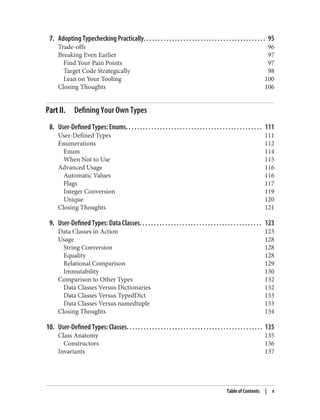


![# Take a meal recipe and change the number of servings
# by adjusting each ingredient
# A recipe's first element is the number of servings, and the remainder
# of elements is (name, amount, unit), such as ("flour", 1.5, "cup")
def adjust_recipe(recipe, servings):
new_recipe = [servings]
old_servings = recipe[0]
factor = servings / old_servings
recipe.pop(0)
while recipe:
ingredient, amount, unit = recipe.pop(0)
# please only use numbers that will be easily measurable
new_recipe.append((ingredient, amount * factor, unit))
return new_recipe
This function takes a recipe and adjusts every ingredient to handle a new number of
servings. However, this code prompts many questions.
• What is the pop for?
• What does recipe[0] signify? Why is that the old servings?
• Why do I need a comment for numbers that will be easily measurable?
This is a bit of questionable Python, for sure. I won’t blame you if you feel the need to
rewrite it. It looks much nicer written like this:
def adjust_recipe(recipe, servings):
old_servings = recipe.pop(0)
factor = servings / old_servings
new_recipe = {ingredient: (amount*factor, unit)
for ingredient, amount, unit in recipe}
new_recipe["servings"] = servings
return new_recipe
Those who favor clean code probably prefer the second version (I certainly do). No
raw loops. Variables do not mutate. I’m returning a dictionary instead of a list of
tuples. All these changes can be seen as positive, depending on the circumstances. But
I may have just introduced three subtle bugs.
• In the original code snippet, I was clearing out the original recipe. Now I am not.
Even if it’s just one area of calling code that is relying on this behavior, I broke
that calling code’s assumptions.
• By returning a dictionary, I have removed the ability to have duplicate ingredi‐
ents in a list. This might have an effect on recipes that have multiple parts (such
as a main dish and a sauce) that both use the same ingredient.
• If any of the ingredients are named “servings” I’ve just introduced a collision with
naming.
6 | Chapter 1: Introduction to Robust Python](https://image.slidesharecdn.com/17121033-250521160237-c0acc205/85/Robust-Python-Write-Clean-And-Maintainable-Code-1st-Edition-Patrick-Viafore-30-320.jpg)
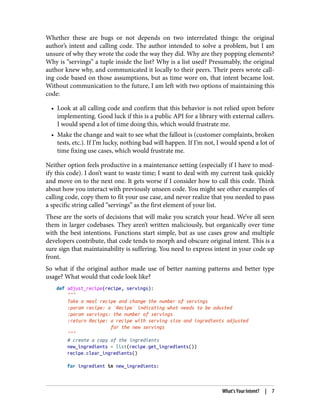
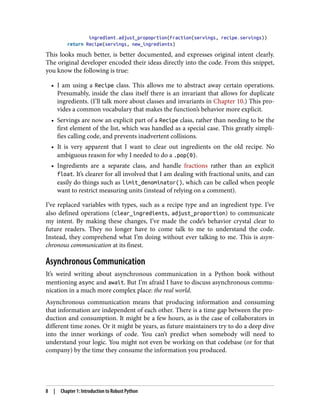
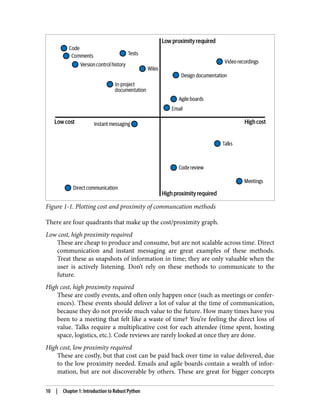
![Self-Documenting Code
The wrong response to Figure 1-1 is “Self-documenting code is all I need!” Code
should absolutely self-document what is being done, but can’t cover every use case of
communication. For example, version control will give you a history of changes.
Design documents discuss sweeping ideals that are not local to any one code file.
Meetings (when done right) can be an important event for synchronizing plan execu‐
tion. Talks are great for sharing ideas with a large audience all at once. While this
book focuses on what you can do in your code, don’t throw away any other valuable
means of communication.
Examples of Intent in Python
Now that I’ve talked through what intent is and how it matters, let’s look at examples
through a Python lens. How can you make sure that you are correctly expressing your
intentions? I will take a look at two different examples of how a decision affects inten‐
tions: collections and iteration.
Collections
When you pick a collection, you are communicating specific information. You must
pick the right collection for the task at hand. Otherwise, maintainers will infer the
wrong intention from your code.
Consider this code that takes a list of cookbooks and provides a mapping between
authors and the number of books written:
def create_author_count_mapping(cookbooks: list[Cookbook]):
counter = {}
for cookbook in cookbooks:
if cookbook.author not in counter:
counter[cookbook.author] = 0
counter[cookbook.author] += 1
return counter
What does my use of collections tell you? Why am I not passing a dictionary or a set?
Why am I not returning a list? Based on my current usage of collections, here’s what
you can assume:
• I pass in a list of cookbooks. There may be duplicate cookbooks in this list (I
might be counting a shelf of cookbooks in a store with multiple copies).
• I am returning a dictionary. Users can look up a specific author, or iterate over
the entire dictionary. I do not have to worry about duplicate authors in the
returned collection.
12 | Chapter 1: Introduction to Robust Python](https://image.slidesharecdn.com/17121033-250521160237-c0acc205/85/Robust-Python-Write-Clean-And-Maintainable-Code-1st-Edition-Patrick-Viafore-36-320.jpg)
![pause, work out what you really meant, and then work around their faulty assump‐
tions (and your faulty assumptions, too).
Dynamic Versus Static Indexing
Depending on the collection type you are using, you may or may not want to use a
static index. A static index is what you get when you use a constant literal to index
into the collection, such as my_list[4] or my_dict["Python"]. In general, lists and
dictionaries will not often need a use case for this. You have no guarantee that the col‐
lection has the element you are looking for at that index, due to their dynamic nature.
If you are looking for specific fields in these types of collections, this is a good sign
that you need a user-defined type (explored in Chapters 8, 9 and 10). It is safe to stati‐
cally index into a tuple, since they are fixed size. Sets and generators are never
indexed into.
Exceptions to this rule include:
• Getting the first or last element of a sequence (my_list[0] or my_list[-1])
• Using a dictionary as an intermediate data type such as when reading JSON or
YAML
• Operations on a sequence dealing specifically with fixed chunks (e.g., always
splitting after the third element or checking for a specific character in a fixed-
format string)
• Performance reasons for a specific collection type
In contrast, dynamic indexing occurs whenever you index into a collection with a
variable that is not known until runtime. This is the most appropriate choice for lists
and dictionaries. You’ll see this when iterating over collections or searching for a spe‐
cific element with an index() function.
These are basic collections, but there are more ways to express intent. Here are some
special collection types that are even more expressive in communicating to the future:
frozenset
A set that is immutable.
OrderedDict
A dictionary that preserves order of elements based on insertion time. As of
CPython 3.6 and Python 3.7, built-in dictionaries will also preserve order of ele‐
ments based on insertion of time.
14 | Chapter 1: Introduction to Robust Python](https://image.slidesharecdn.com/17121033-250521160237-c0acc205/85/Robust-Python-Write-Clean-And-Maintainable-Code-1st-Edition-Patrick-Viafore-38-320.jpg)
![defaultdict
A dictionary that provides a default value if the key is missing. For example, I
could rewrite my earlier example as follows:
from collections import defaultdict
def create_author_count_mapping(cookbooks: List[Cookbook]):
counter = defaultdict(lambda: 0)
for cookbook in cookbooks:
counter[cookbook.author] += 1
return counter
This introduces a new behavior for end users—if they query the dictionary for a
value that doesn’t exist, they will receive a 0. This might be beneficial in some use
cases, but if it’s not, you can just return dict(counter) instead.
Counter
A special type of dictionary used for counting how many times an element
appears. This greatly simplifies our above code to the following:
from collections import Counter
def create_author_count_mapping(cookbooks: List[Cookbook]):
return Counter(book.author for book in cookbooks)
Take a minute to reflect on that last example. Notice how using a Counter gives us
much more concise code without sacrificing readability. If your readers are familiar
with Counter, the meaning of this function (and how the implementation works) is
immediately apparent. This is a great example of communicating intent to the
future through better selection of collection types. I’ll explore collections further in
Chapter 5.
There are plenty of additional types to explore, including array, bytes, and range.
Whenever you come across a new collection type, built-in or otherwise, ask yourself
how it differs from other collections and what it conveys to future readers.
Iteration
Iteration is another example where the abstraction you choose dictates the intent you
convey.
How many times have you seen code like this?
text = "This is some generic text"
index = 0
while index < len(text):
print(text[index])
index += 1
This simple code prints each character on a separate line. This is perfectly fine for a
first pass at Python for this problem, but the solution quickly evolves into the more
Examples of Intent in Python | 15](https://image.slidesharecdn.com/17121033-250521160237-c0acc205/85/Robust-Python-Write-Clean-And-Maintainable-Code-1st-Edition-Patrick-Viafore-39-320.jpg)
![Pythonic (code written in an idiomatic style that aims to emphasize simplicity and is
recognizable to most Python developers):
for character in text:
print(character)
Take a moment and reflect on why this option is preferable. The for loop is a more
appropriate choice; it communicates intentions more clearly. Just like collection types,
the looping construct you select explicitly communicates different concepts. Here’s a
list of some common looping constructs and what they convey:
for loops
for loops are used for iterating over each element in a collection or range and
performing an action/side effect.
for cookbook in cookbooks:
print(cookbook)
while loops
while loops are used for iterating as long as a certain condition is true.
while is_cookbook_open(cookbook):
narrate(cookbook)
Comprehensions
Comprehensions are used for transforming one collection into another (nor‐
mally, this does not have side effects, especially if the comprehension is lazy).
authors = [cookbook.author for cookbook in cookbooks]
Recursion
Recursion is used when the substructure of a collection is identical to the struc‐
ture of a collection (for example, each child of a tree is also a tree).
def list_ingredients(item):
if isinstance(item, PreparedIngredient):
list_ingredients(item)
else:
print(ingredient)
You want each line of your codebase to deliver value. Furthermore, you want each
line to clearly communicate what that value is to future developers. This drives a need
to minimize any amount of boilerplate, scaffolding, and superfluous code. In the
example above, I am iterating over each element and performing a side effect (print‐
ing an element), which makes the for loop an ideal looping construct. I am not wast‐
ing code. In contrast, the while loop requires us to explicitly track looping until a
certain condition occurs. In other words, I need to track a specific condition and
mutate a variable every iteration. This distracts from the value the loop provides, and
provides unwanted cognitive burden.
16 | Chapter 1: Introduction to Robust Python](https://image.slidesharecdn.com/17121033-250521160237-c0acc205/85/Robust-Python-Write-Clean-And-Maintainable-Code-1st-Edition-Patrick-Viafore-40-320.jpg)

![PART I
Annotating Your Code with Types
Welcome to Part I, where I will focus on types in Python. Types model the behavior of
your program. Beginner programmers understand that there are different types in
Python, such as float or str. But what is a type? How does mastering types make
your codebase stronger? Types are a fundamental underpinning of any programming
language, but, unfortunately, most introductory texts gloss over just how types bene‐
fit your codebase (or if misused, those same types increase complexity).
Tell me if you’ve seen this before:
>>>type(3.14)
<class 'float'>
>>>type("This is another boring example")
<class 'str'>
>>> type(["Even", "more", "boring", "examples"])
<class 'list'>
This could be pulled from almost any beginner’s guide to Python. You will learn
about the int, str, float, and bool data types, and all sorts of other things the lan‐
guage offers. Then, boom, you move on, because let’s face it, this Python is not flashy.
You want to dive into the cool stuff, like functions and loops and dictionaries, and I
don’t blame you. But it’s a shame that many tutorials never revisit types and give them
their proper due. As users dig deeper, they may discover type annotations (which I
cover in the next chapter) or start writing classes, but often miss out on the funda‐
mental discussion about when to use types appropriately.
That’s where I’ll start.](https://image.slidesharecdn.com/17121033-250521160237-c0acc205/85/Robust-Python-Write-Clean-And-Maintainable-Code-1st-Edition-Patrick-Viafore-45-320.jpg)

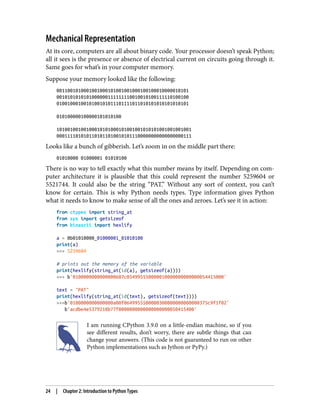
![type, you are told (sometimes quite loudly) through a compiler error or a runtime
error. Languages such as Haskell, TypeScript, and Rust are all considered strongly
typed. Proponents advocate strongly typed languages because errors are more appa‐
rent when building or running code.
In contrast, languages toward the weaker side of the spectrum will not restrict the use
of operations to the types that support them. Types are often coerced into a different
type to make sense of an operation. Languages such as JavaScript, Perl, and older ver‐
sions of C are weakly typed. Proponents advocate the speed with which developers
can quickly iterate on code without fighting language along the way.
Python falls toward the stronger side of the spectrum. There are very few implicit
conversions that happen between types. It is noticeable when you perform illegal
operations:
>>>[] + {}
TypeError: can only concatenate list (not "dict") to list
>>> {} + []
TypeError: unsupported operand type(s) for +: 'dict' and list
Contrast that with a weakly typed language, such as JavaScript:
>>> [] + {}
"[object Object]"
>>> {} + []
0
In terms of robustness, a strongly typed language such as Python certainly helps us
out. While errors still will show up at runtime instead of at development time, they
still will show up in an obvious TypeError exception. This reduces the time taken to
debug issues significantly, again allowing you to deliver incremental value more
quickly.
Are Weakly Typed Languages Inherently Not Robust?
Codebases in weakly typed languages can absolutely be robust; by
no means am I dumping on those languages. Consider the sheer
amount of production-grade JavaScript that the world runs on.
However, a weakly typed language requires extra care to be robust.
It’s easy to mistake the type of a variable and make incorrect
assumptions. Developers come to rely very heavily on linters, tests,
and other tools to improve maintainability.
Typing Systems | 29](https://image.slidesharecdn.com/17121033-250521160237-c0acc205/85/Robust-Python-Write-Clean-And-Maintainable-Code-1st-Edition-Patrick-Viafore-53-320.jpg)






![WINTER SCENES.
The weather had been intensely cold since our arrival at
Fairmount, and for two days the snow had descended
without intermission; but on the second evening a
severe frost set in, and when I stepped out in the
morning, I found that the fallen flakes had become so
hardened that I could walk on them without leaving the impression
of my foot on the surface. I love the country at all seasons, and,
though certainly preferring it in the genial seasons of summer and
autumn, when the woods are decked in their mantle of green, and
the fields brighten in the sunshine with their waving crops of golden
grain, I have nevertheless frequently experienced a large amount of
pleasure in rambling during winter along the frozen roads and lanes,
or contemplating the bleak landscape spreading out before me, with
its white carpet of snow.
After walking briskly onward for a little distance, I determined,
after some hesitation, to revisit the spot where, on a former
occasion,[29]
I had sat to feast myself on the enchanting scenery of
the country, which was then clothed in its gayest summer dress; but
now the scene was completely changed. The skeleton trees
extended their leafless branches sprinkled with snow-flakes; many of
the evergreens in the shrubbery presented a withered and scorched
aspect, from the influence of the frost; while the little birds, who in
the summer had delighted us with their music, were now roaming
about the country in search of food, and some of them not
unfrequently found dead on the roadside from hunger and cold.
As I stood viewing the change which the winter season had made
in the appearance of nature, my mind reverted to the changes which
as suddenly take place in the dispensations of Providence; and I
recalled to my remembrance many who, during my short pilgrimage,](https://image.slidesharecdn.com/17121033-250521160237-c0acc205/85/Robust-Python-Write-Clean-And-Maintainable-Code-1st-Edition-Patrick-Viafore-88-320.jpg)
![had sunk from the heights of prosperity to the depths of adversity,
and whose opening spring of plenty and of hope had been
succeeded by the sterile and stormy winter—closing up the visions of
their anticipated bliss in the gloom of disappointment and of woe.
While thus musing on the mutations of nature and of Providence, I
saw two lads approaching from a distant meadow, and when they
drew near enough for me to trace their features, I recognized the
children of the woodman whom I visited on the evening when his
little daughter died.[30]
They looked very sorrowful and dejected, and
exclaimed, as soon as they recognized me, "O, Sir, we are again in
trouble—we have lost father! Have you seen him, or heard of him?
We have been walking about ever since daybreak, but we can't find
him." They then gave me an account of the calamity which had
befallen them.
After the interment of his daughter, he regained his usual flow of
spirits, and felt resigned to the will of God; but within the last few
weeks he had sunk into a low, desponding state, and often spoke of
his decease as one who believed the hour of his departure was at
hand; and yet health nerved his arm, and he was strong to labour.
"Mother often told him," said the eldest son, "that he ought not to
mistrust Providence, who had always provided food and raiment for
us; nor yet to think that he was going to leave us. But she could not
comfort him; for, after coming home at night, he would sit and
weep, and talk to us till we all wept with him; and we knew not why,
for we saw no danger coming. We were all well and happy except
father."
He had gone to his work on the preceding day, at his usual hour,
taking with him, in his bag and bottle, his refreshment, and was
seen by his master about noon, walking away from the field in which
he had been at work, with his dog by his side, but neither of them
had been heard of since. "We fear, Sir," said the lad, who sobbed
aloud as he spoke, wiping away at the same time the falling tears
with the sleeve of his frock, "he has tumbled into some pit, and has
perished in the snow; but, Sir, we cannot trace any marks of his
footsteps, nor yet hear Trail bark nor howl. Farmer Pickford and his](https://image.slidesharecdn.com/17121033-250521160237-c0acc205/85/Robust-Python-Write-Clean-And-Maintainable-Code-1st-Edition-Patrick-Viafore-89-320.jpg)